Explore the intersection of migration, microfinance, and social innovations in economics through discussions on refugee policies, financial inclusion, and the empowerment of women. Delve into the impacts of migration on poverty alleviation and economic development, highlighting historical migration patterns and their significance.
Please find below an Image/Link to download the presentation.
The content on the website is provided AS IS for your information and personal use only. It may not be sold, licensed, or shared on other websites without obtaining consent from the author. If you encounter any issues during the download, it is possible that the publisher has removed the file from their server.
You are allowed to download the files provided on this website for personal or commercial use, subject to the condition that they are used lawfully. All files are the property of their respective owners.
The content on the website is provided AS IS for your information and personal use only. It may not be sold, licensed, or shared on other websites without obtaining consent from the author.
E N D
Presentation Transcript
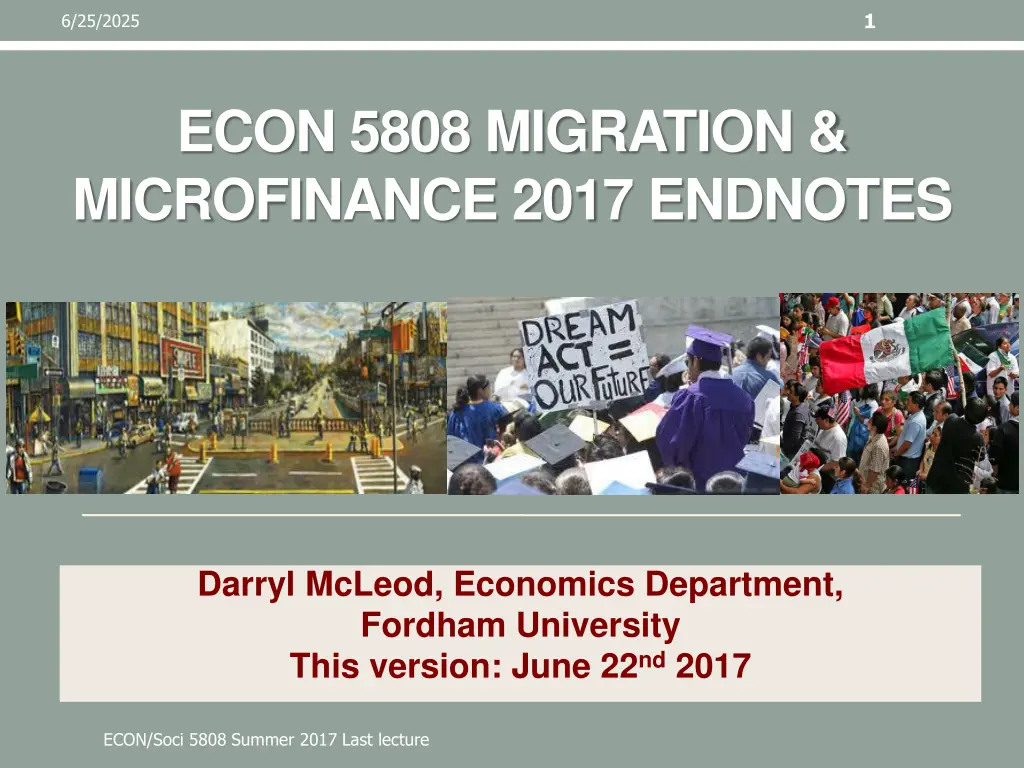
1 6/25/2025 ECON 5808 MIGRATION & MICROFINANCE 2017 ENDNOTES Darryl McLeod, Economics Department, Fordham University This version: June 22nd2017 ECON/Soci 5808 Summer 2017 Last lecture
2 6/25/2025 ECON/Soci 5808 Summer 2015Last lecture Social Innovations & Economic Policies 1. Microfinance; the East Asian version with BRAC-NIDAN (see private transcript) on net helped women in India and Bangladesh 2. Microfinance; the LatAm version: Accion and profits (MiBanco & ADOPEM) helped women and created a new middle class. 3. Refugee policy: documented (legal) or not: (see Gordon Hanson) allowed millions escape violence & poverty: 4. Conditional Cash Transfers (see lecture notes) with electronic payments, helped women in LatAm and reduced child labor
3 6/25/2025 ECON/Soci 5808 Summer 2015Last lecture Immigration Backlash: Brexit & Trump Adds credibility to Immigration s critics, including Collier, 2013 and George Borjas always Still Germany, France, Italy and the Netherlands (and to some lesser extent Canada and Australia) have stood International Agencies, and key U.S. States continue to welcome and reach out to immigrants It is time review the arguments for an
4 6/25/2025 ECON/Soci 5808 Summer 2015Last lecture Similarly for Microfinance and financial Inclusion generally Populist candidates question the value of finance, especially on Wall Street (though not Trump ) Zingales recently told a Fordham Audience business schools train students to violate the law Bethex was closed due to Many object to high interest rates It is time review the arguments for an
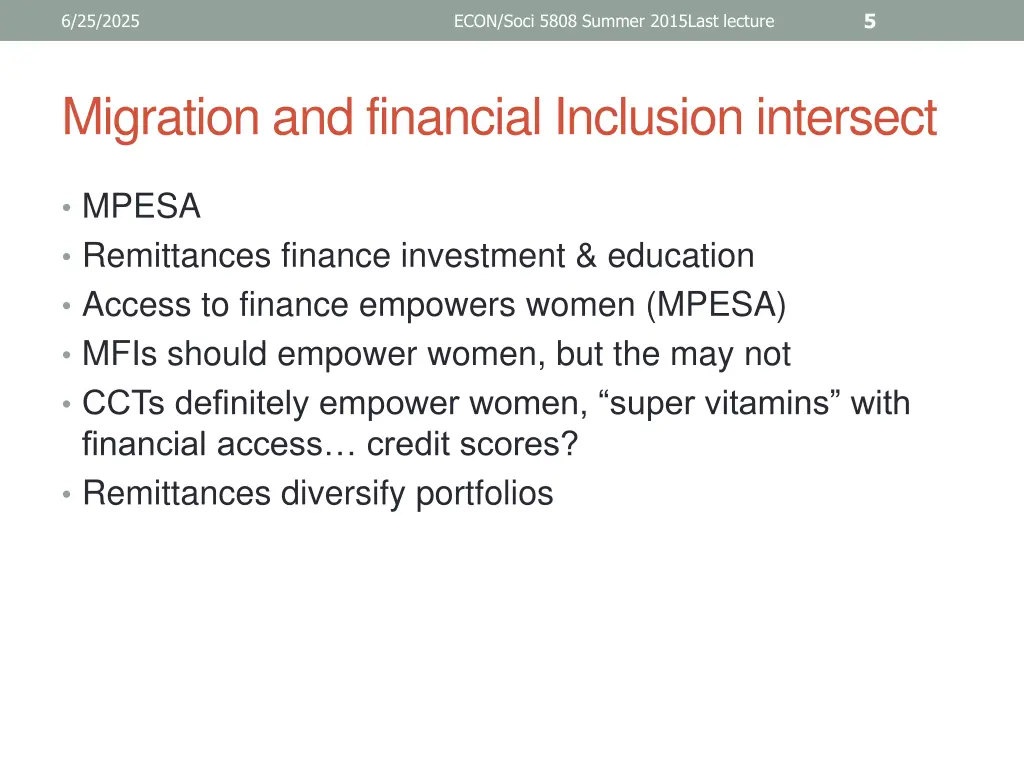
5 6/25/2025 ECON/Soci 5808 Summer 2015Last lecture Migration and financial Inclusion intersect MPESA Remittances finance investment & education Access to finance empowers women (MPESA) MFIs should empower women, but the may not CCTs definitely empower women, super vitamins with financial access credit scores? Remittances diversify portfolios
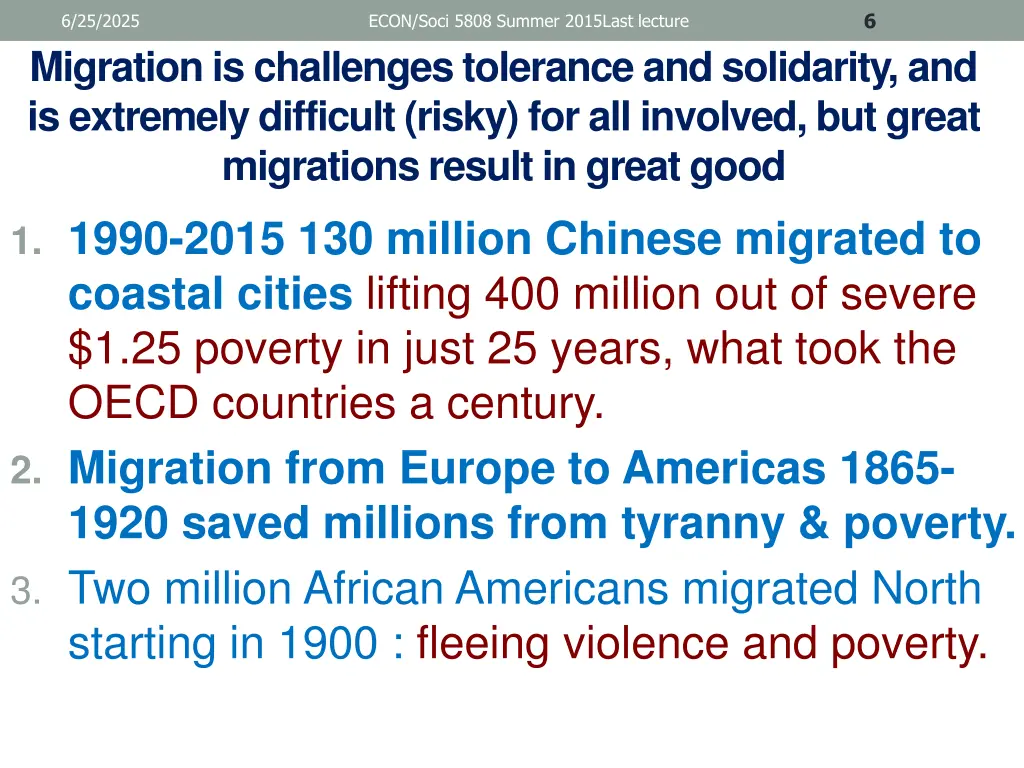
6 6/25/2025 ECON/Soci 5808 Summer 2015Last lecture Migration is challenges tolerance and solidarity, and is extremely difficult (risky) for all involved, but great migrations result in great good 1. 1990-2015 130 million Chinese migrated to coastal cities lifting 400 million out of severe $1.25 poverty in just 25 years, what took the OECD countries a century. 2. Migration from Europe to Americas 1865- 1920 saved millions from tyranny & poverty. 3. Two million African Americans migrated North starting in 1900 : fleeing violence and poverty.
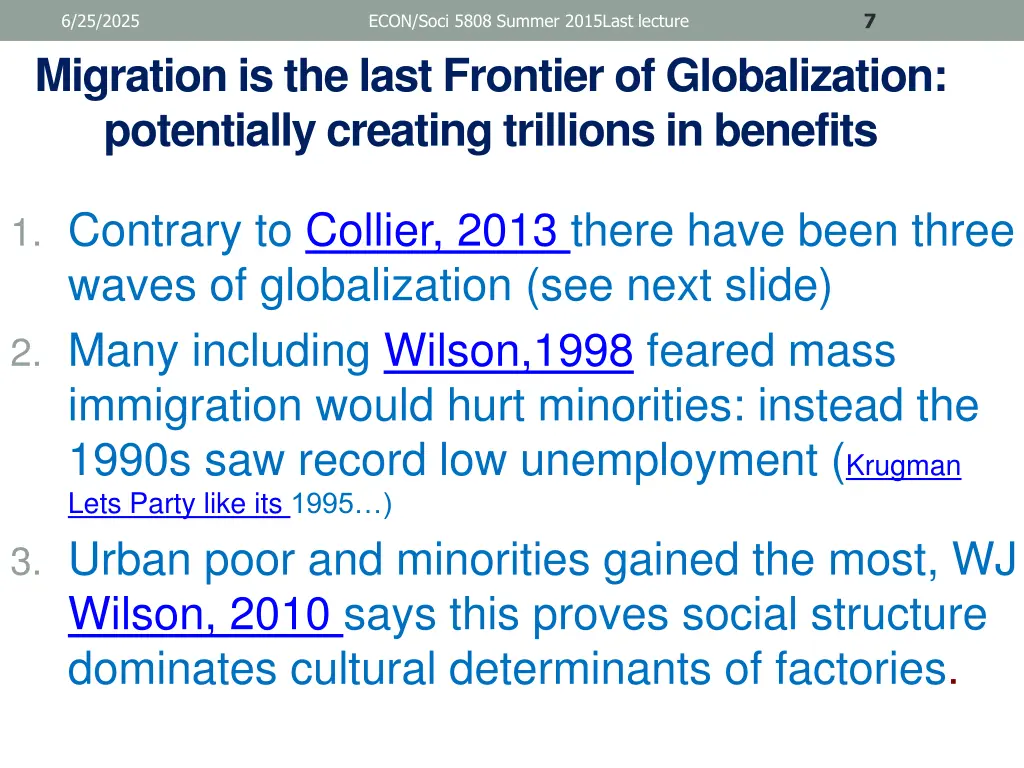
7 6/25/2025 ECON/Soci 5808 Summer 2015Last lecture Migration is the last Frontier of Globalization: potentially creating trillions in benefits 1. Contrary to Collier, 2013 there have been three waves of globalization (see next slide) 2. Many including Wilson,1998 feared mass immigration would hurt minorities: instead the 1990s saw record low unemployment (Krugman Lets Party like its 1995 ) 3. Urban poor and minorities gained the most, WJ Wilson, 2010 says this proves social structure dominates cultural determinants of factories.
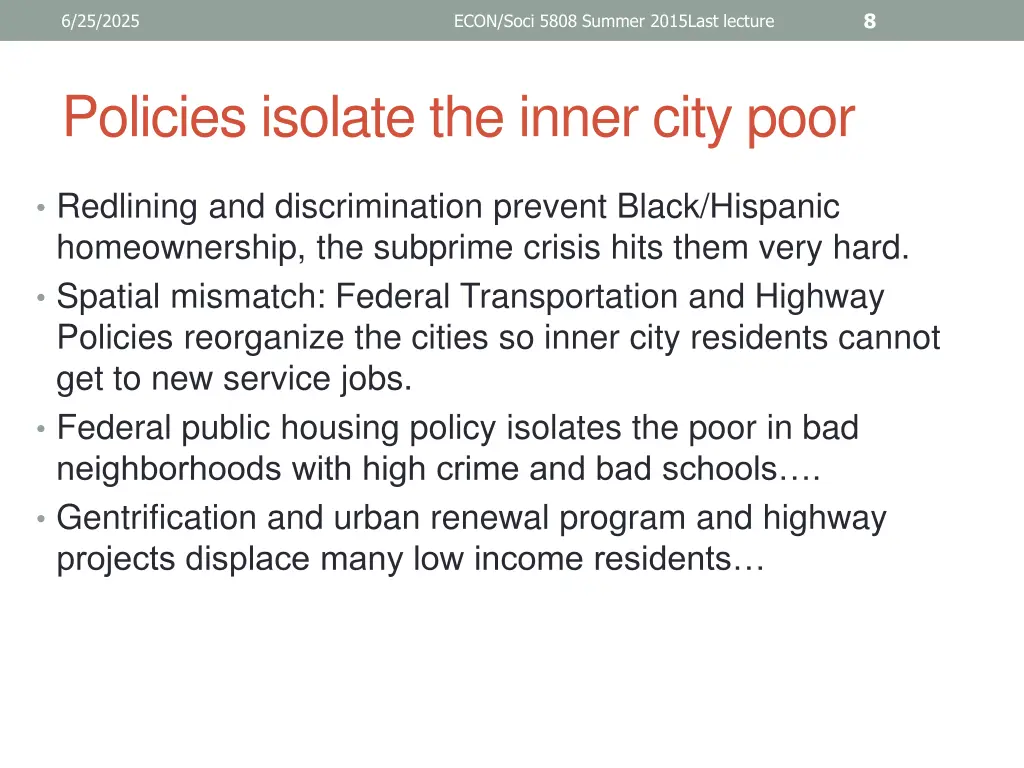
8 6/25/2025 ECON/Soci 5808 Summer 2015Last lecture Policies isolate the inner city poor Redlining and discrimination prevent Black/Hispanic homeownership, the subprime crisis hits them very hard. Spatial mismatch: Federal Transportation and Highway Policies reorganize the cities so inner city residents cannot get to new service jobs. Federal public housing policy isolates the poor in bad neighborhoods with high crime and bad schools . Gentrification and urban renewal program and highway projects displace many low income residents
9 6/25/2025 ECON/Soci 5808 Summer 2015Last lecture Social-Structural factors vs. Culture Economic-social forces vs. culture, who wins? 1. culture vs. opportunity, behavior (single parent families)? 1. Economic and social forces always dominate . 2. During the 1950s, 1960s and 1990s African American and Hispanic poverty fell to record lows, under 5% unemployment 3. But this does not mean opportunity enhancing policies should not target social isolated groups, on the contrary 4. Charter schools and the HCZ work, with massive targeted interventions .
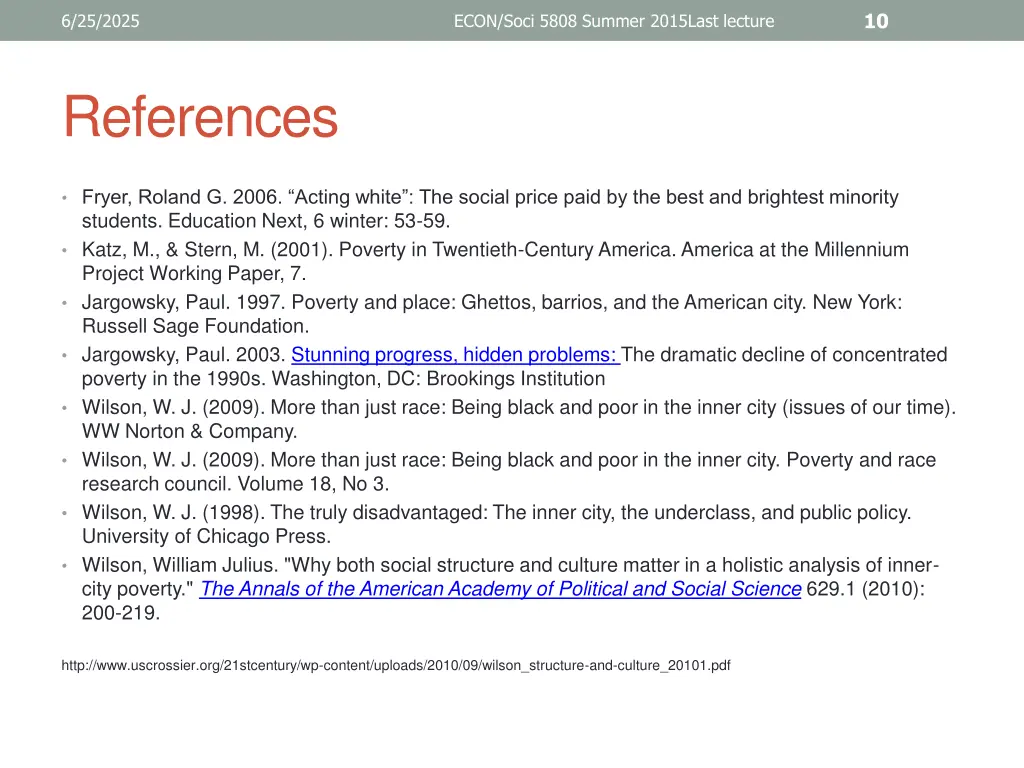
10 6/25/2025 ECON/Soci 5808 Summer 2015Last lecture References Fryer, Roland G. 2006. Acting white : The social price paid by the best and brightest minority students. Education Next, 6 winter: 53-59. Katz, M., & Stern, M. (2001). Poverty in Twentieth-Century America. America at the Millennium Project Working Paper, 7. Jargowsky, Paul. 1997. Poverty and place: Ghettos, barrios, and the American city. New York: Russell Sage Foundation. Jargowsky, Paul. 2003. Stunning progress, hidden problems: The dramatic decline of concentrated poverty in the 1990s. Washington, DC: Brookings Institution Wilson, W. J. (2009). More than just race: Being black and poor in the inner city (issues of our time). WW Norton & Company. Wilson, W. J. (2009). More than just race: Being black and poor in the inner city. Poverty and race research council. Volume 18, No 3. Wilson, W. J. (1998). The truly disadvantaged: The inner city, the underclass, and public policy. University of Chicago Press. Wilson, William Julius. "Why both social structure and culture matter in a holistic analysis of inner- city poverty." The Annals of the American Academy of Political and Social Science 629.1 (2010): 200-219. http://www.uscrossier.org/21stcentury/wp-content/uploads/2010/09/wilson_structure-and-culture_20101.pdf
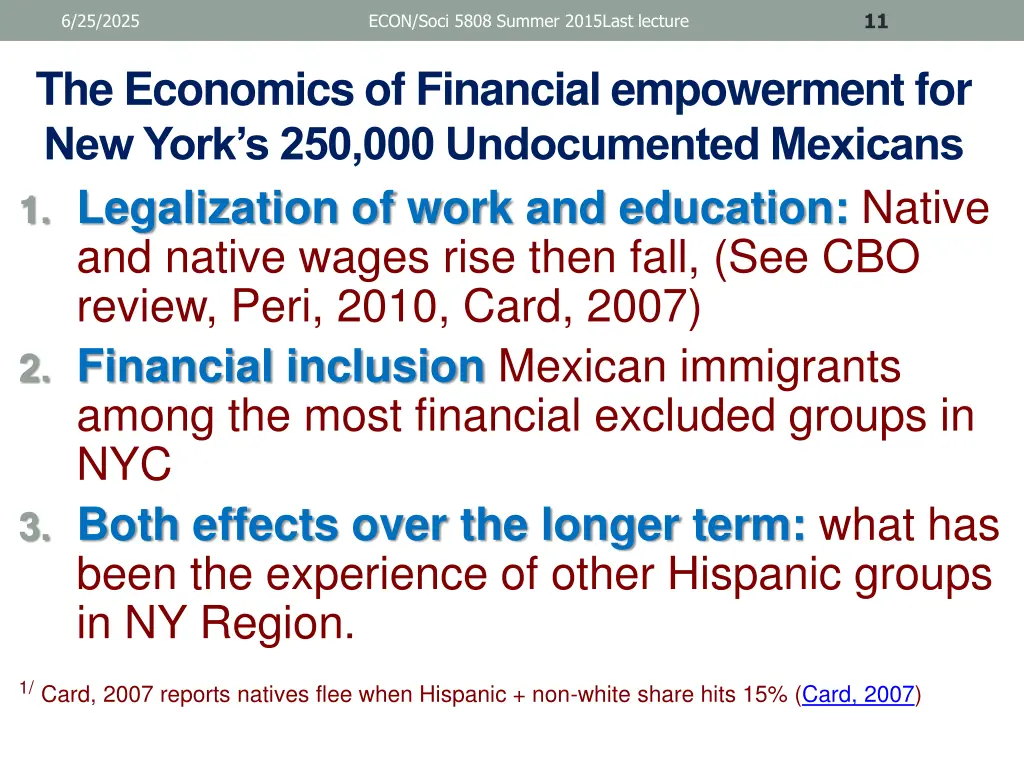
11 6/25/2025 ECON/Soci 5808 Summer 2015Last lecture The Economics of Financial empowerment for New York s 250,000 Undocumented Mexicans 1. Legalization of work and education: Native and native wages rise then fall, (See CBO review, Peri, 2010, Card, 2007) 2. Financial inclusion Mexican immigrants among the most financial excluded groups in NYC 3. Both effects over the longer term: what has been the experience of other Hispanic groups in NY Region. 1/Card, 2007 reports natives flee when Hispanic + non-white share hits 15% (Card, 2007)
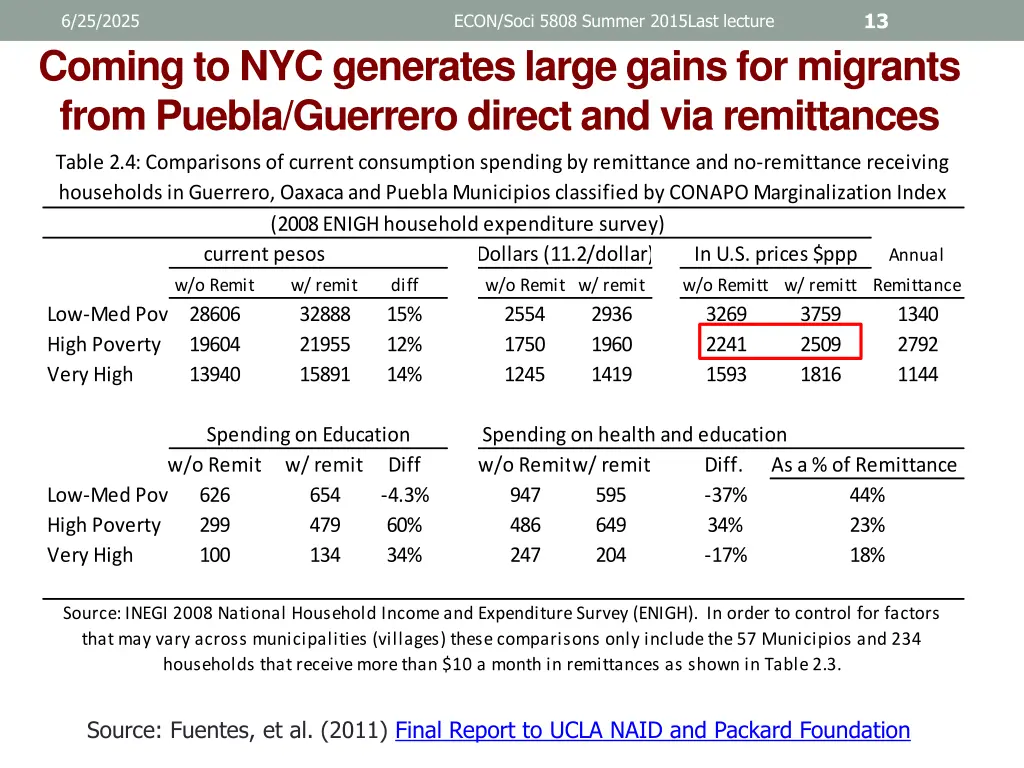
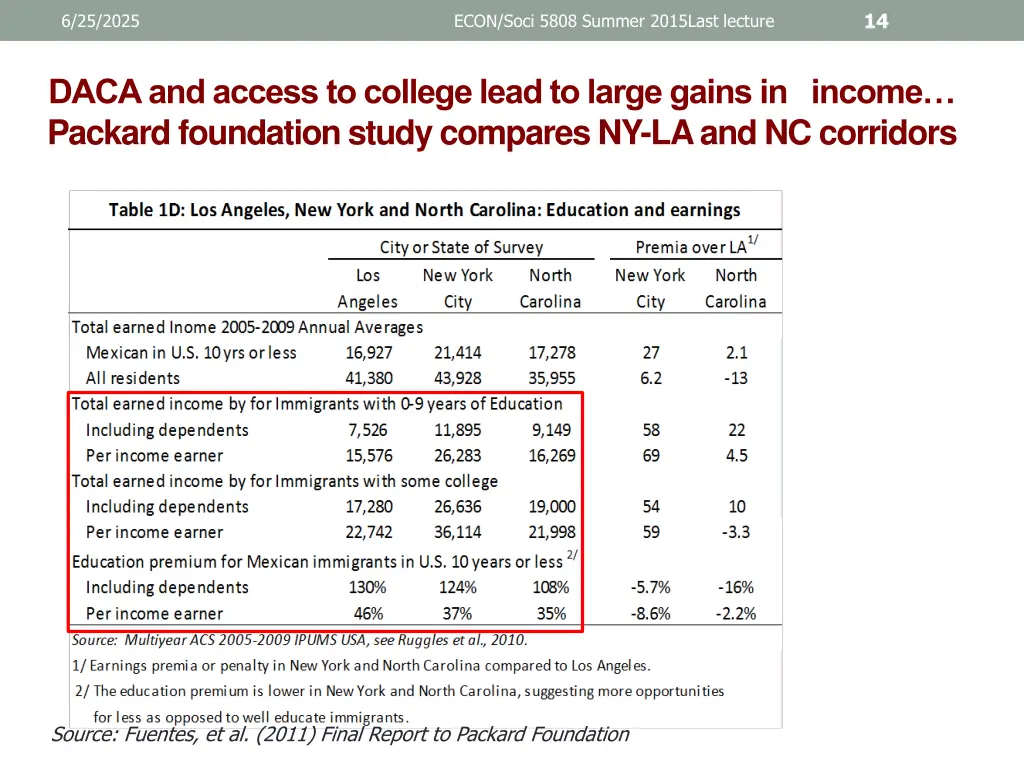
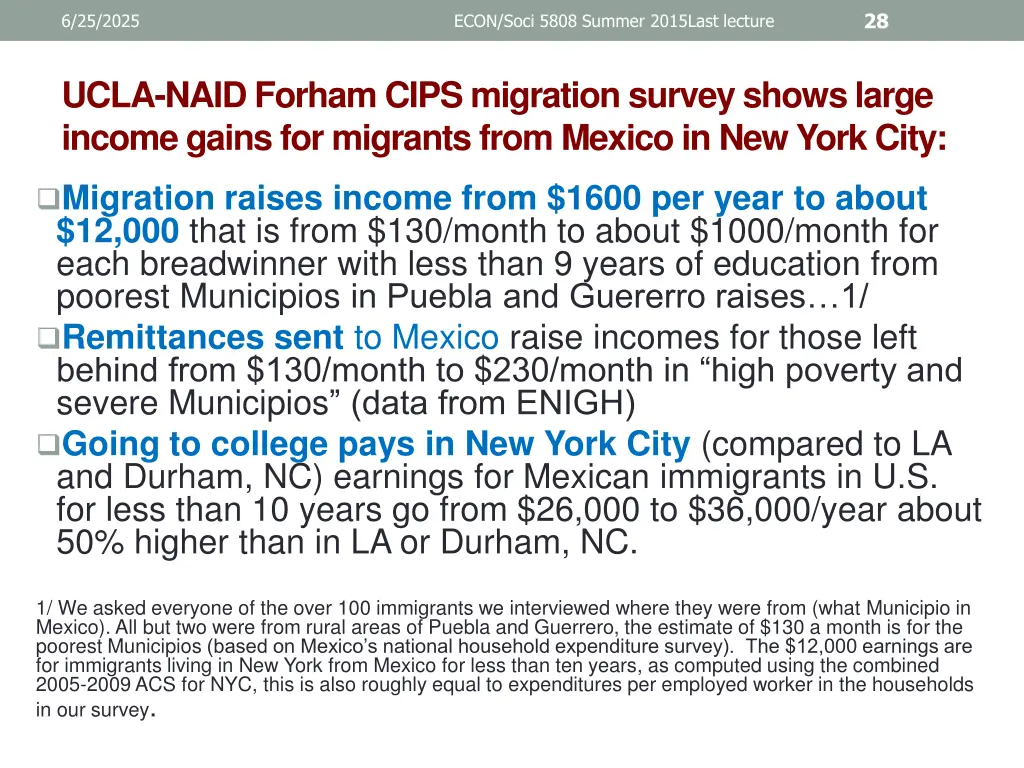
12 6/25/2025 ECON/Soci 5808 Summer 2015Last lecture UCLA-NAID Forham CIPS migration survey shows large income gains for migrants from Mexico in New York City: Migration raises income from $1600 per year to about $12,000 that is from $130/month to about $1000/month for each breadwinner with less than 9 years of education from poorest Municipios in Puebla and Guererro raises 1/ Remittances sent to Mexico raise incomes for those left behind from $130/month to $230/month in high poverty and severe Municipios (data from ENIGH) Going to college pays in New York City (compared to LA and Durham, NC) earnings for Mexican immigrants in U.S. for less than 10 years go from $26,000 to $36,000/year about 50% higher than in LA or Durham, NC. 1/ We asked everyone of the over 100 immigrants we interviewed where they were from (what Municipio in Mexico). All but two were from rural areas of Puebla and Guerrero, the estimate of $130 a month is for the poorest Municipios (based on Mexico s national household expenditure survey). The $12,000 earnings are for immigrants living in New York from Mexico for less than ten years, as computed using the combined 2005-2009 ACS for NYC, this is also roughly equal to expenditures per employed worker in the households in our survey.
13 6/25/2025 ECON/Soci 5808 Summer 2015Last lecture Coming to NYC generates large gains for migrants from Puebla/Guerrero direct and via remittances Table 2.4: Comparisons of current consumption spending by remittance and no-remittance receiving households in Guerrero, Oaxaca and Puebla Municipios classified by CONAPO Marginalization Index (2008 ENIGH household expenditure survey) current pesos Dollars (11.2/dollar) In U.S. prices $ppp Annual w/o Remit w/ remit 32888 21955 15891 diff 15% 12% 14% w/o Remit w/ remit 2554 1750 1245 w/o Remitt w/ remitt Remittance 3269 3759 2241 2509 1593 1816 Low-Med Poverty 28606 High Poverty Very High 2936 1960 1419 1340 2792 1144 19604 13940 Spending on Education Spending on health and education w/o Remitw/ remit 947 595 486 649 247 204 w/o Remit w/ remit 654 479 134 Diff -4.3% 60% 34% Diff. -37% 34% -17% As a % of Remittance 44% 23% 18% Low-Med Poverty 626 High Poverty Very High 299 100 Source: INEGI 2008 National Household Income and Expenditure Survey (ENIGH). In order to control for factors that may vary across municipalities (villages) these comparisons only include the 57 Municipios and 234 households that receive more than $10 a month in remittances as shown in Table 2.3. Source: Fuentes, et al. (2011) Final Report to UCLA NAID and Packard Foundation
14 6/25/2025 ECON/Soci 5808 Summer 2015Last lecture DACA and access to college lead to large gains in income Packard foundation study compares NY-LA and NC corridors Source: Fuentes, et al. (2011) Final Report to Packard Foundation
15 6/25/2025 ECON/Soci 5808 Summer 2015Last lecture Large income gains from U.S. to Mexico migration Source: Hanson, G. 2009 International Migration and Human Rights
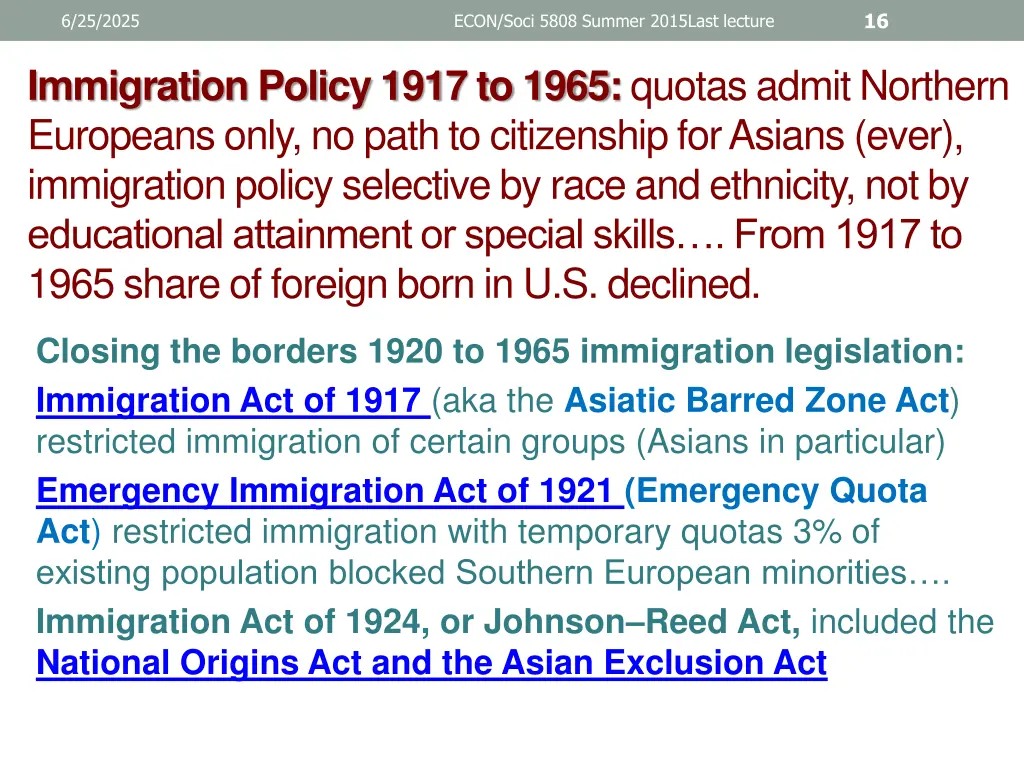
16 6/25/2025 ECON/Soci 5808 Summer 2015Last lecture Immigration Policy 1917 to 1965: quotas admit Northern Europeans only, no path to citizenship for Asians (ever), immigration policy selective by race and ethnicity, not by educational attainment or special skills . From 1917 to 1965 share of foreign born in U.S. declined. Closing the borders 1920 to 1965 immigration legislation: Immigration Act of 1917 (aka the Asiatic Barred Zone Act) restricted immigration of certain groups (Asians in particular) Emergency Immigration Act of 1921 (Emergency Quota Act) restricted immigration with temporary quotas 3% of existing population blocked Southern European minorities . Immigration Act of 1924, or Johnson Reed Act, included the National Origins Act and the Asian Exclusion Act
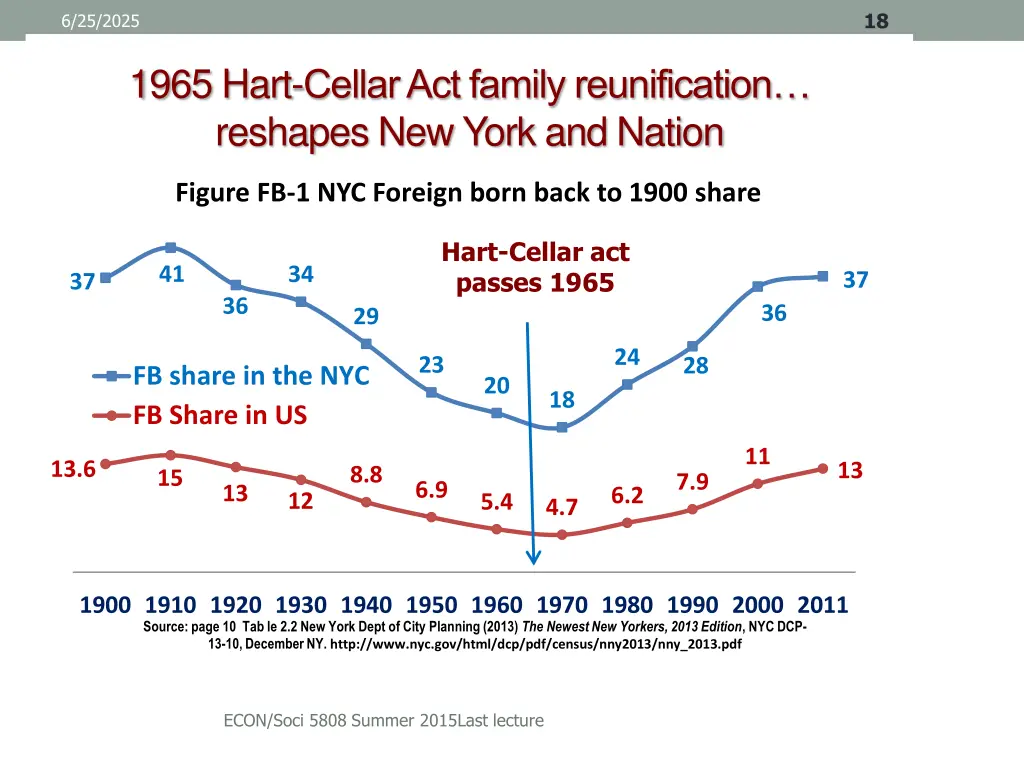
17 6/25/2025 ECON/Soci 5808 Summer 2015Last lecture Race based quota system relaxed in 1965 U.S. immigration shifted quietly but decisively 1965 Immigration and Nationality Act, aka. the Hart-Cellar Act (signed by with little fanfare by President Johnson initiated by President & Attorney General Kennedy and Rep. Emmanuel Cellar of Brooklyn) 1986 Immigration Reform and Control Act of 1986, (IRCA or Simpson-Mazzoli Act) -required employers to verify employees' immigration status. -made it illegal to knowingly hire unauthorized immigrants. - granted amnesty to about 3 million immigrants who entered the US before January 1, 1982 and resided here continuously. 3 DACA: Deferred Action for Childhood Arrivals set the stage for immigration reform 2013, focus on family reunification, children of immigrants
18 6/25/2025 1965 Hart-Cellar Act family reunification reshapes New York and Nation Figure FB-1 NYC Foreign born back to 1900 share Hart-Cellar act passes 1965 41 34 37 37 36 36 29 24 23 28 FB share in the NYC FB Share in US 20 18 11 13.6 13 8.8 15 7.9 6.9 13 6.2 12 5.4 4.7 1900 1910 1920 1930 1940 1950 1960 1970 1980 1990 2000 2011 Source: page 10 Tab le 2.2 New York Dept of City Planning (2013) The Newest New Yorkers, 2013 Edition, NYC DCP- 13-10, December NY. http://www.nyc.gov/html/dcp/pdf/census/nny2013/nny_2013.pdf ECON/Soci 5808 Summer 2015Last lecture
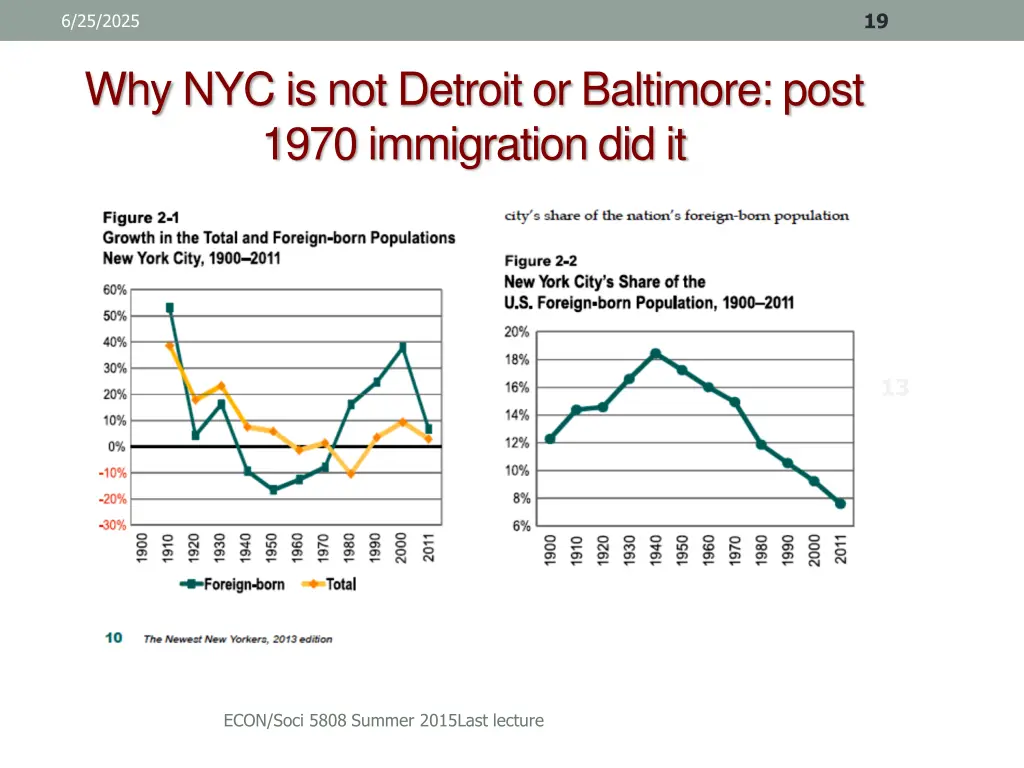
19 6/25/2025 Why NYC is not Detroit or Baltimore: post 1970 immigration did it 13 ECON/Soci 5808 Summer 2015Last lecture
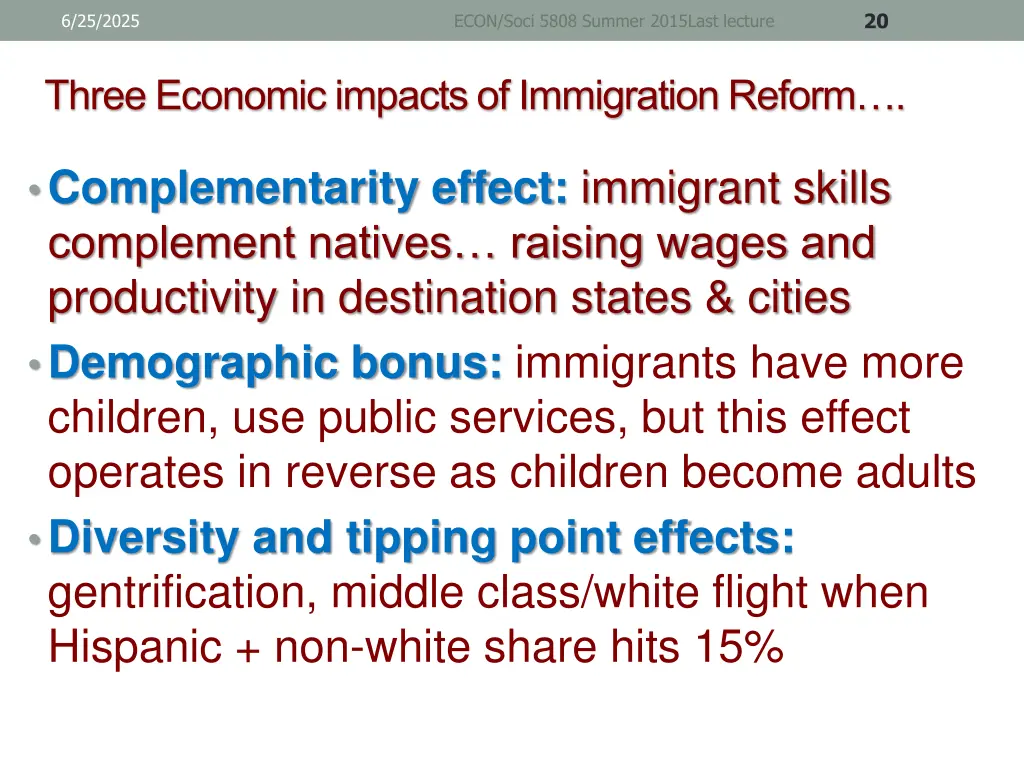
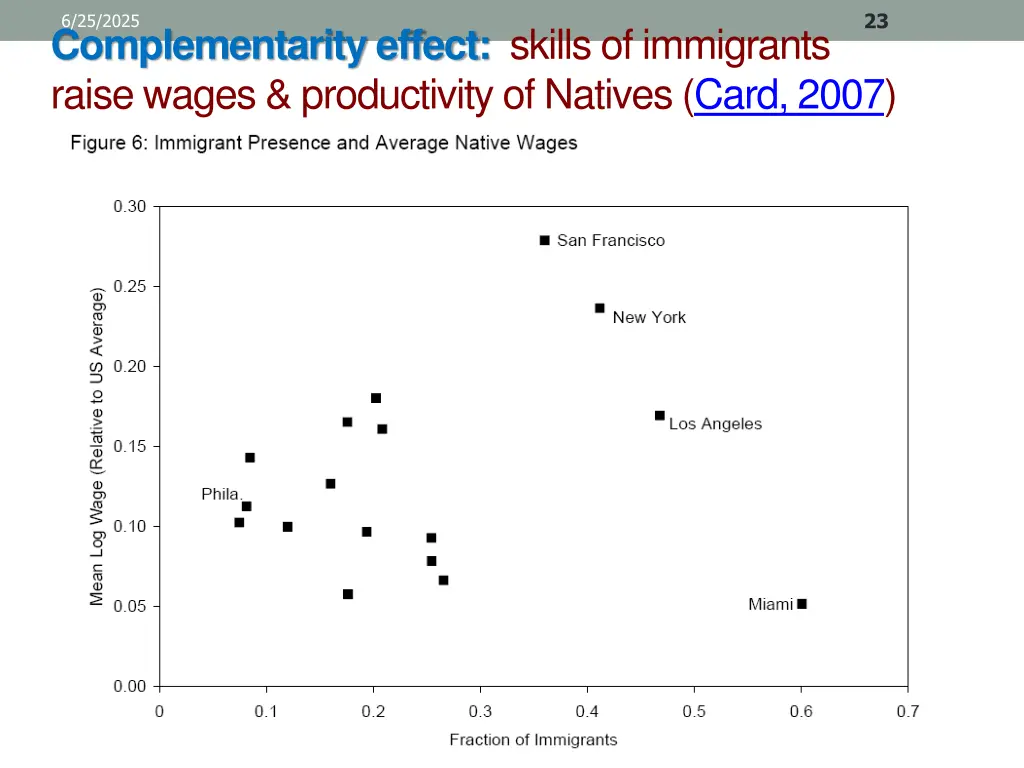
20 6/25/2025 ECON/Soci 5808 Summer 2015Last lecture Three Economic impacts of Immigration Reform . Complementarity effect: immigrant skills complement natives raising wages and productivity in destination states & cities Demographic bonus: immigrants have more children, use public services, but this effect operates in reverse as children become adults Diversity and tipping point effects: gentrification, middle class/white flight when Hispanic + non-white share hits 15%
21 6/25/2025 Complementarity effect: skills/degree mismatch of foreign born vs. native workers Native workers 2009 Foreign born workers 2009 ECON/Soci 5808 Summer 2015Last lecture
22 6/25/2025 Complementarity effect: skills/degree mismatch of foreign born vs. native workers ECON/Soci 5808 Summer 2015Last lecture
23 6/25/2025 Complementarity effect: skills of immigrants raise wages & productivity of Natives (Card, 2007) ECON/Soci 5808 Summer 2015Last lecture
24 6/25/2025 Complementarity effect: skills of immigrants raise wages & productivity Giovanni Peri, 2010 ECON/Soci 5808 Summer 2015Last lecture
25 6/25/2025 ECON/Soci 5808 Summer 2015Last lecture Early negative fiscal impacts mitigated at by demographic bonus: Texas Dream Act
26 6/25/2025 ECON/Soci 5808 Summer 2015Last lecture Similarly, CBO study shows downward pressure on wages, then rising wages, Hispanic wages fall, non-hispanic wages rise Fiscal deficit rises, then falls, http://www.whitehouse.gov/blog/2013/06/18/cbo-report-immigration-reform-will-shrink-deficit-and-grow-economy
27 6/25/2025 ECON/Soci 5808 Summer 2015Last lecture Conclusions: we discussed two of three economic & social impacts of Immigration Reform . Complementarity effect: immigrant skills complement natives raising wages and productivity in destination states & cities Demographic bonus: immigrants tend to have more children, taxing local services, but this effect operates in reverse as children become adults Diversity and tipping point effects: gentrification, middle class/white flight when Hispanic + non-white share hits 15%
28 6/25/2025 ECON/Soci 5808 Summer 2015Last lecture UCLA-NAID Forham CIPS migration survey shows large income gains for migrants from Mexico in New York City: Migration raises income from $1600 per year to about $12,000 that is from $130/month to about $1000/month for each breadwinner with less than 9 years of education from poorest Municipios in Puebla and Guererro raises 1/ Remittances sent to Mexico raise incomes for those left behind from $130/month to $230/month in high poverty and severe Municipios (data from ENIGH) Going to college pays in New York City (compared to LA and Durham, NC) earnings for Mexican immigrants in U.S. for less than 10 years go from $26,000 to $36,000/year about 50% higher than in LA or Durham, NC. 1/ We asked everyone of the over 100 immigrants we interviewed where they were from (what Municipio in Mexico). All but two were from rural areas of Puebla and Guerrero, the estimate of $130 a month is for the poorest Municipios (based on Mexico s national household expenditure survey). The $12,000 earnings are for immigrants living in New York from Mexico for less than ten years, as computed using the combined 2005-2009 ACS for NYC, this is also roughly equal to expenditures per employed worker in the households in our survey.
6/25/2025 ECON/Soci 5808 Summer 2015Last lecture References Card, David. 2001. Immigrant Inflows, Native Outflows, and the Local Labor Market Impacts of Higher Immigration. Journal of Labor Economics 19(1), pp. 22 64. Card, David. 2007. How Immigration Affects U.S. Cities. University College London, Centre for Research and Analysis of Migration Discussion Paper 11/07 www.econ.ucl.ac.uk/cream/pages/CDP/CDP_11_07.pdf Livingston, G. and D Vera Choen (2012) U.S. Birth Rate Falls to Record Low: Decline is greatest among Immigrants, Pew Research Center, http://www.pewsocialtrends.org/files/2012/11/Birth_Rate_Final.pdf Peri, Giovanni. 2010. The Effect of Immigrants On U.S. Employment and Productivity FRBSF Economic Letter, Giovanni. 2009. The Effect of Immigration on Productivity: Evidence from U.S. States. NBER Working Paper 15507. www.nber.org/papers/w15507 Peri, Giovanni, and Chad Sparber. 2009. Task Specialization, Immigration, and Wages. American Economic Journal: Applied Economics 1(3), pp. 135 169 . 2010-6 August 30, 2010, Peri, 29