Multiple-choice clicker questions related to mitosis, the cell cycle, chromosome behavior, spindle fibers, and the causes of cancer. Test your knowledge and understanding in biology chapter 9 concepts.
Please find below an Image/Link to download the presentation.
The content on the website is provided AS IS for your information and personal use only. It may not be sold, licensed, or shared on other websites without obtaining consent from the author. If you encounter any issues during the download, it is possible that the publisher has removed the file from their server.
You are allowed to download the files provided on this website for personal or commercial use, subject to the condition that they are used lawfully. All files are the property of their respective owners.
The content on the website is provided AS IS for your information and personal use only. It may not be sold, licensed, or shared on other websites without obtaining consent from the author.
From top to bottom, which three phases of mitosis are shown? A. metaphase, anaphase, telophase B. prophase, metaphase, anaphase C. telophase, anaphase, metaphase D. anaphase, metaphase, telophase E. prophase, metaphase, telophase
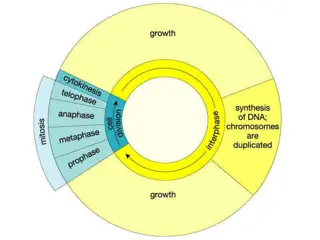
Which of the following best describes what would happen if cells skipped past both G1and G2 phases of the cell cycle (but still went through S phase)? A. Daughter cells would inherit half the normal number of chromosomes. B. Daughter cells would inherit twice the normal number of chromosomes. C. Daughter cells would inherit half the normal number of organelles. D. Daughter cells would be half the normal size. E. Both C and D.
A cell with 20 chromosomes during G1phase undergoes mitosis. If a pair of sister chromatids somehow lost its centromere, how many chromosomes would the two daughter cells inherit assuming mitosis and cytokinesis were otherwise unaffected? A. 19 and 21 B. 0 and 20 C. 0 and 40 D. 20 and 20 E. 40 and 40
The role of spindle fibers during mitosis is to ____________. A. divide the cytoplasm into two daughter cells B. prepare the cell for DNA synthesis C. condense the DNA into chromosomes D. replicate each chromosome once E. separate sister chromatids
Cancer is caused by___________. A. DNA damage B. uncontrolled cell growth C. cells escaping apoptosis D. All of the above. E. None of the above.
Which of the following normally occurs when DNA is damaged during interphase? A. The cell undergoes apoptosis. B. The DNA damage is repaired before the cell proceeds to divide. C. The cell proceeds into mitosis and makes changes after cytokinesis. D. All of the above are normal mechanisms. E. A and B only.
If the DNA sequence pictured below is found in a normal cell, which of the following is most likely true? A. The cell will use repair mechanisms before proceeding through mitosis. B. The cell will proceed through mitosis because the DNA is correctly paired. C. The cell will become cancerous. D. The cell is a human cell. E. A, C, and D are correct.
Which of the following cells would be expected to undergo apoptosis? A. a skin cell that has been damaged by UV light B. a human liver cell exposed to a mutagen C. a kidney cell that has undergone mitosis D. a human cell with 23 pairs of chromosomes E. A, B, and D are correct.
Chemotherapy is________________. A. any treatment used to treat cancer B. using chemicals to treat a disease C. treatment to cure chemical addictions D. Both A and B are correct. E. None of the above.
Cell division occurs frequently in which of the following biological processes? A. embryo development B. wound healing C. muscle contraction D. Both A and B. E. None of the above.
In which of the following cancer patients would chemotherapy likely be used? A. a pregnant woman with breast cancer B. a man with a tumor in his liver C. a child with cancer that has undergone metastasis D. an elderly woman with a tumor in her uterus E. All of the above.
Why do radiation and chemotherapy treatments cause side effects in cancer patients? A. They both damage all body cells. B. Both damage all rapidly dividing cells. C. Cancer patients have weak immune systems and therefore experience more side effects. D. Older treatments causes side effects, but modern treatments do not. E. All of the above.
Which of the following statements is the most accurate about the data presented in the graph to the right? A. Cc is an effective treatment for long-term survival 5 years and beyond. B. Tc treatment shows an increased survival rate in comparison to Cc. C. Cc had no effect on tumor growth because the size of the tumors changed the least. D. Cc causes more side effects than Tc and is less likely to be tolerated by patients. E. B, C, and D are correct.
Taxol was isolated from A. sea sponges. B. spotted owls. C. Pacific yew trees. D. redwood trees. E. lichens growing on Pacific yew trees.
Why is Taxol used to treat ovarian, breast, and lung cancers, but not colon or renal cancers? A. Taxol is more effective in women. B. Taxol is too expensive to use in treating all cancers. C. Taxol usually causes allergic reactions in people with colon or renal cancer. D. The cells in the colon contain different genes than cells in other parts of the body. E. Taxol only works on certain cancers.
What similarity between trees and sea sponges lead researchers to think sea sponges might be a source of chemicals for cancer treatment? A. Sea sponges and trees are very closely related. B. Sea sponges and trees are both sessile and require chemical defenses. C. Sea sponges and trees are the only organisms that do not develop cancer. D. All of the above. E. Both A and B.
How does Taxol prevent cancer cells from spreading? A. It keeps DNA from replicating. B. It prevents the normal assembly of the mitotic spindle. C. It corrects DNA damage. D. It directs cancer cells to undergo apoptosis. E. It blocks telophase from occurring.