MO HealthNet Pharmacy Program: Opioid Interventions and Response Efforts
Discover the comprehensive initiatives of MO HealthNet Pharmacy Program addressing opioid issues, including interventions, oversight, and collaborative efforts to combat the opioid crisis in Missouri. Learn about crucial statistics and strategies implemented to enhance drug access, utilization, and patient safety in response to the opioid epidemic.

Download Presentation

Please find below an Image/Link to download the presentation.
The content on the website is provided AS IS for your information and personal use only. It may not be sold, licensed, or shared on other websites without obtaining consent from the author. If you encounter any issues during the download, it is possible that the publisher has removed the file from their server.
You are allowed to download the files provided on this website for personal or commercial use, subject to the condition that they are used lawfully. All files are the property of their respective owners.
The content on the website is provided AS IS for your information and personal use only. It may not be sold, licensed, or shared on other websites without obtaining consent from the author.
E N D
Presentation Transcript
MO HealthNet Pharmacy Program Opioid Interventions MO HealthNet Oversight Committee Tuesday, August 15, 2017 Stephen Calloway, RPh Director of Pharmacy
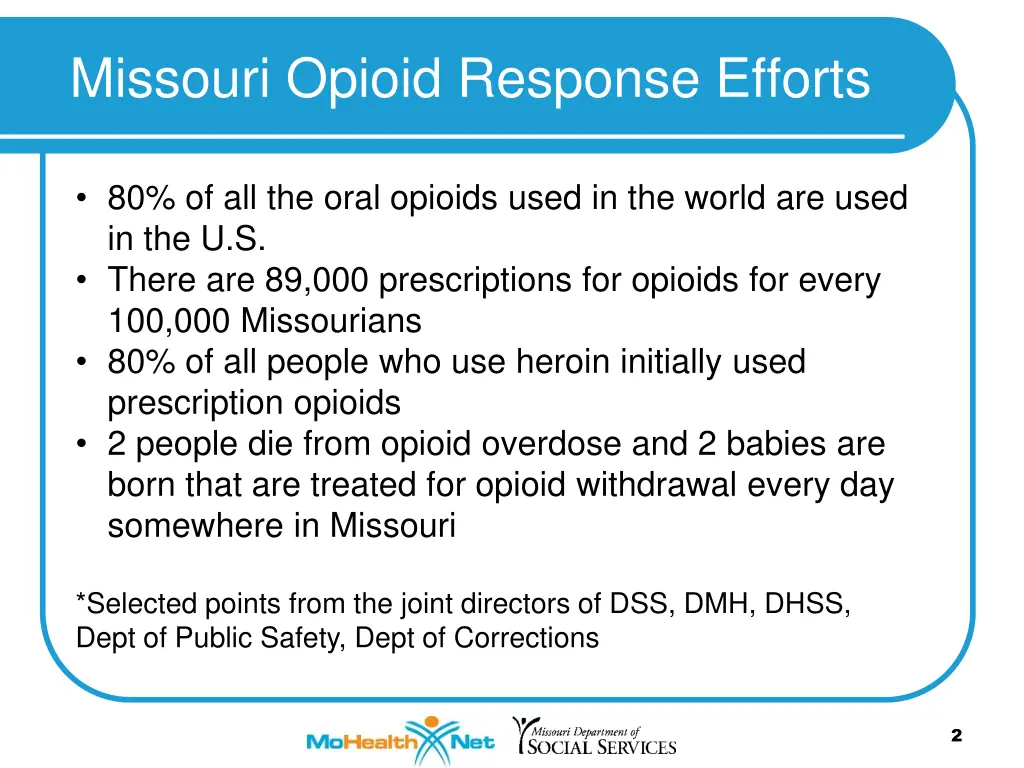
Missouri Opioid Response Efforts 80% of all the oral opioids used in the world are used in the U.S. There are 89,000 prescriptions for opioids for every 100,000 Missourians 80% of all people who use heroin initially used prescription opioids 2 people die from opioid overdose and 2 babies are born that are treated for opioid withdrawal every day somewhere in Missouri *Selected points from the joint directors of DSS, DMH, DHSS, Dept of Public Safety, Dept of Corrections 2
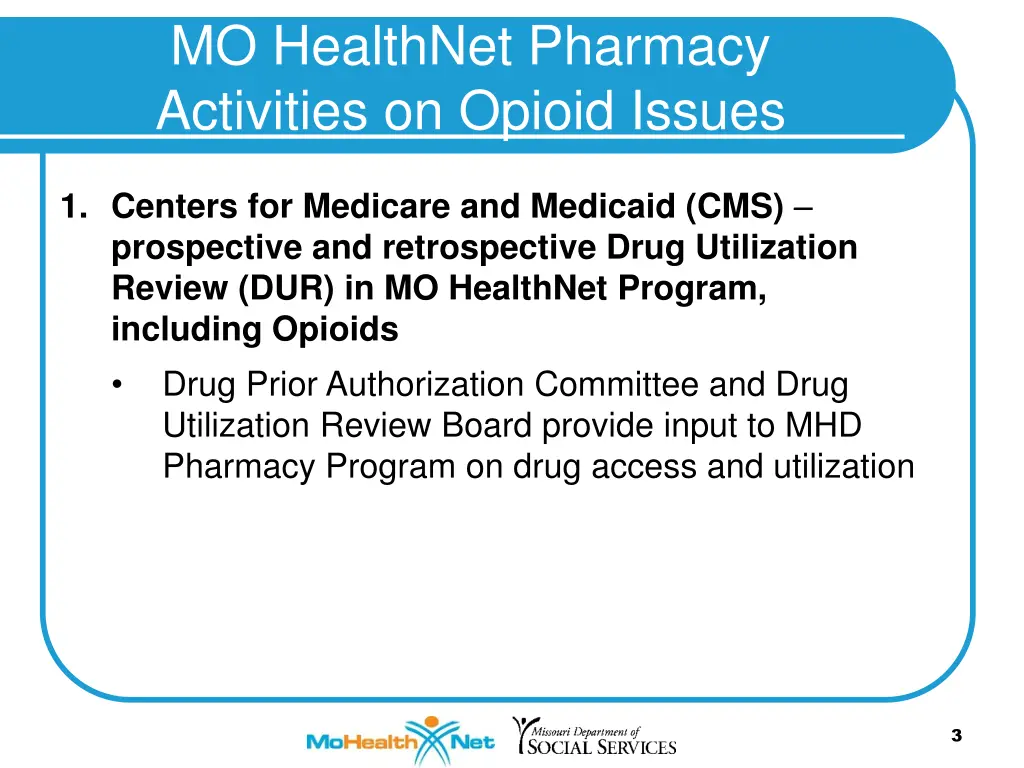
MO HealthNet Pharmacy Activities on Opioid Issues 1. Centers for Medicare and Medicaid (CMS) prospective and retrospective Drug Utilization Review (DUR) in MO HealthNet Program, including Opioids Drug Prior Authorization Committee and Drug Utilization Review Board provide input to MHD Pharmacy Program on drug access and utilization 3
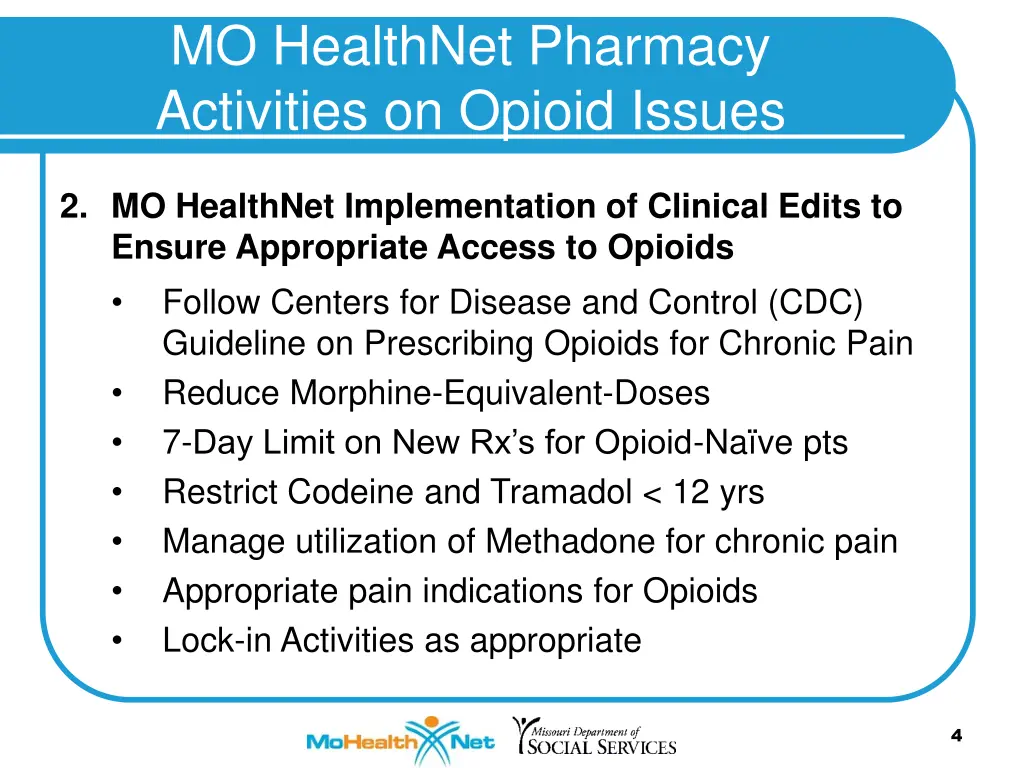
MO HealthNet Pharmacy Activities on Opioid Issues 2. MO HealthNet Implementation of Clinical Edits to Ensure Appropriate Access to Opioids Follow Centers for Disease and Control (CDC) Guideline on Prescribing Opioids for Chronic Pain Reduce Morphine-Equivalent-Doses 7-Day Limit on New Rx s for Opioid-Na ve pts Restrict Codeine and Tramadol < 12 yrs Manage utilization of Methadone for chronic pain Appropriate pain indications for Opioids Lock-in Activities as appropriate 4
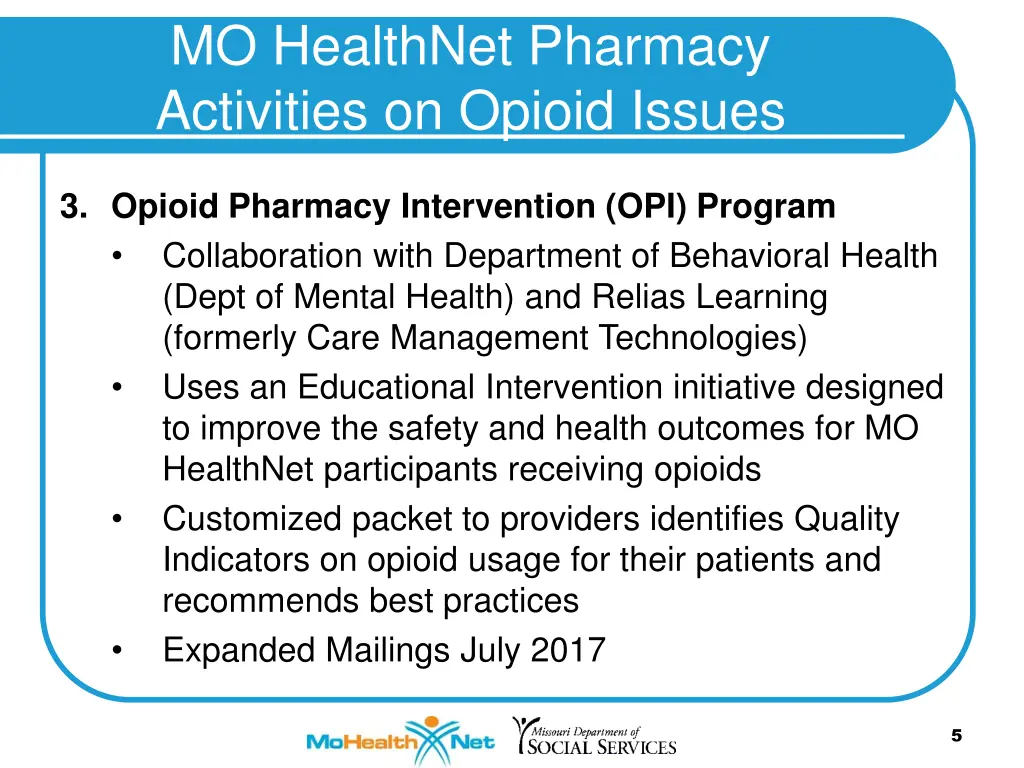
MO HealthNet Pharmacy Activities on Opioid Issues 3. Opioid Pharmacy Intervention (OPI) Program Collaboration with Department of Behavioral Health (Dept of Mental Health) and Relias Learning (formerly Care Management Technologies) Uses an Educational Intervention initiative designed to improve the safety and health outcomes for MO HealthNet participants receiving opioids Customized packet to providers identifies Quality Indicators on opioid usage for their patients and recommends best practices Expanded Mailings July 2017 5
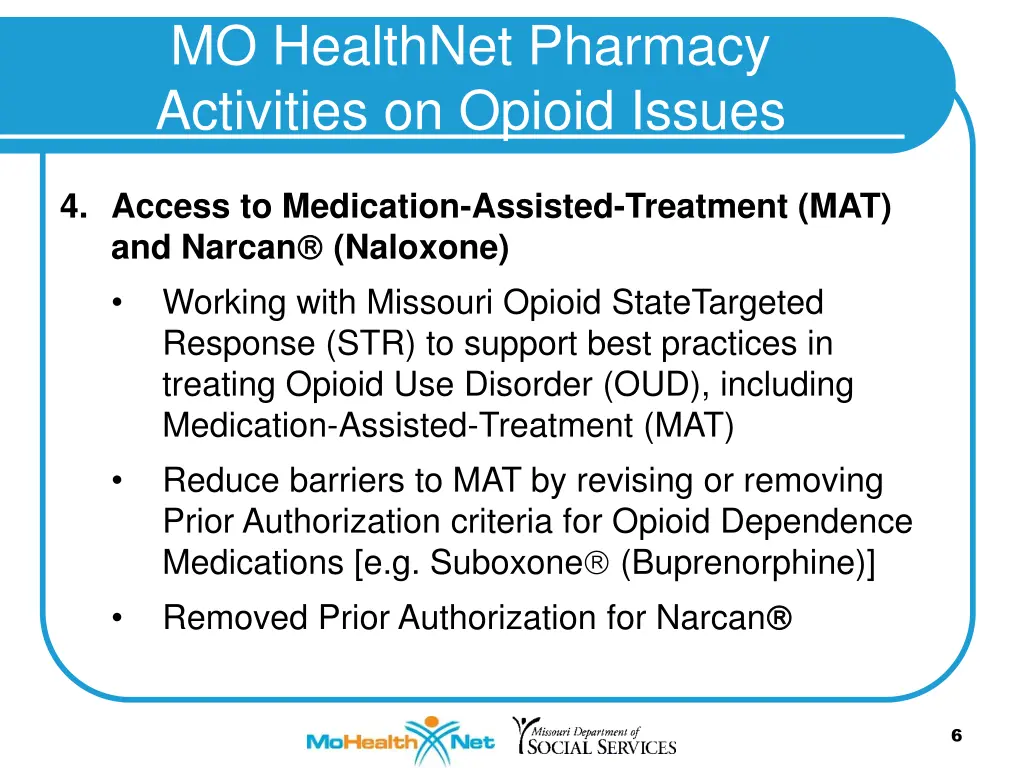
MO HealthNet Pharmacy Activities on Opioid Issues 4. Access to Medication-Assisted-Treatment (MAT) and Narcan (Naloxone) Working with Missouri Opioid StateTargeted Response (STR) to support best practices in treating Opioid Use Disorder (OUD), including Medication-Assisted-Treatment (MAT) Reduce barriers to MAT by revising or removing Prior Authorization criteria for Opioid Dependence Medications [e.g. Suboxone (Buprenorphine)] Removed Prior Authorization for Narcan 6
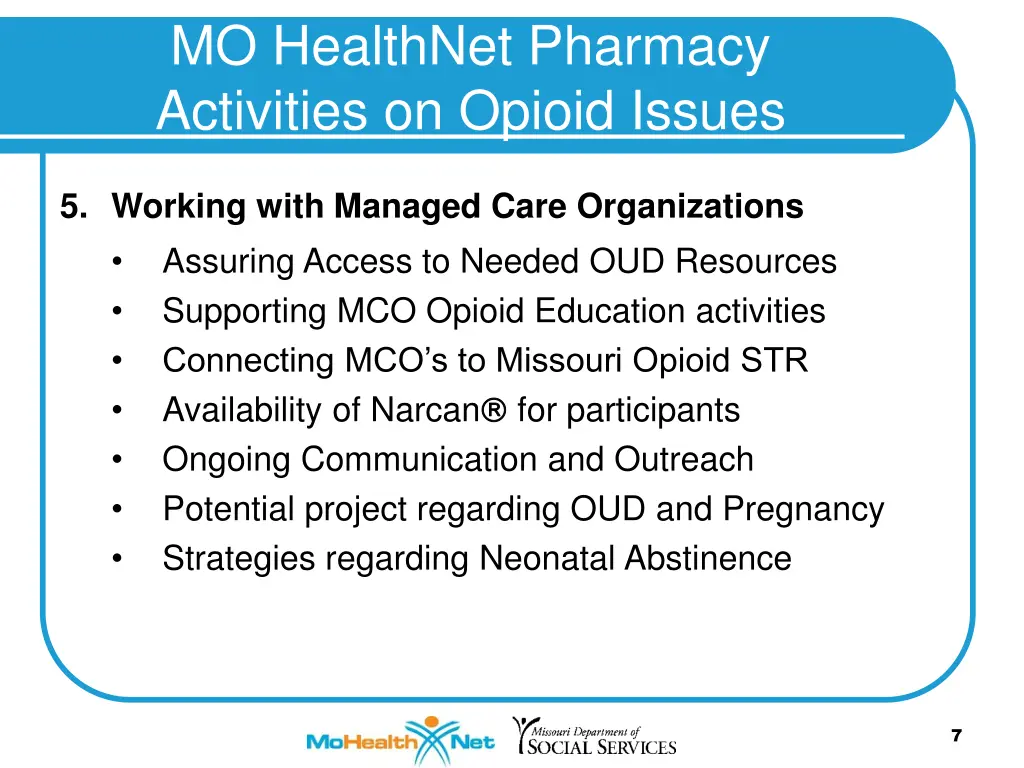
MO HealthNet Pharmacy Activities on Opioid Issues 5. Working with Managed Care Organizations Assuring Access to Needed OUD Resources Supporting MCO Opioid Education activities Connecting MCO s to Missouri Opioid STR Availability of Narcan for participants Ongoing Communication and Outreach Potential project regarding OUD and Pregnancy Strategies regarding Neonatal Abstinence 7
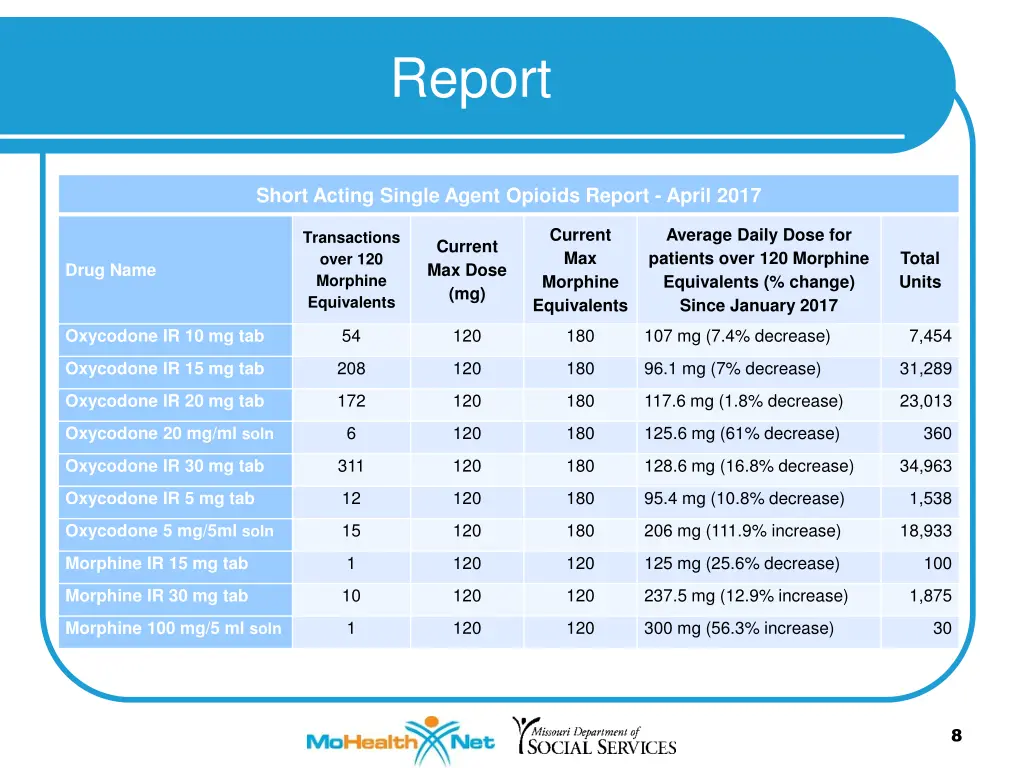
Report Short Acting Single Agent Opioids Report - April 2017 Current Max Morphine Equivalents Average Daily Dose for patients over 120 Morphine Equivalents (% change) Since January 2017 Transactions over 120 Morphine Equivalents Current Max Dose (mg) Total Units Drug Name 54 120 180 107 mg (7.4% decrease) 7,454 Oxycodone IR 10 mg tab 208 120 180 96.1 mg (7% decrease) 31,289 Oxycodone IR 15 mg tab 172 120 180 117.6 mg (1.8% decrease) 23,013 Oxycodone IR 20 mg tab 6 120 180 125.6 mg (61% decrease) 360 Oxycodone 20 mg/ml soln 311 120 180 128.6 mg (16.8% decrease) 34,963 Oxycodone IR 30 mg tab 12 120 180 95.4 mg (10.8% decrease) 1,538 Oxycodone IR 5 mg tab 15 120 180 206 mg (111.9% increase) 18,933 Oxycodone 5 mg/5ml soln 1 120 120 125 mg (25.6% decrease) 100 Morphine IR 15 mg tab 10 120 120 237.5 mg (12.9% increase) 1,875 Morphine IR 30 mg tab 1 120 120 300 mg (56.3% increase) 30 Morphine 100 mg/5 ml soln 8
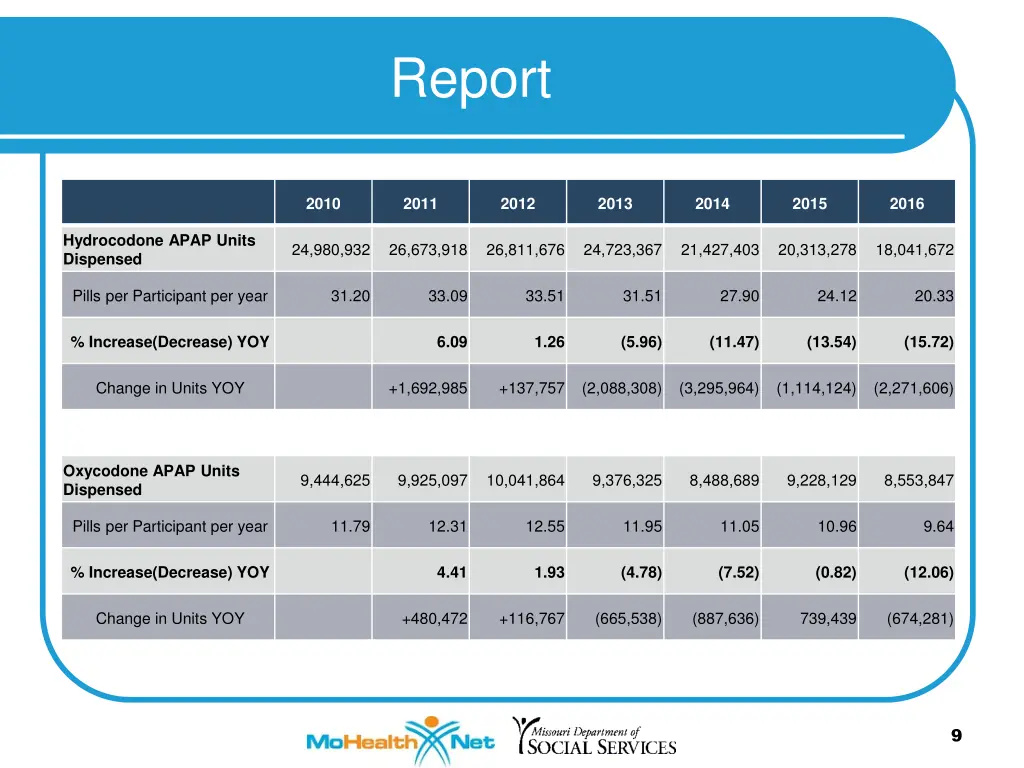
Report 2010 2011 2012 2013 2014 2015 2016 Hydrocodone APAP Units Dispensed 24,980,932 26,673,918 26,811,676 24,723,367 21,427,403 20,313,278 18,041,672 Pills per Participant per year 31.20 33.09 33.51 31.51 27.90 24.12 20.33 % Increase(Decrease) YOY 6.09 1.26 (5.96) (11.47) (13.54) (15.72) Change in Units YOY +1,692,985 +137,757 (2,088,308) (3,295,964) (1,114,124) (2,271,606) Oxycodone APAP Units Dispensed 9,444,625 9,925,097 10,041,864 9,376,325 8,488,689 9,228,129 8,553,847 Pills per Participant per year 11.79 12.31 12.55 11.95 11.05 10.96 9.64 % Increase(Decrease) YOY 4.41 1.93 (4.78) (7.52) (0.82) (12.06) Change in Units YOY +480,472 +116,767 (665,538) (887,636) 739,439 (674,281) 9
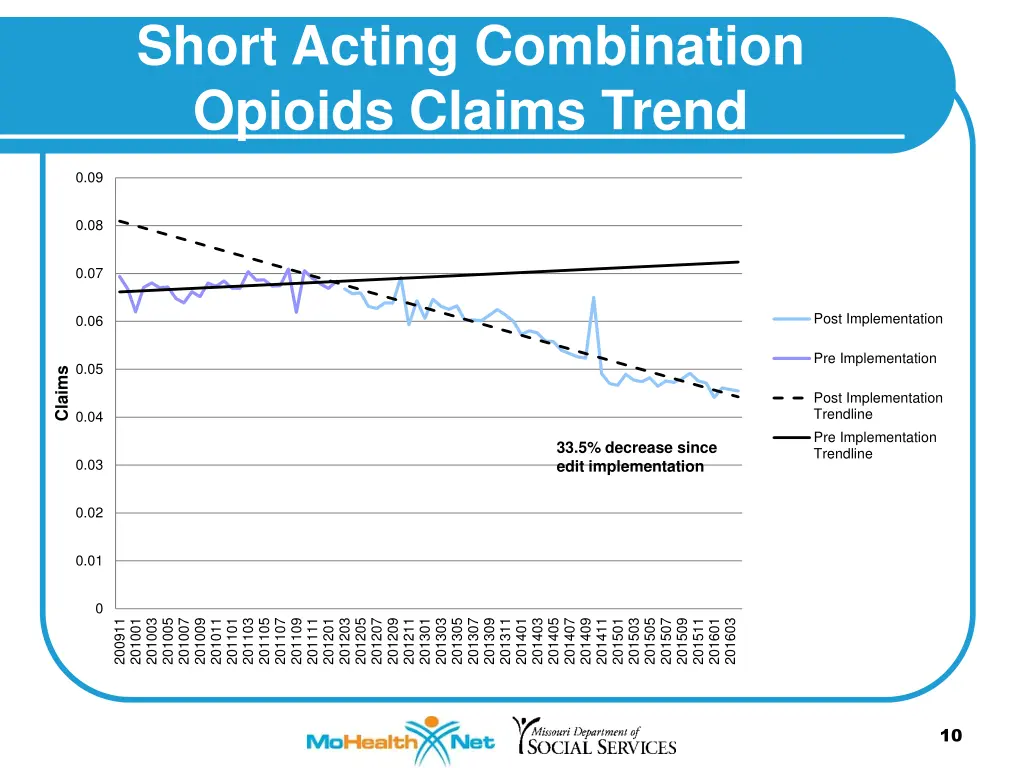
Short Acting Combination Opioids Claims Trend 0.09 0.08 0.07 Post Implementation 0.06 Pre Implementation 0.05 Claims Post Implementation Trendline Pre Implementation Trendline 0.04 33.5% decrease since edit implementation 0.03 0.02 0.01 0 200911 201001 201003 201005 201007 201009 201011 201101 201103 201105 201107 201109 201111 201201 201203 201205 201207 201209 201211 201301 201303 201305 201307 201309 201311 201401 201403 201405 201407 201409 201411 201501 201503 201505 201507 201509 201511 201601 201603 10
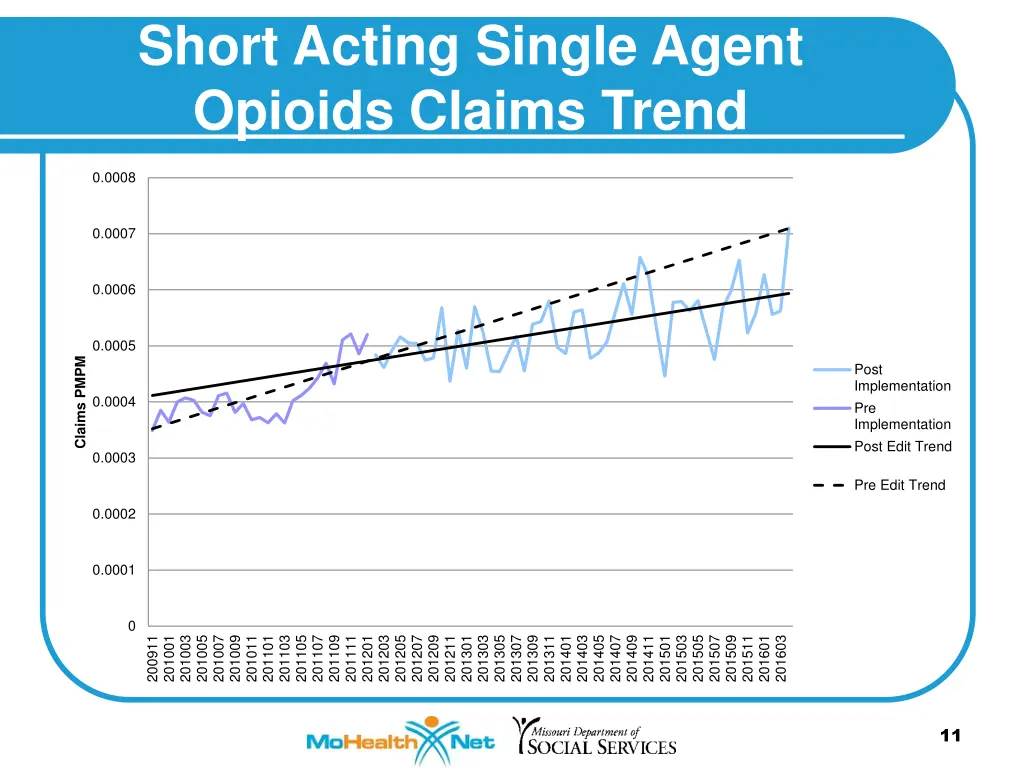
Short Acting Single Agent Opioids Claims Trend 0.0008 0.0007 0.0006 0.0005 Claims PMPM Post Implementation Pre Implementation Post Edit Trend 0.0004 0.0003 Pre Edit Trend 0.0002 0.0001 0 200911 201001 201003 201005 201007 201009 201011 201101 201103 201105 201107 201109 201111 201201 201203 201205 201207 201209 201211 201301 201303 201305 201307 201309 201311 201401 201403 201405 201407 201409 201411 201501 201503 201505 201507 201509 201511 201601 201603 11
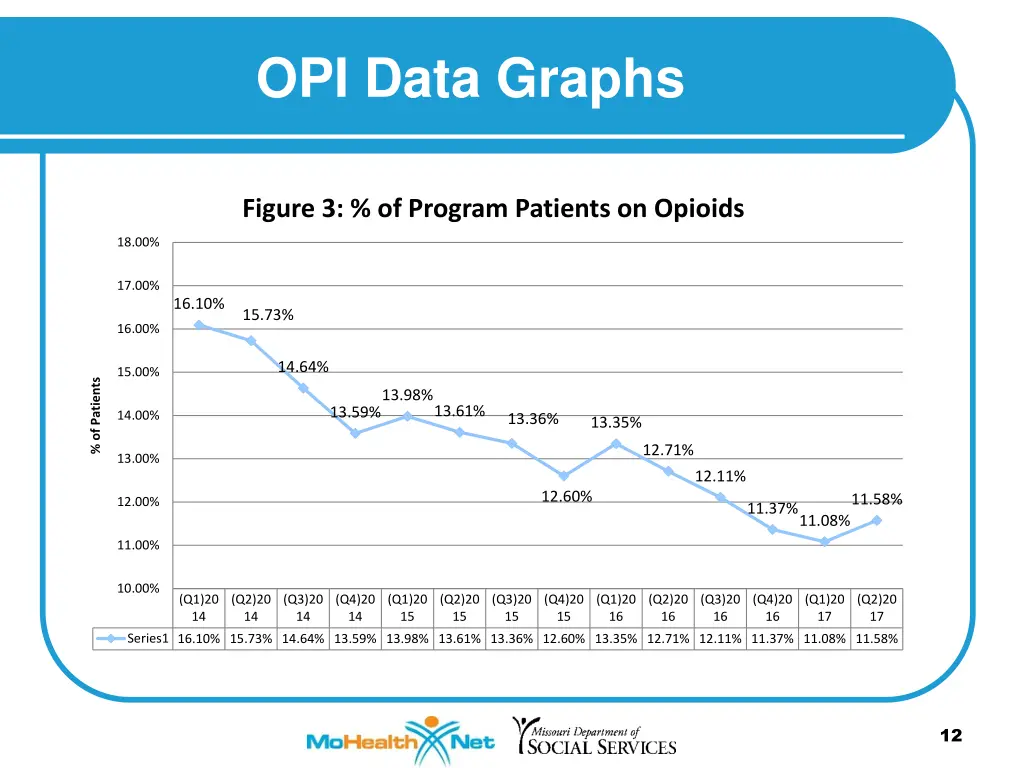
OPI Data Graphs Figure 3: % of Program Patients on Opioids 18.00% 17.00% 16.10% 15.73% 16.00% 14.64% 15.00% % of Patients 13.98% 13.61% 13.59% 14.00% 13.36% 13.35% 12.71% 13.00% 12.11% 12.60% 11.58% 12.00% 11.37%11.08% 11.00% 10.00% (Q1)20 14 (Q2)20 14 (Q3)20 14 (Q4)20 14 (Q1)20 15 (Q2)20 15 (Q3)20 15 (Q4)20 15 (Q1)20 16 (Q2)20 16 (Q3)20 16 (Q4)20 16 (Q1)20 17 (Q2)20 17 Series1 16.10% 15.73% 14.64% 13.59% 13.98% 13.61% 13.36% 12.60% 13.35% 12.71% 12.11% 11.37% 11.08% 11.58% 12
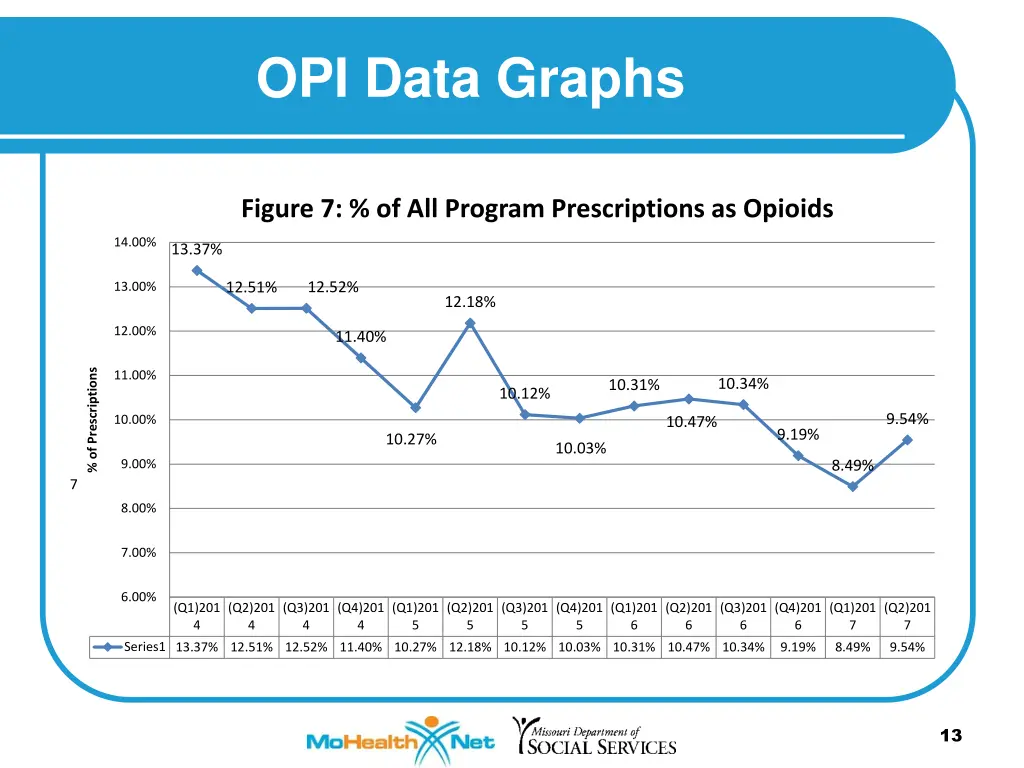
OPI Data Graphs Figure 7: % of All Program Prescriptions as Opioids 14.00% 13.37% 12.52% 12.51% 13.00% 12.18% 12.00% 11.40% % of Prescriptions 11.00% 10.34% 10.31% 10.12% 9.54% 10.00% 10.47% 9.19% 10.27% 10.03% 9.00% 8.49% 7 8.00% 7.00% 6.00% (Q1)201 4 (Q2)201 4 (Q3)201 4 (Q4)201 4 (Q1)201 5 (Q2)201 5 (Q3)201 5 (Q4)201 5 (Q1)201 6 (Q2)201 6 (Q3)201 6 (Q4)201 6 (Q1)201 7 (Q2)201 7 Series1 13.37% 12.51% 12.52% 11.40% 10.27% 12.18% 10.12% 10.03% 10.31% 10.47% 10.34% 9.19% 8.49% 9.54% 13
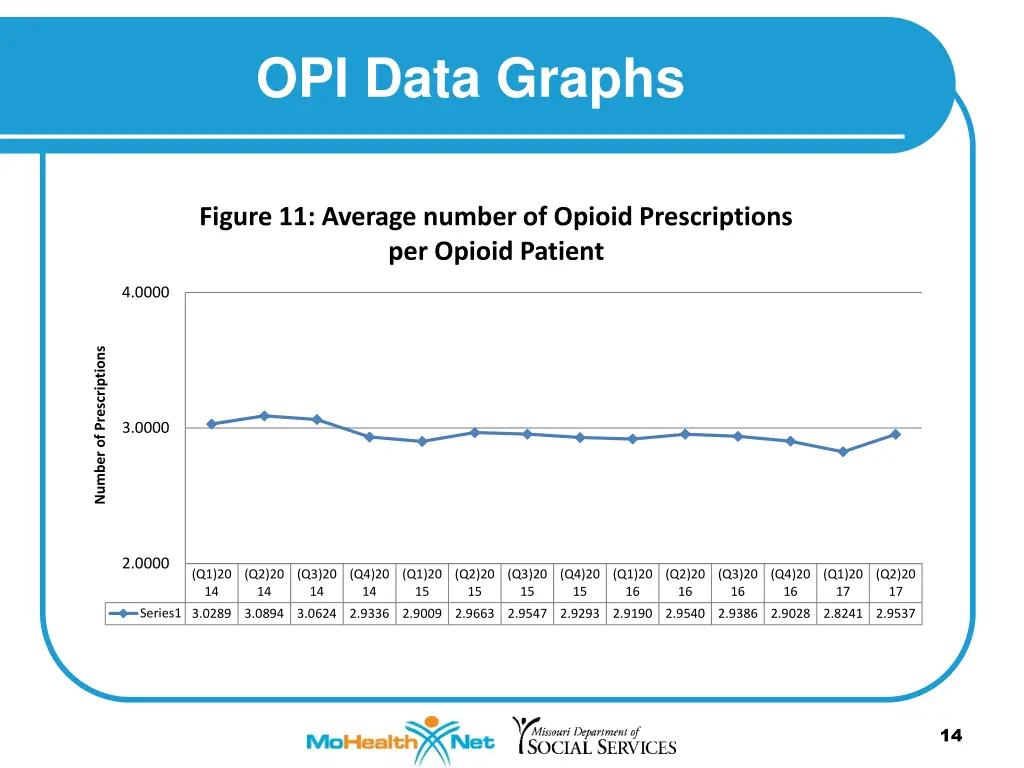
OPI Data Graphs Figure 11: Average number of Opioid Prescriptions per Opioid Patient 4.0000 Number of Prescriptions 3.0000 2.0000 (Q1)20 14 (Q2)20 14 (Q3)20 14 (Q4)20 14 (Q1)20 15 (Q2)20 15 (Q3)20 15 (Q4)20 15 (Q1)20 16 (Q2)20 16 (Q3)20 16 (Q4)20 16 (Q1)20 17 (Q2)20 17 Series1 3.0289 3.0894 3.0624 2.9336 2.9009 2.9663 2.9547 2.9293 2.9190 2.9540 2.9386 2.9028 2.8241 2.9537 14
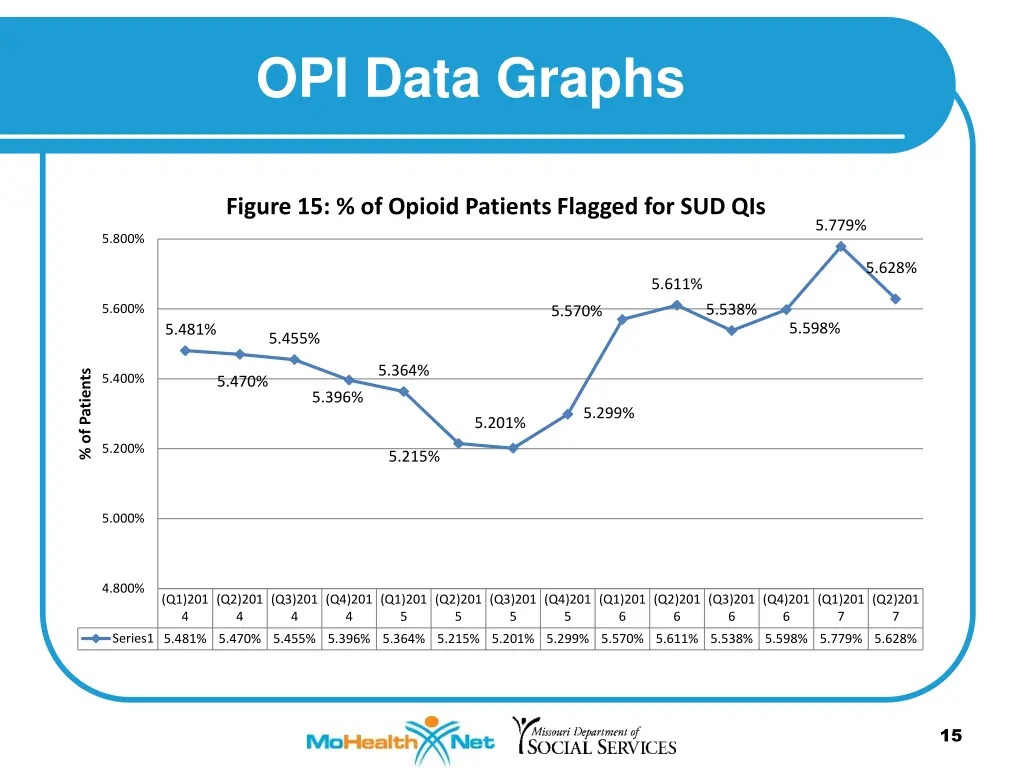
OPI Data Graphs Figure 15: % of Opioid Patients Flagged for SUD QIs 5.779% 5.800% 5.628% 5.611% 5.538% 5.600% 5.570% 5.598% 5.481% 5.455% 5.364% % of Patients 5.400% 5.470% 5.396% 5.299% 5.201% 5.200% 5.215% 5.000% 4.800% (Q1)201 4 (Q2)201 4 (Q3)201 4 (Q4)201 4 (Q1)201 5 (Q2)201 5 (Q3)201 5 (Q4)201 5 (Q1)201 6 (Q2)201 6 (Q3)201 6 (Q4)201 6 (Q1)201 7 (Q2)201 7 Series1 5.481% 5.470% 5.455% 5.396% 5.364% 5.215% 5.201% 5.299% 5.570% 5.611% 5.538% 5.598% 5.779% 5.628% 15
Discussion Questions? Stephen.Calloway@dss.mo.gov (573) 751-6961 Thank you! Missouri Outline with photos of children in center. Link to Each Day information 16