Modeling and Statistical Research with R at Touro College
In this research tool, explore R - a versatile system for data analysis. Delve into textbooks, research papers, and summaries covering a range of topics. Uncover the extensive resources available for statistical analysis and scientific computing in R, ideal for both students and researchers. Dive into various textbooks and project guides that discuss different aspects of R, from introductory levels to advanced statistical concepts. Discover how R can be a valuable tool for modeling and statistical research in academic settings.

Download Presentation

Please find below an Image/Link to download the presentation.
The content on the website is provided AS IS for your information and personal use only. It may not be sold, licensed, or shared on other websites without obtaining consent from the author. If you encounter any issues during the download, it is possible that the publisher has removed the file from their server.
You are allowed to download the files provided on this website for personal or commercial use, subject to the condition that they are used lawfully. All files are the property of their respective owners.
The content on the website is provided AS IS for your information and personal use only. It may not be sold, licensed, or shared on other websites without obtaining consent from the author.
E N D
Presentation Transcript
Water & Environment Sector Overview of 2016/17 Grant and Budget Guidelines Ministry of Water and Environment
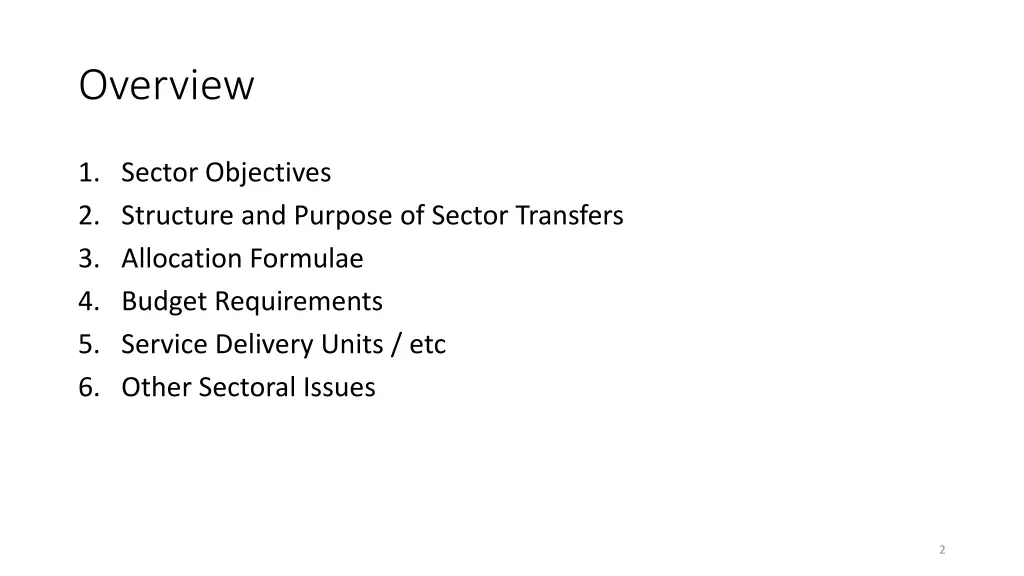
Overview 1. Sector Objectives 2. Structure and Purpose of Sector Transfers 3. Allocation Formulae 4. Budget Requirements 5. Service Delivery Units / etc 6. Other Sectoral Issues 2
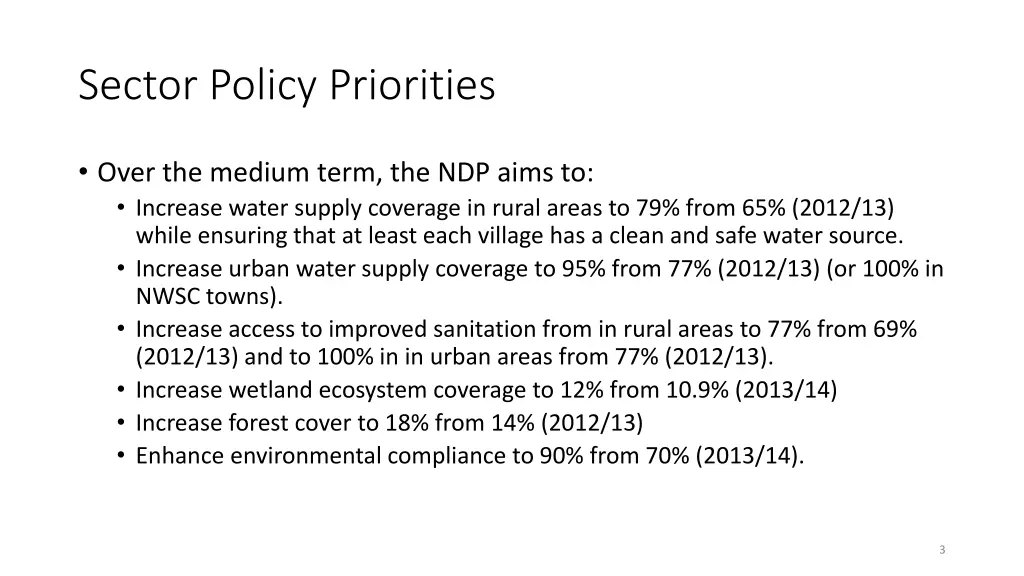
Sector Policy Priorities Over the medium term, the NDP aims to: Increase water supply coverage in rural areas to 79% from 65% (2012/13) while ensuring that at least each village has a clean and safe water source. Increase urban water supply coverage to 95% from 77% (2012/13) (or 100% in NWSC towns). Increase access to improved sanitation from in rural areas to 77% from 69% (2012/13) and to 100% in in urban areas from 77% (2012/13). Increase wetland ecosystem coverage to 12% from 10.9% (2013/14) Increase forest cover to 18% from 14% (2012/13) Enhance environmental compliance to 90% from 70% (2013/14). 3
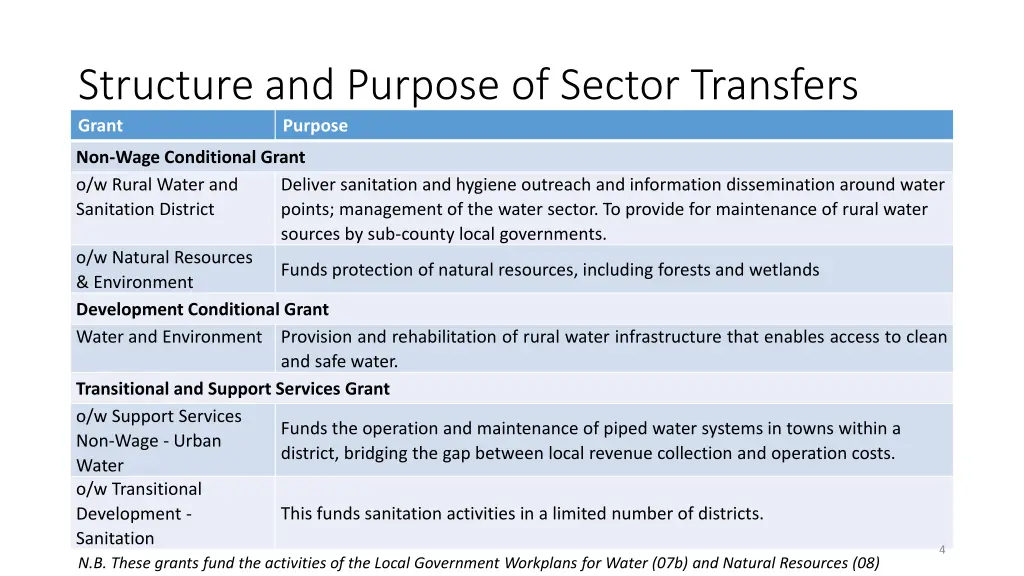
Structure and Purpose of Sector Transfers Grant Purpose Non-Wage Conditional Grant o/w Rural Water and Sanitation District Deliver sanitation and hygiene outreach and information dissemination around water points; management of the water sector. To provide for maintenance of rural water sources by sub-county local governments. o/w Natural Resources & Environment Development Conditional Grant Water and Environment Funds protection of natural resources, including forests and wetlands Provision and rehabilitation of rural water infrastructure that enables access to clean and safe water. Transitional and Support Services Grant o/w Support Services Non-Wage - Urban Water o/w Transitional Development - Sanitation N.B. These grants fund the activities of the Local Government Workplans for Water (07b) and Natural Resources (08) Funds the operation and maintenance of piped water systems in towns within a district, bridging the gap between local revenue collection and operation costs. This funds sanitation activities in a limited number of districts. 4
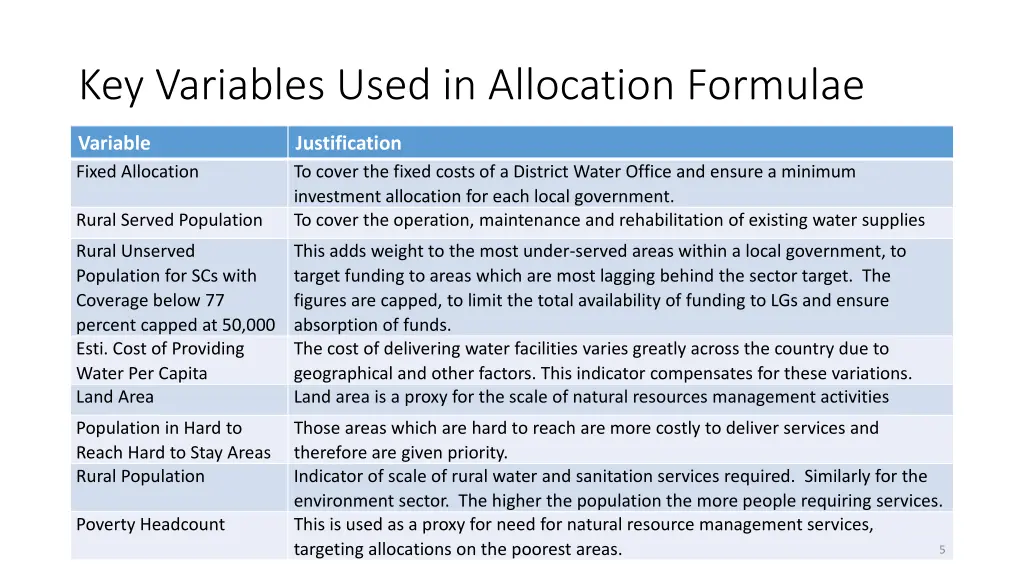
Key Variables Used in Allocation Formulae Variable Fixed Allocation Justification To cover the fixed costs of a District Water Office and ensure a minimum investment allocation for each local government. To cover the operation, maintenance and rehabilitation of existing water supplies Rural Served Population Rural Unserved Population for SCs with Coverage below 77 percent capped at 50,000 Esti. Cost of Providing Water Per Capita Land Area This adds weight to the most under-served areas within a local government, to target funding to areas which are most lagging behind the sector target. The figures are capped, to limit the total availability of funding to LGs and ensure absorption of funds. The cost of delivering water facilities varies greatly across the country due to geographical and other factors. This indicator compensates for these variations. Land area is a proxy for the scale of natural resources management activities Population in Hard to Reach Hard to Stay Areas Rural Population Those areas which are hard to reach are more costly to deliver services and therefore are given priority. Indicator of scale of rural water and sanitation services required. Similarly for the environment sector. The higher the population the more people requiring services. This is used as a proxy for need for natural resource management services, targeting allocations on the poorest areas. Poverty Headcount 5
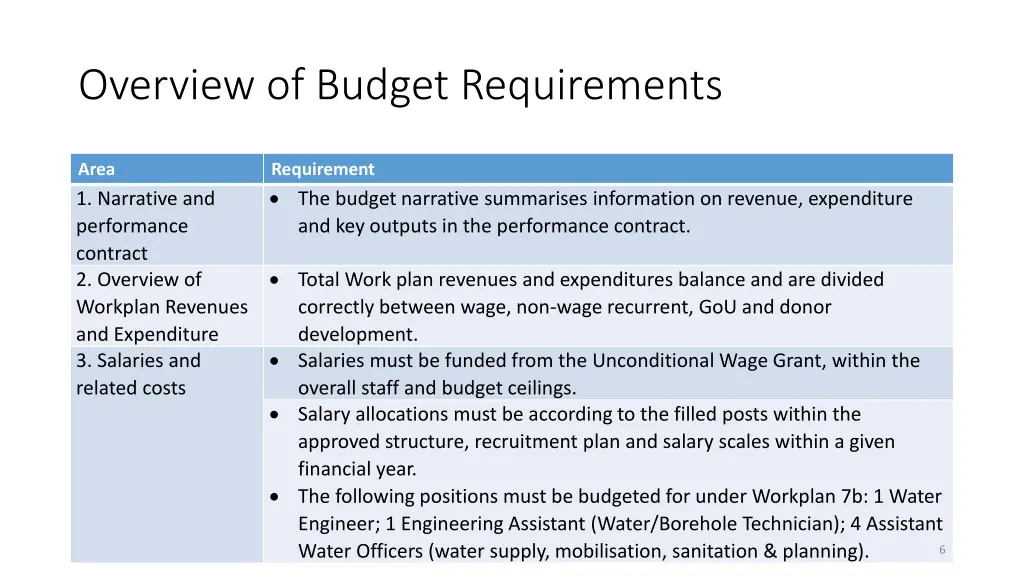
Overview of Budget Requirements Area 1. Narrative and performance contract 2. Overview of Workplan Revenues and Expenditure 3. Salaries and related costs Requirement The budget narrative summarises information on revenue, expenditure and key outputs in the performance contract. Total Work plan revenues and expenditures balance and are divided correctly between wage, non-wage recurrent, GoU and donor development. Salaries must be funded from the Unconditional Wage Grant, within the overall staff and budget ceilings. Salary allocations must be according to the filled posts within the approved structure, recruitment plan and salary scales within a given financial year. The following positions must be budgeted for under Workplan 7b: 1 Water Engineer; 1 Engineering Assistant (Water/Borehole Technician); 4 Assistant Water Officers (water supply, mobilisation, sanitation & planning). 6
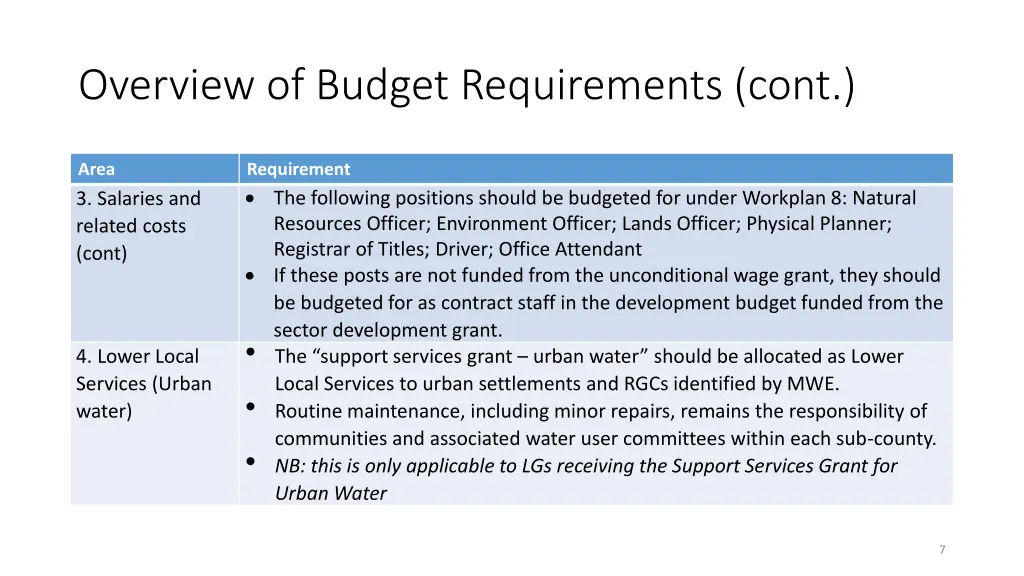
Overview of Budget Requirements (cont.) Area 3. Salaries and related costs (cont) Requirement The following positions should be budgeted for under Workplan 8: Natural Resources Officer; Environment Officer; Lands Officer; Physical Planner; Registrar of Titles; Driver; Office Attendant If these posts are not funded from the unconditional wage grant, they should be budgeted for as contract staff in the development budget funded from the sector development grant. The support services grant urban water should be allocated as Lower Local Services to urban settlements and RGCs identified by MWE. Routine maintenance, including minor repairs, remains the responsibility of communities and associated water user committees within each sub-county. NB: this is only applicable to LGs receiving the Support Services Grant for Urban Water 4. Lower Local Services (Urban water) 7
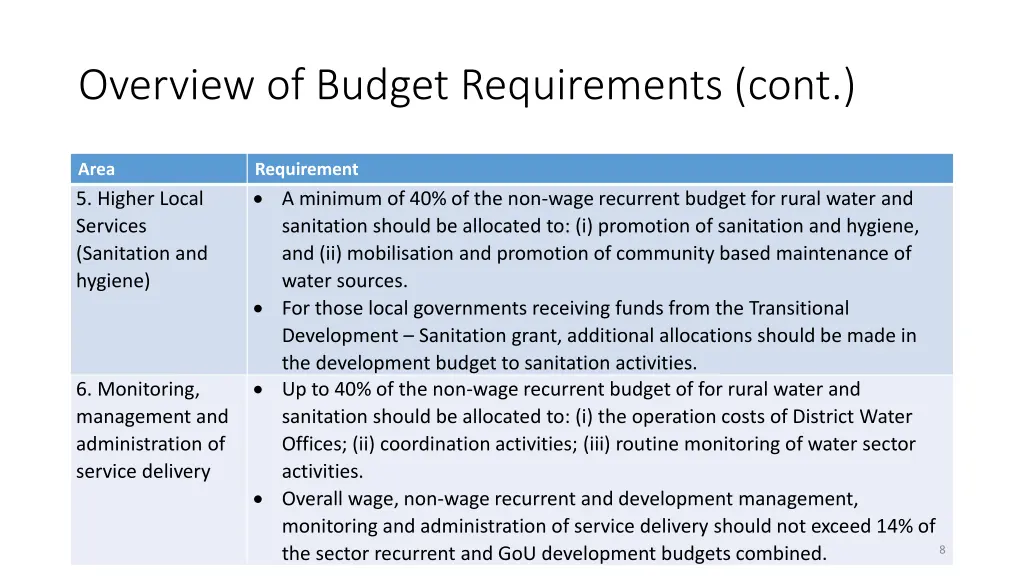
Overview of Budget Requirements (cont.) Area 5. Higher Local Services (Sanitation and hygiene) Requirement A minimum of 40% of the non-wage recurrent budget for rural water and sanitation should be allocated to: (i) promotion of sanitation and hygiene, and (ii) mobilisation and promotion of community based maintenance of water sources. For those local governments receiving funds from the Transitional Development Sanitation grant, additional allocations should be made in the development budget to sanitation activities. Up to 40% of the non-wage recurrent budget of for rural water and sanitation should be allocated to: (i) the operation costs of District Water Offices; (ii) coordination activities; (iii) routine monitoring of water sector activities. Overall wage, non-wage recurrent and development management, monitoring and administration of service delivery should not exceed 14% of the sector recurrent and GoU development budgets combined. 6. Monitoring, management and administration of service delivery 8
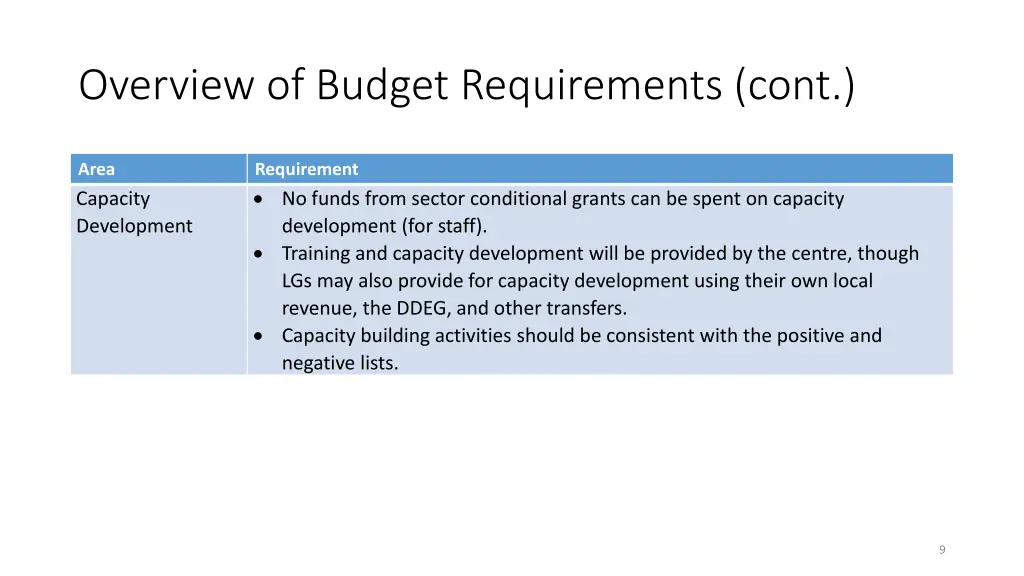
Overview of Budget Requirements (cont.) Area Capacity Development Requirement No funds from sector conditional grants can be spent on capacity development (for staff). Training and capacity development will be provided by the centre, though LGs may also provide for capacity development using their own local revenue, the DDEG, and other transfers. Capacity building activities should be consistent with the positive and negative lists. 9
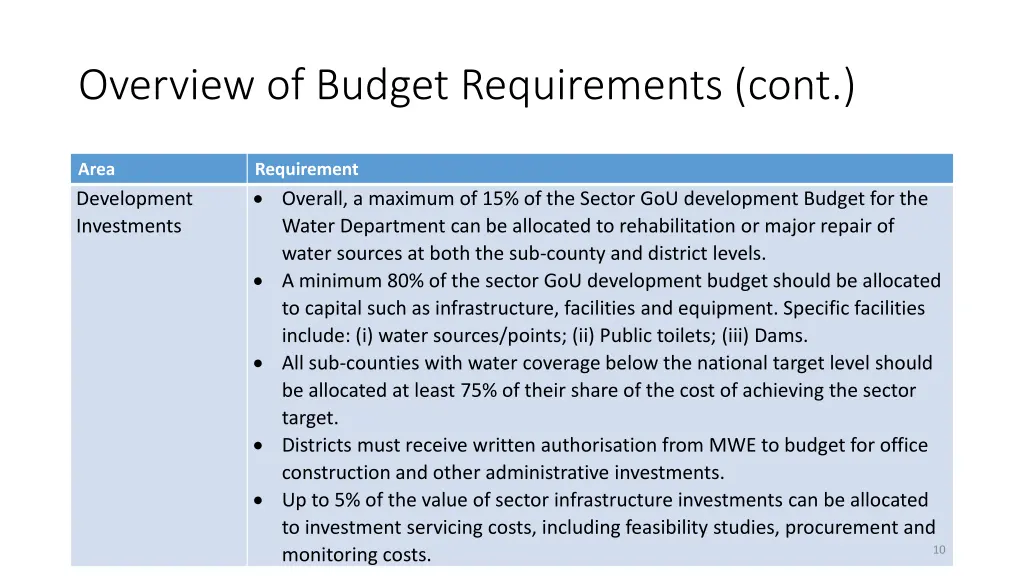
Overview of Budget Requirements (cont.) Area Development Investments Requirement Overall, a maximum of 15% of the Sector GoU development Budget for the Water Department can be allocated to rehabilitation or major repair of water sources at both the sub-county and district levels. A minimum 80% of the sector GoU development budget should be allocated to capital such as infrastructure, facilities and equipment. Specific facilities include: (i) water sources/points; (ii) Public toilets; (iii) Dams. All sub-counties with water coverage below the national target level should be allocated at least 75% of their share of the cost of achieving the sector target. Districts must receive written authorisation from MWE to budget for office construction and other administrative investments. Up to 5% of the value of sector infrastructure investments can be allocated to investment servicing costs, including feasibility studies, procurement and monitoring costs. 10
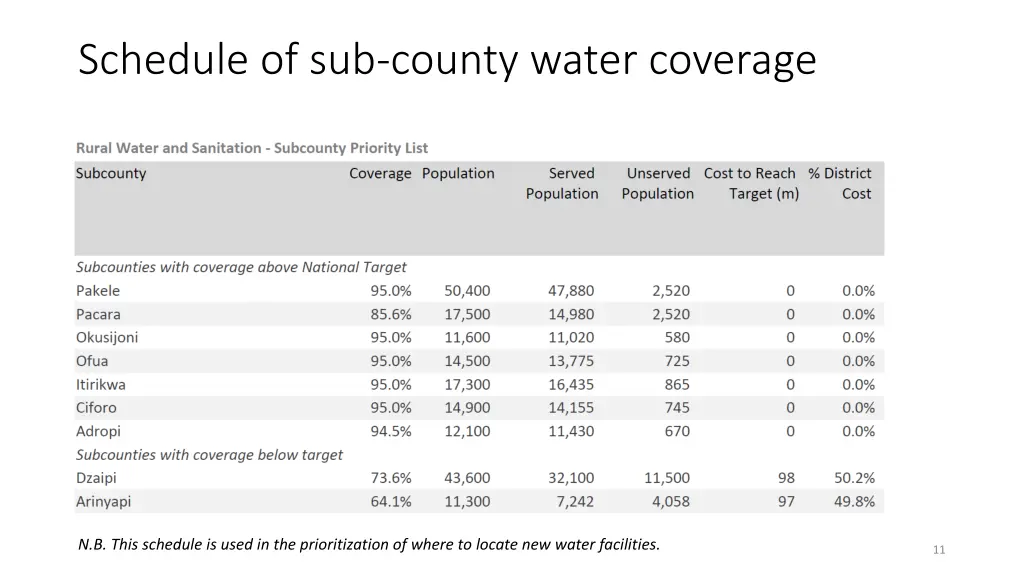
Schedule of sub-county water coverage N.B. This schedule is used in the prioritization of where to locate new water facilities. 11
Other Sectoral Issues Optional slide to be completed by line ministries 12