Modern Approaches in NLP: Word Embeddings and Vector Space Model Recap
Explore the significance of word embeddings and the vector space model in natural language processing (NLP). Understand how words are represented as learned numerical vectors and how documents are represented as vectors of word weights. Discover the implications of modern approaches relying heavily on word embeddings for NLP tasks.

Download Presentation

Please find below an Image/Link to download the presentation.
The content on the website is provided AS IS for your information and personal use only. It may not be sold, licensed, or shared on other websites without obtaining consent from the author. If you encounter any issues during the download, it is possible that the publisher has removed the file from their server.
You are allowed to download the files provided on this website for personal or commercial use, subject to the condition that they are used lawfully. All files are the property of their respective owners.
The content on the website is provided AS IS for your information and personal use only. It may not be sold, licensed, or shared on other websites without obtaining consent from the author.
E N D
Presentation Transcript
ECE469: Artificial Intelligence Deep Learning and NLP
Natural Language Processing (recap) Recall that natural language processing (NLP) is a subfield of artificial intelligence (AI) that deals with the processing of text specified using natural languages Natural languages are languages that are spoken by (or written by or otherwise used by) people; e.g., English, French, Japanese, etc. This is as opposed to formal languages, such as first-order logic or programming languages In this course, I have divided our unit on NLP is divided into three topics; I am calling them: "Conventional Statistical Natural Language Processing" This will cover statistical NLP approaches that dominated the field until around 2013 "Conventional Computational Linguistics" This covers natural languages, in general, and approaches to processing natural languages that consider linguistics "Deep Learning and NLP" This covers modern approaches to NLP We have already covered conventional, statistical NLP as well as conventional computational linguistics We are not going to cover deep learning and NLP This topic is partially based on Chapter 24 of the 4th Edition of the textbook, titled "Dep Learning for Natural Language Processing" This topic is also partially based on material from parts of of "Speech and Language Processing" by Jurafsky and Martin
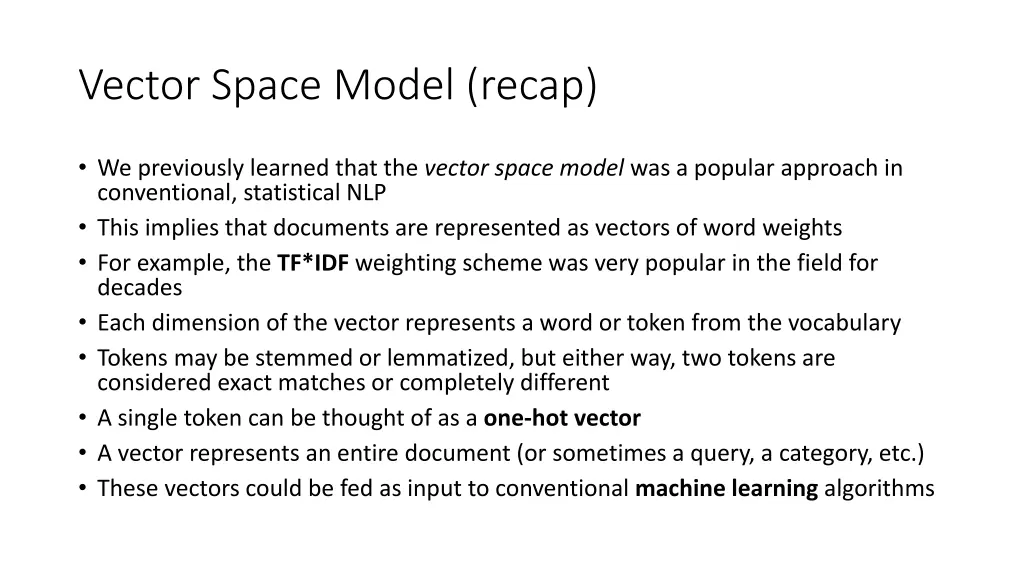
Vector Space Model (recap) We previously learned that the vector space model was a popular approach in conventional, statistical NLP This implies that documents are represented as vectors of word weights For example, the TF*IDF weighting scheme was very popular in the field for decades Each dimension of the vector represents a word or token from the vocabulary Tokens may be stemmed or lemmatized, but either way, two tokens are considered exact matches or completely different A single token can be thought of as a one-hot vector A vector represents an entire document (or sometimes a query, a category, etc.) These vectors could be fed as input to conventional machine learning algorithms
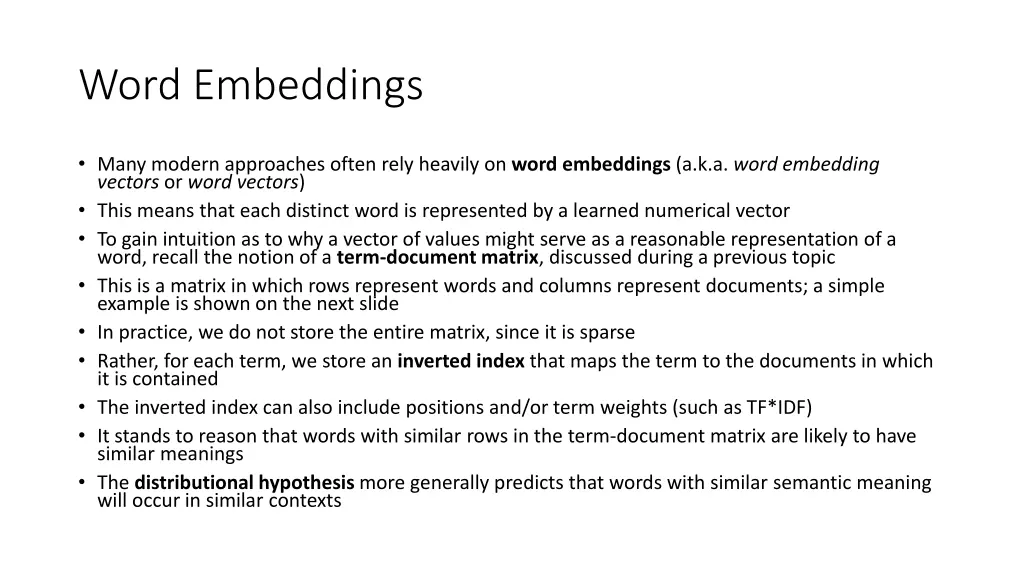
Word Embeddings Many modern approaches often rely heavily on word embeddings (a.k.a. word embedding vectors or word vectors) This means that each distinct word is represented by a learned numerical vector To gain intuition as to why a vector of values might serve as a reasonable representation of a word, recall the notion of a term-document matrix, discussed during a previous topic This is a matrix in which rows represent words and columns represent documents; a simple example is shown on the next slide In practice, we do not store the entire matrix, since it is sparse Rather, for each term, we store an inverted index that maps the term to the documents in which it is contained The inverted index can also include positions and/or term weights (such as TF*IDF) It stands to reason that words with similar rows in the term-document matrix are likely to have similar meanings The distributional hypothesis more generally predicts that words with similar semantic meaning will occur in similar contexts
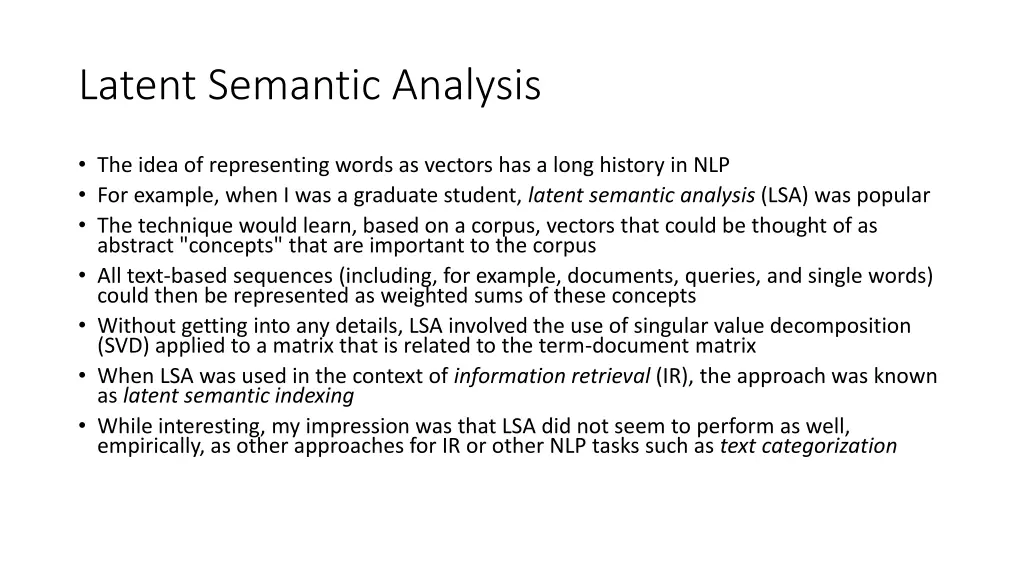
Latent Semantic Analysis The idea of representing words as vectors has a long history in NLP For example, when I was a graduate student, latent semantic analysis (LSA) was popular The technique would learn, based on a corpus, vectors that could be thought of as abstract "concepts" that are important to the corpus All text-based sequences (including, for example, documents, queries, and single words) could then be represented as weighted sums of these concepts Without getting into any details, LSA involved the use of singular value decomposition (SVD) applied to a matrix that is related to the term-document matrix When LSA was used in the context of information retrieval (IR), the approach was known as latent semantic indexing While interesting, my impression was that LSA did not seem to perform as well, empirically, as other approaches for IR or other NLP tasks such as text categorization
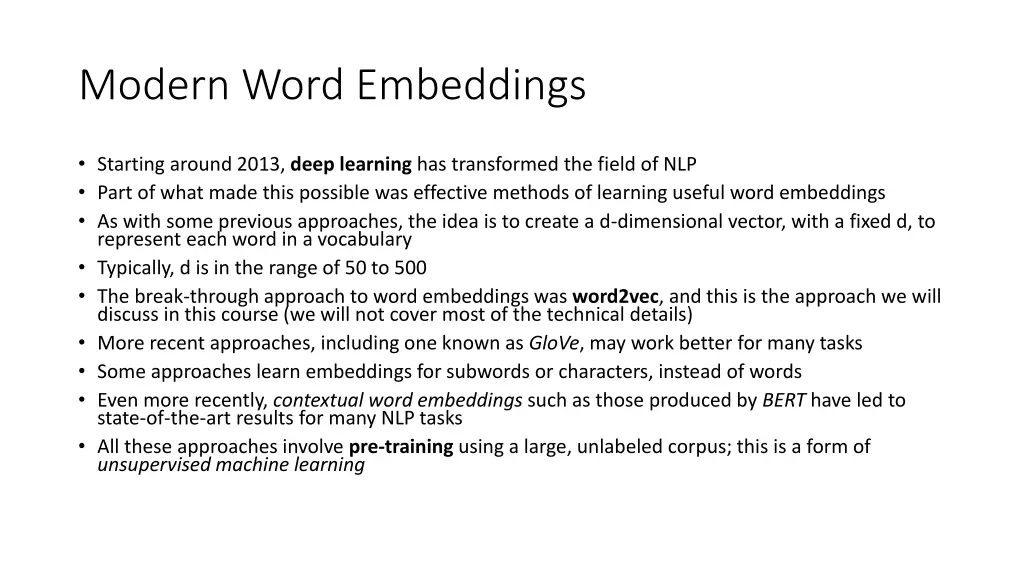
Modern Word Embeddings Starting around 2013, deep learning has transformed the field of NLP Part of what made this possible was effective methods of learning useful word embeddings As with some previous approaches, the idea is to create a d-dimensional vector, with a fixed d, to represent each word in a vocabulary Typically, d is in the range of 50 to 500 The break-through approach to word embeddings was word2vec, and this is the approach we will discuss in this course (we will not cover most of the technical details) More recent approaches, including one known as GloVe, may work better for many tasks Some approaches learn embeddings for subwords or characters, instead of words Even more recently, contextual word embeddings such as those produced by BERT have led to state-of-the-art results for many NLP tasks All these approaches involve pre-training using a large, unlabeled corpus; this is a form of unsupervised machine learning
Pre-word-embedding Neural Networks Consider neural networks (NNs) applied to NLP tasks (such as text categorization) without word embeddings A typical conventional approach was to have an input node for every word in the vocabulary If the size of the vocabulary were V, there would be V input nodes The values of the inputs could be Boolean, word counts, or TF*IDF values Of course, this was a bag-of-words approach; the order of the words in the input document does not affect the input to the neural network Optionally, other input features could also be included
Problems with Pre-word-embedding NNs There were a lot of weights between the inputs and the first hidden layer (this could lead to overfitting) There is no simple way to incorporate word order into the methodology Even incorporating bigrams would blow up the number of input nodes Two very similar words are represented by entirely different nodes Of course, techniques such as stemming or lemmatization could be used Still, any two tokens would be treated as either identical or totally different It is my impression that, before word embeddings became popular, NNs did not achieve state-of-the-art results for most (possibly all) NLP tasks
Advantages of Word Embeddings for NNs The number of input nodes is related to d, the dimension of the word embeddings For different tasks and architectures, the input might be one word embedding at a time or a fixed number of word embeddings at a time The input to feedforward neural networks, convolutional neural networks, or transformers might be word embeddings from one padded sentence The input to recurrent neural networks is typically one word embedding at a time, and the words of a sentence are traversed in a sequence Similar (but non-identical) words will have similar word embeddings
Word2vec Really, word2vec includes two related methods for learning word embeddings The principle behind both methods is related to the distributional hypothesis (mentioned earlier) One method, called continuous bag-of-words (CBOW), learns embeddings useful to producing the current word in a text based on the surrounding context words The other method, called the skip-gram method, learns embeddings useful to predict context words within a window of the current word We will focus on the skip-gram method Conceptually, either method can learn word embeddings by training a shallow neural network on an unlabeled corpus In practice, more efficient techniques are used
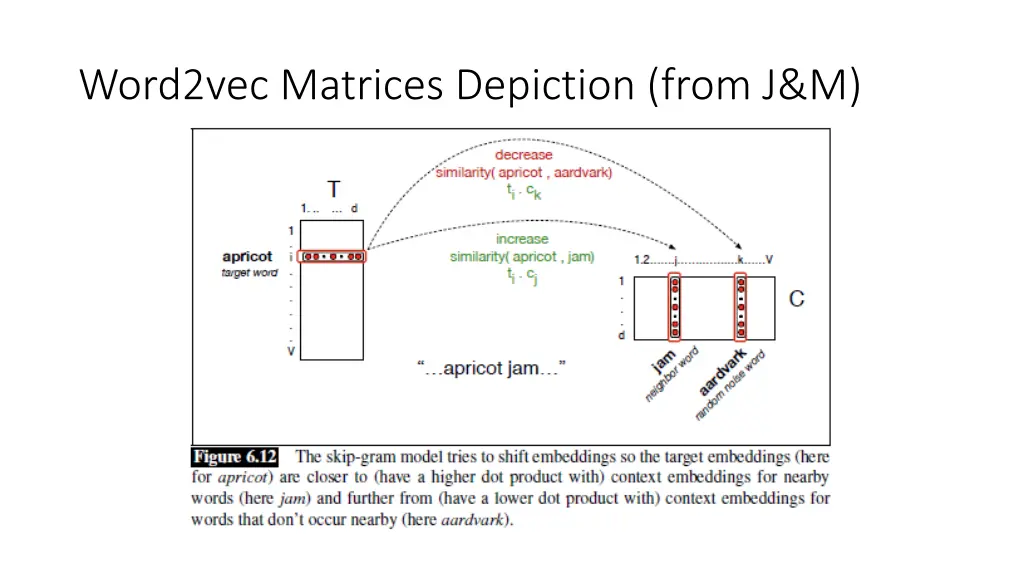
The Skip-gram Model Learns Two Embeddings The skip-gram method learns two embeddings for each word, w One is called the target embedding, t The other is called the context embedding, c A target matrix, T, contains all the target embeddings The ithrow of T is a 1 x d vector, ti, for the ithword of the vocabulary, V, where d is the dimension of the word embeddings A context matrix, C, contains all the context embedding The jthcolumn of C is a d x 1 vector, cj, for the jthword of the vocabulary, V
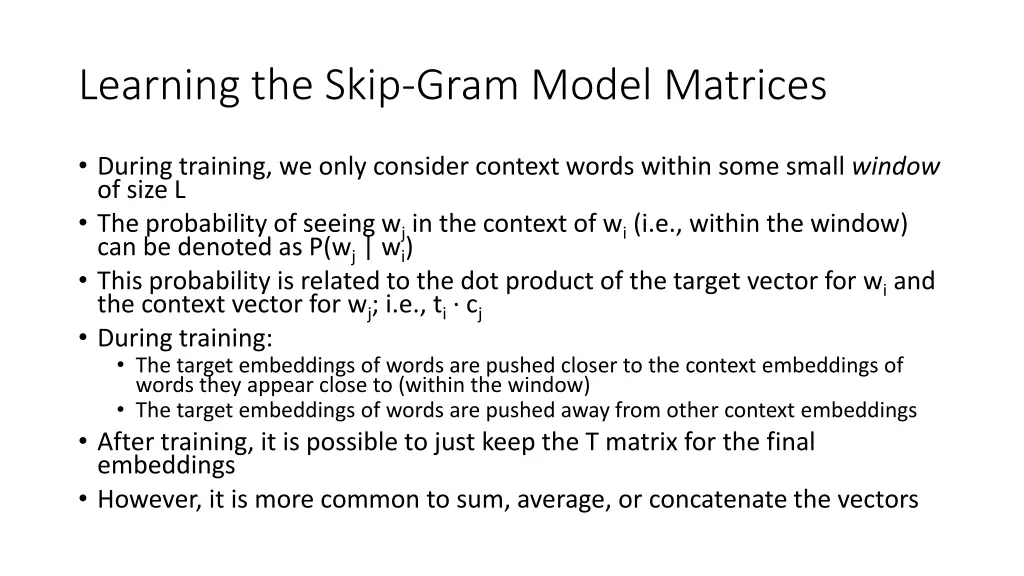
Learning the Skip-Gram Model Matrices During training, we only consider context words within some small window of size L The probability of seeing wjin the context of wi(i.e., within the window) can be denoted as P(wj| wi) This probability is related to the dot product of the target vector for wiand the context vector for wj; i.e., ti cj During training: The target embeddings of words are pushed closer to the context embeddings of words they appear close to (within the window) The target embeddings of words are pushed away from other context embeddings After training, it is possible to just keep the T matrix for the final embeddings However, it is more common to sum, average, or concatenate the vectors
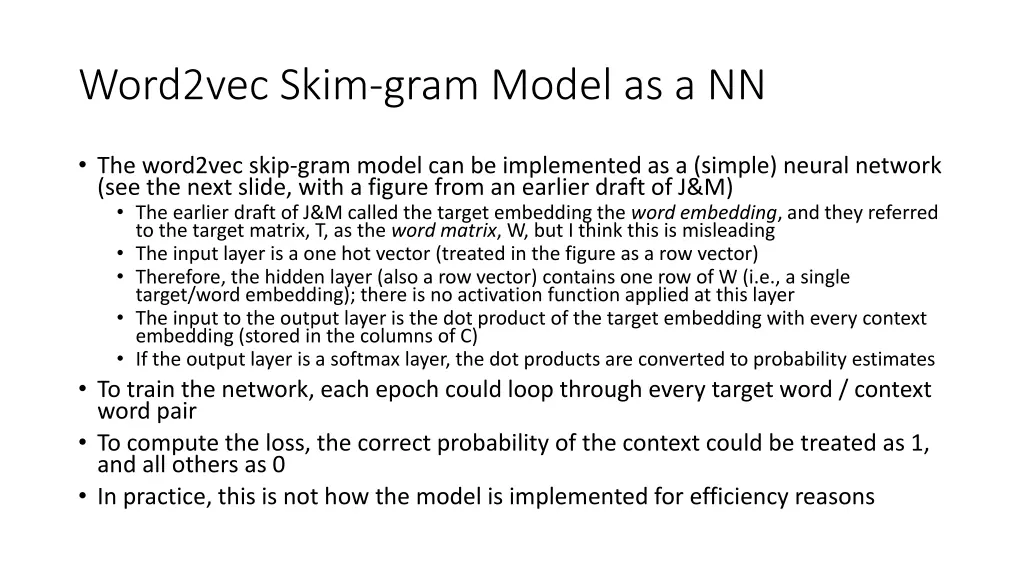
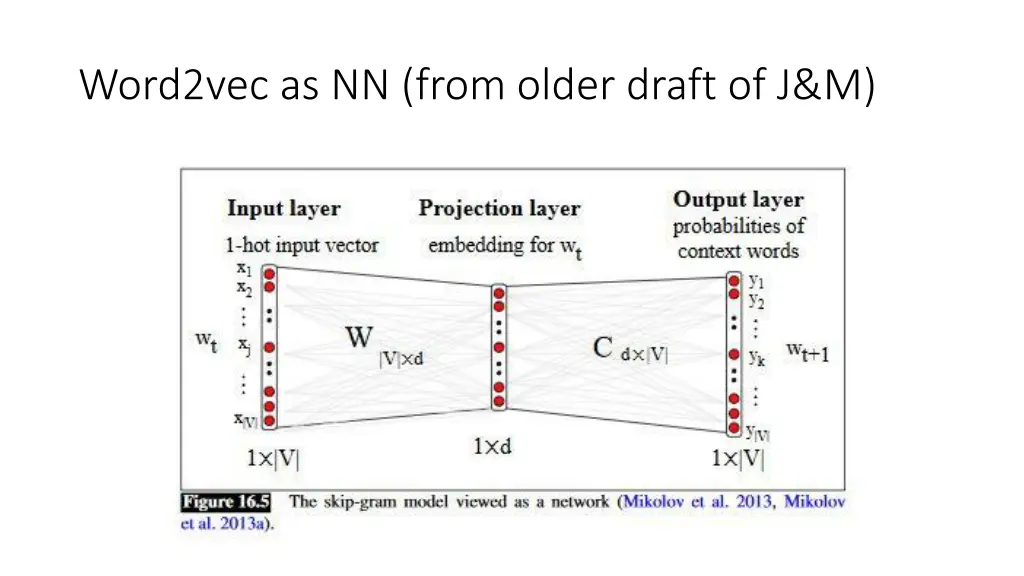
Word2vec Skim-gram Model as a NN The word2vec skip-gram model can be implemented as a (simple) neural network (see the next slide, with a figure from an earlier draft of J&M) The earlier draft of J&M called the target embedding the word embedding, and they referred to the target matrix, T, as the word matrix, W, but I think this is misleading The input layer is a one hot vector (treated in the figure as a row vector) Therefore, the hidden layer (also a row vector) contains one row of W (i.e., a single target/word embedding); there is no activation function applied at this layer The input to the output layer is the dot product of the target embedding with every context embedding (stored in the columns of C) If the output layer is a softmax layer, the dot products are converted to probability estimates To train the network, each epoch could loop through every target word / context word pair To compute the loss, the correct probability of the context could be treated as 1, and all others as 0 In practice, this is not how the model is implemented for efficiency reasons
Skip-gram with Negative Sampling In practice, neural networks are not actually used to learn the word embeddings Calculating the dot product of each center word with every word in the vocabular would be too expensive Instead, skip-gram with negative sampling is used; we will only discuss this at a conceptual level Basically, for each target word, the actual context words within the window size are used to push the target vector and context vectors closer to each other Additionally, k words from the vocabulary are randomly chosen and assumed to be non-context words; their context vectors and the target vector are pushed further apart Typical values of k range from 5 to 20, with smaller datasets requiring higher values of k to achieve good results The k negative sampled words are typically chosen with probabilities proportional to their unigram frequencies raised to the power of 0.75 Learning word embeddings using the skip-gram method with negative sampling is much faster than training a neural network, and it produces embeddings that are about as useful
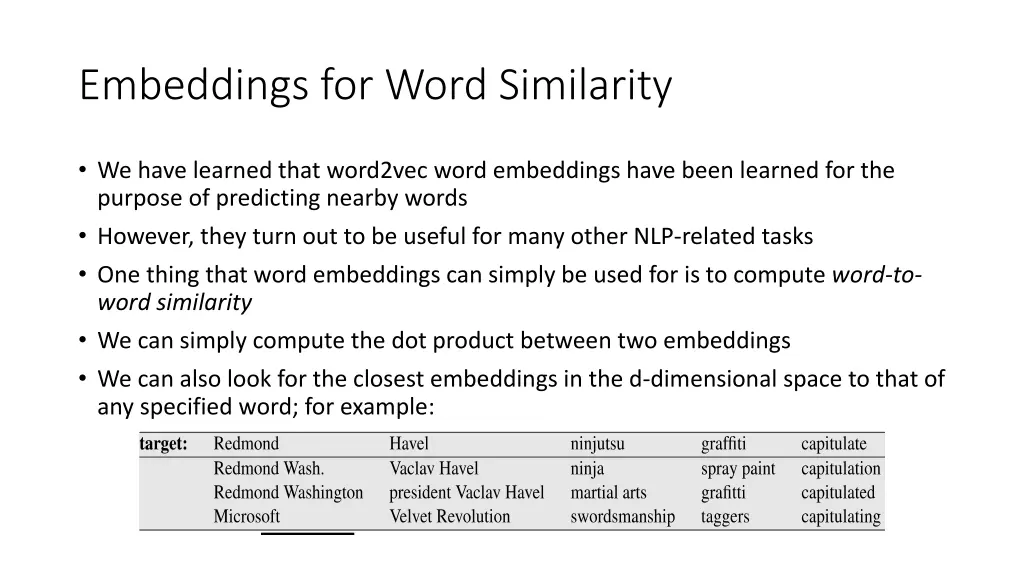
Embeddings for Word Similarity We have learned that word2vec word embeddings have been learned for the purpose of predicting nearby words However, they turn out to be useful for many other NLP-related tasks One thing that word embeddings can simply be used for is to compute word-to- word similarity We can simply compute the dot product between two embeddings We can also look for the closest embeddings in the d-dimensional space to that of any specified word; for example:
Visualizing Word Embeddings To help with visualization of word embeddings, the d-dimensional vectors can be mapped to two dimensions One approach to do this is principal component analysis (PCA) Today, a more popular method is known as t-SNE These t-SNE plots can also help visualize differences between embeddings Surprisingly, differences between embeddings also seem to be meaningful (the next slide shows an example to help visualize this)
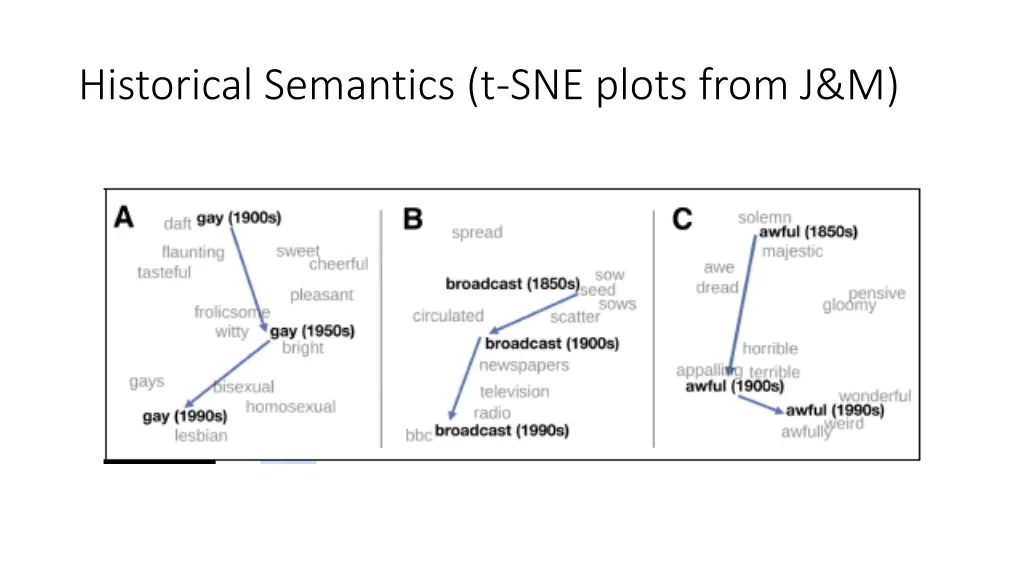
Differences Between Embeddings (examples) Part (a) shows that vector("woman") vector("man") vector("aunt") vector("uncle") vector("queen") vector("king"), etc. Part (b) shows that vector("slower") vector("slow") vector("stronger") vector("strong"), etc., and that this also works for superlatives Another way to express one of these approximations is: vector("king") - vector("man") + vector("woman") vector("queen") This can be used to help solve analogies! For example, consider the analogy: "king":"man" as ???:"woman You can compute the left-hand side of the approximation above and find the closest embedding Another example: vector("Paris") - vector("France") + vector("Italy") vector("Rome") You can also train word embeddings on corpora from different time periods, to examine how meanings of words have changed (see next slide)
Evaluating Word Embeddings There are various ways to evaluate word embeddings; for example: Word similarity scores can be correlated to human judgements of similarity The embeddings can be evaluated with word analogy tasks The embeddings can be used for other, more complex tasks, and the performance on those tasks can then be evaluated The first two tasks could arguably be considered examples of intrinsic evaluation (although I would claim this is debatable) The third example would be an example of extrinsic evaluation Examples of tasks that rely on embeddings include sentence classification, machine translation, question answering, etc.
Using Word Embeddings with NNs Word embeddings can now be used as inputs to various forms of NNs, including feedforward neural networks, convolutional neural networks, and recurrent neural networks (RNNs) In this course, we will focus on recurrent neural networks, because these are unusually different from other neural networks, and have been used in NLP more than other fields Until a few years ago, they also dominated the field for many NLP tasks More recently, transformer-based architectures have performed even better for most of these tasks) Depending on the task, either pre-trained word embeddings (e.g., from word2vec) can be used, or lower layers of the networks can learn task-specific and domain-specific embeddings For some tasks, such as POS-tagging, each input word gets mapped to a predicted token (e.g., a POS tag or an IOB tag) For other tasks, such as text categorization, a document or a sentence gets mapped to a category For other tasks, such as machine translation, where we want to map an input sequence to an output sequence, an encoder-decoder model is used
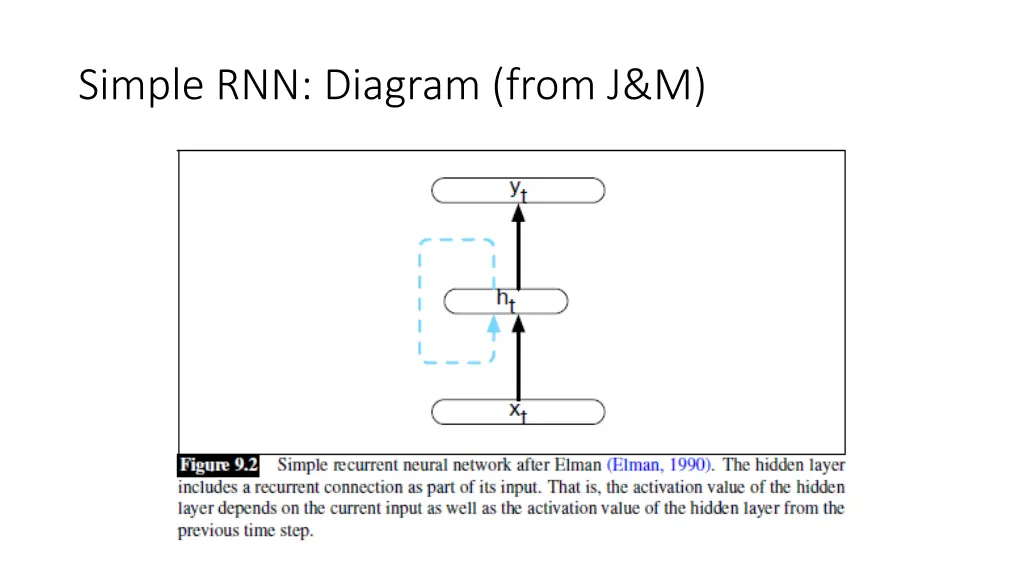
Simple RNN A recurrent neural network (RNN) "is any network that contains a cycle within its network connections" We will start by covering simple recurrent networks, a.k.a. Elman networks or vanilla RNNs A simple RNN has a single hidden layer, with outputs that lead back to its own inputs; the J&M textbook calls this a recurrent link As with feedforward neural networks, layers can be implemented as vectors, and weights between layers can be implemented as matrices The recurrent link can also be implemented as a matrix
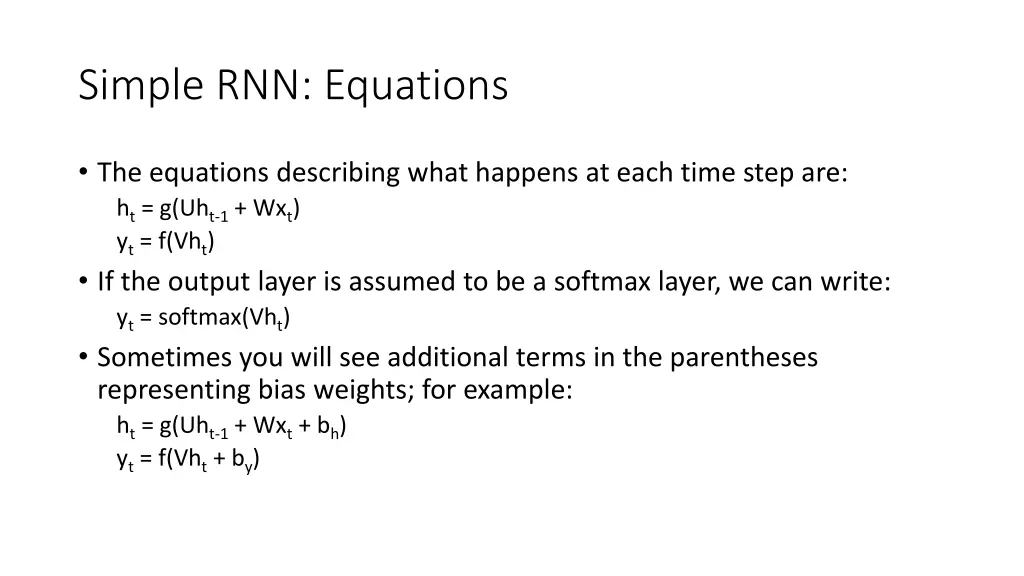
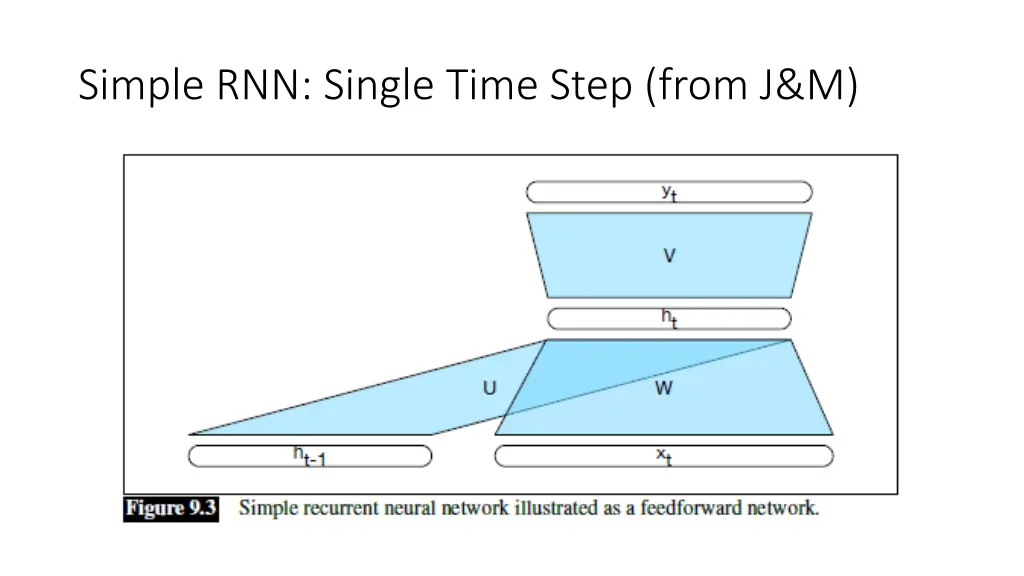
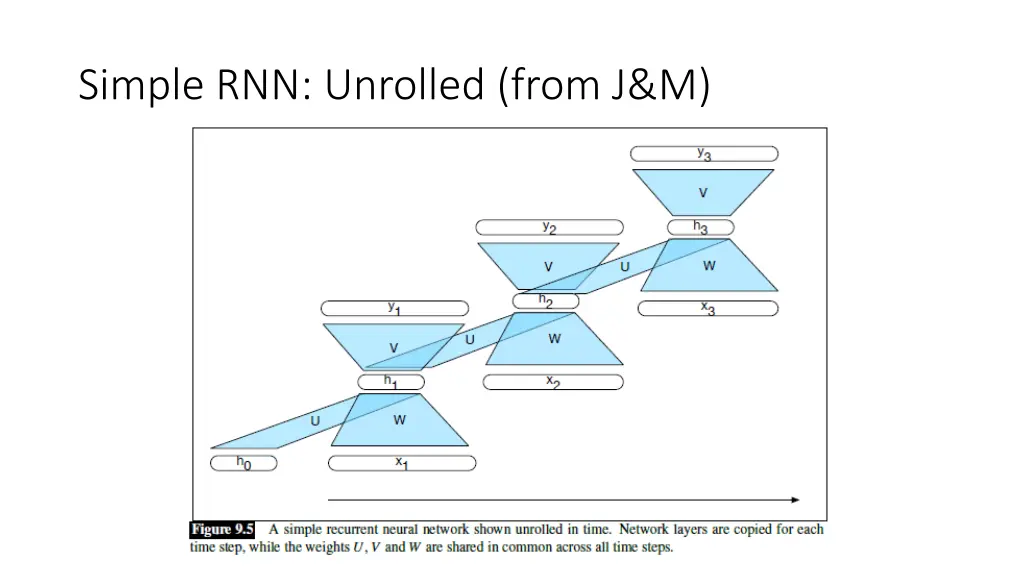
Simple RNN: Equations The equations describing what happens at each time step are: ht= g(Uht-1+ Wxt) yt= f(Vht) If the output layer is assumed to be a softmax layer, we can write: yt= softmax(Vht) Sometimes you will see additional terms in the parentheses representing bias weights; for example: ht= g(Uht-1+ Wxt+ bh) yt= f(Vht+ by)
Simple RNN: Unrolling an RNN It is common to depict an RNN as unrolled (e.g., see the next slide) Basically, each time step (for some fixed number of time steps) is drawn separately The number of depicted time steps shown in the unrolled network is arbitrary When a simple RNN is applied to input, it keeps taking inputs until there are no more Such a diagram helps intuit how forward inference in an RNN proceeds The values at the hidden layers and output nodes are changing, but the U, W, and V matrices are not (they change during training, but not during forward inference) As with feedforward neural networks, the network can be trained using stochastic gradient descent and backpropagation! The matrices change multiple times during the backpropagation of a single example or batch; for RNNs, this is sometimes called backpropagation through time
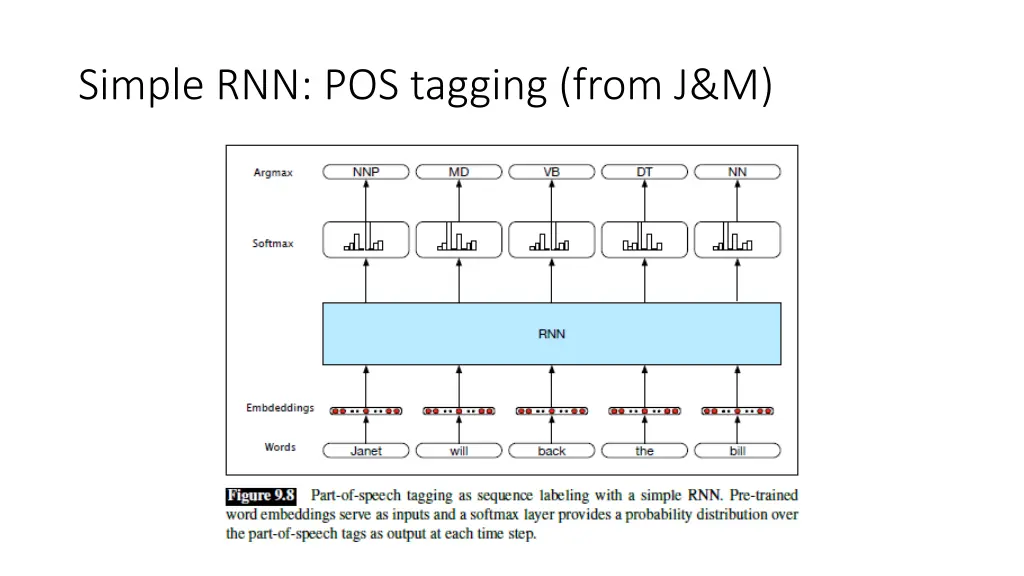
Simple RNN: Sequence labelling Sequence labeling refers to any task that involves categorizing every item in a sequence One example is part-of-speech tagging (POS tagging) See the next slide for a diagram of a simple RNN that can be used for POS tagging The softmax layer is used to here pick the single most likely tag, given the current hidden state The current hidden state, in turn, is based on the current word s embedding and the previous hidden state Recall that conventional approaches for POS tagging include hidden Markov models (HMMs) and maximum entropy Markov models (MEMMs) In general, state-of-the-art deep learning POS taggers do a bit better than state-of-the- art MEMM POS taggers which do a bit better than state-of-the-art HMM POS taggers State-of-the-art deep learning taggers do not use simple RNNs, but rather use variations of RNNs that we have not discussed yet
Simple RNN: Text Categorization Simple RNNs can be applied for text categorization (TC) As with other tasks we have discussed, state-of-the-art RNN results involve variations of RNNs that we haven t yet discussed RNNs, in general, have mostly been successful for the categorization of short sequences of text, such as tweets or individual sentences See the next slide for a diagram of a simple RNN that can be used for TC When an RNN is applied for TC, a common approach is to have the final hidden state become the input to a feedforward neural network It is common to think of the final hidden state as representing the meaning of the text As with all neural networks we have looked at, the network can be trained end-to-end using stochastic gradient descent and backpropagation
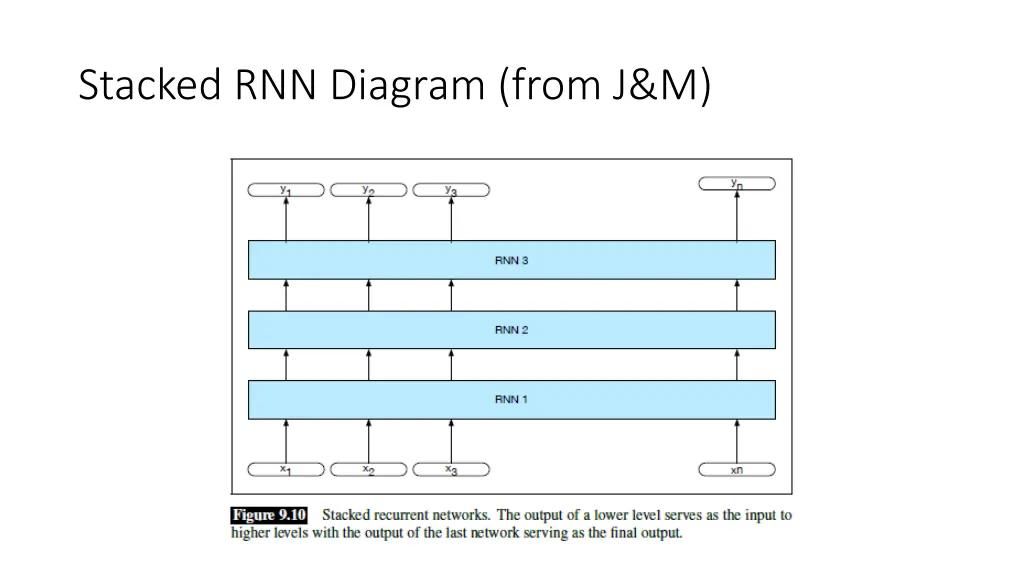
Stacked RNNs A stacked RNN uses the hidden stated produced by one RNN as the inputs to the next We can then refer to each RNN as a layer The final RNN in the stack produces the final outputs for the stack Stacks RNNs have outperformed single-layer RNNs for many tasks The optimal number of RNN layers varies according to the task and the training set Adding additional layers of RNNs can significantly increase the training time
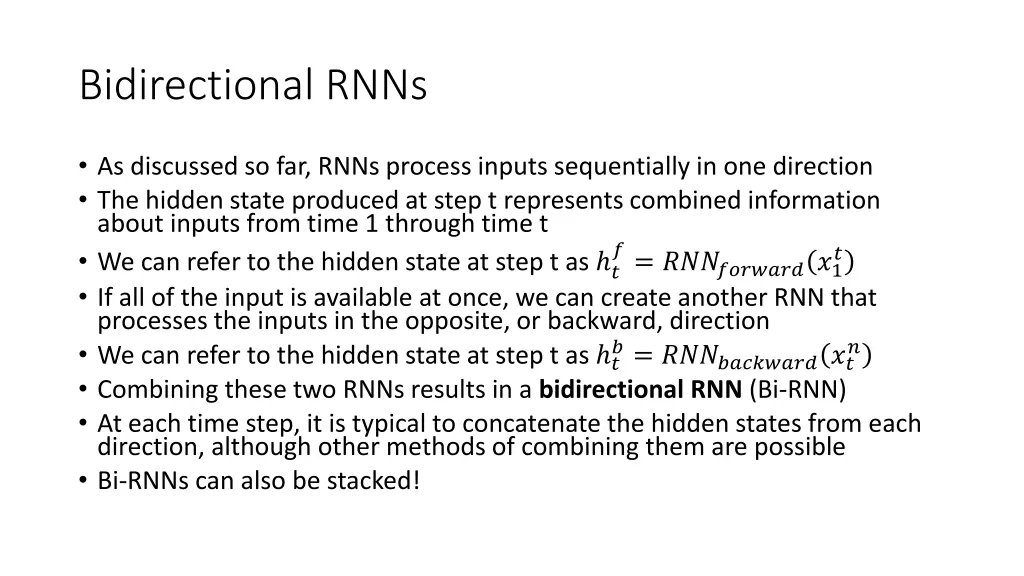
Bidirectional RNNs As discussed so far, RNNs process inputs sequentially in one direction The hidden state produced at step t represents combined information about inputs from time 1 through time t We can refer to the hidden state at step t as ? If all of the input is available at once, we can create another RNN that processes the inputs in the opposite, or backward, direction We can refer to the hidden state at step t as ? Combining these two RNNs results in a bidirectional RNN (Bi-RNN) At each time step, it is typical to concatenate the hidden states from each direction, although other methods of combining them are possible Bi-RNNs can also be stacked! ?= ???????????1 ? ?= ??????????????
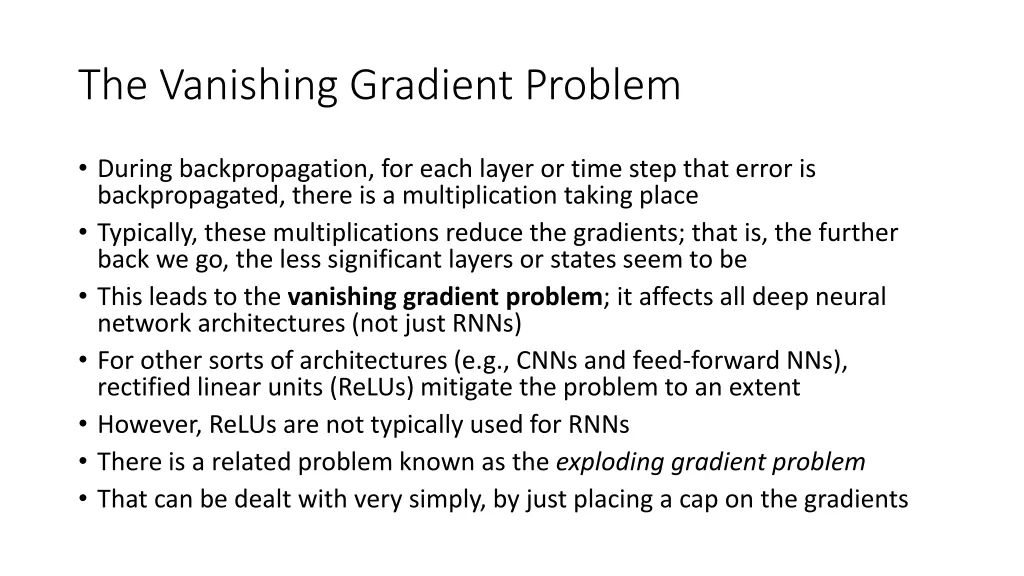
The Vanishing Gradient Problem During backpropagation, for each layer or time step that error is backpropagated, there is a multiplication taking place Typically, these multiplications reduce the gradients; that is, the further back we go, the less significant layers or states seem to be This leads to the vanishing gradient problem; it affects all deep neural network architectures (not just RNNs) For other sorts of architectures (e.g., CNNs and feed-forward NNs), rectified linear units (ReLUs) mitigate the problem to an extent However, ReLUs are not typically used for RNNs There is a related problem known as the exploding gradient problem That can be dealt with very simply, by just placing a cap on the gradients
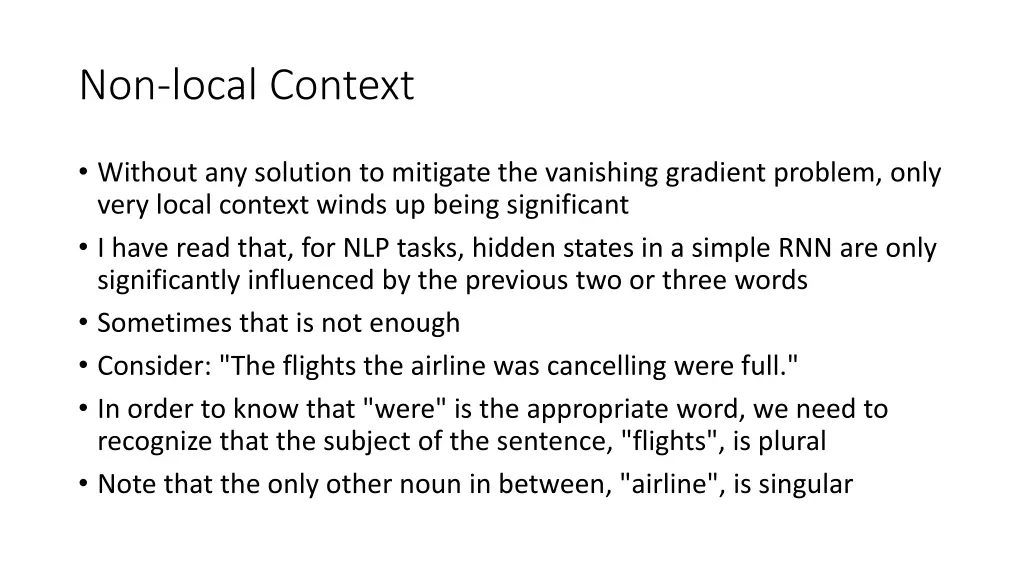
Non-local Context Without any solution to mitigate the vanishing gradient problem, only very local context winds up being significant I have read that, for NLP tasks, hidden states in a simple RNN are only significantly influenced by the previous two or three words Sometimes that is not enough Consider: "The flights the airline was cancelling were full." In order to know that "were" is the appropriate word, we need to recognize that the subject of the sentence, "flights", is plural Note that the only other noun in between, "airline", is singular
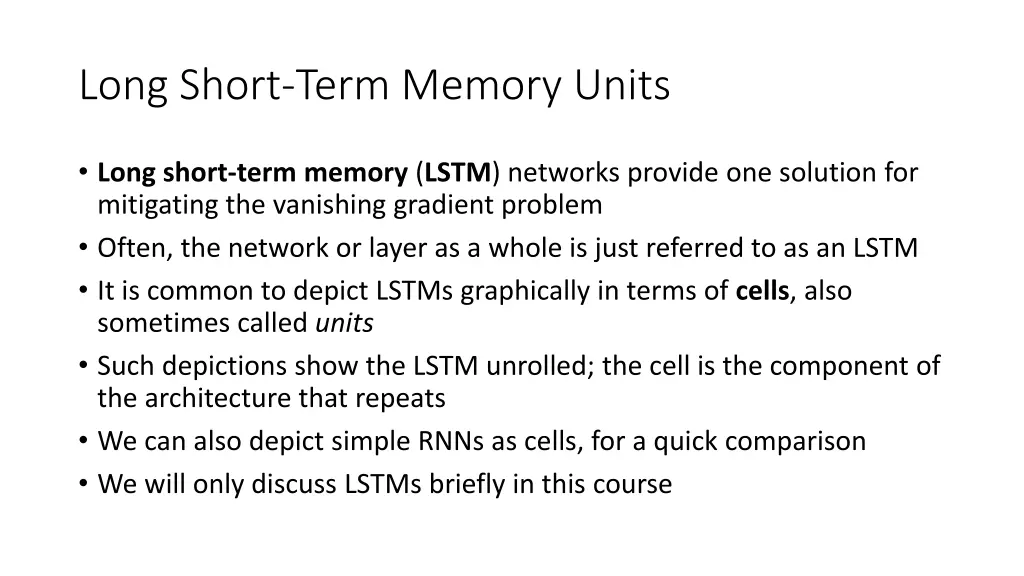
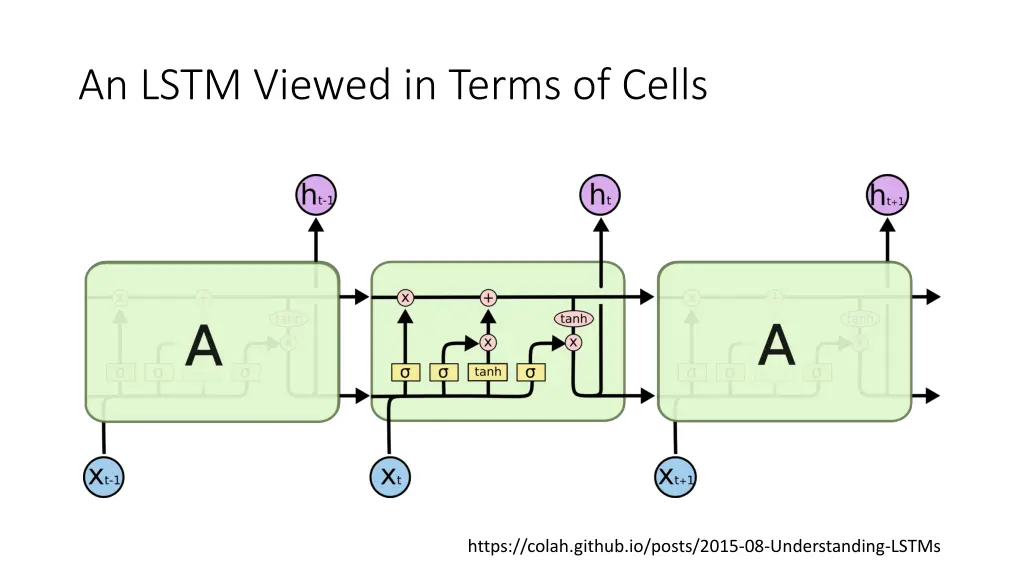
Long Short-Term Memory Units Long short-term memory (LSTM) networks provide one solution for mitigating the vanishing gradient problem Often, the network or layer as a whole is just referred to as an LSTM It is common to depict LSTMs graphically in terms of cells, also sometimes called units Such depictions show the LSTM unrolled; the cell is the component of the architecture that repeats We can also depict simple RNNs as cells, for a quick comparison We will only discuss LSTMs briefly in this course
A Simple RNN Viewed in Terms of Cells https://colah.github.io/posts/2015-08-Understanding-LSTMs
An LSTM Viewed in Terms of Cells https://colah.github.io/posts/2015-08-Understanding-LSTMs
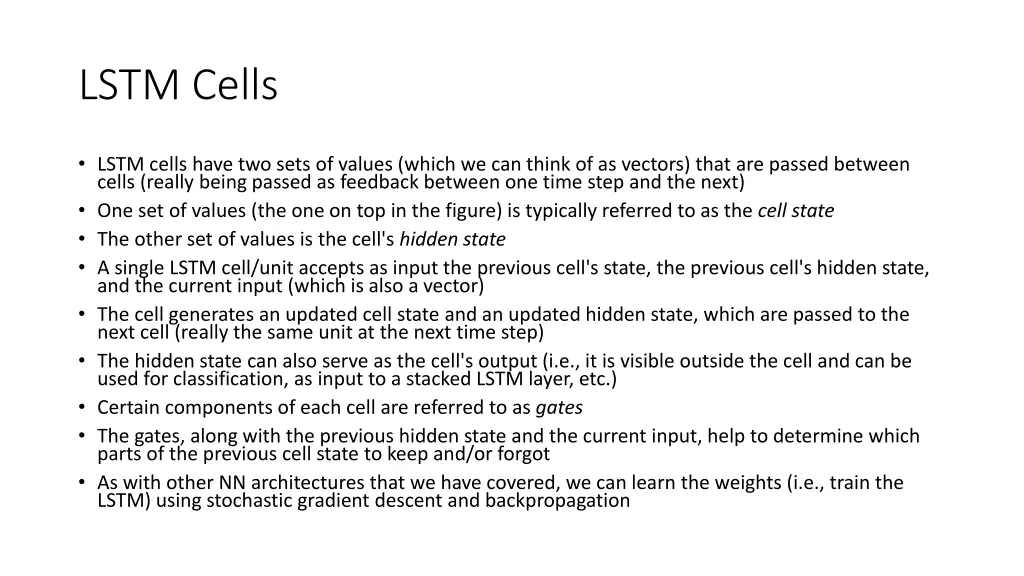
LSTM Cells LSTM cells have two sets of values (which we can think of as vectors) that are passed between cells (really being passed as feedback between one time step and the next) One set of values (the one on top in the figure) is typically referred to as the cell state The other set of values is the cell's hidden state A single LSTM cell/unit accepts as input the previous cell's state, the previous cell's hidden state, and the current input (which is also a vector) The cell generates an updated cell state and an updated hidden state, which are passed to the next cell (really the same unit at the next time step) The hidden state can also serve as the cell's output (i.e., it is visible outside the cell and can be used for classification, as input to a stacked LSTM layer, etc.) Certain components of each cell are referred to as gates The gates, along with the previous hidden state and the current input, help to determine which parts of the previous cell state to keep and/or forgot As with other NN architectures that we have covered, we can learn the weights (i.e., train the LSTM) using stochastic gradient descent and backpropagation
Encoder Decoder Networks Many NLP tasks involve mapping a sequence of text to another sequence of text Examples include machine translation (MT), summarization, and (in some sense) question-answering (QA) Encoder-decoder networks, also known as sequence-to-sequence (seq2seq) models are capable of this The first portion of such a network is the encoder, which processes the input sequence, resulting in a context The second part of a network, called the decoder, starts with the context and generates the output sequence We will not discuss encoder-decoder networks in detail in this course
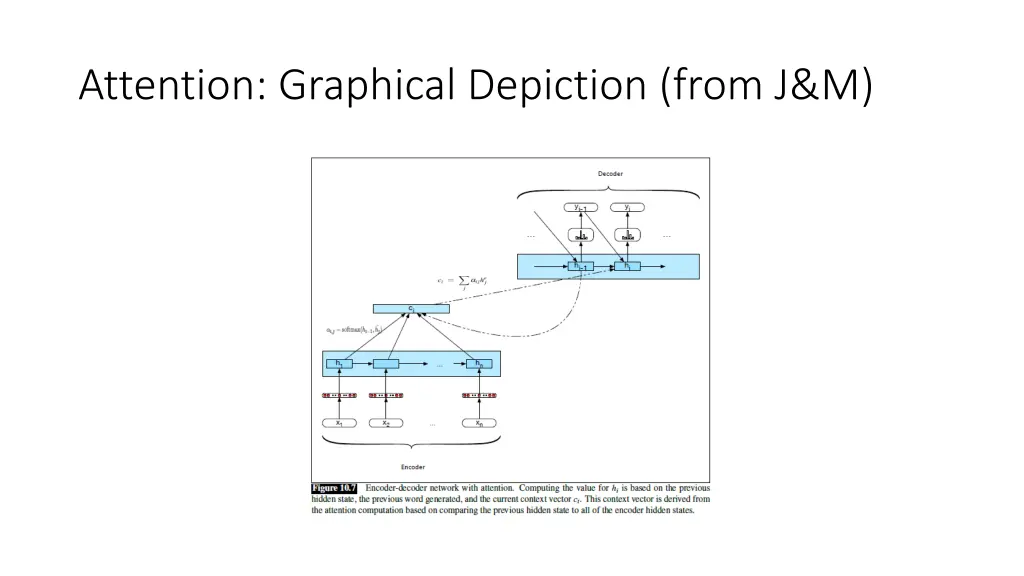
Attention One issue is that, as the output sequence is generated, the relative importance of different portions of the input sequence change A very important concept known as attention can help to deal with this Instead of having a static context vector, a different context vector is generated at each time step of the decoder The next slide shows a graphical depiction of attention from the J&M textbook Circa 2016, LSTMs with attention dominated the field of NLP We will not discuss attention in detail in this course
Transformers In December 2017, a paper titled "Attention is All You Need" was published by a group of researchers from Google The paper introduces a new neural architecture called a transformer (sometimes capitalized), which does not rely on any recurrence or convolutions A transformer is another example of an encoder-decoder network The encoder and decoder rely on stacked layers, and each layer has sub-layers Some sublayers rely on a concept called self-attention Other sublayers are pointwise, fully-connected, feed-forward NNs The decoder also uses attention applied to the encoder output Since the publication, variations of transformers have dominated the field of NLP Transformers also led to the development of systems such as BERT that can produce contextual word embeddings We will not discuss Transformers or contextual word embeddings further in this course