Learn how to estimate number-average molecular weight from colligative properties and viscosity-average molecular weight from viscometer measurements. Classify polymers based on crystallinity and solve problems involving osmotic pressure and falling time data analysis.
Please find below an Image/Link to download the presentation.
The content on the website is provided AS IS for your information and personal use only. It may not be sold, licensed, or shared on other websites without obtaining consent from the author. If you encounter any issues during the download, it is possible that the publisher has removed the file from their server.
You are allowed to download the files provided on this website for personal or commercial use, subject to the condition that they are used lawfully. All files are the property of their respective owners.
The content on the website is provided AS IS for your information and personal use only. It may not be sold, licensed, or shared on other websites without obtaining consent from the author.
E N D
Presentation Transcript
(Molecular-weight Estimation from Experimental Data) At the end of this lecture, you should be able to: - Estimate number-average molecular weight from the colligative properties (those properties of solutions that depend on the ratio of the number of solute particles to the number of solvent molecules in a solution). - Estimate viscosity-average molecular weight from a viscometer measurements. - Classify polymers based on the degree of crystallinity . Mustansiriyah University/ Materials Eng. Dept. Dr Ahmed A. AYASH March 2020
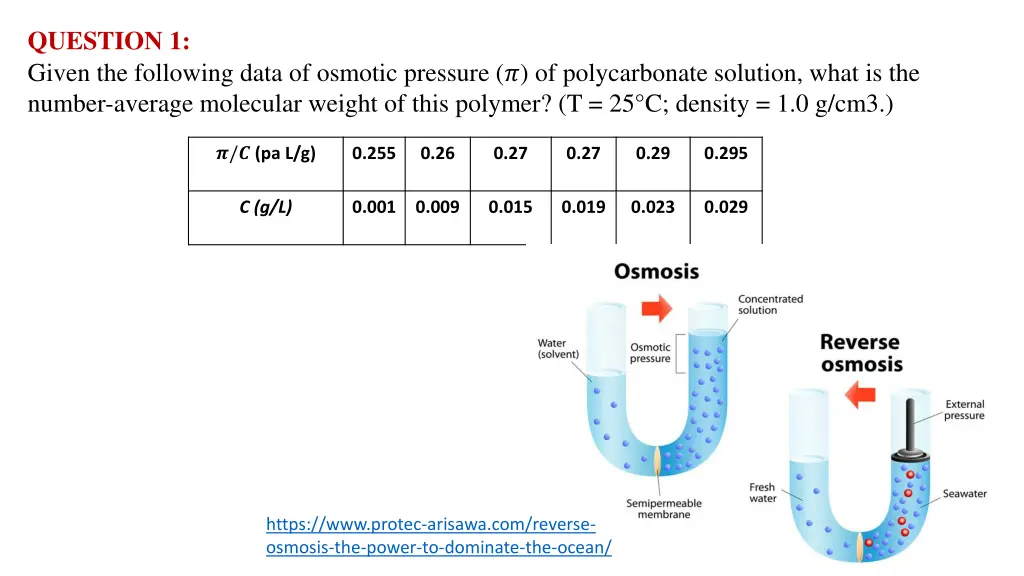
QUESTION 1: Given the following data of osmotic pressure (?) of polycarbonate solution, what is the number-average molecular weight of this polymer? (T = 25 C; density = 1.0 g/cm3.) ?/? (pa L/g) 0.255 0.26 0.27 0.27 0.29 0.295 C (g/L) 0.001 0.009 0.015 0.019 0.023 0.029 https://www.protec-arisawa.com/reverse- osmosis-the-power-to-dominate-the-ocean/
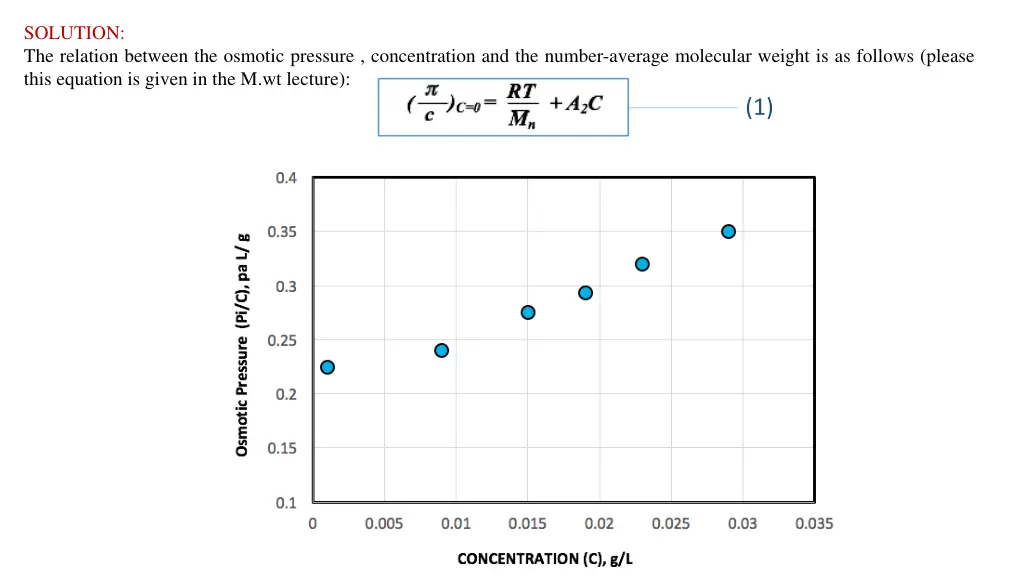
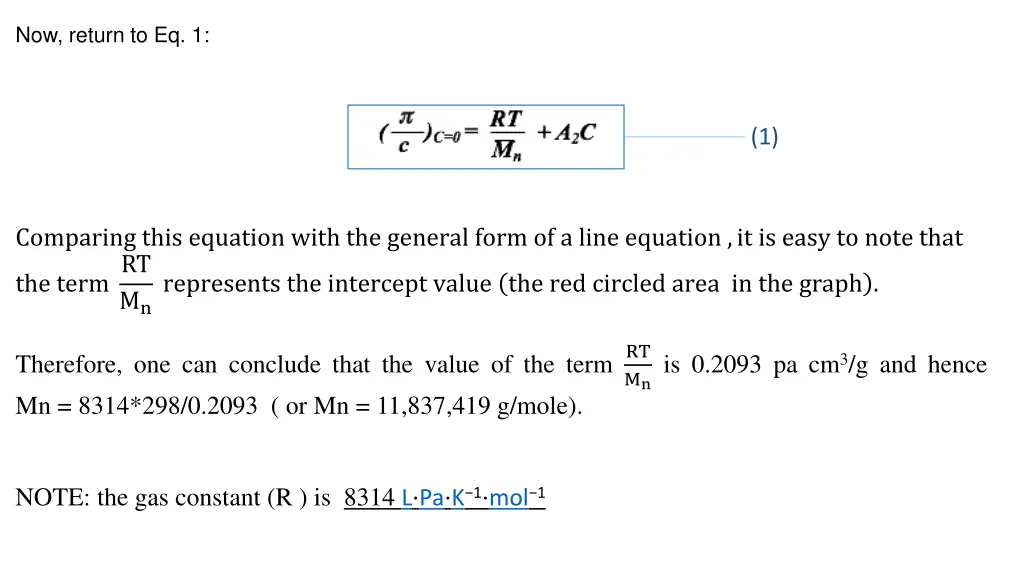
SOLUTION: The relation between the osmotic pressure , concentration and the number-average molecular weight is as follows (please this equation is given in the M.wt lecture): (1)
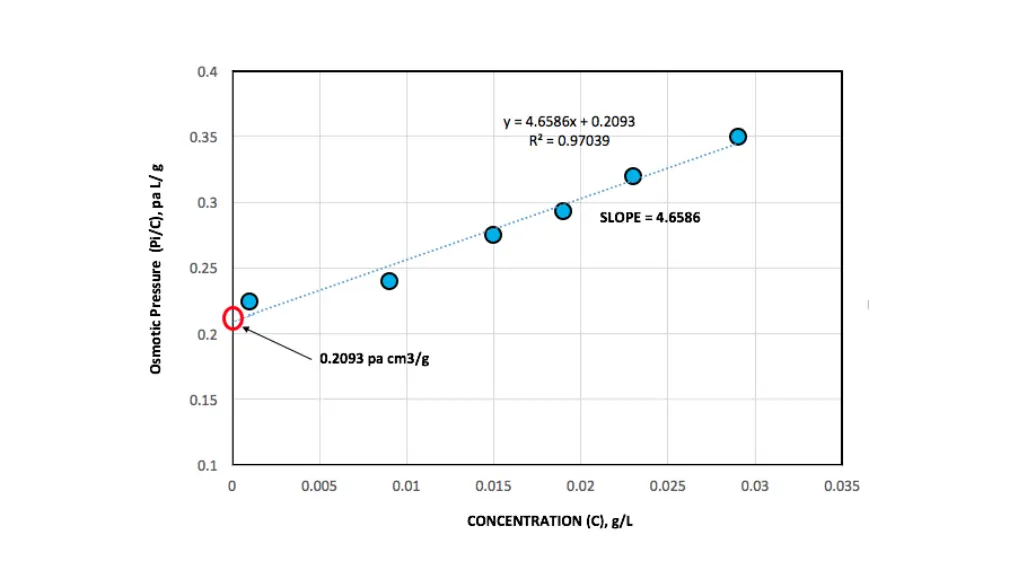
Now, return to Eq. 1: (1) Comparing this equation with the general form of a line equation ,it is easy to note that the termRT Mn Therefore, one can conclude that the value of the term Mn = 8314*298/0.2093 ( or Mn = 11,837,419 g/mole). represents the intercept value the red circled area in the graph . RT Mn is 0.2093 pa cm3/g and hence L Pa K mol NOTE: the gas constant (R ) is 8314 L Pa K 1 mol 1
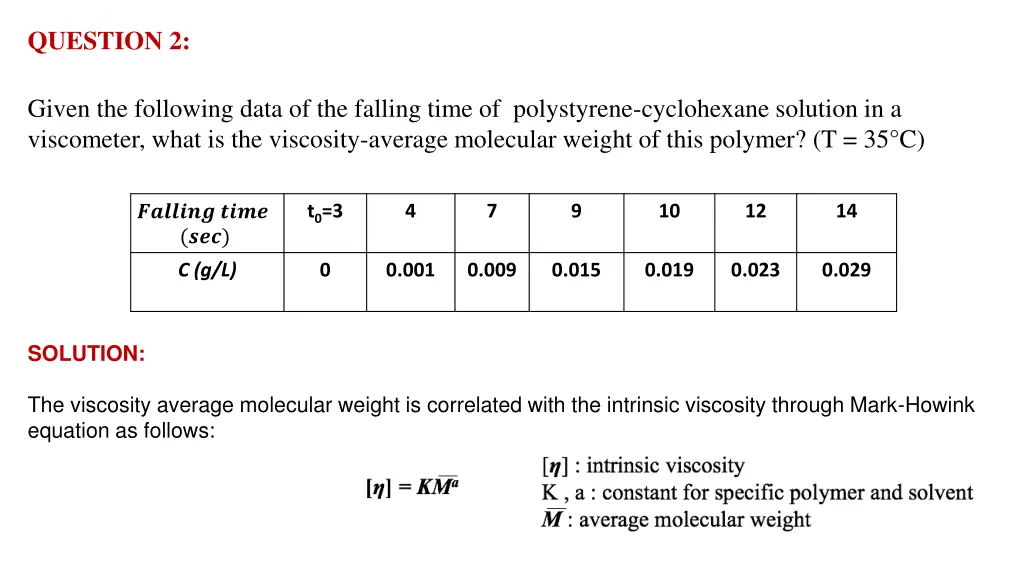
QUESTION 2: Given the following data of the falling time of polystyrene-cyclohexane solution in a viscometer, what is the viscosity-average molecular weight of this polymer? (T = 35 C) t0=3 4 7 9 10 12 14 ??????? ???? (???) C (g/L) 0 0.001 0.009 0.015 0.019 0.023 0.029 SOLUTION: The viscosity average molecular weight is correlated with the intrinsic viscosity through Mark-Howink equation as follows:
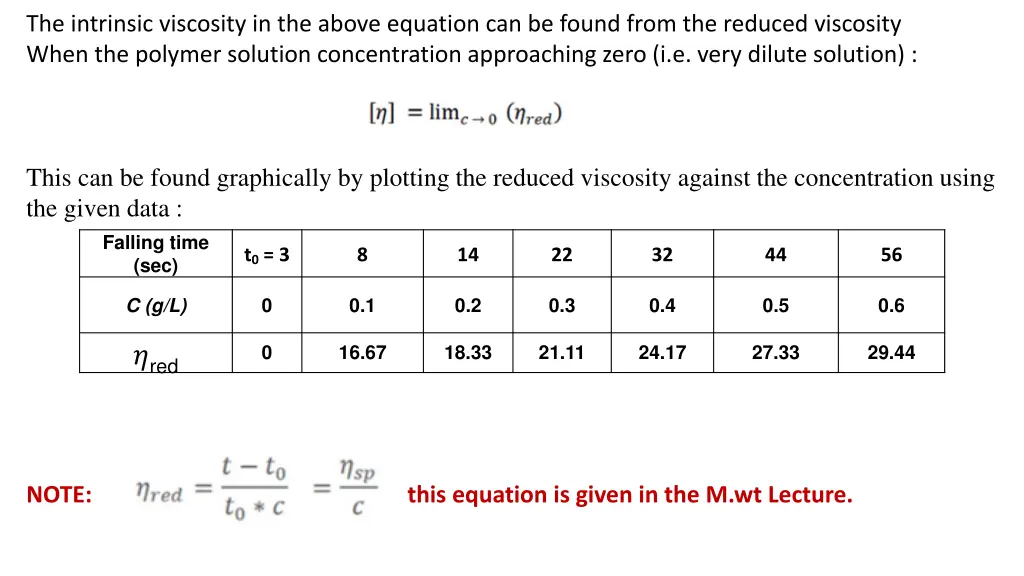
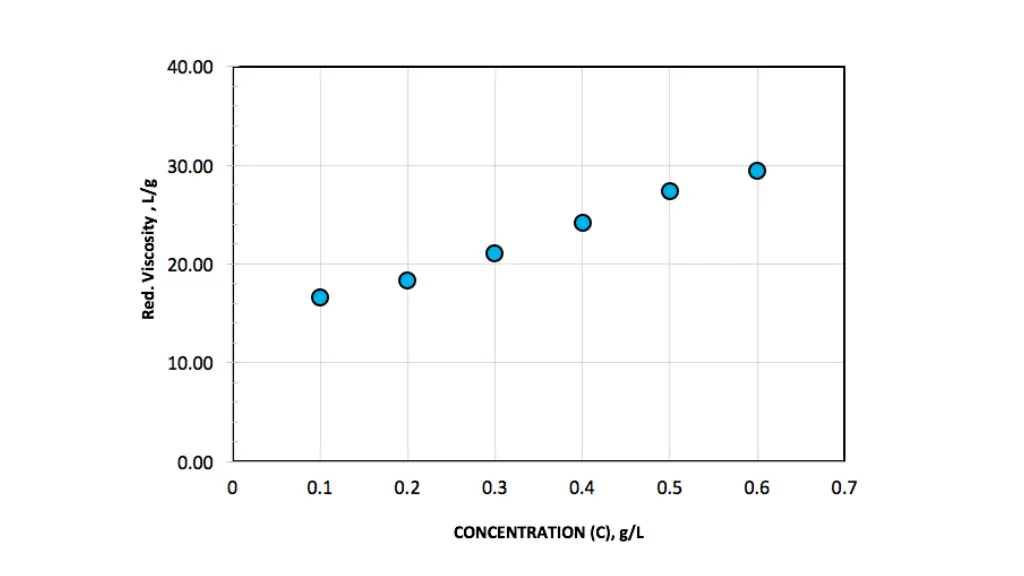
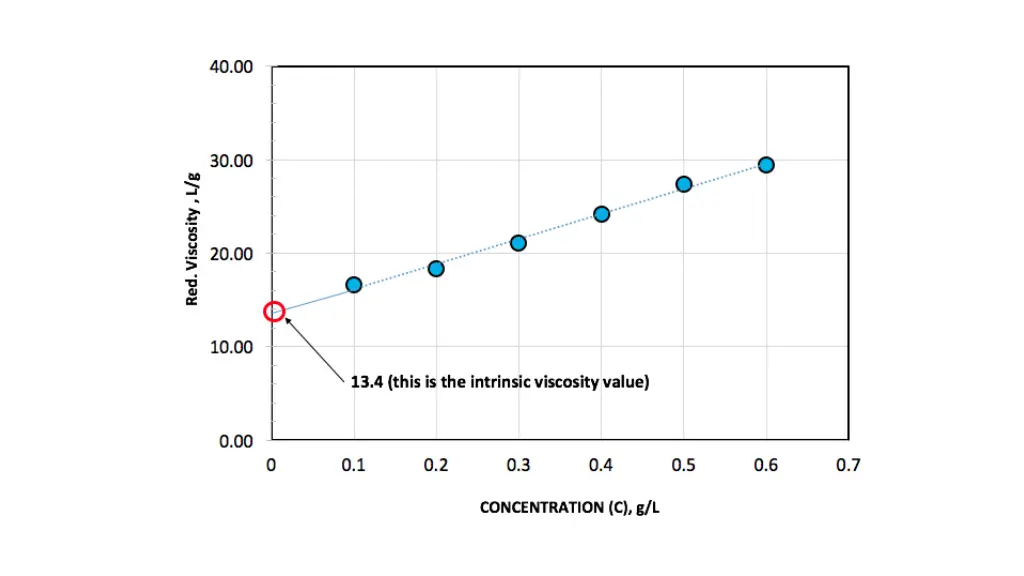
The intrinsic viscosity in the above equation can be found from the reduced viscosity When the polymer solution concentration approaching zero (i.e. very dilute solution) : This can be found graphically by plotting the reduced viscosity against the concentration using the given data : Falling time (sec) t0 = 3 8 14 22 32 44 56 C (g/L) 0 0.1 0.2 0.3 0.4 0.5 0.6 0 16.67 18.33 21.11 24.17 27.33 29.44 ?red NOTE: this equation is given in the M.wt Lecture.
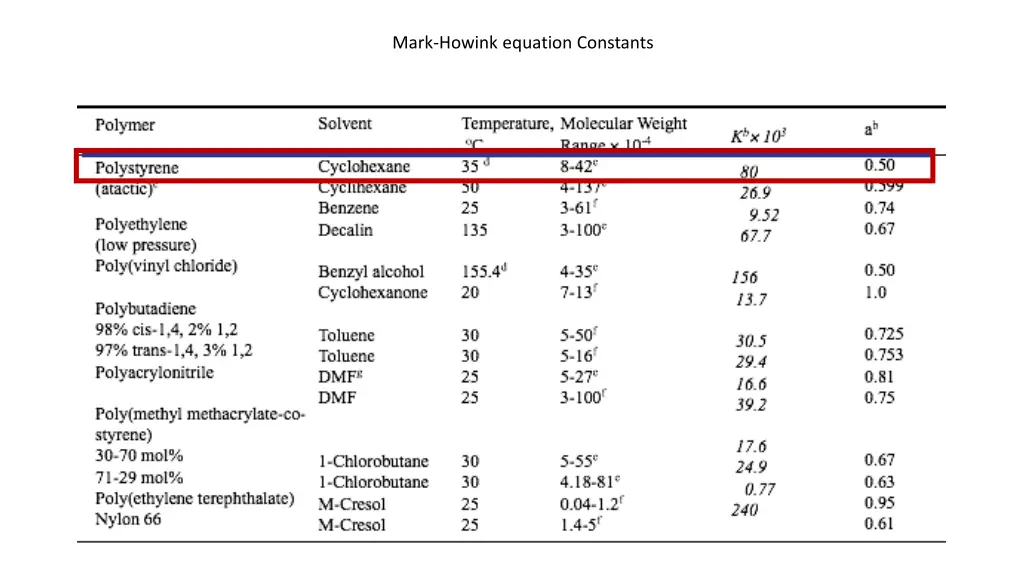
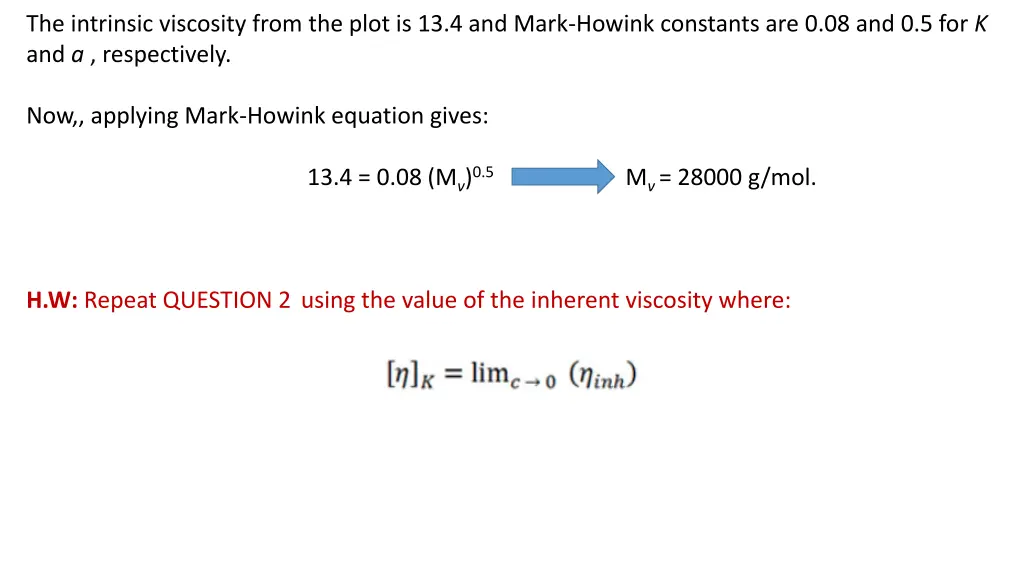
The intrinsic viscosity from the plot is 13.4 and Mark-Howink constants are 0.08 and 0.5 for K and a , respectively. Now,, applying Mark-Howink equation gives: 13.4 = 0.08 (Mv)0.5 Mv = 28000 g/mol. H.W: Repeat QUESTION 2 using the value of the inherent viscosity where:
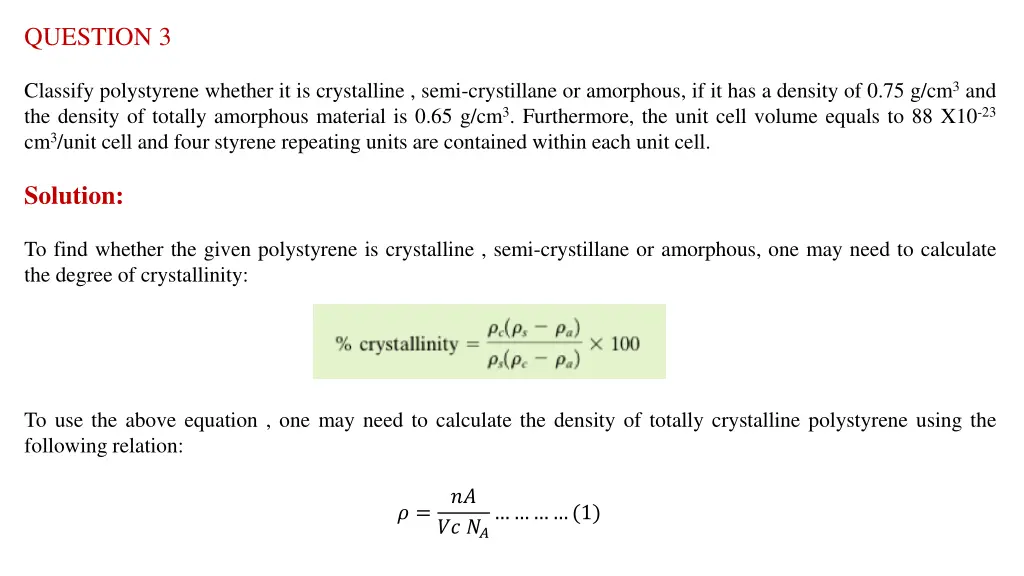
QUESTION 3 Classify polystyrene whether it is crystalline , semi-crystillane or amorphous, if it has a density of 0.75 g/cm3 and the density of totally amorphous material is 0.65 g/cm3. Furthermore, the unit cell volume equals to 88 X10-23 cm3/unit cell and four styrene repeating units are contained within each unit cell. Solution: To find whether the given polystyrene is crystalline , semi-crystillane or amorphous, one may need to calculate the degree of crystallinity: To use the above equation , one may need to calculate the density of totally crystalline polystyrene using the following relation: ?? ? = ?? ?? (1)
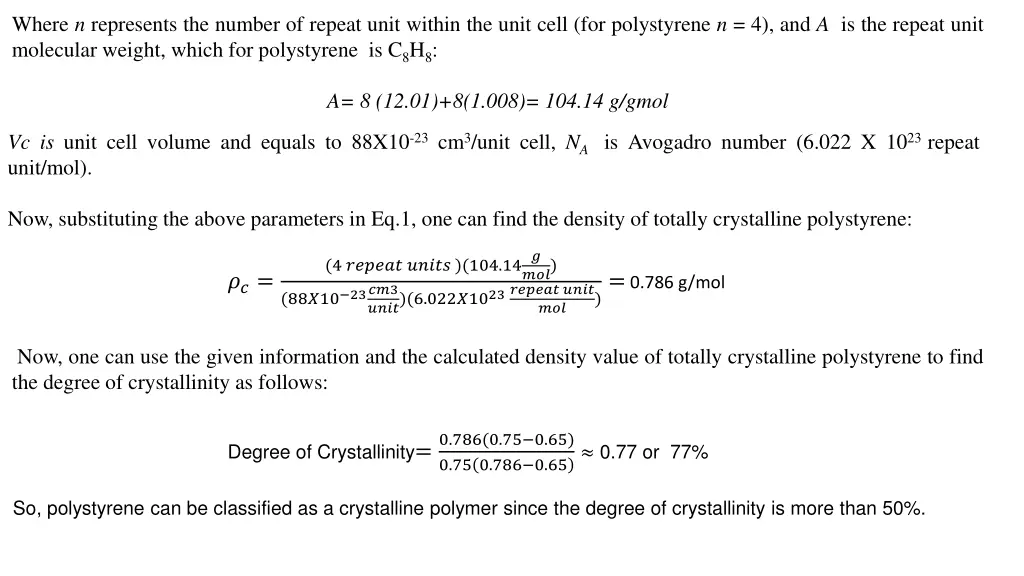
Where n represents the number of repeat unit within the unit cell (for polystyrene n = 4), and A is the repeat unit molecular weight, which for polystyrene is C8H8: A= 8 (12.01)+8(1.008)= 104.14 g/gmol Vc is unit cell volume and equals to 88X10-23 cm3/unit cell, NA is Avogadro number (6.022 X 10²³ repeat unit/mol). Now, substituting the above parameters in Eq.1, one can find the density of totally crystalline polystyrene: ? (4 ?????? ????? )(104.14 (88?10 23??3 ???) ??= )= 0.786 g/mol ????)(6.022?1023?????? ???? ??? Now, one can use the given information and the calculated density value of totally crystalline polystyrene to find the degree of crystallinity as follows: Degree of Crystallinity=0.786(0.75 0.65) 0.75 0.786 0.65 0.77 or 77% So, polystyrene can be classified as a crystalline polymer since the degree of crystallinity is more than 50%.