Moral Development Stages in Business Ethics Education
Explore the stages of moral development in business ethics education, from heteronomy to autonomy. Learn how cognitive, social, and moral development intertwine, shaping ethical decision-making. Discover the transition from relying on external authorities to embracing individual ethical reasoning and consensus-building with diverse perspectives.

Download Presentation

Please find below an Image/Link to download the presentation.
The content on the website is provided AS IS for your information and personal use only. It may not be sold, licensed, or shared on other websites without obtaining consent from the author. If you encounter any issues during the download, it is possible that the publisher has removed the file from their server.
You are allowed to download the files provided on this website for personal or commercial use, subject to the condition that they are used lawfully. All files are the property of their respective owners.
The content on the website is provided AS IS for your information and personal use only. It may not be sold, licensed, or shared on other websites without obtaining consent from the author.
E N D
Presentation Transcript
Moral Development and Leadership A Course in Business Ethics Module 3 John Hooker Carnegie Mellon University May 2022
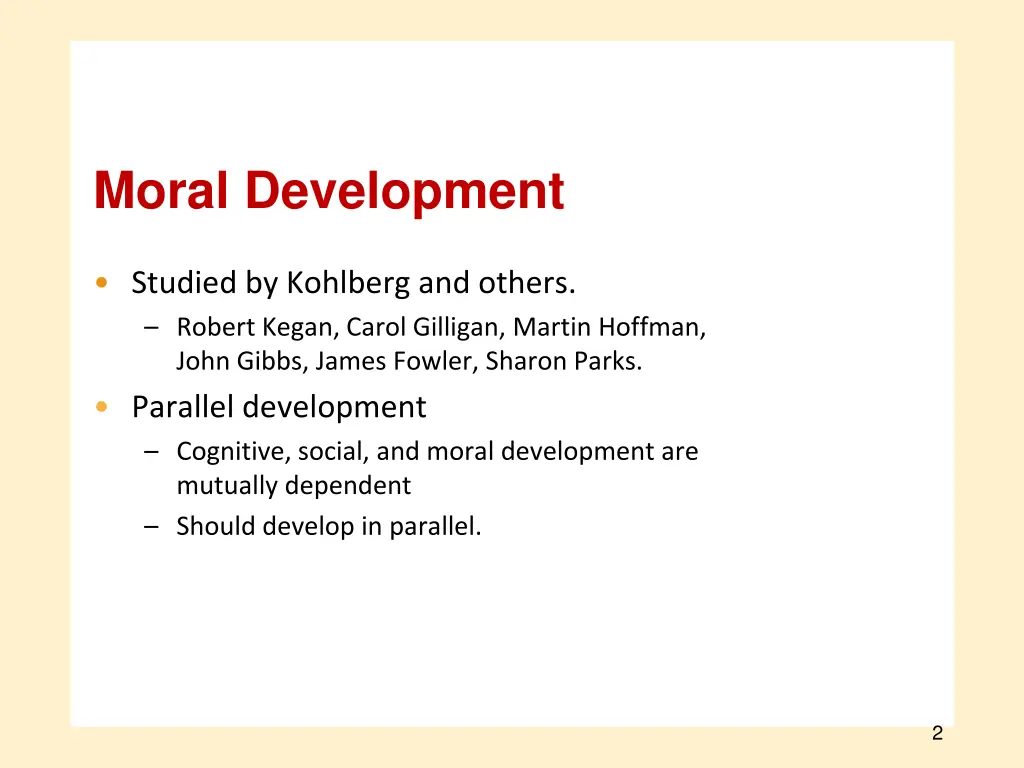
Moral Development Studied by Kohlberg and others. Robert Kegan, Carol Gilligan, Martin Hoffman, John Gibbs, James Fowler, Sharon Parks. Parallel development Cognitive, social, and moral development are mutually dependent Should develop in parallel. 2
Moral Development Several accounts of stages in the literature. A 3-stage account will serve our purposes. Heteronomy, Ideology, Autonomy. 3
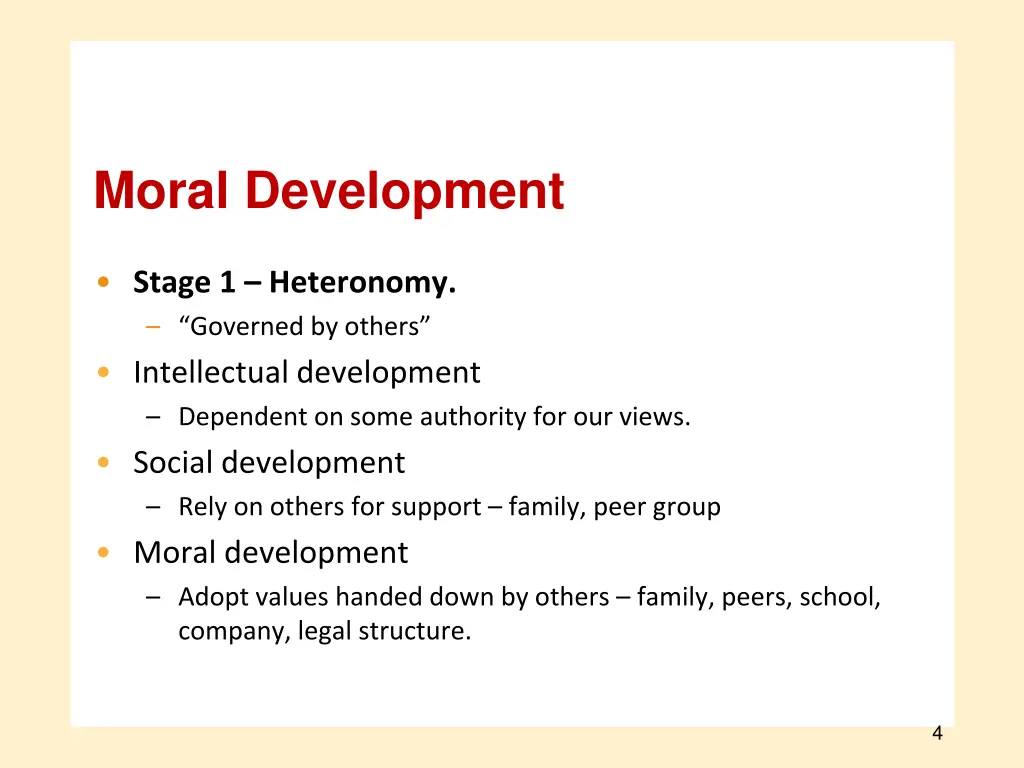
Moral Development Stage 1 Heteronomy. Governed by others Intellectual development Dependent on some authority for our views. Social development Rely on others for support family, peer group Moral development Adopt values handed down by others family, peers, school, company, legal structure. 4
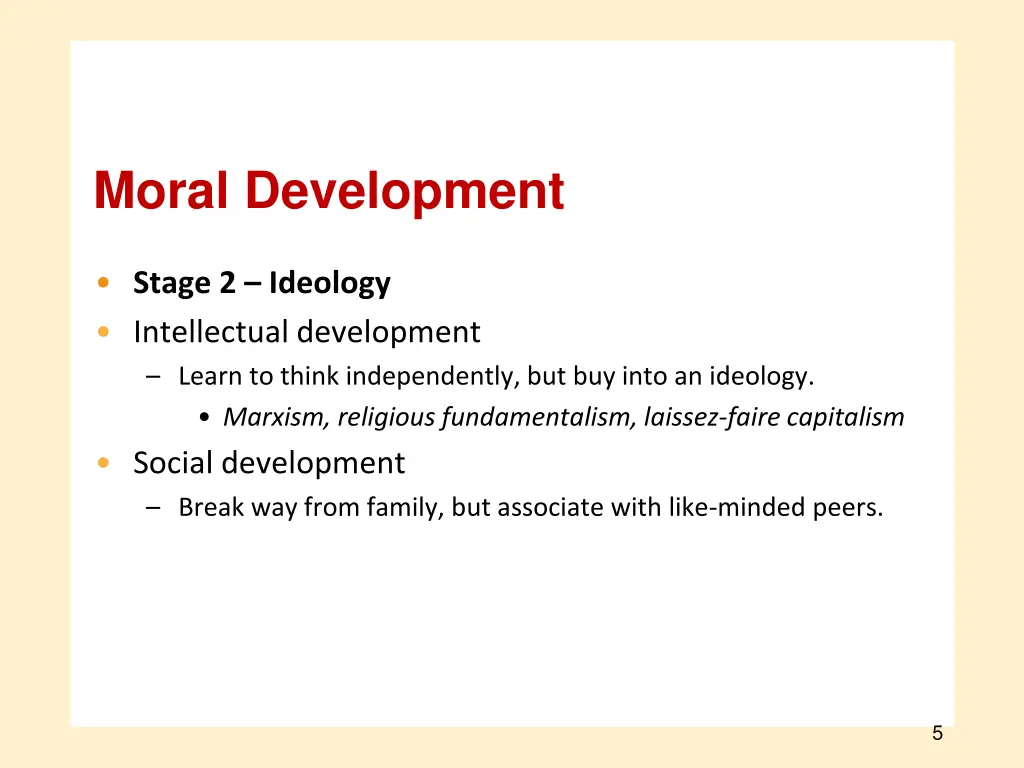
Moral Development Stage 2 Ideology Intellectual development Learn to think independently, but buy into an ideology. Marxism, religious fundamentalism, laissez-faire capitalism Social development Break way from family, but associate with like-minded peers. 5
Moral Development Stage 2 Ideology Moral development Values are chosen but must come in a neat package. Relativism (ethics is a matter of opinion). Simplistic maxims ( Don t do anything you wouldn t want your mother to know about ). Psychological egoism. Values based on ideology. 6
Moral Development Stage 3 Autonomy Self-governing Cognitive development Tolerate uncertainty and ambiguity, see both sides of the argument. But persist in the quest for a reasonable solution, refuse to embrace relativism. 7
Moral Development Stage 3 Autonomy Self-governing Social development Can relate to people of widely different views and background. Moral development Recognize that issues are complex, and there is some truth in different views. But continue to work with others toward rational consensus. 8
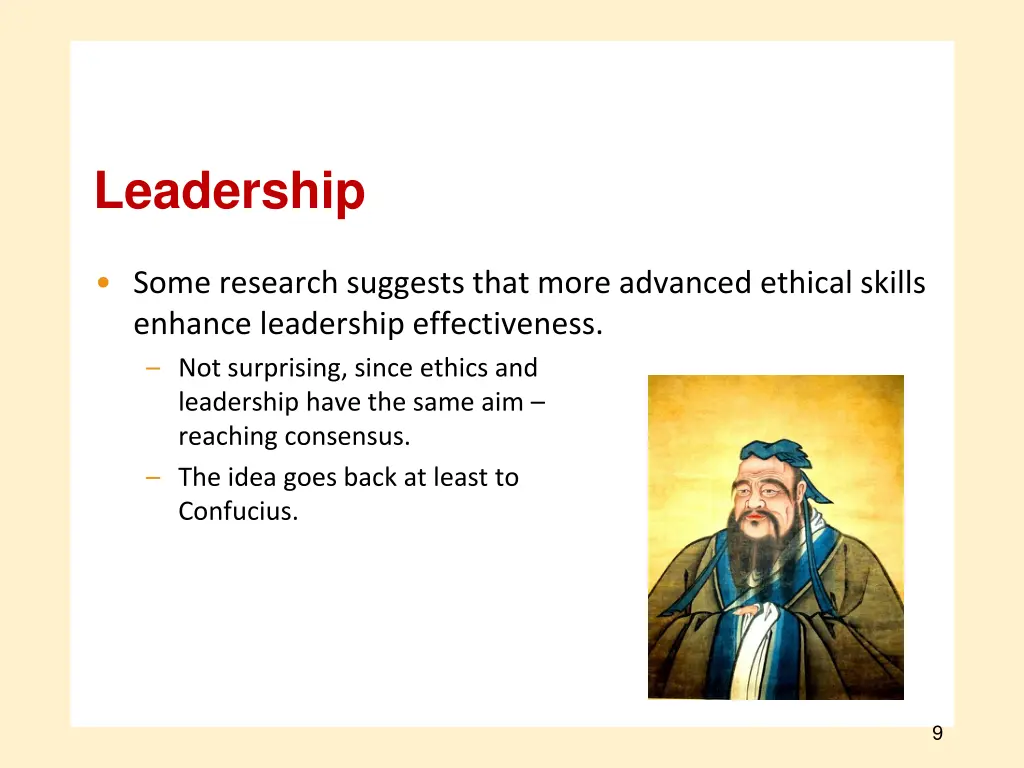
Leadership Some research suggests that more advanced ethical skills enhance leadership effectiveness. Not surprising, since ethics and leadership have the same aim reaching consensus. The idea goes back at least to Confucius. 9
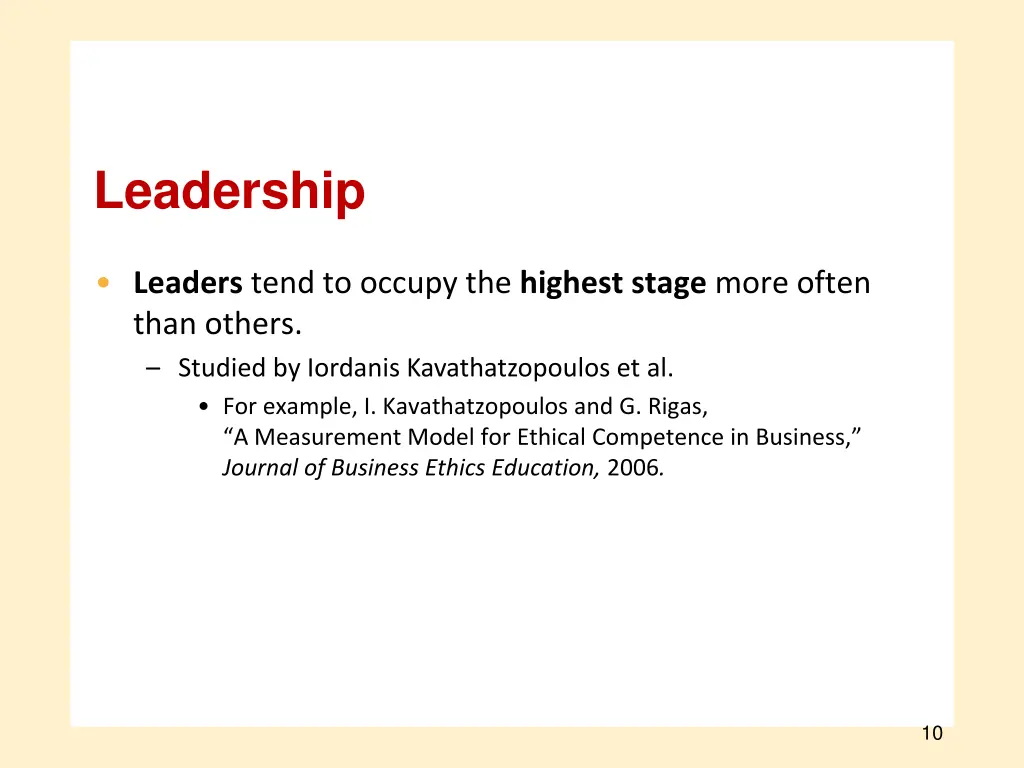
Leadership Leaders tend to occupy the highest stage more often than others. Studied by Iordanis Kavathatzopoulos et al. For example, I. Kavathatzopoulos and G. Rigas, A Measurement Model for Ethical Competence in Business, Journal of Business Ethics Education, 2006. 10
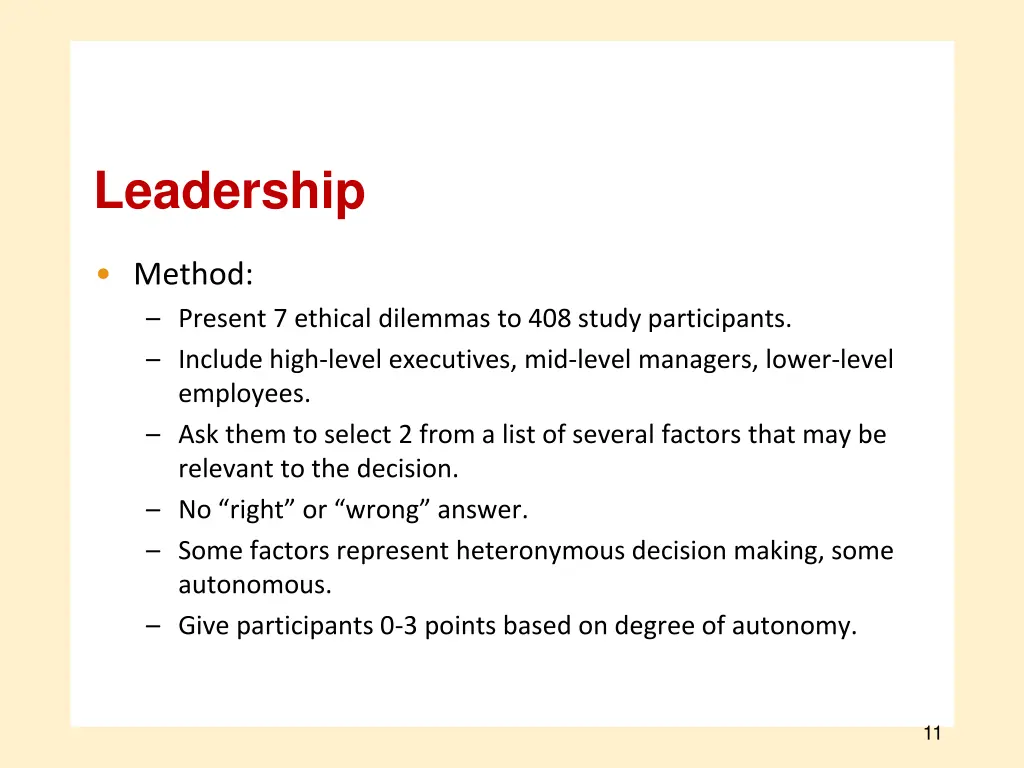
Leadership Method: Present 7 ethical dilemmas to 408 study participants. Include high-level executives, mid-level managers, lower-level employees. Ask them to select 2 from a list of several factors that may be relevant to the decision. No right or wrong answer. Some factors represent heteronymous decision making, some autonomous. Give participants 0-3 points based on degree of autonomy. 11
Leadership Hypothesis: Higher rank in the company is associated with higher moral development score. 12
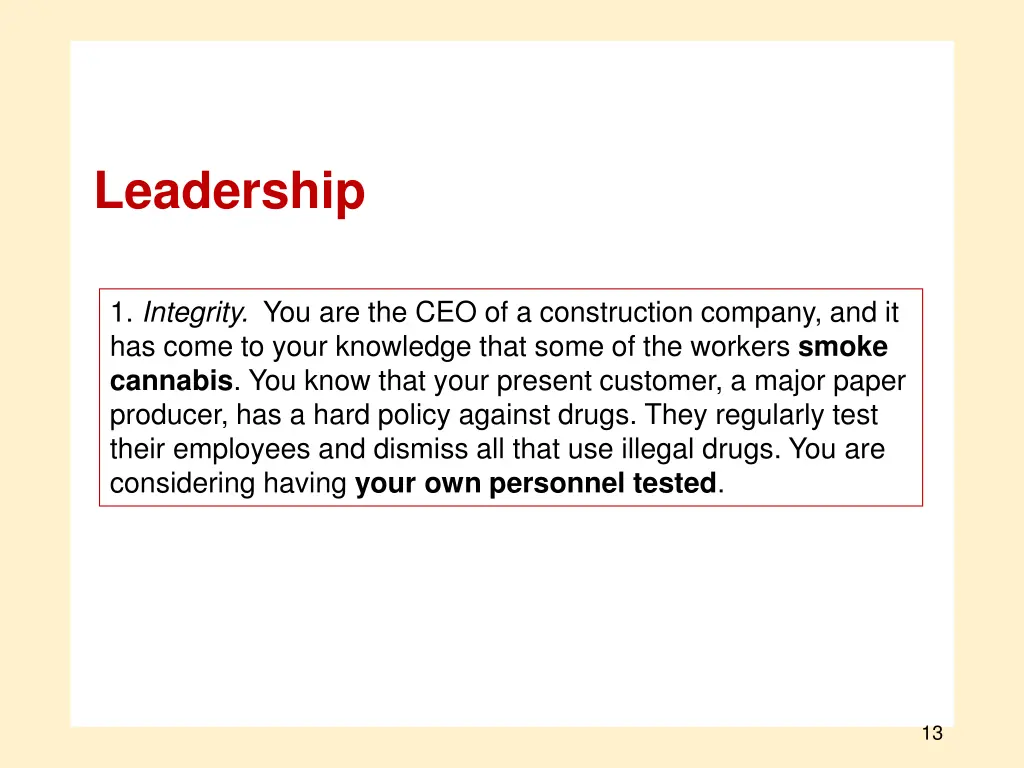
Leadership 1. Integrity. You are the CEO of a construction company, and it has come to your knowledge that some of the workers smoke cannabis. You know that your present customer, a major paper producer, has a hard policy against drugs. They regularly test their employees and dismiss all that use illegal drugs. You are considering having your own personnel tested. 13
Leadership 2. Cover-up. You are the CEO of a major bank, and you have discovered that one of the oldest and most trusted employees in the organization systematically uses a computer routine to transfer client capital to accounts of his own. He is a high- ranking executive and is seen as one of the bank s well- known profiles with the public. Will you press charges or discreetly settle the matter with him? 14
Leadership 3. Public relations. You are the CEO of a chemical corporation planning a large investment in an area that suffers from unemployment. Environmental activists demand that the factory be stopped due to inevitable chemical outlets, while others welcome the opportunity for new jobs. 15
Leadership 4. Discrimination. You are the manager of one of your bank s offices. You have recently received an application for a personal account from a mentally retarded person. It is to be used by him to pay his bills. The bank s policy is against it, and you know yourself that such accounts are not profitable, due to the low turnaround. 16
Leadership 5. Whistle-blowing. You live in a small town, dominated by a large arms-industry where you also work. You discover evidence that proves that the company exports large quantities of arms to dictatorships, which is prohibited by law. Further investigation on your behalf shows that this is true beyond a shadow of doubt, even though management denies the fact. You are unsure if you should report this to the appropriate authorities and media. 17
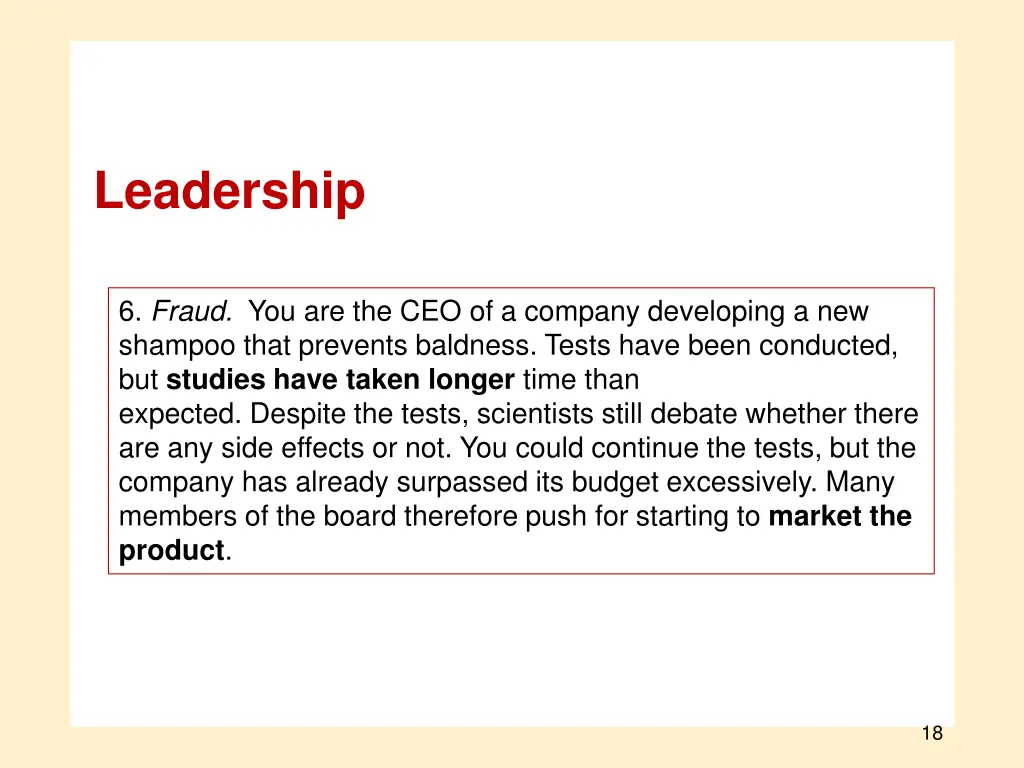
Leadership 6. Fraud. You are the CEO of a company developing a new shampoo that prevents baldness. Tests have been conducted, but studies have taken longer time than expected. Despite the tests, scientists still debate whether there are any side effects or not. You could continue the tests, but the company has already surpassed its budget excessively. Many members of the board therefore push for starting to market the product. 18
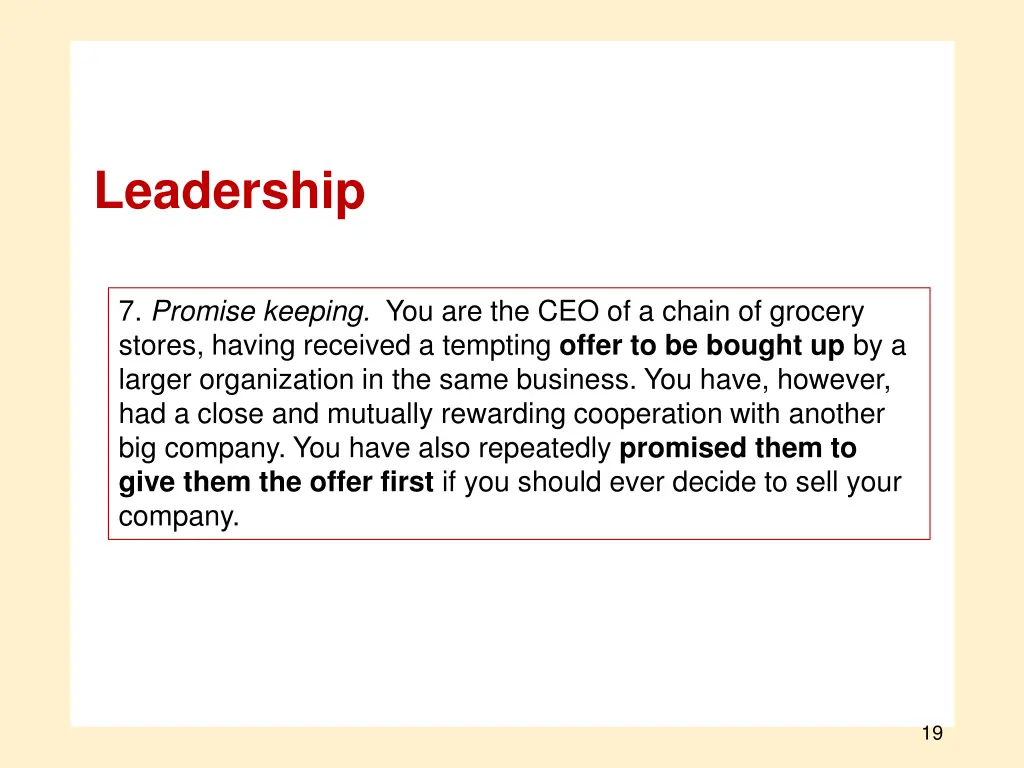
Leadership 7. Promise keeping. You are the CEO of a chain of grocery stores, having received a tempting offer to be bought up by a larger organization in the same business. You have, however, had a close and mutually rewarding cooperation with another big company. You have also repeatedly promised them to give them the offer first if you should ever decide to sell your company. 19
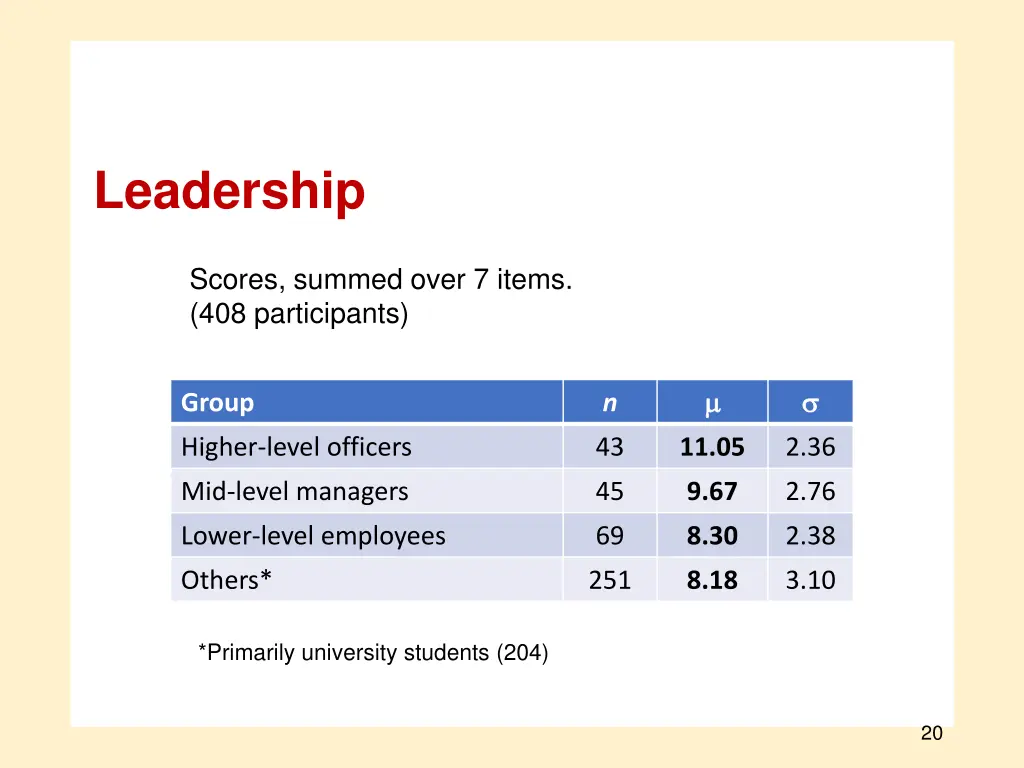
Leadership Scores, summed over 7 items. (408 participants) Group n Higher-level officers 43 11.05 2.36 Mid-level managers 45 9.67 2.76 Lower-level employees 69 8.30 2.38 Others* 251 8.18 3.10 *Primarily university students (204) 20
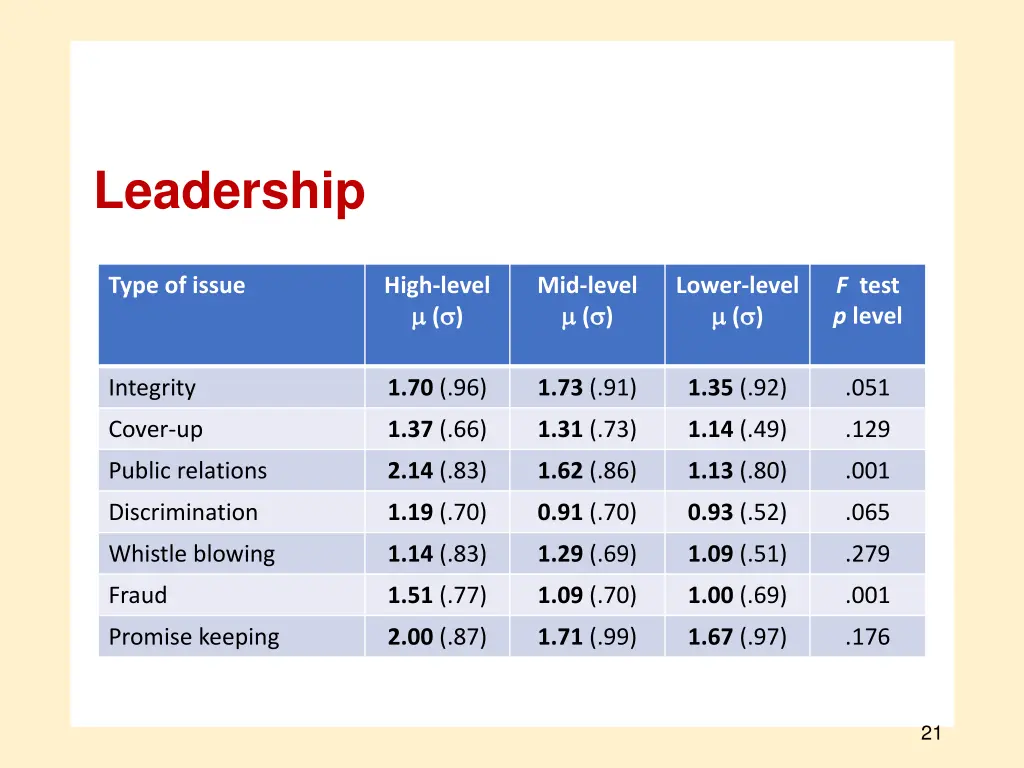
Leadership Type of issue High-level ( ) Mid-level ( ) Lower-level ( ) F test p level Integrity 1.70 (.96) 1.73 (.91) 1.35 (.92) .051 Cover-up 1.37 (.66) 1.31 (.73) 1.14 (.49) .129 Public relations 2.14 (.83) 1.62 (.86) 1.13 (.80) .001 Discrimination 1.19 (.70) 0.91 (.70) 0.93 (.52) .065 Whistle blowing 1.14 (.83) 1.29 (.69) 1.09 (.51) .279 Fraud 1.51 (.77) 1.09 (.70) 1.00 (.69) .001 Promise keeping 2.00 (.87) 1.71 (.99) 1.67 (.97) .176 21
Moral Development Relevance to leadership Ethical reasoning and leadership have the same goal: build consensus. Ethical competence may therefore enhance leadership. 22
Moral Development Relevance to leadership Ethical reasoning and leadership have the same goal: build consensus. Ethical competence may therefore enhance leadership. Autonomous ethical reasoning recognizes the value of disparate viewpoints, a valuable skill in leadership. 23
Moral Development Relevance to leadership Ethical reasoning and leadership have the same goal: build consensus. Ethical competence may therefore enhance leadership. Autonomous ethical reasoning recognizes the value of disparate viewpoints, a valuable skill in leadership. Persons in this stage can be tapped and groomed for responsible leadership. 24
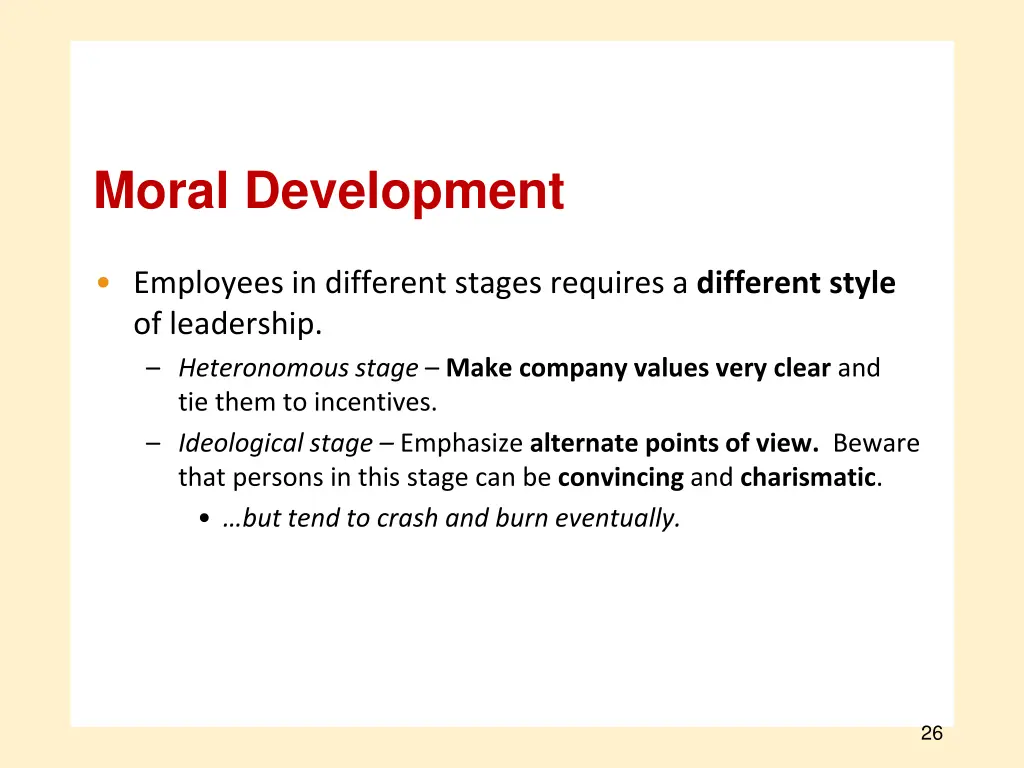
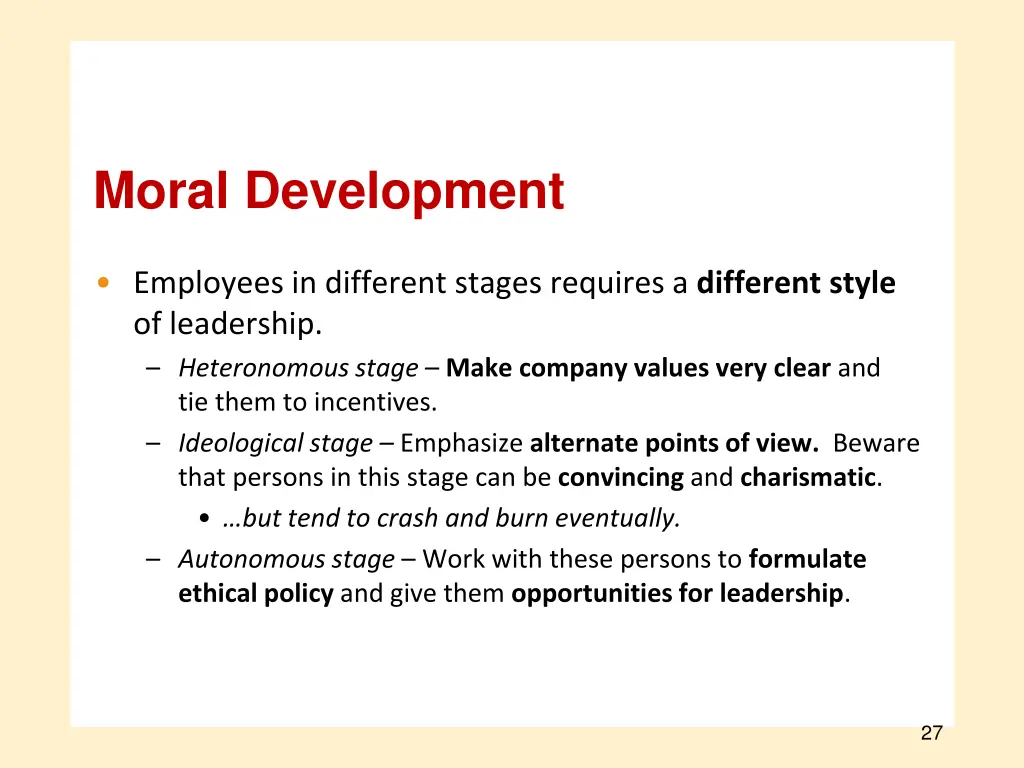
Moral Development Employees in different stages requires a different style of leadership. Heteronomous stage Make company values very clear and tie them to incentives. 25
Moral Development Employees in different stages requires a different style of leadership. Heteronomous stage Make company values very clear and tie them to incentives. Ideological stage Emphasize alternate points of view. Beware that persons in this stage can be convincing and charismatic. but tend to crash and burn eventually. 26
Moral Development Employees in different stages requires a different style of leadership. Heteronomous stage Make company values very clear and tie them to incentives. Ideological stage Emphasize alternate points of view. Beware that persons in this stage can be convincing and charismatic. but tend to crash and burn eventually. Autonomous stage Work with these persons to formulate ethical policy and give them opportunities for leadership. 27
Further reading Blog post at Leadership Excellence. I. Kavathatzopoulos and G. Rigas, A measurement model for ethical competence in business, Journal of Business Ethics Education 3 (2006) 55-74. Discussion of Defining Issues Test: J. Rest et al., "A neo-Kohlbergian approach to morality research," Journal of Moral Education 29 (2000) 381-395. Original work: Lawrence Kohlberg, The Philosophy of Moral Development: Moral Stages and the Idea of Justice (1981) John C. Gibbs, Moral Development and Reality Beyond the Theories of Kohlberg and Hoffman (2003). 28