Multi-AP Coordination over Fibre for Enhanced Wi-Fi Deployment
Throughput enhancement is essential for service operators in evolving in-premises networks, but factors like high-end XR technologies, 3D display advancements, and quality of experience considerations are becoming key. This document discusses how Fibre-to-The-Room (FTTR) scenarios can provide stable, reliable, and low-latency connections for various business and home applications, with a focus on coordination between multiple access points (APs) over fibre links to improve overall Wi-Fi deployment.

Download Presentation

Please find below an Image/Link to download the presentation.
The content on the website is provided AS IS for your information and personal use only. It may not be sold, licensed, or shared on other websites without obtaining consent from the author.If you encounter any issues during the download, it is possible that the publisher has removed the file from their server.
You are allowed to download the files provided on this website for personal or commercial use, subject to the condition that they are used lawfully. All files are the property of their respective owners.
The content on the website is provided AS IS for your information and personal use only. It may not be sold, licensed, or shared on other websites without obtaining consent from the author.
E N D
Presentation Transcript
July 2023 doc.: IEEE 802.11-23/1186-00-0wng Multi-AP coordination over Fibre Date: 2023-06-25 Authors: Name Affiliation Address Phone Email Tony Zeng tony.zengyan@huawei.com Xuming Wu Yanchun Li Huawei Submission Slide 1 Tony Zeng, Huawei
July 2023 doc.: IEEE 802.11-23/1186-00-0wng Introduction Throughput enhancement is not the only driven factor for service operator to evolve the in-premises network High-end XR continually grows 3D naked eye display provides 3D imaging and multiple view angles QoE is becoming the key factor for Wi-Fi deployment Latency: industrial application, cloud gaming, XR, etc. Green: green ICT, ICT enables green digitalization Others: connectivity, etc. UHR matches the needs to solve the QoE problems Traditionally, IEEE 802.11 is mainly focusing on air interface ITU-T SG15 Q3 is working on defining in-premises fibre communication protocol (G.fin series recommendation & G.p2pf) for Fibre-to-the-room (FTTR) scenario for full Wi-Fi coverage Submission Slide 2 Tony Zeng, Huawei
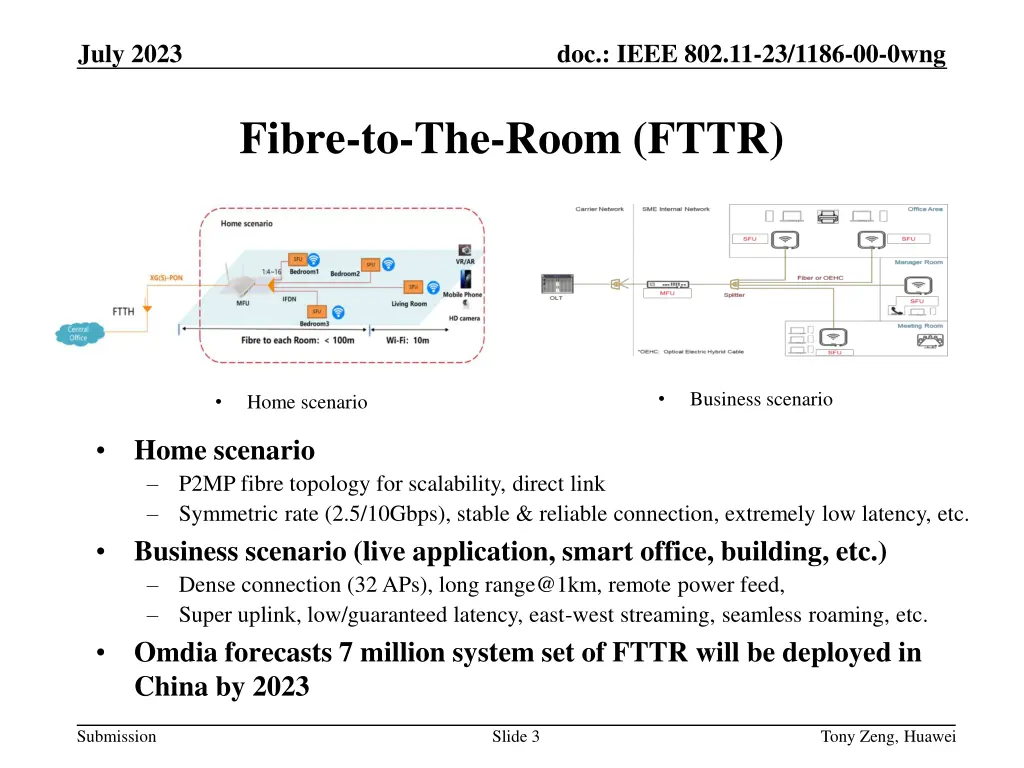
July 2023 doc.: IEEE 802.11-23/1186-00-0wng Fibre-to-The-Room (FTTR) Business scenario Home scenario Home scenario P2MP fibre topology for scalability, direct link Symmetric rate (2.5/10Gbps), stable & reliable connection, extremely low latency, etc. Business scenario (live application, smart office, building, etc.) Dense connection (32 APs), long range@1km, remote power feed, Super uplink, low/guaranteed latency, east-west streaming, seamless roaming, etc. Omdia forecasts 7 million system set of FTTR will be deployed in China by 2023 Submission Slide 3 Tony Zeng, Huawei
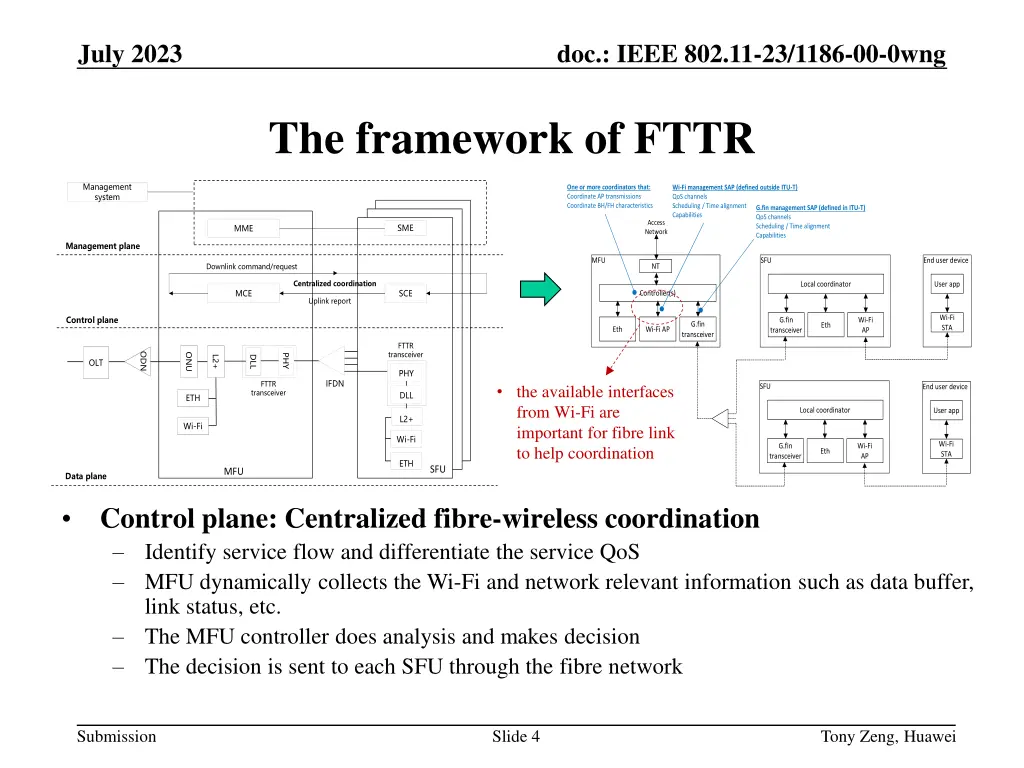
July 2023 doc.: IEEE 802.11-23/1186-00-0wng The framework of FTTR Management system One or more coordinators that: Coordinate AP transmissions Coordinate BH/FH characteristics Wi-Fi management SAP (defined outside ITU-T) QoS channels Scheduling / Time alignment Capabilities G.fin management SAP (defined in ITU-T) QoS channels Scheduling / Time alignment Capabilities Access Network SME MME Management plane MFU SFU End user device Downlink command/request NT Centralized coordination Local coordinator User app MCE SCE Controller(s) Uplink report Wi-Fi STA Control plane G.fin Wi-Fi AP G.fin Eth Eth Wi-Fi AP transceiver transceiver FTTR transceiver ODN ONU PHY L2+ DLL OLT PHY IFDN FTTR the available interfaces from Wi-Fi are important for fibre link to help coordination SFU End user device transceiver DLL ETH Local coordinator User app L2+ Wi-Fi Wi-Fi Wi-Fi STA G.fin Wi-Fi AP Eth transceiver ETH SFU MFU Data plane Control plane: Centralized fibre-wireless coordination Identify service flow and differentiate the service QoS MFU dynamically collects the Wi-Fi and network relevant information such as data buffer, link status, etc. The MFU controller does analysis and makes decision The decision is sent to each SFU through the fibre network Submission Slide 4 Tony Zeng, Huawei
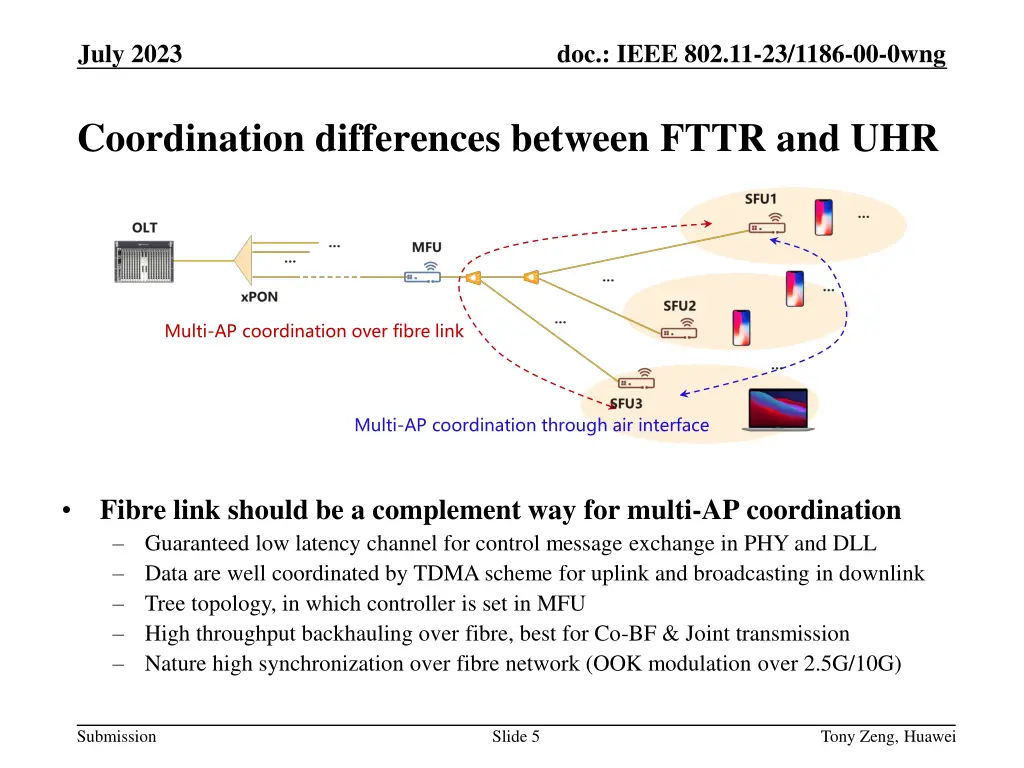
July 2023 doc.: IEEE 802.11-23/1186-00-0wng Coordination differences between FTTR and UHR Multi-AP coordination over fibre link Multi-AP coordination through air interface Fibre link should be a complement way for multi-AP coordination Guaranteed low latency channel for control message exchange in PHY and DLL Data are well coordinated by TDMA scheme for uplink and broadcasting in downlink Tree topology, in which controller is set in MFU High throughput backhauling over fibre, best for Co-BF & Joint transmission Nature high synchronization over fibre network (OOK modulation over 2.5G/10G) Submission Slide 5 Tony Zeng, Huawei
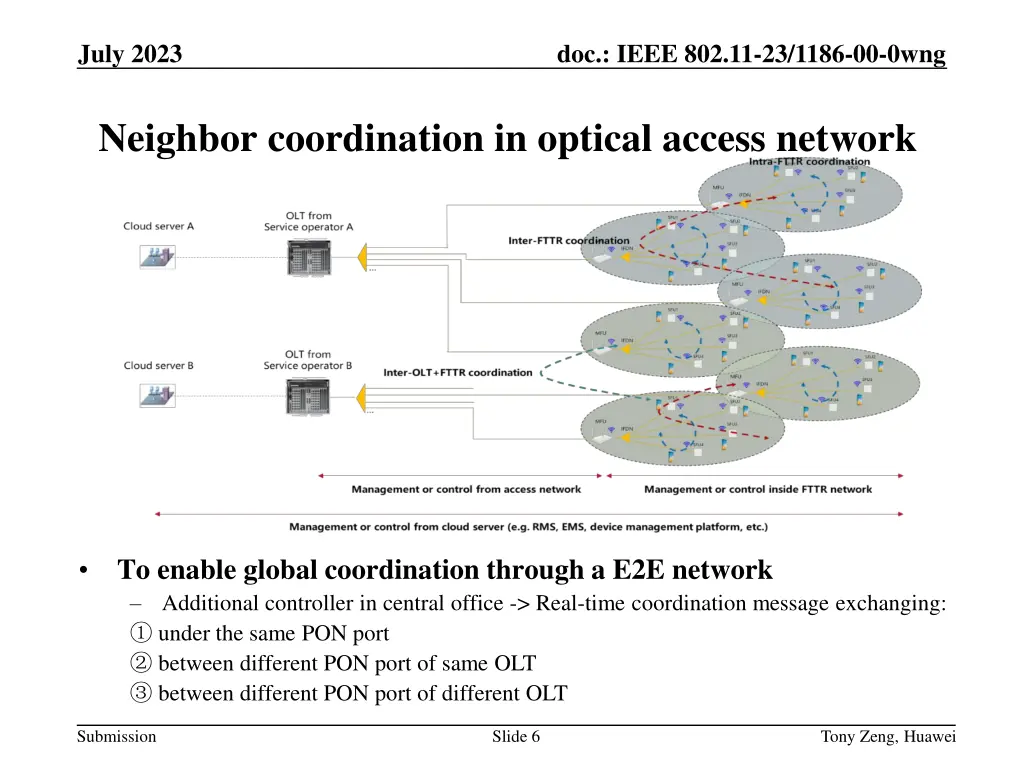
July 2023 doc.: IEEE 802.11-23/1186-00-0wng Neighbor coordination in optical access network To enable global coordination through a E2E network Additional controller in central office -> Real-time coordination message exchanging: under the same PON port between different PON port of same OLT between different PON port of different OLT Submission Slide 6 Tony Zeng, Huawei
July 2023 doc.: IEEE 802.11-23/1186-00-0wng Summary Multi-AP complementary way as that over air interface: UHR may specify the multi-AP coordination control interface for fibre backhaul link coordination over fibre can be Submission Slide 7 Tony Zeng, Huawei
July 2023 doc.: IEEE 802.11-23/1186-00-0wng References [1] 11-22-1083-01-0wng-next-generation-sg-formation [2] ITU-T G.9940 High speed fibre-based in-premises transceivers system architecture [3] ITU-T GSTP-FTTR Use cases and requirements of fibre-to-the-room (FTTR) [4] ITU-T G.suppl.78 Use case and requirements of fibre-to-the-room for small business applications Submission Slide 8 Tony Zeng, Huawei