Multi-Level, Multi-Discipline Cyber Education Approach
This paper discusses the definition and approach of cyber education, aiming to provide relevant knowledge to individuals based on their societal roles. It explores the evolving nature of the Cyber Domain and sets goals for advancing cyber education at various academic levels.

Download Presentation

Please find below an Image/Link to download the presentation.
The content on the website is provided AS IS for your information and personal use only. It may not be sold, licensed, or shared on other websites without obtaining consent from the author.If you encounter any issues during the download, it is possible that the publisher has removed the file from their server.
You are allowed to download the files provided on this website for personal or commercial use, subject to the condition that they are used lawfully. All files are the property of their respective owners.
The content on the website is provided AS IS for your information and personal use only. It may not be sold, licensed, or shared on other websites without obtaining consent from the author.
E N D
Presentation Transcript
Cyber Education: A Multi-Level, Multi-Discipline Approach Edward Sobiesk, Jean Blair, Gregory Conti, Michael Lanham, and Howard Taylor United States Military Academy West Point, New York 10996 USA
Goals of the paper Discuss the definition of cyber Describe a multi-level, multi-discipline approach to cyber education with the goal of providing all educated individuals a level of cyber education appropriate for their role in society Overall, contribute to the emerging dialogue on the direction, content, and techniques involved in cyber education
What is Cyber? NSA National Centers of Academic Excellence (CAE) Cyber Education Project (CEP) Cyberspace Operations from Joint Publication 3-12 (R) Military Academy CYBER Education Working Group Information Assurance and Security Knowledge Areas from IT2008 and CS2013 Papers by BYU, USNA, ACM Inroads, etc. NICE, DoL, DoE
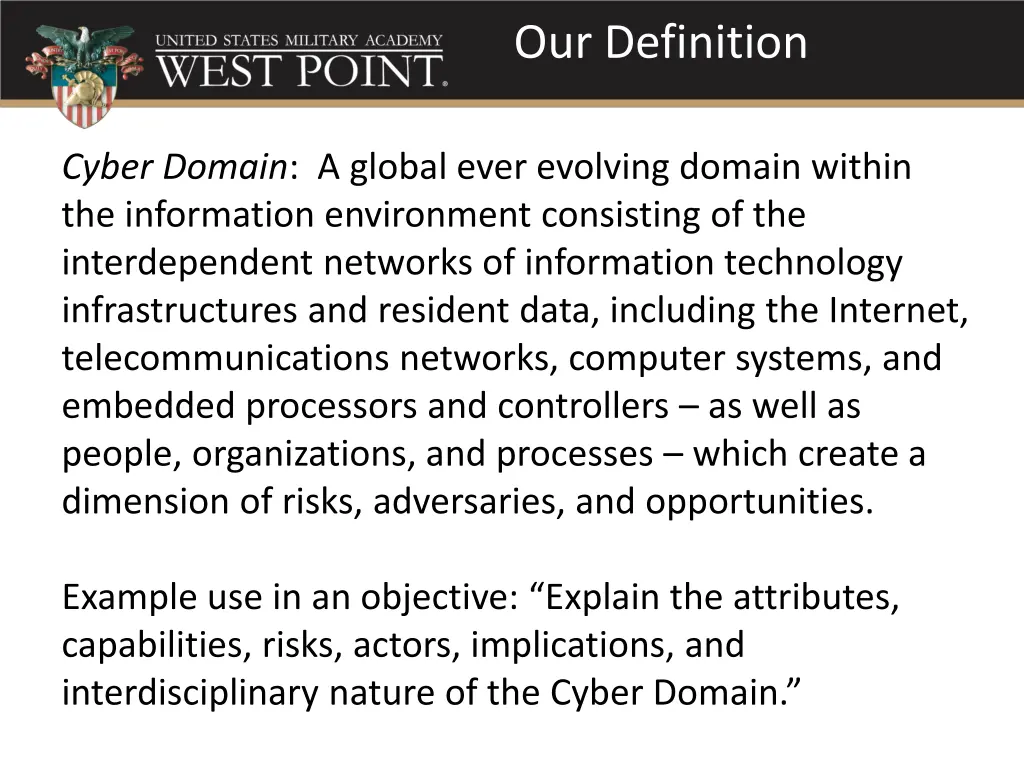
Our Definition Cyber Domain: A global ever evolving domain within the information environment consisting of the interdependent networks of information technology infrastructures and resident data, including the Internet, telecommunications networks, computer systems, and embedded processors and controllers as well as people, organizations, and processes which create a dimension of risks, adversaries, and opportunities. Example use in an objective: Explain the attributes, capabilities, risks, actors, implications, and interdisciplinary nature of the Cyber Domain.
Goals of the paper Goal: Provide all educated individuals a level of cyber education appropriate for their role in society
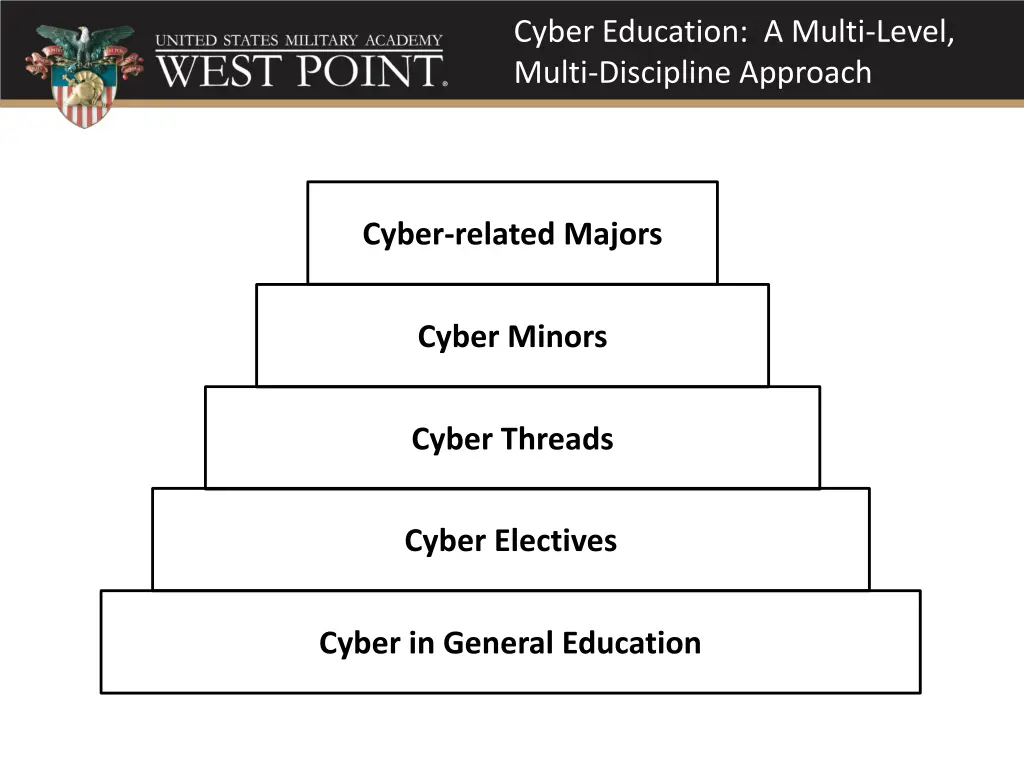
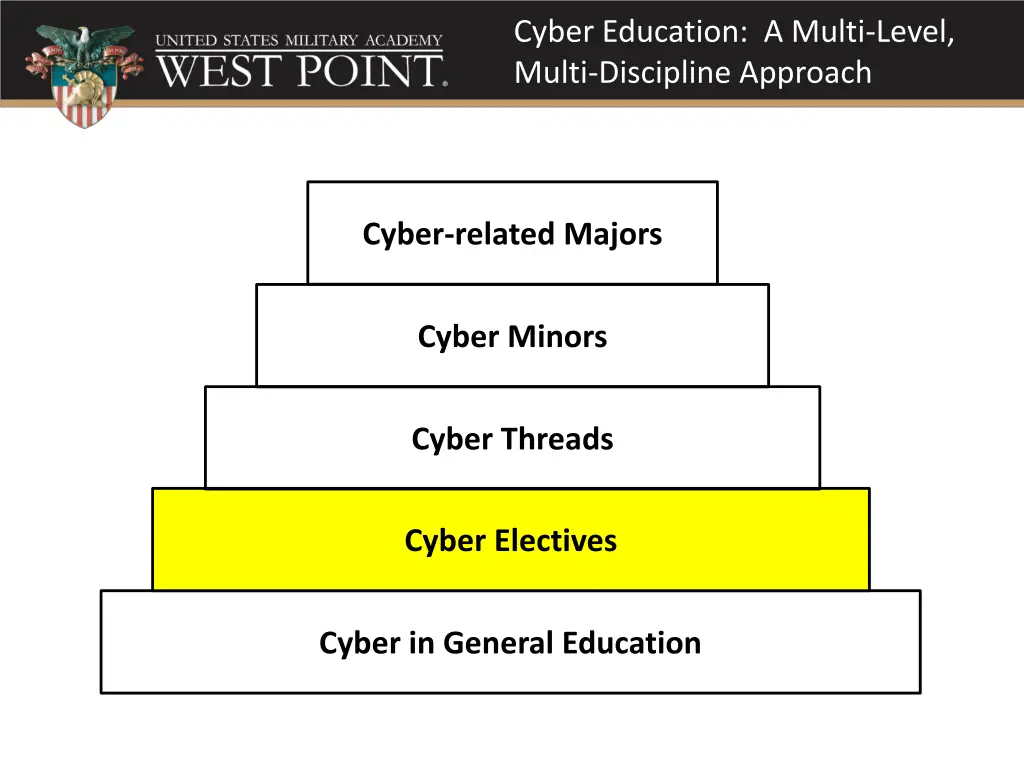
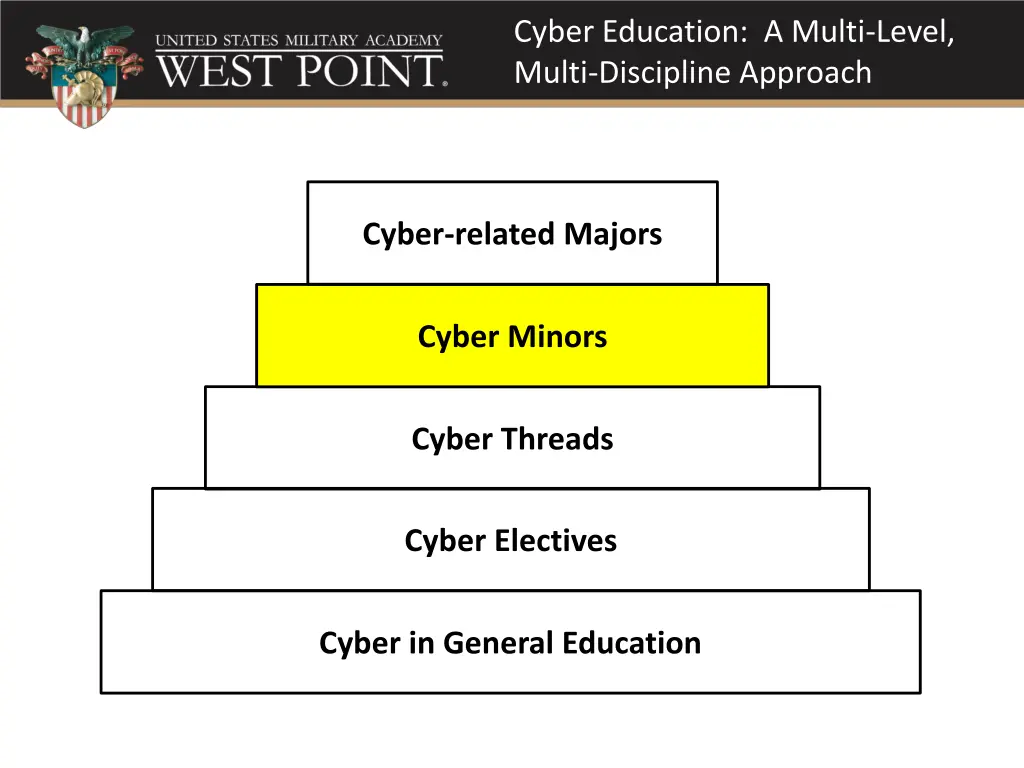
Cyber Education: A Multi-Level, Multi-Discipline Approach Cyber-related Majors Cyber Minors Cyber Threads Cyber Electives Cyber in General Education
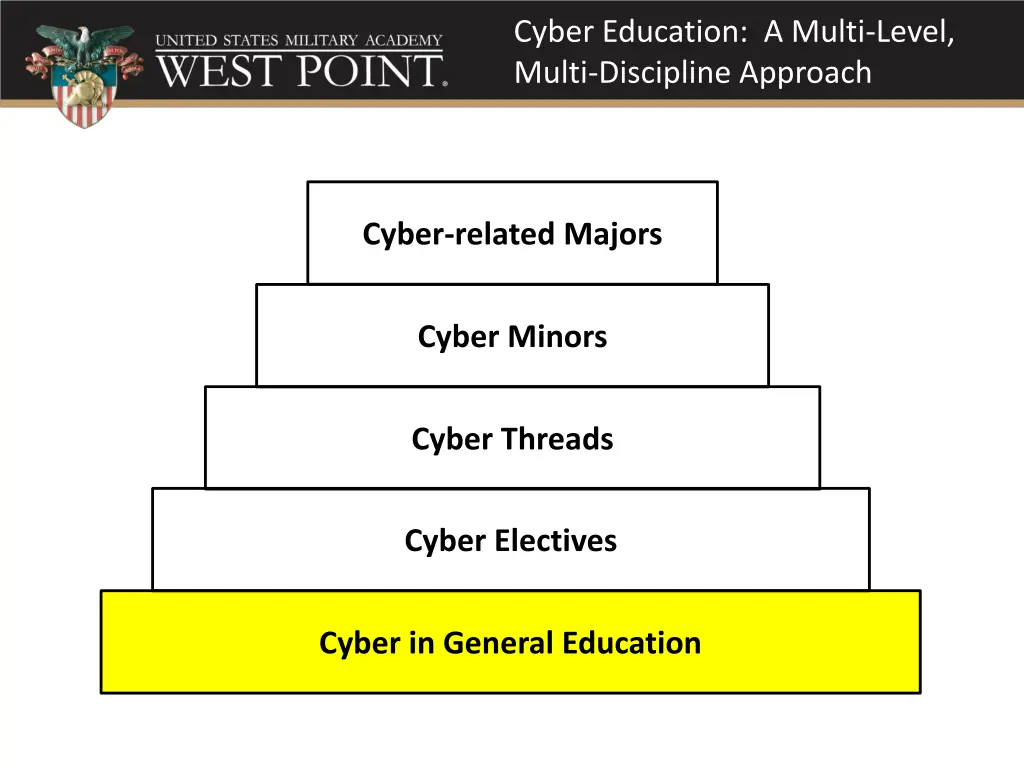
Cyber Education: A Multi-Level, Multi-Discipline Approach Cyber-related Majors Cyber Minors Cyber Threads Cyber Electives Cyber in General Education
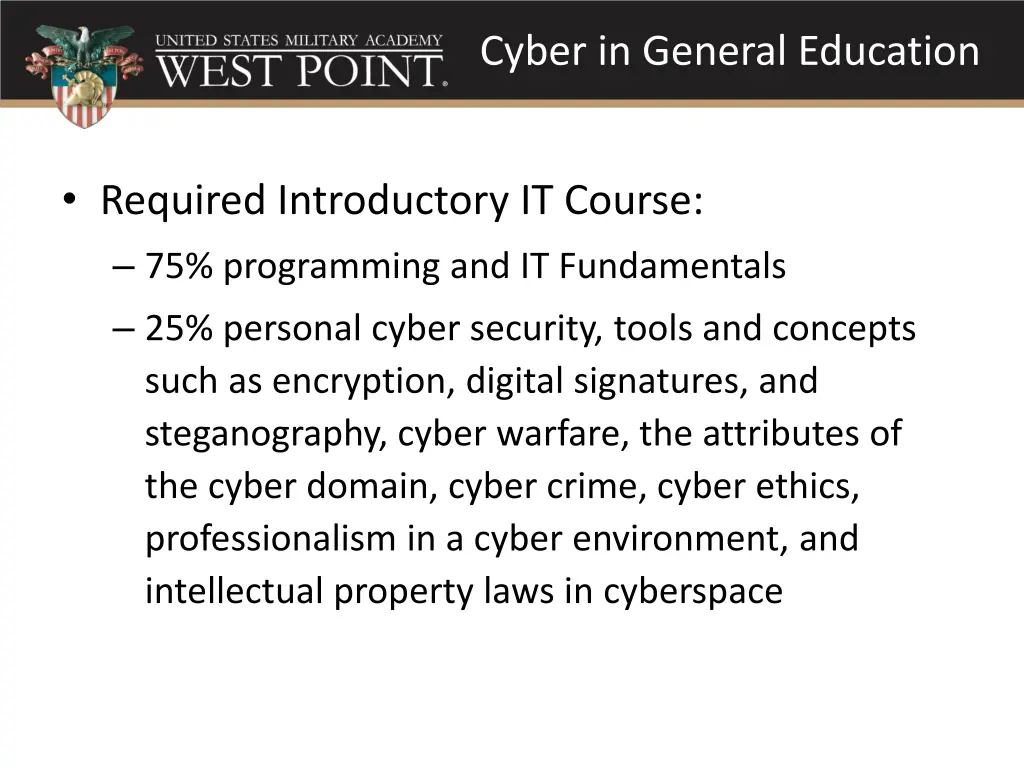
Cyber in General Education Required Introductory IT Course: 75% programming and IT Fundamentals 25% personal cyber security, tools and concepts such as encryption, digital signatures, and steganography, cyber warfare, the attributes of the cyber domain, cyber crime, cyber ethics, professionalism in a cyber environment, and intellectual property laws in cyberspace
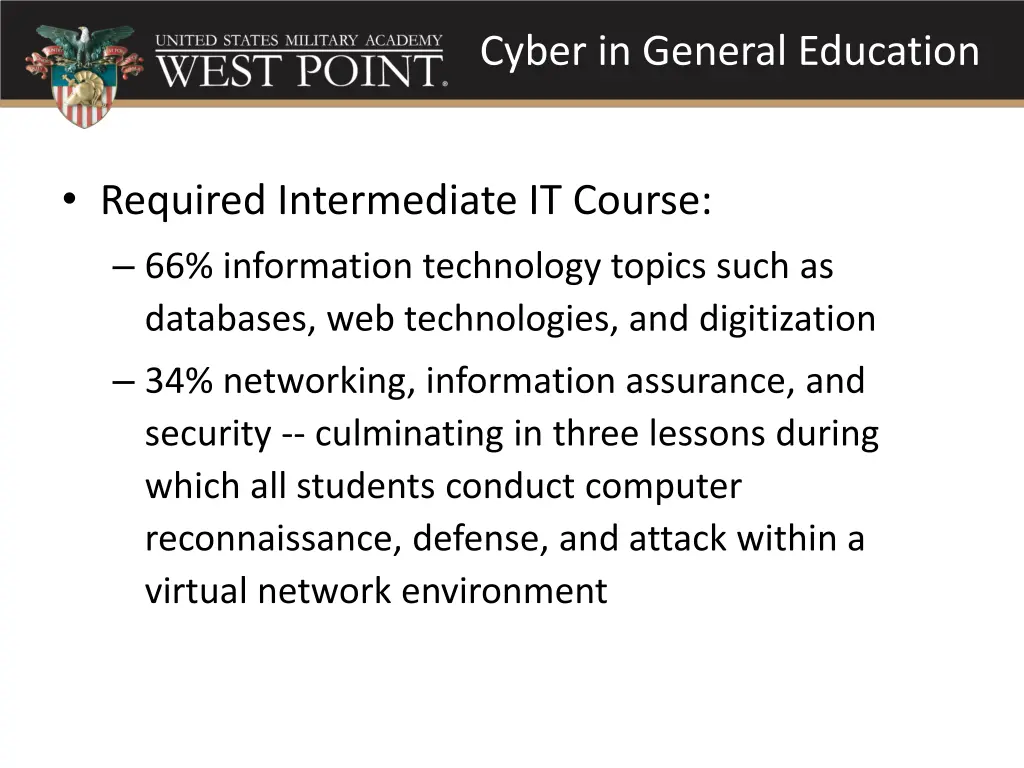
Cyber in General Education Required Intermediate IT Course: 66% information technology topics such as databases, web technologies, and digitization 34% networking, information assurance, and security -- culminating in three lessons during which all students conduct computer reconnaissance, defense, and attack within a virtual network environment
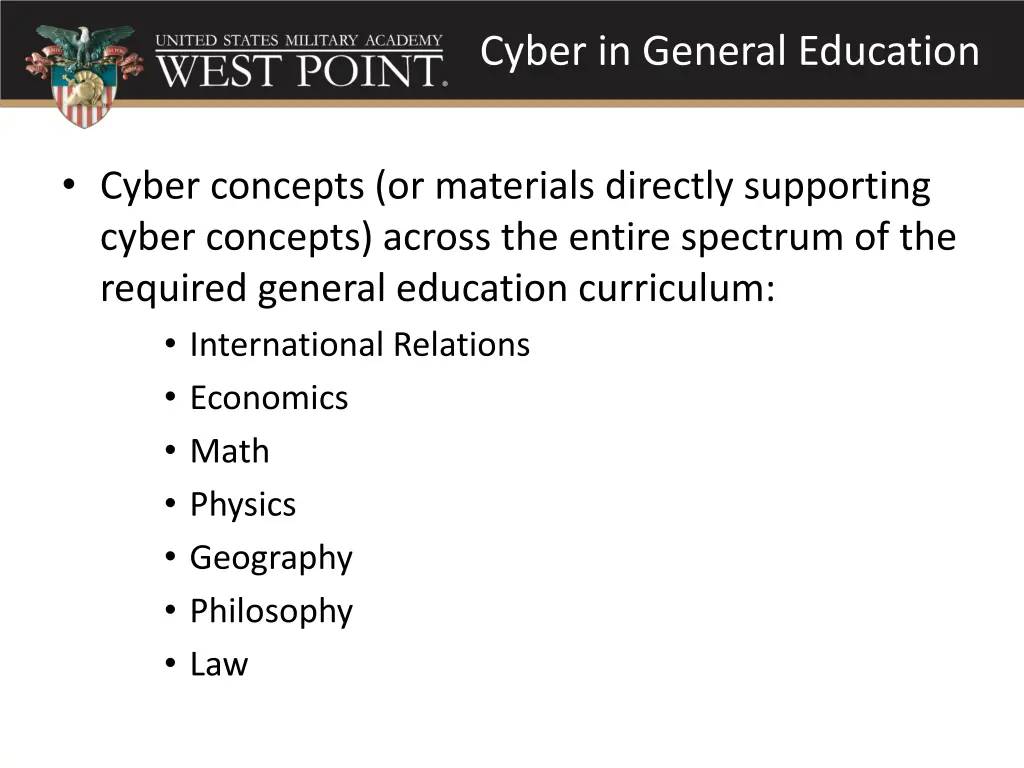
Cyber in General Education Cyber concepts (or materials directly supporting cyber concepts) across the entire spectrum of the required general education curriculum: International Relations Economics Math Physics Geography Philosophy Law
Cyber Education: A Multi-Level, Multi-Discipline Approach Cyber-related Majors Cyber Minors Cyber Threads Cyber Electives Cyber in General Education
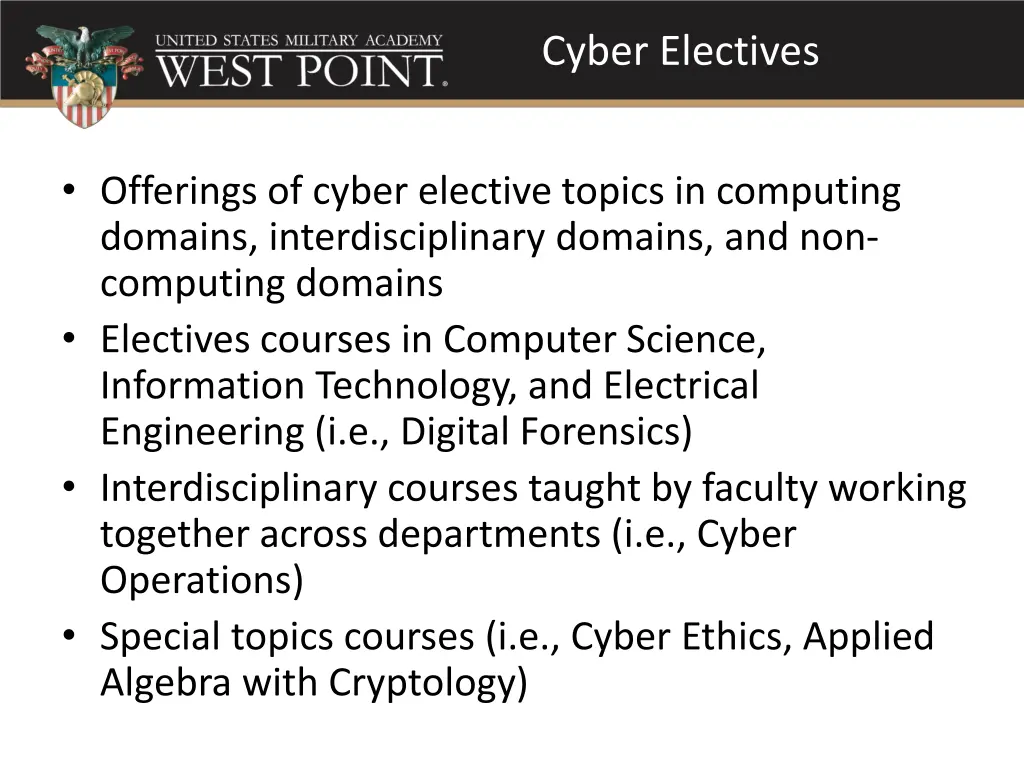
Cyber Electives Offerings of cyber elective topics in computing domains, interdisciplinary domains, and non- computing domains Electives courses in Computer Science, Information Technology, and Electrical Engineering (i.e., Digital Forensics) Interdisciplinary courses taught by faculty working together across departments (i.e., Cyber Operations) Special topics courses (i.e., Cyber Ethics, Applied Algebra with Cryptology)
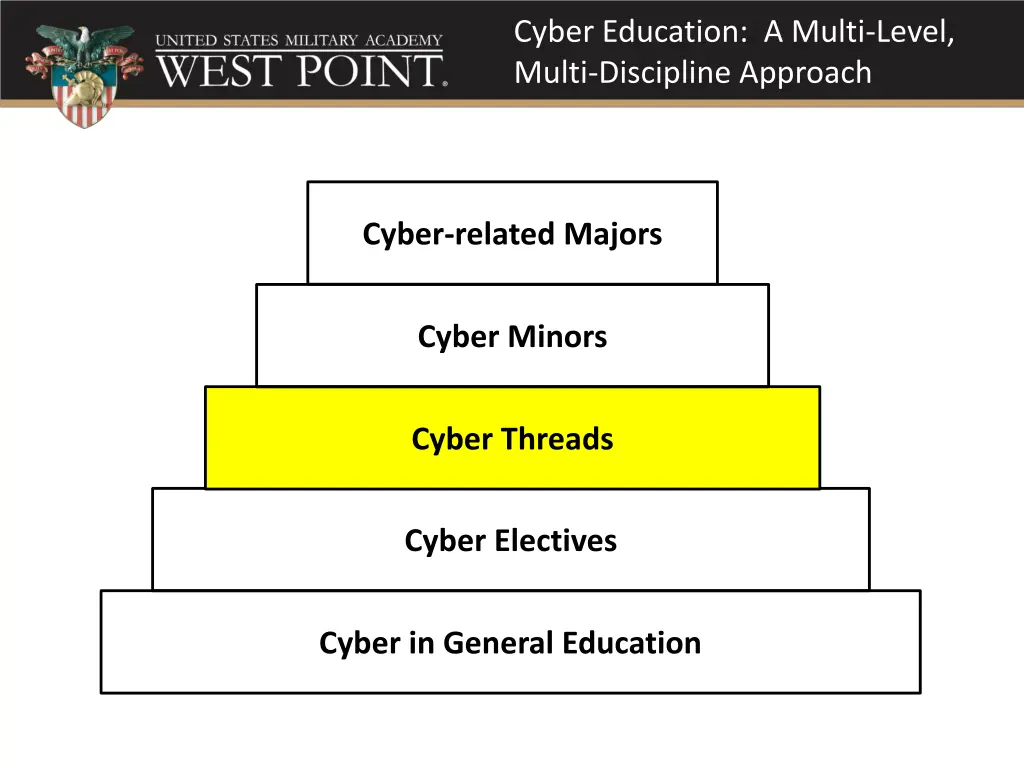
Cyber Education: A Multi-Level, Multi-Discipline Approach Cyber-related Majors Cyber Minors Cyber Threads Cyber Electives Cyber in General Education
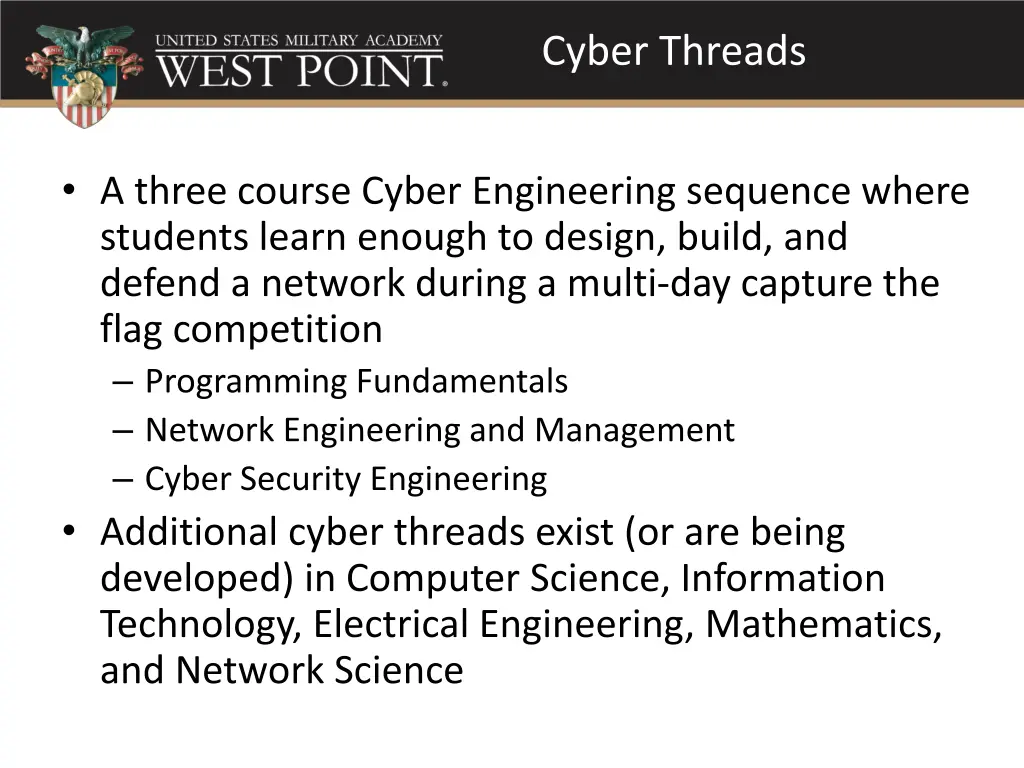
Cyber Threads A three course Cyber Engineering sequence where students learn enough to design, build, and defend a network during a multi-day capture the flag competition Programming Fundamentals Network Engineering and Management Cyber Security Engineering Additional cyber threads exist (or are being developed) in Computer Science, Information Technology, Electrical Engineering, Mathematics, and Network Science
Cyber Education: A Multi-Level, Multi-Discipline Approach Cyber-related Majors Cyber Minors Cyber Threads Cyber Electives Cyber in General Education
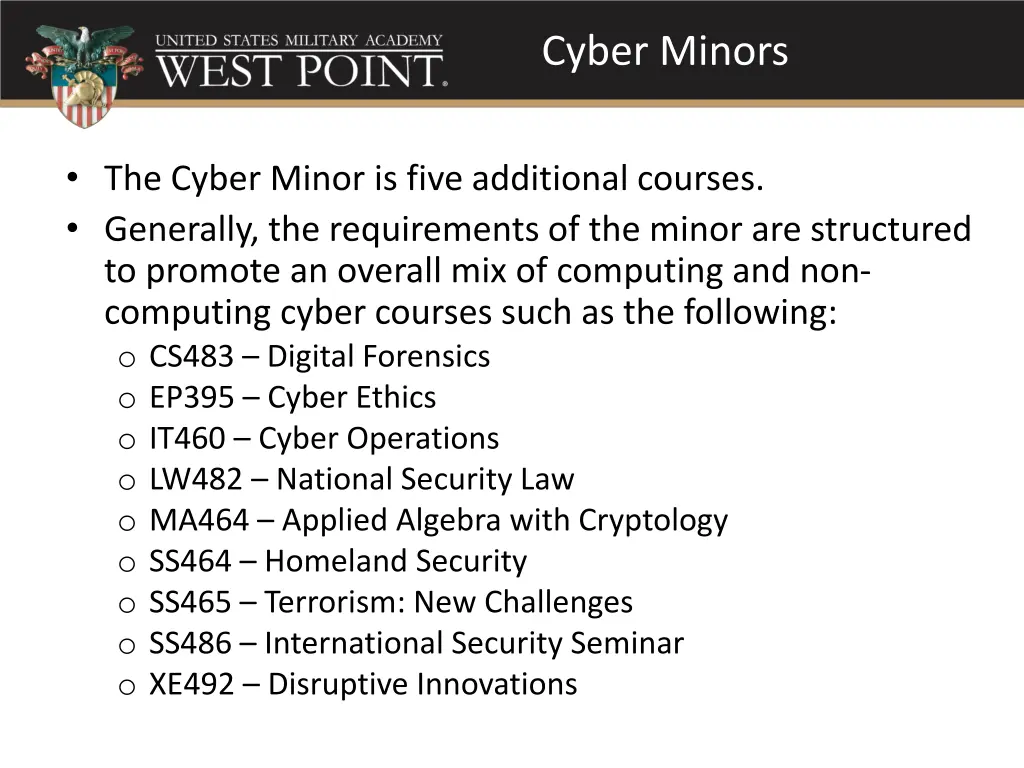
Cyber Minors The Cyber Minor is five additional courses. Generally, the requirements of the minor are structured to promote an overall mix of computing and non- computing cyber courses such as the following: o CS483 Digital Forensics o EP395 Cyber Ethics o IT460 Cyber Operations o LW482 National Security Law o MA464 Applied Algebra with Cryptology o SS464 Homeland Security o SS465 Terrorism: New Challenges o SS486 International Security Seminar o XE492 Disruptive Innovations
Cyber Education: A Multi-Level, Multi-Discipline Approach Cyber-related Majors Cyber Minors Cyber Threads Cyber Electives Cyber in General Education
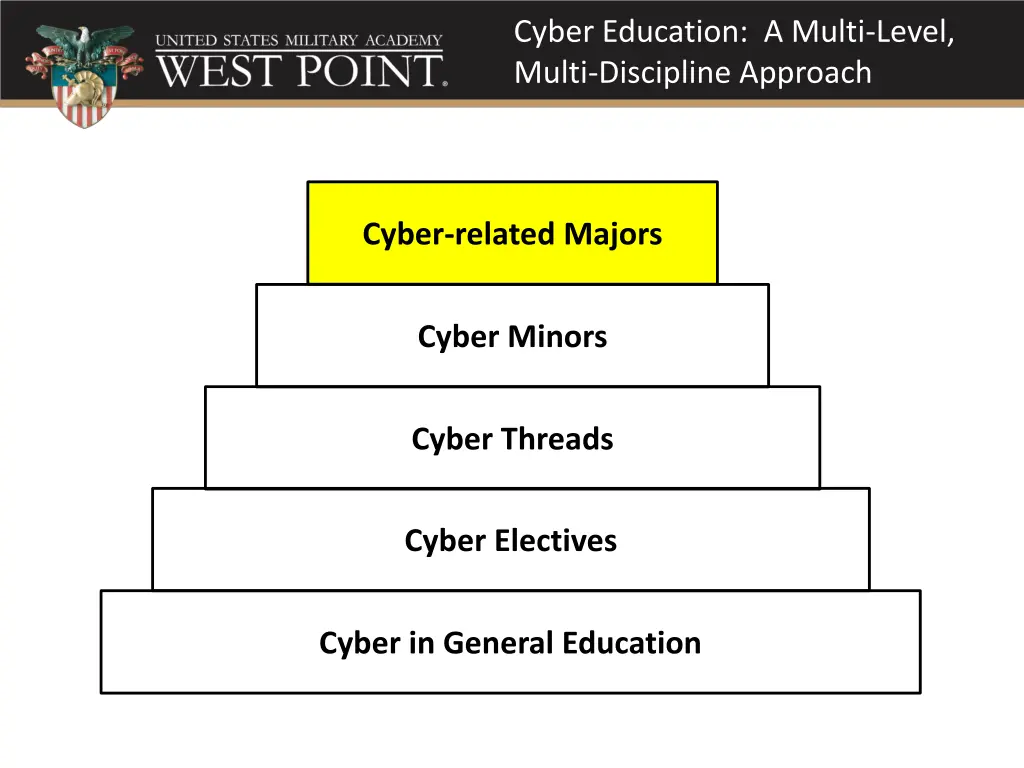
Cyber-related Majors West Point offers technical, cyber-related majors in Computer Science, Information Technology, and Electrical Engineering (and possibly soon in Math) All three programs offer technical threads, or sequences of courses, that allow students to focus on their preferred sub-topics within their chosen major (e.g., CS s computer forensics, IT s networks and security, and EE s information assurance) The majors present cyber across the entire span of the curriculum and all include a culminating, nine-month capstone project, many of which are directly related to the Cyber Domain.
Cyber-related Majors Additionally, many other Science, Mathematics, Engineering and non-technical majors, when matched with a Cyber Minor and the enrichment opportunities described next, produce graduates prepared to contribute and lead within the Cyber Domain. Example majors include Defense and Strategic Studies, Geospatial Information Science, International Relations, Legal Studies, Mathematics, Operations Research, Political Science, and Systems Engineering.
Cyber Education: A Multi-Level, Multi-Discipline Approach Cyber-related Majors Cyber Minors Cyber Threads Enrichment Cyber Electives Opportunities Cyber in General Education
Enrichment Opportunities Enrichment opportunities are key to a culture and environment that inspires students to naturally apply the cyber curriculum. Student-driven independent study and undergraduate research experiences combined with a vibrant cyber extracurricular program creates tremendous synergy with the prescribed curriculum.
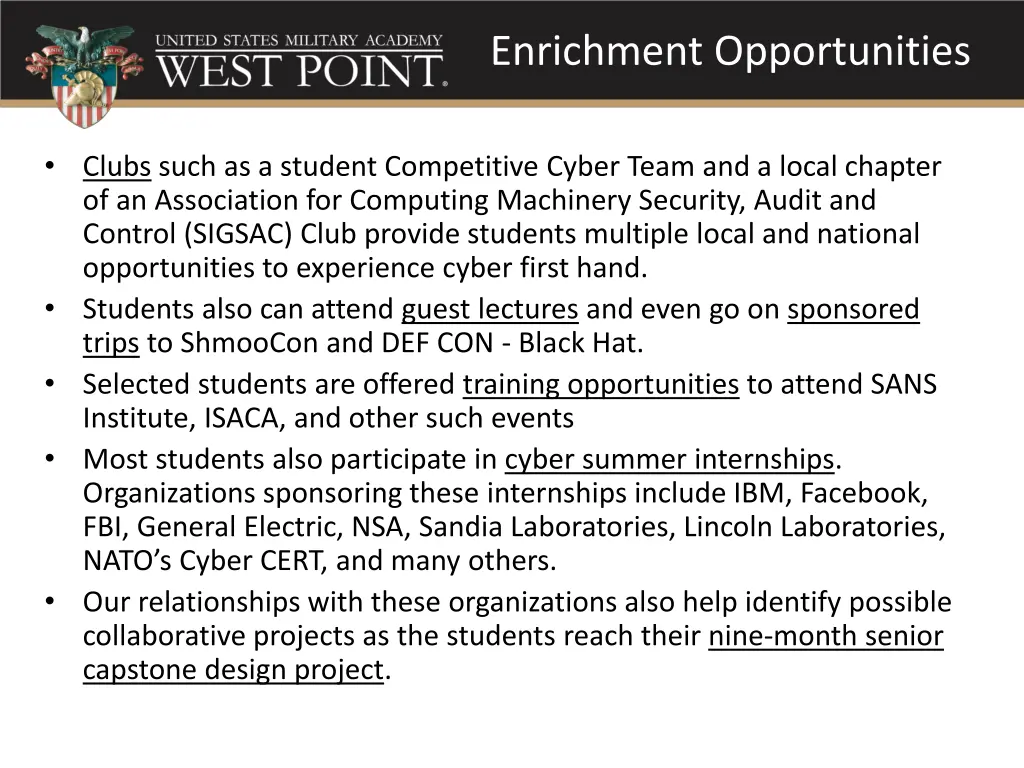
Enrichment Opportunities Clubs such as a student Competitive Cyber Team and a local chapter of an Association for Computing Machinery Security, Audit and Control (SIGSAC) Club provide students multiple local and national opportunities to experience cyber first hand. Students also can attend guest lectures and even go on sponsored trips to ShmooCon and DEF CON - Black Hat. Selected students are offered training opportunities to attend SANS Institute, ISACA, and other such events Most students also participate in cyber summer internships. Organizations sponsoring these internships include IBM, Facebook, FBI, General Electric, NSA, Sandia Laboratories, Lincoln Laboratories, NATO s Cyber CERT, and many others. Our relationships with these organizations also help identify possible collaborative projects as the students reach their nine-month senior capstone design project.
Enrichment Opportunities Perhaps most importantly, throughout a student s undergraduate experience, there is a conscious effort to provide the culture, environment, and role models that grow them into cyber professionals and leaders who possess the character and competence our constituents demand.
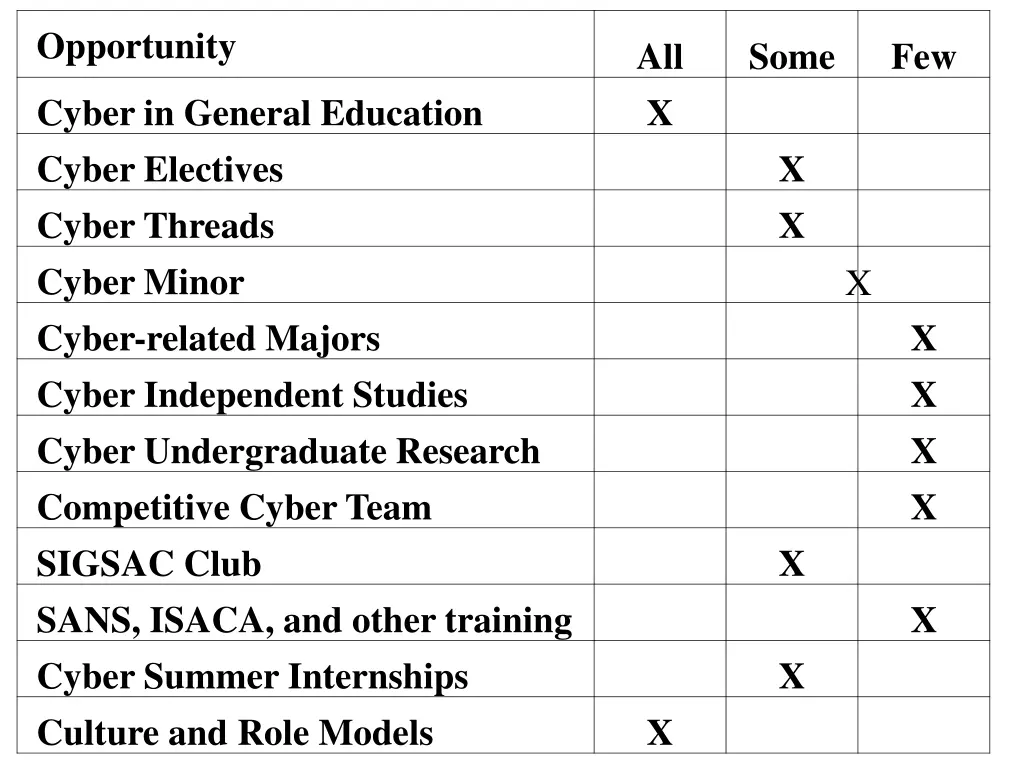
Opportunity All X Some Few Cyber in General Education Cyber Electives Cyber Threads Cyber Minor Cyber-related Majors Cyber Independent Studies Cyber Undergraduate Research Competitive Cyber Team SIGSAC Club SANS, ISACA, and other training Cyber Summer Internships Culture and Role Models X X X X X X X X X X X
Conclusion The principle contributions of this paper included: 1) a discussion of the diverse challenges and viewpoints involved in defining the term cyber 2) presentation of a holistic multi-level, multi- discipline approach to cyber education that addressed all educated individuals We seek further debate, discussion, and increased involvement on the critical topic of cyber education. We hope our multi-level, multi-discipline educational approach has a positive impact on this effort.