Explore a multi-omics approach to study novel genes and pathways in Miller-Dieker Syndrome (MDS). RNA and protein analyses reveal significant gene expression changes related to nervous system development and phenotypic features in MDS cells. Discover the implications of gene alterations and potential therapeutic biomarkers for MDS prognosis and treatment.
Please find below an Image/Link to download the presentation.
The content on the website is provided AS IS for your information and personal use only. It may not be sold, licensed, or shared on other websites without obtaining consent from the author. If you encounter any issues during the download, it is possible that the publisher has removed the file from their server.
You are allowed to download the files provided on this website for personal or commercial use, subject to the condition that they are used lawfully. All files are the property of their respective owners.
The content on the website is provided AS IS for your information and personal use only. It may not be sold, licensed, or shared on other websites without obtaining consent from the author.
E N D
Presentation Transcript
Indiana Clinical and Translational Sciences Institute 2023 Annual Meeting Multi-omics approach to study novel genes and pathways affected in Miller-Dieker Syndrome Gowthami Mahendran Ph. D candidate, University of Notre Dame
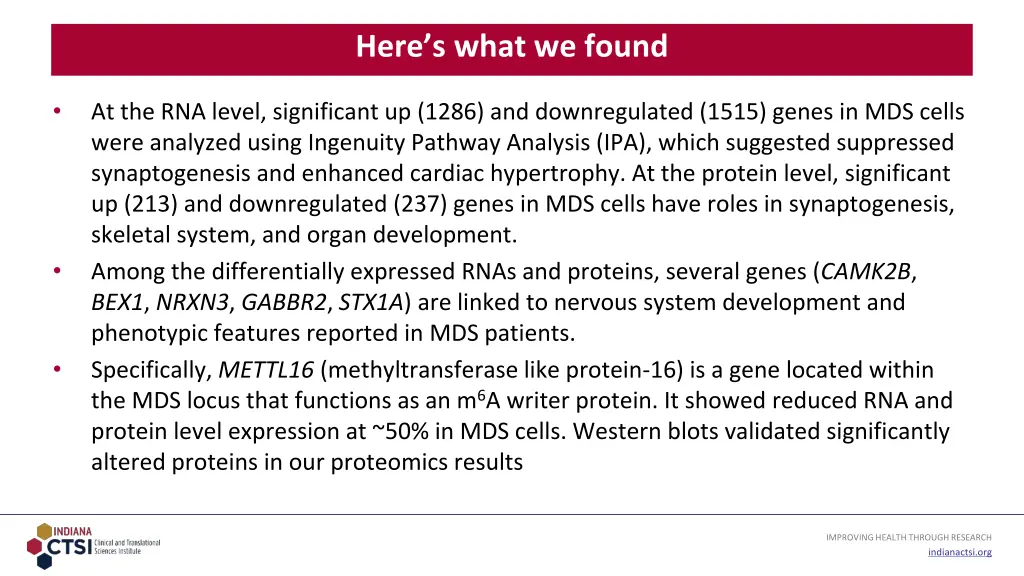
Heres what we found At the RNA level, significant up (1286) and downregulated (1515) genes in MDS cells were analyzed using Ingenuity Pathway Analysis (IPA), which suggested suppressed synaptogenesis and enhanced cardiac hypertrophy. At the protein level, significant up (213) and downregulated (237) genes in MDS cells have roles in synaptogenesis, skeletal system, and organ development. Among the differentially expressed RNAs and proteins, several genes (CAMK2B, BEX1, NRXN3, GABBR2, STX1A) are linked to nervous system development and phenotypic features reported in MDS patients. Specifically, METTL16 (methyltransferase like protein-16) is a gene located within the MDS locus that functions as an m6A writer protein. It showed reduced RNA and protein level expression at ~50% in MDS cells. Western blots validated significantly altered proteins in our proteomics results IMPROVING HEALTH THROUGH RESEARCH indianactsi.org
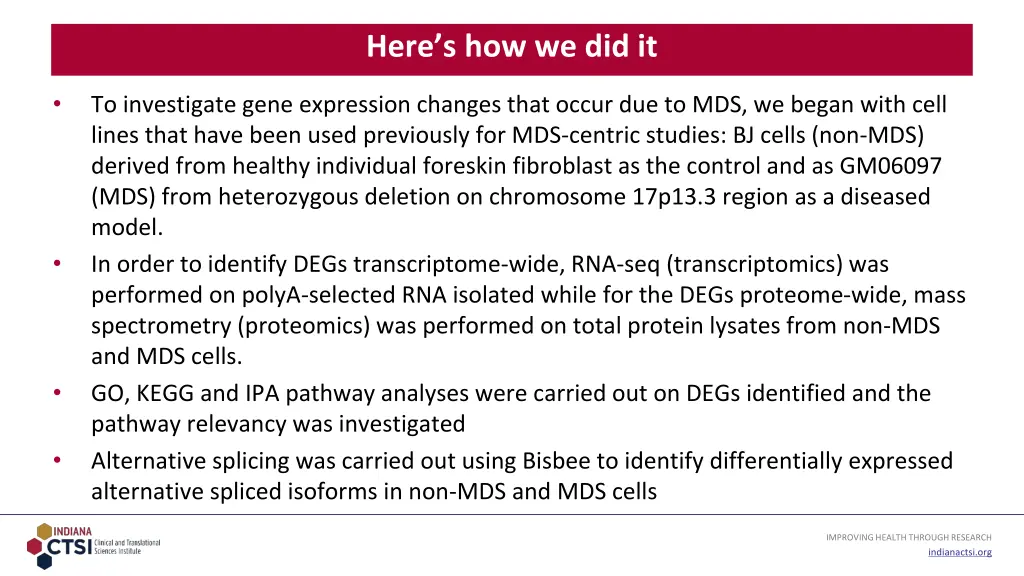
Heres how we did it To investigate gene expression changes that occur due to MDS, we began with cell lines that have been used previously for MDS-centric studies: BJ cells (non-MDS) derived from healthy individual foreskin fibroblast as the control and as GM06097 (MDS) from heterozygous deletion on chromosome 17p13.3 region as a diseased model. In order to identify DEGs transcriptome-wide, RNA-seq (transcriptomics) was performed on polyA-selected RNA isolated while for the DEGs proteome-wide, mass spectrometry (proteomics) was performed on total protein lysates from non-MDS and MDS cells. GO, KEGG and IPA pathway analyses were carried out on DEGs identified and the pathway relevancy was investigated Alternative splicing was carried out using Bisbee to identify differentially expressed alternative spliced isoforms in non-MDS and MDS cells IMPROVING HEALTH THROUGH RESEARCH indianactsi.org
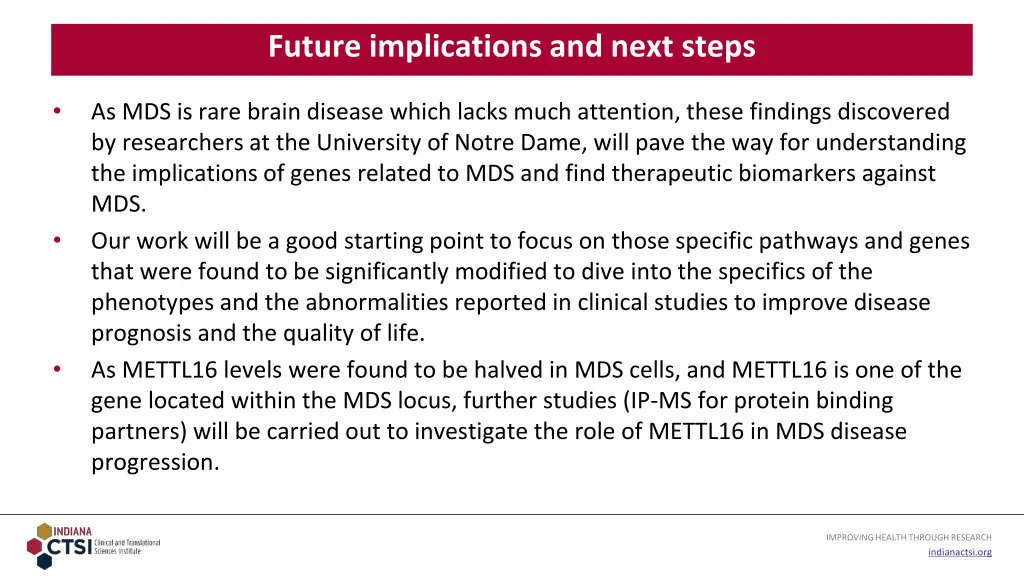
Future implications and next steps As MDS is rare brain disease which lacks much attention, these findings discovered by researchers at the University of Notre Dame, will pave the way for understanding the implications of genes related to MDS and find therapeutic biomarkers against MDS. Our work will be a good starting point to focus on those specific pathways and genes that were found to be significantly modified to dive into the specifics of the phenotypes and the abnormalities reported in clinical studies to improve disease prognosis and the quality of life. As METTL16 levels were found to be halved in MDS cells, and METTL16 is one of the gene located within the MDS locus, further studies (IP-MS for protein binding partners) will be carried out to investigate the role of METTL16 in MDS disease progression. IMPROVING HEALTH THROUGH RESEARCH indianactsi.org
Grant Acknowledgement Pilot Funding for Research use of core facilities: Project supported by the Indiana Clinical and Translational Sciences Institute, funded in part by grant #UL1TR001108 from the National Institutes of Health, National Center for Advancing Translational Sciences, Clinical and Translational Sciences Award. NIH R35 203681 Berthiaume Institute for Precision health Thank you! IMPROVING HEALTH THROUGH RESEARCH indianactsi.org