Mutual Learning Exercise on R&I Strategies and Policies in Mozambique
The Mutual Learning Exercise focuses on the Research and Innovation (R&I) ecosystem in Mozambique, highlighting key policies, stakeholders, challenges, and progress. It discusses the status of R&I policies, monitoring, and evaluation in the country, providing insights into the main actors and stakeholders involved in shaping the R&I landscape. The event aims to facilitate knowledge sharing and collaboration to enhance research productivity and institutionalize science and technology initiatives effectively.

Download Presentation

Please find below an Image/Link to download the presentation.
The content on the website is provided AS IS for your information and personal use only. It may not be sold, licensed, or shared on other websites without obtaining consent from the author.If you encounter any issues during the download, it is possible that the publisher has removed the file from their server.
You are allowed to download the files provided on this website for personal or commercial use, subject to the condition that they are used lawfully. All files are the property of their respective owners.
The content on the website is provided AS IS for your information and personal use only. It may not be sold, licensed, or shared on other websites without obtaining consent from the author.
E N D
Presentation Transcript
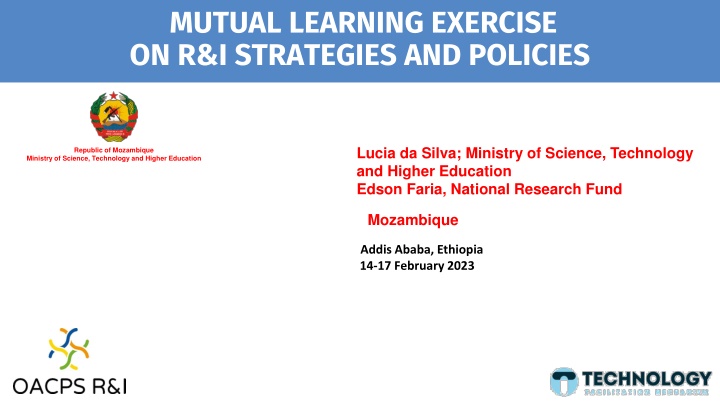
MUTUAL LEARNING EXERCISE ON R&I STRATEGIES AND POLICIES Lucia da Silva; Ministry of Science, Technology and Higher Education Edson Faria, National Research Fund Republic of Mozambique Ministry of Science, Technology and Higher Education Mozambique Addis Ababa, Ethiopia 14-17 February 2023
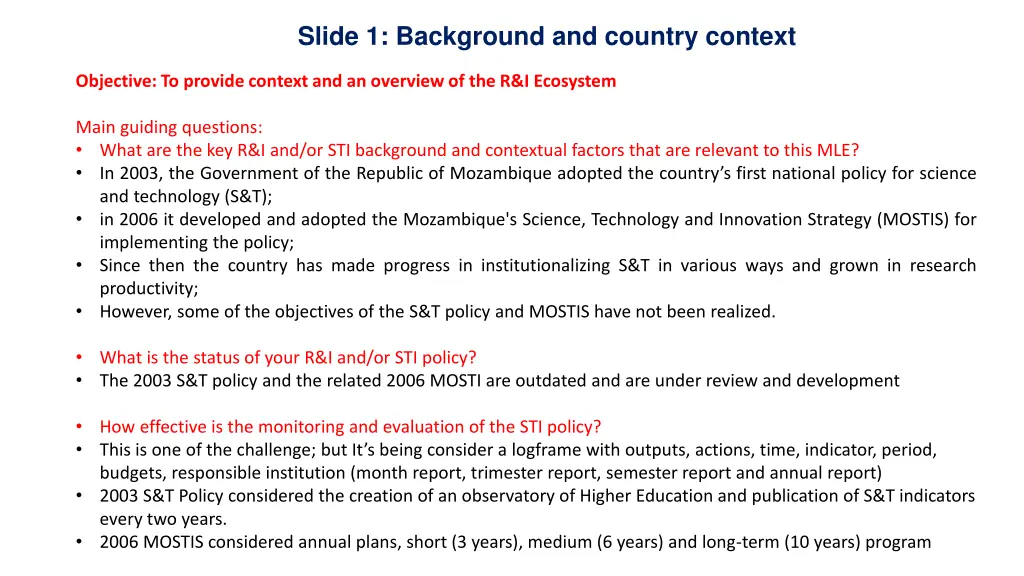
Slide 1: Background and country context Objective: To provide context and an overview of the R&I Ecosystem Main guiding questions: What are the key R&I and/or STI background and contextual factors that are relevant to this MLE? In 2003, the Government of the Republic of Mozambique adopted the country s first national policy for science and technology (S&T); in 2006 it developed and adopted the Mozambique's Science, Technology and Innovation Strategy (MOSTIS) for implementing the policy; Since then the country has made progress in institutionalizing S&T in various ways and grown in research productivity; However, some of the objectives of the S&T policy and MOSTIS have not been realized. What is the status of your R&I and/or STI policy? The 2003 S&T policy and the related 2006 MOSTI are outdated and are under review and development How effective is the monitoring and evaluation of the STI policy? This is one of the challenge; but It s being consider a logframe with outputs, actions, time, indicator, period, budgets, responsible institution (month report, trimester report, semester report and annual report) 2003 S&T Policy considered the creation of an observatory of Higher Education and publication of S&T indicators every two years. 2006 MOSTIS considered annual plans, short (3 years), medium (6 years) and long-term (10 years) program
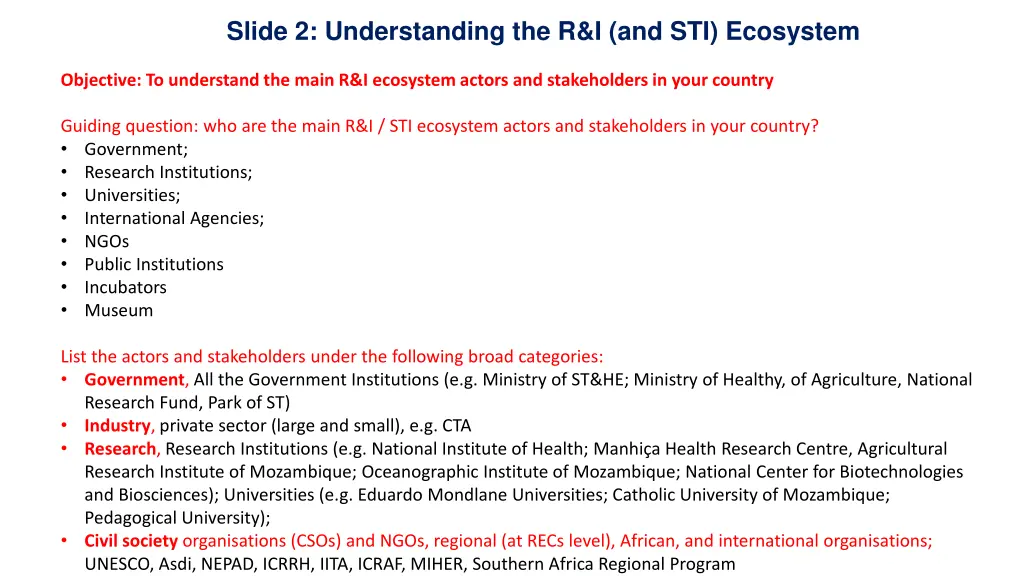
Slide 2: Understanding the R&I (and STI) Ecosystem Objective: To understand the main R&I ecosystem actors and stakeholders in your country Guiding question: who are the main R&I / STI ecosystem actors and stakeholders in your country? Government; Research Institutions; Universities; International Agencies; NGOs Public Institutions Incubators Museum List the actors and stakeholders under the following broad categories: Government, All the Government Institutions (e.g. Ministry of ST&HE; Ministry of Healthy, of Agriculture, National Research Fund, Park of ST) Industry, private sector (large and small), e.g. CTA Research, Research Institutions (e.g. National Institute of Health; Manhi a Health Research Centre, Agricultural Research Institute of Mozambique; Oceanographic Institute of Mozambique; National Center for Biotechnologies and Biosciences); Universities (e.g. Eduardo Mondlane Universities; Catholic University of Mozambique; Pedagogical University); Civil society organisations (CSOs) and NGOs, regional (at RECs level), African, and international organisations; UNESCO, Asdi, NEPAD, ICRRH, IITA, ICRAF, MIHER, Southern Africa Regional Program
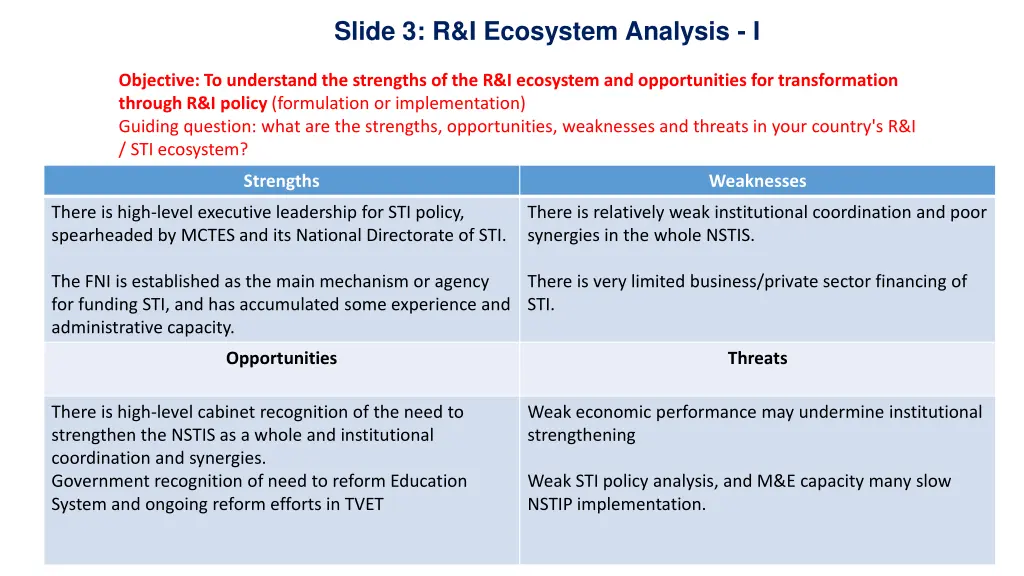
Slide 3: R&I Ecosystem Analysis - I Objective: To understand the strengths of the R&I ecosystem and opportunities for transformation through R&I policy (formulation or implementation) Guiding question: what are the strengths, opportunities, weaknesses and threats in your country's R&I / STI ecosystem? Strengths Weaknesses There is high-level executive leadership for STI policy, spearheaded by MCTES and its National Directorate of STI. The FNI is established as the main mechanism or agency for funding STI, and has accumulated some experience and administrative capacity. There is relatively weak institutional coordination and poor synergies in the whole NSTIS. There is very limited business/private sector financing of STI. Opportunities Threats There is high-level cabinet recognition of the need to strengthen the NSTIS as a whole and institutional coordination and synergies. Government recognition of need to reform Education System and ongoing reform efforts in TVET Weak economic performance may undermine institutional strengthening Weak STI policy analysis, and M&E capacity many slow NSTIP implementation.
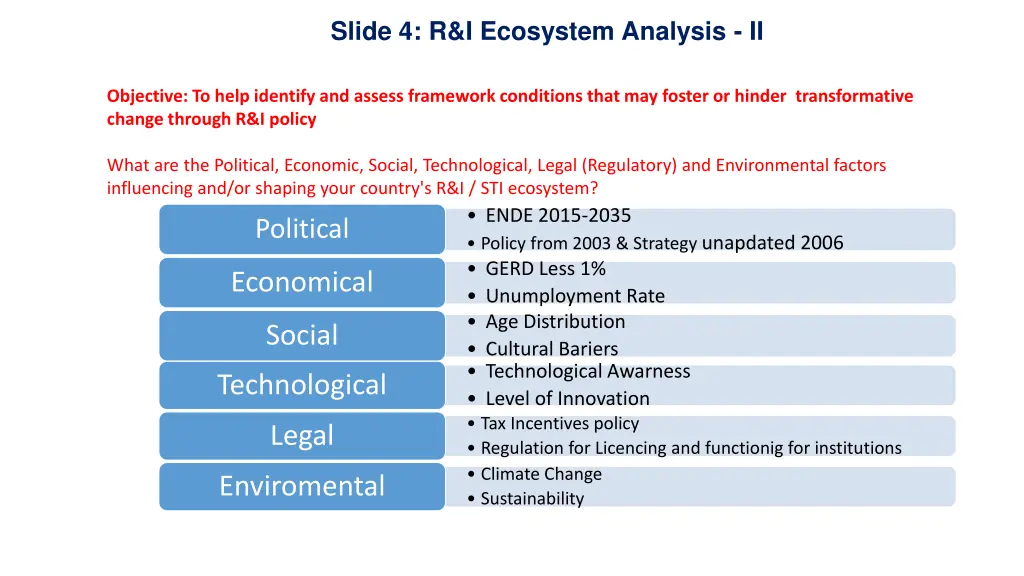
Slide 4: R&I Ecosystem Analysis - II Objective: To help identify and assess framework conditions that may foster or hinder transformative change through R&I policy What are the Political, Economic, Social, Technological, Legal (Regulatory) and Environmental factors influencing and/or shaping your country's R&I / STI ecosystem? ENDE 2015-2035 Policy from 2003 & Strategy unapdated 2006 Political GERD Less 1% Unumployment Rate Economical Age Distribution Cultural Bariers Social Technological Awarness Level of Innovation Technological Tax Incentives policy Regulation for Licencing and functionig for institutions Legal Climate Change Sustainability Enviromental
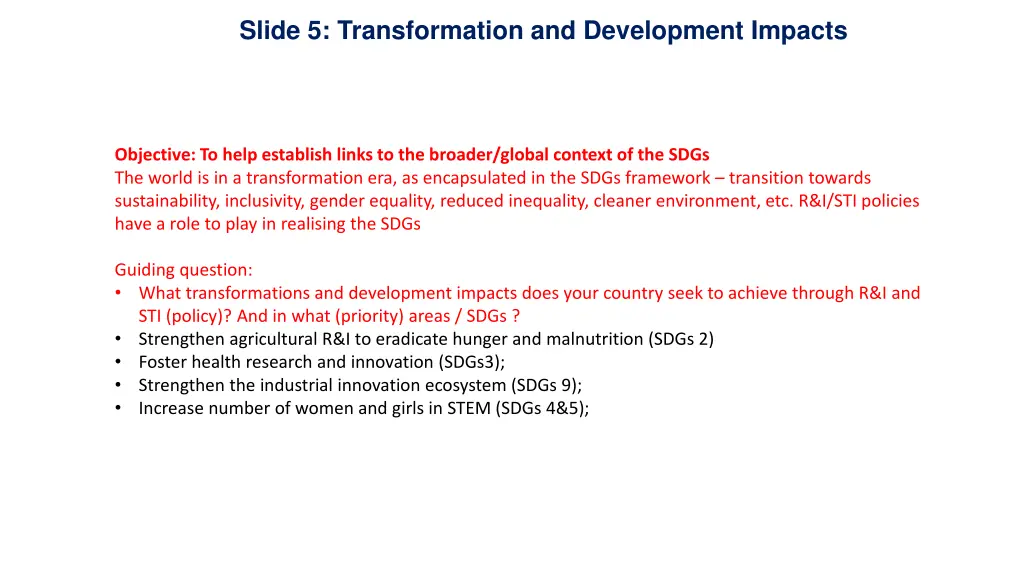
Slide 5: Transformation and Development Impacts Objective: To help establish links to the broader/global context of the SDGs The world is in a transformation era, as encapsulated in the SDGs framework transition towards sustainability, inclusivity, gender equality, reduced inequality, cleaner environment, etc. R&I/STI policies have a role to play in realising the SDGs Guiding question: What transformations and development impacts does your country seek to achieve through R&I and STI (policy)? And in what (priority) areas / SDGs ? Strengthen agricultural R&I to eradicate hunger and malnutrition (SDGs 2) Foster health research and innovation (SDGs3); Strengthen the industrial innovation ecosystem (SDGs 9); Increase number of women and girls in STEM (SDGs 4&5);
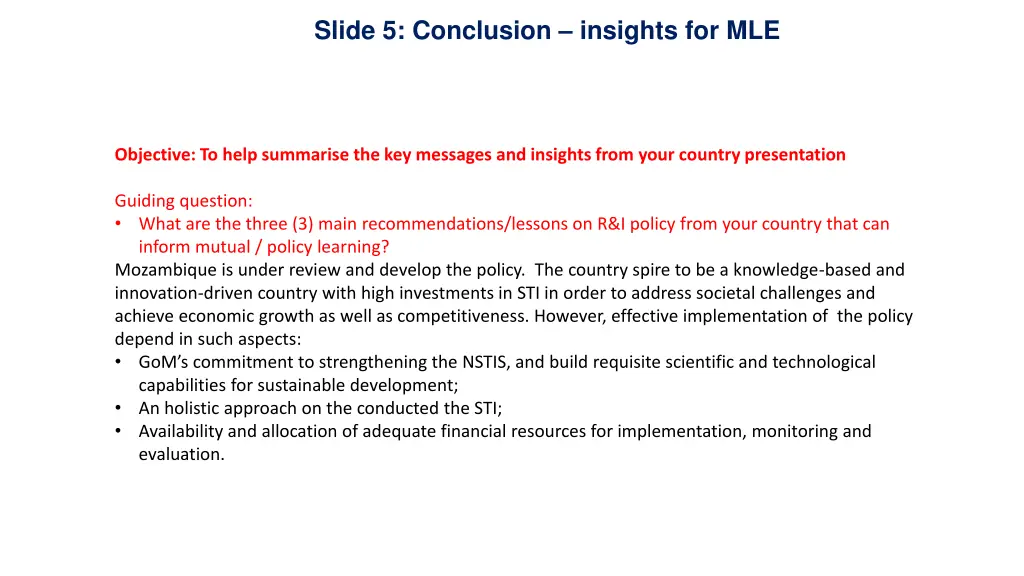
Slide 5: Conclusion insights for MLE Objective: To help summarise the key messages and insights from your country presentation Guiding question: What are the three (3) main recommendations/lessons on R&I policy from your country that can inform mutual / policy learning? Mozambique is under review and develop the policy. The country spire to be a knowledge-based and innovation-driven country with high investments in STI in order to address societal challenges and achieve economic growth as well as competitiveness. However, effective implementation of the policy depend in such aspects: GoM s commitment to strengthening the NSTIS, and build requisite scientific and technological capabilities for sustainable development; An holistic approach on the conducted the STI; Availability and allocation of adequate financial resources for implementation, monitoring and evaluation.
Slide 5: References (optional) Kindly provide a list of references or access to relevant information and data/evidence Weblinks, where applicable, will be ok - www.mctes.gov.mz; - www.fni.gov.mz;