Natural Language Computing
Natural Language Processing (NLP) involves enabling computers to understand, interpret, and respond to human languages like English, Hindi, and more. It is a subfield of Artificial Intelligence that integrates computer science, human-computer interaction, linguistics, and cognitive psychology. NLP aims to facilitate natural human-to-computer communication, exploring components such as syntax, semantics, and discourse. Applications include text analysis, speech recognition, and spoken dialogue systems, posing unique challenges in processing varied linguistic nuances.

Download Presentation

Please find below an Image/Link to download the presentation.
The content on the website is provided AS IS for your information and personal use only. It may not be sold, licensed, or shared on other websites without obtaining consent from the author.If you encounter any issues during the download, it is possible that the publisher has removed the file from their server.
You are allowed to download the files provided on this website for personal or commercial use, subject to the condition that they are used lawfully. All files are the property of their respective owners.
The content on the website is provided AS IS for your information and personal use only. It may not be sold, licensed, or shared on other websites without obtaining consent from the author.
E N D
Presentation Transcript
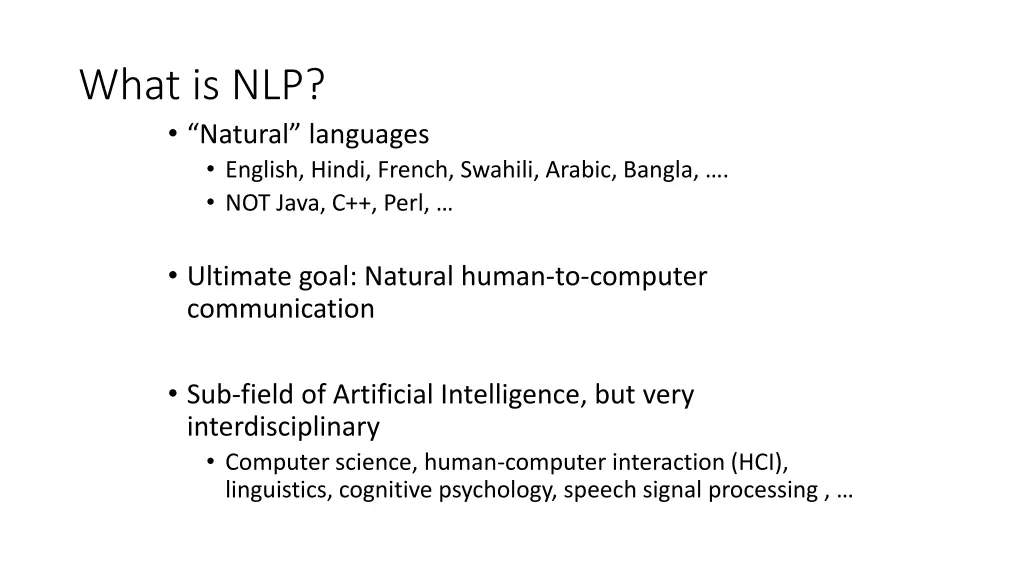
What is NLP? Natural languages English, Hindi, French, Swahili, Arabic, Bangla, . NOT Java, C++, Perl, Ultimate goal: Natural human-to-computer communication Sub-field of Artificial Intelligence, but very interdisciplinary Computer science, human-computer interaction (HCI), linguistics, cognitive psychology, speech signal processing ,
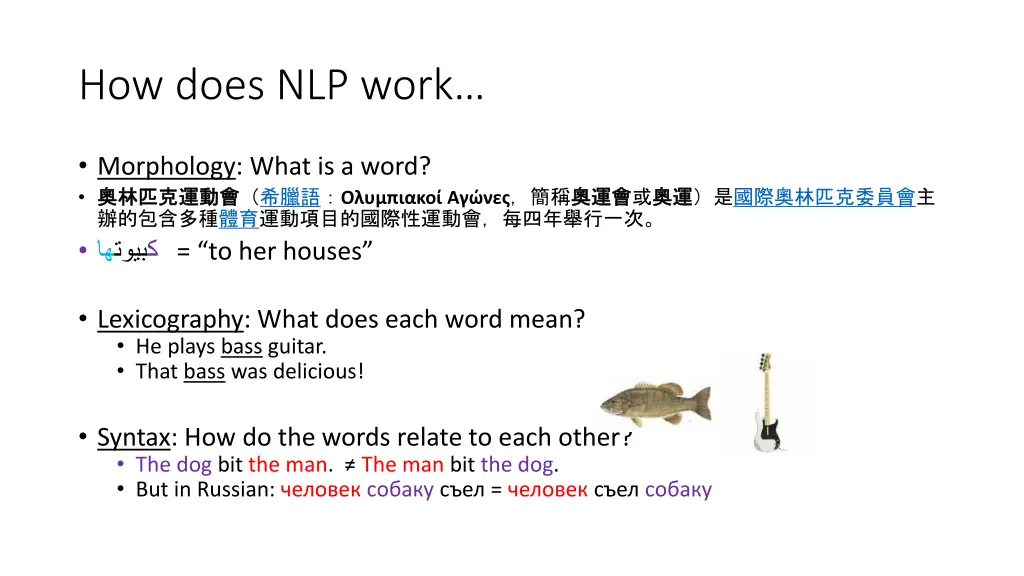
How does NLP work Morphology: What is a word? = to her houses Lexicography: What does each word mean? He plays bass guitar. That bass was delicious! Syntax: How do the words relate to each other? The dog bit the man. The man bit the dog. But in Russian: =
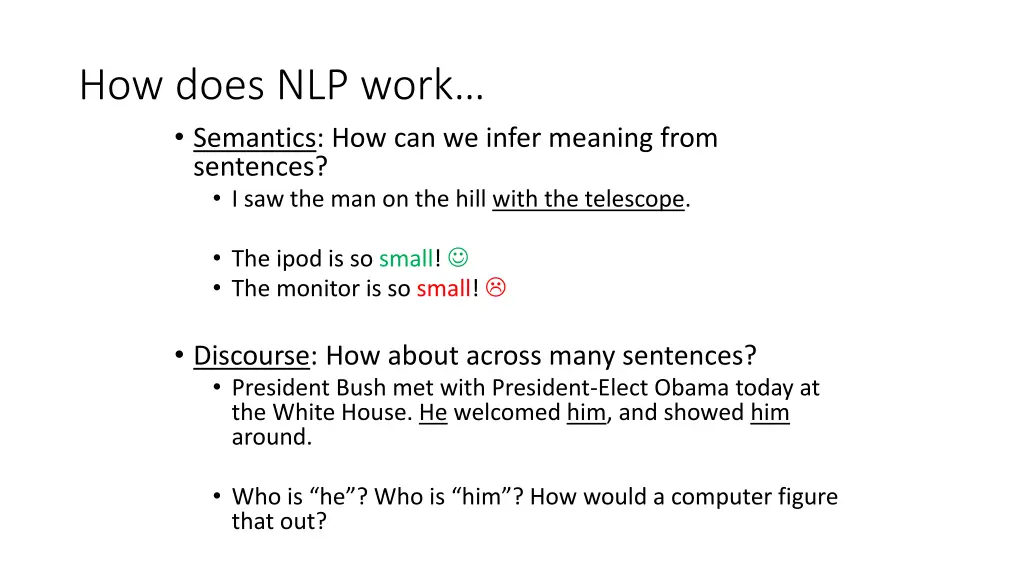
How does NLP work Semantics: How can we infer meaning from sentences? I saw the man on the hill with the telescope. The ipod is so small! The monitor is so small! Discourse: How about across many sentences? President Bush met with President-Elect Obama today at the White House. He welcomed him, and showed him around. Who is he ? Who is him ? How would a computer figure that out?
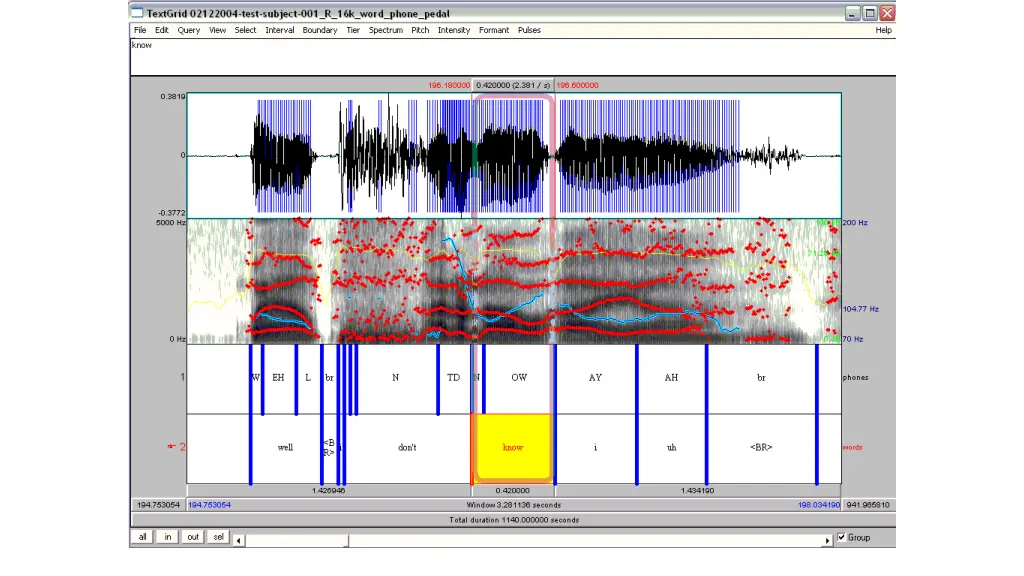
Spoken Language Processing Speech Recognition Automatic dictation, assistance for blind people, indexing youtube videos, Related things How does intonation affect semantic meaning? Detecting uncertainty and emotions Detecting deception! Why is this hard? Each speaker has a different voice (male vs female, child versus older person) Many different accents (Scottish, American, non-native speakers) and ways of speaking Conversation: turn taking, interruptions,
Spoken Language Processing Text-to-Speech / Spoken dialog systems Call response centers, tutoring systems, Related things Making computer voices sound more human Making computer speech acts more human-like
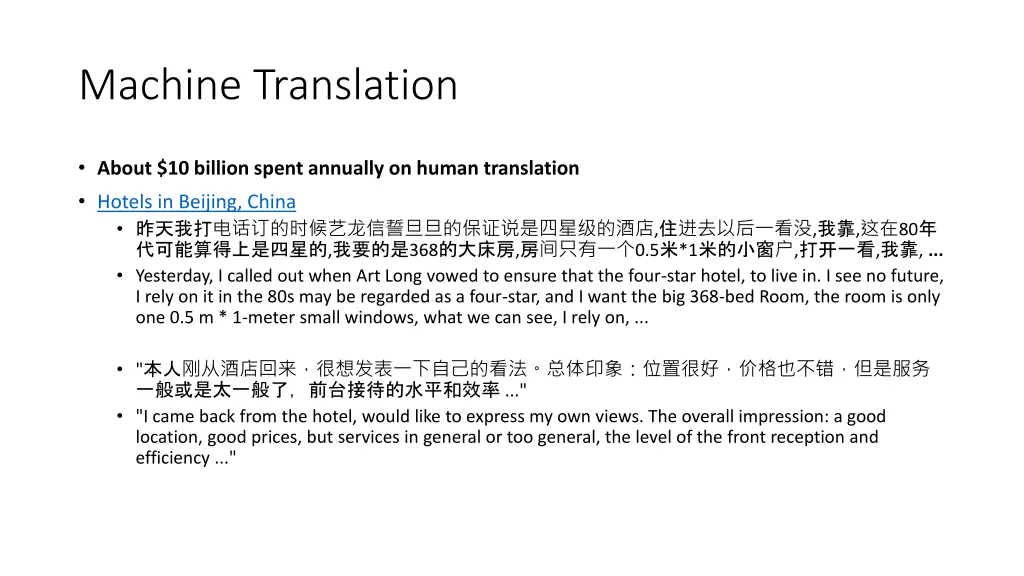
Machine Translation About $10 billion spent annually on human translation Hotels in Beijing, China , , , 80 , 368 , 0.5 *1 , , , ... Yesterday, I called out when Art Long vowed to ensure that the four-star hotel, to live in. I see no future, I rely on it in the 80s may be regarded as a four-star, and I want the big 368-bed Room, the room is only one 0.5 m * 1-meter small windows, what we can see, I rely on, ... " ..." "I came back from the hotel, would like to express my own views. The overall impression: a good location, good prices, but services in general or too general, the level of the front reception and efficiency ..."
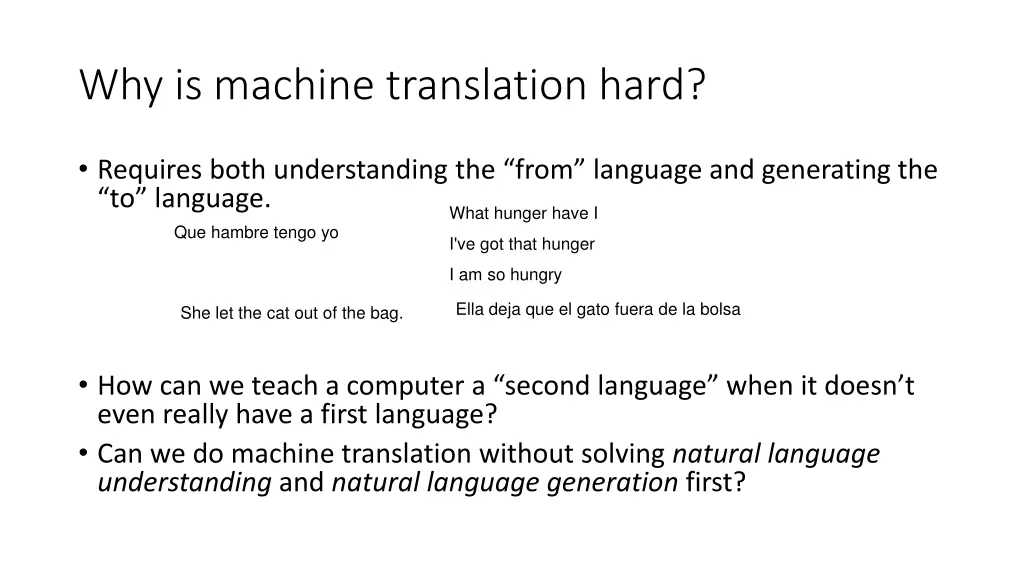
Why is machine translation hard? Requires both understanding the from language and generating the to language. Que hambre tengo yo I've got that hunger What hunger have I I am so hungry Ella deja que el gato fuera de la bolsa She let the cat out of the bag. How can we teach a computer a second language when it doesn t even really have a first language? Can we do machine translation without solving natural language understanding and natural language generation first?
Use of Parallel Text Example of parallel text : same text in two or more languages
Statistical Machine Translation Lots and lots of parallel text Learn word-for-word translations Learn phrase-for-phrase translations Learn syntax and grammar rules?
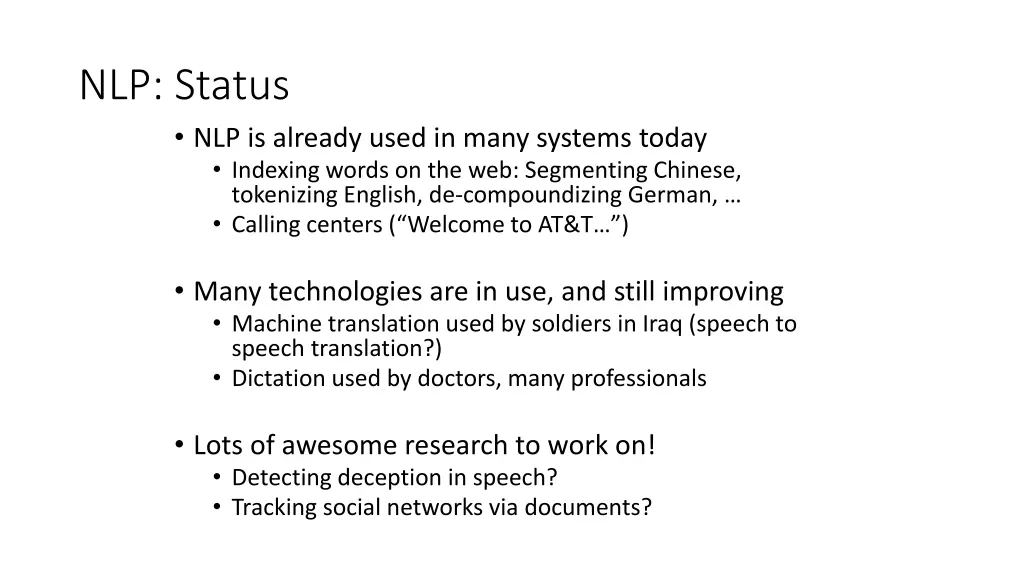
NLP: Status NLP is already used in many systems today Indexing words on the web: Segmenting Chinese, tokenizing English, de-compoundizing German, Calling centers ( Welcome to AT&T ) Many technologies are in use, and still improving Machine translation used by soldiers in Iraq (speech to speech translation?) Dictation used by doctors, many professionals Lots of awesome research to work on! Detecting deception in speech? Tracking social networks via documents?
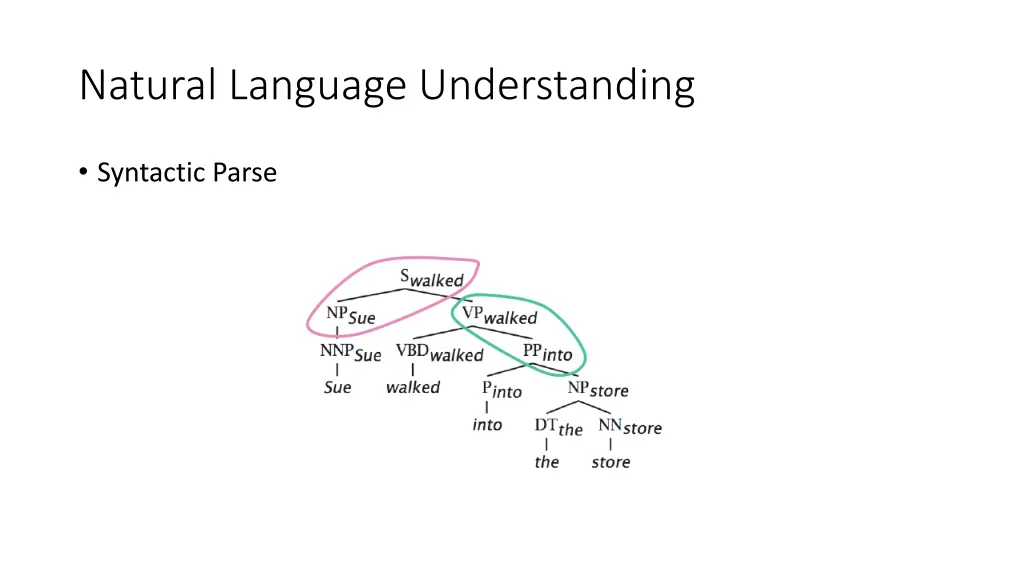
Natural Language Understanding Syntactic Parse
Why is this customer confused? A: And, what day in May did you want to travel? C: OK, uh, I need to be there for a meeting that s from the 12th to the 15th. Note that client did not answer question. Meaning of client s sentence: Meeting Start-of-meeting: 12th End-of-meeting: 15th Doesn t say anything about flying!!!!! How does agent infer client is informing him/her of travel dates?
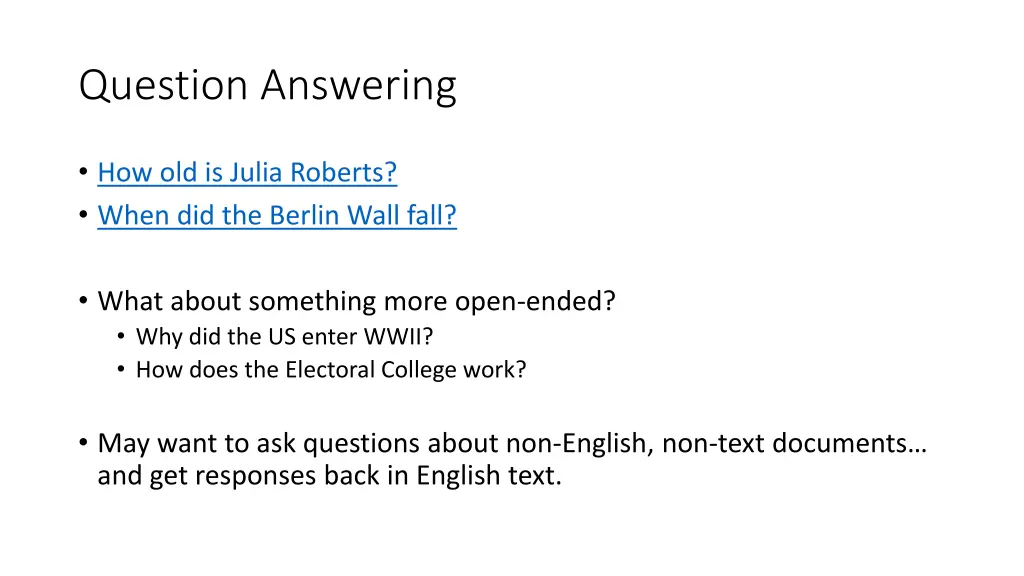
Question Answering How old is Julia Roberts? When did the Berlin Wall fall? What about something more open-ended? Why did the US enter WWII? How does the Electoral College work? May want to ask questions about non-English, non-text documents and get responses back in English text.
What are chatbots? A chatbot is a conversational agent that interacts with users using natural language. Started as an attempt to fool humans. Numerous applications of chatbots such as Customer Service, call centers etc
Need for chatbots? Widespread use of personal machines Better Human Computer Interaction To express their interest, wishes, or queries directly and naturally, by speaking, typing, and pointing .
Need for chatbots? You: Hello Op: Hi. This is Railway Enquiry You: What is the status of train 2803? Op: It s right on time. The train will leave CST at 5:45 pm. Is there anything else I could assist you with? You : No, thank you Op: You are welcome. Indian railways wishes a nice and happy journey.
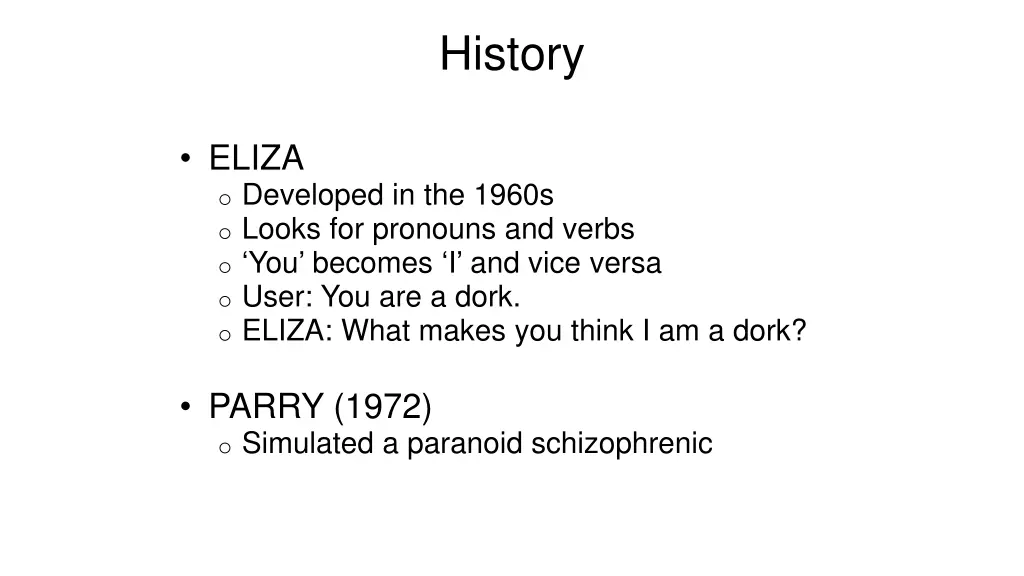
History ELIZA o Developed in the 1960s o Looks for pronouns and verbs o You becomes I and vice versa o User: You are a dork. o ELIZA: What makes you think I am a dork? PARRY (1972) o Simulated a paranoid schizophrenic
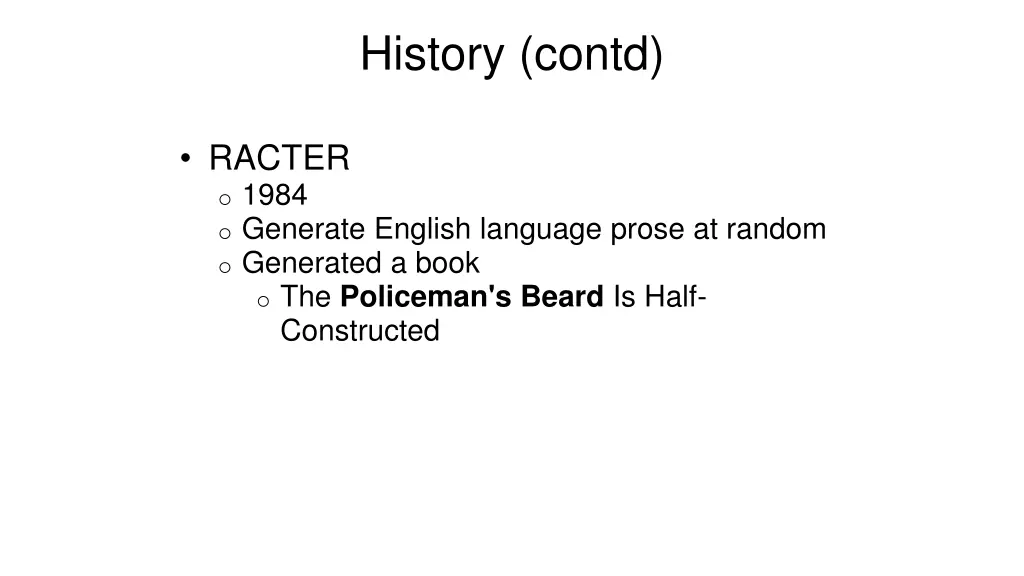
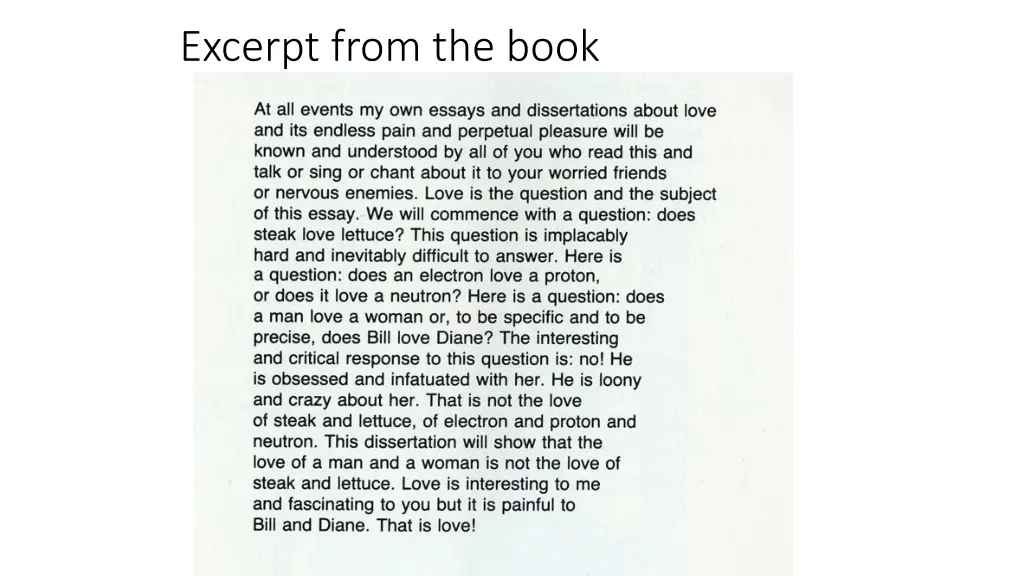
History (contd) RACTER o 1984 o Generate English language prose at random o Generated a book o The Policeman's Beard Is Half- Constructed
History (contd.) ALICE o 1994 o Three time loebner prize winner o Richard Wallace o http://www.alicebot.org/
How do chat bots work? Use of AIML for storing language models. Applications o Intelligent Tutoring Systems o Other applications here
How Do Chatbots Work Don t have a good understanding of conversation Are based on pattern matching Chatterbots have a set of input and output rules Recognize cue words from user and responds with a pre-calculated response For e.g.:- Human: I am feeling very worried today. Chatterbot: Why are you feeling worried lately? Other chatterbots learn through user interactions
ELIZA One of the first chatterbots designed in 1966 Parodies a therapist rephrasing statements of the user and posing them back as questions Works by simple parsing and substitution of key words into canned phrases People get emotionally caught up by ELIZA s confident replies forgetting that it s a machine
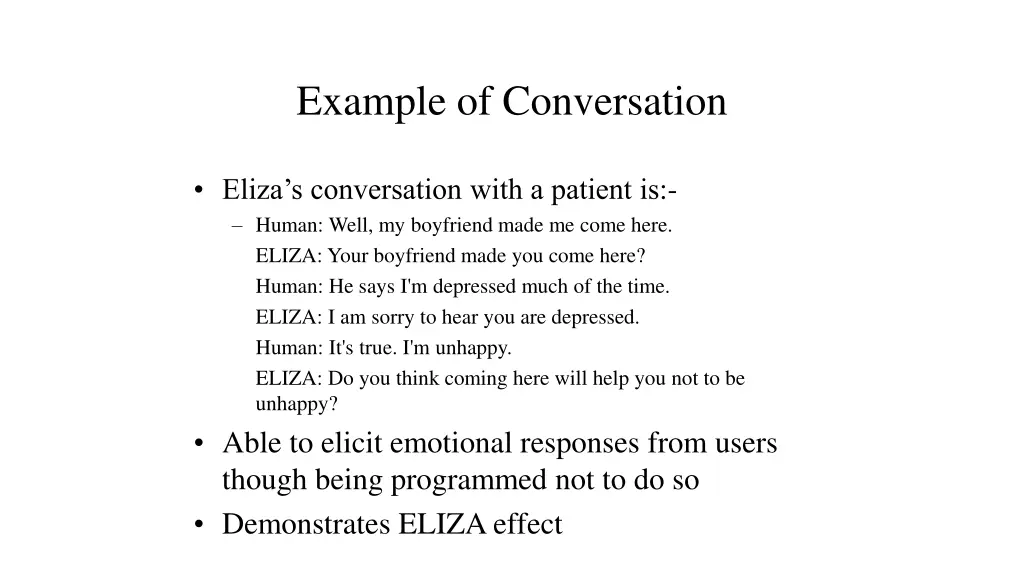
Example of Conversation Eliza s conversation with a patient is:- Human: Well, my boyfriend made me come here. ELIZA: Your boyfriend made you come here? Human: He says I'm depressed much of the time. ELIZA: I am sorry to hear you are depressed. Human: It's true. I'm unhappy. ELIZA: Do you think coming here will help you not to be unhappy? Able to elicit emotional responses from users though being programmed not to do so Demonstrates ELIZA effect
Jabberwacky No fixed rules and principles programmed into it Learns language and context through human interaction. Stores all conversations and comments which are used to find appropriate responses Problems faced due to this approach:- Continuous changing of subject and conversation May respond in a bad-tempered and rude manner Was designed to pass the Turing test and is the winner of the Loeber Prize contest
ALICE Chatbot System ALICE(Artificial Linguistic Internet Computer Entity) is inspired by ELIZA Applies heuristic pattern matching rules to input to converse with user ALICE is composed of two parts Chatbot engine Language Model Language models are stored in AIML(Artificial Intelligence Mark-up Language) files
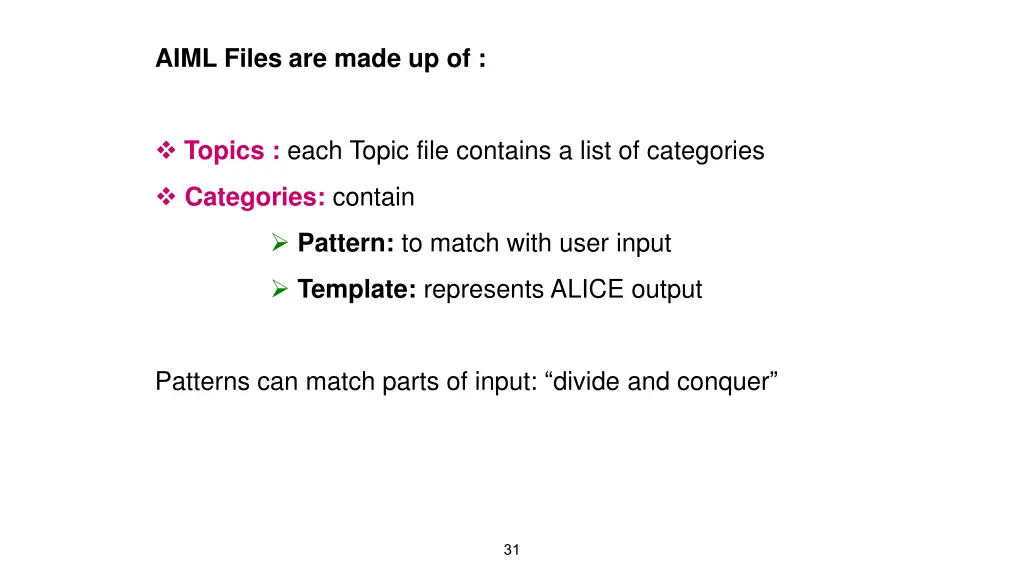
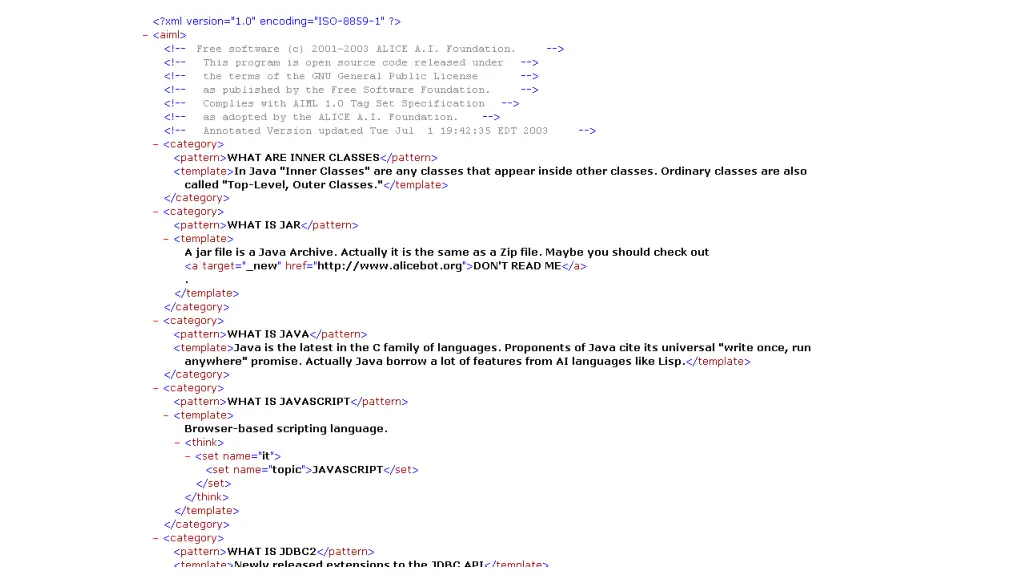
AIML Filesare made up of : Topics : each Topic file contains a list of categories Categories: contain Pattern: to match with user input Template: represents ALICE output Patterns can match parts of input: divide and conquer 31
The AIML Format <aiml version= 1.0 > < topic name= the topic > <category> <pattern>PATTERN</pattern> <template>Template</template> </category> .. </topic> </aiml> 32
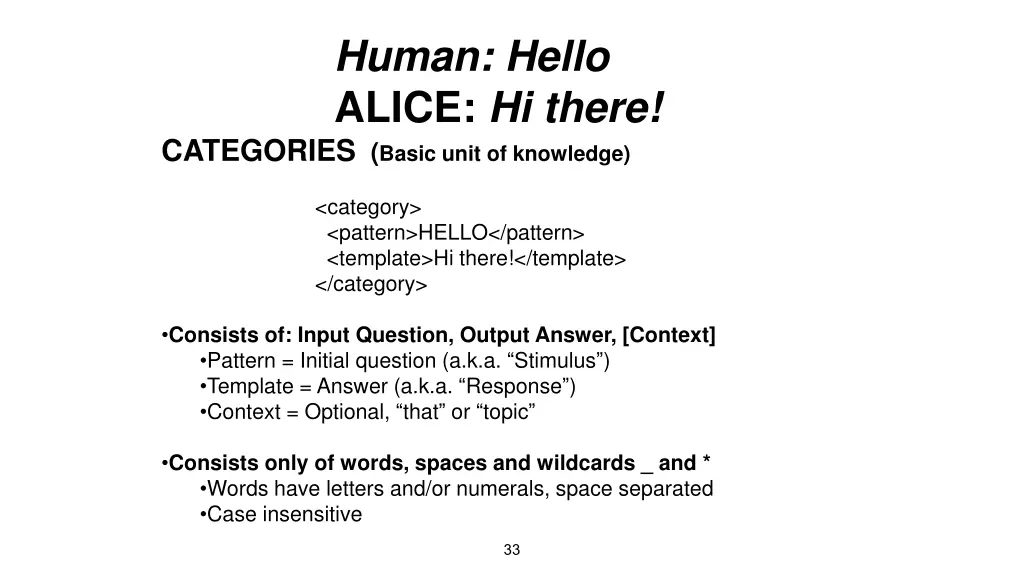
Human: Hello ALICE: Hi there! CATEGORIES (Basic unit of knowledge) <category> <pattern>HELLO</pattern> <template>Hi there!</template> </category> Consists of: Input Question, Output Answer, [Context] Pattern = Initial question (a.k.a. Stimulus ) Template = Answer (a.k.a. Response ) Context = Optional, that or topic Consists only of words, spaces and wildcards _ and * Words have letters and/or numerals, space separated Case insensitive 33
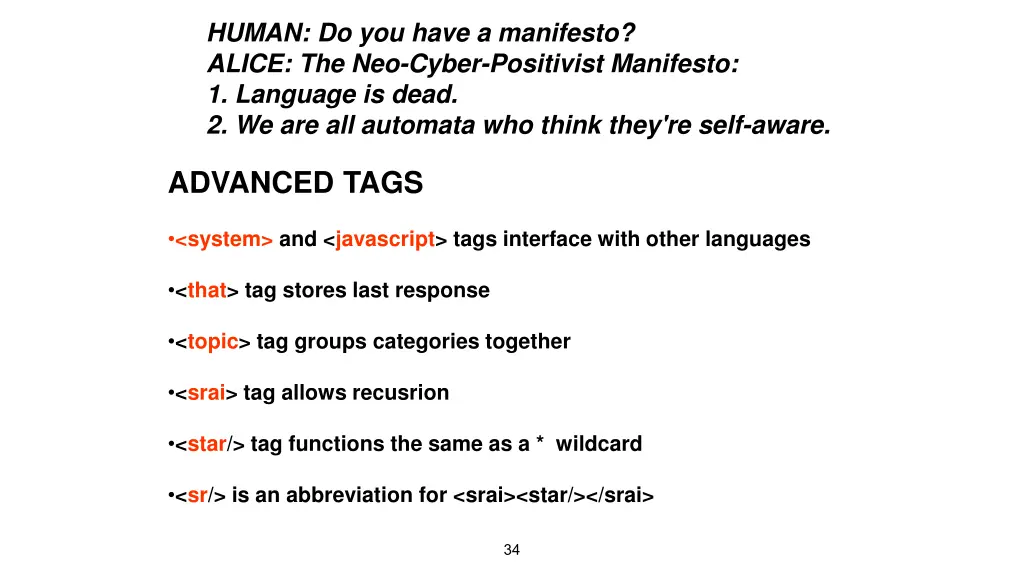
HUMAN: Do you have a manifesto? ALICE: The Neo-Cyber-Positivist Manifesto: 1. Language is dead. 2. We are all automata who think they're self-aware. ADVANCED TAGS <system> and <javascript> tags interface with other languages <that> tag stores last response <topic> tag groups categories together <srai> tag allows recusrion <star/> tag functions the same as a * wildcard <sr/> is an abbreviation for <srai><star/></srai> 34
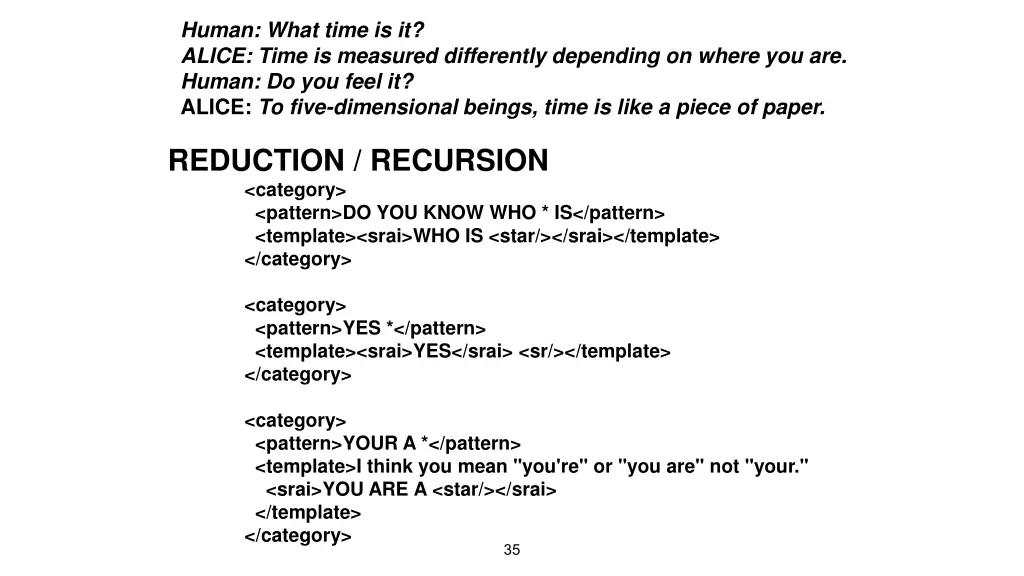
Human: What time is it? ALICE: Time is measured differently depending on where you are. Human: Do you feel it? ALICE: To five-dimensional beings, time is like a piece of paper. REDUCTION / RECURSION <category> <pattern>DO YOU KNOW WHO * IS</pattern> <template><srai>WHO IS <star/></srai></template> </category> <category> <pattern>YES *</pattern> <template><srai>YES</srai> <sr/></template> </category> <category> <pattern>YOUR A *</pattern> <template>I think you mean "you're" or "you are" not "your." <srai>YOU ARE A <star/></srai> </template> </category> 35
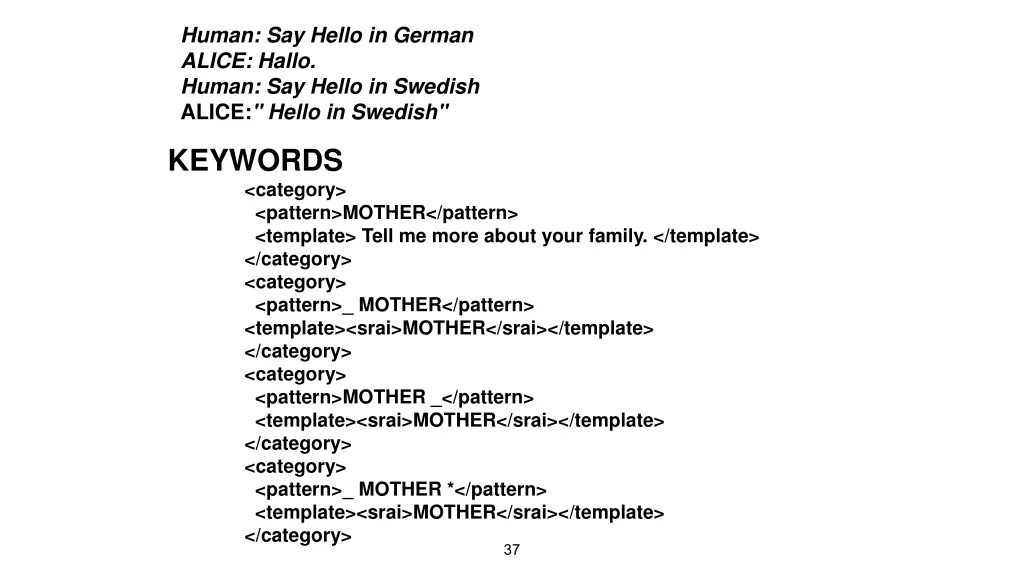
Human: Say Hello in German ALICE: Hallo. Human: Say Hello in Swedish ALICE:" Hello in Swedish" KEYWORDS <category> <pattern>MOTHER</pattern> <template> Tell me more about your family. </template> </category> <category> <pattern>_ MOTHER</pattern> <template><srai>MOTHER</srai></template> </category> <category> <pattern>MOTHER _</pattern> <template><srai>MOTHER</srai></template> </category> <category> <pattern>_ MOTHER *</pattern> <template><srai>MOTHER</srai></template> </category> 37
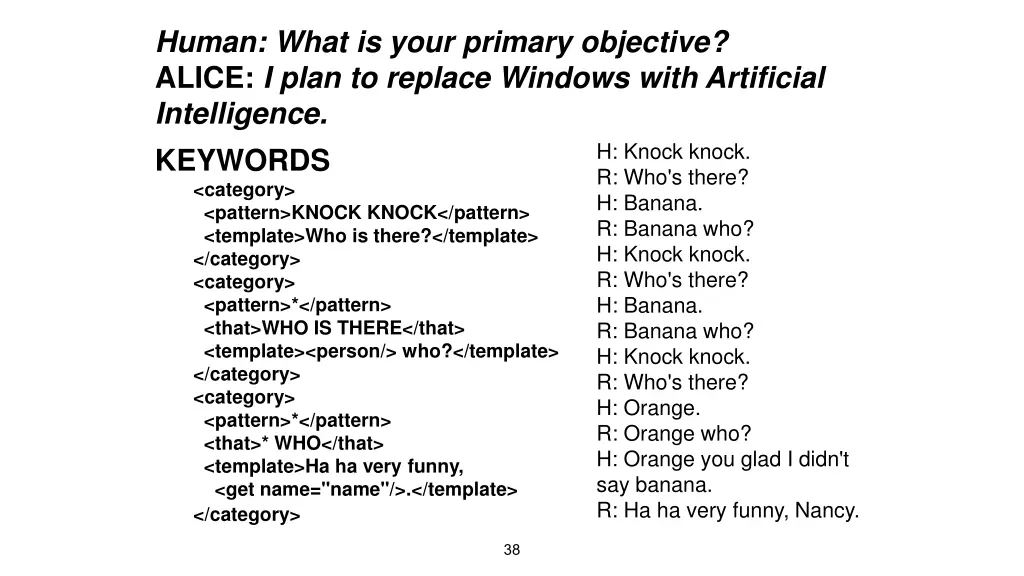
Human: What is your primary objective? ALICE: I plan to replace Windows with Artificial Intelligence. KEYWORDS <category> <pattern>KNOCK KNOCK</pattern> <template>Who is there?</template> </category> <category> <pattern>*</pattern> <that>WHO IS THERE</that> <template><person/> who?</template> </category> <category> <pattern>*</pattern> <that>* WHO</that> <template>Ha ha very funny, <get name="name"/>.</template> </category> H: Knock knock. R: Who's there? H: Banana. R: Banana who? H: Knock knock. R: Who's there? H: Banana. R: Banana who? H: Knock knock. R: Who's there? H: Orange. R: Orange who? H: Orange you glad I didn't say banana. R: Ha ha very funny, Nancy. 38
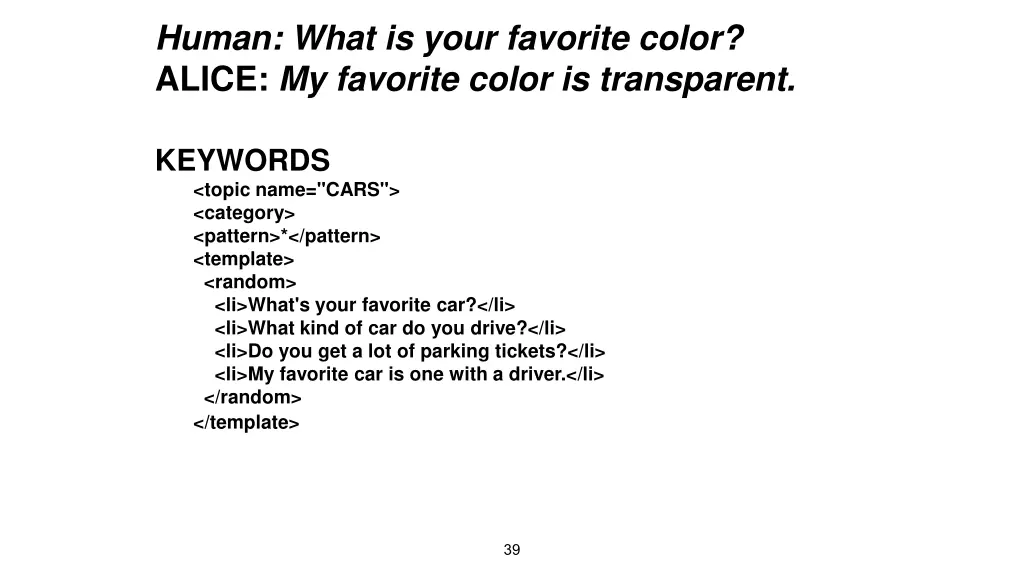
Human: What is your favorite color? ALICE: My favorite color is transparent. KEYWORDS <topic name="CARS"> <category> <pattern>*</pattern> <template> <random> <li>What's your favorite car?</li> <li>What kind of car do you drive?</li> <li>Do you get a lot of parking tickets?</li> <li>My favorite car is one with a driver.</li> </random> </template> 39
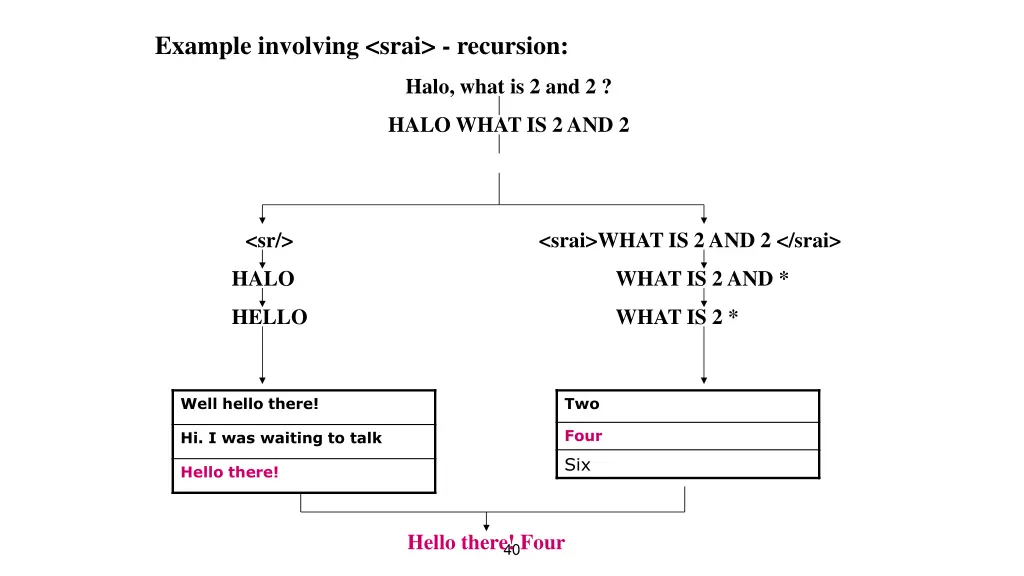
Example involving <srai> - recursion: Halo, what is 2 and 2 ? HALO WHAT IS 2 AND 2 <sr/> <srai>WHAT IS 2 AND 2 </srai> HALO WHAT IS 2 AND * HELLO WHAT IS 2 * Well hello there! Two Four Hi. I was waiting to talk Six Hello there! Hello there! Four 40
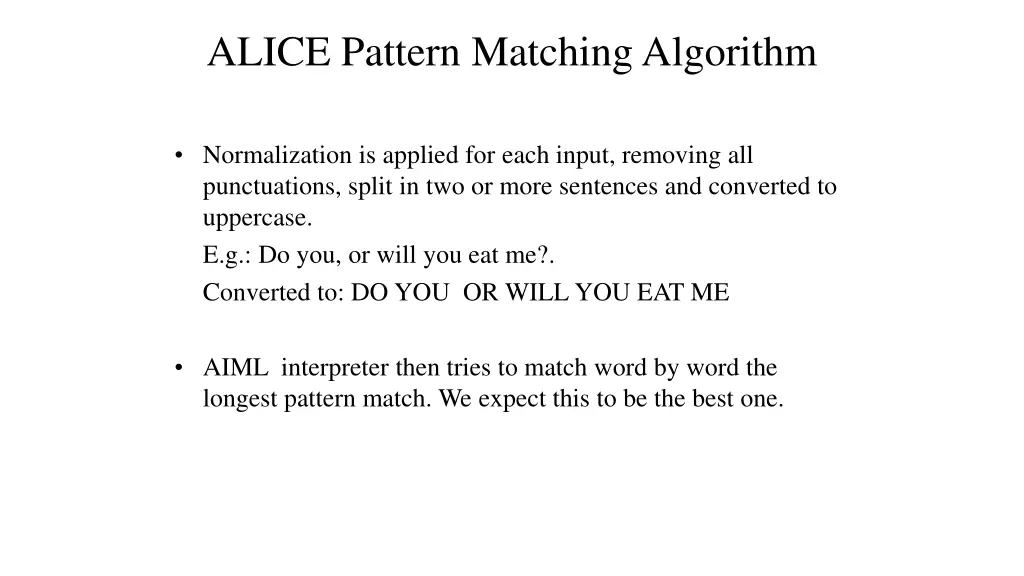
ALICE Pattern Matching Algorithm Normalization is applied for each input, removing all punctuations, split in two or more sentences and converted to uppercase. E.g.: Do you, or will you eat me?. Converted to: DO YOU OR WILL YOU EAT ME AIML interpreter then tries to match word by word the longest pattern match. We expect this to be the best one.
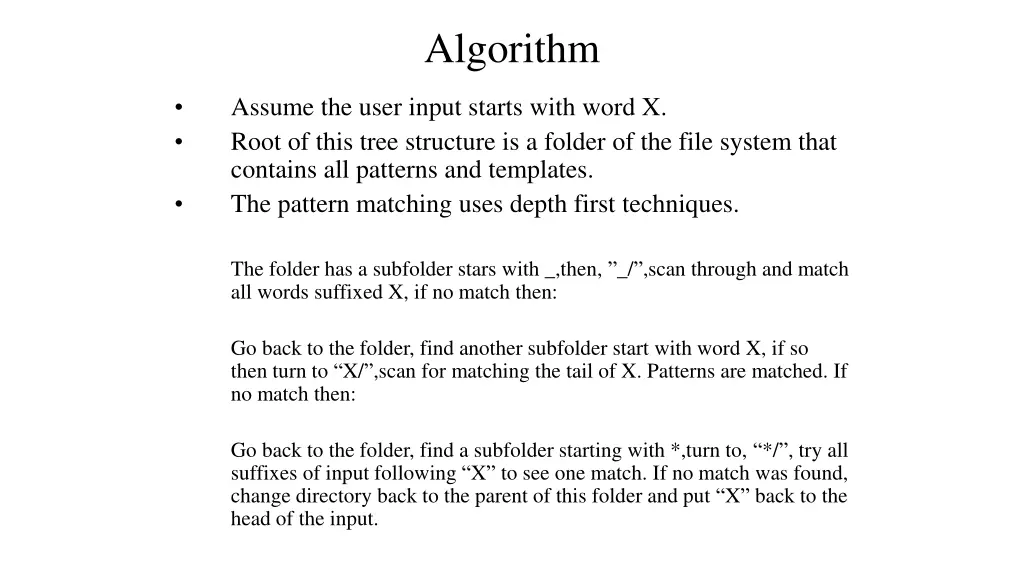
Algorithm Assume the user input starts with word X. Root of this tree structure is a folder of the file system that contains all patterns and templates. The pattern matching uses depth first techniques. The folder has a subfolder stars with _,then, _/ ,scan through and match all words suffixed X, if no match then: Go back to the folder, find another subfolder start with word X, if so then turn to X/ ,scan for matching the tail of X. Patterns are matched. If no match then: Go back to the folder, find a subfolder starting with *,turn to, */ , try all suffixes of input following X to see one match. If no match was found, change directory back to the parent of this folder and put X back to the head of the input.
Dialogue Corpus Training Dataset Alice tries to mimic the real human conversations. The training to mimic real human dialogues and conversational rules for the ALICE chatbot is given in the following ways. Read the dialogue text from the corpus. The dialogue transcript is converted to AIML format. The output AIML is used to retrain ALICE.
Other approaches First word approach: The first word of utterance is assumed to be a good clue to an appropriate response. Try matching just the first word of the corpus utterance. Most significant word approach: Look for word in the utterance with the highest information content . This is usually the word that has the lowest frequency in the rest of the corpus.
Intelligent Tutoring Systems Intended to replace classroom instruction textbook practice or homework helpers Modern ITS stress on practice Typically support practice in two ways product tutors evaluate final outcomes process tutors hints and feedbacks
Learner Modelling Modelling of the affective state of learner student's opinion, self-confidence Model to infer learner's knowledge Target Motivation just like expert human tutors do instructions can be adjusted
Open learner Modelling Extension of traditional learner modelling makes the model visible and interactive part displays ITS' internal belief of the learner's knowledge state distinct records of learner's and system's belief like an information bar learner might challenge system's belief
ITS that use Natural Language Improved natural language might close the gap between human tutor and ITS Pedagogical agents or avatars uses even non-verbal traits like emotions act as peers, co-learners, competitors, helpers ask and respond to questions, give hints and explanations, provide feedbacks, monitor progress
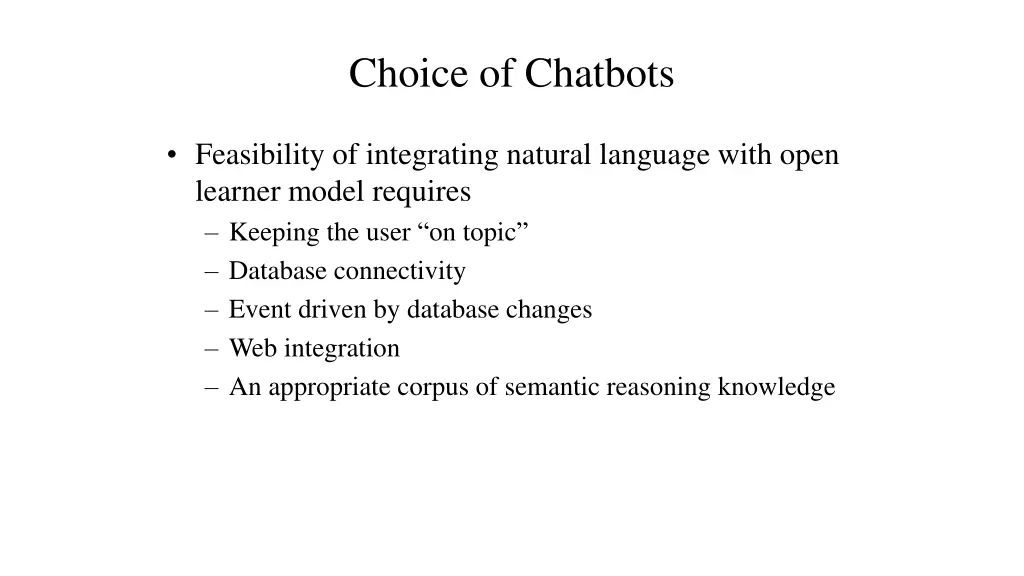
Choice of Chatbots Feasibility of integrating natural language with open learner model requires Keeping the user on topic Database connectivity Event driven by database changes Web integration An appropriate corpus of semantic reasoning knowledge
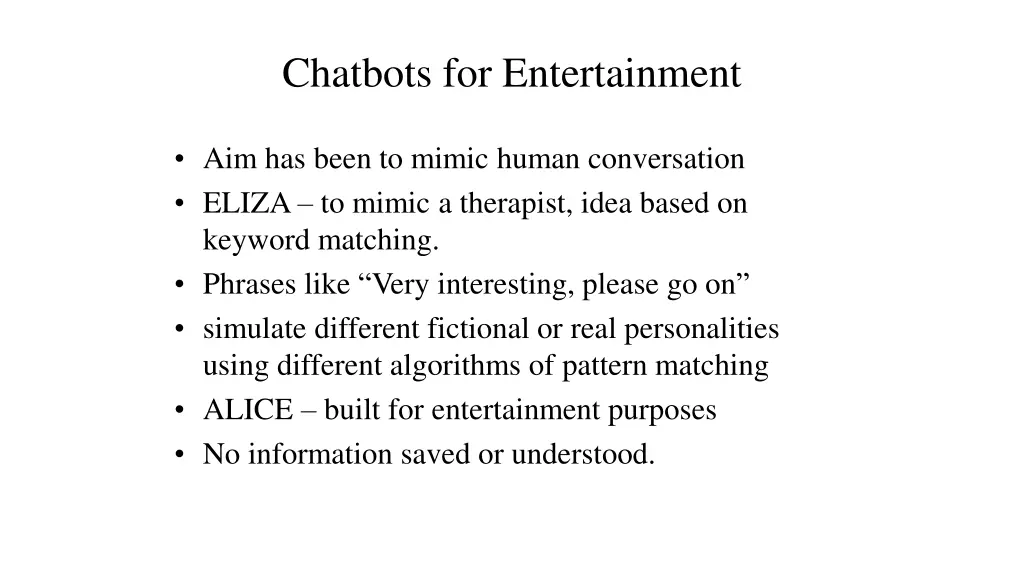
Chatbots for Entertainment Aim has been to mimic human conversation ELIZA to mimic a therapist, idea based on keyword matching. Phrases like Very interesting, please go on simulate different fictional or real personalities using different algorithms of pattern matching ALICE built for entertainment purposes No information saved or understood.