Natural Language Processing Vector Semantics and Embeddings
Delve into the intricacies of word meaning as interpreted through lexical semantics and senses. Understand how words, lemmas, senses, and definitions play a crucial role in representing the nuanced meanings of words. Explore concepts like synonymity and how relationships between words and senses contribute to understanding the richness of language.

Download Presentation

Please find below an Image/Link to download the presentation.
The content on the website is provided AS IS for your information and personal use only. It may not be sold, licensed, or shared on other websites without obtaining consent from the author.If you encounter any issues during the download, it is possible that the publisher has removed the file from their server.
You are allowed to download the files provided on this website for personal or commercial use, subject to the condition that they are used lawfully. All files are the property of their respective owners.
The content on the website is provided AS IS for your information and personal use only. It may not be sold, licensed, or shared on other websites without obtaining consent from the author.
E N D
Presentation Transcript
Natural Language Processing Vector Semantics and Embeddings Demetris Paschalides Department of Computer Science University of Cyprus
What is the meaning of Words? From N-Gram and Text Classification: Words are sequences of letters, or indices wiin a vocabulary list.
What is the meaning of Words? From N-Gram and Text Classification: Words are sequences of letters, or indices wiin a vocabulary list. How can we represent the meaning of a word?
What is the meaning of Words? From N-Gram and Text Classification: Words are sequences of letters, or indices wiin a vocabulary list. How can we represent the meaning of a word? Look at Lexical Semantics, the linguistic study of word meaning. Words, lemmas, senses, definitions
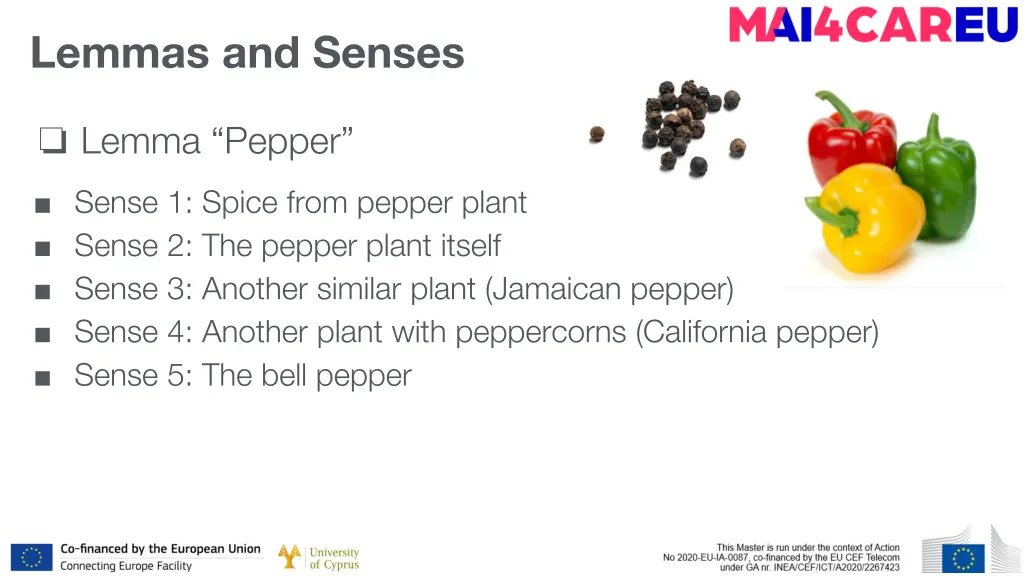
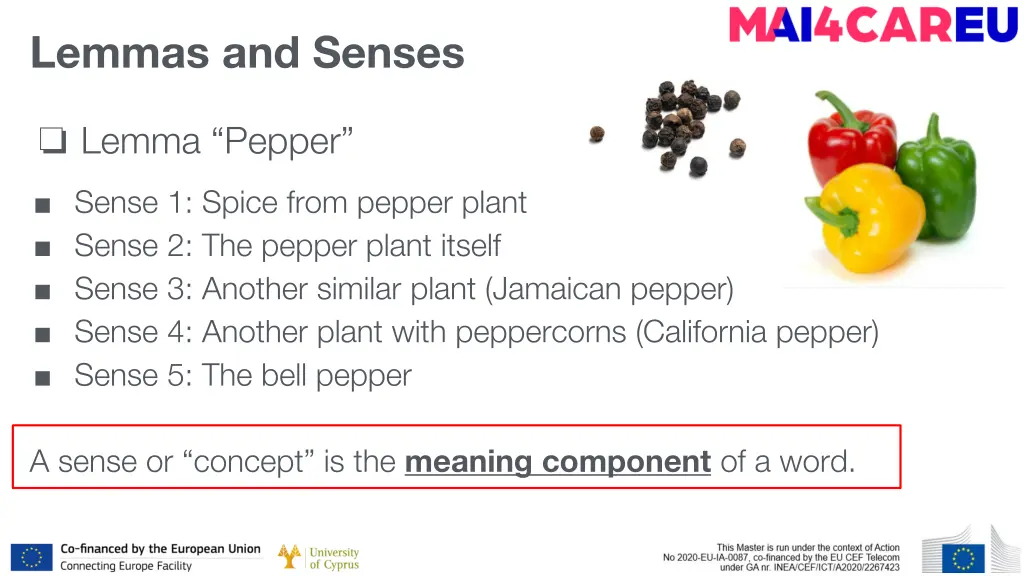
Lemmas and Senses Lemma Pepper Sense 1: Spice from pepper plant Sense 2: The pepper plant itself Sense 3: Another similar plant (Jamaican pepper) Sense 4: Another plant with peppercorns (California pepper) Sense 5: The bell pepper
Lemmas and Senses Lemma Pepper Sense 1: Spice from pepper plant Sense 2: The pepper plant itself Sense 3: Another similar plant (Jamaican pepper) Sense 4: Another plant with peppercorns (California pepper) Sense 5: The bell pepper A sense or concept is the meaning component of a word.
Lemmas and Senses Lemma Mouse Sense 1: Any numerous small rodents. Sense 2: A hand-operated device that controls a cursor.
Lemmas and Senses Lemma Mouse Sense 1: Any numerous small rodents. Sense 2: A hand-operated device that controls a cursor. How should we represent the meaning of a word? Use of words, lemmas, senses, and definitions Use of relationships between words or senses
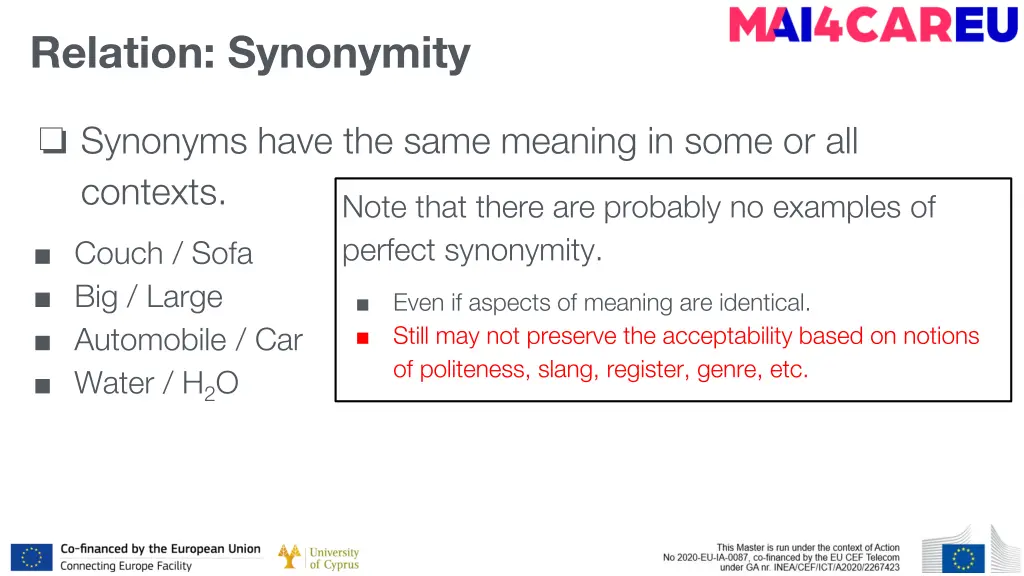
Relation: Synonymity Synonyms have the same meaning in some or all contexts. Couch / Sofa Big / Large Automobile / Car Water / H2O
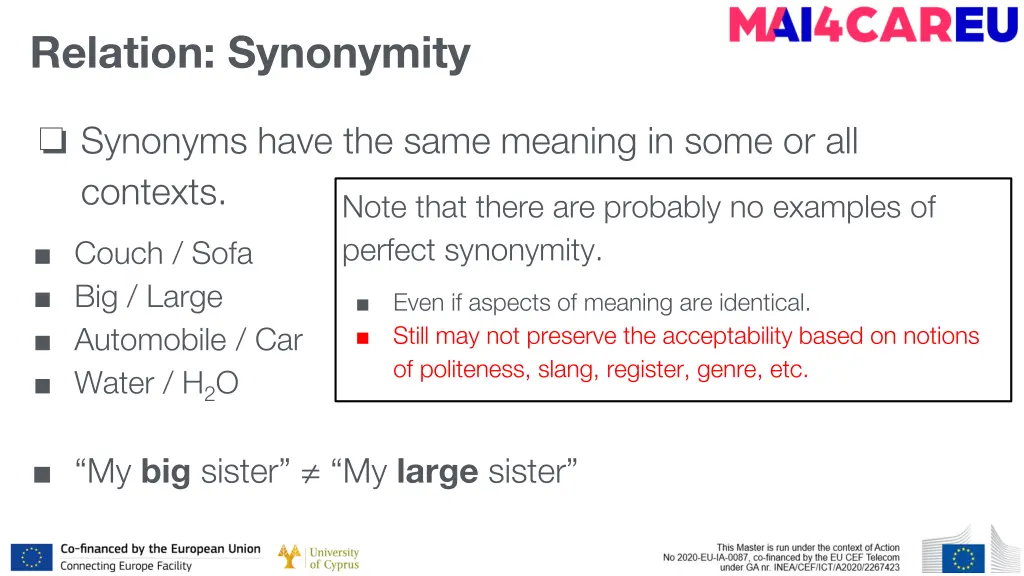
Relation: Synonymity Synonyms have the same meaning in some or all contexts. Note that there are probably no examples of perfect synonymity. Couch / Sofa Big / Large Automobile / Car Water / H2O Even if aspects of meaning are identical. Still may not preserve the acceptability based on notions of politeness, slang, register, genre, etc.
Relation: Synonymity Synonyms have the same meaning in some or all contexts. Note that there are probably no examples of perfect synonymity. Couch / Sofa Big / Large Automobile / Car Water / H2O Even if aspects of meaning are identical. Still may not preserve the acceptability based on notions of politeness, slang, register, genre, etc. My big sister My large sister
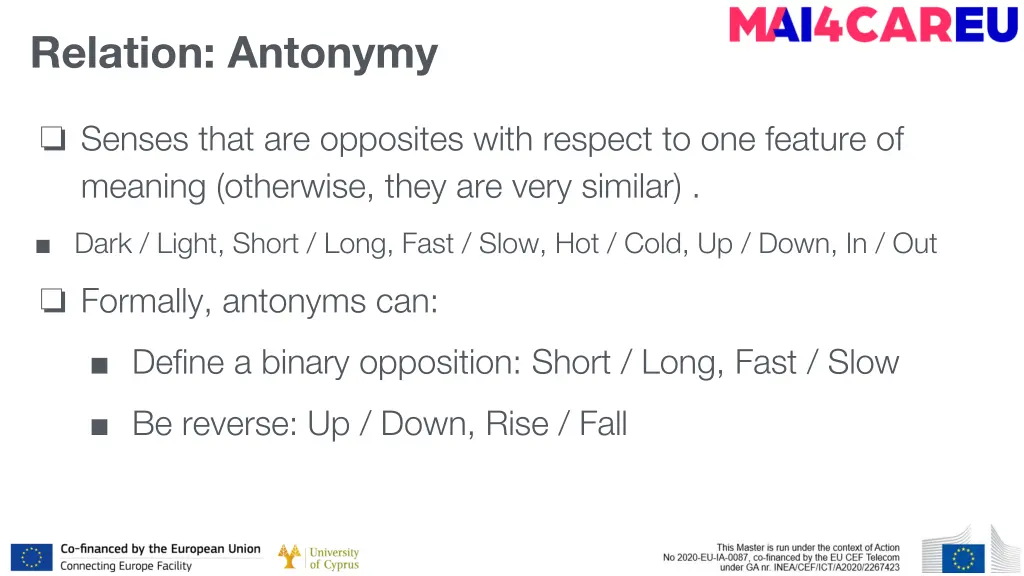
Relation: Antonymy Senses that are opposites with respect to one feature of meaning (otherwise, they are very similar) . Dark / Light, Short / Long, Fast / Slow, Hot / Cold, Up / Down, In / Out Formally, antonyms can: Define a binary opposition: Short / Long, Fast / Slow Be reverse: Up / Down, Rise / Fall
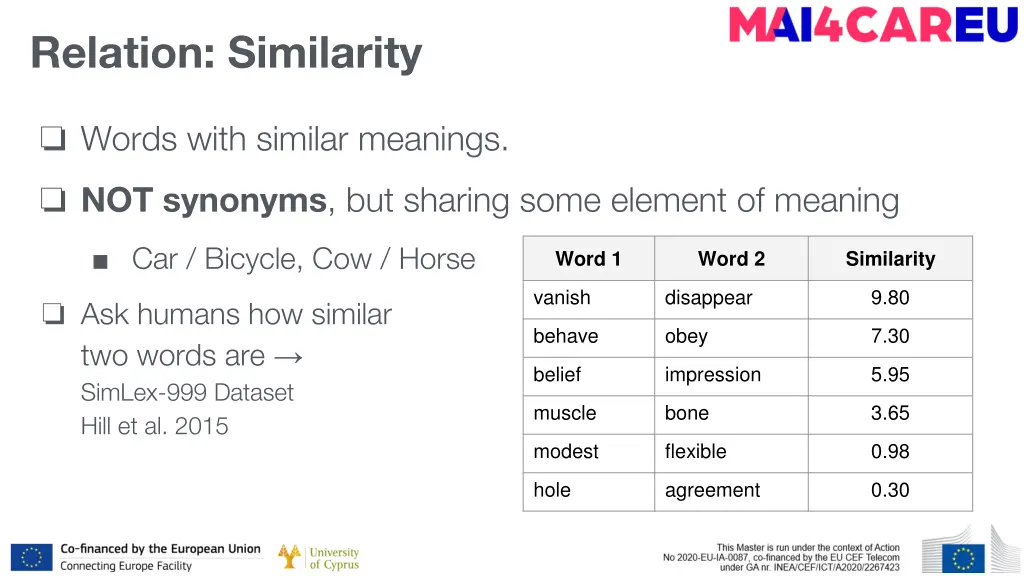
Relation: Similarity Words with similar meanings. NOT synonyms, but sharing some element of meaning Car / Bicycle, Cow / Horse Ask humans how similar two words are SimLex-999 Dataset Hill et al. 2015 Word 1 Word 2 Similarity vanish disappear 9.80 behave obey 7.30 belief impression 5.95 muscle bone 3.65 modest flexible 0.98 hole agreement 0.30
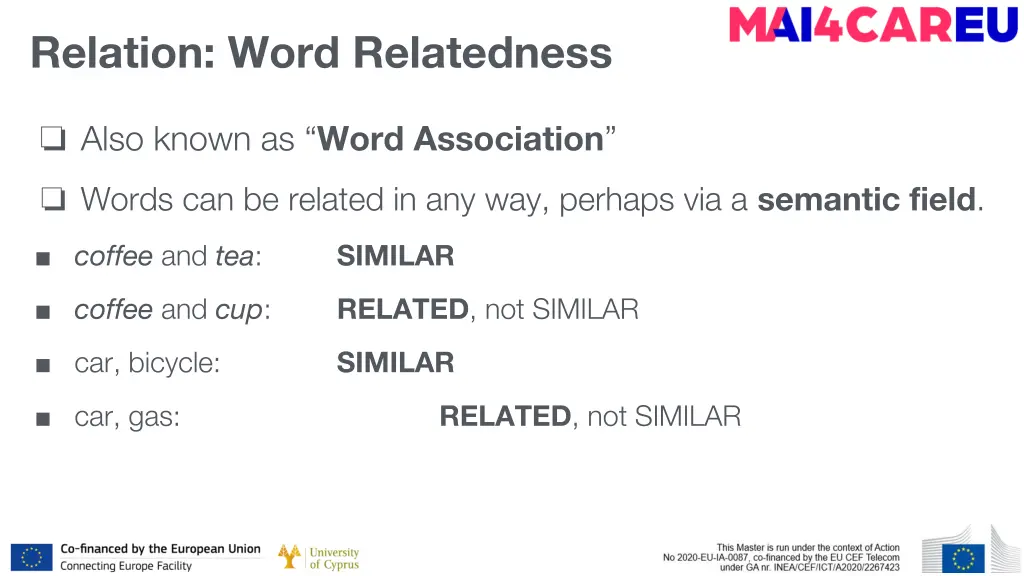
Relation: Word Relatedness Also known as Word Association Words can be related in any way, perhaps via a semantic field. coffee and tea: SIMILAR coffee and cup: RELATED, not SIMILAR car, bicycle: SIMILAR car, gas: RELATED, not SIMILAR
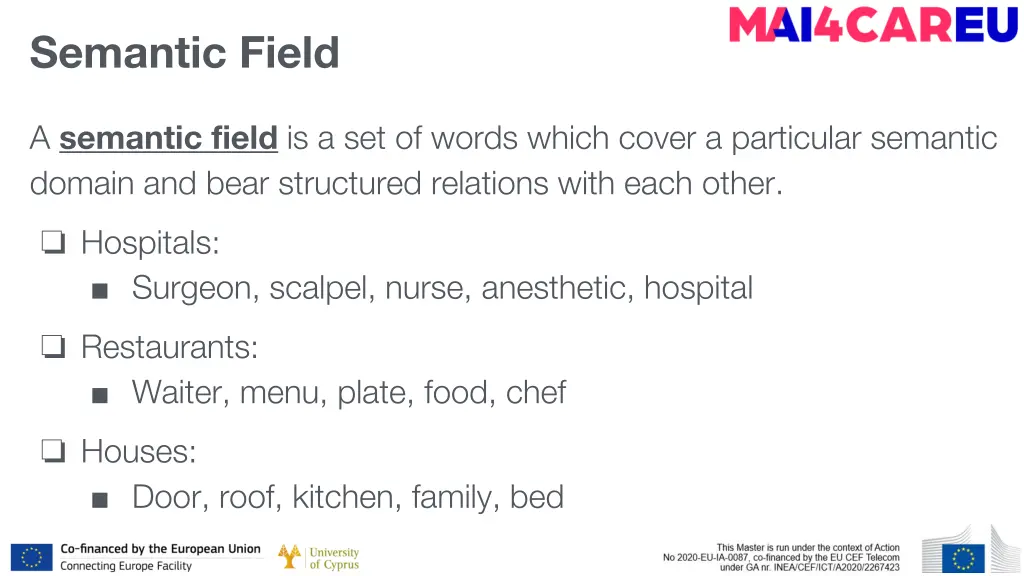
Semantic Field A semantic field is a set of words which cover a particular semantic domain and bear structured relations with each other. Hospitals: Surgeon, scalpel, nurse, anesthetic, hospital Restaurants: Waiter, menu, plate, food, chef Houses: Door, roof, kitchen, family, bed
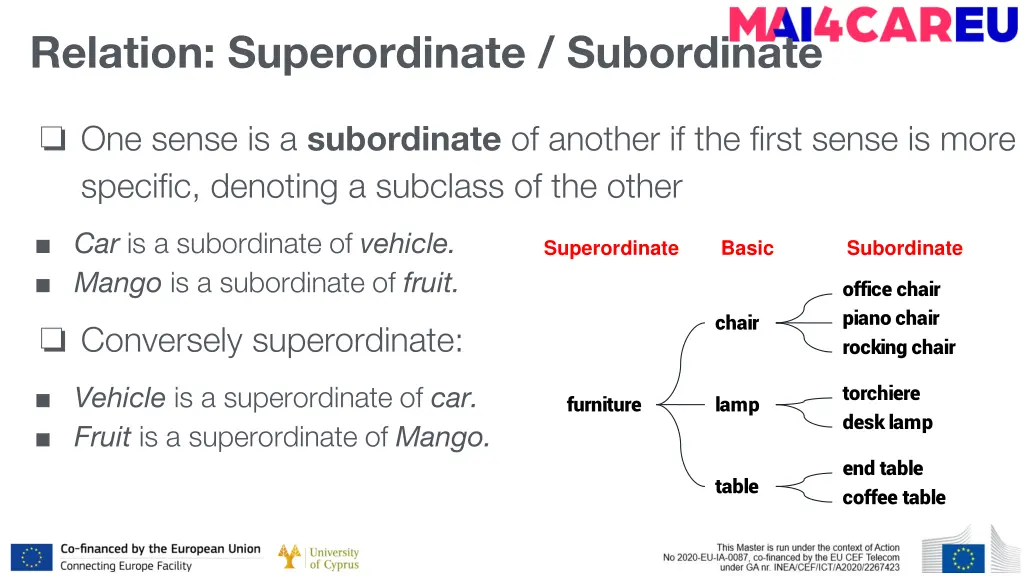
Relation: Superordinate / Subordinate One sense is a subordinate of another if the first sense is more specific, denoting a subclass of the other Car is a subordinate of vehicle. Mango is a subordinate of fruit. Conversely superordinate: Superordinate Basic Subordinate office chair piano chair rocking chair chair torchiere desk lamp Vehicle is a superordinate of car. Fruit is a superordinate of Mango. furniture lamp end table coffee table table
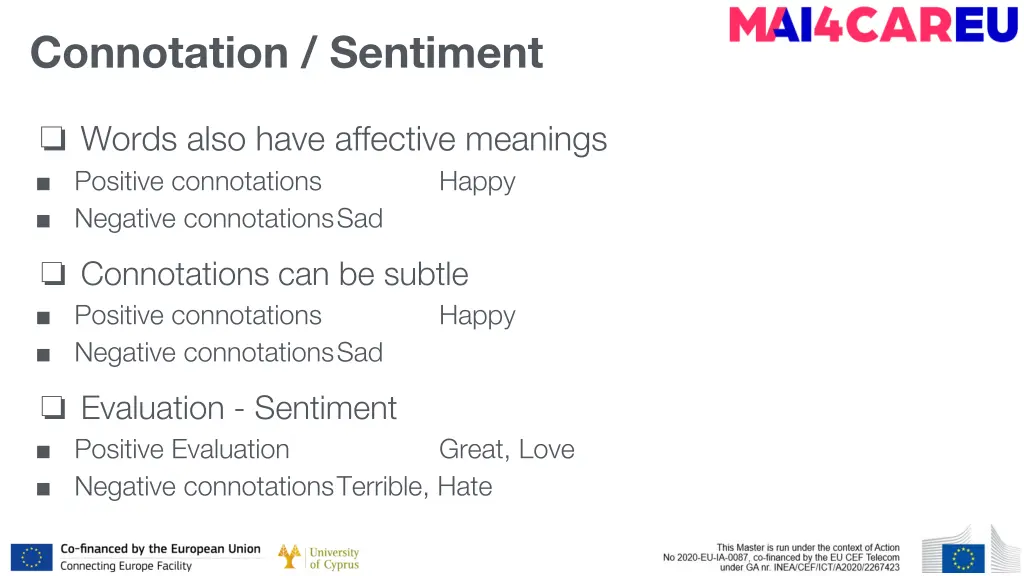
Connotation / Sentiment Words also have affective meanings Positive connotations Negative connotationsSad Connotations can be subtle Positive connotations Negative connotationsSad Evaluation - Sentiment Positive Evaluation Negative connotationsTerrible, Hate Happy Happy Great, Love
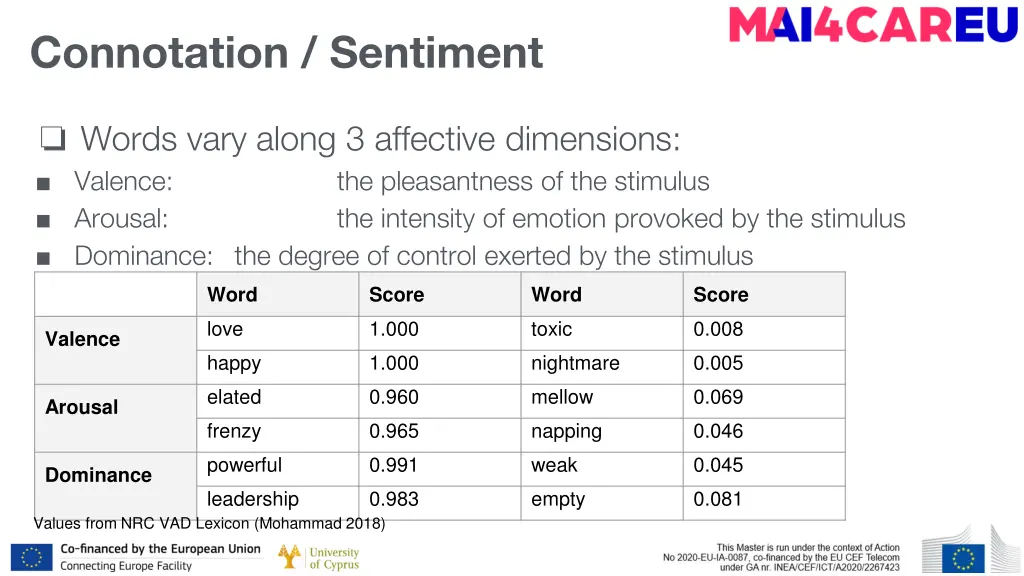
Connotation / Sentiment Words vary along 3 affective dimensions: Valence: the pleasantness of the stimulus Arousal: the intensity of emotion provoked by the stimulus Dominance: the degree of control exerted by the stimulus Word Score Word Score love 1.000 toxic 0.008 Valence happy 1.000 nightmare 0.005 elated 0.960 mellow 0.069 Arousal frenzy 0.965 napping 0.046 powerful 0.991 weak 0.045 Dominance leadership 0.983 empty 0.081 Values from NRC VAD Lexicon (Mohammad 2018)
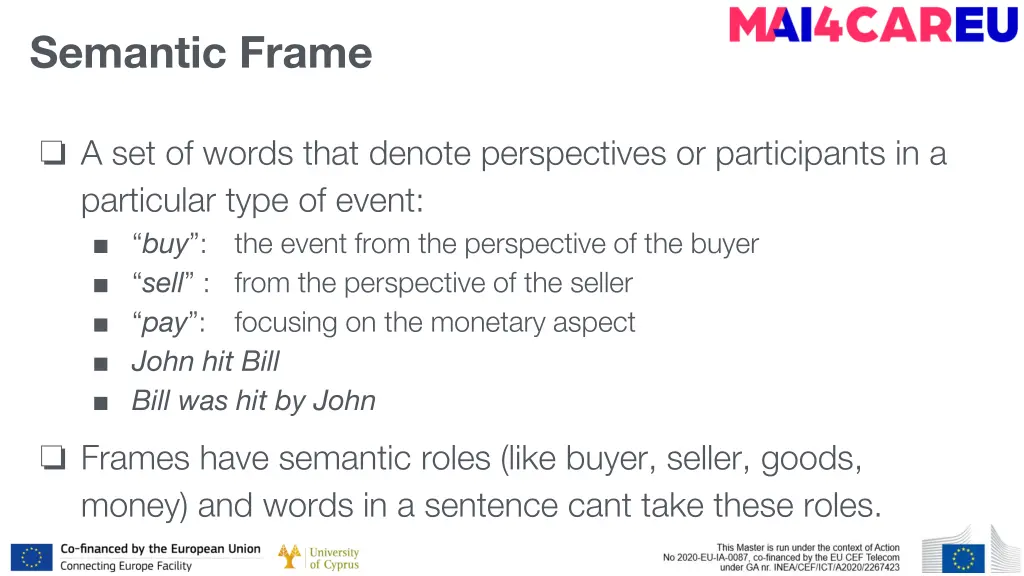
Semantic Frame A set of words that denote perspectives or participants in a particular type of event: buy : the event from the perspective of the buyer sell : from the perspective of the seller pay : focusing on the monetary aspect John hit Bill Bill was hit by John Frames have semantic roles (like buyer, seller, goods, money) and words in a sentence cant take these roles.
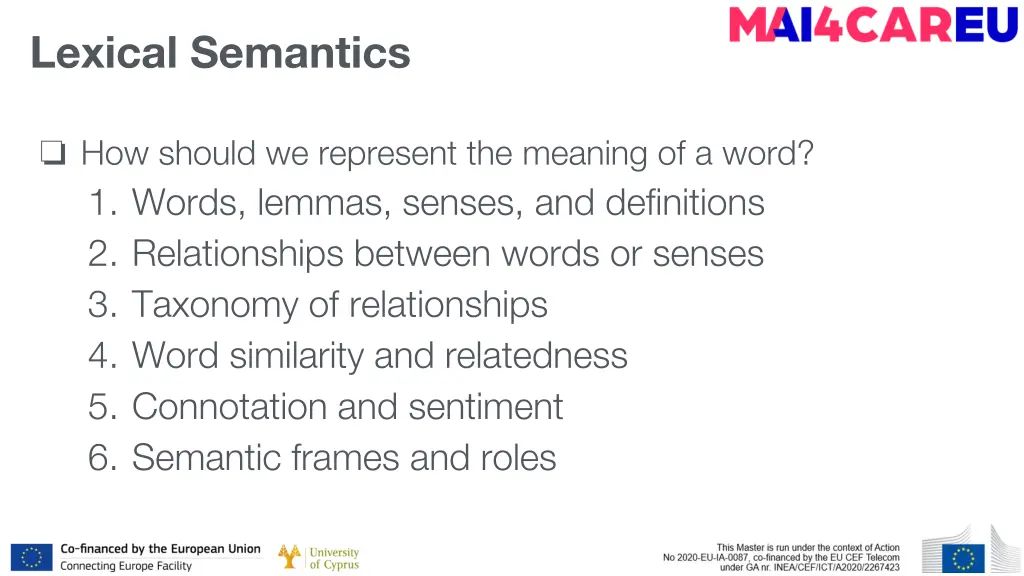
Lexical Semantics How should we represent the meaning of a word? 1. Words, lemmas, senses, and definitions 2. Relationships between words or senses 3. Taxonomy of relationships 4. Word similarity and relatedness 5. Connotation and sentiment 6. Semantic frames and roles
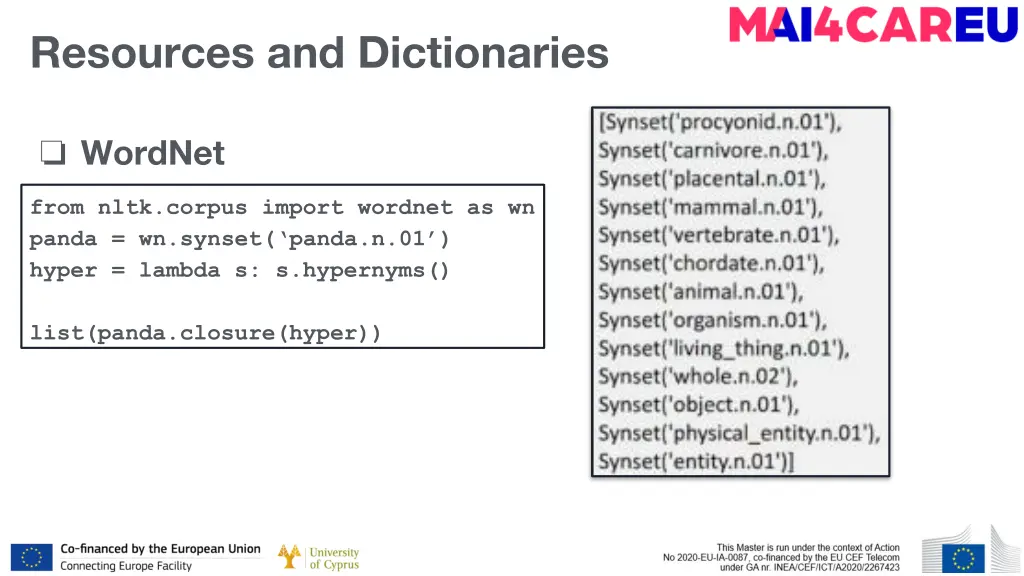
Resources and Dictionaries WordNet from nltk.corpus import wordnet as wn panda = wn.synset( panda.n.01 ) hyper = lambda s: s.hypernyms() list(panda.closure(hyper))
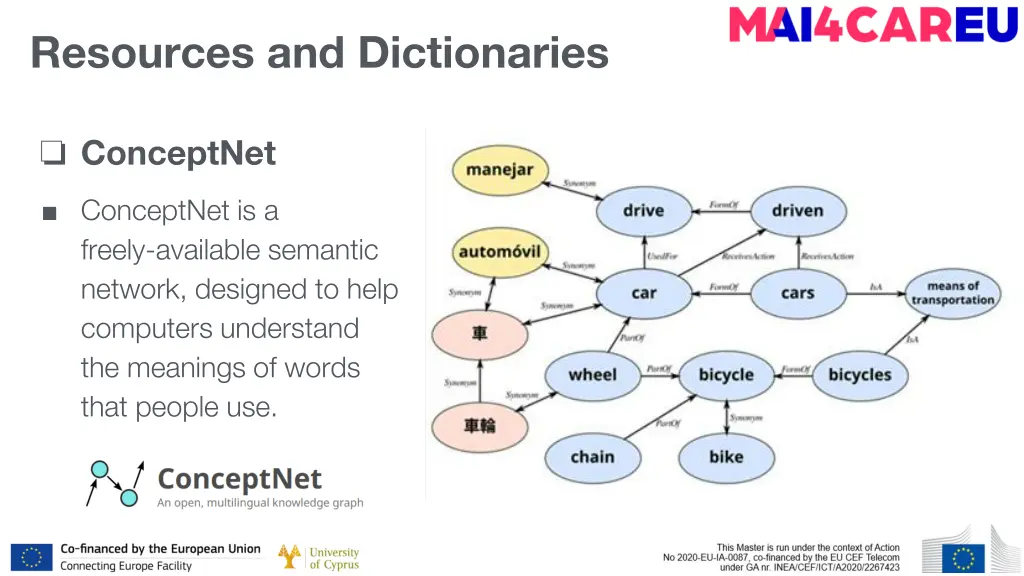
Resources and Dictionaries ConceptNet ConceptNet is a freely-available semantic network, designed to help computers understand the meanings of words that people use.
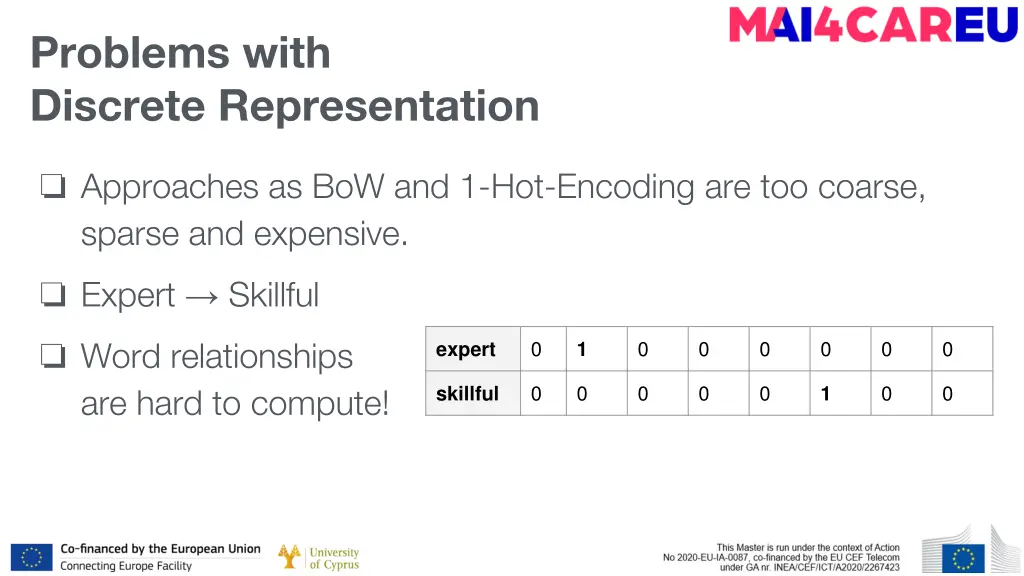
Problems with Discrete Representation Approaches as BoW and 1-Hot-Encoding are too coarse, sparse and expensive. Expert Skillful Word relationships are hard to compute! 0 0 0 0 0 0 0 expert 1 0 0 0 0 0 0 0 skillful 1
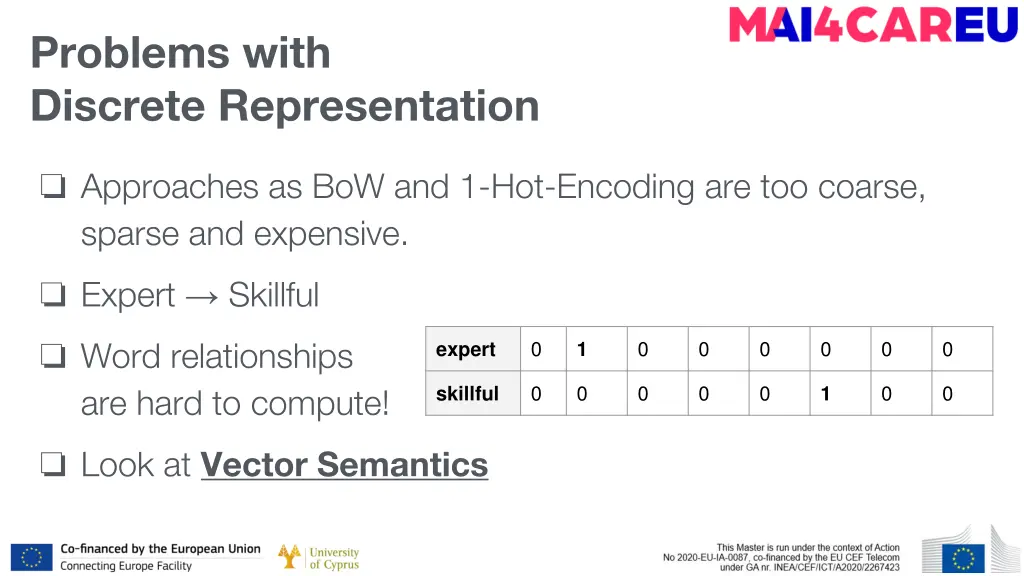
Problems with Discrete Representation Approaches as BoW and 1-Hot-Encoding are too coarse, sparse and expensive. Expert Skillful Word relationships are hard to compute! Look at Vector Semantics 0 0 0 0 0 0 0 expert 1 0 0 0 0 0 0 0 skillful 1
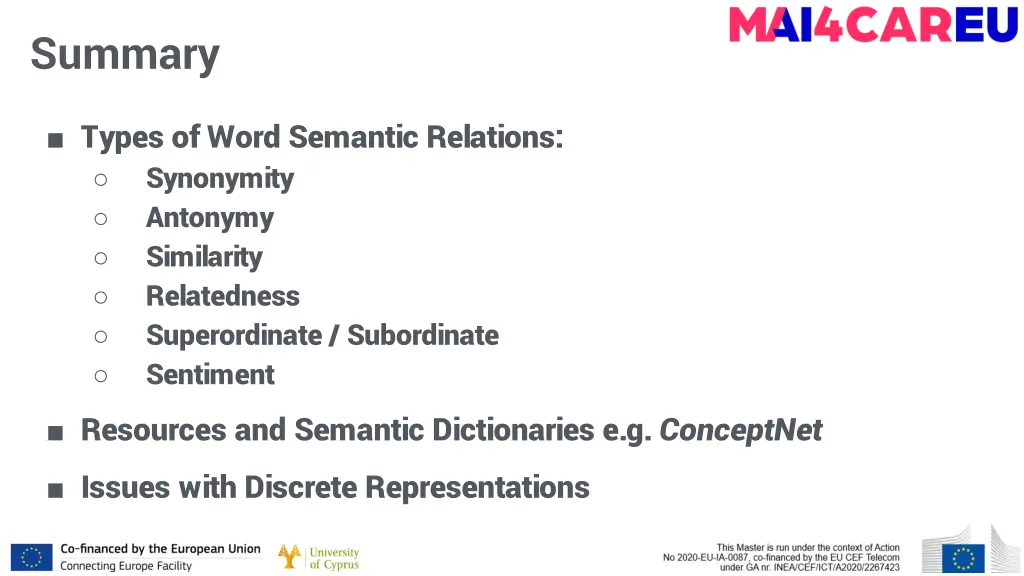
Summary Types of Word Semantic Relations: Synonymity Antonymy Similarity Relatedness Superordinate / Subordinate Sentiment Resources and Semantic Dictionaries e.g. ConceptNet Issues with Discrete Representations
Resources Jurafsky, D. and H. Martin Justin, Chapter 6. "Vector Semantics and Embeddings" Speech and Language Processing ConceptNet: https://conceptnet.io/ WordNet: https://wordnet.princeton.edu/