Nature and Concept of Person in Law
Explore the nature and concept of person in law, distinguishing between legal entities and human beings. Learn about the definition of a person, their rights, duties, and legal status, including insights on lower animals, dead persons, and the legal status of unborn individuals.

Download Presentation

Please find below an Image/Link to download the presentation.
The content on the website is provided AS IS for your information and personal use only. It may not be sold, licensed, or shared on other websites without obtaining consent from the author. If you encounter any issues during the download, it is possible that the publisher has removed the file from their server.
You are allowed to download the files provided on this website for personal or commercial use, subject to the condition that they are used lawfully. All files are the property of their respective owners.
The content on the website is provided AS IS for your information and personal use only. It may not be sold, licensed, or shared on other websites without obtaining consent from the author.
E N D
Presentation Transcript
Unit I Nature and Concept of Person By Dr Pramod Kumar
Nature and Concept of Person In our daily life, we use the term person as a human being, either man or woman. On the other hand, in law, a person means a distinct, separate legal entity recognized by law, which possesses various legal rights like to sue and be sued by others, to enter into contract with others, to acquire property(both movable and immovable) in its name, to appear before a court either by itself or by its lawyer.
Definition of Person The term person has several meanings. It has been derived from the word personare which meant mask. This mask was used to cover the face of actors who used to recite verses during the scene of a drama. The purpose of wearing the mask was to make the actors voice vibrant and loud. According to Kelson, juristic persons and natural persons have been defined by their rights and liabilities which have been taken together and are expressed through the concept of person .
Definition of Person According to Salmond A person is any being whom the law regards as capable of rights or duties . Any being that is so capable is a person, whether a human being or not and no being that is not so capable is a person, even though, he be a man . persons are the substances of which rights and duties are the attributes. It is only in respect that person possesses juridical significance and this is the exclusive point of view from which personality receives legal recognition.
Legal status of lower animals The only natural persons are human being Beast are not persons, either natural or legal Object of legal rights and duties but never the subject of them. Law is made for men and allows no fellowship or bonds of obligation between men and lower animals.
Legal Status of Dead persons The personality of human being commences its existence on birth and ceases to exit at death. Dead are no longer persons in the eye of law. They have no rights because they no interest Without conferring rights upon the dead, law recognizes and takes account after the death of a person of his desires and interests when alive. The reputation of a dead person receives some degree of protection from criminal law. ( Williams v. Williams)
Status of unborn person Unborn person possess legal personality There is nothing in law to prevent a man from owning property before he is born His ownership is contingent as he may never be born at all, but it is a real and present ownership No testator can direct his fortune to be accumulated for a hundred years and then distributed among his descended
Status of unborn person To what extent an unborn person can posses personal and proprietary rights is a somewhat unsettled question all right of unborn person ,whether personal and proprietary ,all are contingent on his birth as a living human being. A posthumous child may inherit, but if he dies in the womb or still born ,his inheritance fails to take effect and no one can claim through him
Theories of Juristic Personality Fiction Theory This theory was put forward by Von Savigny, Salmond, Coke, Blackstone, and Holland etc According to this theory, the personality of a corporation is different from that of its members. Savigny regarded corporation as an exclusive creation of law having no existence apart from its individual members who form the corporate group and whose acts are attributed to the corporate entity. As a result of this, any change in the membership does not affect the existence of the corporation. It is essential to recognize clearly the element of legal fiction involved in this process.
Concession Theory This theory is concerned with the Sovereignty of a State. It pre-supposes that corporation as a legal person has great importance because it is recognized by the State or the law. According to this theory, a juristic person is merely a concession or creation of the state. Nonetheless, it is obvious that while the fiction theory is ultimately a philosophical theory that a corporation is merely a name and a thing of the intellect, the concession theory is indifferent to the question of the reality of a corporation in as much as it focuses only on the source (State) from which the legal power of the corporation is derived.
Group Personality Theory or Realist Sociological Theory This theory was propounded Althusius and carried forward by Otto Van Gierke. This group of theorists believed that every collective group has a real mind, a real will and a real power of action. A corporation therefore, has a real existence, irrespective of the fact whether it is recognized by the State or not. The main defect of the fiction theory according to the realist jurists was sociological facts that evolved around the law making process. by Johannes the ignorance of
The Bracket Theory or the Symbolist Theory This theory was propounded by Rudolph Ritter von Jhering (also Ihering). According to Ihering, the conception of corporate personality is essential and is merely an economic device by which we can simplify the task of coordinating legal relations. Hence, when necessary, it is emphasized that the law should look behind the entity to discover the real state of affairs. This is also similar to the concept of lifting of the corporate veil.
Purpose Theory or the theory of Zweck Vermogen The advocates of this theory are Ernst Immanuel Bekker and Alois von Brinz. This theory is also quite similar to the fiction theory. It declared that only human beings can be a person and have rights. This theory also said that a juristic person is no person at all but merely a subject less property destined for a particular purpose. There is ownership but no owner. Thus a juristic person is not constructed round a group of persons but based on an object and purpose.
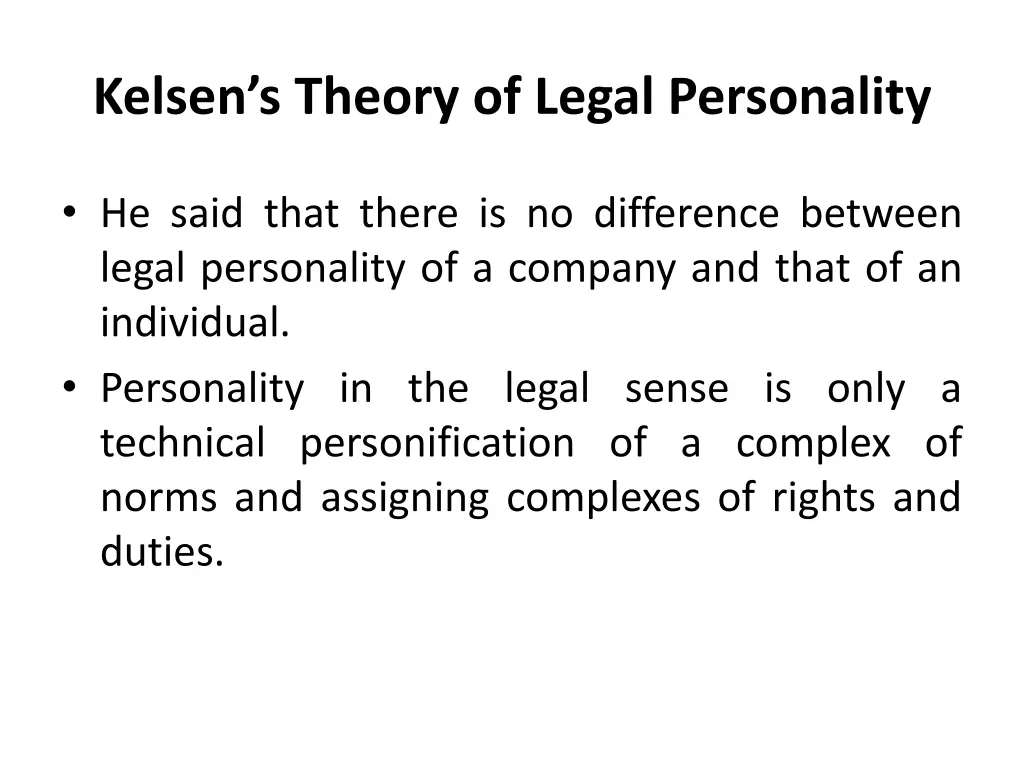
Kelsens Theory of Legal Personality He said that there is no difference between legal personality of a company and that of an individual. Personality in the legal sense is only a technical personification of a complex of norms and assigning complexes of rights and duties.
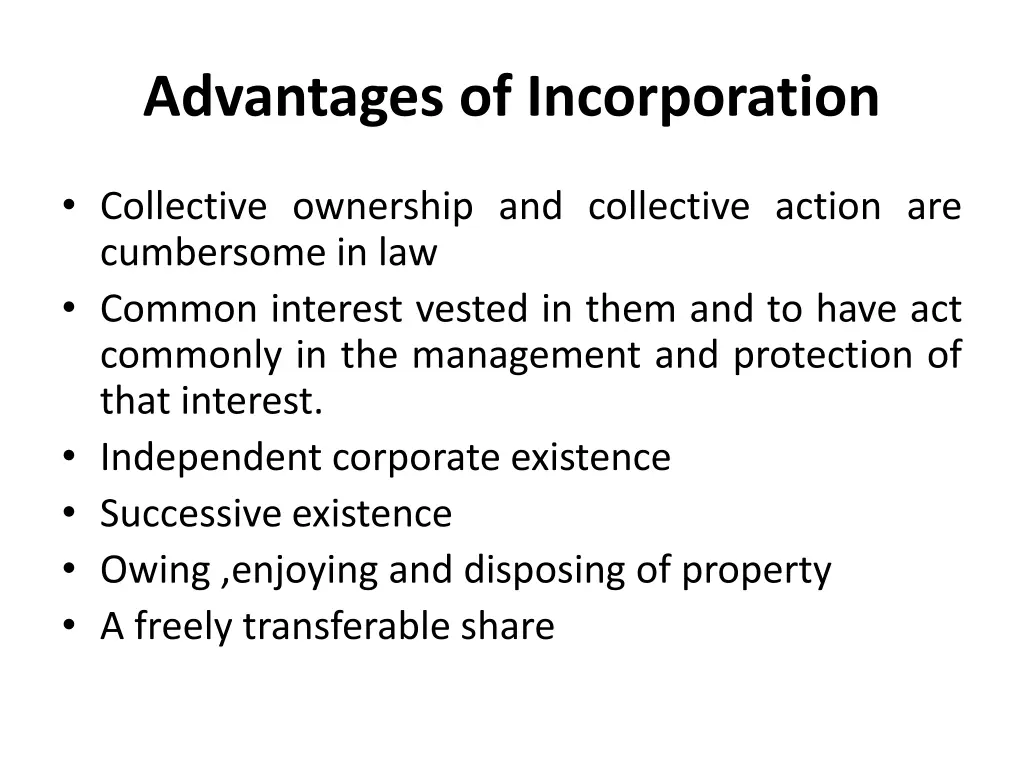
Advantages of Incorporation Collective ownership and collective action are cumbersome in law Common interest vested in them and to have act commonly in the management and protection of that interest. Independent corporate existence Successive existence Owing ,enjoying and disposing of property A freely transferable share