NBA Tips Session at VSSUT by Prof. Shyam Sundar Pattnaik
This content delves into an NBA tips session conducted at VSSUT by Prof. Shyam Sundar Pattnaik, covering areas such as vision, mission, program educational objectives, curriculum, and learning processes. The material includes discussions on the relevance and dissemination of educational objectives, mapping PEOs with missions, and curriculum design processes. Dive into insights provided by NBA experts and criteria assessments to gain valuable knowledge.

Download Presentation

Please find below an Image/Link to download the presentation.
The content on the website is provided AS IS for your information and personal use only. It may not be sold, licensed, or shared on other websites without obtaining consent from the author.If you encounter any issues during the download, it is possible that the publisher has removed the file from their server.
You are allowed to download the files provided on this website for personal or commercial use, subject to the condition that they are used lawfully. All files are the property of their respective owners.
The content on the website is provided AS IS for your information and personal use only. It may not be sold, licensed, or shared on other websites without obtaining consent from the author.
E N D
Presentation Transcript
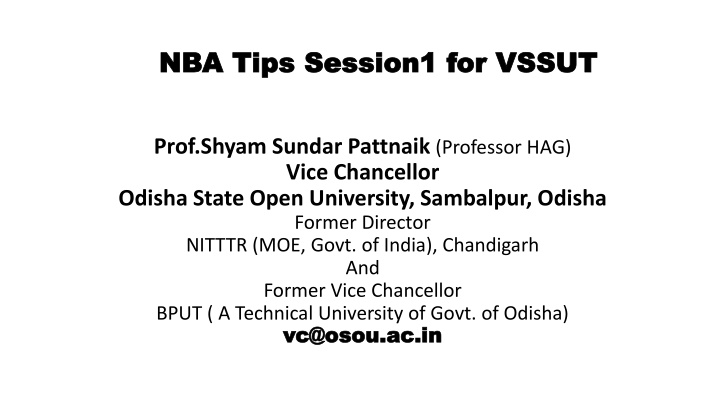
NBA Tips Session1 for VSSUT NBA Tips Session1 for VSSUT Prof.Shyam Sundar Pattnaik (Professor HAG) Vice Chancellor Odisha State Open University, Sambalpur, Odisha Former Director NITTTR (MOE, Govt. of India), Chandigarh And Former Vice Chancellor BPUT ( A Technical University of Govt. of Odisha) vc@osou.ac.in vc@osou.ac.in
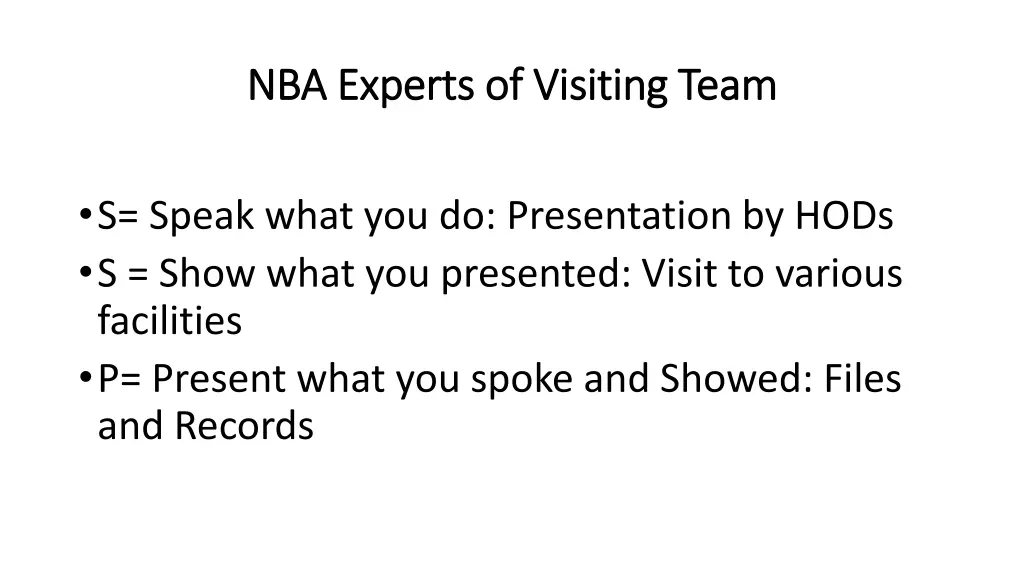
NBA Experts of Visiting Team NBA Experts of Visiting Team S= Speak what you do: Presentation by HODs S = Show what you presented: Visit to various facilities P= Present what you spoke and Showed: Files and Records
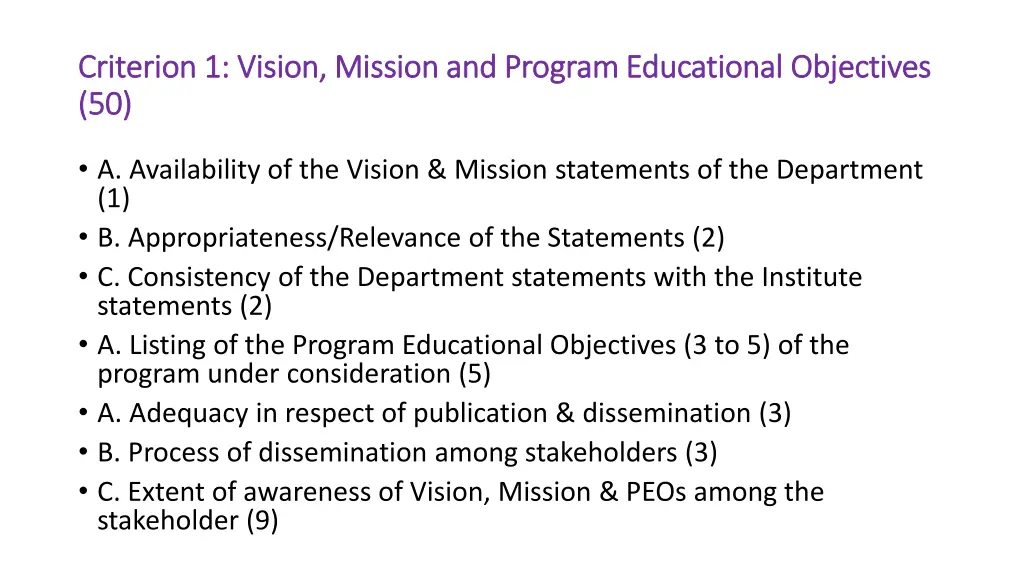
Criterion 1: Criterion 1: Vision, Mission and Program Educational Vision, Mission and Program Educational Objectives (50) (50) Objectives A. Availability of the Vision & Mission statements of the Department (1) B. Appropriateness/Relevance of the Statements (2) C. Consistency of the Department statements with the Institute statements (2) A. Listing of the Program Educational Objectives (3 to 5) of the program under consideration (5) A. Adequacy in respect of publication & dissemination (3) B. Process of dissemination among stakeholders (3) C. Extent of awareness of Vision, Mission & PEOs among the stakeholder (9)
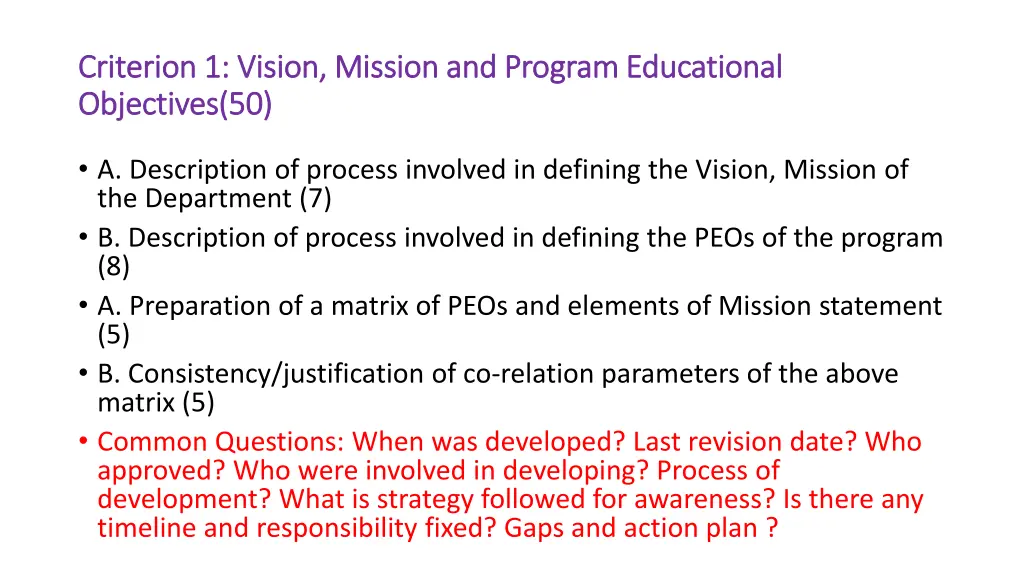
Criterion 1: Criterion 1: Vision, Mission and Program Educational Vision, Mission and Program Educational Objectives(50) Objectives(50) A. Description of process involved in defining the Vision, Mission of the Department (7) B. Description of process involved in defining the PEOs of the program (8) A. Preparation of a matrix of PEOs and elements of Mission statement (5) B. Consistency/justification of co-relation parameters of the above matrix (5) Common Questions: When was developed? Last revision date? Who approved? Who were involved in developing? Process of development? What is strategy followed for awareness? Is there any timeline and responsibility fixed? Gaps and action plan ?
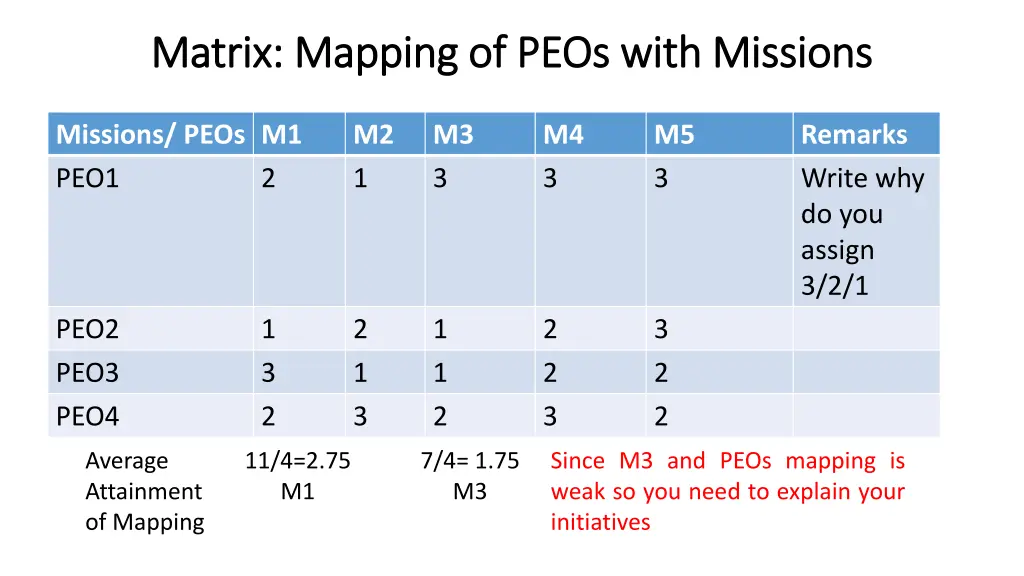
Matrix: Mapping of PEOs with Missions Matrix: Mapping of PEOs with Missions Missions/ PEOs M1 PEO1 M2 1 M3 3 M4 3 M5 3 Remarks Write why do you assign 3/2/1 2 PEO2 PEO3 PEO4 1 3 2 2 1 3 1 1 2 2 2 3 3 2 2 Average Attainment of Mapping 11/4=2.75 M1 7/4= 1.75 M3 Since M3 and PEOs mapping is weak so you need to explain your initiatives
Criterion2 : Criterion2 :Program Curriculum and Teaching Program Curriculum and Teaching Learning Processes (100 Processes (100): Curriculum:30 ): Curriculum:30 Learning Process used to demonstrate how the program curriculum is evolved and periodically reviewed (10): Process of designing curriculum considering the POs and PSOs. Also consider the involvement of the Industry. Refer to SAR: Expectation in 2.1.2 & 2.1.3 is that the curriculum is well balanced structure &appropriate for a degree program. (5): Structure Refer to SAR: Expectation in 2.1.2 & 2.1.3 is that the curriculum is well balanced structure & appropriate for a degree program(5): Components Process used to identify extent of compliance of curriculum for attaining POs and PSOs(10): Extent of compliance curriculum for attaining the Program Outcomes(POs) &Program Specific Outcomes(PSOs)
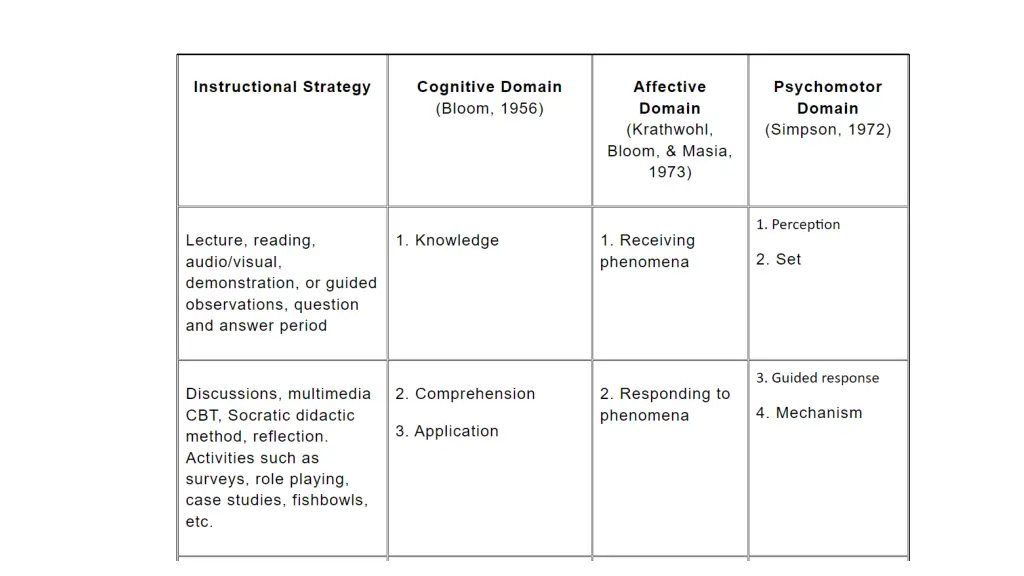
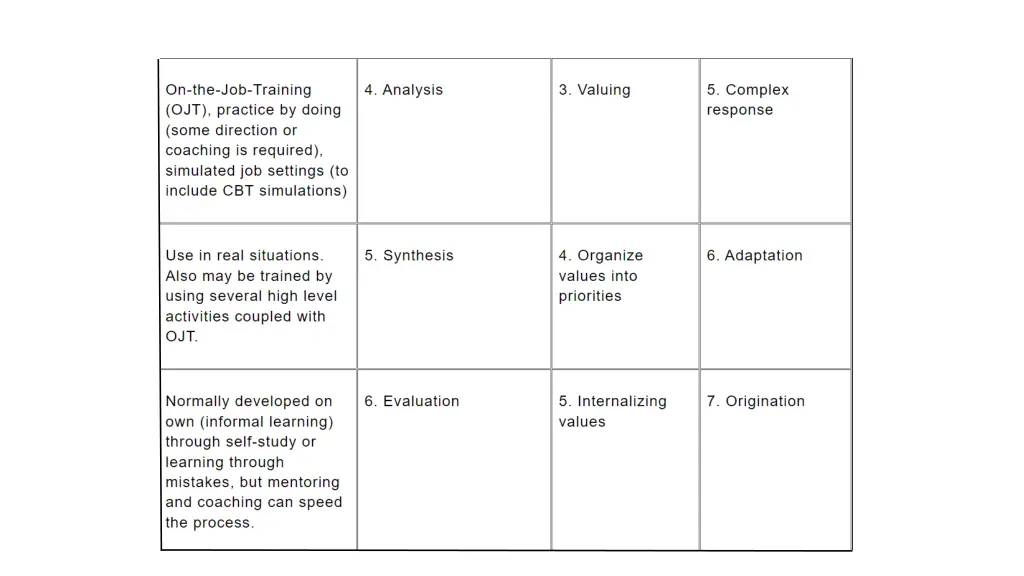
Criterion2 : Criterion2 :Program Curriculum and Teaching Program Curriculum and Teaching Learning Processes (100) Processes (100) Learning Common Questions: Curriculum (30) When was last revised or designed? % industry experts involved in BOS? List to be kept ready with attendance sheet having signatures. If any specific suggestions that have been incorporated then highlight that. % of Outside academician involved Process of gap analysis and action plan to integrate in curriculum Mapping matrix with POs and PSOs? Distributions: Cognitive Domain, Psychomotor Domain and Affective Domain? (We will discuss this under Taxonomy) Novelty?
Criterion2 : Criterion2 :Program Curriculum and Teaching Program Curriculum and Teaching Learning Processes (100 Processes (100): Teaching ): Teaching- -Learning (70) Learning (70) Learning A. Adherence to Academic Calendar (2) B. Pedagogical initiatives (2) C. Methodologies to support weak students and encourage bright students(2) D. Quality of classroom teaching (Observation in a Class) (2) E. Conduct of experiments (Observation in Lab) (2) F. Continuous Assessment in the laboratory (3) G. Student feedback of teaching learning process and actions taken (2)
Criterion2 : Criterion2 :Program Curriculum and Teaching Program Curriculum and Teaching Learning Processes (100 Processes (100): Teaching ): Teaching- -Learning (70) Learning (70) Learning A. Identification of projects and allocation methodology to Faculty Members (2) B. Types and relevance of the projects and their contribution towards attainment of POs and PSOs (2) C. Project related to Industry (3) D. Process for monitoring and evaluation (2) E. Process to assess individual and team performance (3) F. Quality of completed projects/working prototypes (5) G. Evidences of papers published /Awards received by projects etc. (3)
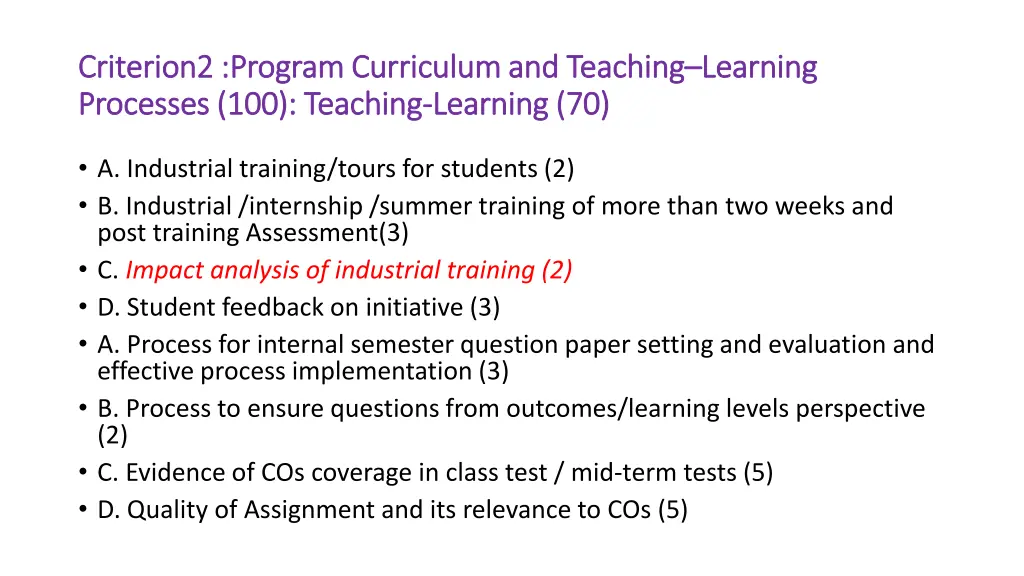
Criterion2 : Criterion2 :Program Curriculum and Teaching Program Curriculum and Teaching Learning Processes (100 Processes (100): Teaching ): Teaching- -Learning (70) Learning (70) Learning A. Industrial training/tours for students (2) B. Industrial /internship /summer training of more than two weeks and post training Assessment(3) C. Impact analysis of industrial training (2) D. Student feedback on initiative (3) A. Process for internal semester question paper setting and evaluation and effective process implementation (3) B. Process to ensure questions from outcomes/learning levels perspective (2) C. Evidence of COs coverage in class test / mid-term tests (5) D. Quality of Assignment and its relevance to COs (5)
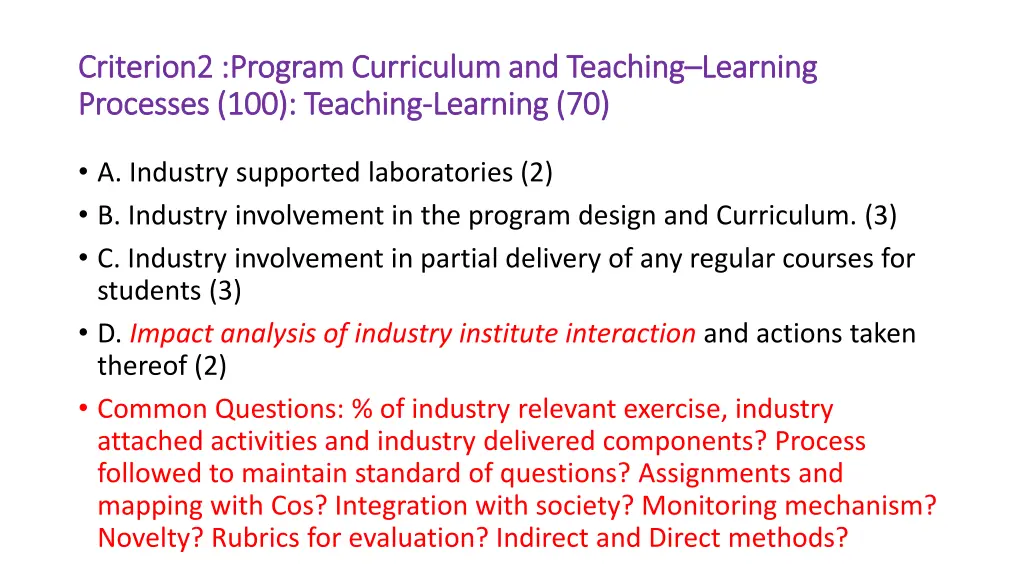
Criterion2 : Criterion2 :Program Curriculum and Teaching Program Curriculum and Teaching Learning Processes (100 Processes (100): Teaching ): Teaching- -Learning (70) Learning (70) Learning A. Industry supported laboratories (2) B. Industry involvement in the program design and Curriculum. (3) C. Industry involvement in partial delivery of any regular courses for students (3) D. Impact analysis of industry institute interaction and actions taken thereof (2) Common Questions: % of industry relevant exercise, industry attached activities and industry delivered components? Process followed to maintain standard of questions? Assignments and mapping with Cos? Integration with society? Monitoring mechanism? Novelty? Rubrics for evaluation? Indirect and Direct methods?
Taxonomy for Taxonomy for Cognitive (Intellectual) Domain, Cognitive (Intellectual) Domain, Psychomotor (Skill and Coordination) Psychomotor (Skill and Coordination) Domain Domain & & Affective (Attitude) Domain Affective (Attitude) Domain
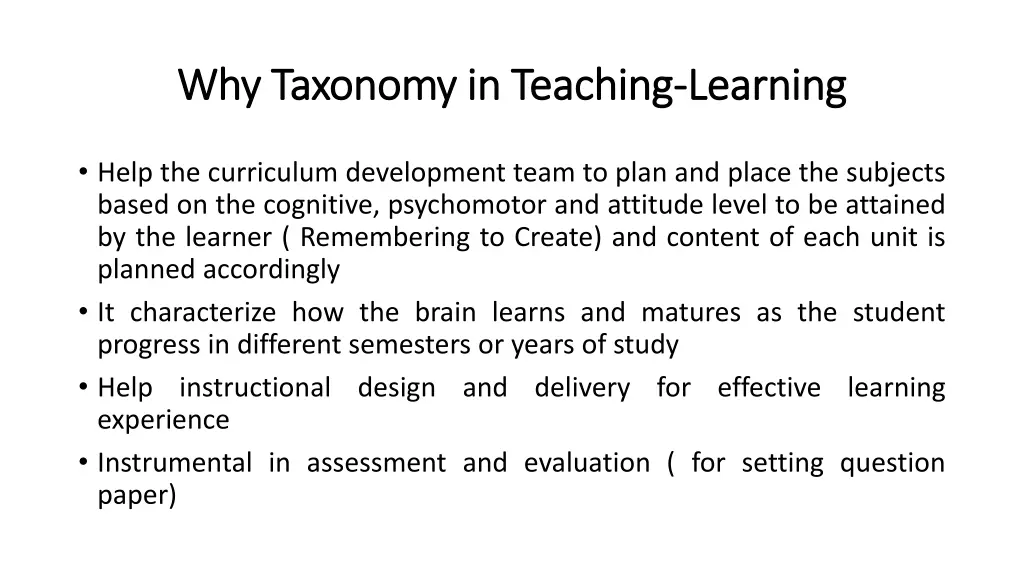
Why Taxonomy in Teaching Why Taxonomy in Teaching- -Learning Learning Help the curriculum development team to plan and place the subjects based on the cognitive, psychomotor and attitude level to be attained by the learner ( Remembering to Create) and content of each unit is planned accordingly It characterize how the brain learns and matures as the student progress in different semesters or years of study Help instructional design and delivery for effective learning experience Instrumental in assessment and evaluation ( for setting question paper)
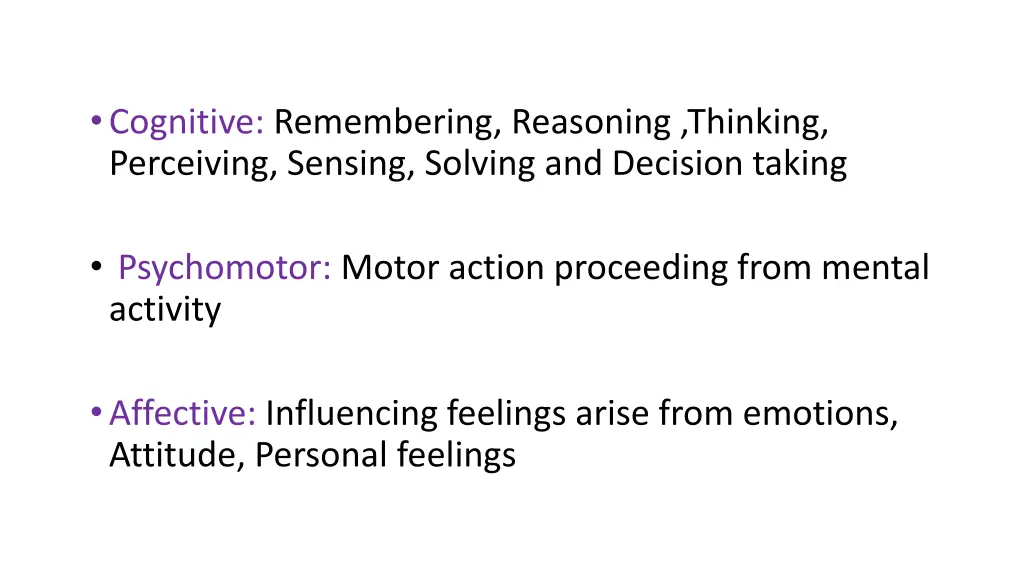
Cognitive: Remembering, Reasoning ,Thinking, Perceiving, Sensing, Solving and Decision taking Psychomotor: Motor action proceeding from mental activity Affective: Influencing feelings arise from emotions, Attitude, Personal feelings
Blooms Taxonomy for Cognitive Bloom s Taxonomy for Cognitive (Intellectual), Domain Domain (Intellectual),
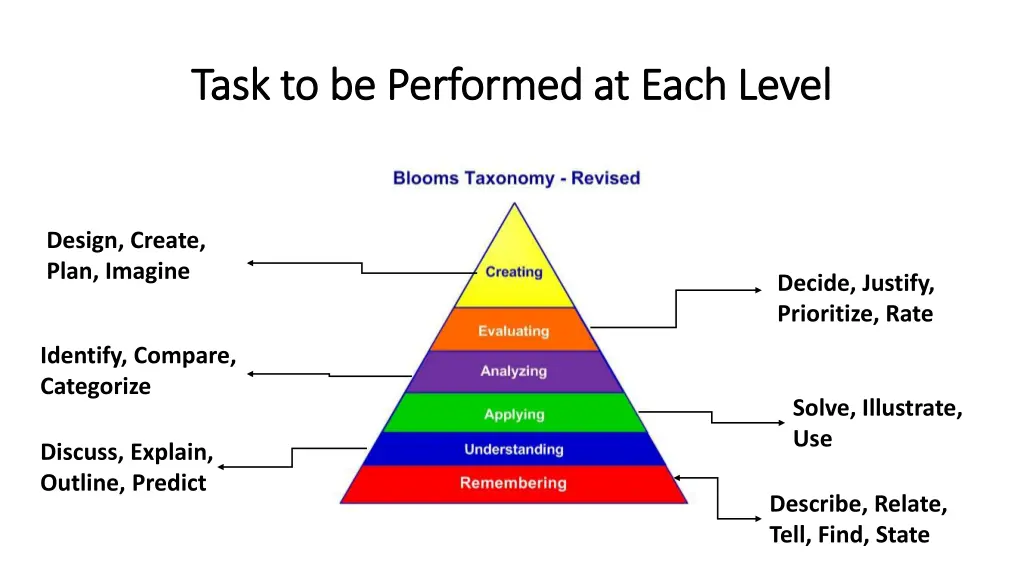
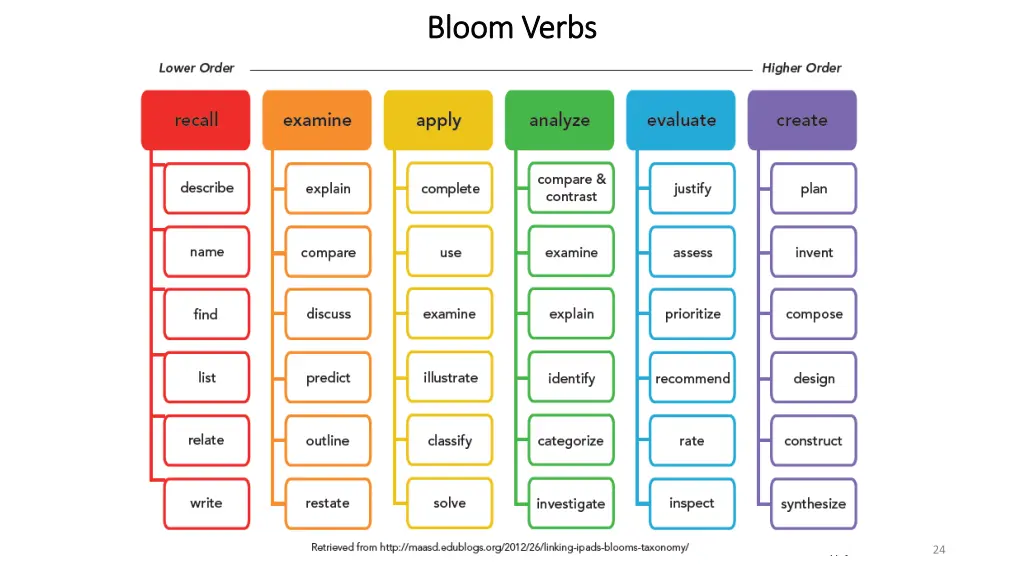
Task to be Performed at Each Level Task to be Performed at Each Level Design, Create, Plan, Imagine Decide, Justify, Prioritize, Rate Identify, Compare, Categorize Solve, Illustrate, Use Discuss, Explain, Outline, Predict Describe, Relate, Tell, Find, State
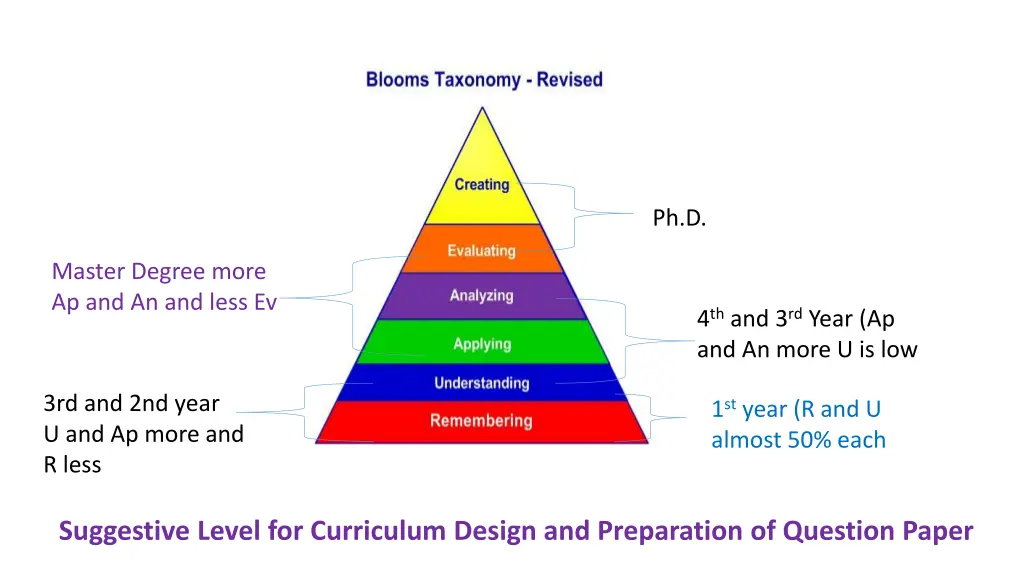
Ph.D. Master Degree more Ap and An and less Ev 4th and 3rd Year (Ap and An more U is low 3rd and 2nd year U and Ap more and R less 1st year (R and U almost 50% each Suggestive Level for Curriculum Design and Preparation of Question Paper
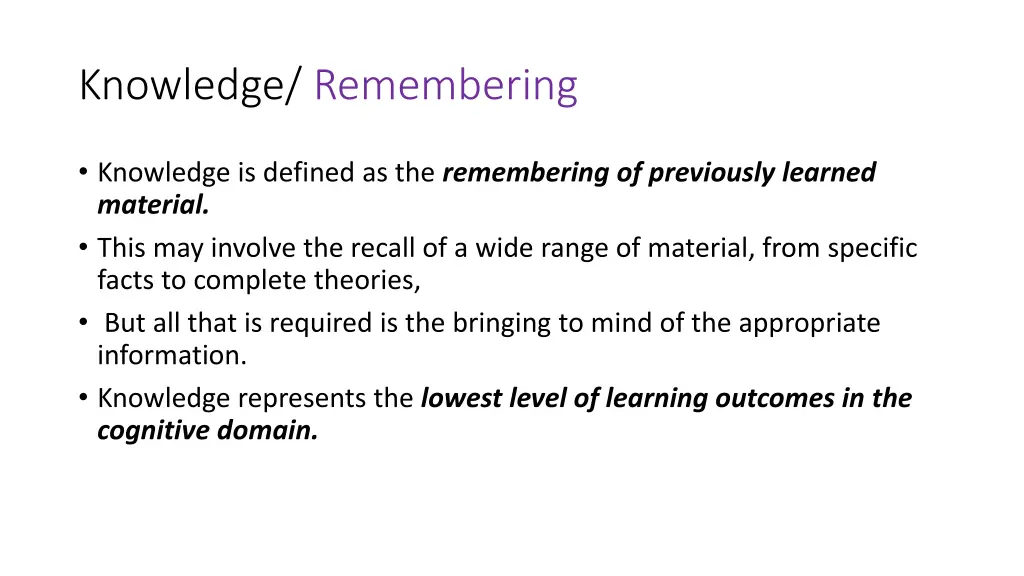
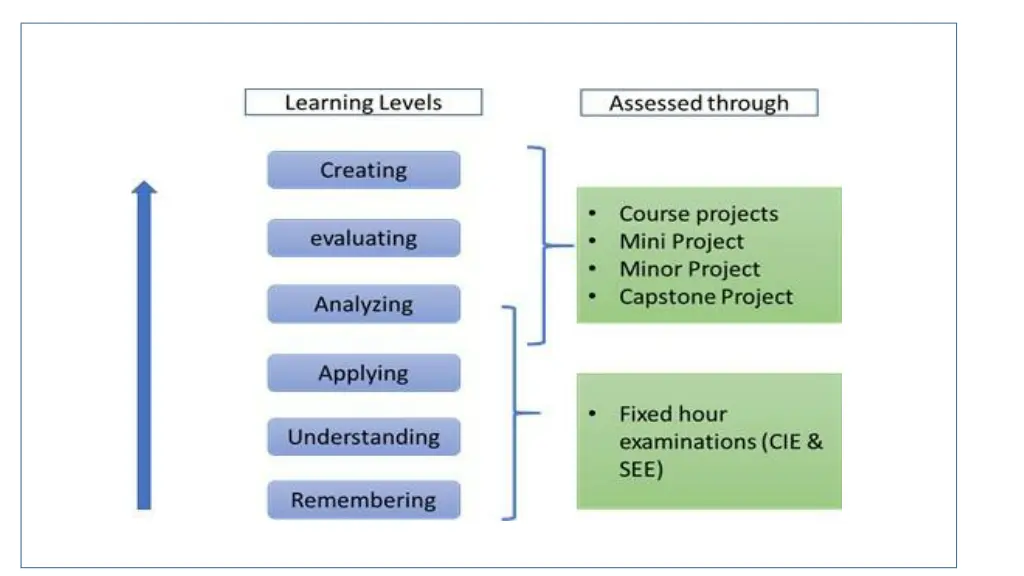
Knowledge/ Remembering Knowledge is defined as the remembering of previously learned material. This may involve the recall of a wide range of material, from specific facts to complete theories, But all that is required is the bringing to mind of the appropriate information. Knowledge represents the lowest level of learning outcomes in the cognitive domain.
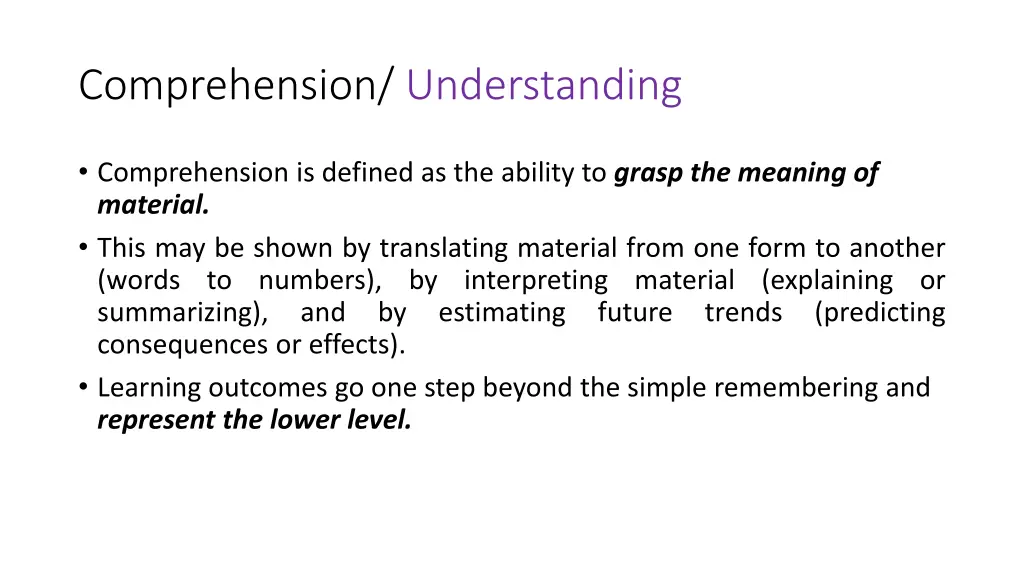
Comprehension/ Understanding Comprehension is defined as the ability to grasp the meaning of material. This may be shown by translating material from one form to another (words to numbers), by interpreting material (explaining or summarizing), and by estimating future trends (predicting consequences or effects). Learning outcomes go one step beyond the simple remembering and represent the lower level.
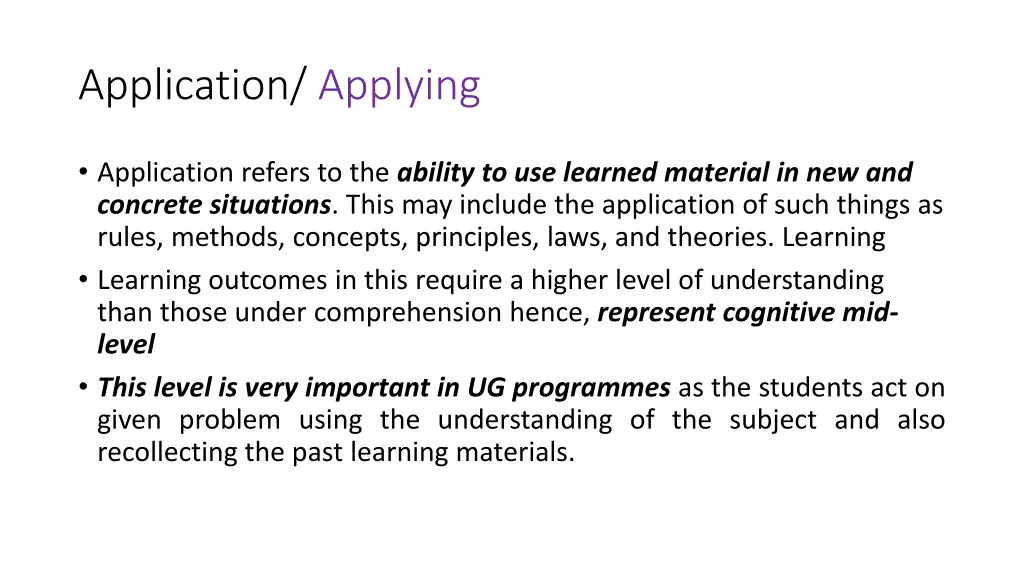
Application/ Applying Application refers to the ability to use learned material in new and concrete situations. This may include the application of such things as rules, methods, concepts, principles, laws, and theories. Learning Learning outcomes in this require a higher level of understanding than those under comprehension hence, represent cognitive mid- level This level is very important in UG programmes as the students act on given problem using the understanding of the subject and also recollecting the past learning materials.
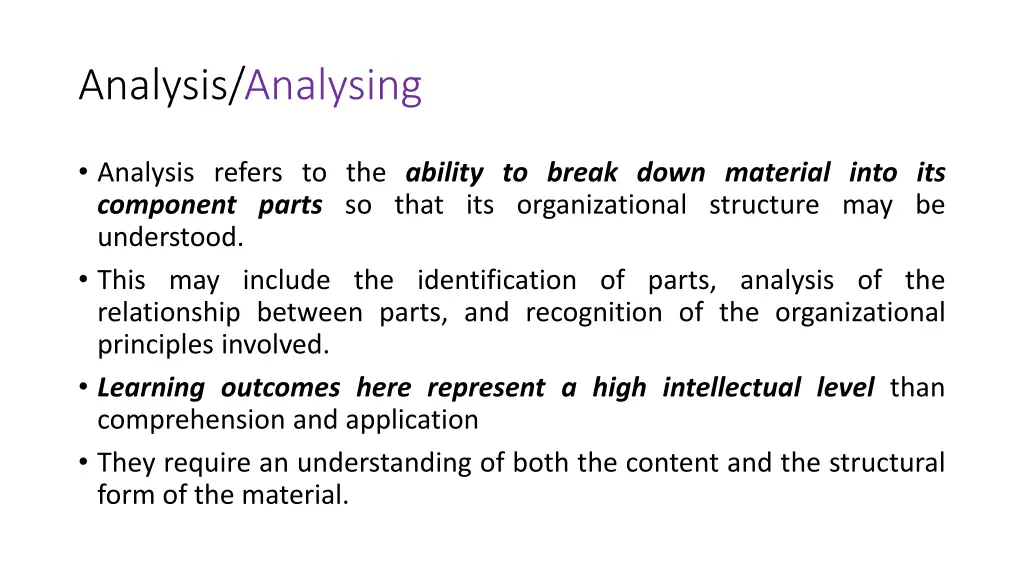
Analysis/Analysing Analysis refers to the ability to break down material into its component parts so that its organizational structure may be understood. This may include the identification of parts, analysis of the relationship between parts, and recognition of the organizational principles involved. Learning outcomes here represent a high intellectual level than comprehension and application They require an understanding of both the content and the structural form of the material.
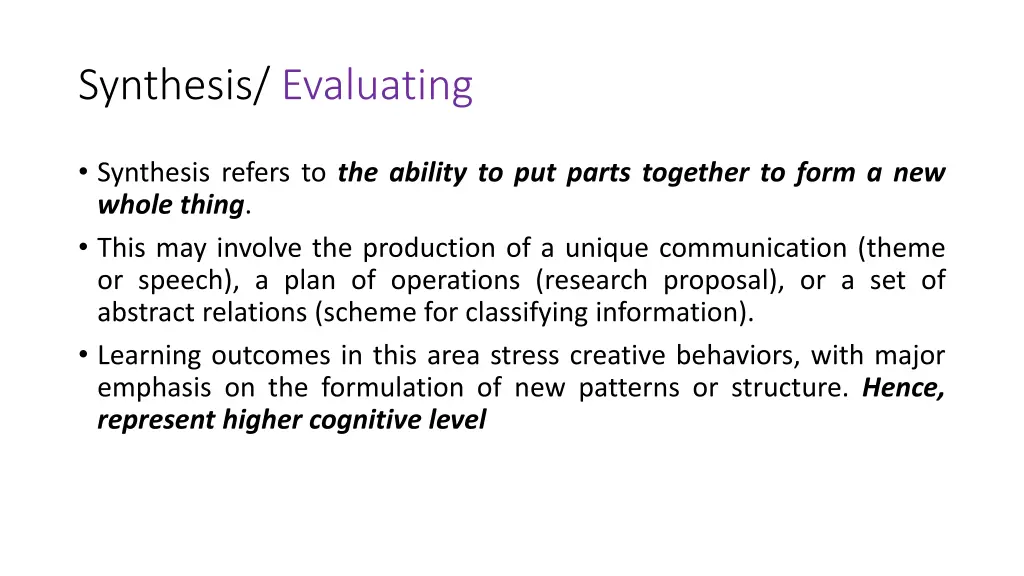
Synthesis/ Evaluating Synthesis refers to the ability to put parts together to form a new whole thing. This may involve the production of a unique communication (theme or speech), a plan of operations (research proposal), or a set of abstract relations (scheme for classifying information). Learning outcomes in this area stress creative behaviors, with major emphasis on the formulation of new patterns or structure. Hence, represent higher cognitive level
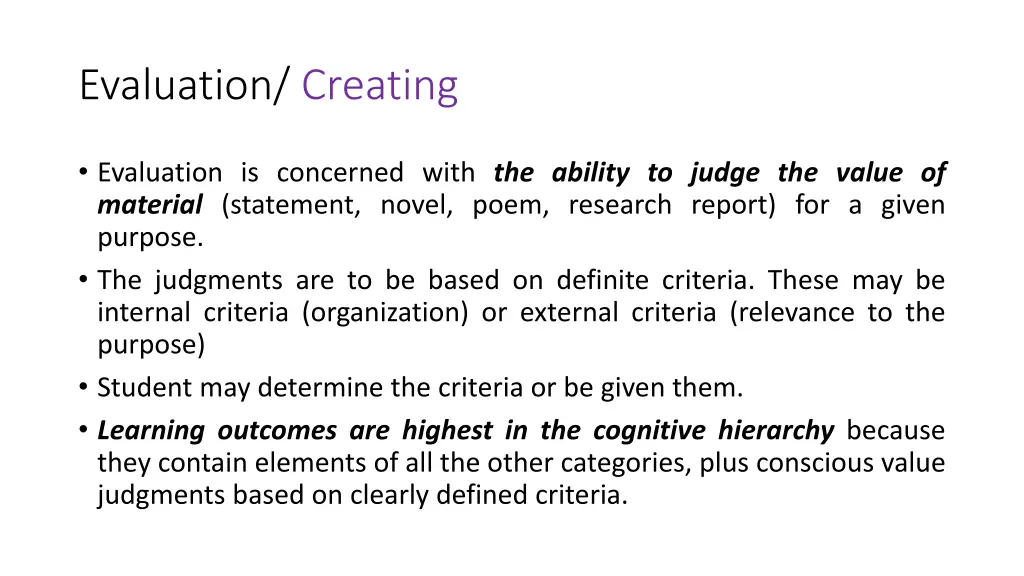
Evaluation/ Creating Evaluation is concerned with the ability to judge the value of material (statement, novel, poem, research report) for a given purpose. The judgments are to be based on definite criteria. These may be internal criteria (organization) or external criteria (relevance to the purpose) Student may determine the criteria or be given them. Learning outcomes are highest in the cognitive hierarchy because they contain elements of all the other categories, plus conscious value judgments based on clearly defined criteria.
Bloom Bloom Verbs Verbs 24
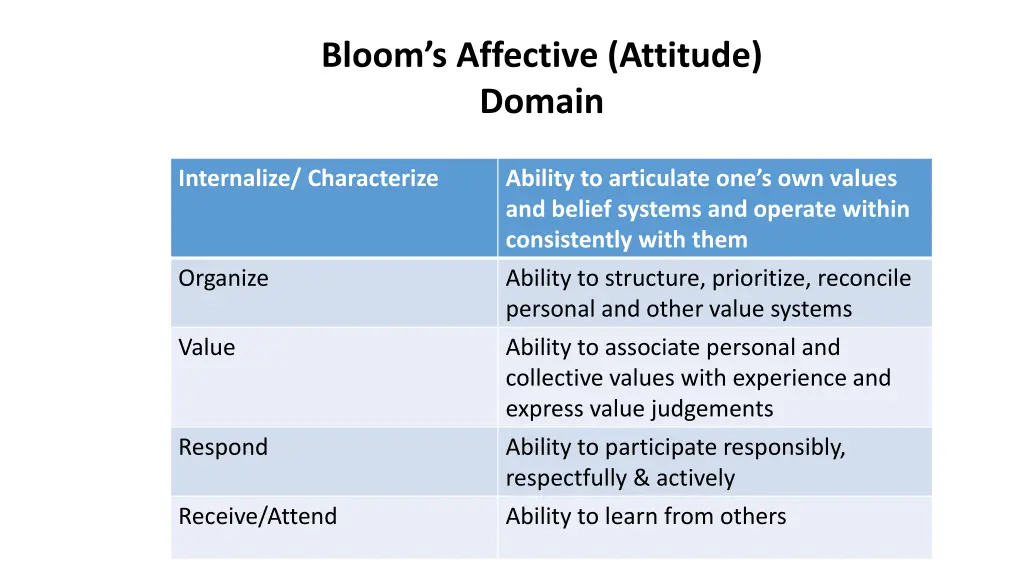
Blooms Affective (Attitude) Domain Internalize/ Characterize Ability to articulate one s own values and belief systems and operate within consistently with them Organize Ability to structure, prioritize, reconcile personal and other value systems Value Ability to associate personal and collective values with experience and express value judgements Ability to participate responsibly, respectfully & actively Respond Receive/Attend Ability to learn from others
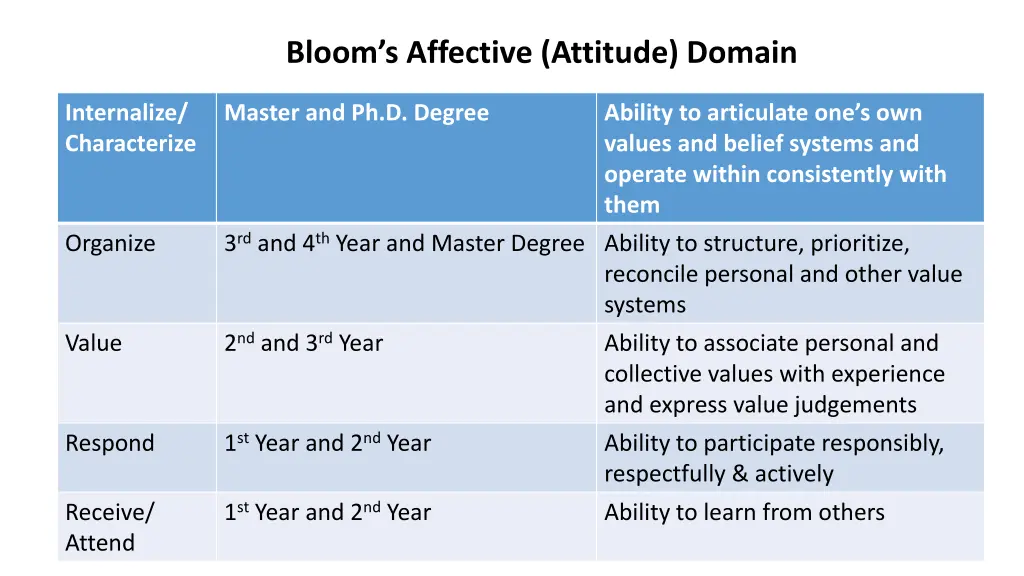
Blooms Affective (Attitude) Domain Internalize/ Characterize Master and Ph.D. Degree Ability to articulate one s own values and belief systems and operate within consistently with them 3rd and 4th Year and Master Degree Ability to structure, prioritize, Organize reconcile personal and other value systems 2nd and 3rd Year Value Ability to associate personal and collective values with experience and express value judgements 1st Year and 2nd Year Respond Ability to participate responsibly, respectfully & actively 1st Year and 2nd Year Receive/ Attend Ability to learn from others
Psychomotor (Skill) Psychomotor (Skill) Domain Physical action Physical action- - Hands and Mind On Hands and Mind On Domain
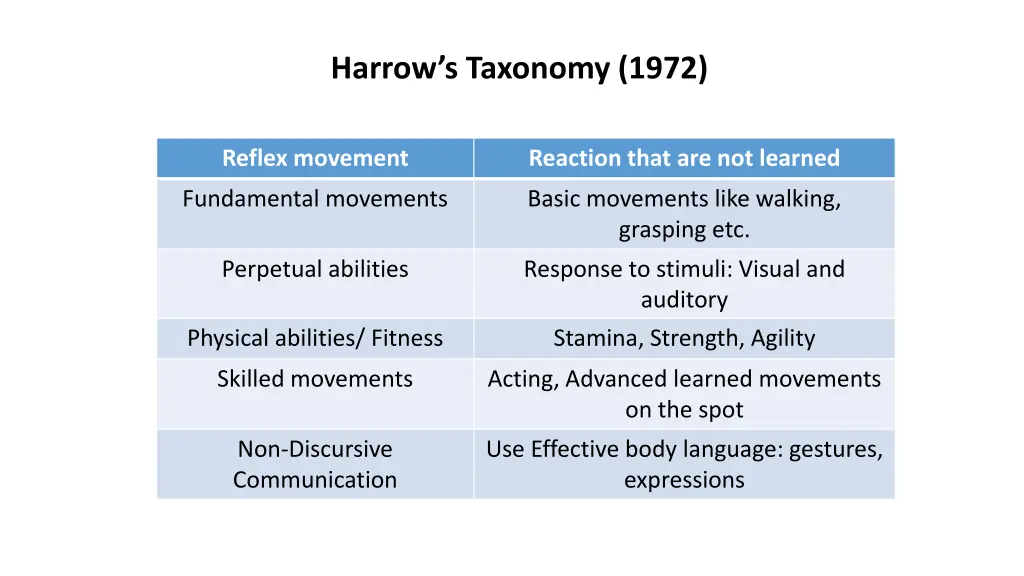
Harrows Taxonomy (1972) Reflex movement Reaction that are not learned Fundamental movements Basic movements like walking, grasping etc. Perpetual abilities Response to stimuli: Visual and auditory Physical abilities/ Fitness Stamina, Strength, Agility Skilled movements Acting, Advanced learned movements on the spot Non-Discursive Communication Use Effective body language: gestures, expressions
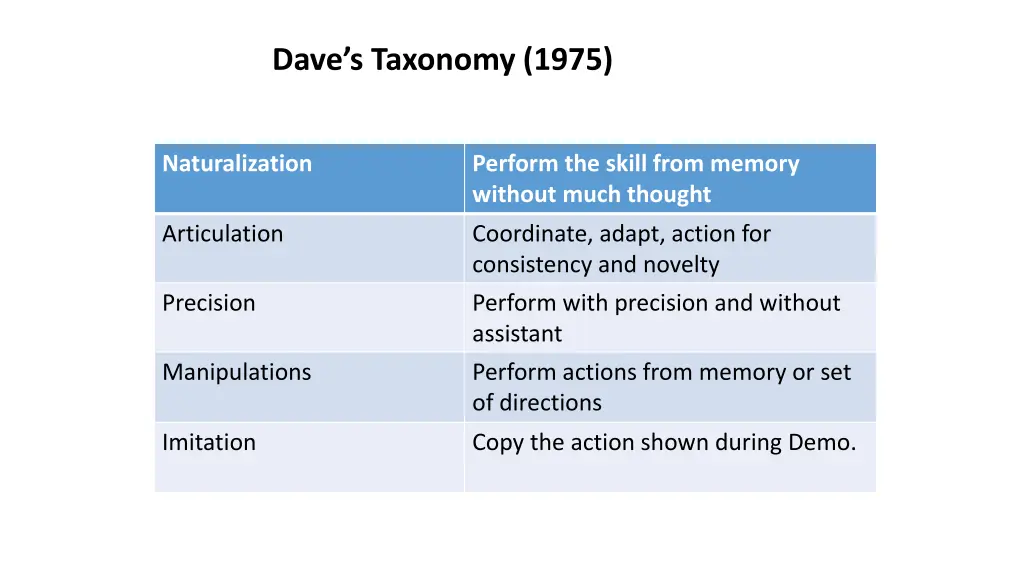
Daves Taxonomy (1975) Naturalization Perform the skill from memory without much thought Articulation Coordinate, adapt, action for consistency and novelty Perform with precision and without assistant Precision Manipulations Perform actions from memory or set of directions Imitation Copy the action shown during Demo.
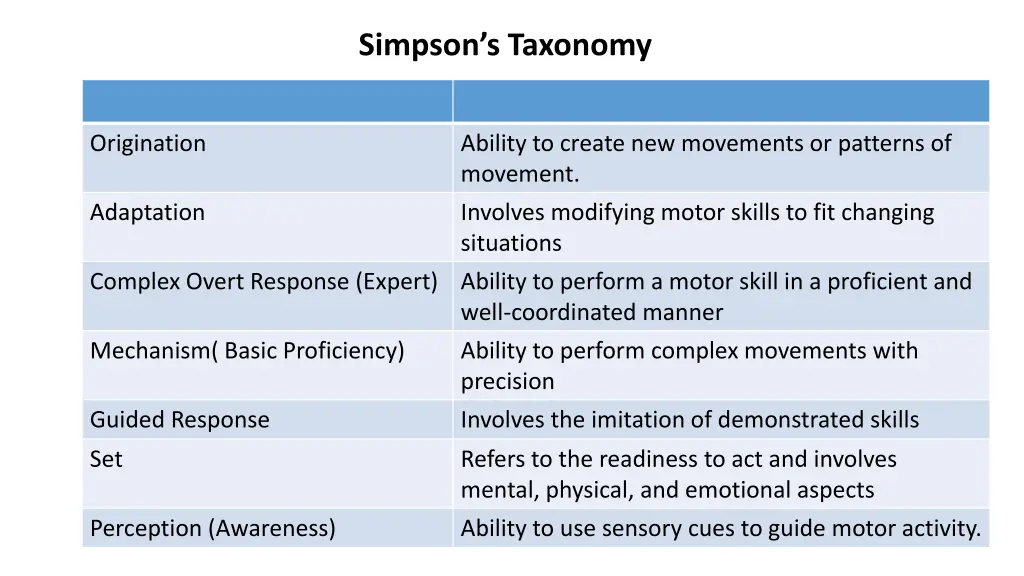
Simpsons Taxonomy Origination Ability to create new movements or patterns of movement. Adaptation Involves modifying motor skills to fit changing situations Complex Overt Response (Expert) Ability to perform a motor skill in a proficient and well-coordinated manner Mechanism( Basic Proficiency) Ability to perform complex movements with precision Guided Response Involves the imitation of demonstrated skills Set Refers to the readiness to act and involves mental, physical, and emotional aspects Ability to use sensory cues to guide motor activity. Perception (Awareness)
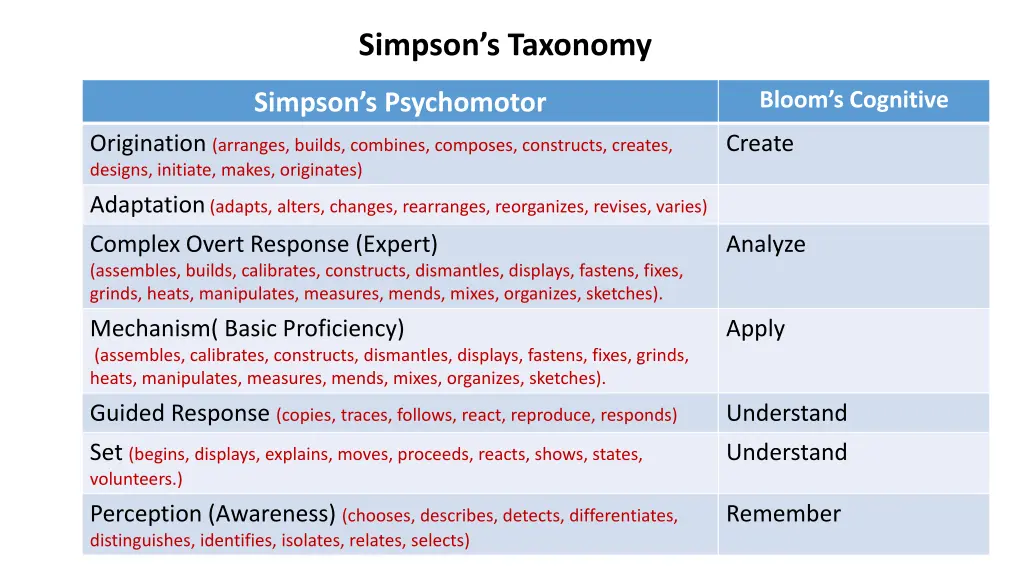
Simpsons Taxonomy Bloom s Cognitive Simpson s Psychomotor Origination (arranges, builds, combines, composes, constructs, creates, designs, initiate, makes, originates) Adaptation (adapts, alters, changes, rearranges, reorganizes, revises, varies) Create Complex Overt Response (Expert) (assembles, builds, calibrates, constructs, dismantles, displays, fastens, fixes, grinds, heats, manipulates, measures, mends, mixes, organizes, sketches). Mechanism( Basic Proficiency) (assembles, calibrates, constructs, dismantles, displays, fastens, fixes, grinds, heats, manipulates, measures, mends, mixes, organizes, sketches). Guided Response (copies, traces, follows, react, reproduce, responds) Analyze Apply Understand Set (begins, displays, explains, moves, proceeds, reacts, shows, states, volunteers.) Perception (Awareness) (chooses, describes, detects, differentiates, distinguishes, identifies, isolates, relates, selects) Understand Remember
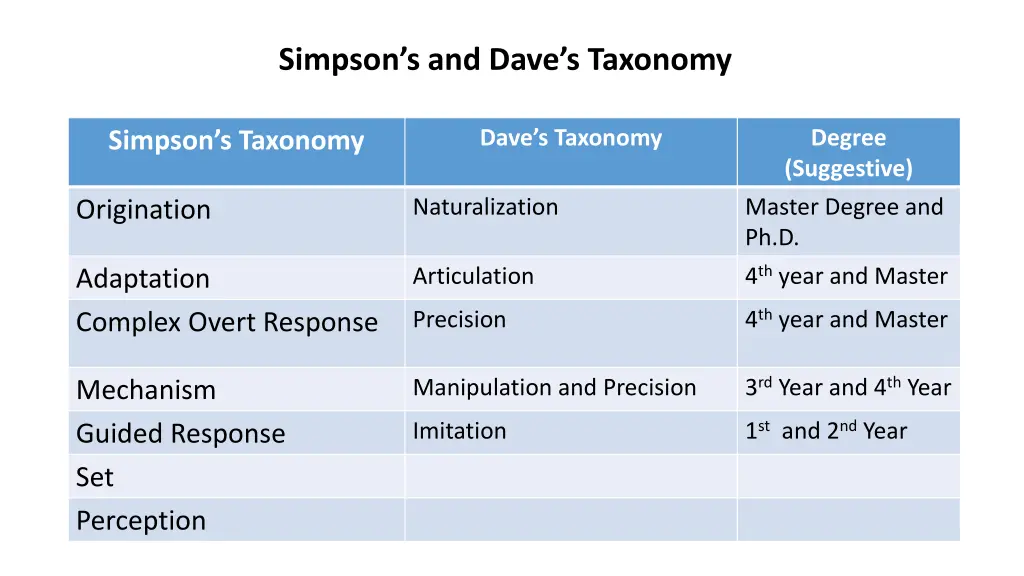
Simpsons and Daves Taxonomy Dave s Taxonomy Degree (Suggestive) Simpson s Taxonomy Naturalization Master Degree and Ph.D. 4th year and Master Origination Articulation Adaptation Complex Overt Response 4th year and Master Precision 3rd Year and 4th Year Manipulation and Precision Mechanism Guided Response Set Perception 1st and 2nd Year Imitation
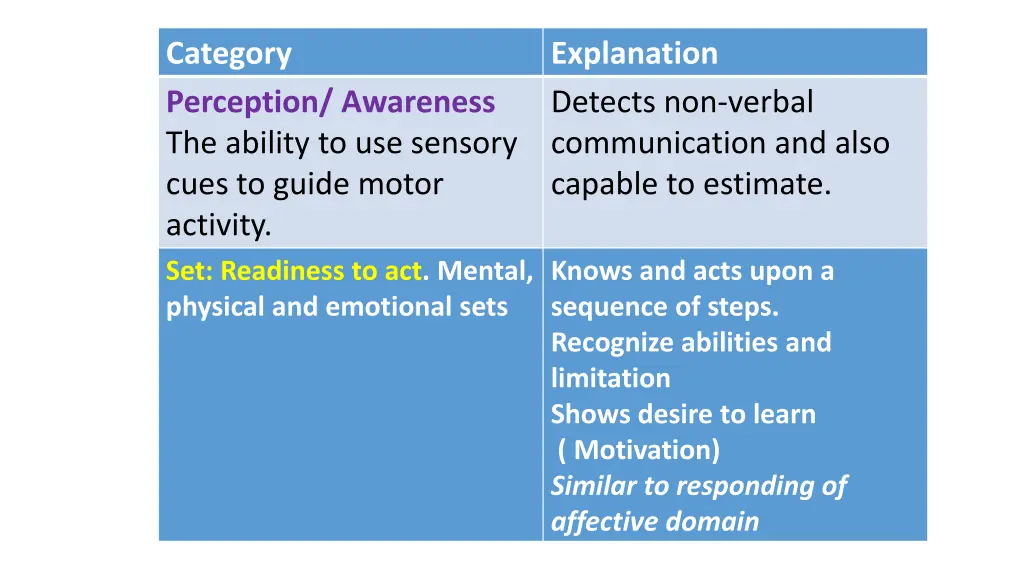
Category Perception/ Awareness The ability to use sensory cues to guide motor activity. Set: Readiness to act. Mental, physical and emotional sets Explanation Detects non-verbal communication and also capable to estimate. Knows and acts upon a sequence of steps. Recognize abilities and limitation Shows desire to learn ( Motivation) Similar to responding of affective domain
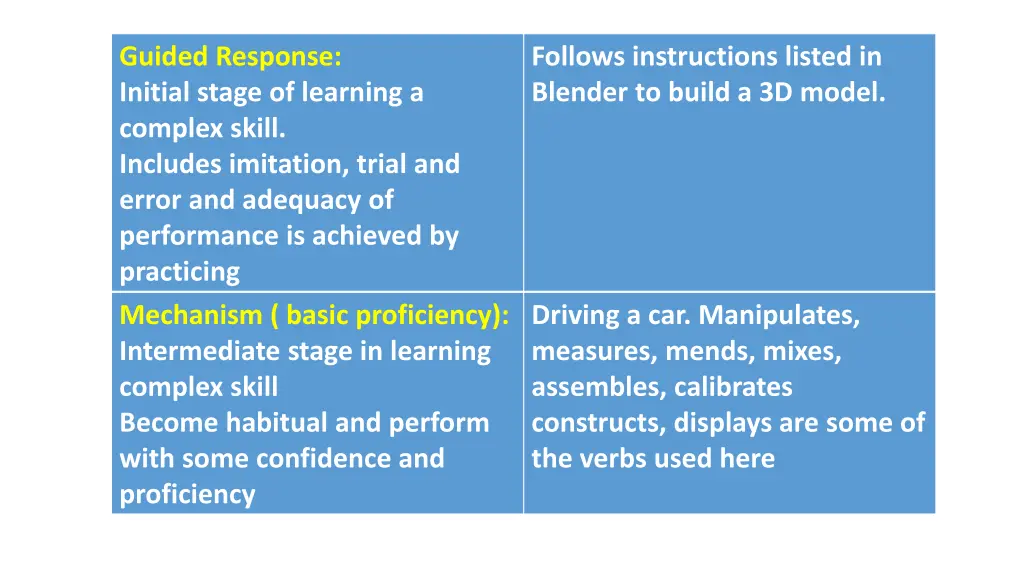
Guided Response: Initial stage of learning a complex skill. Includes imitation, trial and error and adequacy of performance is achieved by practicing Mechanism ( basic proficiency): Intermediate stage in learning complex skill Become habitual and perform with some confidence and proficiency Follows instructions listed in Blender to build a 3D model. Driving a car. Manipulates, measures, mends, mixes, assembles, calibrates constructs, displays are some of the verbs used here
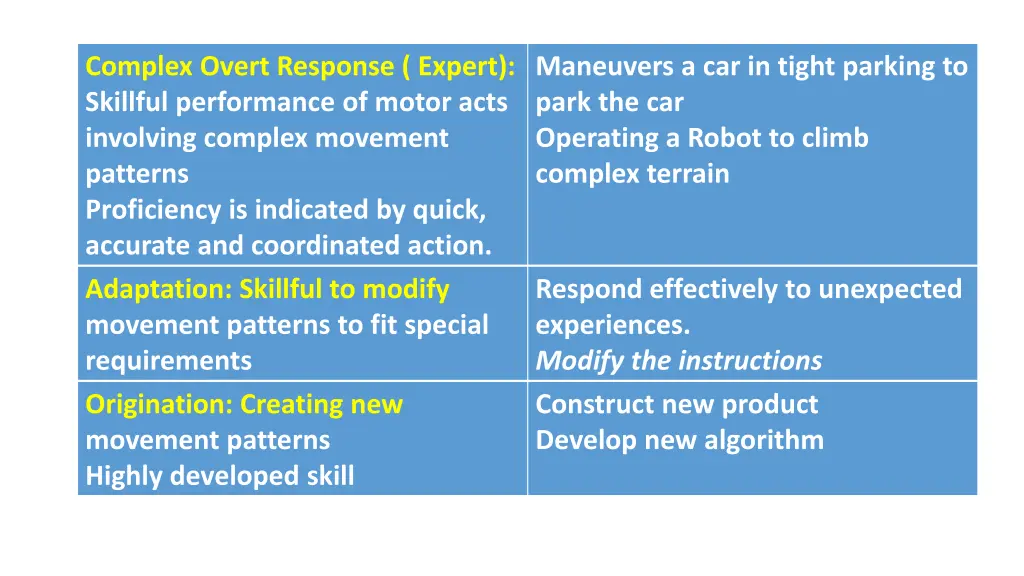
Complex Overt Response ( Expert): Skillful performance of motor acts involving complex movement patterns Proficiency is indicated by quick, accurate and coordinated action. Adaptation: Skillful to modify movement patterns to fit special requirements Origination: Creating new movement patterns Highly developed skill Maneuvers a car in tight parking to park the car Operating a Robot to climb complex terrain Respond effectively to unexpected experiences. Modify the instructions Construct new product Develop new algorithm
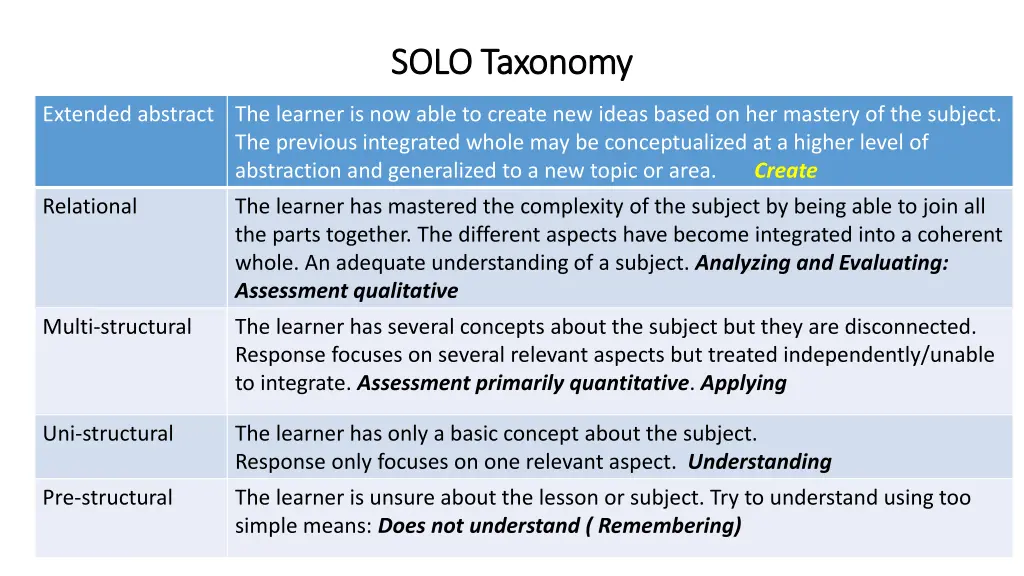
Structure of Observed Learning Outcome (SOLO) Taxonomy (1982)
SOLO Taxonomy SOLO Taxonomy Extended abstract The learner is now able to create new ideas based on her mastery of the subject. The previous integrated whole may be conceptualized at a higher level of abstraction and generalized to a new topic or area. Create Relational The learner has mastered the complexity of the subject by being able to join all the parts together. The different aspects have become integrated into a coherent whole. An adequate understanding of a subject. Analyzing and Evaluating: Assessment qualitative Multi-structural The learner has several concepts about the subject but they are disconnected. Response focuses on several relevant aspects but treated independently/unable to integrate. Assessment primarily quantitative. Applying Uni-structural The learner has only a basic concept about the subject. Response only focuses on one relevant aspect. Understanding Pre-structural The learner is unsure about the lesson or subject. Try to understand using too simple means: Does not understand ( Remembering)
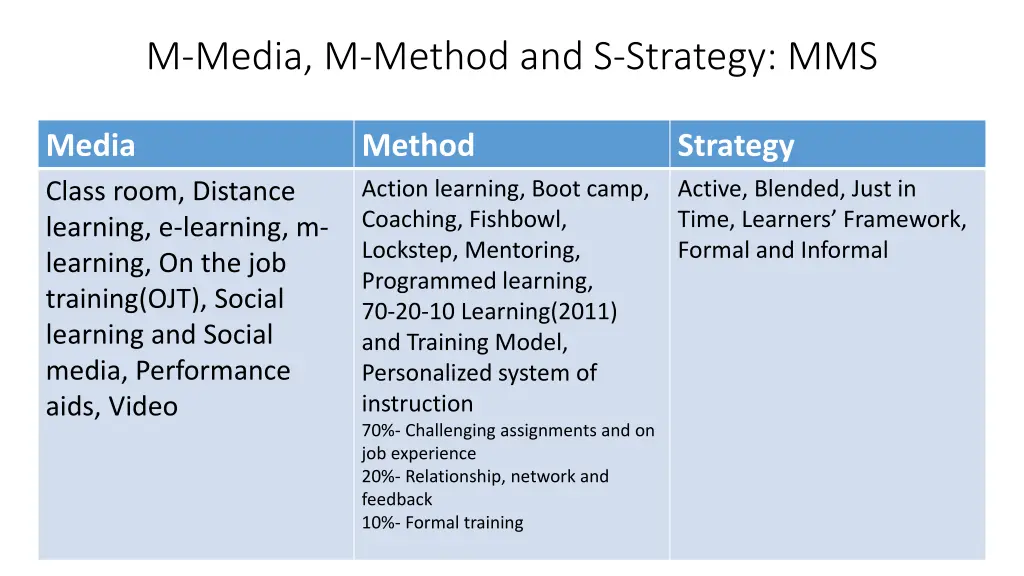
M-Media, M-Method and S-Strategy: MMS Media Class room, Distance learning, e-learning, m- learning, On the job training(OJT), Social learning and Social media, Performance aids, Video Method Strategy Action learning, Boot camp, Coaching, Fishbowl, Lockstep, Mentoring, Programmed learning, 70-20-10 Learning(2011) and Training Model, Personalized system of instruction 70%- Challenging assignments and on job experience 20%- Relationship, network and feedback 10%- Formal training Active, Blended, Just in Time, Learners Framework, Formal and Informal
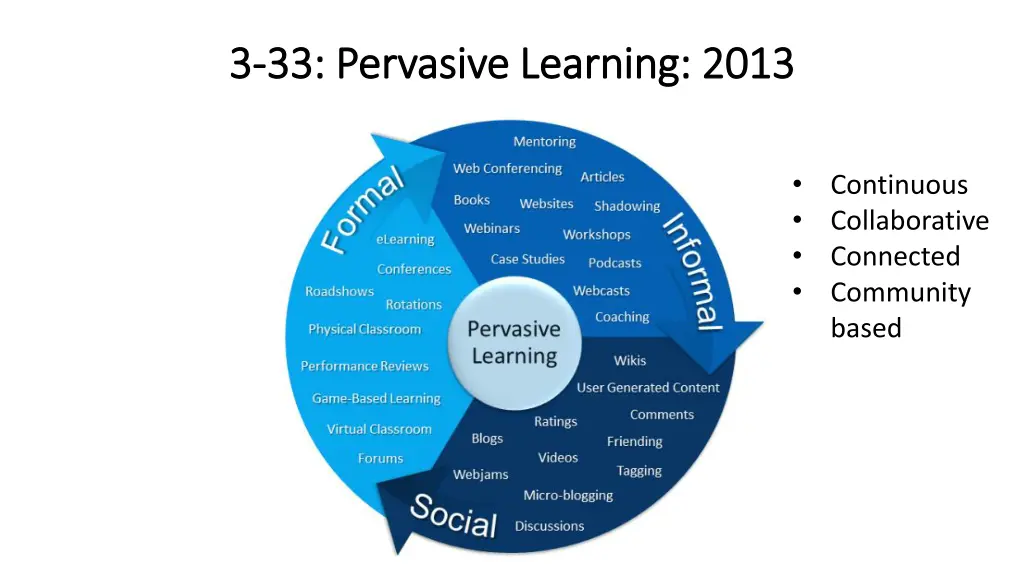
3 3- -33: Pervasive Learning: 2013 33: Pervasive Learning: 2013 Continuous Collaborative Connected Community based
Strengthening Assessment and Strengthening Assessment and Accreditation of Higher Education Accreditation of Higher Education Institutions in India Institutions in India Abstract of Overarching Committee Abstract of Overarching Committee Report Report
Transformative Reforms Transformative Reforms Overarching Committee Chairman: Overarching Committee Chairman: Dr.K.Radhakrishnan Chairman BOG, IIT Kanpur and Standing Committee of IIT Chairman BOG, IIT Kanpur and Standing Committee of IIT Council Council Dr.K.Radhakrishnan Purpose: To propose actionable recommendations to strengthen the accreditation processes by NAAC, NBA and NIRF To recommend how more institutions come into the fold of accreditation To prepare a roadmap for aligning NAAC, NBA and NIRF to the proposed of NAC in HECI
Backdrop of the Recommendations Recommendations have been with strategic intent to be consistent with the Vision of NEP 2020 Adopt right away, a simple, trust based, credible, objective and rationalized system for approval, accreditation and ranking A variable and secured centralized database Technology-driven modern system that could replace/ minimize manual involvement Mentoring and incentivizing schemes for raising the participation as well as accreditation level, towards eminence, significance and global acclaim
Recommendations 1. Transition from 8-Point Grading System of NAAC to Binary Accreditation System Accredited Awaiting Accreditation Not Accredited 2. Encourage Accredited Institutions to Raise their Bar Gradually Level 1 to Level 4: Institutions of National Excellence ( In-depth in disciplines or in-breadth in disciplines) Level 5: Institutions of Global Excellence for Multi-Disciplinary Research and Education
Recommendations 3. Enable Choice-based Ranking System for Diverse Users Potential users; students, funding agencies, industries etc could be enabled to make more informed choice for studies, research and consultancy In-built tools need to be provided to process and refine the vectored scores that are based on gross parameters with user-specifiable weightages and selectable parameters
Recommendations 4.Amalgate Programme Accreditation and Institution-Accreditation, considering their inter-dependency and evolve a Composite Assessment System with compliance to accepted conditions of Washington Accord Parameters and threshold levels for the scores on institutional assessment and each of programmatic domain assessment may be specified The composite assessment may be provided as a composite table for each HEI or in Infographics e.g. starPlots with central core circle scaled to the institutional base
Star plot: a sequence of equiangular spokes representing major programmatic domains and their length proportional to the rating of each domain . They assist in identifying the dominant variable, similar observations and detecting outliers. Each of the variable measure some property of the observations and such plots assist in assessing the relative values of a single data point. This in turn facilitates finding and locating the comparable and dissimilar points. The length of the equiangular spokes, which reflect an observation s value on the variables is proportional to the magnitude of the variable at that point in relation to the variable s maximum data point. All data points are connected by a line to represent the plot. Accreditation scores are paramount than the rankings When data is collected on more than one variable, star chart are used to illustrate and represent the multivariate data.