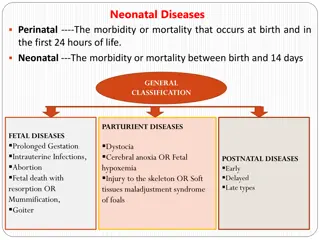
Neonatal sepsis algorithm for identifying signs, symptoms, and risk factors of sepsis in newborns. Includes guidelines for antibiotic doses, management, and supportive care. Also covers the Hypoxic Ischaemic Encephalopathy Algorithm for assessing risk factors and symptoms related to HIE.
Please find below an Image/Link to download the presentation.
The content on the website is provided AS IS for your information and personal use only. It may not be sold, licensed, or shared on other websites without obtaining consent from the author. If you encounter any issues during the download, it is possible that the publisher has removed the file from their server.
You are allowed to download the files provided on this website for personal or commercial use, subject to the condition that they are used lawfully. All files are the property of their respective owners.
The content on the website is provided AS IS for your information and personal use only. It may not be sold, licensed, or shared on other websites without obtaining consent from the author.
E N D
Presentation Transcript
Neonatal Sepsis Algorithm Any major SIGN/SYMPTOM of sepsis No Any other SIGNS/SYMPTOMS of sepsis 0 or 1 Any major RISK FACTOR of sepsis A Yes >1 No Any other RISK FACTORS of sepsis Yes 0 or 1 >1 Sepsis unlikely Symptomatic sepsis Asymptomatic sepsis Other LICs Malawi 48 hours of IVAB 7-10 days. Stop day 7 if clinically well 5 days of IVAB
Neonatal Sepsis Algorithm Risk factors Major Other risk factors <32/40 weeks gestation or <1500g (spontaneous labour only) Maternal fever >38 C in labour Prolonged rupture of membranes (PROM) >18 hours Foul smelling amniotic fluid Signs/symptoms Major Other signs/symptoms Pallor Neonatal temperature >37.5 C Boil/abscess Grunting/severe respiratory distress/ mod-severe WOB Lethargy Umbilical redness extending to the periumbilical skin or umbilicus draining pus Deep jaundice: palms and soles of the baby deep yellow Tachypnoea > 60 bpm Convulsions/twitching or abnormal movements Many or severe skin pustules Bilious vomiting with severe abdominal distension Bulging fontanelle New onset of poor feeding Not moving when stimulated Swollen red eyelids with pus Central cyanosis
Neonatal sepsis management Antibiotic doses Gentamicin (IM/IV) <7 days: 3 mg/kg (LBW) and 5 mg/kg (normal BW) per dose once a day >7 days 7.5 mg/kg once a day Ampicillin (IM/IV) <7 days: 50 mg/kg every 12 h >7 days every 8 h Benzylpenicillin (penicillin G) (IM) <7 days: 50 000 U/kg every 12 h >7 days every 6 h Investigations If possible perform sepsis screen: FBC, CRP, blood culture LP only for those who have clinical signs of meningitis (but stable) or late-onset neonatal sepsis Antibiotic choices 1st line: give local recommendations IM/IV gentamicin and benzylpenicillin or ampicillin 2nd line: If no improvement after 48 hours change to a third-generation cephalosporin IV cloxacillin and gentamicin if greater risk of staphylococcal (skin infection). Supportive care Thermoregulation: aim for 36.5-37.5 C Provide respiratory support oxygen or CPAP as needed according to CPAP algorithm Check blood glucose and provide feeding support as needed Consider 10ml/kg fluid bolus if shocked as per SHOCK algorithm Consider 2.5mls/kg 10% dextrose if BS<2.5 mmol or 45 mg/dl as per HYPOGLYCAEMIA algorithm Antibiotic duration (without investigations) Asymptomatic sepsis: Treat for 48 hours and stop if well (Treat for 5 days in Malawi) Symptomatic sepsis: Stop at day 7 if clinically well otherwise continue for 10 days
Hypoxic Ischaemic Encephalopathy Algorithm Any one risk factor Foetal distress Resuscitation: Assisted ventilation >5 minutes or CPR >10 minutes Apgar at 5 minutes <7 Perform Thompson score to assess for HIE No Yes Yes Any one sign or symptom Coma Convulsions Lethargy Hypotonia Absent Moro reflex Absent suck Respiratory distress Yes >37 weeks gestation No Consider HIE but seek clinician review to confirm diagnosis No Unlikely HIE
Management page for HIE Thermoregulation Aim for normothermia Avoid hyperthermia and hypothermia Respiratory support Give respiratory support as appropriate. Give oxygen if saturations <90% in air Feedingsupport, anticonvulsants and antibiotics Give feeding support as appropriate 1. Oral feeds (breast feed or bottle if breastfeeding is not possible) 2. Give NG feeds if BS <2.5mmol/L or <45mg/dL and not tolerating oral feeds 3. Give IV fluids if BS <2.5mmol/L or <45mg/dL and not tolerating NG feed If evidence of seizure activity give Phenobarbitoneas per convulsions algorithm. Reassess suck, tone, coma, seizures every 8 hours for 72 hours in hospital Treat for sepsis with antibiotics
Respiratory Distress Algorithm Any one or more signs or symptoms of respiratory distress Unlikely RDN Saturations in air <90% Tachypnoea >60 bpm Fever >37.5 C or <36 C and crepitations on auscultation Grunting Recessions Any increased work of breathing Cyanosis Apnoea No Yes Respiratory Distress of the Newborn (RDN) Management
Teaching page for RDN Management page RDN Meconium aspiration Consider if meconium stained amniotic fluid Just because there was meconium at delivery doesn t mean it was aspirated. Most aspiration occurs in utero before the baby is born, so more likely if there was foetal distress in labour or has signs of birth asphyxia. Floppy babies with severe HIE and meconium aspiration are unlikely to benefit from CPAP. Transient tachypnoea of the newborn (TTN) These babies are not unwell RR is usually between 60-80 bpm and they don t usually need oxygen This should resolve in the first few hours of life. TTN is more likely following elective C-section or a rapid vaginal delivery. Give antibiotics if unable to exclude other causes i.e no chest xray Respiratory distress syndrome Consider if < 37 weeks or diabetic mother Benefit from CPAP see Algorithm Congenital Pneumonia Consider if temperature > 37.5 c or < 36 c and crepitations on auscultation Risk factors for sepsis i.e maternal fever/PROM/foul smelling amniotic fluid Investigations Perform a chest x-ray if it will change management or if the infant is not improving as expected or deteriorating. Airway and respiratory support Position airway Give oxygen if oxygen saturations < 90% in air If > 1kg consider CPAP according to CPAP algorithm Feeding support If breathing 60-80 bpm use cup/NGT If needing CPAP use OGT If breathing > 80bpm consider IV fluids IV Access for Antibiotics Give antibiotics including for suspected TTN (unless have chest x-ray and can safely exclude.)
Hypothermia Algorithm Recheck temp every 30-60 mins Temperature <36.4 C? Hypothermia management page in NeoTree: Warm the baby Skin to skin Place on warmer/resuscitaire if unstable No Yes Limit heat loss Make sure the baby is dry Put on a hat and wrap up the baby If on the resuscitaire put the sides up Ensure room is free from drafts - windows and doors closed Hypothermia Temperature >37.5 C? Mild = 36-36.4 C Mod = 32-35.9 C Severe = <32 C No Yes Monitor Recheck temperature every 30-60 minutes until normothermic Watch out for overwarming Complete NeoTree assessment to assess for signs of infection (consider if persistent hypothermia despite warming), apnoea and hypoglycaemia. Normothermia Address any environmental causes: unwrap or remove baby from under resuscitaire If fever persists follow NEONATAL SEPSIS algorithm