Network Distribution Efficiency and Transmission Analysis
Explore the concept of network transmission and distribution efficiency, including factors affecting round-trip times, DNS setup, TCP connections, access delays, and propagation delays. Learn about optimizing data distribution for client-server and P2P networks to enhance performance.

Download Presentation

Please find below an Image/Link to download the presentation.
The content on the website is provided AS IS for your information and personal use only. It may not be sold, licensed, or shared on other websites without obtaining consent from the author. If you encounter any issues during the download, it is possible that the publisher has removed the file from their server.
You are allowed to download the files provided on this website for personal or commercial use, subject to the condition that they are used lawfully. All files are the property of their respective owners.
The content on the website is provided AS IS for your information and personal use only. It may not be sold, licensed, or shared on other websites without obtaining consent from the author.
E N D
Presentation Transcript
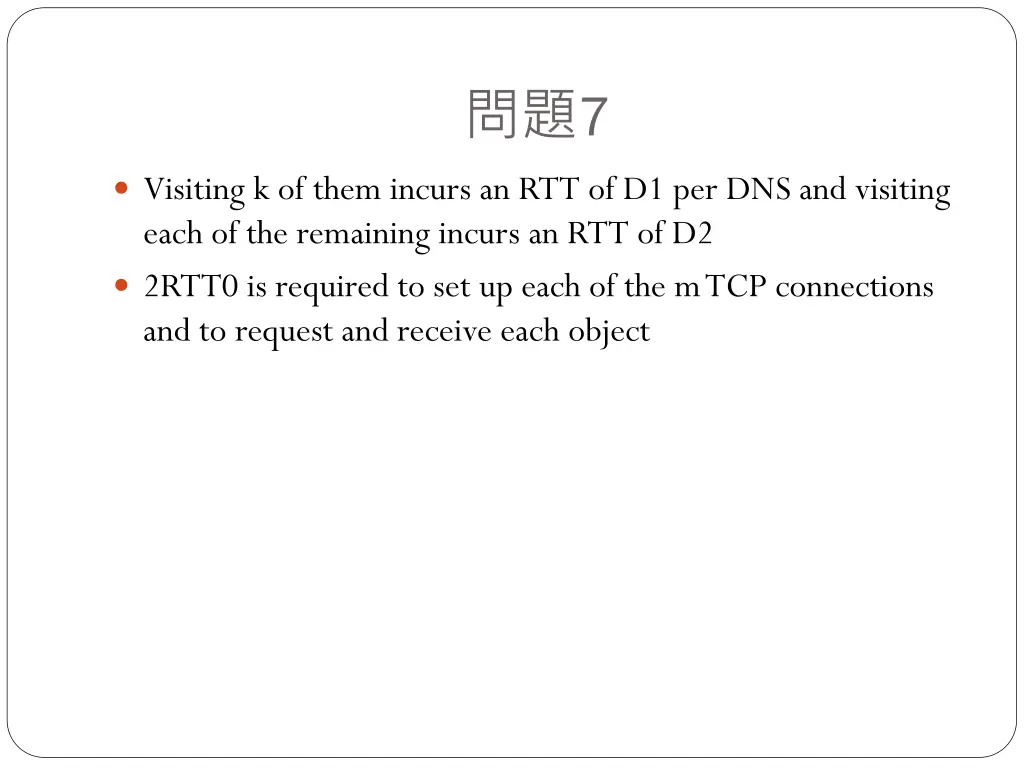
7 Visiting k of them incurs an RTT of D1 per DNS and visiting each of the remaining incurs an RTT of D2 2RTT0 is required to set up each of the m TCP connections and to request and receive each object
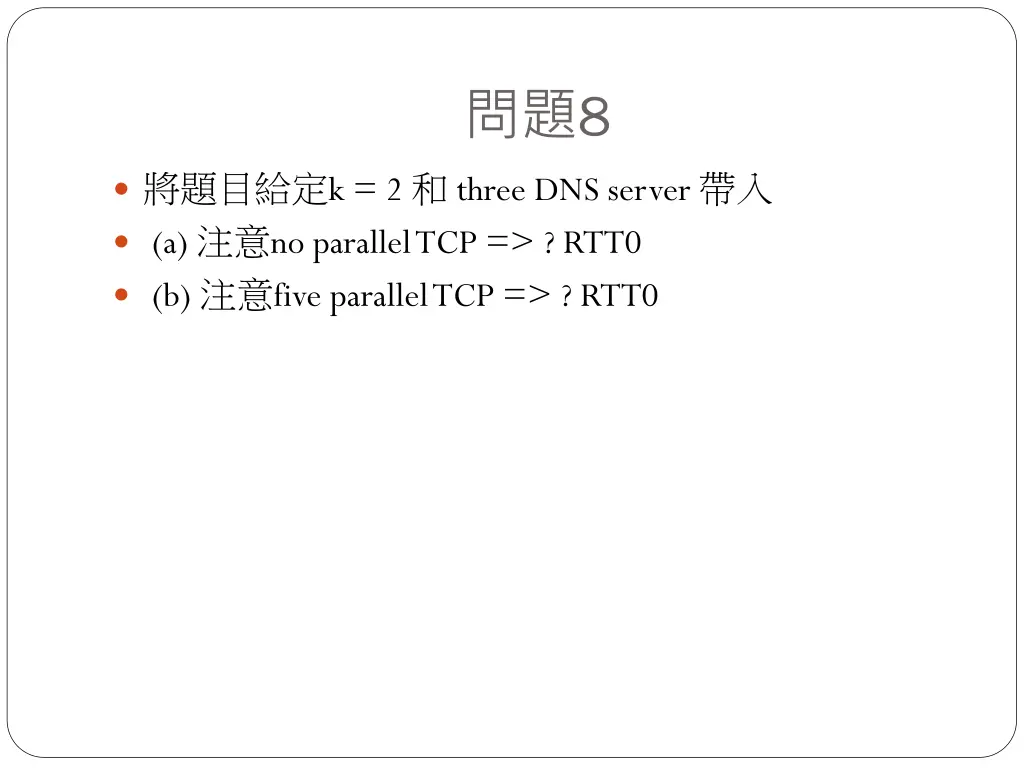
8 k = 2 three DNS server (a) no parallel TCP => ? RTT0 (b) five parallel TCP => ? RTT0
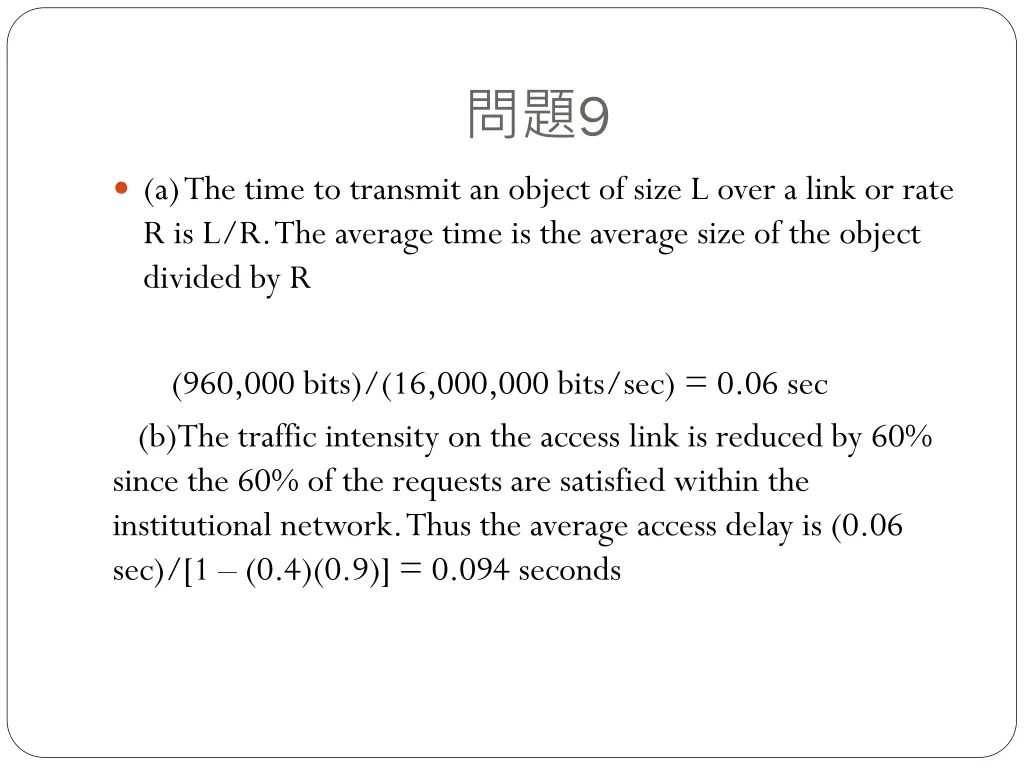
9 (a) The time to transmit an object of size L over a link or rate R is L/R. The average time is the average size of the object divided by R (960,000 bits)/(16,000,000 bits/sec) = 0.06 sec (b)The traffic intensity on the access link is reduced by 60% since the 60% of the requests are satisfied within the institutional network. Thus the average access delay is (0.06 sec)/[1 (0.4)(0.9)] = 0.094 seconds
10 Note that each downloaded object can be completely put into one data packet. Let Tp denote the one-way propagation delay between the client and the server
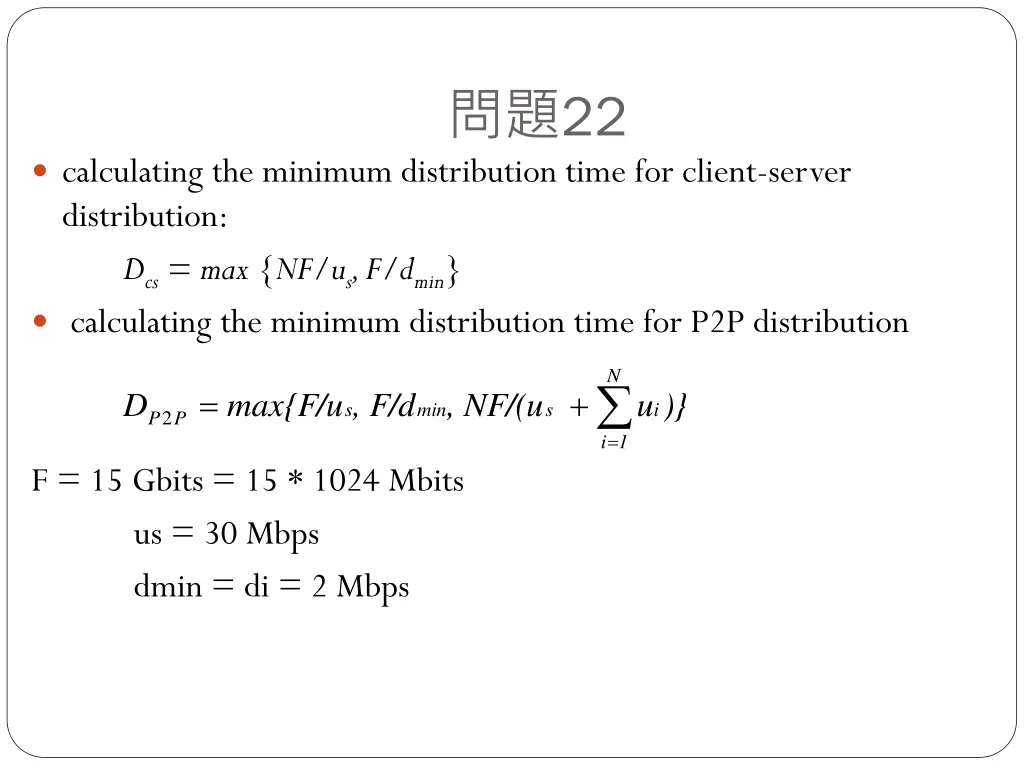
22 calculating the minimum distribution time for client-server distribution: Dcs= max {NF/us, F/dmin} calculating the minimum distribution time for P2P distribution N = = + D max{F/u , F/d s , NF/(u u )} min s i 2 P P i 1 F = 15 Gbits = 15 * 1024 Mbits us = 30 Mbps dmin = di = 2 Mbps
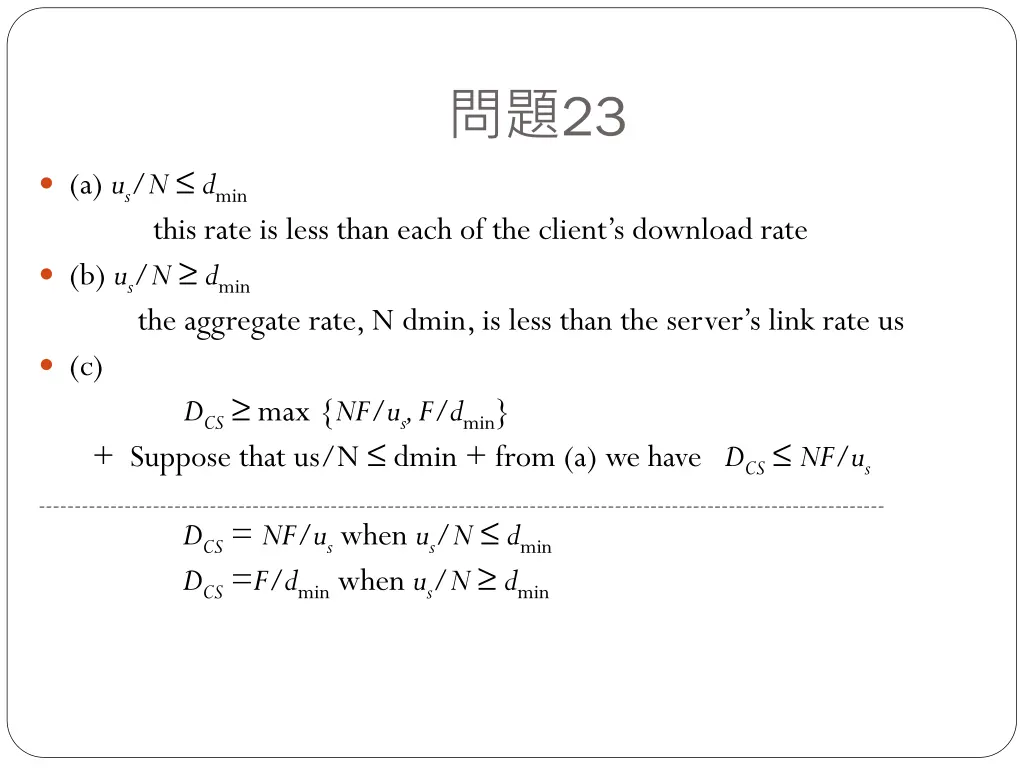
23 (a) us/N dmin this rate is less than each of the client s download rate (b) us/N dmin the aggregate rate, N dmin, is less than the server s link rate us (c) DCS max {NF/us, F/dmin} + Suppose that us/N dmin + from (a) we have DCS NF/us ----------------------------------------------------------------------------------------------------------------------- DCS= NF/uswhen us/N dmin DCS=F/dminwhen us/N dmin
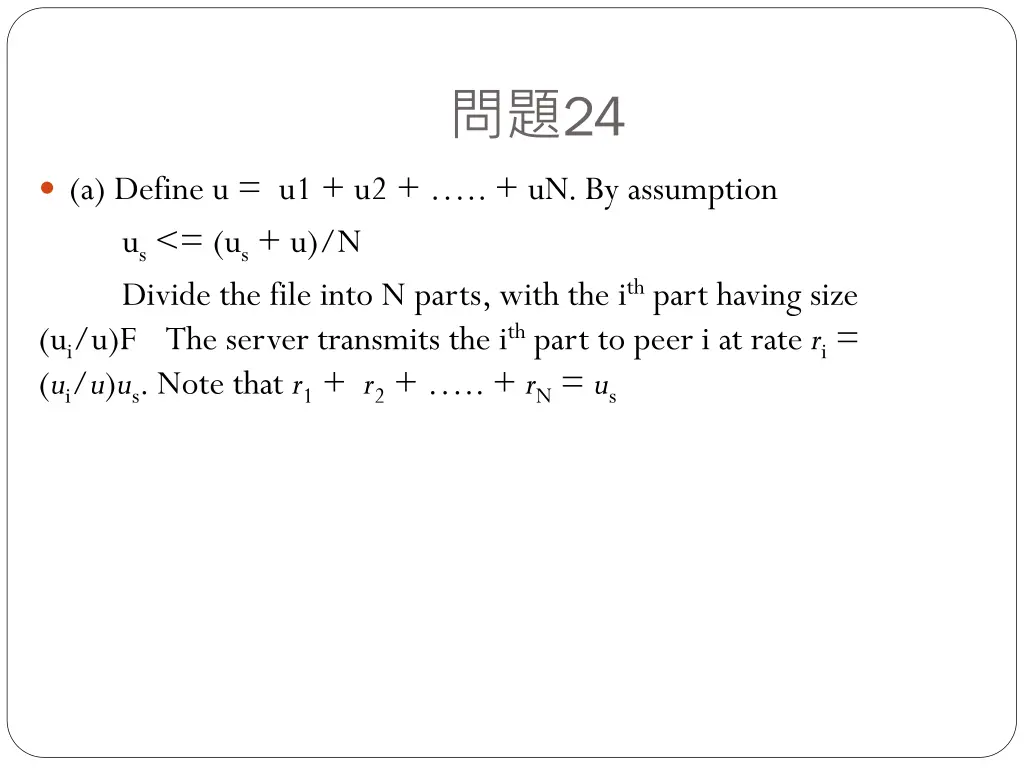
24 (a) Define u = u1 + u2 + .. + uN. By assumption us<= (us+ u)/N Divide the file into N parts, with the ithpart having size (ui/u)F The server transmits the ithpart to peer i at rate ri= (ui/u)us. Note that r1+ r2+ .. + rN= us
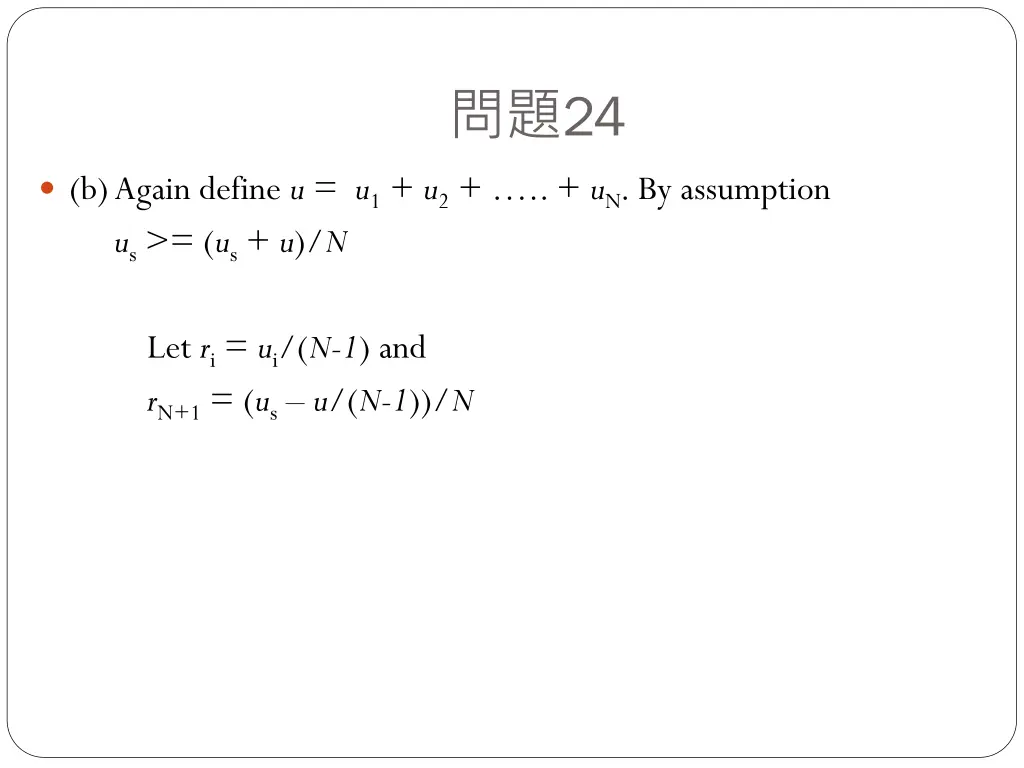
24 (b) Again define u = u1+ u2+ .. + uN. By assumption us>= (us+ u)/N Let ri= ui/(N-1) and rN+1= (us u/(N-1))/N
28 Peer 6 would first send peer 15 a message, saying what will be peer 6 s predecessor and successor?
32 UDPServer determines the client port number by unraveling the datagram it receives from the client.