Neurosurgery SIG Meeting Sydney 2013 Agenda
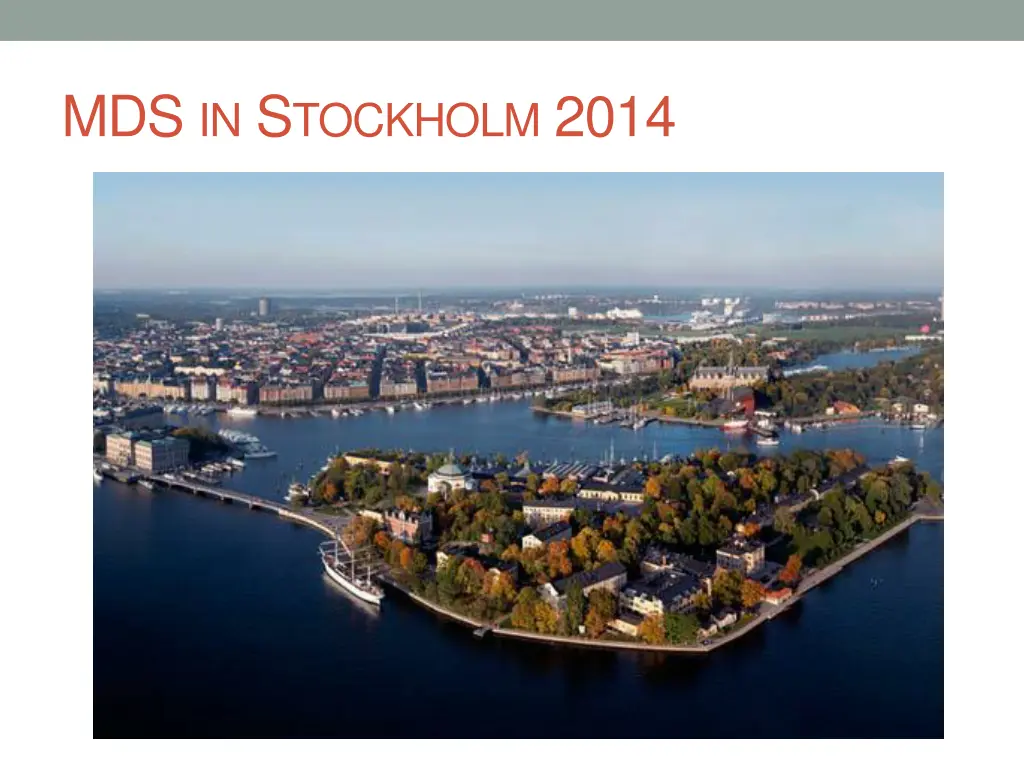
Neurosurgical topics discussed at the MDS meeting in 2014, including deep brain lesioning, new tools for understanding Parkinson's disease, and ethical issues in DBS surgery. The agenda covers symposium titles, suggested session chairs, possible speakers, and review of past actions.

Download Presentation

Please find below an Image/Link to download the presentation.
The content on the website is provided AS IS for your information and personal use only. It may not be sold, licensed, or shared on other websites without obtaining consent from the author. If you encounter any issues during the download, it is possible that the publisher has removed the file from their server.
You are allowed to download the files provided on this website for personal or commercial use, subject to the condition that they are used lawfully. All files are the property of their respective owners.
The content on the website is provided AS IS for your information and personal use only. It may not be sold, licensed, or shared on other websites without obtaining consent from the author.
E N D
Presentation Transcript
THE NEUROSURGERY SIG MEETING Sydney 2013
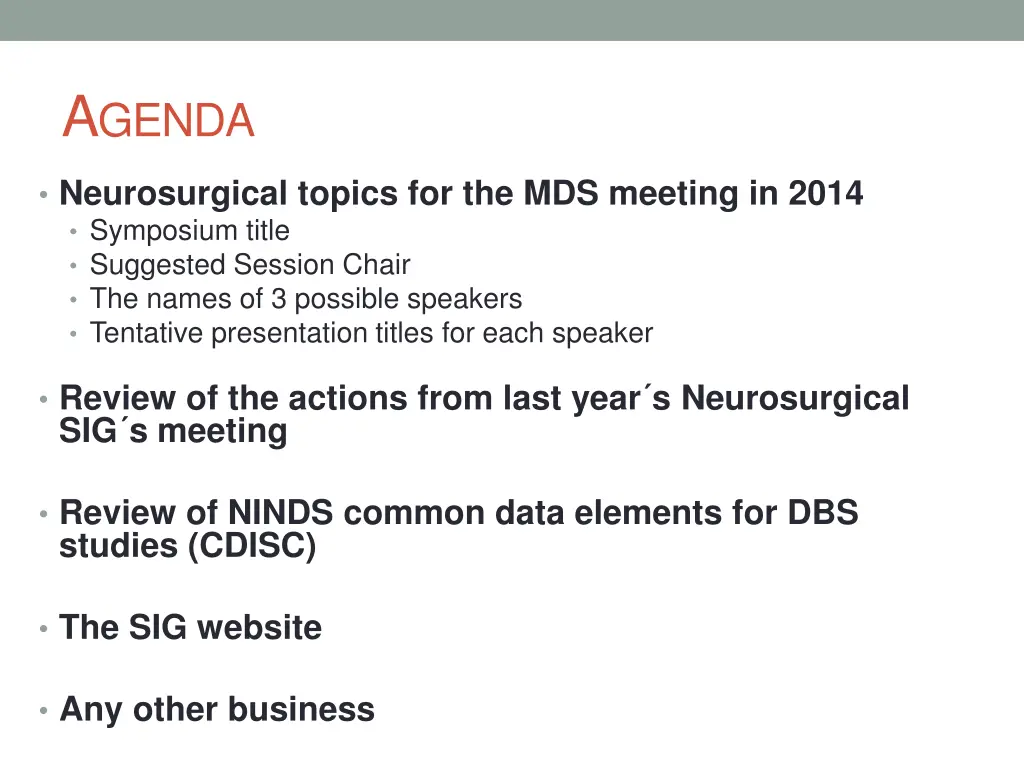
AGENDA Neurosurgical topics for the MDS meeting in 2014 Symposium title Suggested Session Chair The names of 3 possible speakers Tentative presentation titles for each speaker Review of the actions from last year s Neurosurgical SIG s meeting Review of NINDS common data elements for DBS studies (CDISC) The SIG website Any other business
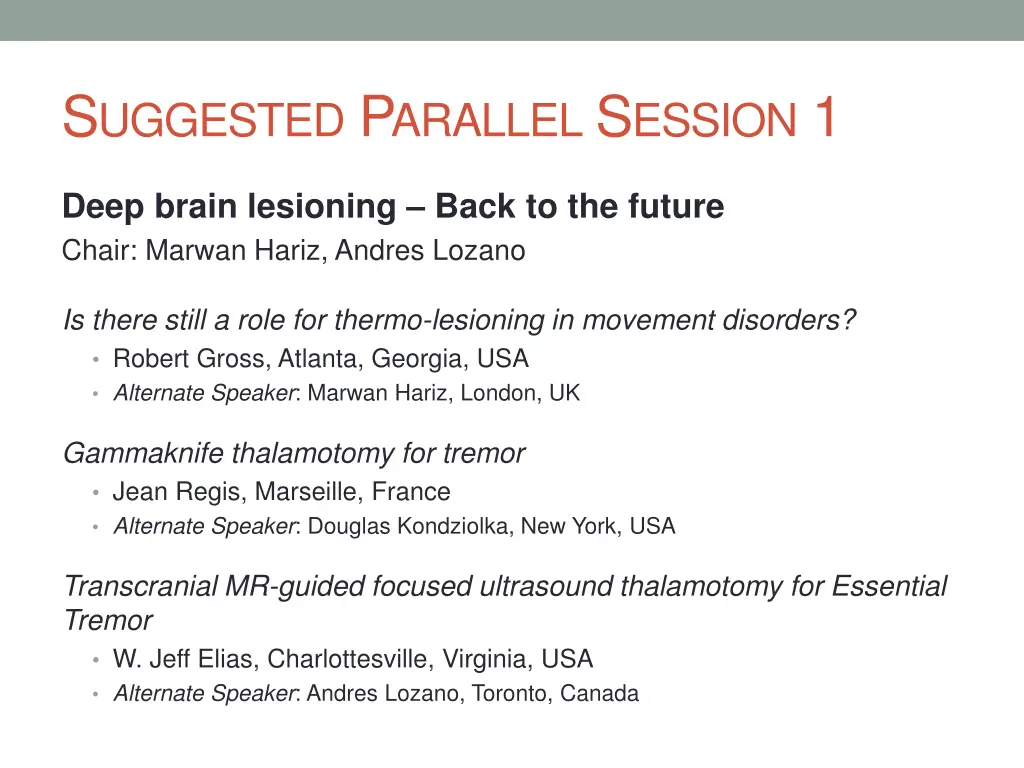
SUGGESTED PARALLEL SESSION 1 Deep brain lesioning Back to the future Chair: Marwan Hariz, Andres Lozano Is there still a role for thermo-lesioning in movement disorders? Robert Gross, Atlanta, Georgia, USA Alternate Speaker: Marwan Hariz, London, UK Gammaknife thalamotomy for tremor Jean Regis, Marseille, France Alternate Speaker: Douglas Kondziolka, New York, USA Transcranial MR-guided focused ultrasound thalamotomy for Essential Tremor W. Jeff Elias, Charlottesville, Virginia, USA Alternate Speaker: Andres Lozano, Toronto, Canada
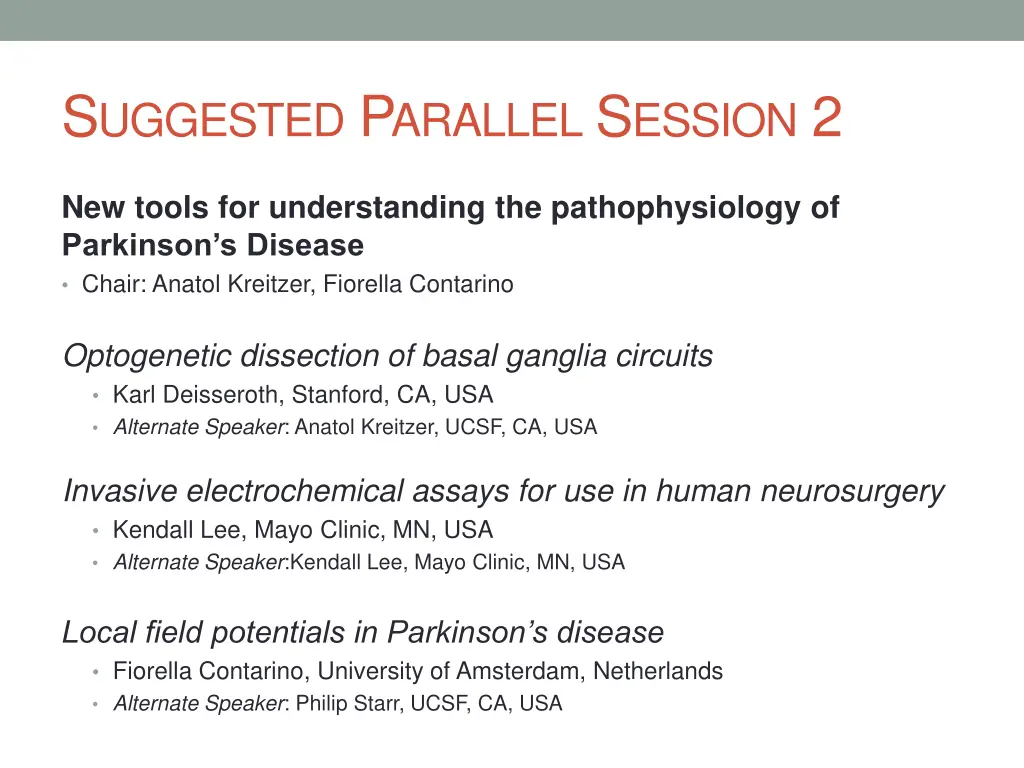
SUGGESTED PARALLEL SESSION 2 New tools for understanding the pathophysiology of Parkinson s Disease Chair: Anatol Kreitzer, Fiorella Contarino Optogenetic dissection of basal ganglia circuits Karl Deisseroth, Stanford, CA, USA Alternate Speaker: Anatol Kreitzer, UCSF, CA, USA Invasive electrochemical assays for use in human neurosurgery Kendall Lee, Mayo Clinic, MN, USA Alternate Speaker:Kendall Lee, Mayo Clinic, MN, USA Local field potentials in Parkinson s disease Fiorella Contarino, University of Amsterdam, Netherlands Alternate Speaker: Philip Starr, UCSF, CA, USA
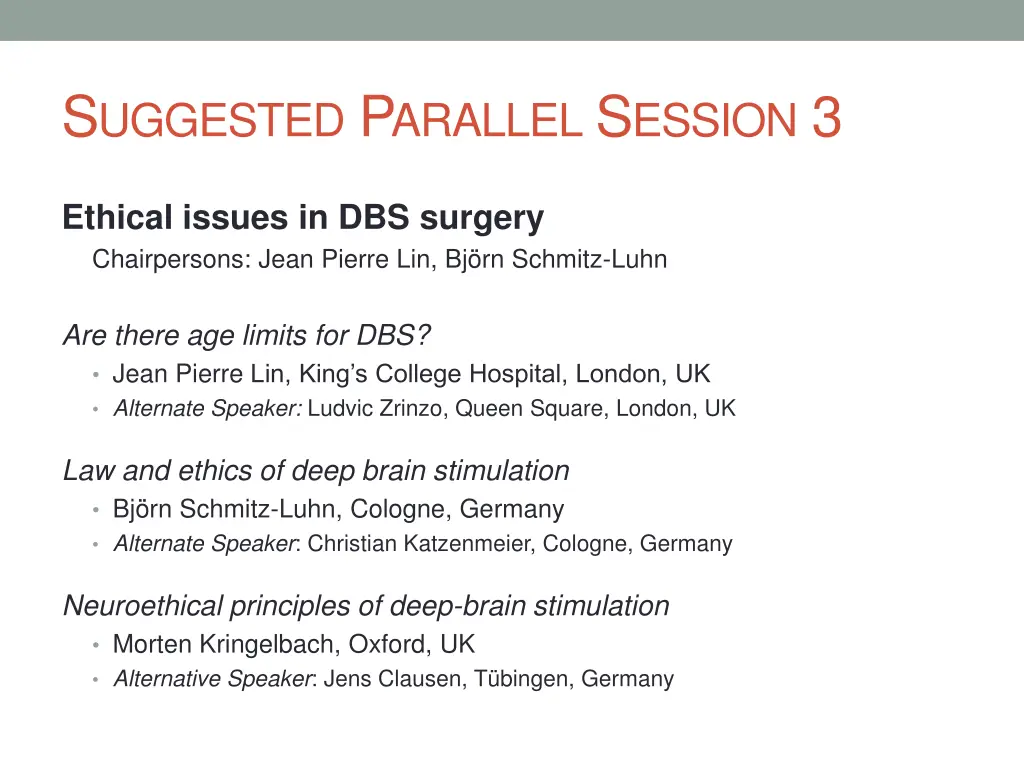
SUGGESTED PARALLEL SESSION 3 Ethical issues in DBS surgery Chairpersons: Jean Pierre Lin, Bj rn Schmitz-Luhn Are there age limits for DBS? Jean Pierre Lin, King s College Hospital, London, UK Alternate Speaker: Ludvic Zrinzo, Queen Square, London, UK Law and ethics of deep brain stimulation Bj rn Schmitz-Luhn, Cologne, Germany Alternate Speaker: Christian Katzenmeier, Cologne, Germany Neuroethical principles of deep-brain stimulation Morten Kringelbach, Oxford, UK Alternative Speaker: Jens Clausen, T bingen, Germany
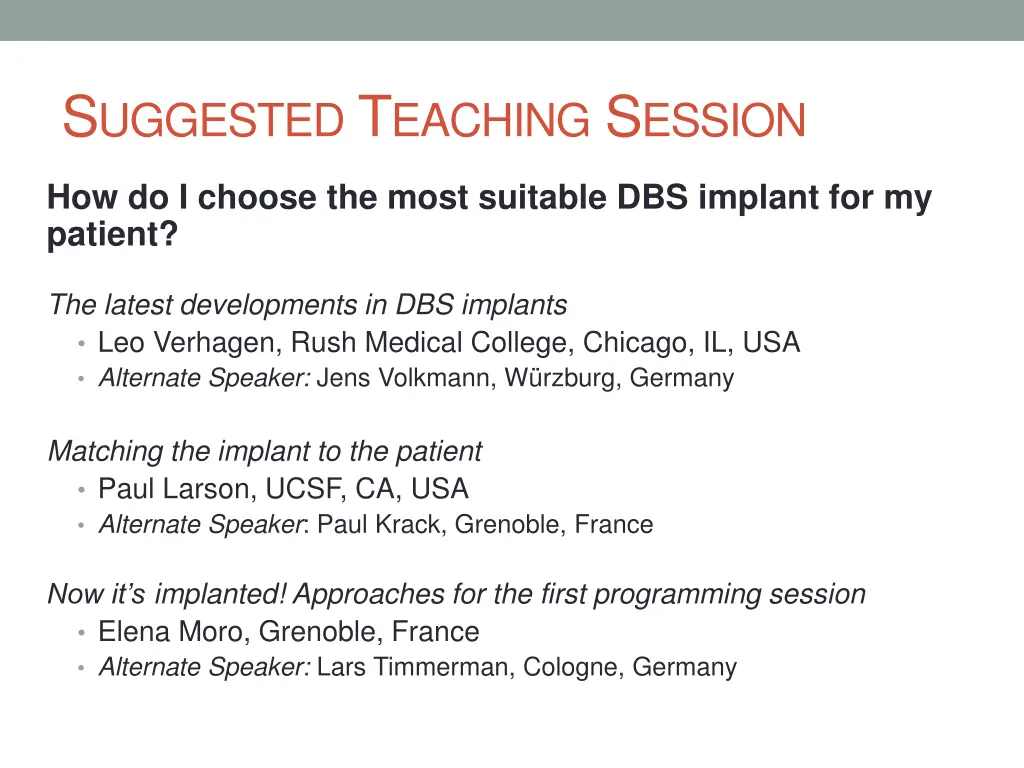
SUGGESTED TEACHING SESSION How do I choose the most suitable DBS implant for my patient? The latest developments in DBS implants Leo Verhagen, Rush Medical College, Chicago, IL, USA Alternate Speaker: Jens Volkmann, W rzburg, Germany Matching the implant to the patient Paul Larson, UCSF, CA, USA Alternate Speaker: Paul Krack, Grenoble, France Now it s implanted! Approaches for the first programming session Elena Moro, Grenoble, France Alternate Speaker: Lars Timmerman, Cologne, Germany
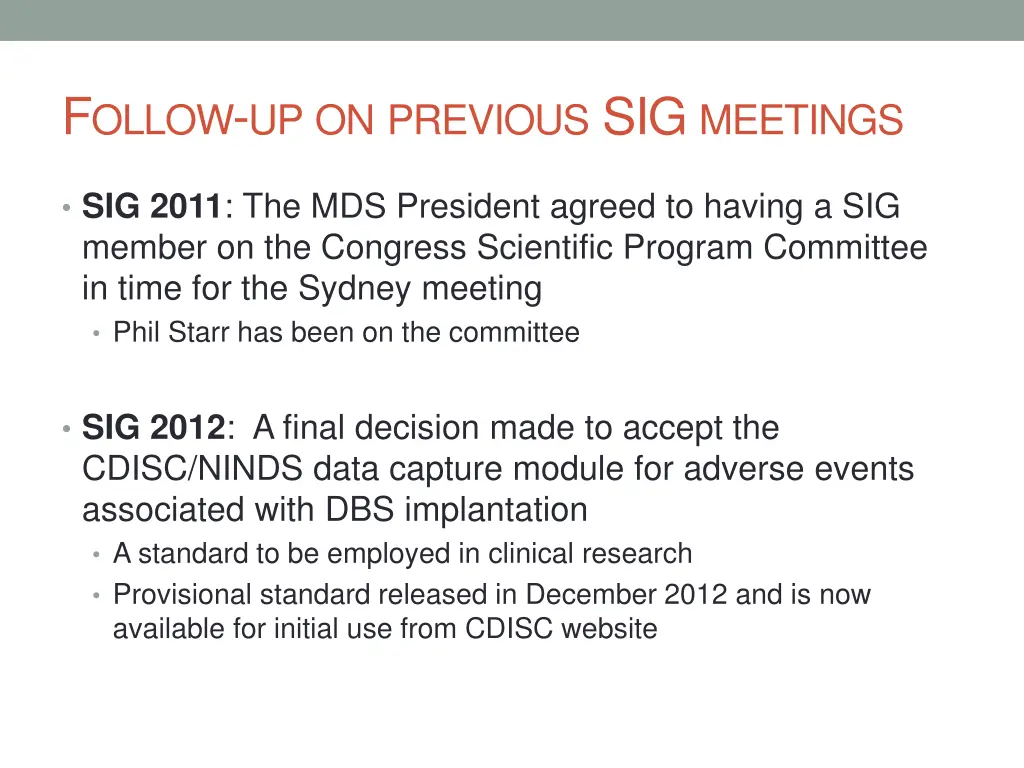
FOLLOW-UP ON PREVIOUS SIG MEETINGS SIG 2011: The MDS President agreed to having a SIG member on the Congress Scientific Program Committee in time for the Sydney meeting Phil Starr has been on the committee SIG 2012: A final decision made to accept the CDISC/NINDS data capture module for adverse events associated with DBS implantation A standard to be employed in clinical research Provisional standard released in December 2012 and is now available for initial use from CDISC website
CDISC: A global, open, multidisciplinary, non-profit organization Establishes standards to support clinical data collection, exchange, submission and archiving Mission: To develop and support global, platform-independent data standards in order to improve medical research and related areas of healthcare CDISC standards are vendor-neutral, platform-independent and freely available via the CDISC website
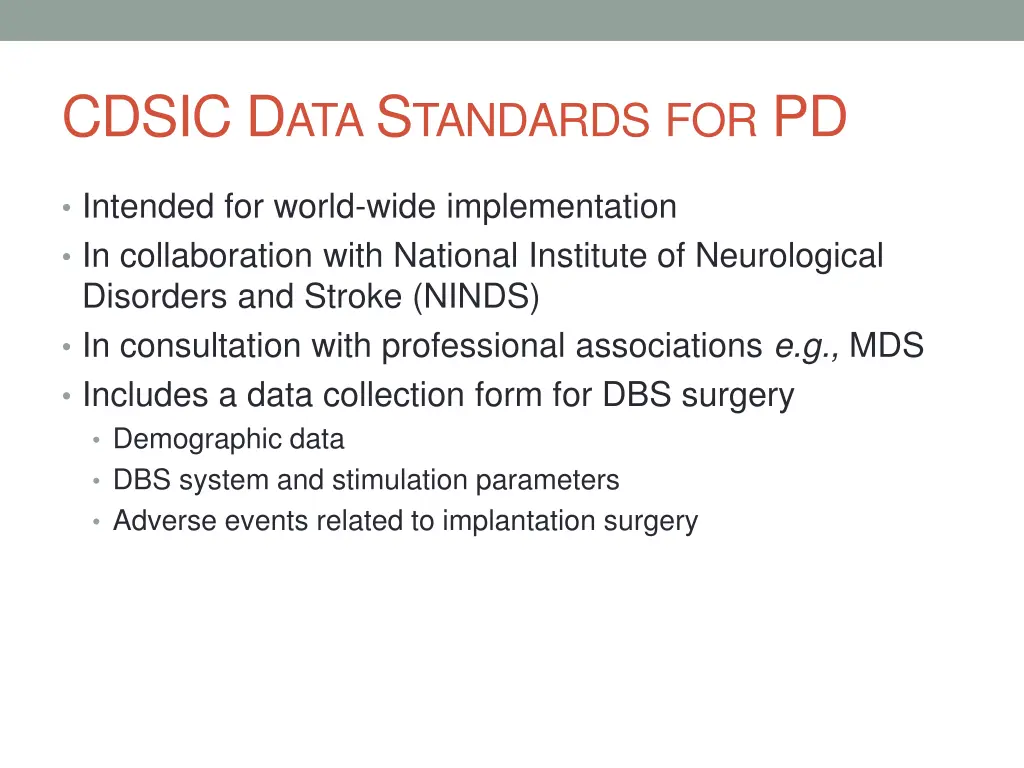
CDSIC DATASTANDARDS FOR PD Intended for world-wide implementation In collaboration with National Institute of Neurological Disorders and Stroke (NINDS) In consultation with professional associations e.g., MDS Includes a data collection form for DBS surgery Demographic data DBS system and stimulation parameters Adverse events related to implantation surgery
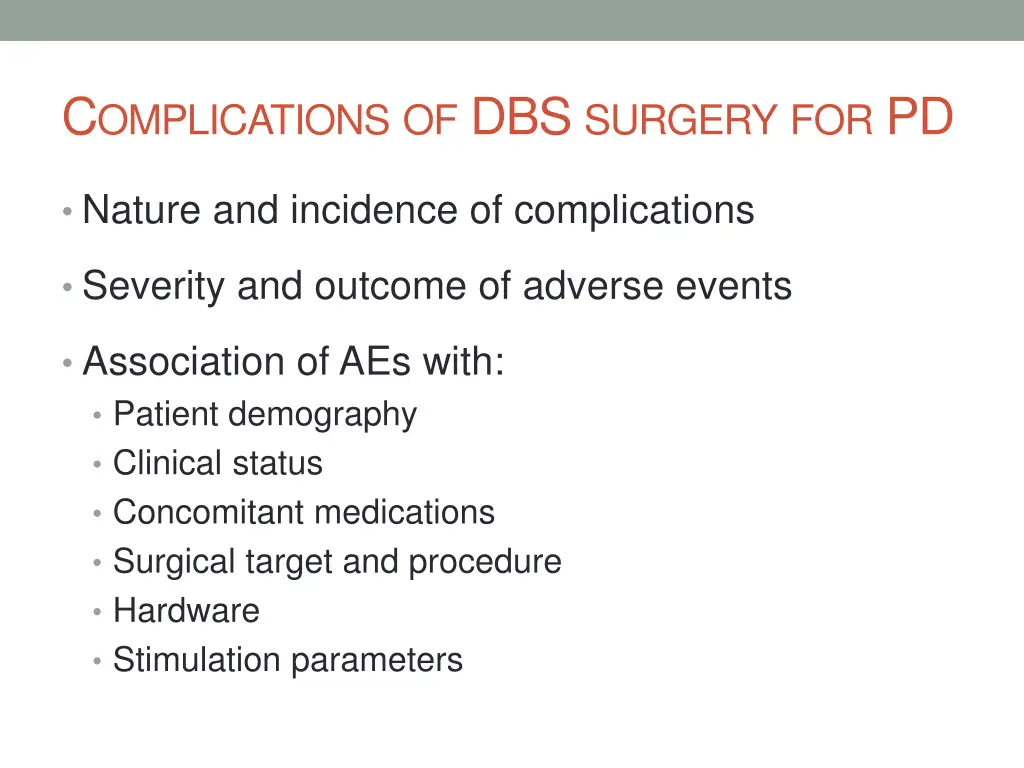
COMPLICATIONS OF DBS SURGERY FOR PD Nature and incidence of complications Severity and outcome of adverse events Association of AEs with: Patient demography Clinical status Concomitant medications Surgical target and procedure Hardware Stimulation parameters
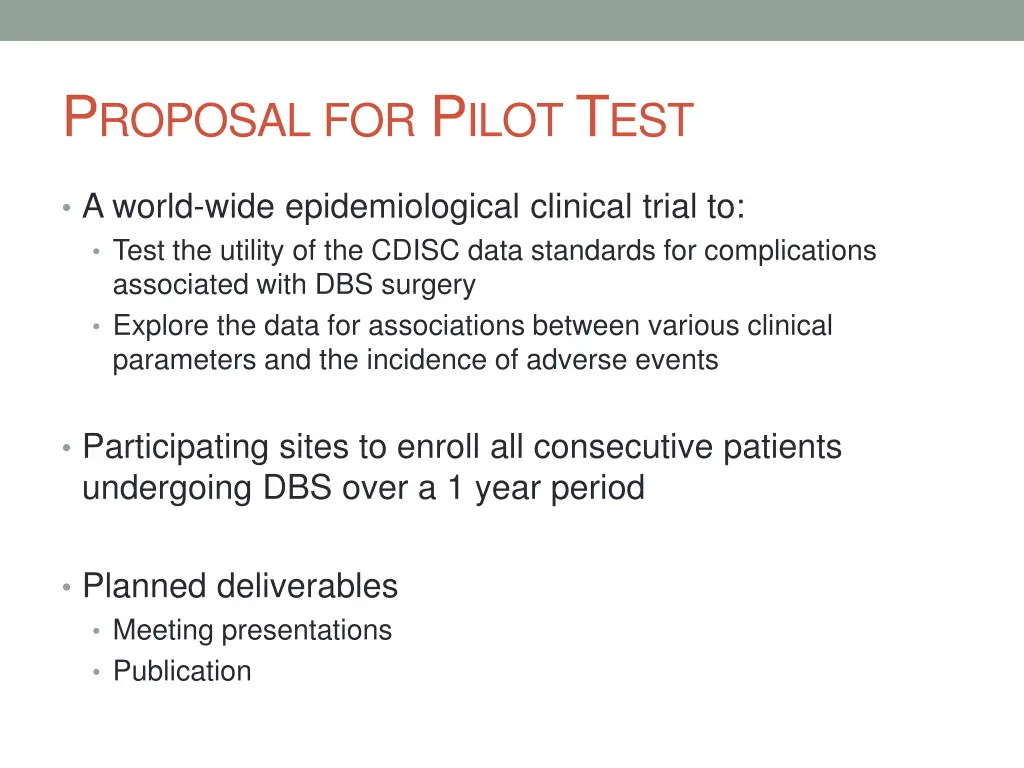
PROPOSAL FOR PILOTTEST A world-wide epidemiological clinical trial to: Test the utility of the CDISC data standards for complications associated with DBS surgery Explore the data for associations between various clinical parameters and the incidence of adverse events Participating sites to enroll all consecutive patients undergoing DBS over a 1 year period Planned deliverables Meeting presentations Publication
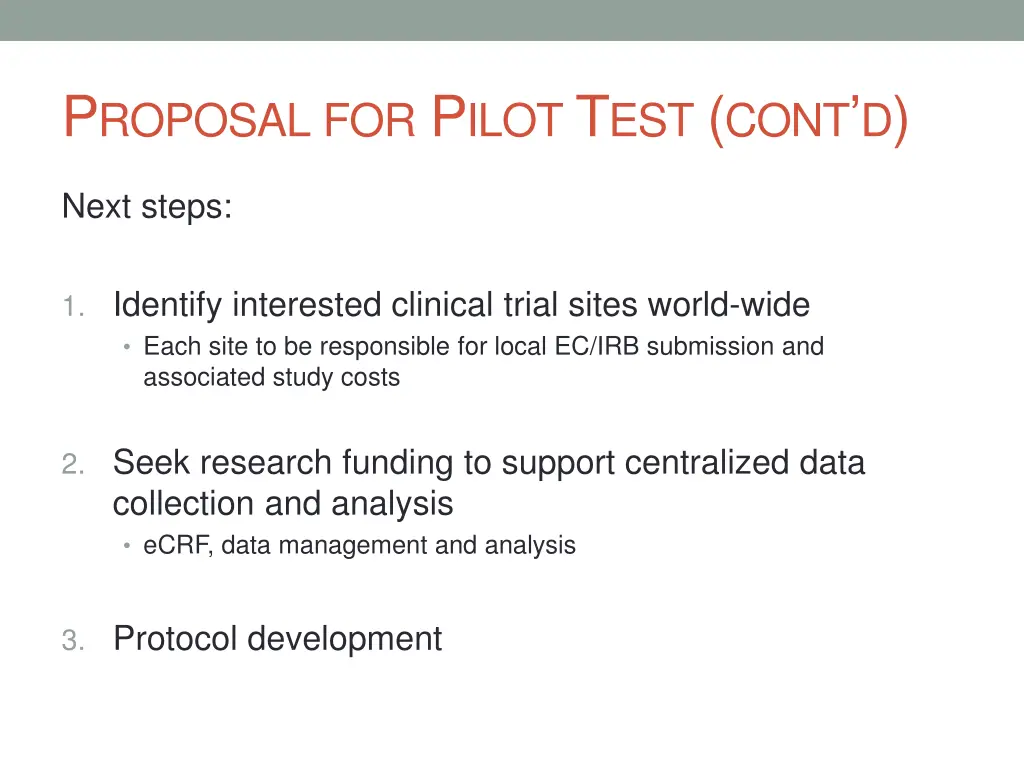
PROPOSAL FOR PILOTTEST (CONTD) Next steps: 1. Identify interested clinical trial sites world-wide Each site to be responsible for local EC/IRB submission and associated study costs 2. Seek research funding to support centralized data collection and analysis eCRF, data management and analysis 3. Protocol development
SIG WEBSITE New content! Interactive space for members to discuss patient cases Updates to the section on future treatments Any volunteers? Authors will be recognized on the website A nice opportunity for residents to show their interest in the field Please contact me with suggestions for content at per.almqvist@ki.se