Delve into the fascinating world of neutrino oscillations with this detailed exploration of the solar neutrino problem, flavor oscillation mechanisms, effective Hamiltonian modeling, and more. Discover the complexities behind neutrinos and their oscillatory nature in this informative resource.
Please find below an Image/Link to download the presentation.
The content on the website is provided AS IS for your information and personal use only. It may not be sold, licensed, or shared on other websites without obtaining consent from the author. If you encounter any issues during the download, it is possible that the publisher has removed the file from their server.
You are allowed to download the files provided on this website for personal or commercial use, subject to the condition that they are used lawfully. All files are the property of their respective owners.
The content on the website is provided AS IS for your information and personal use only. It may not be sold, licensed, or shared on other websites without obtaining consent from the author.
Outline: Introduction to neutrinos Solar neutrino problem and MSW Early Universe neutrinos
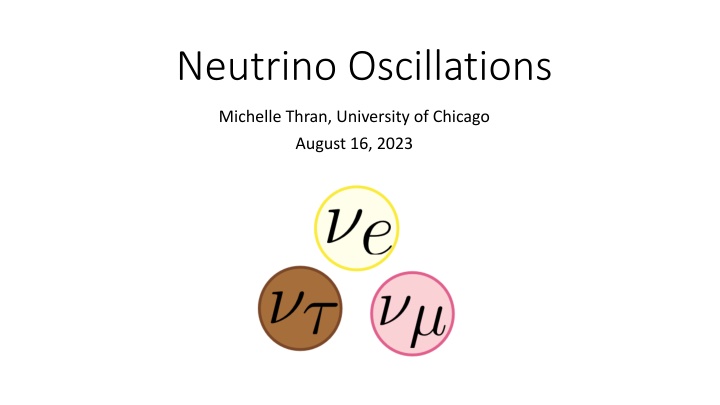
Neutrinos Chargeless, three leptonic flavors (??, ? , ? ) associated with ?,?,? in weak interaction Each flavor is a linear combination of 3 mass eigenstates A neutrino s flavor may oscillate as it propagates! ? ??+ ?
Solar Neutrino Problem ?? produced in nuclear fusion (proton-proton chain reaction) ??-flux measured on Earth from Sun a third of theorized value! Resolution: flavor oscillation!
Flavor Oscillation Mechanism Time evolution of mass eigenstates Relativistic approximation Time evolution of flavor eigenstate Amplitude of flavor oscillation
Effective Hamiltonian Flavor oscillation dynamics can be modeled with effective Hamiltonian and Schrodinger equation vacuum effective Hamiltonian is related to relationship between mass and flavor eigenstates
Density Matrix (bear with me!) Time evolution (Schrodinger eq!) Vanilla formalism Density Matrix formalism i-th diagonal gives probability of observing i-th state Time evolution
Early Universe Neutrinos As universe cools, various particles decouple from primordial plasma (occurs when MFP becomes larger than particle horizon) In temperature range 100-1 MeV, neutrinos in thermal equilibrium. Electron neutrinos decouple at ~1.3 MeV, other neutrinos at ~1.5 MeV These relic neutrinos now redshifted beyond current observational capabilities (~10 4 10 6 MeV) What is the spectrum and flavor content of these neutrinos when they decouple in the early universe?
Early Universe Toy Model Hamiltonian with vacuum and thermal potential terms from electron-positron and neutrino-antineutrino scattering potentials Assume 2 flavors and neglect spin degrees of freedom Allow for simple inelastic collision terms that may have flavor-dependent scattering amplitudes Assume non-degenerate bath of neutrinos and targets (i.e. ignore Pauli blocking) Instead of continuous energy distribution, assume n discrete energy bins Work in Bloch form
Form of QKEs Effective Hamiltonian Thermal terms dominate at higher temperatures Familiar time evolution term Collision terms Bloch form (for neutrino) Collisions
Takeaways: Mass basis does not correspond to flavor basis! Mass (anti-)/alignment for neutrino/antineutrino Precession is adiabatic (polarization vectors track Hamiltonian vector
Thank you! Special thanks to: Vincenzo Cirigliano NSF All of you :)