New Framework of DAMPE Offline Software
This proposal introduces a new framework for the offline software of DAMPE, focusing on aspects such as Reconstruction, Analysis, Simulation, Calibration, and more. The framework aims to provide a clear and simple structure for developers with high readability and decoupling modules for enhanced extensibility. Users can expect a system that is simple, convenient to use, and fully configurable for various tasks. Tools, architecture, structure, algorithms, extensibility options, and installation guidelines are elaborated in detail.

Download Presentation

Please find below an Image/Link to download the presentation.
The content on the website is provided AS IS for your information and personal use only. It may not be sold, licensed, or shared on other websites without obtaining consent from the author.If you encounter any issues during the download, it is possible that the publisher has removed the file from their server.
You are allowed to download the files provided on this website for personal or commercial use, subject to the condition that they are used lawfully. All files are the property of their respective owners.
The content on the website is provided AS IS for your information and personal use only. It may not be sold, licensed, or shared on other websites without obtaining consent from the author.
E N D
Presentation Transcript
Suggestion of a New Framework of DAMPE offline software Chi WANG (chiwang@mail.ustc.edu.cn) Guangshun HUANG (hgs@ustc.edu.cn) On behalf of ustc-group 2014-05-12
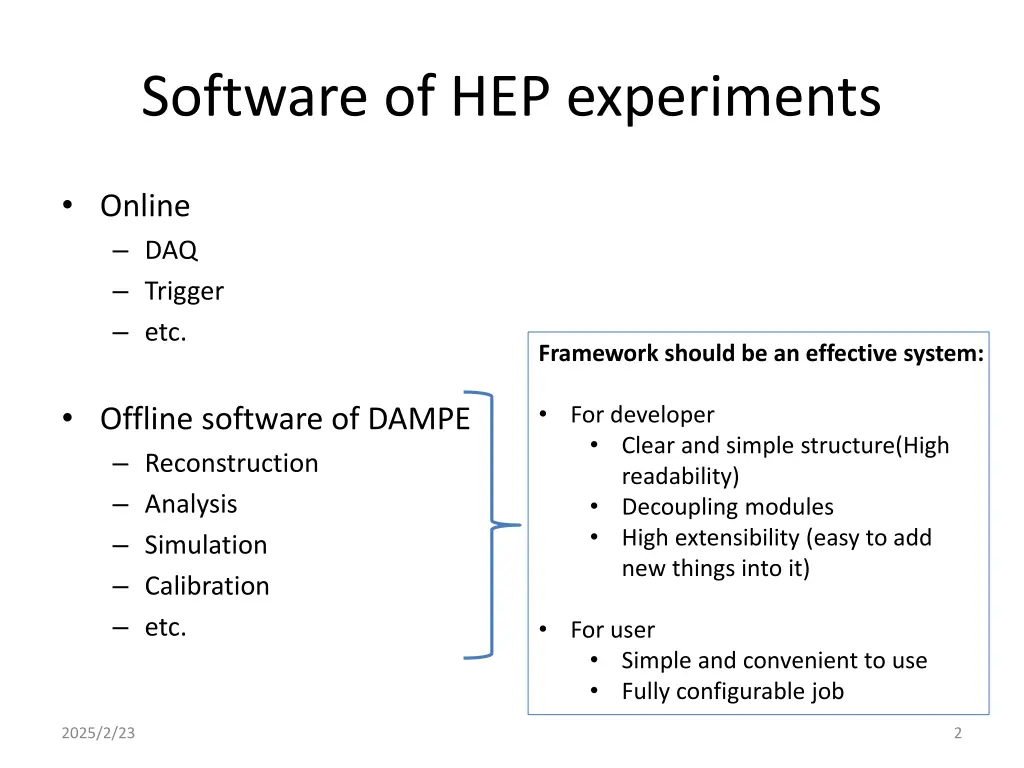
Software of HEP experiments Online DAQ Trigger etc. Framework should be an effective system: Offline software of DAMPE Reconstruction Analysis Simulation Calibration etc. For developer Clear and simple structure(High readability) Decoupling modules High extensibility (easy to add new things into it) For user Simple and convenient to use Fully configurable job 2025/2/23 2
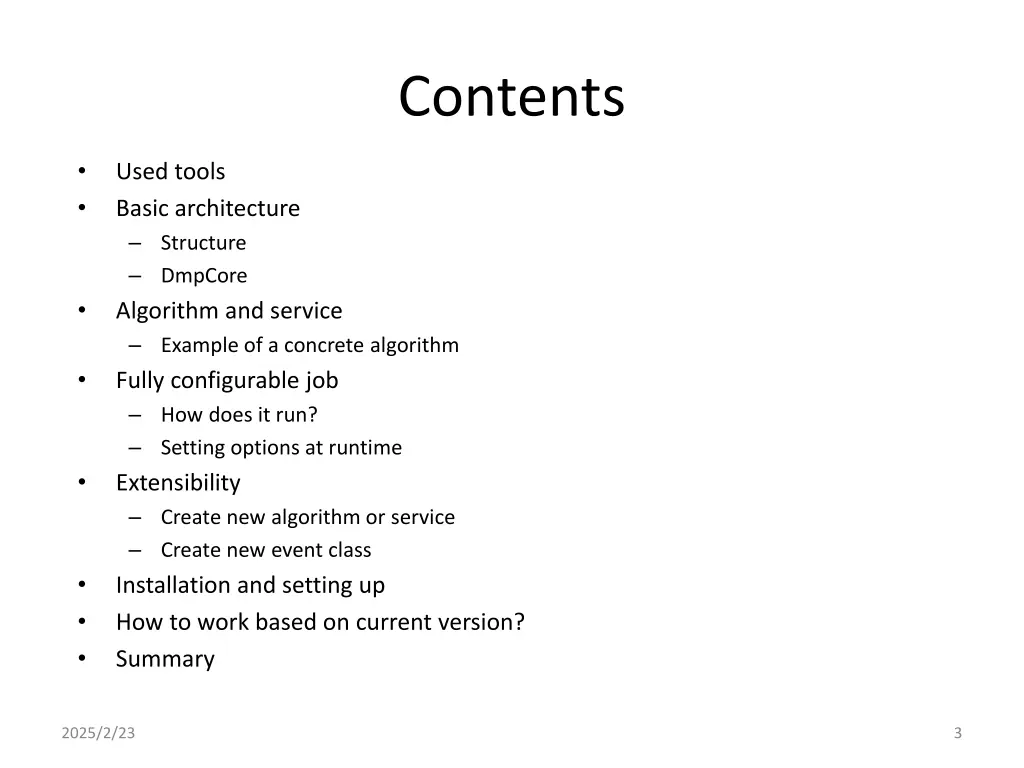
Contents Used tools Basic architecture Structure DmpCore Algorithm and service Example of a concrete algorithm Fully configurable job How does it run? Setting options at runtime Extensibility Create new algorithm or service Create new event class Installation and setting up How to work based on current version? Summary 2025/2/23 3
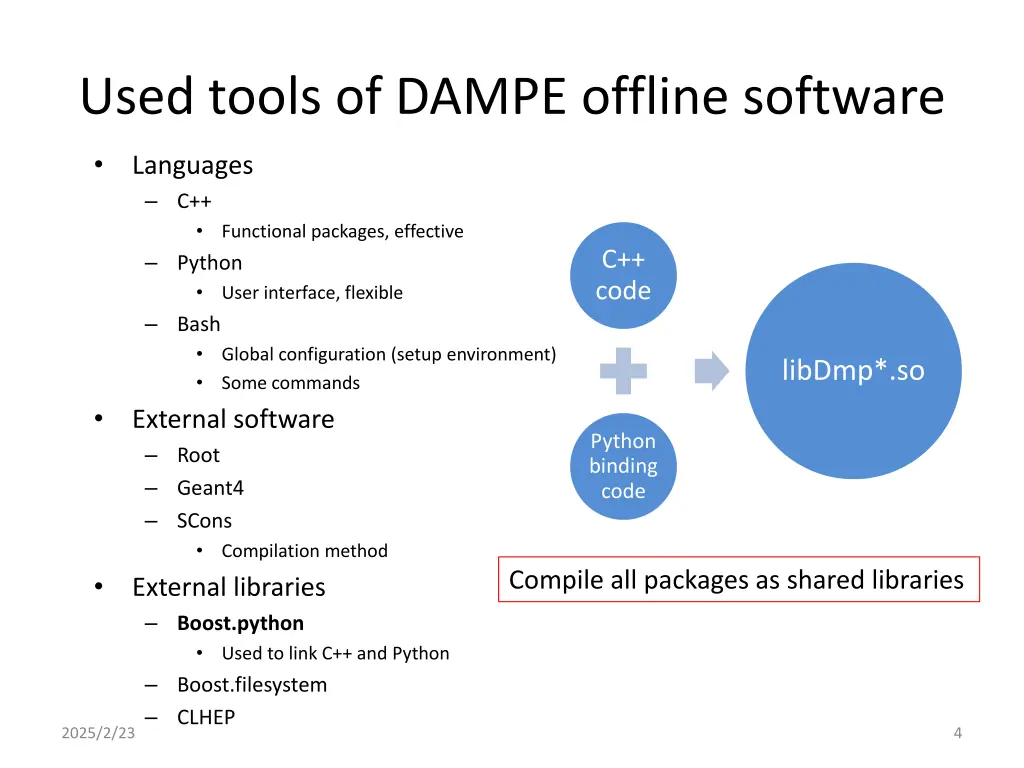
Used tools of DAMPE offline software Languages C++ Functional packages, effective Python User interface, flexible Bash Global configuration (setup environment) Some commands External software Root Geant4 SCons Compilation method External libraries Boost.python Used to link C++ and Python Boost.filesystem CLHEP 2025/2/23 C++ code libDmp*.so Python binding code Compile all packages as shared libraries 4
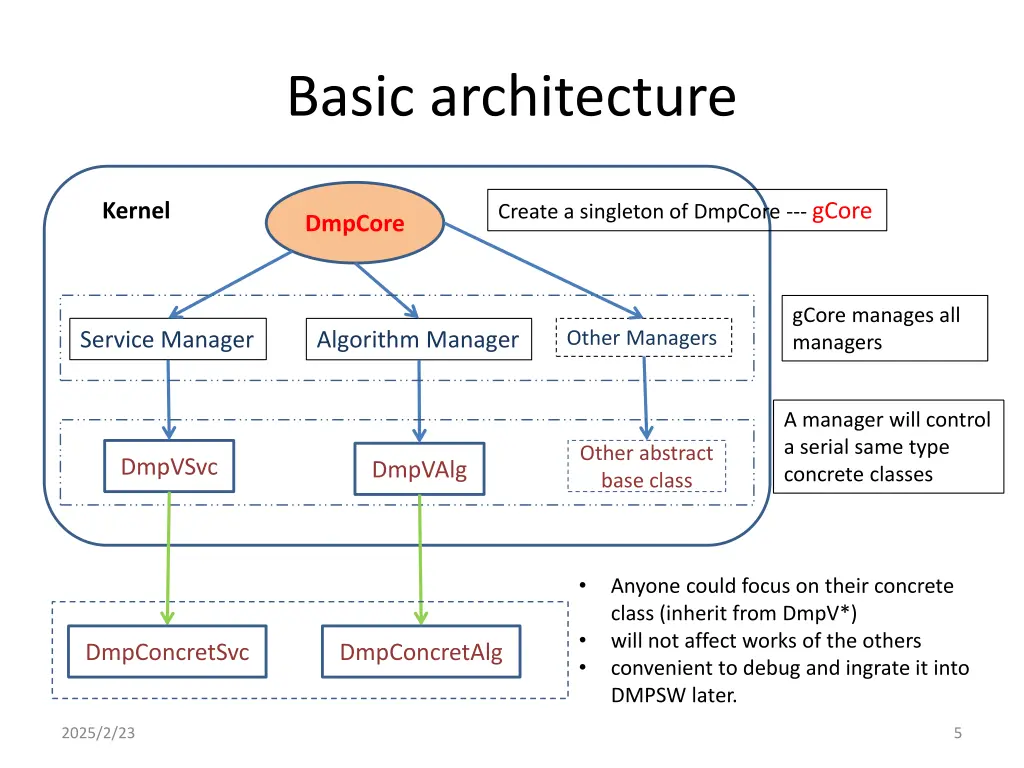
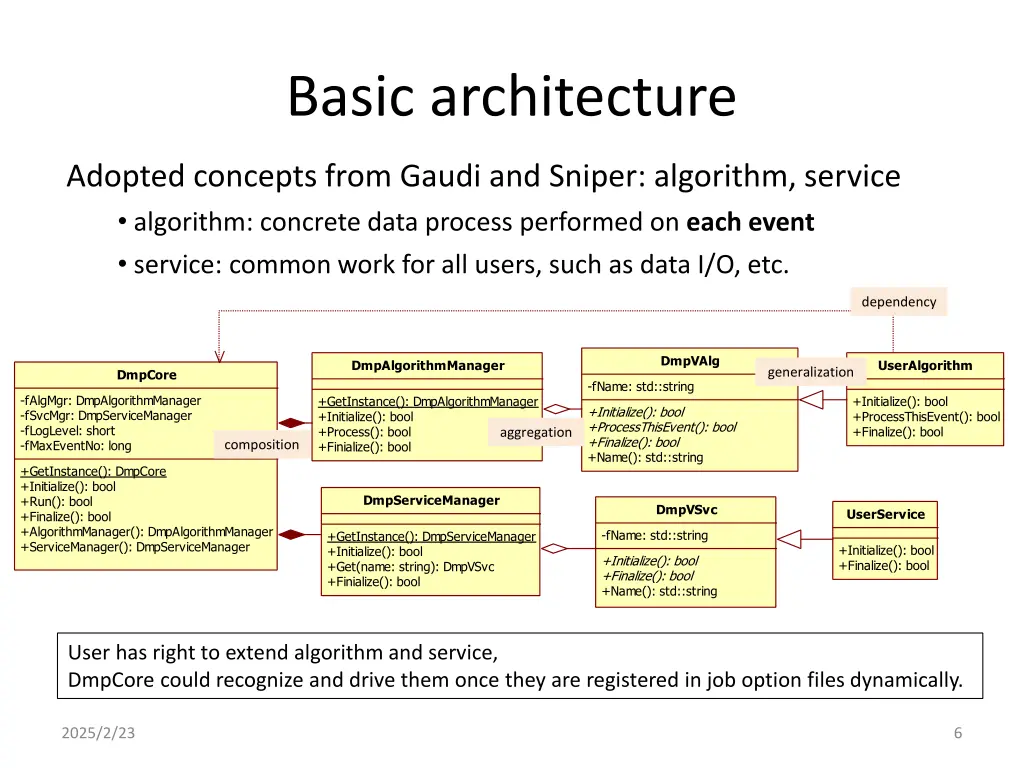
Basic architecture Kernel Create a singleton of DmpCore ---gCore DmpCore gCore manages all managers Other Managers Service Manager Algorithm Manager A manager will control a serial same type concrete classes Other abstract base class DmpVSvc DmpVAlg Anyone could focus on their concrete class (inherit from DmpV*) will not affect works of the others convenient to debug and ingrate it into DMPSW later. DmpConcretSvc DmpConcretAlg 2025/2/23 5
Basic architecture Adopted concepts from Gaudi and Sniper: algorithm, service algorithm: concrete data process performed on each event service: common work for all users, such as data I/O, etc. dependency DmpVAlg DmpAlgorithmManager UserAlgorithm generalization DmpCore -fName: std::string -fAlgMgr: DmpAlgorithmManager -fSvcMgr: DmpServiceManager -fLogLevel: short -fMaxEventNo: long +GetInstance(): DmpAlgorithmManager +Initialize(): bool +Process(): bool +Finialize(): bool +Initialize(): bool +ProcessThisEvent(): bool +Finalize(): bool +Initialize(): bool +ProcessThisEvent(): bool +Finalize(): bool +Name(): std::string aggregation composition +GetInstance(): DmpCore +Initialize(): bool +Run(): bool +Finalize(): bool +AlgorithmManager(): DmpAlgorithmManager +ServiceManager(): DmpServiceManager DmpServiceManager DmpVSvc UserService -fName: std::string +GetInstance(): DmpServiceManager +Initialize(): bool +Get(name: string): DmpVSvc +Finialize(): bool +Initialize(): bool +Finalize(): bool +Initialize(): bool +Finalize(): bool +Name(): std::string User has right to extend algorithm and service, DmpCore could recognize and drive them once they are registered in job option files dynamically. 2025/2/23 6
Algorithm and service They are classes to finish one certain function. Difference: process performed on each event? DmpAlgorithm(Service)Manager manipulates all user s (or default) algorithms (services) once they are registered into manager as specified in job option file. DmpVAlg -fName: std::string +Initialize(): bool +ProcessThisEvent(): bool +Finalize(): bool +Name(): std::string Concrete algorithm: (User focus on how to process one event) Impliment bool ProcessThisEvent() Get needed service in bool Initialize() because ProcessThisEvent() has not argument fetch all needed services through the global pointer gCore UserAlgorithm +Initialize(): bool +ProcessThisEvent(): bool +Finalize(): bool DmpVSvc -fName: std::string Concrete service: Each service has a unique name So, user could get it from service manager Decoupling from algorithm Since algorithm may have many implementation, For instance, Rdc for BT2012 and Rdc for prototype +Initialize(): bool +Finalize(): bool +Name(): std::string UserService +Initialize(): bool +Finalize(): bool 2025/2/23 7
Example of a concrete algorithm 2025/2/23 8
Job option files (python script) 1. Import needed libraries We can use those classes and methods in python script, since we bind them by using boost.python Create algorithms and services 2. Create whatever you need and append them into DmpCore DmpCore only manipulates those algorithms and services which are explicitly appended into managers 3. Register them into DmpCore Strict order of execution of all appended Alg. as the order of appending 4. Run this job Optimizing this part. Better as: dmpCore.Run() 2025/2/23 9
How are the algorithms booted? DmpCore::Initialize() invoke Initialize() of all concrete services which are in DmpServiceManager, then, invoke all Initialize() of all concrete alg. which are in DmpAlgorithmManager DmpCore::Run() Communicate by event classes * Event loop, (how many envet? DmpCore::fMaxEventNo) Algorithm 1 Data Buffer Algorithm 2 * Execute all algorithms in DmpAlgorithmManager Algorithm 3 DmpCore::Finalize() invoke all Finalize() of all alg. in DmpAlgorithmManager, then, call Finalize () of all services in DmpServiceManager 2025/2/23 10
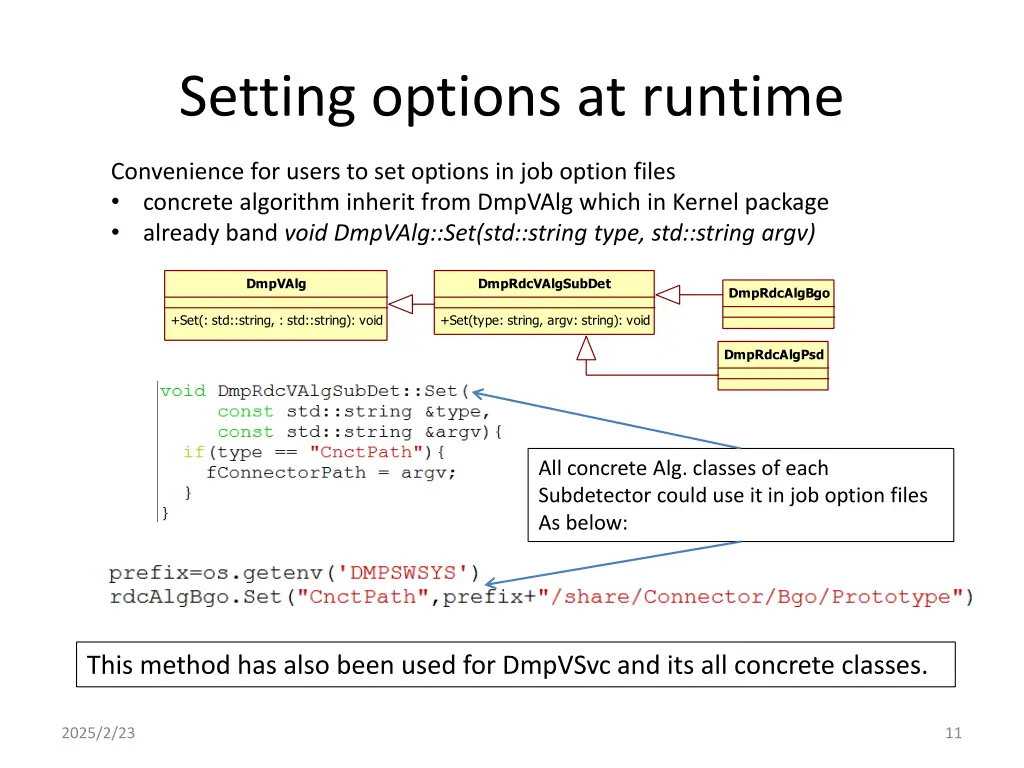
Setting options at runtime Convenience for users to set options in job option files concrete algorithm inherit from DmpVAlg which in Kernel package already band void DmpVAlg::Set(std::string type, std::string argv) DmpVAlg DmpRdcVAlgSubDet DmpRdcAlgBgo +Set(: std::string, : std::string): void +Set(type: string, argv: string): void DmpRdcAlgPsd All concrete Alg. classes of each Subdetector could use it in job option files As below: This method has also been used for DmpVSvc and its all concrete classes. 2025/2/23 11
Extensibility -- create a new algorithm libDmpRdcAlg VS libDmpRdcBT2012. Only convert algorithms are different: How to create a new alg.? 1. Create a new package by using the command: dmpNewAlg (after installation) -- will create the template for you Binding file, and SConstruct file 2. Implement your code 3. Compile it * will compile all *.cc filein src , * and install the created lib. into $DMPSWWORK Service takes the same strategy Default algorithms of Rdc prototype (2014) Extended algorithms of Rdc Beam Test (2012) 2025/2/23 12
Extensibility -- create new event class Why we need new event classes? Algorithms communicate by event classes We can NOT design all algorithms at this time Reserve data members for one global event class is NOT a good way! can NOT use old root file which was created by old event class suppose, we decide to add an new (or delete) data member one day later. We can not use the new event class to read the root files which are created by using the old event class Communicate by event classes Algorithm 1 Data Buffer Algorithm 2 Algorithm 3 Do it Step by Step Many types of event classes, corresponding to different levels of data Do NOT worry about the higher level event classes, just make sure that the event class of current level is right! 2025/2/23 13
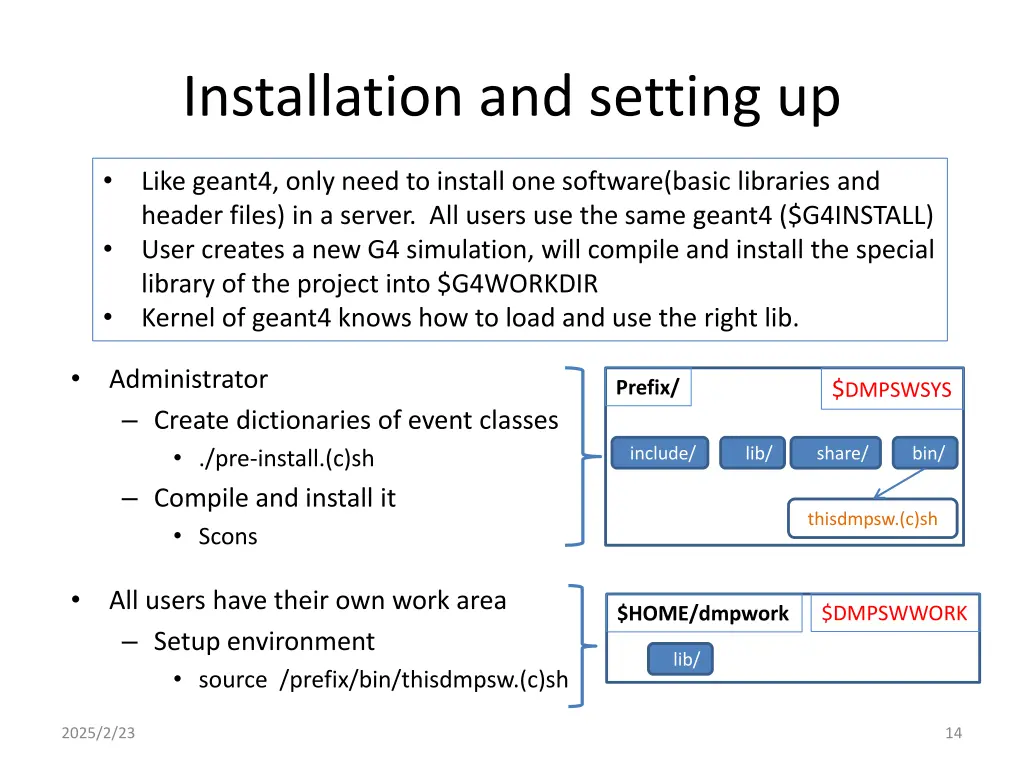
Installation and setting up Like geant4, only need to install one software(basic libraries and header files) in a server. All users use the same geant4 ($G4INSTALL) User creates a new G4 simulation, will compile and install the special library of the project into $G4WORKDIR Kernel of geant4 knows how to load and use the right lib. Administrator Create dictionaries of event classes ./pre-install.(c)sh Compile and install it Scons Prefix/ $DMPSWSYS include/ lib/ share/ bin/ thisdmpsw.(c)sh All users have their own work area Setup environment source /prefix/bin/thisdmpsw.(c)sh $DMPSWWORK $HOME/dmpwork lib/ 2025/2/23 14
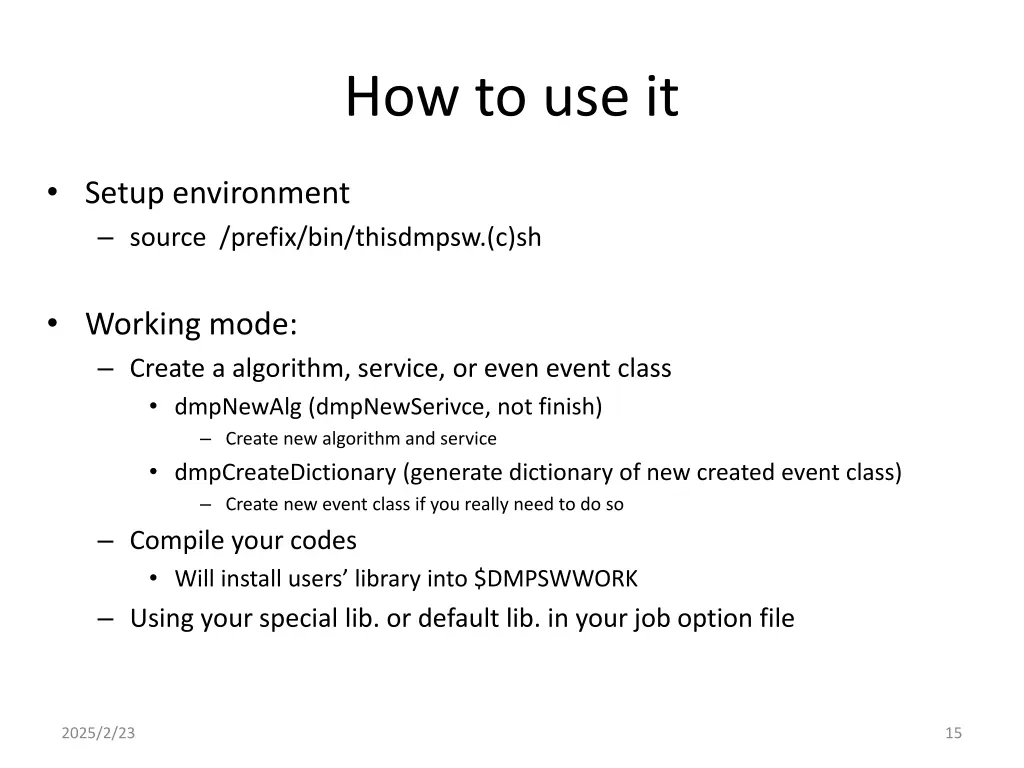
How to use it Setup environment source /prefix/bin/thisdmpsw.(c)sh Working mode: Create a algorithm, service, or even event class dmpNewAlg (dmpNewSerivce, not finish) Create new algorithm and service dmpCreateDictionary (generate dictionary of new created event class) Create new event class if you really need to do so Compile your codes Will install users library into $DMPSWWORK Using your special lib. or default lib. in your job option file 2025/2/23 15
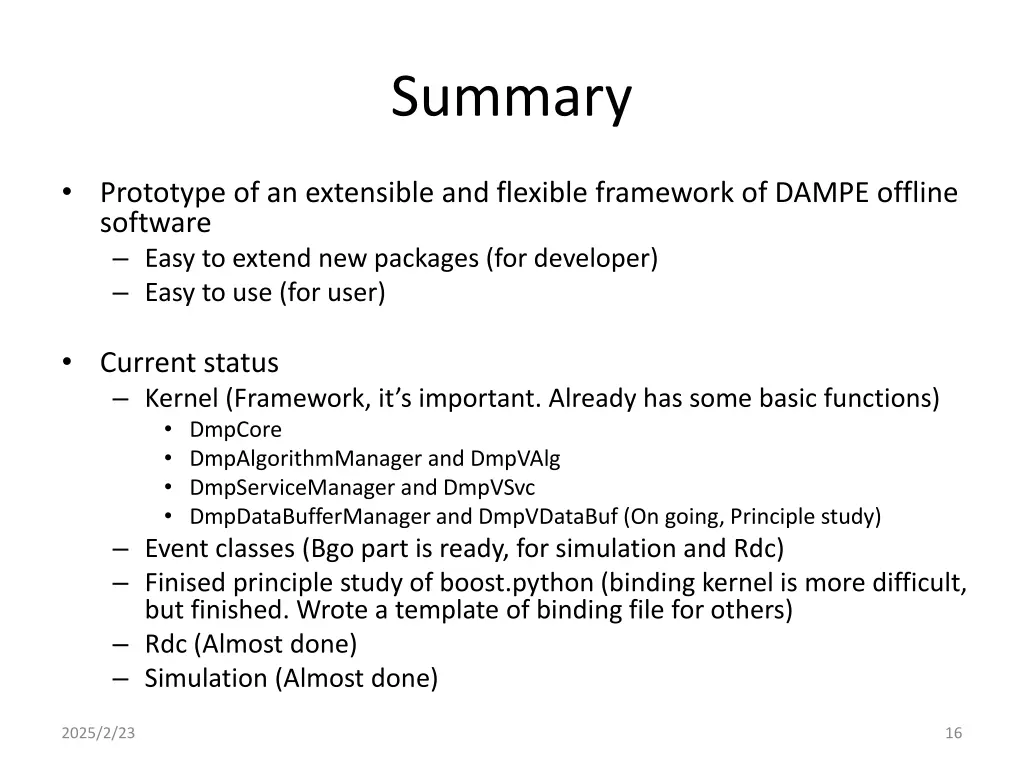
Summary Prototype of an extensible and flexible framework of DAMPE offline software Easy to extend new packages (for developer) Easy to use (for user) Current status Kernel (Framework, it s important. Already has some basic functions) DmpCore DmpAlgorithmManager and DmpVAlg DmpServiceManager and DmpVSvc DmpDataBufferManager and DmpVDataBuf (On going, Principle study) Event classes (Bgo part is ready, for simulation and Rdc) Finised principle study of boost.python (binding kernel is more difficult, but finished. Wrote a template of binding file for others) Rdc (Almost done) Simulation (Almost done) 2025/2/23 16
Many good suggestions from Weidong LI (liwd@ihep.ac.cn) Tao LIN (lintao@ihep.ac.cn) Very grateful for their help! 2025/2/23 17
Backup 2025/2/23 18
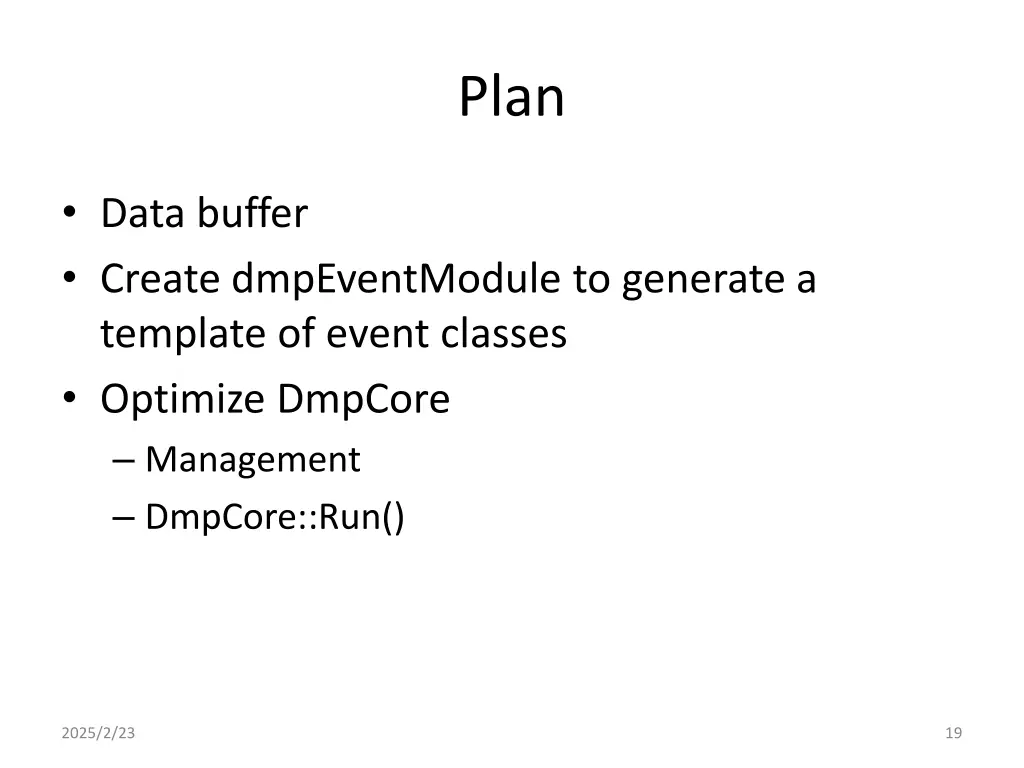
Plan Data buffer Create dmpEventModule to generate a template of event classes Optimize DmpCore Management DmpCore::Run() 2025/2/23 19
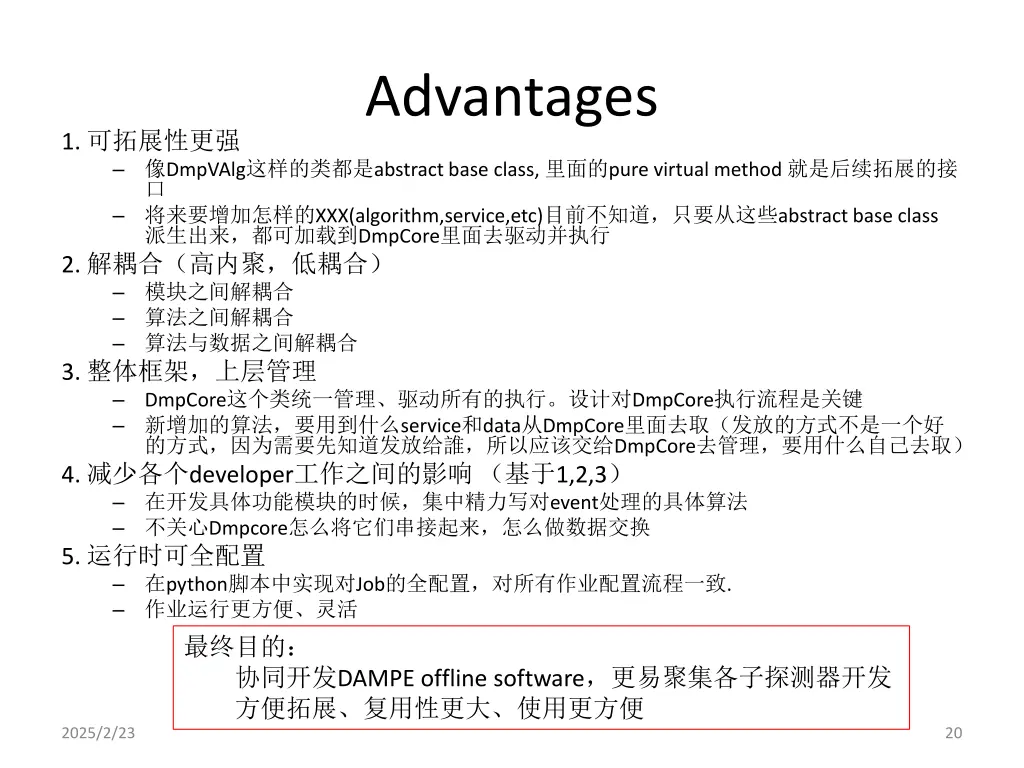
Advantages 1. DmpVAlg abstract base class, pure virtual method XXX(algorithm,service,etc) abstract base class DmpCore 2. 3. DmpCore DmpCore service data DmpCore DmpCore 4. developer 1,2,3 event Dmpcore 5. python Job . DAMPE offline software 2025/2/23 20