New Legislation for Wing in Ground Effect Vessels and Wig Ferries
Discover the new legislation surrounding Wing in Ground Effect vessels and Wig Ferries, their potential efficiency, and the companies already investing in this innovative transportation method. Learn how this shift can revolutionize medium to long-haul traffic and harbor operations, presenting new opportunities for faster and more energy-efficient transport. Find out about the engines and fuels suitable for Wig Ferries and the environmental considerations involved in their operation.

Download Presentation

Please find below an Image/Link to download the presentation.
The content on the website is provided AS IS for your information and personal use only. It may not be sold, licensed, or shared on other websites without obtaining consent from the author. If you encounter any issues during the download, it is possible that the publisher has removed the file from their server.
You are allowed to download the files provided on this website for personal or commercial use, subject to the condition that they are used lawfully. All files are the property of their respective owners.
The content on the website is provided AS IS for your information and personal use only. It may not be sold, licensed, or shared on other websites without obtaining consent from the author.
E N D
Presentation Transcript
NEW W.W. LEGISLATION FOR WIG FERRIES Due to new recommendations from the IMO, almost all countries have approved new legislation on Wing In Ground effect vessels. From having to apply to aviation legislation, such vessels will in future totally and without any other conditions apply to maritime legislation. The only major exception currently are in the UK, where they are still considered as being aircrafts if being used at not in contact with water mode. The driver behind IMO promoting such changes in the legislation world wide is the very high efficiency inherent with Wing In Ground effect, which in turn bring a potential for fuel or energy savings.
WHAT IS WING IN GROUND EFFECT? WIG ( Wing In Ground effect) is a hoovering type of phenomenon occuring when a wing get close to the ground or water surface. It is the least resistant way to carry a load compared to any other method except magnetic levitation. The key is, to be completely of from the enormously resisting contact with water, but still exploiting the air cushion of ground effect gliding only some seven to ten meters above the sea surface. It is also capable of carrying many times more load, as compared to an airplane with the same wingspan. It therefore lends itself to fast and efficient transportation duties from port to port for medium and long haul trafic.
WIG FERRIES OPEN UP FOR A NEW KIND OF TRAFIC As Wig ferries are both faster door to door and more energy and CO2 efficient as compared to both road traffic and airfright, they will be carrying trucks, cars and passengers between medium distant destinations like between for example Gothenburg - Kiel, Gdynia Kiel, Gdynia- Dover, Callais-Bilbao and Dover- Lissbon. The potentials for new traffic are massive. It would also imply the possibility of using a strategicly possitioned harbour as a trafic hub, allowing for extended trafic. The question is if DFDS will be in this race or not!
WHO IS ALREADY ON TRACK FOR WIG? There is a good number of companies allready on track to exploit WIG due to the new legislation. Before having this new legislation in place, you could not do it. Howard Hughes tried it once with his Spruce Goose and the Russians have built a number of military such crafts, but for civilian purposes, earlier legislation have made it impossible to exploit. At this point now, Brittany Ferries, Flying ship, Airfish, Aron flyingship, DrAGOnflydesign and a lot more are at different stages of development on WIG crafts.
ENGINES AND FUELS For the long haul duties that will be ideal for WIG ferries, EV wouldn t be an alternative choice. The most relevant engines would be the turboprop type. When not having to apply to aviation regulations, there is allready E options available on fuels to such engines though. One is SAF ( Sustainable Aviation Fuel) and one other alternative is Ammonia- Hydrogen Peroxide ( instant Hydrazine). Ammonia is being much persued by engine makers, but there is the issue of storing a poisonous liquid on board a ship. Also without using an oxidizing agent like Hydrogen Peroxide, it is a challenge on the combustion criteria. For a WIG Ferry, Ammonia can be stored in tanks in the wings and go directly to the engines and pose no risk. As well, there is no fire or explosion risk using ammonia as fuel and Hydrogen Peroxide as promoting oxidant. Both E Ammonia and E Hydrogen Peroxide is going to be readily available, but as well, the standard qualities as produced from natural gas at low commodity cost levels allready are.
CONCEPT DESIGN PROPOSAL Due to my unusual and coincidental combination of experience, having been both a boat designer as well as now working with engineering on gas flow dynamics in big scale industrial process ventilation systems, I am among a very few engineers at this point, doing safe calculations, predictions and design on WIG vessels. Apart from conceptual design and calculation work, I am also able to supply small scale vessels for proof of concept. At first, a 5 m WIG Tender Boat will be available within a ten weeks delivery time and then a 4 m WIG scooter also featuring the Hoovering capability of the proposed WIG Ferry, will be available for test work and scalable validation work with about 20 weeks delivery time. For 3 D modelling and renderings, I am collaborating with one other smaller consultant company and we will do such work through them on demand.
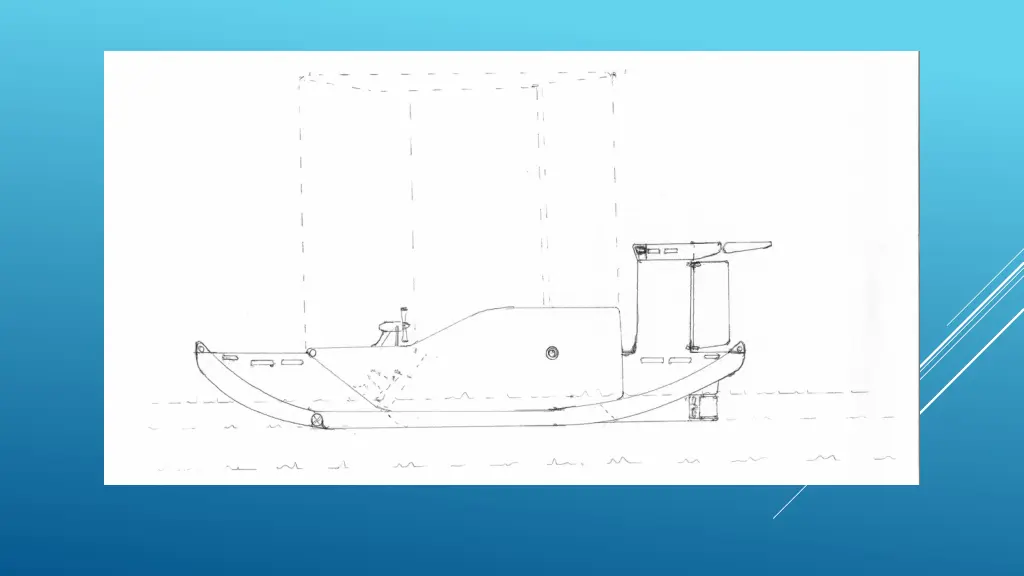
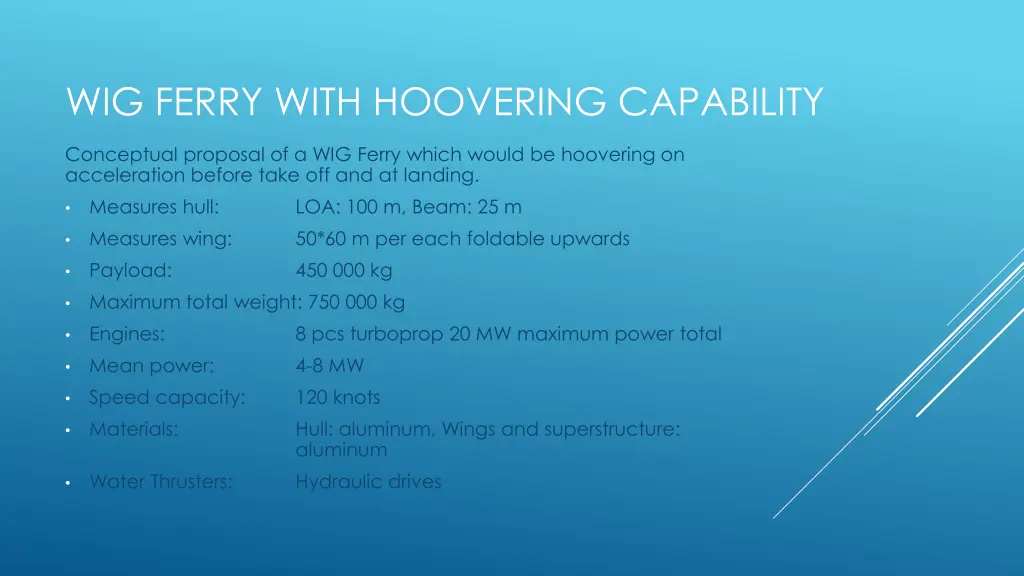
WIG FERRY WITH HOOVERING CAPABILITY Conceptual proposal of a WIG Ferry which would be hoovering on acceleration before take off and at landing. Measures hull: LOA: 100 m, Beam: 25 m Measures wing: 50*60 m per each foldable upwards Payload: 450 000 kg Maximum total weight: 750 000 kg Engines: 8 pcs turboprop 20 MW maximum power total Mean power: 4-8 MW Speed capacity: 120 knots Materials: Hull: aluminum, Wings and superstructure: aluminum Water Thrusters: Hydraulic drives
HOPING TO WORK FOR YOU! Peter S bom DrAGOnflydesign A: vej 6, 8500 Grenaa, Danmark M: peter.sabom@sekur.com W: www.xcomp.se T: +46709621716