Explore the innovative metrics and strategies for evaluating Sustainable Development Goal 2 (SDG2) on food and nutrition security, developed by the FSIN Technical Working Group at Tufts University. Dive into the advancements in measuring food security, diet quality, and data collection, with a focus on enhancing global food systems and nutrition policies.
Please find below an Image/Link to download the presentation.
The content on the website is provided AS IS for your information and personal use only. It may not be sold, licensed, or shared on other websites without obtaining consent from the author. If you encounter any issues during the download, it is possible that the publisher has removed the file from their server.
You are allowed to download the files provided on this website for personal or commercial use, subject to the condition that they are used lawfully. All files are the property of their respective owners.
The content on the website is provided AS IS for your information and personal use only. It may not be sold, licensed, or shared on other websites without obtaining consent from the author.
E N D
Presentation Transcript
New metrics for the evaluation of SDG2: Insights from the FSIN Technical Working Group on Measuring Food and Nutrition Security (and many other projects*) Will Masters Friedman School of Nutrition Science & Policy, Tufts University www.nutrition.tufts.edu | http://sites.tufts.edu/willmasters * Especially building on www.nutritioninnovationlab.org, www.lcirah.ac.uk/Immana, and www.globaldietarydatabase.org Rome-Based Agencies (RBAs) Technical Seminar on Evaluation of SDG2 IFAD Headquarters 17-18 November 2015
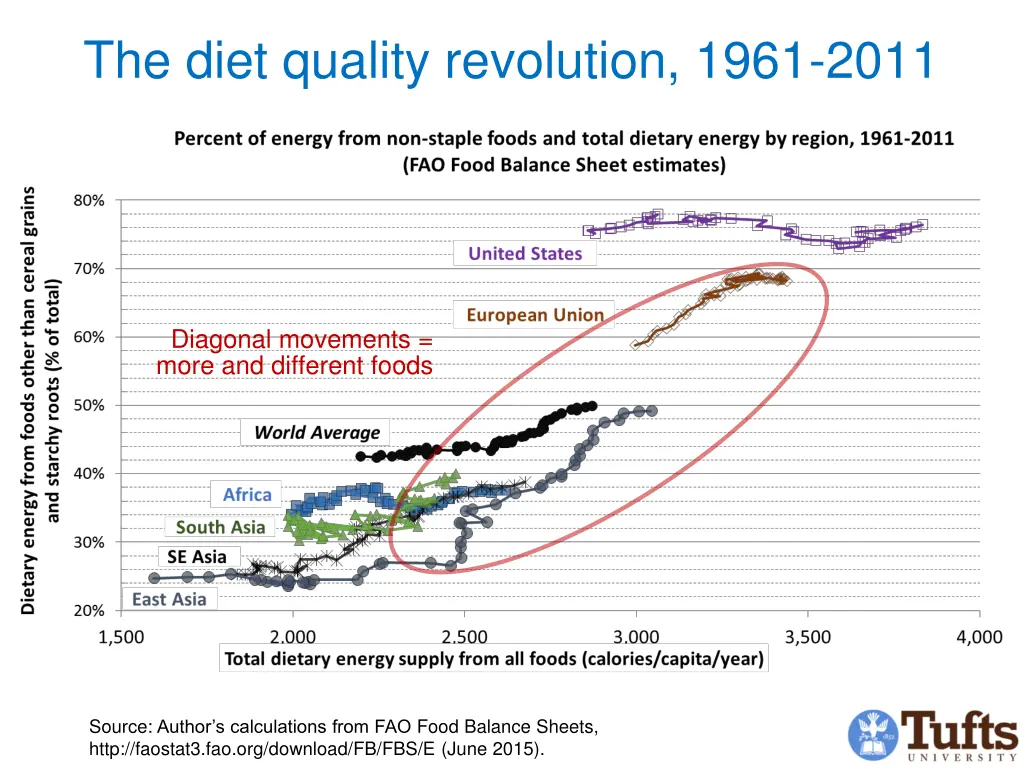
The diet quality revolution, 1961-2011 Diagonal movements = more and different foods Source: Author s calculations from FAO Food Balance Sheets, http://faostat3.fao.org/download/FB/FBS/E (June 2015).
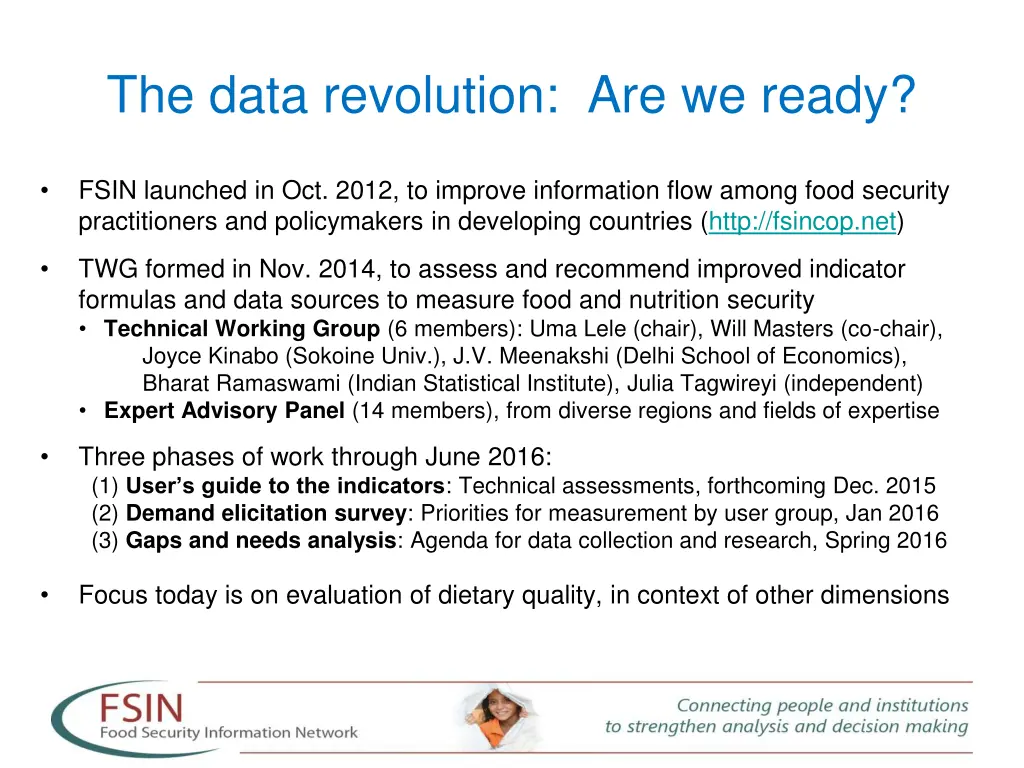
The data revolution: Are we ready? FSIN launched in Oct. 2012, to improve information flow among food security practitioners and policymakers in developing countries (http://fsincop.net) TWG formed in Nov. 2014, to assess and recommend improved indicator formulas and data sources to measure food and nutrition security Technical Working Group (6 members): Uma Lele (chair), Will Masters (co-chair), Joyce Kinabo (Sokoine Univ.), J.V. Meenakshi (Delhi School of Economics), Bharat Ramaswami (Indian Statistical Institute), Julia Tagwireyi (independent) Expert Advisory Panel (14 members), from diverse regions and fields of expertise Three phases of work through June 2016: (1) User s guide to the indicators: Technical assessments, forthcoming Dec. 2015 (2) Demand elicitation survey: Priorities for measurement by user group, Jan 2016 (3) Gaps and needs analysis: Agenda for data collection and research, Spring 2016 Focus today is on evaluation of dietary quality, in context of other dimensions
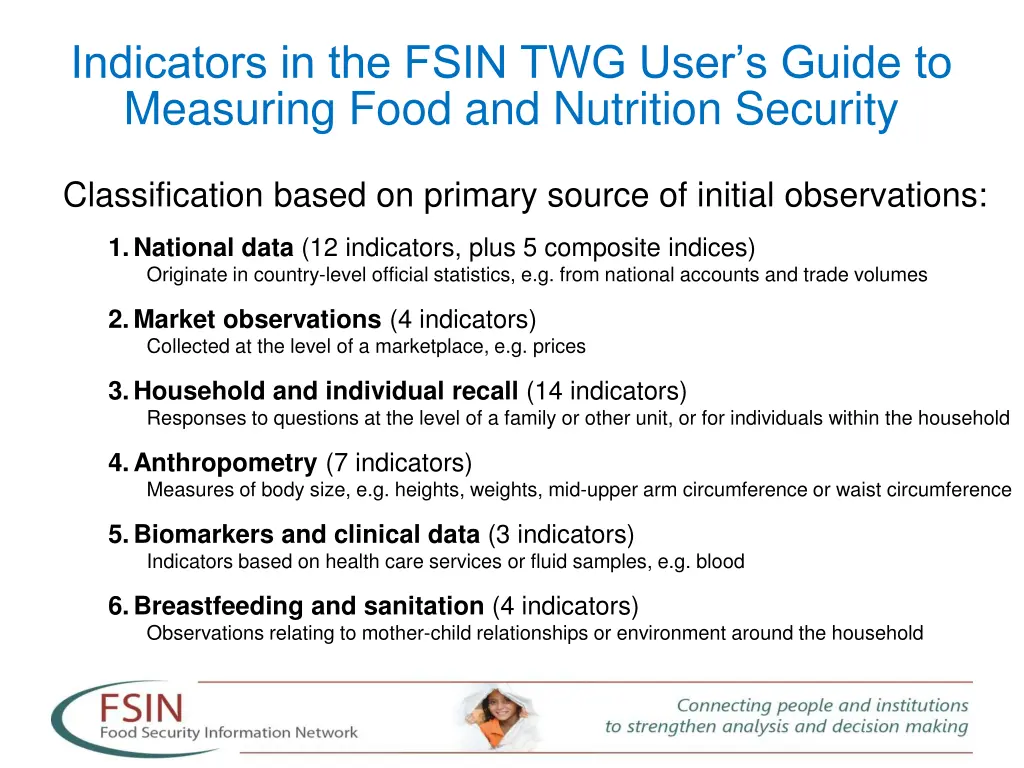
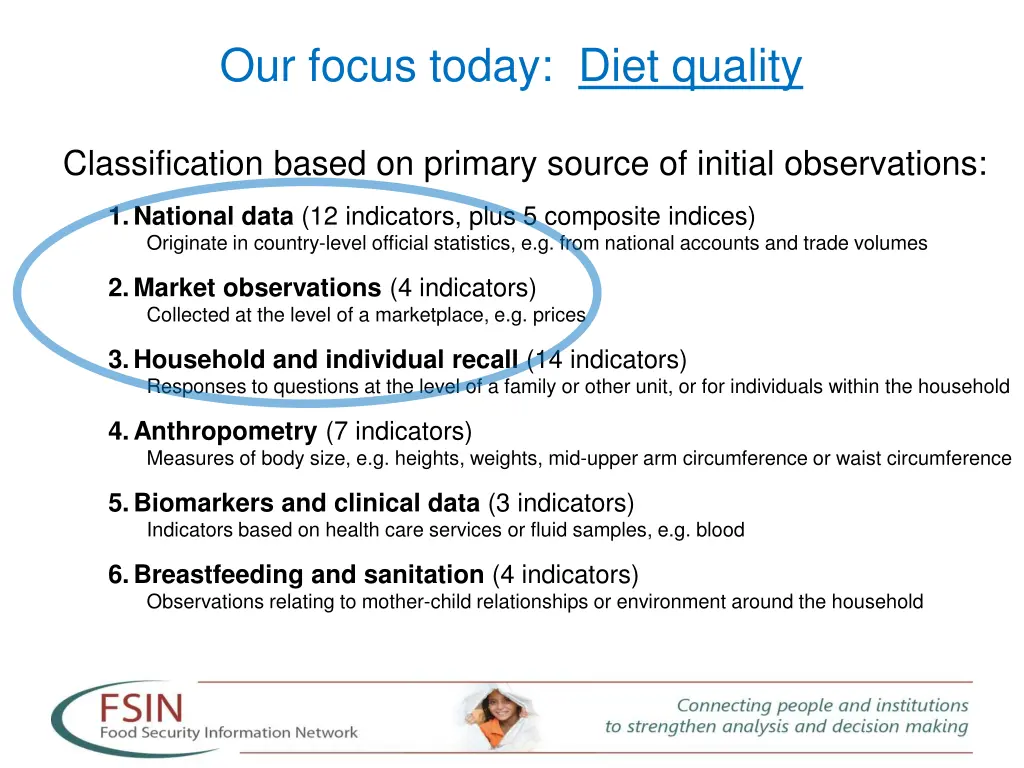
Indicators in the FSIN TWG Users Guide to Measuring Food and Nutrition Security Classification based on primary source of initial observations: 1.National data (12 indicators, plus 5 composite indices) Originate in country-level official statistics, e.g. from national accounts and trade volumes 2.Market observations (4 indicators) Collected at the level of a marketplace, e.g. prices 3.Household and individual recall (14 indicators) Responses to questions at the level of a family or other unit, or for individuals within the household 4.Anthropometry (7 indicators) Measures of body size, e.g. heights, weights, mid-upper arm circumference or waist circumference 5.Biomarkers and clinical data (3 indicators) Indicators based on health care services or fluid samples, e.g. blood 6.Breastfeeding and sanitation (4 indicators) Observations relating to mother-child relationships or environment around the household
Our focus today: Diet quality Classification based on primary source of initial observations: 1.National data (12 indicators, plus 5 composite indices) Originate in country-level official statistics, e.g. from national accounts and trade volumes 2.Market observations (4 indicators) Collected at the level of a marketplace, e.g. prices 3.Household and individual recall (14 indicators) Responses to questions at the level of a family or other unit, or for individuals within the household 4.Anthropometry (7 indicators) Measures of body size, e.g. heights, weights, mid-upper arm circumference or waist circumference 5.Biomarkers and clinical data (3 indicators) Indicators based on health care services or fluid samples, e.g. blood 6.Breastfeeding and sanitation (4 indicators) Observations relating to mother-child relationships or environment around the household
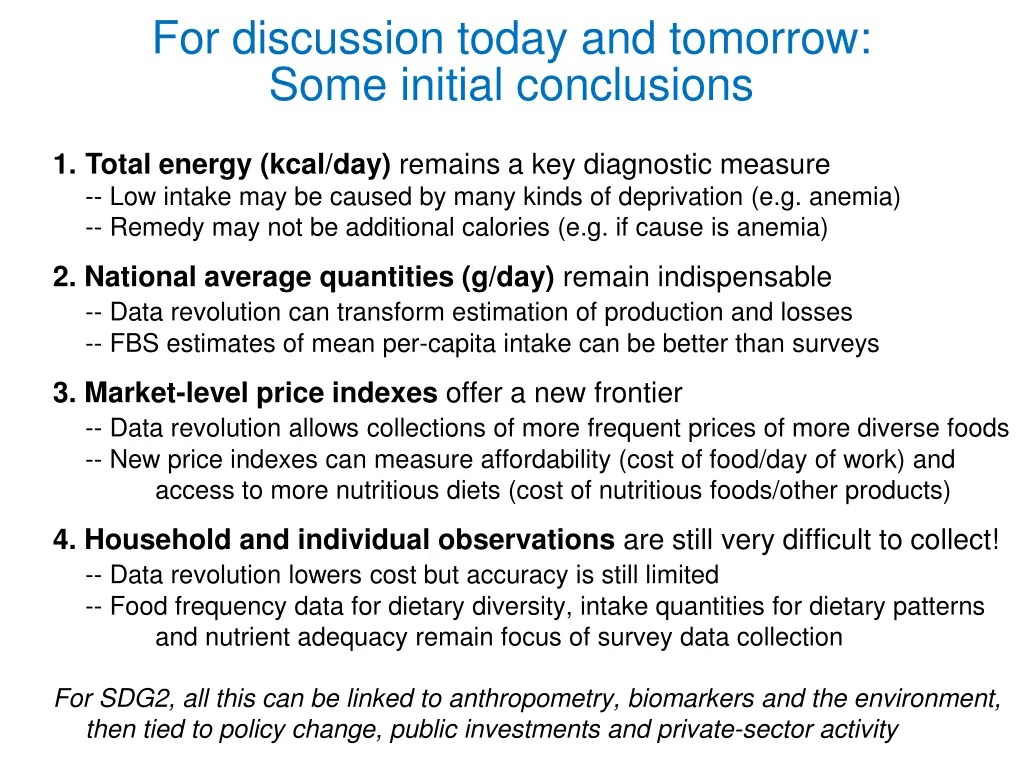
For discussion today and tomorrow: Some initial conclusions 1. Total energy (kcal/day) remains a key diagnostic measure -- Low intake may be caused by many kinds of deprivation (e.g. anemia) -- Remedy may not be additional calories (e.g. if cause is anemia) 2. National average quantities (g/day) remain indispensable -- Data revolution can transform estimation of production and losses -- FBS estimates of mean per-capita intake can be better than surveys 3. Market-level price indexes offer a new frontier -- Data revolution allows collections of more frequent prices of more diverse foods -- New price indexes can measure affordability (cost of food/day of work) and access to more nutritious diets (cost of nutritious foods/other products) 4. Household and individual observations are still very difficult to collect! -- Data revolution lowers cost but accuracy is still limited -- Food frequency data for dietary diversity, intake quantities for dietary patterns and nutrient adequacy remain focus of survey data collection For SDG2, all this can be linked to anthropometry, biomarkers and the environment, then tied to policy change, public investments and private-sector activity
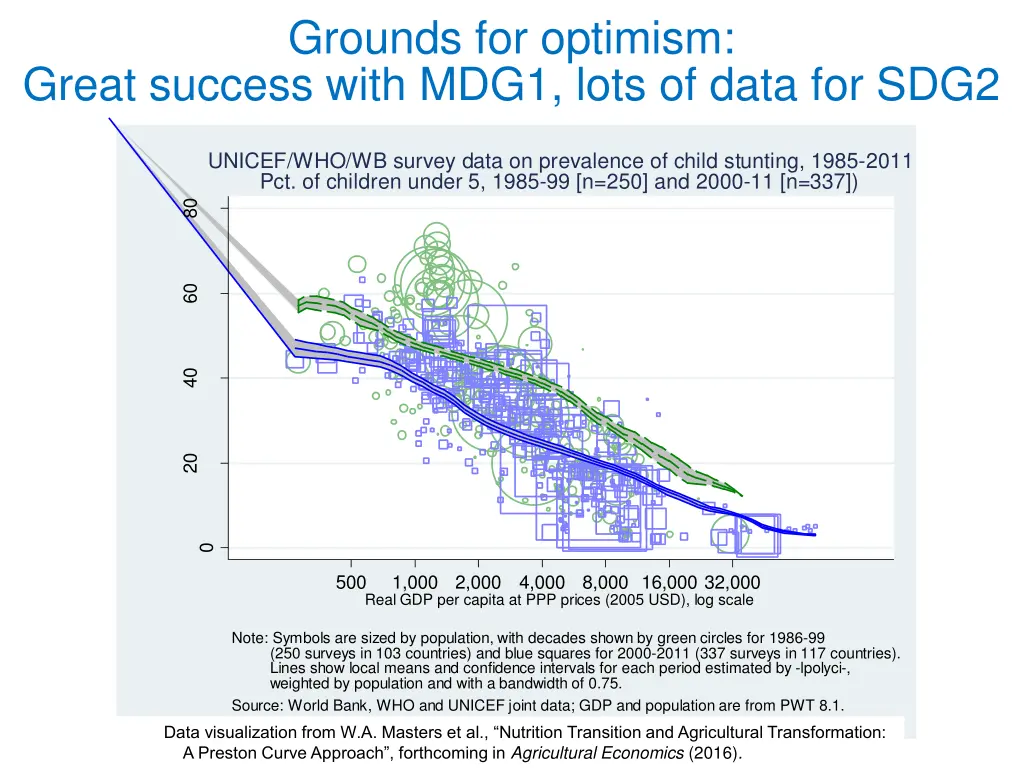
Grounds for optimism: Great success with MDG1, lots of data for SDG2 UNICEF/WHO/WB survey data on prevalence of child stunting, 1985-2011 Pct. of children under 5, 1985-99 [n=250] and 2000-11 [n=337]) 80 Pct. of children under 5 with HAZ<-2 at each level of national income 60 40 20 0 500 1,000 2,000 4,000 8,000 16,000 32,000 Real GDP per capita at PPP prices (2005 USD), log scale Note: Symbols are sized by population, with decades shown by green circles for 1986-99 (250 surveys in 103 countries) and blue squares for 2000-2011 (337 surveys in 117 countries). Lines show local means and confidence intervals for each period estimated by -lpolyci-, weighted by population and with a bandwidth of 0.75. Source: World Bank, WHO and UNICEF joint data; GDP and population are from PWT 8.1. Data visualization from W.A. Masters et al., Nutrition Transition and Agricultural Transformation: A Preston Curve Approach , forthcoming in Agricultural Economics (2016).