Nights Away: Yellow Phase Guidelines and Approval Process
Nights Away activities in the Yellow phase allow for group mixing, lateral flow testing, and day visitors. Camps or residentials must include COVID hazards in the risk assessment. Approval process involves submitting the Risk Assessment and complying with government guidelines on numbers and social distancing.

Download Presentation

Please find below an Image/Link to download the presentation.
The content on the website is provided AS IS for your information and personal use only. It may not be sold, licensed, or shared on other websites without obtaining consent from the author.If you encounter any issues during the download, it is possible that the publisher has removed the file from their server.
You are allowed to download the files provided on this website for personal or commercial use, subject to the condition that they are used lawfully. All files are the property of their respective owners.
The content on the website is provided AS IS for your information and personal use only. It may not be sold, licensed, or shared on other websites without obtaining consent from the author.
E N D
Presentation Transcript
Nights Away UPDATE, we are YELLOW What can we now do and how
Nights Away Nights away activities may take place No limit on overall numbers (except leader ratios) Limited to a maximum of 6 people per sleeping space (tent or room). COVID measures such as good hygiene remain in place Lateral flow testing is strongly recommended to take place immediately prior to departure, twice a week throughout the trip and on return for those age 11 and over. Groups can mix and adult volunteers can move from group to group. Day visitors to residential groups are allowed.
Nights Away Nights Away Approval Process Camps or Residentials taking place whilst areas are in Yellow must have COVID hazards and controls included within the event risk assessment. The Risk Assessment to be submitted along with the Nights Away Notification Form. Please submit to nightsaway@blackpoolscouts.org.uk at least 2 weeks before the event.
Nights Away Nights Away Approval Process .. Cont d The Risk Assessment will be checked by someone within the District and like any overnight event requires DC approval. The Risk Assessment does not need to go through the HQ Restart Risk Assessment Smartsheet process. Those organising camps or residentials MUST show how they comply with current government guidance on numbers, social distancing and safe use of accommodation and sleeping areas.
Nights Away Questions on what we can do
Nights Away Risk Assessment A comprehensive Risk Assessment is needed for every Nights Away event A Risk Assessment for the particular event must submitted with the NAN form One submission does not hold for subsequent events Once submitted any feedback will be given as soon as possible (2 weeks isn t long for them to be looked, feedback and possibly adjusted !)
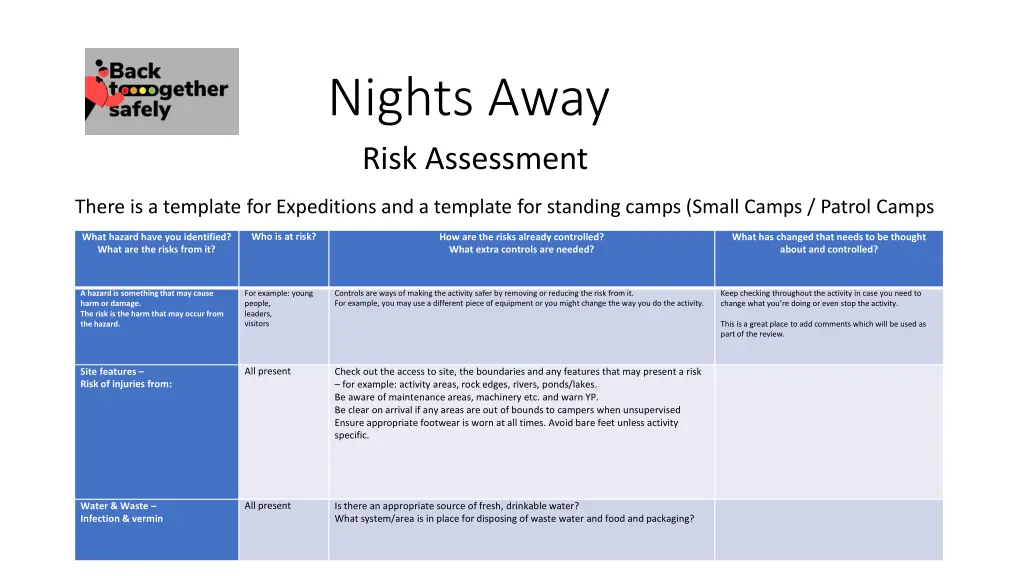
Nights Away Risk Assessment There is a template for Expeditions and a template for standing camps (Small Camps / Patrol Camps Who is at risk? What hazard have you identified? What are the risks from it? How are the risks already controlled? What extra controls are needed? What has changed that needs to be thought about and controlled? A hazard is something that may cause harm or damage. The risk is the harm that may occur from the hazard. For example: young people, leaders, visitors Controls are ways of making the activity safer by removing or reducing the risk from it. For example, you may use a different piece of equipment or you might change the way you do the activity. Keep checking throughout the activity in case you need to change what you re doing or even stop the activity. This is a great place to add comments which will be used as part of the review. All present Site features Risk of injuries from: Check out the access to site, the boundaries and any features that may present a risk for example: activity areas, rock edges, rivers, ponds/lakes. Be aware of maintenance areas, machinery etc. and warn YP. Be clear on arrival if any areas are out of bounds to campers when unsupervised Ensure appropriate footwear is worn at all times. Avoid bare feet unless activity specific. All present Water & Waste Infection & vermin Is there an appropriate source of fresh, drinkable water? What system/area is in place for disposing of waste water and food and packaging?
Nights Away Questions on Risk Assessments
Nights Away Transport & Minibuses You can use minibuses and coaches to get to and from camps and to take groups offsite for activities. Spread individuals out when using shared transport. Where possible, you should aim to maintain 2 meters distance. If you cannot keep a 2 meter distance, reduce the risk to yourself and others by maintaining as much distance as possible. If using a mini-bus or coach all the seats can be used to transport young people if its vital to the running of your camp. Whenever you are using minibuses and coaches the following good practice applies: If taking more than one group (maximum size 30) on camp, each group must travel independently.
Other Activities A reminder POR rule 9.1 The District Commissioner is responsible for approving all activities for Beaver Scouts, Cub Scouts, Scouts and Explorer Scouts. If the Activity requires a Permit the Permit Holder is the DC delegate If the Activity is adventurous but not requiring a Permit e.g. Terrain Zero walking, the pond at Waddecar , advice should be sought from the ADC Activities who is the DC delegate For other activities the Group Scout Leader or District Explorer Scout Commissioner is the DC delegate It is also very useful to inform the DC and keep Victoria in the picture as to what is going on