Explore the world of Non-Governmental Organizations (NGOs), independent entities that operate for social causes without government affiliation. Learn about their history, structure, features, and activities, shedding light on their vital role in society.
Please find below an Image/Link to download the presentation.
The content on the website is provided AS IS for your information and personal use only. It may not be sold, licensed, or shared on other websites without obtaining consent from the author. If you encounter any issues during the download, it is possible that the publisher has removed the file from their server.
You are allowed to download the files provided on this website for personal or commercial use, subject to the condition that they are used lawfully. All files are the property of their respective owners.
The content on the website is provided AS IS for your information and personal use only. It may not be sold, licensed, or shared on other websites without obtaining consent from the author.
E N D
Presentation Transcript
NON GOVERNMENTAL ORGANIZATION Dr. Digvijay Sharma School of health Sciences
INTRODUCTION A non-governmental organization (NGO) is an organization that is neither a part of a government nor a conventional for-profit business. NGOs may be funded by governments, foundations, schools, businesses or private people. Some may have charitable status, while others may be registered for tax exemption based on recognition of social purposes. Others may be for political, religious, or other interests.
HISTORY The term "non-governmental organization" was first coined in 1945, when the United Nations (UN) was created and there were 1083 NGOs. According to the UN any kind of private organization that is independent from government control can be termed as NGO . In some countries the term NGO is applied to an organization that in another country would be called as NPO (non profit organization)
International NGOs were important in the anti-slavery movement and the movement for women's suffrage. Based on Societies Registration Act (SRA) NGO was approved in 1860. India is estimated to had around 2 million NGOs in 2014.
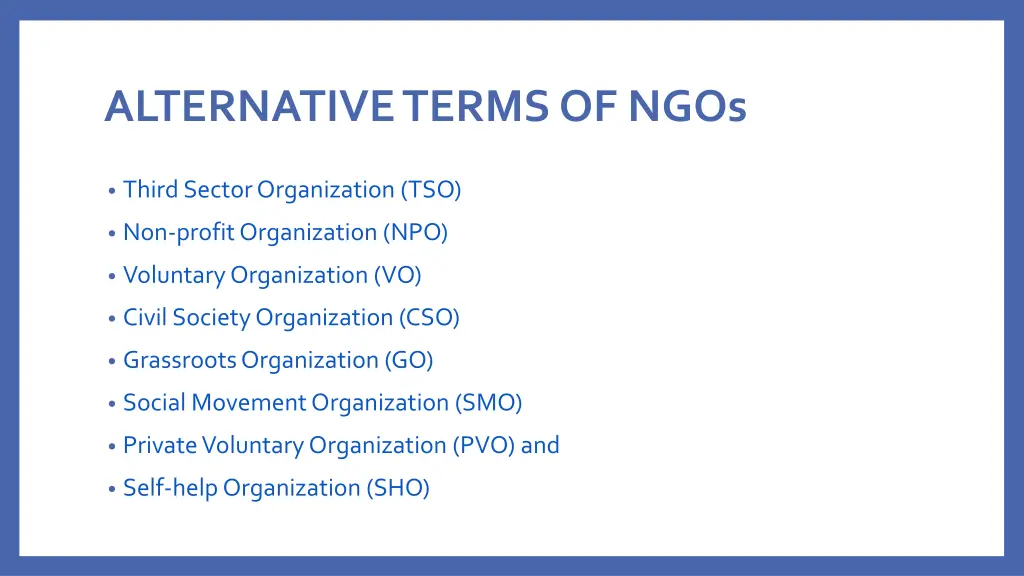
ALTERNATIVE TERMS OF NGOs Third Sector Organization (TSO) Non-profit Organization (NPO) Voluntary Organization (VO) Civil Society Organization (CSO) Grassroots Organization (GO) Social Movement Organization (SMO) Private Voluntary Organization (PVO) and Self-help Organization (SHO)
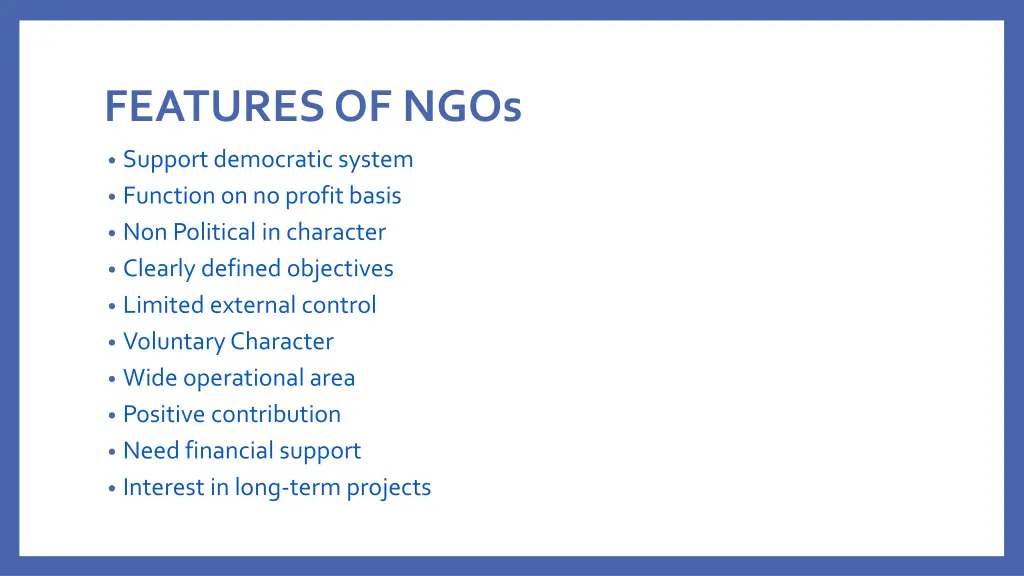
FEATURES OF NGOs Support democratic system Function on no profit basis Non Political in character Clearly defined objectives Limited external control Voluntary Character Wide operational area Positive contribution Need financial support Interest in long-term projects
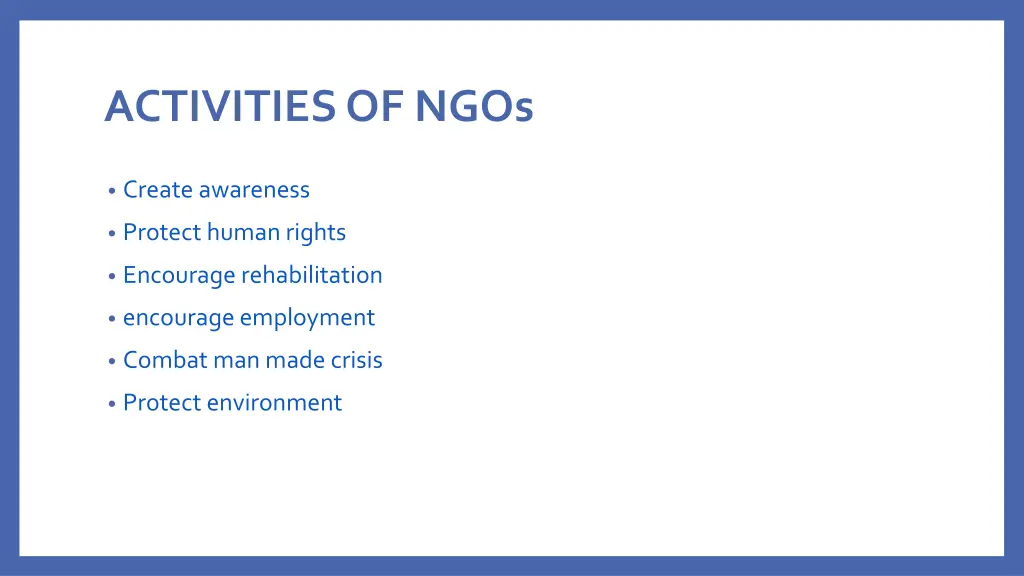
ACTIVITIES OF NGOs Create awareness Protect human rights Encourage rehabilitation encourage employment Combat man made crisis Protect environment
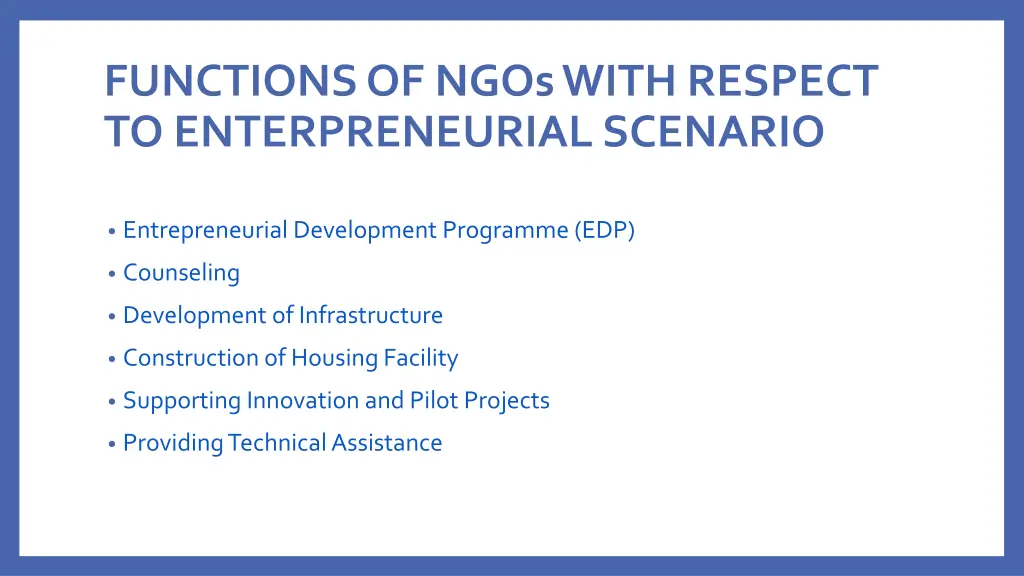
FUNCTIONS OF NGOs WITH RESPECT TO ENTERPRENEURIAL SCENARIO Entrepreneurial Development Programme (EDP) Counseling Development of Infrastructure Construction of Housing Facility Supporting Innovation and Pilot Projects Providing Technical Assistance
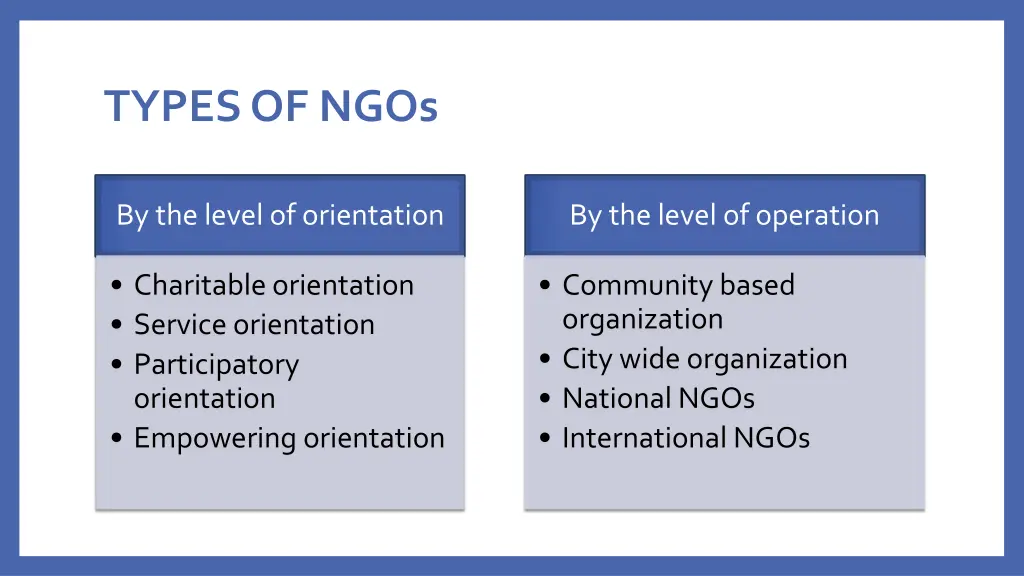
TYPES OF NGOs By the level of orientation By the level of operation Charitable orientation Service orientation Participatory orientation Empowering orientation Community based organization City wide organization National NGOs International NGOs
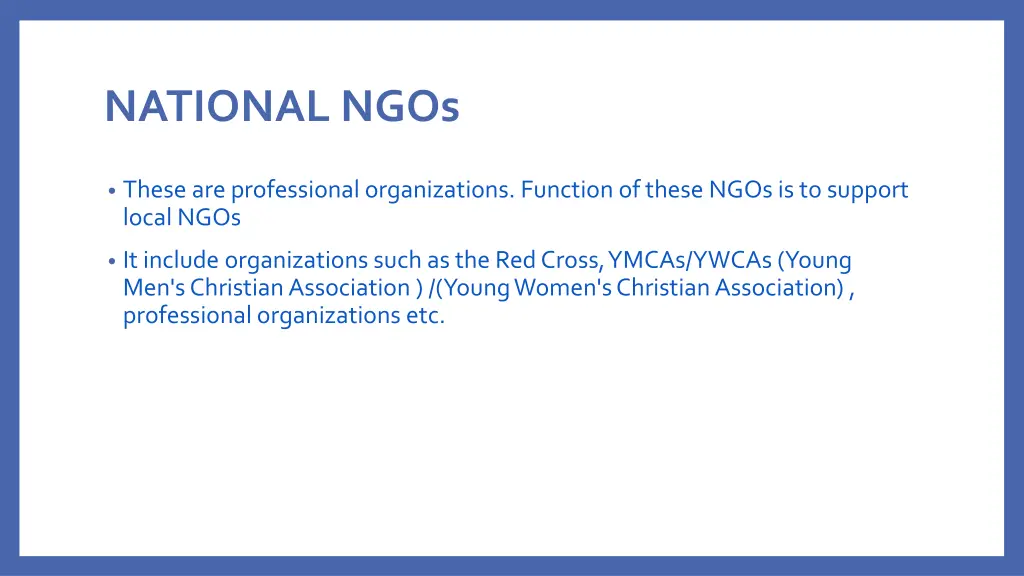
NATIONAL NGOs These are professional organizations. Function of these NGOs is to support local NGOs It include organizations such as the Red Cross, YMCAs/YWCAs (Young Men's Christian Association ) /(Young Women's Christian Association) , professional organizations etc.
INTERNATIONAL NGOs Main function of this NGOs is funding to local NGOs, implementing various projects. It range from secular agencies such as REDDA BARNA and Save the Children organizations, CARE, UNDP, and UNICEF, Ford and Rockefeller Foundations to religiously motivated groups
WASME (World Association for Small and Medium Enterprises ) Established in 1980 Headquartered in Noida, India Objectives of WASME: Developing relationship between SMEs in developed and developing countries. Networking with related/similar organizations. Enlarging collaboration with UN agencies and international organizations. Capacity building of SMEs through managerial and skill development programmes. Disseminating information on and about international developments in SME sector. Carrying out research and studies on topical issues confronting SMEs
AWAKE (Association of Women Entrepreneurs of Karnataka) Established in 1983 Headquartered in Bangalore, Karnataka, India Strives to promote entrepreneurship among women as a means to achieve self reliance and socio-economic independence. AWAKE aims to: To promote entrepreneurship among women and thereby empower them to join the economic mainstream To enhance the status of women in the society, by creating a culture of entrepreneurship amongst women in both rural and urban areas To develop successful models of entrepreneurship for emulation world-wide
OXFAM (India) Oxford Committee for Famine Relief India Operating in India since 1951 A member of a global confederation of 17 Oxfams. They fight poverty and injustice by linking grassroots programming (through partner NGOs) to local, national and global advocacy and policy-making Oxfam India works in partnership with over 130 grassroots NGOs to address root causes of poverty and injustice in the four areas of Economic Justice Essential Services Gender Justice and Humanitarian Response and Disaster Risk Reduction (DRR)
CRY (Child Rights and You) Established in 1979 It was started by Rippan Kapur Non-profit organization in India that aims to restore children's rights in India. It focuses mainly on the 4 basic rights: Survival, Development, Protection Participation
SEWA (Self Employed Women's Association) Headquartered in Ahmedabad, Gujarat, India It is an organization of poor, self-employed women workers who earn a living through their own labour or small businesses. SEWA s area of concerns are: Member s Employment Housing Literacy Better Income Organizational Strength Food and Nutrition Safety and Security Self Reliance Established in 1972
MULTILATERAL AGENCIES Multilateral organizations obtain their funding from multiple governments and spend it on projects in various countries. They normally require job-seekers to have specialized training in relevant fields such as public health, economics, business and social or behavioral sciences, as well as prior experience.
Examples of Multilateral Agencies World Health Organization World Bank UNICEF (United Nations International Children s Education Fund) UNDP (United Nations Development program)
BILATERAL AGENCIES A Bilateral organization is a government agency or nonprofit organization that receives funding from its home country s government to then be used toward a developing country.
Examples of Bilateral Agencies Some bilateral organizations include: The United States Agency for International Development (USAID), The U.S. Public Health Service and the Centers for Disease Control and Prevention (CDC).
REFERENCES https://en.wikipedia.org/wiki/Non-governmental_organization https://borgenproject.org/bilateral-organization/ https://www.uniteforsight.org/global-health-careers/module5 Park s textbook of Preventive and social medicine (23th Edition)