Explore the world of non-linear data structures through trees and graphs. Learn about single parent trees, N-ary trees, binary search trees, and the importance of balanced trees in optimizing search operations. Dive into the principles of recursion and efficient data processing techniques using these structures.
Please find below an Image/Link to download the presentation.
The content on the website is provided AS IS for your information and personal use only. It may not be sold, licensed, or shared on other websites without obtaining consent from the author. If you encounter any issues during the download, it is possible that the publisher has removed the file from their server.
You are allowed to download the files provided on this website for personal or commercial use, subject to the condition that they are used lawfully. All files are the property of their respective owners.
The content on the website is provided AS IS for your information and personal use only. It may not be sold, licensed, or shared on other websites without obtaining consent from the author.
Non-Linear data structures 2 primary types: Trees Graphs All trees are graphs, but not all graphs are trees Recursion is useful and is the easiest way to process them. It helps keep track of what's been processed and what remain
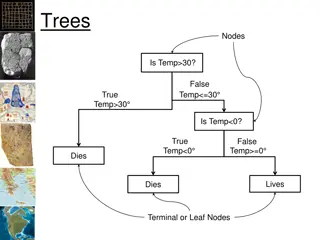
Trees Single parent 0 or more children A node with no children is called a "leaf" The topmost node is called the "root" N-ary trees Binary trees
N-ary Trees The best example of an n-ary tree is your computer s directory system. It has a single starting point and then 0 or more branches.
Binary Search Trees Binary search trees allow for fast insertion and removal of elements They are specially designed for fast searching A binary tree consists of two nodes, each of which has two child nodes All nodes in a binary search tree fulfill the property that: Descendants to the left have smaller data values than the node data value Descendants to the right have larger data values than the node data value
BST Tree Nodes This is important and is worthy of being repeated: All nodes in a binary search tree fulfill the property that: Descendants to the left have smaller data values than the node data value Descendants to the right have larger data values than the node data value
Build the Tree Insert the following data into a BST that has a root node of 15: 25, 8, 4, 10, 30, 20, 6, 2, 12, 17, 36, 24, 9, 28 15 8 25 4 10 20 30 2 6 9 12 17 24 28 36
BST Balanced tree: each node has approximately as many descendants on the left as on the right If a binary search tree is balanced, then adding an element takes O(log(n)) time If the tree is unbalanced, insertion can be slow Perhaps as slow as insertion into a linked list
Tree Traversal Tree traversal schemes include Preorder traversal generates prefix order for expression tree Inorder traversal generates the data in sorted order Postorder traversal useful for deleting nodes from the tree These are depth first processes. You will encounter other processes in data structures.
Tree Traversal Using L for the left child, R for the right child and P for Print Preorder traversal is P L R Inorder traversal is L P R Postorder traversal is L R P Inorder: 2, 4, 6, 8, 9, 10, 12, 15, 17, 20, 24, 25, 28, 30, 36 PreOrder: 15, 8, 4, 2, 6, 10, 9, 12, 25, 20, 17, 24, 30, 28, 36 PostOrder: 2, 6, 4, 9, 12, 10, 8, 17, 24, 20, 28, 36, 30, 25, 15
Recursive Processing Example void PrintTree(Node current) { if (current != null) { PRINT(current.data); PrintTree(current.left); PrintTree(current.right); } }
In Java A built in implementation of a Binary Search Tree in Java is TreeMap:
Graphs Graphs can have multiple references in and multiple references out (whereas tree node only has one reference in) Graphs can be directed or undirected and cyclic or acyclic