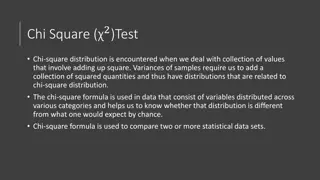
Explore the occurrence of non-Mendelian patterns in genetics through practical genetic crosses involving true-breeding plants and corn kernels. Learn how to analyze data using Chi-square tests to determine genetic hypotheses and potential genotypes.
Please find below an Image/Link to download the presentation.
The content on the website is provided AS IS for your information and personal use only. It may not be sold, licensed, or shared on other websites without obtaining consent from the author. If you encounter any issues during the download, it is possible that the publisher has removed the file from their server.
You are allowed to download the files provided on this website for personal or commercial use, subject to the condition that they are used lawfully. All files are the property of their respective owners.
The content on the website is provided AS IS for your information and personal use only. It may not be sold, licensed, or shared on other websites without obtaining consent from the author.
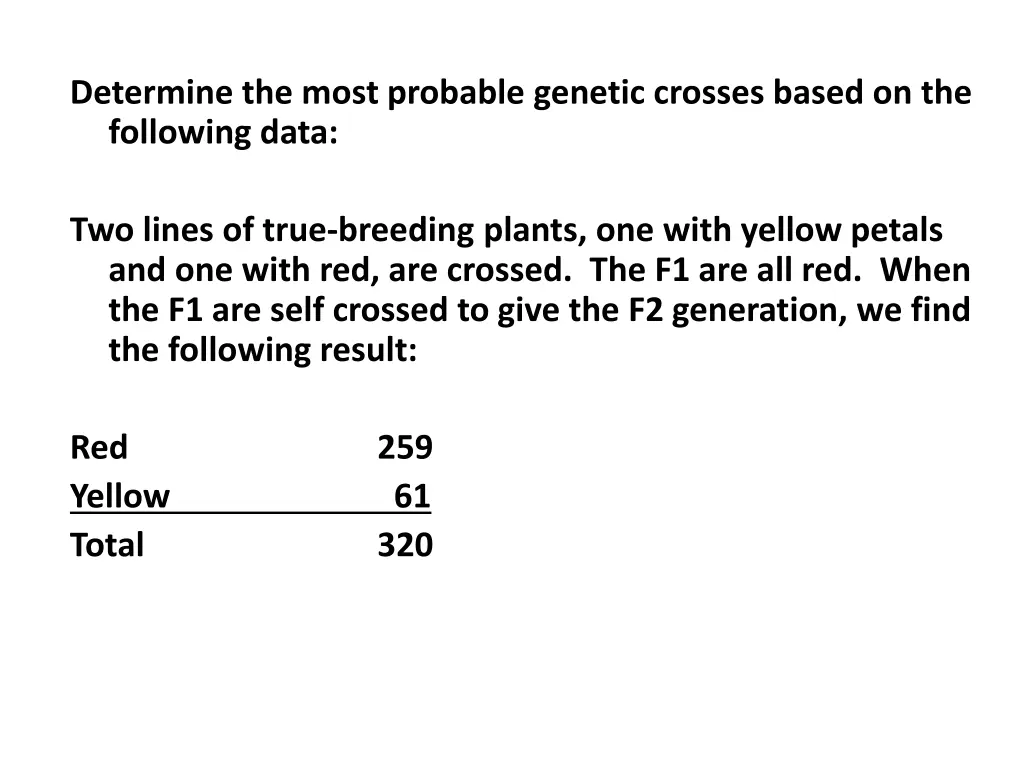
Determine the most probable genetic crosses based on the following data: Two lines of true-breeding plants, one with yellow petals and one with red, are crossed. The F1 are all red. When the F1 are self crossed to give the F2 generation, we find the following result: Red Yellow Total 259 61 320
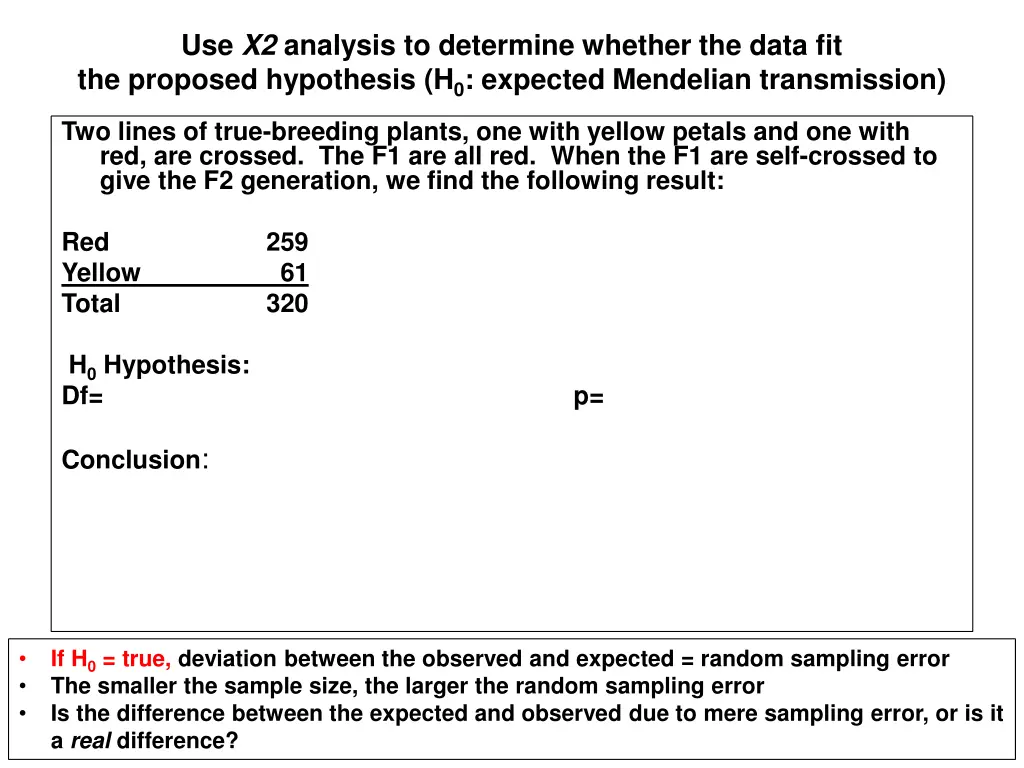
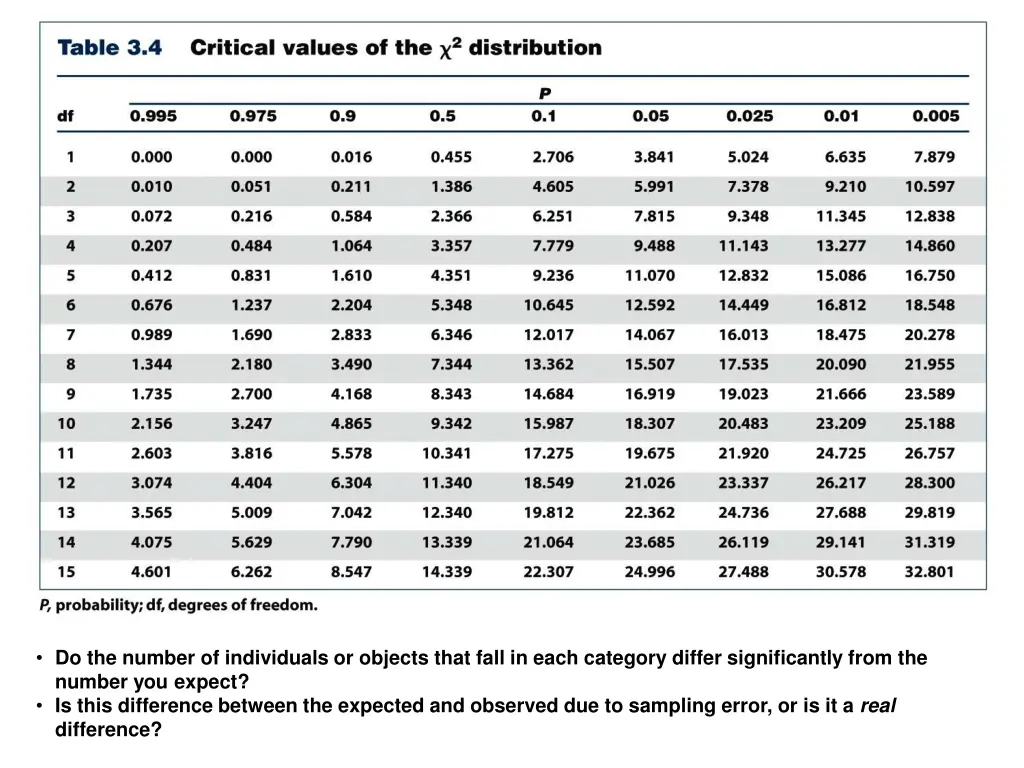
Use X2 analysis to determine whether the data fit the proposed hypothesis (H0: expected Mendelian transmission) Two lines of true-breeding plants, one with yellow petals and one with red, are crossed. The F1 are all red. When the F1 are self-crossed to give the F2 generation, we find the following result: Red Yellow Total 259 61 320 H0Hypothesis: Df= p= Conclusion: If H0 = true, deviation between the observed and expected = random sampling error The smaller the sample size, the larger the random sampling error Is the difference between the expected and observed due to mere sampling error, or is it a real difference?
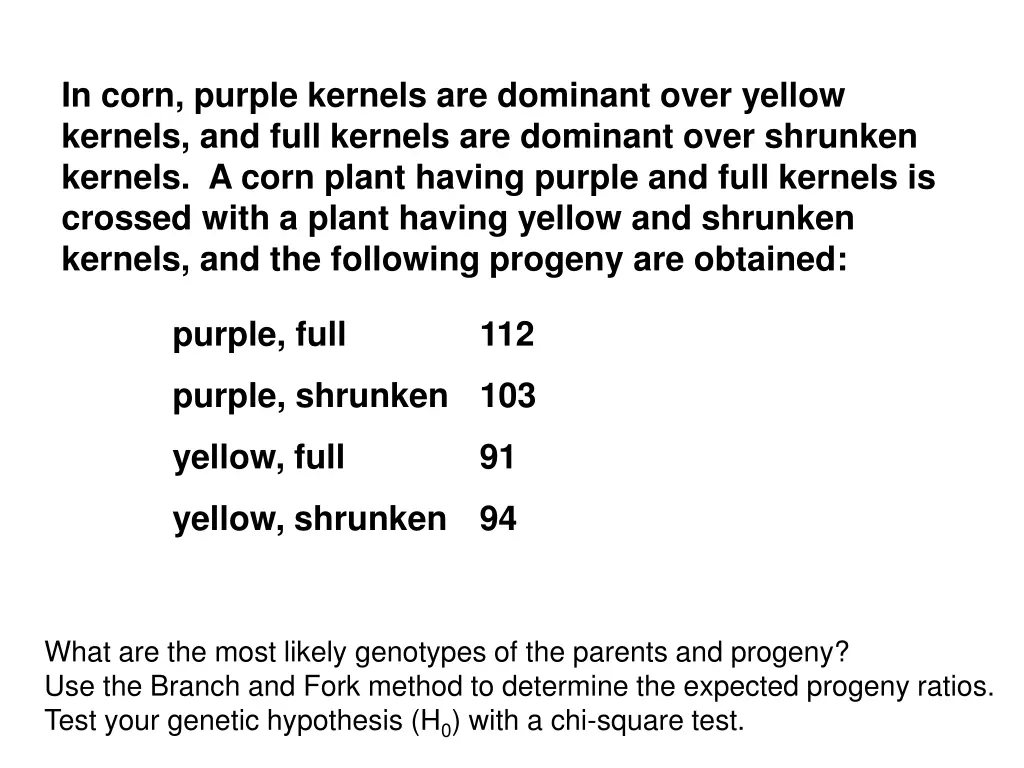
In corn, purple kernels are dominant over yellow kernels, and full kernels are dominant over shrunken kernels. A corn plant having purple and full kernels is crossed with a plant having yellow and shrunken kernels, and the following progeny are obtained: purple, full 112 purple, shrunken 103 yellow, full 91 yellow, shrunken 94 What are the most likely genotypes of the parents and progeny? Use the Branch and Fork method to determine the expected progeny ratios. Test your genetic hypothesis (H0) with a chi-square test.
Do the number of individuals or objects that fall in each category differ significantly from the number you expect? Is this difference between the expected and observed due to sampling error, or is it a real difference?
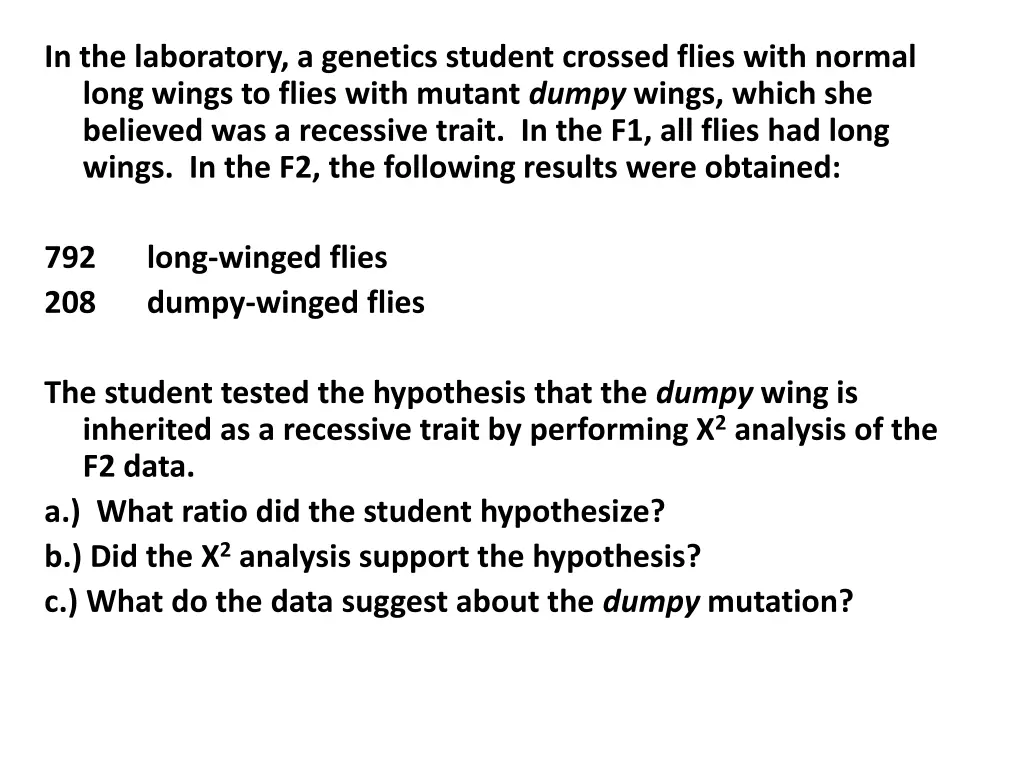
In the laboratory, a genetics student crossed flies with normal long wings to flies with mutant dumpy wings, which she believed was a recessive trait. In the F1, all flies had long wings. In the F2, the following results were obtained: 792 208 long-winged flies dumpy-winged flies The student tested the hypothesis that the dumpy wing is inherited as a recessive trait by performing X2 analysis of the F2 data. a.) What ratio did the student hypothesize? b.) Did the X2 analysis support the hypothesis? c.) What do the data suggest about the dumpy mutation?
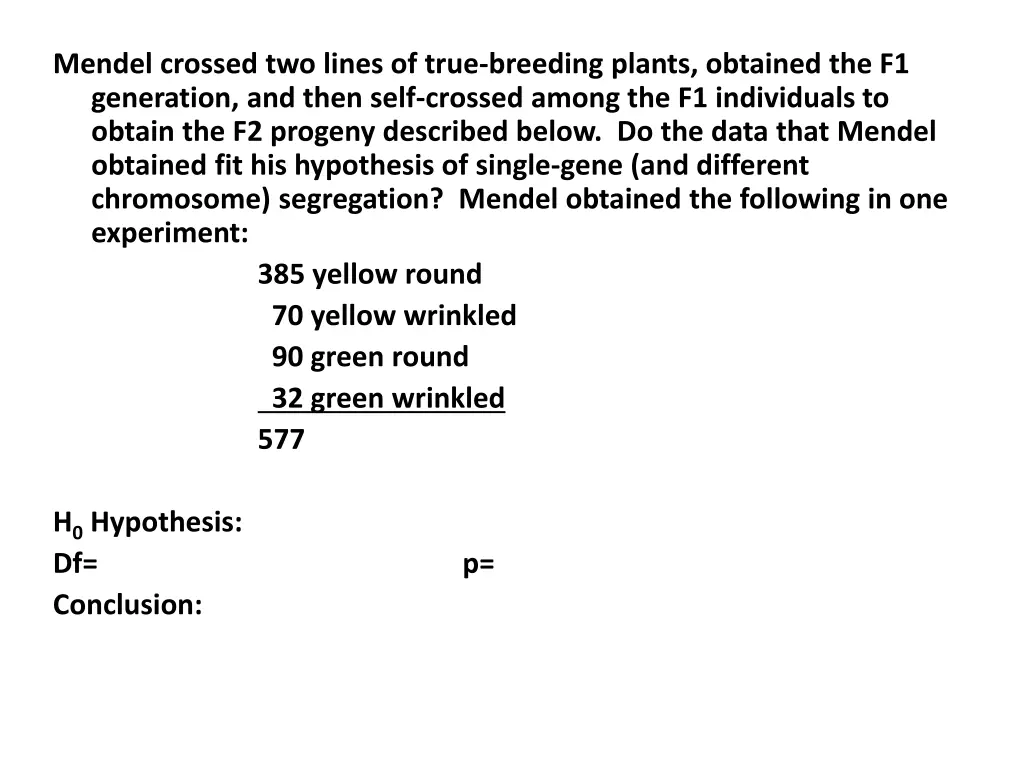
Mendel crossed two lines of true-breeding plants, obtained the F1 generation, and then self-crossed among the F1 individuals to obtain the F2 progeny described below. Do the data that Mendel obtained fit his hypothesis of single-gene (and different chromosome) segregation? Mendel obtained the following in one experiment: 385 yellow round 70 yellow wrinkled 90 green round 32 green wrinkled 577 H0 Hypothesis: Df= Conclusion: p=
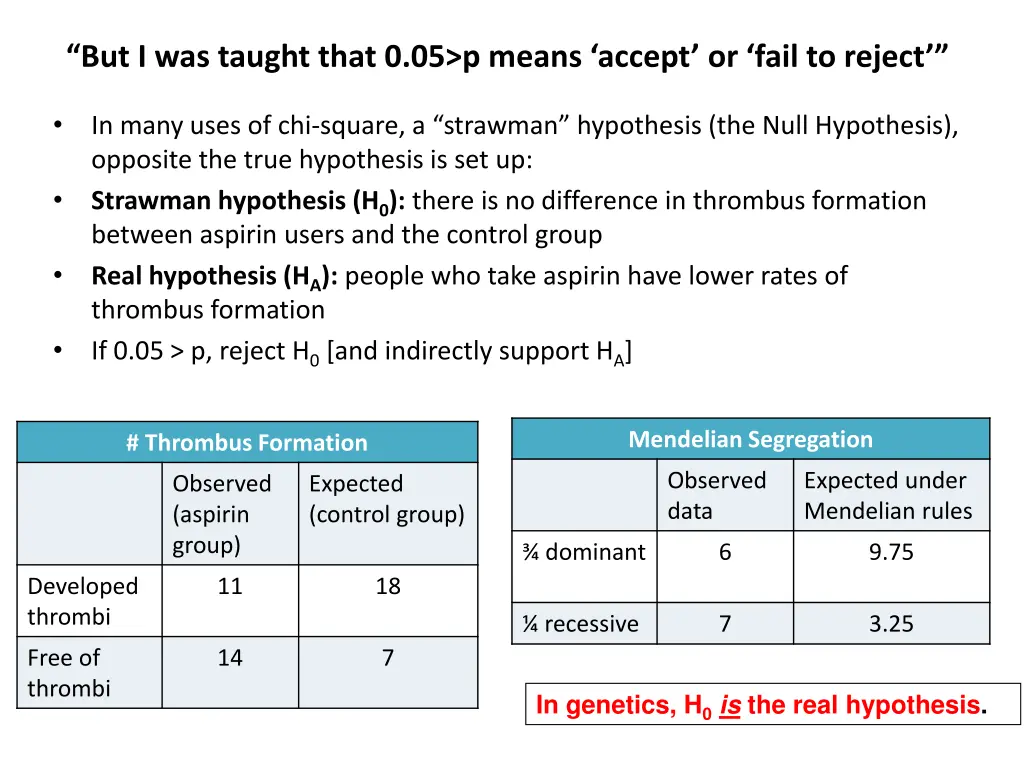
But I was taught that 0.05>p means accept or fail to reject In many uses of chi-square, a strawman hypothesis (the Null Hypothesis), opposite the true hypothesis is set up: Strawman hypothesis (H0): there is no difference in thrombus formation between aspirin users and the control group Real hypothesis (HA): people who take aspirin have lower rates of thrombus formation If 0.05 > p, reject H0 [and indirectly support HA] Mendelian Segregation # Thrombus Formation Observed data Expected under Mendelian rules Observed (aspirin group) Expected (control group) dominant 6 9.75 Developed thrombi 11 18 recessive 7 3.25 Free of thrombi 14 7 In genetics, H0is the real hypothesis.
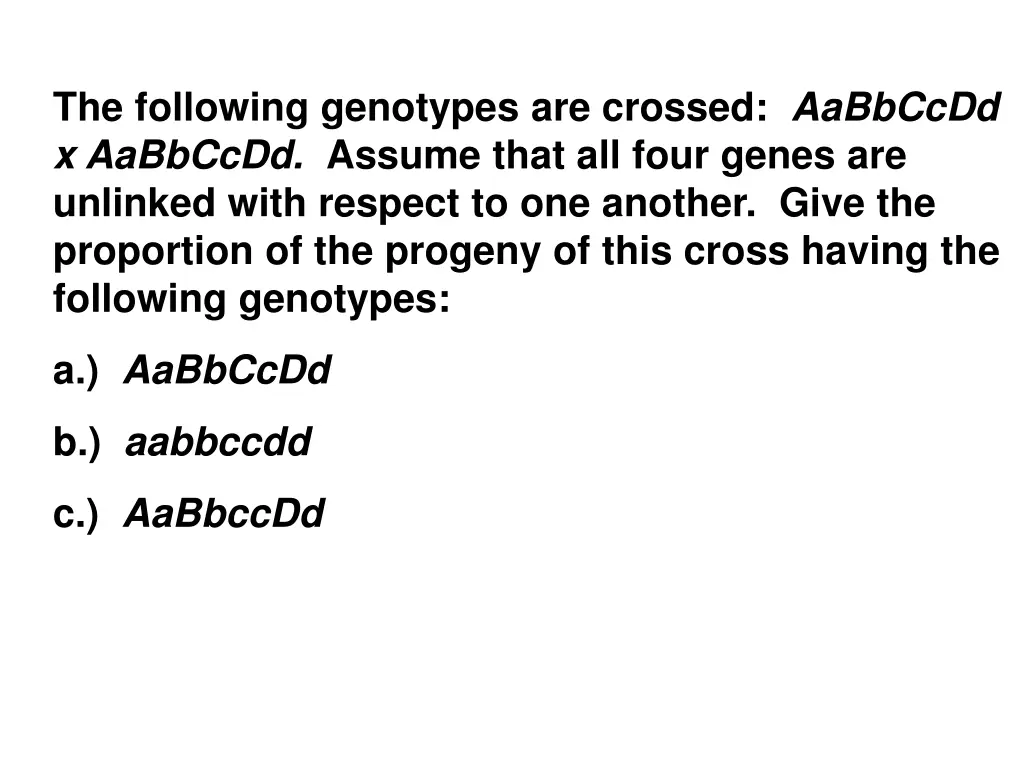
The following genotypes are crossed: AaBbCcDd x AaBbCcDd. Assume that all four genes are unlinked with respect to one another. Give the proportion of the progeny of this cross having the following genotypes: a.) AaBbCcDd b.) aabbccdd c.) AaBbccDd
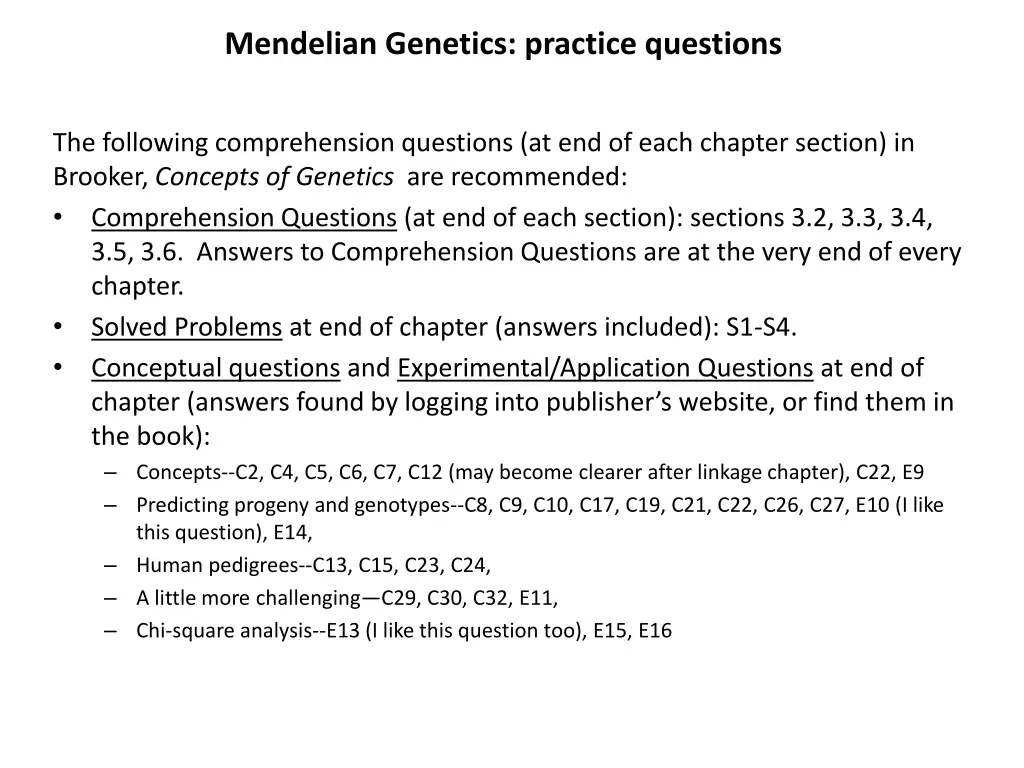
Mendelian Genetics: practice questions The following comprehension questions (at end of each chapter section) in Brooker, Concepts of Genetics are recommended: Comprehension Questions (at end of each section): sections 3.2, 3.3, 3.4, 3.5, 3.6. Answers to Comprehension Questions are at the very end of every chapter. Solved Problems at end of chapter (answers included): S1-S4. Conceptual questions and Experimental/Application Questions at end of chapter (answers found by logging into publisher s website, or find them in the book): Concepts--C2, C4, C5, C6, C7, C12 (may become clearer after linkage chapter), C22, E9 Predicting progeny and genotypes--C8, C9, C10, C17, C19, C21, C22, C26, C27, E10 (I like this question), E14, Human pedigrees--C13, C15, C23, C24, A little more challenging C29, C30, C32, E11, Chi-square analysis--E13 (I like this question too), E15, E16
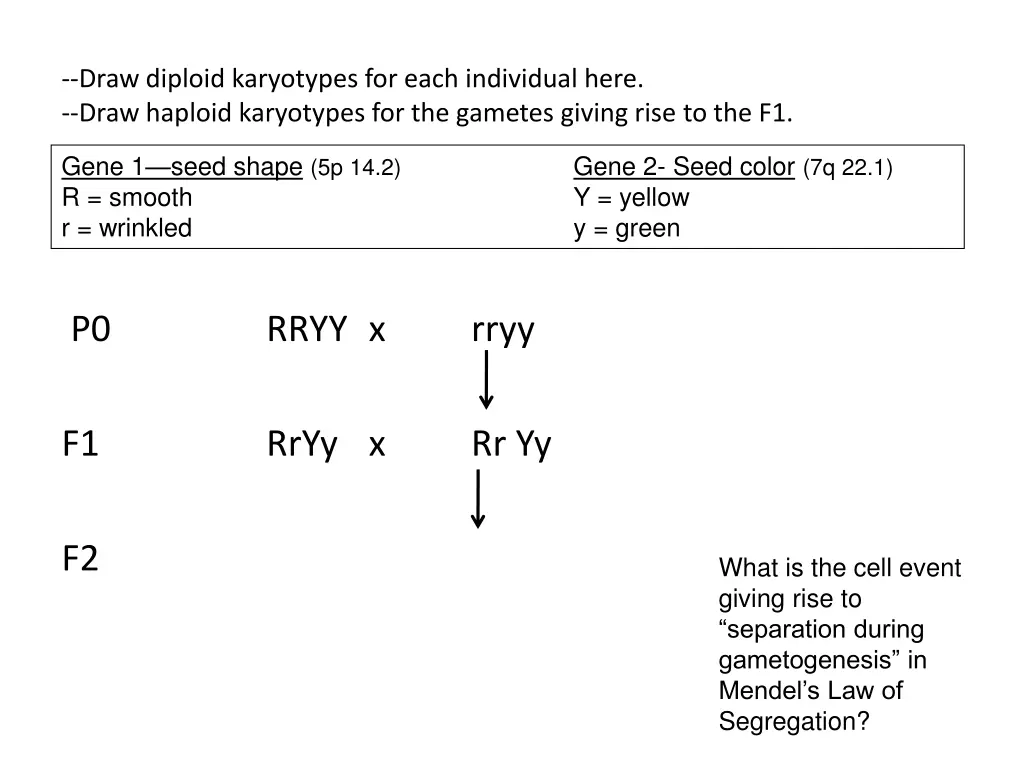
--Draw diploid karyotypes for each individual here. --Draw haploid karyotypes for the gametes giving rise to the F1. Gene 1 seed shape (5p 14.2) R = smooth r = wrinkled Gene 2- Seed color (7q 22.1) Y = yellow y = green P0 RRYY x rryy F1 RrYy x Rr Yy F2 What is the cell event giving rise to separation during gametogenesis in Mendel s Law of Segregation?
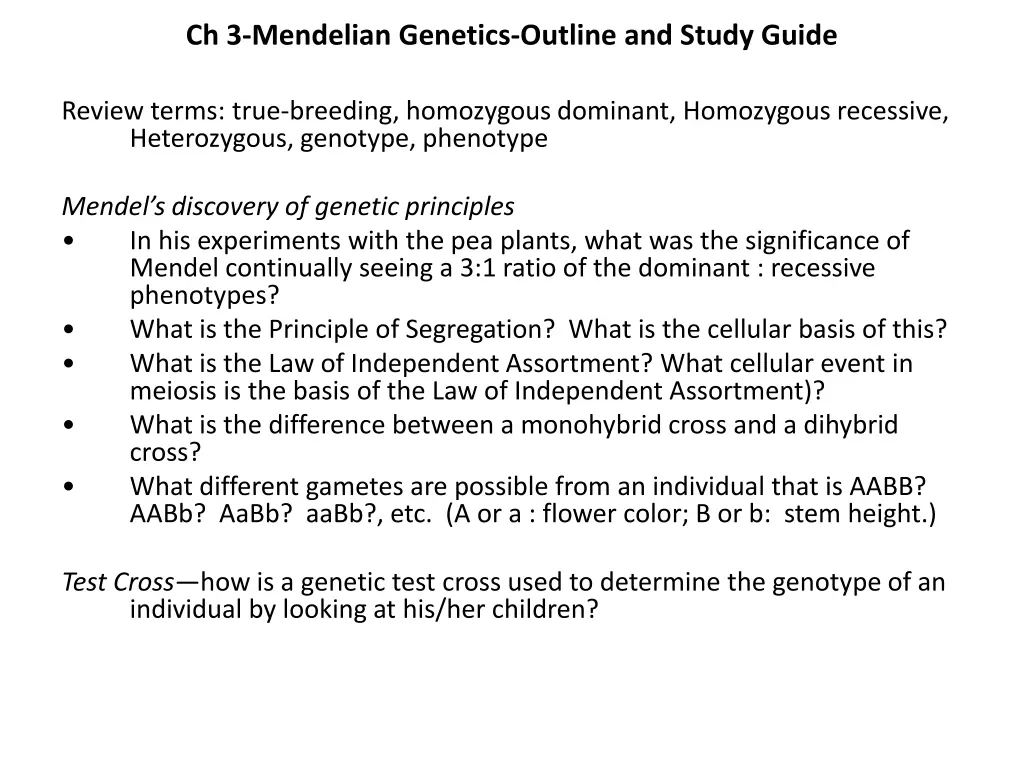
Ch 3-Mendelian Genetics-Outline and Study Guide Review terms: true-breeding, homozygous dominant, Homozygous recessive, Heterozygous, genotype, phenotype Mendel s discovery of genetic principles In his experiments with the pea plants, what was the significance of Mendel continually seeing a 3:1 ratio of the dominant : recessive phenotypes? What is the Principle of Segregation? What is the cellular basis of this? What is the Law of Independent Assortment? What cellular event in meiosis is the basis of the Law of Independent Assortment)? What is the difference between a monohybrid cross and a dihybrid cross? What different gametes are possible from an individual that is AABB? AABb? AaBb? aaBb?, etc. (A or a : flower color; B or b: stem height.) Test Cross how is a genetic test cross used to determine the genotype of an individual by looking at his/her children?
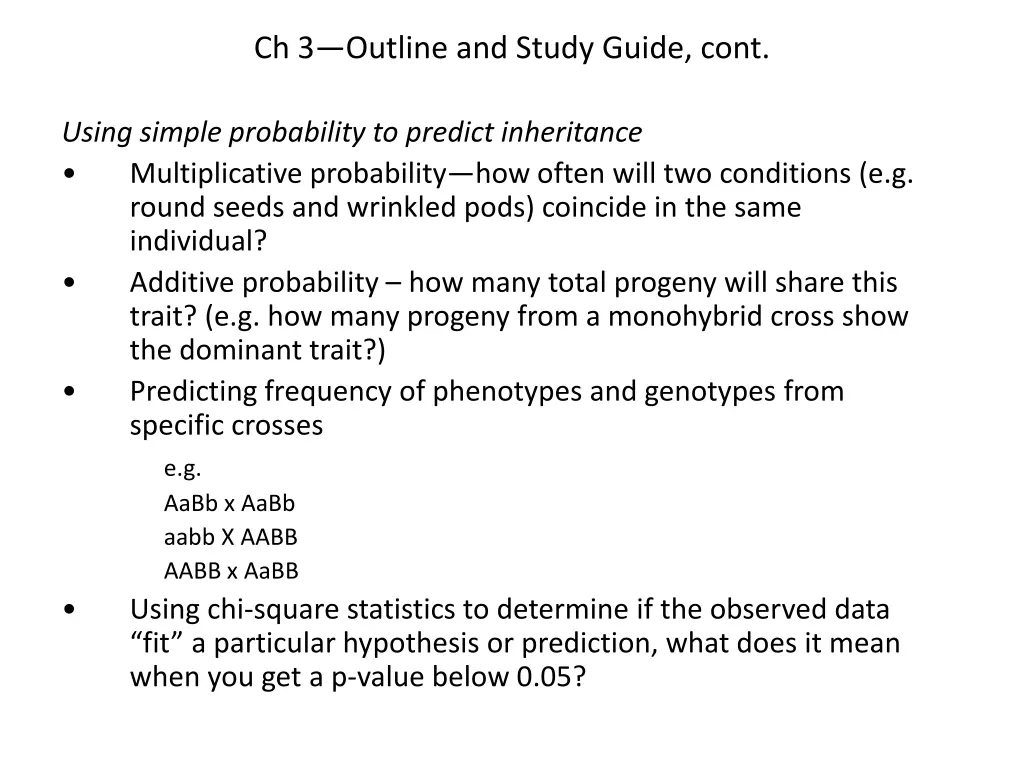
Ch 3Outline and Study Guide, cont. Using simple probability to predict inheritance Multiplicative probability how often will two conditions (e.g. round seeds and wrinkled pods) coincide in the same individual? Additive probability how many total progeny will share this trait? (e.g. how many progeny from a monohybrid cross show the dominant trait?) Predicting frequency of phenotypes and genotypes from specific crosses e.g. AaBb x AaBb aabb X AABB AABB x AaBB Using chi-square statistics to determine if the observed data fit a particular hypothesis or prediction, what does it mean when you get a p-value below 0.05?