Discover a novel laser spectroscopy technique, MIRACLS, to access nuclides beyond conventional methods. Explore the disappearance of the N=20 shell closure and emergence of new structures in the Island of Inversion with collinear laser spectroscopy. Gain insights into nuclear shell closures, charge radii measurements along the Mg isotopic chain, and the phenomena in modern nuclear theory.
Please find below an Image/Link to download the presentation.
The content on the website is provided AS IS for your information and personal use only. It may not be sold, licensed, or shared on other websites without obtaining consent from the author. If you encounter any issues during the download, it is possible that the publisher has removed the file from their server.
You are allowed to download the files provided on this website for personal or commercial use, subject to the condition that they are used lawfully. All files are the property of their respective owners.
The content on the website is provided AS IS for your information and personal use only. It may not be sold, licensed, or shared on other websites without obtaining consent from the author.
E N D
Presentation Transcript
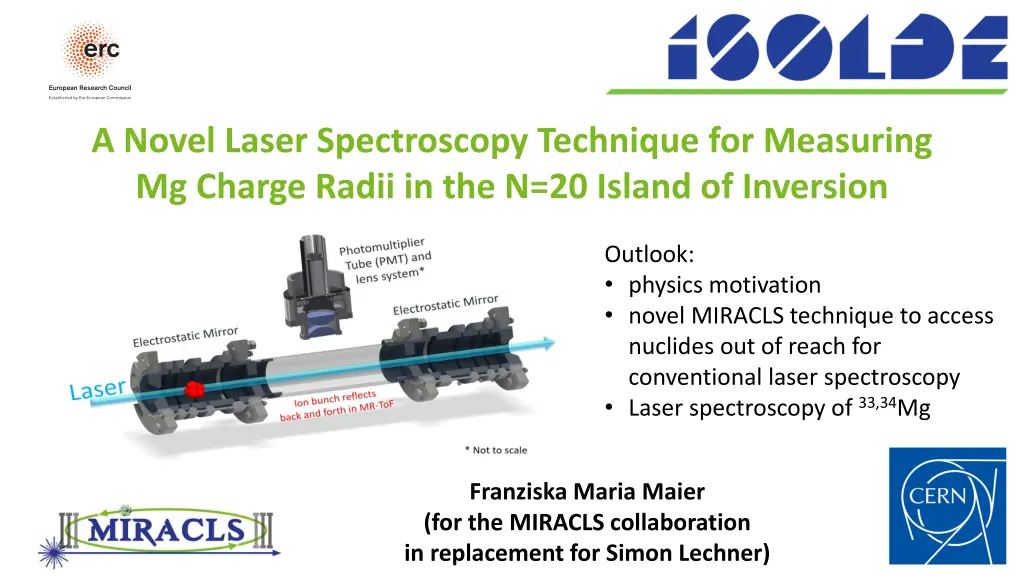
A Novel Laser Spectroscopy Technique for Measuring Mg Charge Radii in the N=20 Island of Inversion Outlook: physics motivation novel MIRACLS technique to access nuclides out of reach for conventional laser spectroscopy Laser spectroscopy of 33,34Mg Franziska Maria Maier (for the MIRACLS collaboration in replacement for Simon Lechner)
N=20 shell closure disappears far away from stability Island of Inversion shell structure & magic numbers Maria Goeppert Mayer J. Hans D. Jensen Nobel Prize 1963 N=20 protons Z=8 N=20 disappears Island of Inversion N=16 appears N=8 neutrons studies at modern radioactive ion beam (RIB) facilities disappearance of established shell closures emergence of new ones O. Sorlin, M.-G. Porquet, Prog. Part. Nucl. Phys. 61, 602 (2008) R. Kanungo, Phys. Scr. T 152, 014002 (2013) 2
Collinear laser spectroscopy (CLS) reveals information about nuclear shell closures Fluorescence-based laser spectroscopy: Photon counts excited state ground state Relative frequency (MHz) De-excitation: detect fluorescence photons Excitation using laser photons Photomultiplier Tube photon Laser K. Blaum et al., Phys. Scr. T152, 014017 (2013) P. Campbell et al., Prog. Part. and Nucl. Phys. 86, 127-180 (2016) R. Neugart et al., J. Phys. G: Nucl. Part. Phys. 44, 064002 (2017) ion or atom 3
Collinear laser spectroscopy (CLS) reveals information about nuclear shell closures Fluorescence-based laser spectroscopy: excited state Electric quadrupole moment Qs magnetic dipol moment ? ? rms charge radius spin I ground state study nuclear structure phenomena benchmark for modern nuclear theory Photomultiplier Tube photon Laser K. Blaum et al., Phys. Scr. T152, 014017 (2013) P. Campbell et al., Prog. Part. and Nucl. Phys. 86, 127-180 (2016) R. Neugart et al., J. Phys. G: Nucl. Part. Phys. 44, 064002 (2017) ion or atom 4
Charge radii measurements along the Mg isotopic chain provide insights into island of inversion Linear trends between A=21-26 & 26-30 &31-32 in addition to odd-even staggering Filling of respective neutron orbits Island of inversion: Increasing slope deformation, cross-shell excitation of two neutrons D. T. Yordanov et al., Phys. Rev. Lett., 108:042504 (2012) 5
Charge radii measurements along the Mg isotopic chain provide insights into island of inversion Charge Radii Measurements of 33,34Mg would enable further insights into island of inversion stringent benchmark for ab initio theory But: Very low production yields D. T. Yordanov et al., Phys. Rev. Lett., 108:042504 (2012) 6
The MIRACLS technique enables an increased sensitivity Collinear Laser Spectroscopy (CLS) known for high resolution Limited to short observation times Combine CLS with advanced ion-trap techniques increase observation time 33,34Mg become accessible 7
The MIRACLS technique enables an increased sensitivity Increased observation time gain in sensitivity by 1-2 orders of magnitude More exotic nuclides accessible 2017-2020: Successful proof-of-principle experiment 2020-2023: Design and construction of new beamline 2024: Charge radii measurement of 33,34Mg 8
The MIRACLS technique enables an increased sensitivity Offline ion source ISOLDE beam Paul-trap cooler-buncher HV cage with 30 bender Laser beam 10.5 keV MR-ToF device copies of our Paul trap also operational at Greifswald, MIT, Beijing, Darmstadt & ISOLTRAP F.M. Maier, M. Vilen et al., NIMA 1048, 167927 (2023). F.M. Maier et al., NIMA 1057, 170365 (2025). S. Lechner, S. Sels et al., NIMA 1065, 169471 (2024). 9
The MIRACLS technique enables an increased sensitivity First MR-ToF device worldwide that stores ions at 10.5 keV beam energy as required to maintain high resolution Linewidth: ? ? Photomultiplier tube ? Laser stored ion bunch > 50% capture efficiency electrostatic mirror electrostatic mirror F.M. Maier, M. Vilen et al., NIMA 1048, 167927 (2023). F.M. Maier et al., NIMA 1057, 170365 (2025). 10
MIRACLS CLS measurement of 24,26,28,30,32Mg is in good agreement with existing data Difference to COLLAPS measurement 24Mg 26Mg Photon counts 28Mg 30Mg 32Mg Relative frequency (MHz) Figures prepared by Anthony Roitman 11
MIRACLS CLS measurement of 33,34Mg will provide insights into island of inversion Data analysis and physics interpretation in progress Preliminary Preliminary 34Mg 33Mg Photon counts Photon counts Relative frequency (MHz) Relative frequency (MHz) 12
Conclusion and Outlook MIRACLS is a novel technique for highly sensitive laser spectroscopy (CLS) Successful charge radii measurements of 33,34Mg will provide insight into island of inversion Cd measurements planned for this summer to provide new information of N=50 shell closure MIRACLS also has applications beyond fluorescence-based CLS Platform for Doppler and Sympathetic Cooling Investigations S. Sels, F.M. Maier et al., Phys. Rev. Research 4, 033229 (2022). Highly sensitive electron-affinity measurements F.M. Maier, E. Leistenschneider et al. (stay tuned!) Highly selective and high-flux mass separation F.M. Maier et al, NIMA 1056, 168545 (2023). F.M. Maier et al, NIMA 1057, 170365 (2025). Talks on Friday by Lukas Nies and myself: Parallel Session 8 11:00-13:00, Room 10: 1F #107 (DCC) 13
Thank you! MIRACLS collaboration: L. Croquette, H. Heylen, E. Leistenschneider, C. Kanitz, S. Lechner, F. Maier, L. Nies, P. Plattner, M. Rosenbusch, F. Wienholtz, M. Vilen, F. Buchinger, W. N rtersh user, A. Roitman, L. Schweikhard, S. Malbrunot-Ettenauer Thanks to all Mg beamtime participants: O. Ahmad, T. Fabritz, P. Giesel, C. Klink, K. Koenig, D. Lange, L. Lalanne, T. Lellinger, A. Mcglone, K. Mohr, L. Nies, J. Palmes, V. Repo, L. V. Rodriguez, C. Schweiger, J. Warbinek, J. Wilson, Z. Yue, C. Farjado Zambrano Franziska Maier (maierf@frib.msu.edu) (for the MIRACLS collaboration in replacement for Simon Lechner) 14
MIRACLS Also Enables Highly Sensitive Electron-Affinity Measurements Electron Affinity EA: Binding energy of additional electron of a negatively charged ion (around 1 eV) Powerful benchmarks of atomic theories reliant on many-body quantum mechanics 100,000x smaller yield electron Laser Cl atom Cl-ion Opens a pathway to measure electron affinities of rarely produced radioactive ions, e.g. superheavy elements. MIRACLS 1.5 keV setup F. M. Maier, E. Leistenschneider et al., In preparation. 17
Increased beam energy of stored ions results in increased ion flux Provide isobaric pure beams: Virtually all fields of rare isotope science pursued at low-energy branches of RIB facilities will benefit from isobaric pure beams with a high ion intensity, ranging from fundamental symmetry studies, nuclear structure, astrophysics, material science, production of medical isotopes to rare isotope studies with antimatter. Provide isomeric pure beams for decay studies for nuclear structure and nuclear astrophysics MIRACLS setup will be reconfigured to provide purified ion beams to PUMA and travelling setups. A dedicated high-voltage mass separator is in development at FRIB. F.M. Maier et al, NIMA 1056, 168545 (2023). F.M. Maier et al, NIMA 1057, 170365 (2025). 19