Explore the importance and application of numerical methods in the field of engineering. Learn about solving mathematical problems efficiently using arithmetic operations and computer programming. Grasp the fundamentals of numerical analysis and its significance in engineering and scientific endeavors.
Please find below an Image/Link to download the presentation.
The content on the website is provided AS IS for your information and personal use only. It may not be sold, licensed, or shared on other websites without obtaining consent from the author. If you encounter any issues during the download, it is possible that the publisher has removed the file from their server.
You are allowed to download the files provided on this website for personal or commercial use, subject to the condition that they are used lawfully. All files are the property of their respective owners.
The content on the website is provided AS IS for your information and personal use only. It may not be sold, licensed, or shared on other websites without obtaining consent from the author.
Respect, Professionalism, & Entrepreneurship TIU : Mahasiswa dapat mencari akar-akar suatu persamaan, menyelesaikan persamaan aljabar linear, pencocokan kurva, dan membuat program aplikasi analisis numeriknya TIK : Mahasiswa dapatmemberikan definisi tentang analisis numerik dan tingkat ketelitian dari perhitungan dengan solusi numerik
Respect, Professionalism, & Entrepreneurship Sub Pokok Bahasan : Definisi metode numerik dan analisis numerik Nilai bena, tingkat ketelitian dan error Text Book : Chapra, S., Canale, R.P. (2010). Numerical Methods for Engineers. 6th ed. Mc Graw Hill, Inc. Setiawan, A. (2007). Pengantar Metode Numerik. 2nd ed. Penerbit Andi Bobot Penilaian : Tugas Ujian Tengah Semester Ujian Akhir Semester : 25 % : 30% : 45%
Respect, Professionalism, & Entrepreneurship What are Numerical Methods? Techniques by which mathematical problems are formulated so that they can be solved with arithmetic operations {+,-, ,:} , that can then be performed by a computer.
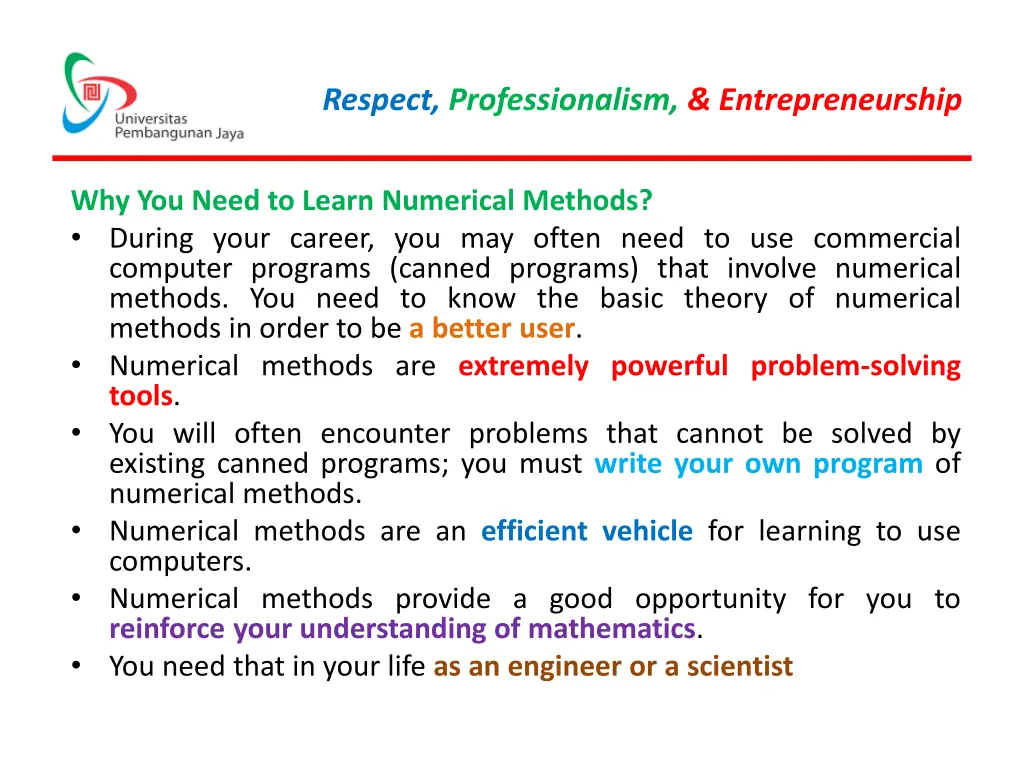
Respect, Professionalism, & Entrepreneurship Why You Need to Learn Numerical Methods? During your career, you may often need to use commercial computer programs (canned programs) that involve numerical methods. You need to know the basic theory of numerical methods in order to be a better user. Numerical methods are extremely powerful problem-solving tools. You will often encounter problems that cannot be solved by existing canned programs; you must write your own program of numerical methods. Numerical methods are an efficient vehicle for learning to use computers. Numerical methods provide a good opportunity for you to reinforce your understanding of mathematics. You need that in your life as an engineer or a scientist
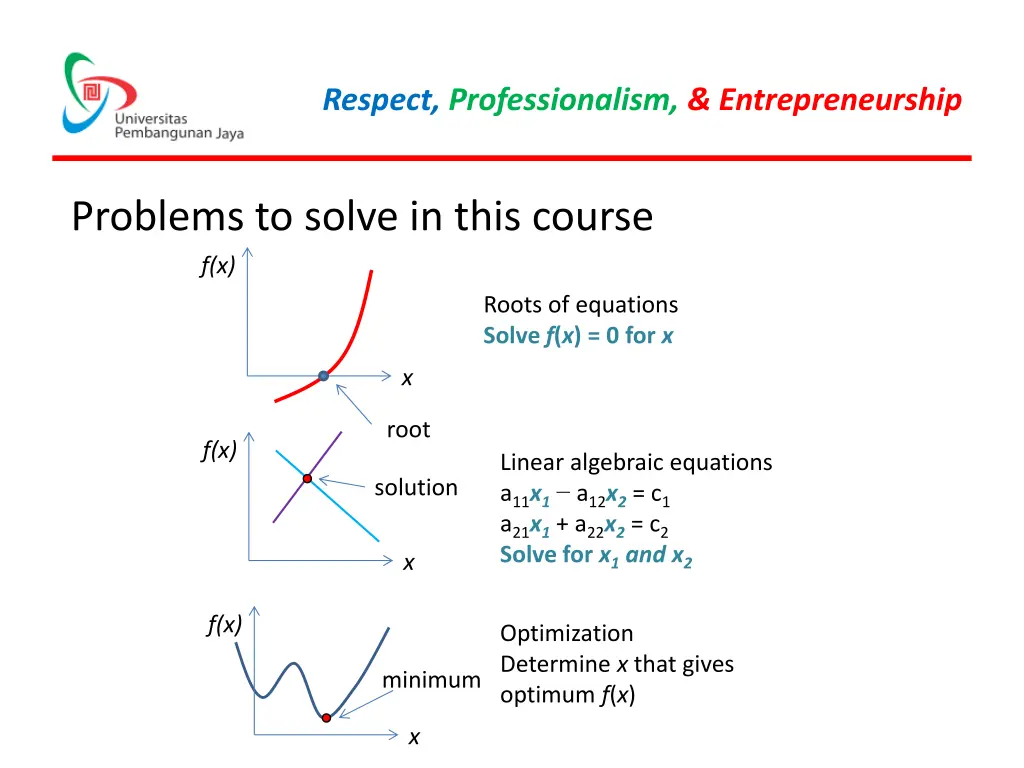
Respect, Professionalism, & Entrepreneurship Problems to solve in this course f(x) Roots of equations Solve f(x) = 0 for x x root f(x) Linear algebraic equations a11x1 a12x2 = c1 a21x1 + a22x2 = c2 Solve for x1 and x2 solution x f(x) Optimization Determine x that gives optimum f(x) minimum x
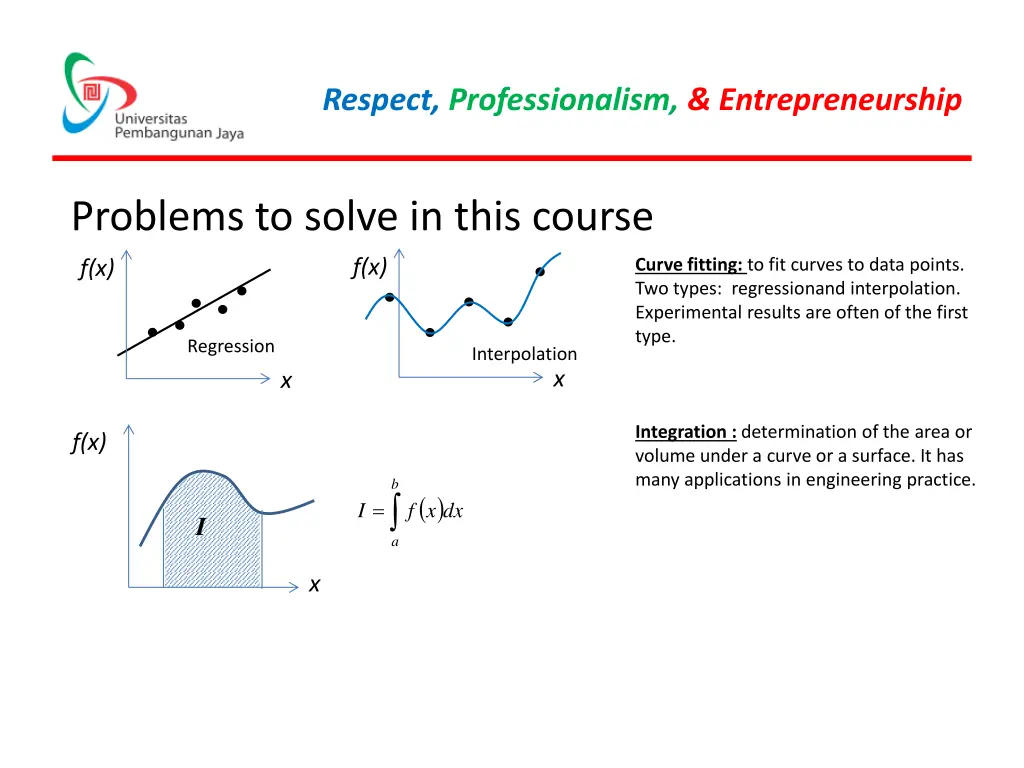
Respect, Professionalism, & Entrepreneurship Problems to solve in this course f(x) Curve fitting: to fit curves to data points. Two types: regressionand interpolation. Experimental results are often of the first type. f(x) Regression Interpolation x x Integration : determination of the area or volume under a curve or a surface. It has many applications in engineering practice. f(x) b ( ) x a = I f dx I x
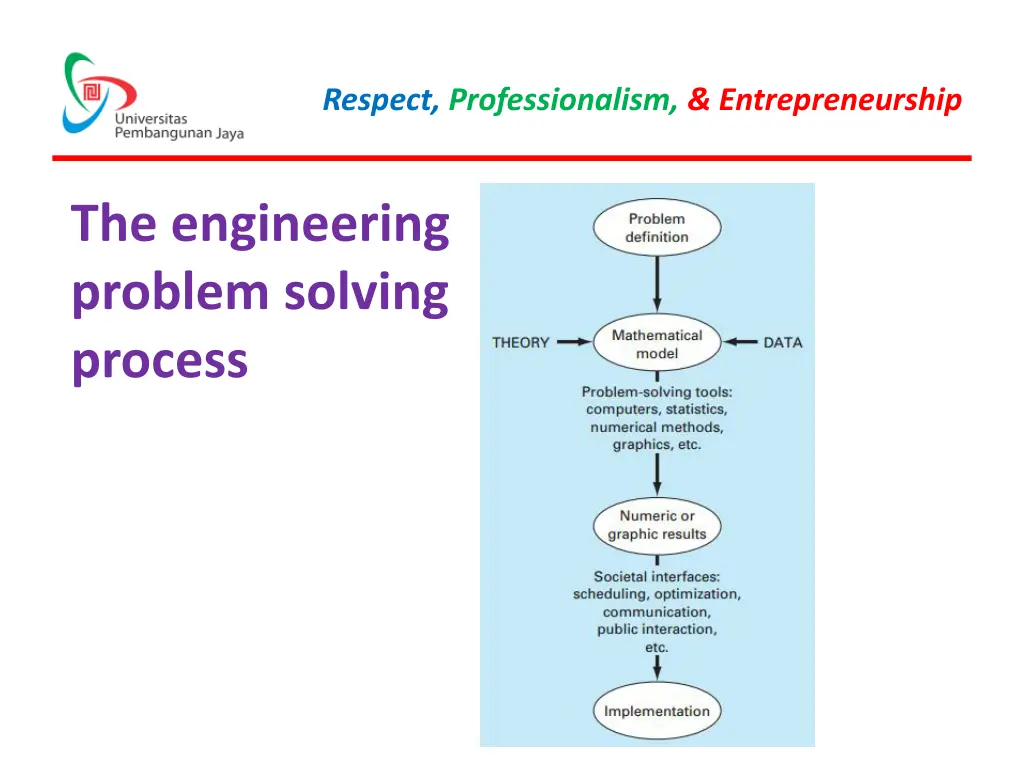
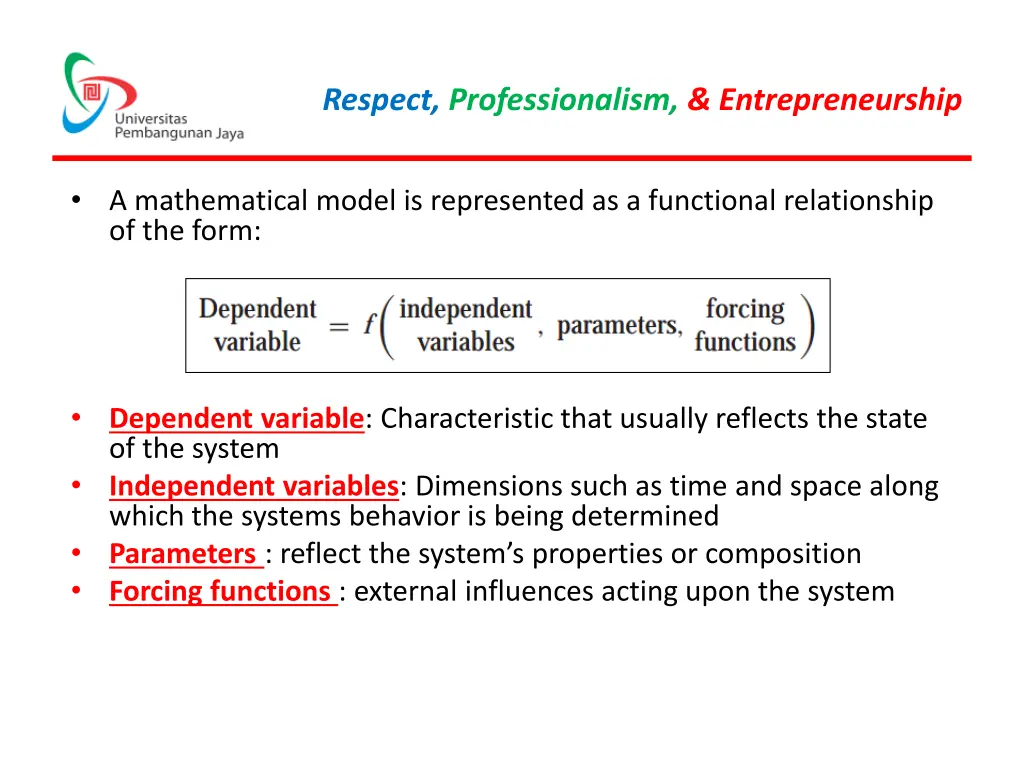
Respect, Professionalism, & Entrepreneurship A mathematical model is represented as a functional relationship of the form: Dependent variable: Characteristic that usually reflects the state of the system Independent variables: Dimensions such as time and space along which the systems behavior is being determined Parameters : reflect the system s properties or composition Forcing functions : external influences acting upon the system
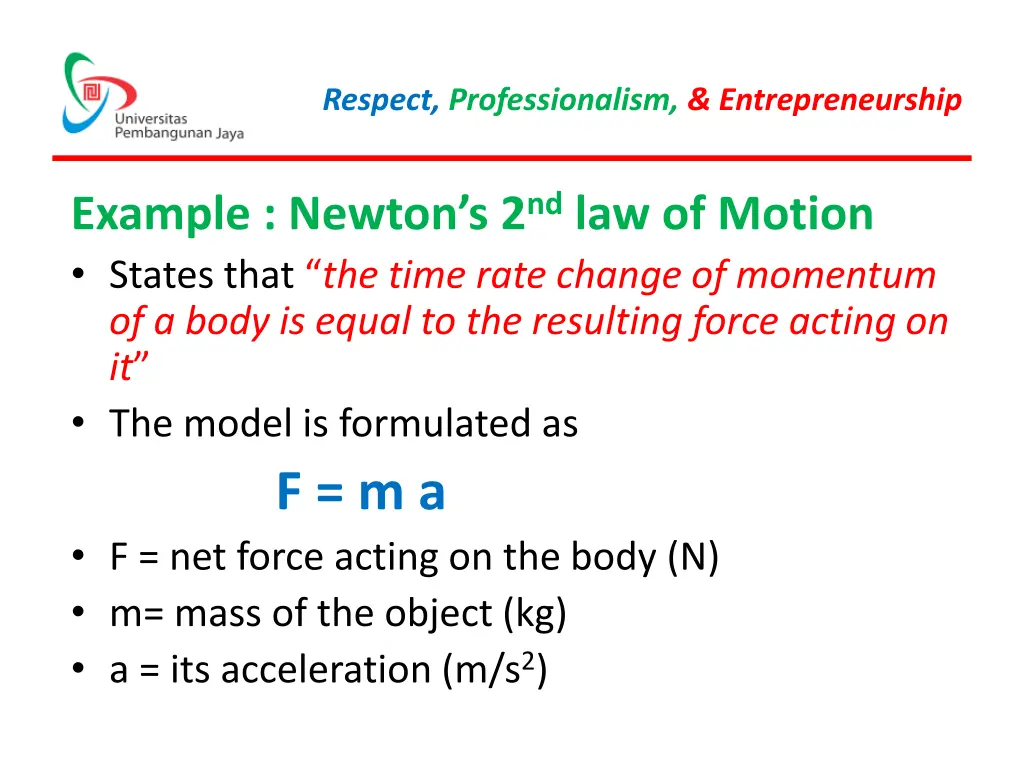
Respect, Professionalism, & Entrepreneurship Example : Newton s 2nd law of Motion States that the time rate change of momentum of a body is equal to the resulting force acting on it The model is formulated as F = m a F = net force acting on the body (N) m= mass of the object (kg) a = its acceleration (m/s2)
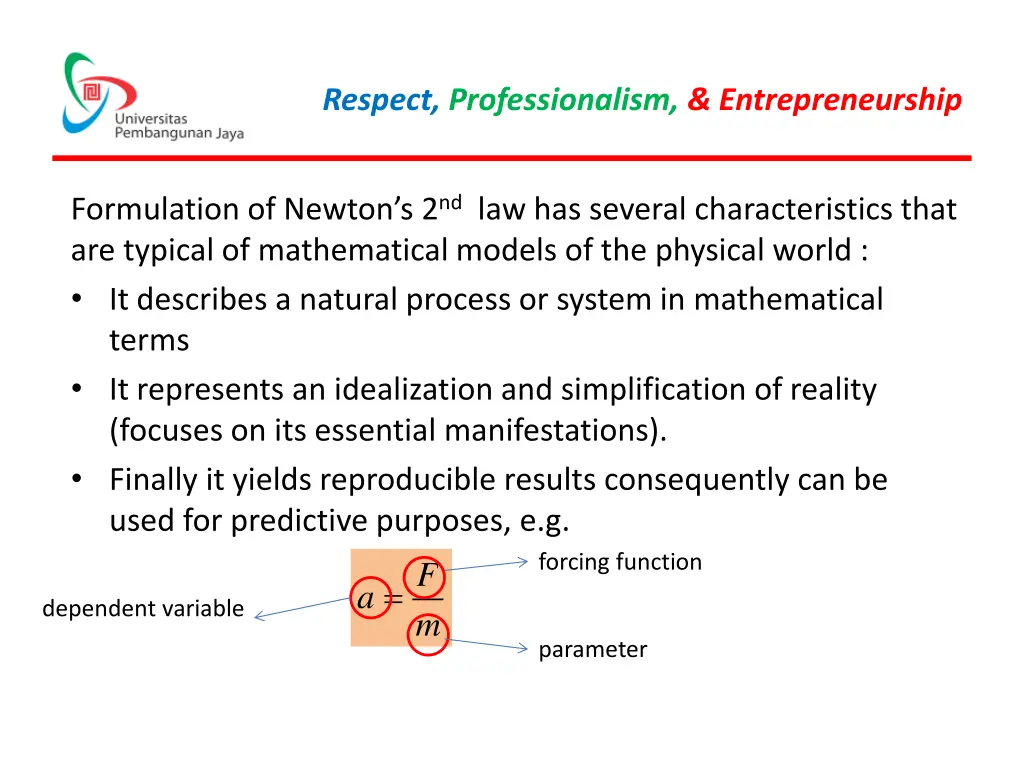
Respect, Professionalism, & Entrepreneurship Formulation of Newton s 2nd law has several characteristics that are typical of mathematical models of the physical world : It describes a natural process or system in mathematical terms It represents an idealization and simplification of reality (focuses on its essential manifestations). Finally it yields reproducible results consequently can be used for predictive purposes, e.g. F a = dependent variable forcing function m parameter
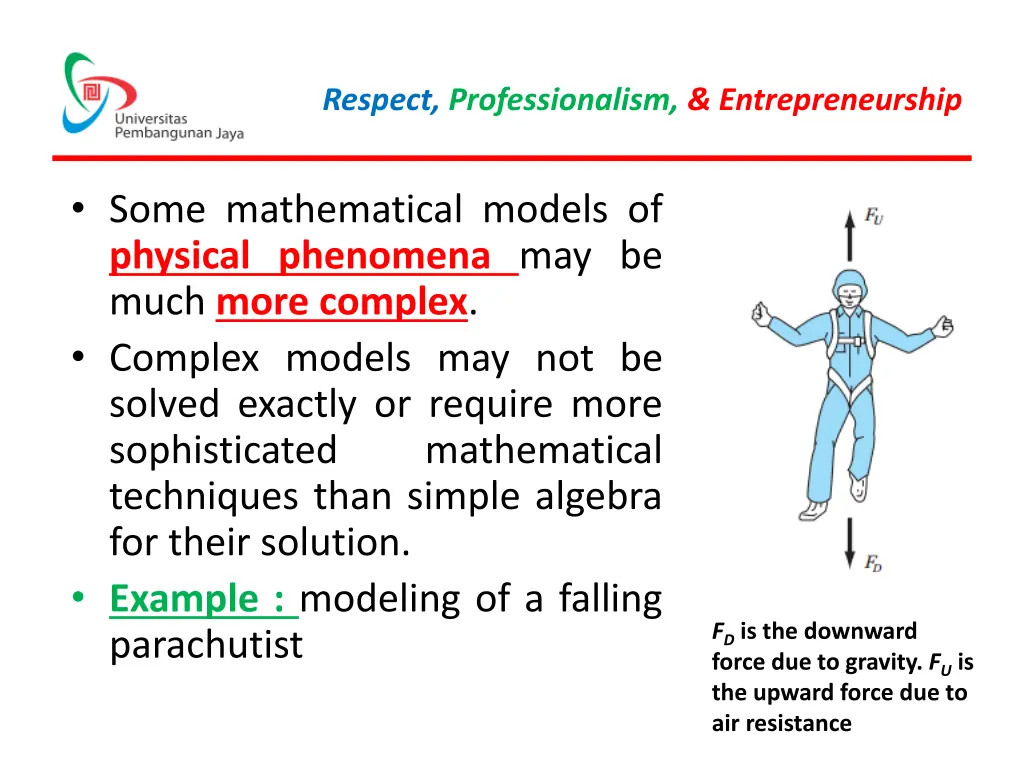
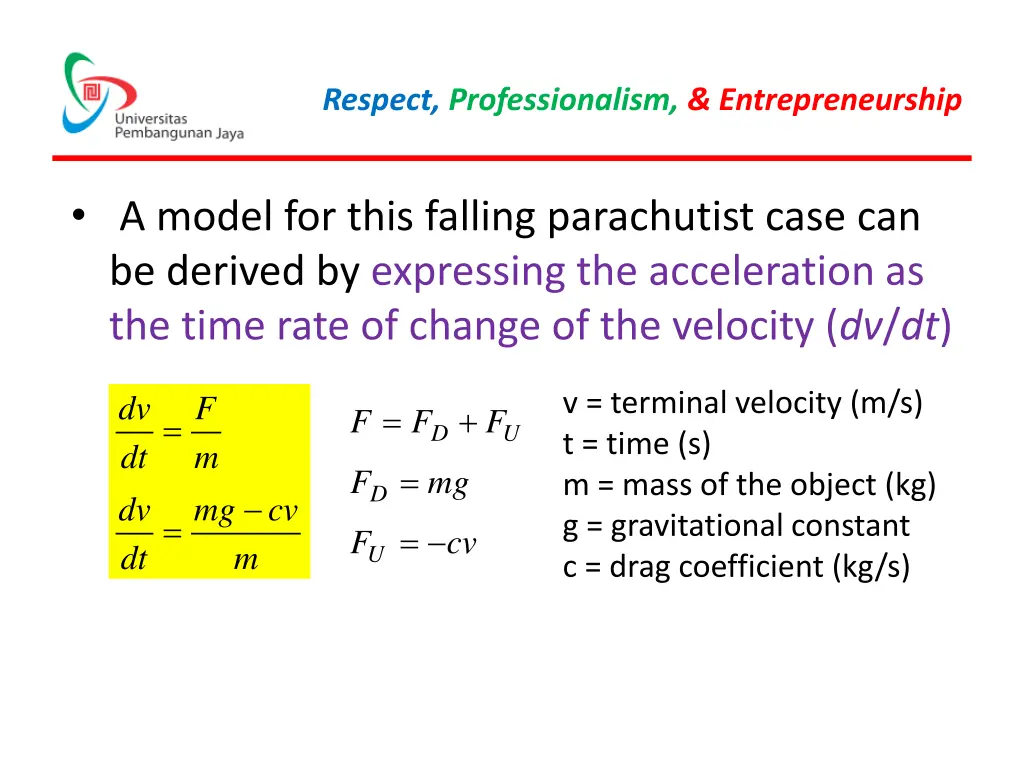
Respect, Professionalism, & Entrepreneurship Some mathematical models of physical phenomena may be much more complex. Complex models may not be solved exactly or require more sophisticated techniques than simple algebra for their solution. Example : modeling of a falling parachutist mathematical FD is the downward force due to gravity. FU is the upward force due to air resistance
Respect, Professionalism, & Entrepreneurship A model for this falling parachutist case can be derived by expressing the acceleration as the time rate of change of the velocity (dv/dt) v = terminal velocity (m/s) t = time (s) m = mass of the object (kg) g = gravitational constant c = drag coefficient (kg/s) dv F = + F F F = D U dt m = F mg D dv mg cv = = F cv dt m U
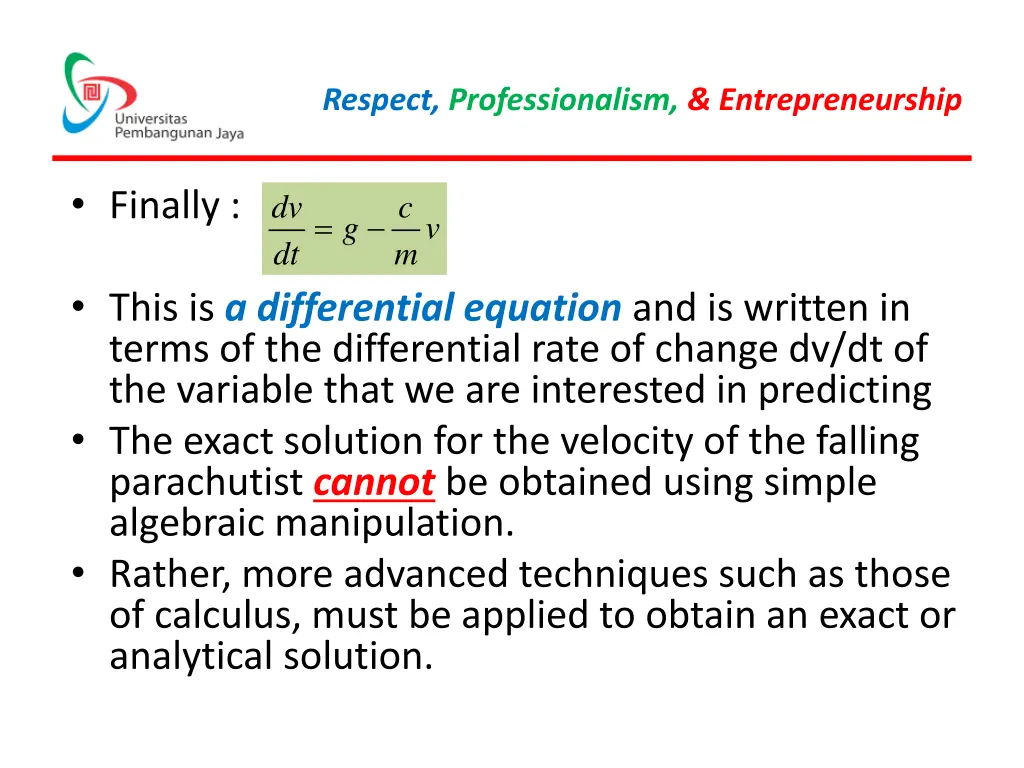
Respect, Professionalism, & Entrepreneurship Finally : dv c = g v dt m This is a differential equation and is written in terms of the differential rate of change dv/dt of the variable that we are interested in predicting The exact solution for the velocity of the falling parachutist cannot be obtained using simple algebraic manipulation. Rather, more advanced techniques such as those of calculus, must be applied to obtain an exact or analytical solution.
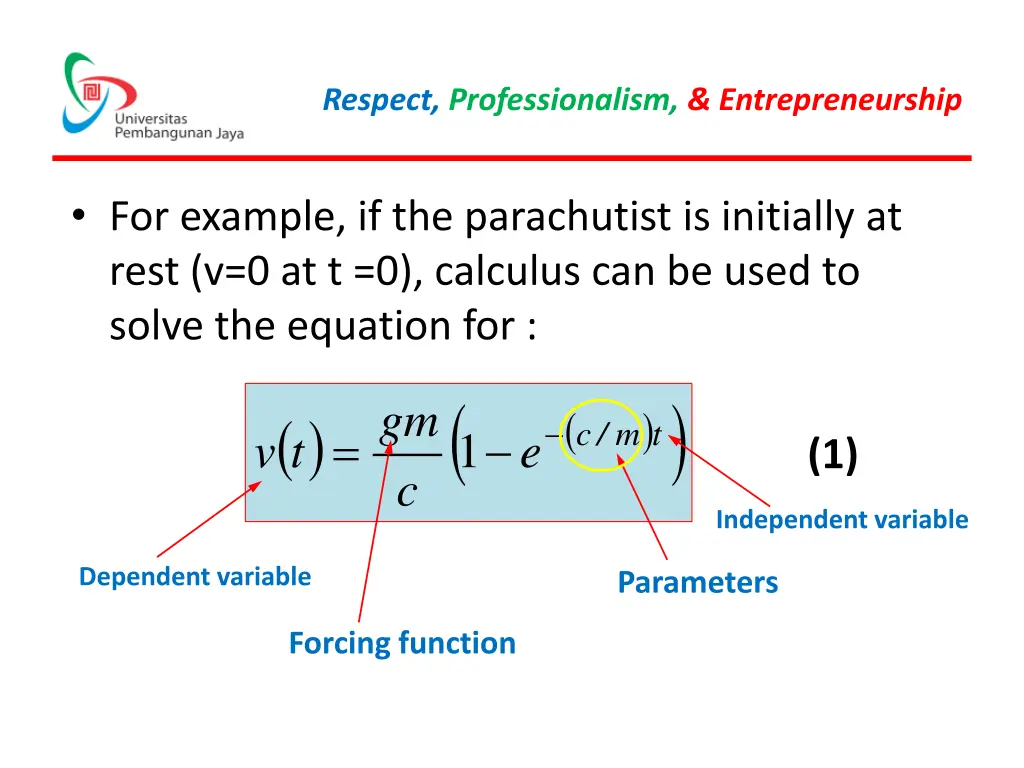
Respect, Professionalism, & Entrepreneurship For example, if the parachutist is initially at rest (v=0 at t =0), calculus can be used to solve the equation for : ( c ) gm ( ) ( ) t c / m t = 1 v e (1) Independent variable Dependent variable Parameters Forcing function
Respect, Professionalism, & Entrepreneurship Solution for differential equation cannot always be solved analytically using simple algebraic solution. The exact solution for differential equation can be solved using calculus or by approximation using numerical methods.
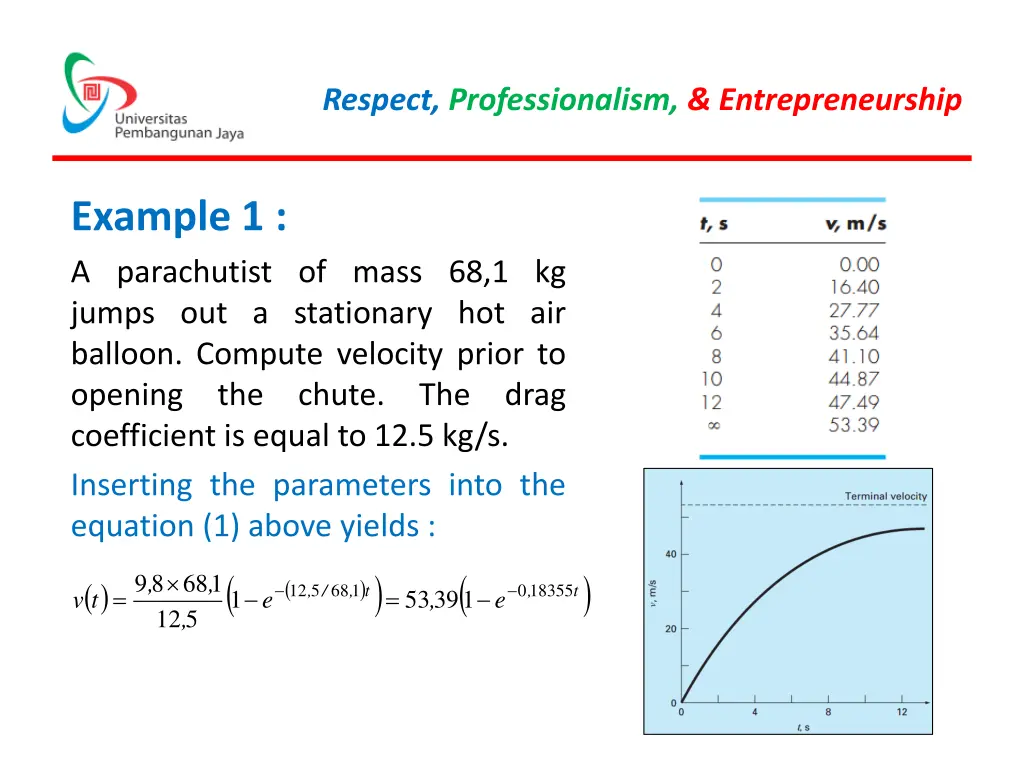
Respect, Professionalism, & Entrepreneurship Example 1 : A parachutist of mass 68,1 kg jumps out a stationary hot air balloon. Compute velocity prior to opening the chute. The drag coefficient is equal to 12.5 kg/s. Inserting the parameters into the equation (1) above yields : ( e , 5 12 ) ( 1 ) 9 8 68 , 1 , ( ) ( ) t 12 5 68 , 1 0 , 18355 , / t t = = 1 53 39 v , e
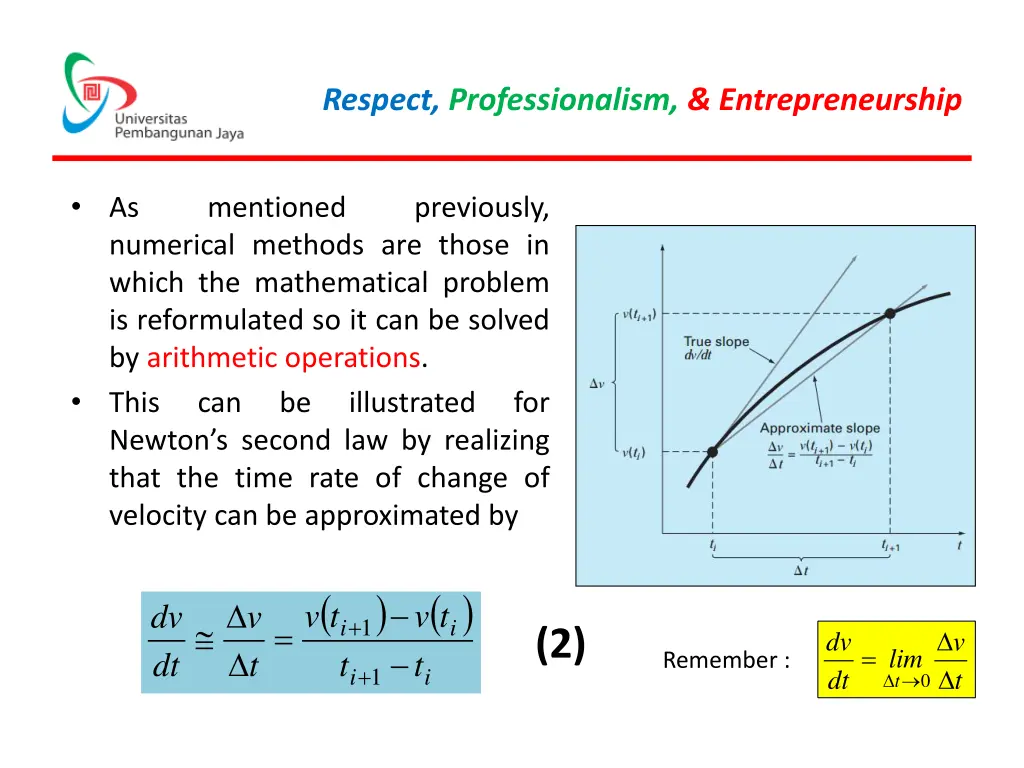
Respect, Professionalism, & Entrepreneurship As mentioned previously, numerical methods are those in which the mathematical problem is reformulated so it can be solved by arithmetic operations. This can be Newton s second law by realizing that the time rate of change of velocity can be approximated by illustrated for ( ) ( ) i t v t v dv v + 1 i t = (2) dv v = lim t dt t t Remember : + 1 i i dt t 0
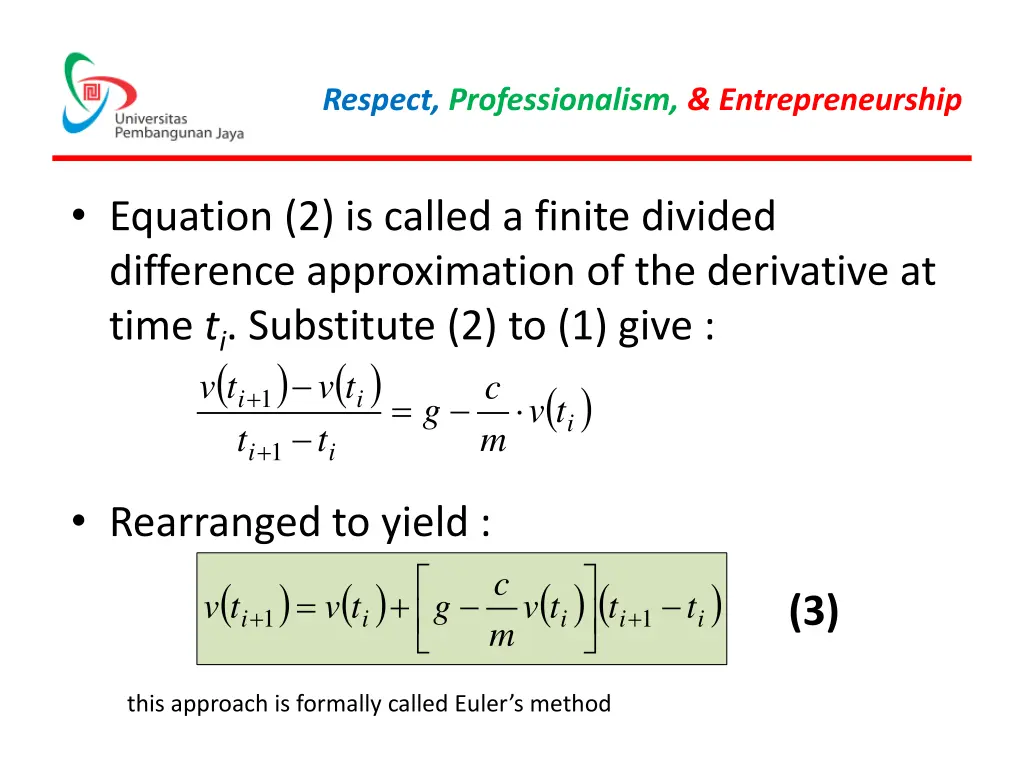
Respect, Professionalism, & Entrepreneurship Equation (2) is called a finite divided difference approximation of the derivative at time ti. Substitute (2) to (1) give : ( ) ( ) i i m t t + 1 v t v t c ( ) i t + 1 = g v i i Rearranged to yield : c ( ) ( ) i t ( ) ( i t ) = + v t v g v t t (3) + + 1 1 i i i m this approach is formally called Euler s method
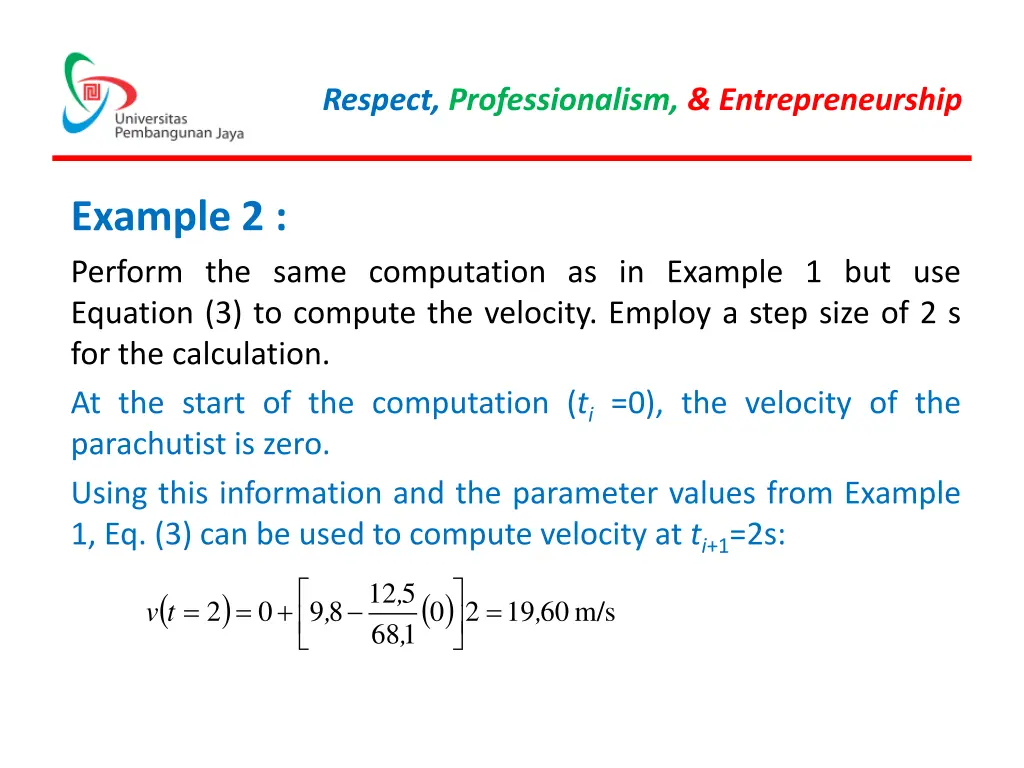
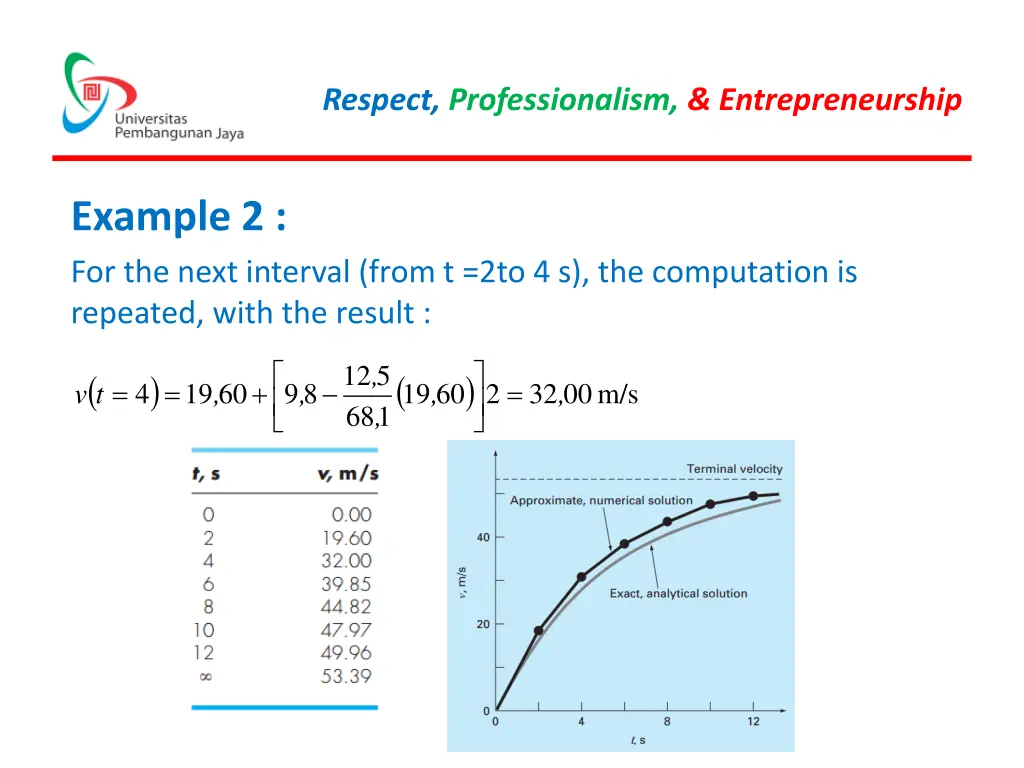
Respect, Professionalism, & Entrepreneurship Example 2 : Perform the same computation as in Example 1 but use Equation (3) to compute the velocity. Employ a step size of 2 s for the calculation. At the start of the computation (ti =0), the velocity of the parachutist is zero. Using this information and the parameter values from Example 1, Eq. (3) can be used to compute velocity at ti+1=2s: 12 5 , ( ) ( ) 0 = = + = 2 0 9 8 , 2 19 60 , m/s v t 68 1 ,
Respect, Professionalism, & Entrepreneurship Example 2 : For the next interval (from t =2to 4 s), the computation is repeated, with the result : 12 5 , ( ) ( ) = = + = 4 19 60 , 9 8 , 19 60 , 2 32 00 , m/s v t 68 1 ,
Respect, Professionalism, & Entrepreneurship Approximations and Round-Off Errors Although the numerical technique yielded estimates that were close to the exact analytical solution, there was a discrepancy, or error, because the numerical method involved an approximation. Actually, we were fortunate in that case because the availability of an analytical solution allowed us to compute the error exactly. For many applied engineering problems, we cannot obtain analytical solutions. Therefore, we cannot compute exactly the errors associated with our numerical methods. In these cases, we must settle for approximations or estimates of the errors
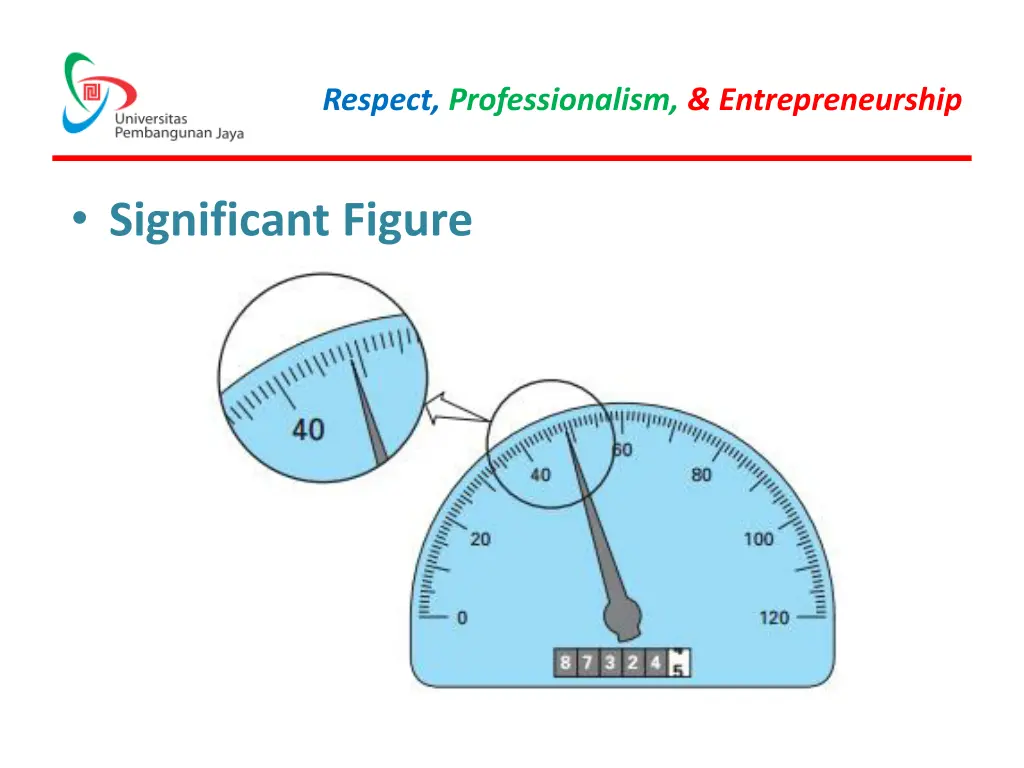
Respect, Professionalism, & Entrepreneurship The significant digits of a number are those that can be used with confidence. They correspond to the number of certain digits plus one estimated digit. For example, the speedometer and the odometer yield readings of three and seven significant figures, respectively. For the speedometer, the two certain digits are 48. It is conventional to set the estimated digit at one-half of the smallest scale division on the measurement device. Thus the speedometer reading would consist of the three significant figures: 48.5. In a similar fashion, the odometer would yield a seven- significant-figure reading of 87,324.45
Respect, Professionalism, & Entrepreneurship The concept of significant figures has two important implications for our study of numerical methods: 1. As introduced in the falling parachutist problem, numerical methods yield approximate results. We must, therefore, develop criteria to specify how confident we are in our approximate result. One way to do this is in terms of significant figures. For example, we might decide that our approximation is acceptable if it is correct to four significant figures. 2. Although quantities such as , e, or 7 represent specific quantities, they cannot be expressed exactly by a limited number of digits. For example, =3.141592653589793238462643... Because computers retain only a finite number of significant figures, such numbers can never be represented exactly. The omission of the remaining significant figures is called round-off error.
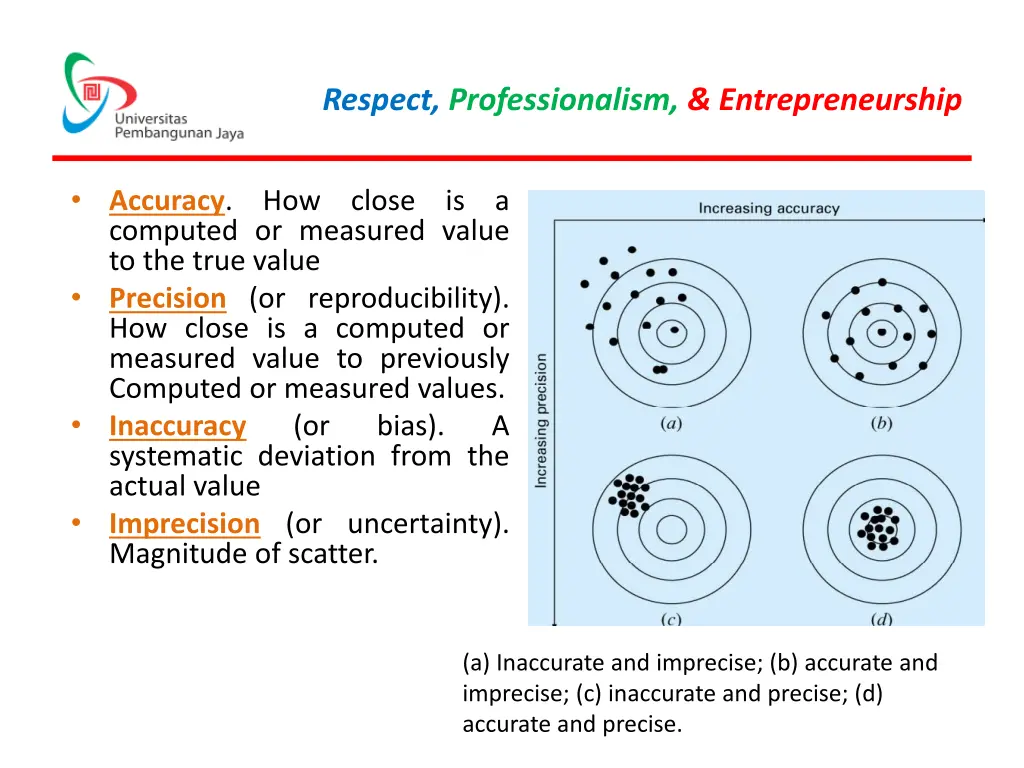
Respect, Professionalism, & Entrepreneurship Accuracy. How close is a computed or measured value to the true value Precision (or reproducibility). How close is a computed or measured value to previously Computed or measured values. Inaccuracy (or systematic deviation from the actual value Imprecision (or uncertainty). Magnitude of scatter. bias). A (a) Inaccurate and imprecise; (b) accurate and imprecise; (c) inaccurate and precise; (d) accurate and precise.
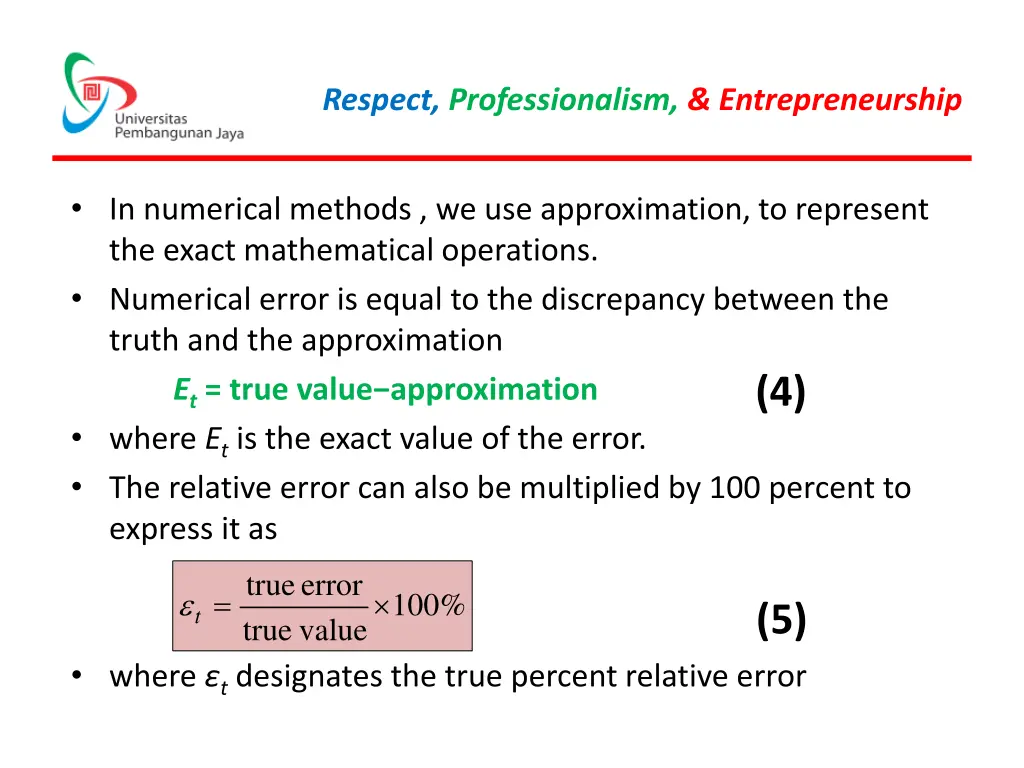
Respect, Professionalism, & Entrepreneurship In numerical methods , we use approximation, to represent the exact mathematical operations. Numerical error is equal to the discrepancy between the truth and the approximation Et= true value approximation where Et is the exact value of the error. The relative error can also be multiplied by 100 percent to express it as (4) true error = 100 % (5) t true value where t designates the true percent relative error
Respect, Professionalism, & Entrepreneurship Example 3 : Suppose that you have the task of measuring the lengths of a bridge and a rivet and come up with 9999 and 9 cm, respectively. If the true values are 10,000 and 10 cm, respectively, compute (a) the true error and (b) the true percent relative error for each case.
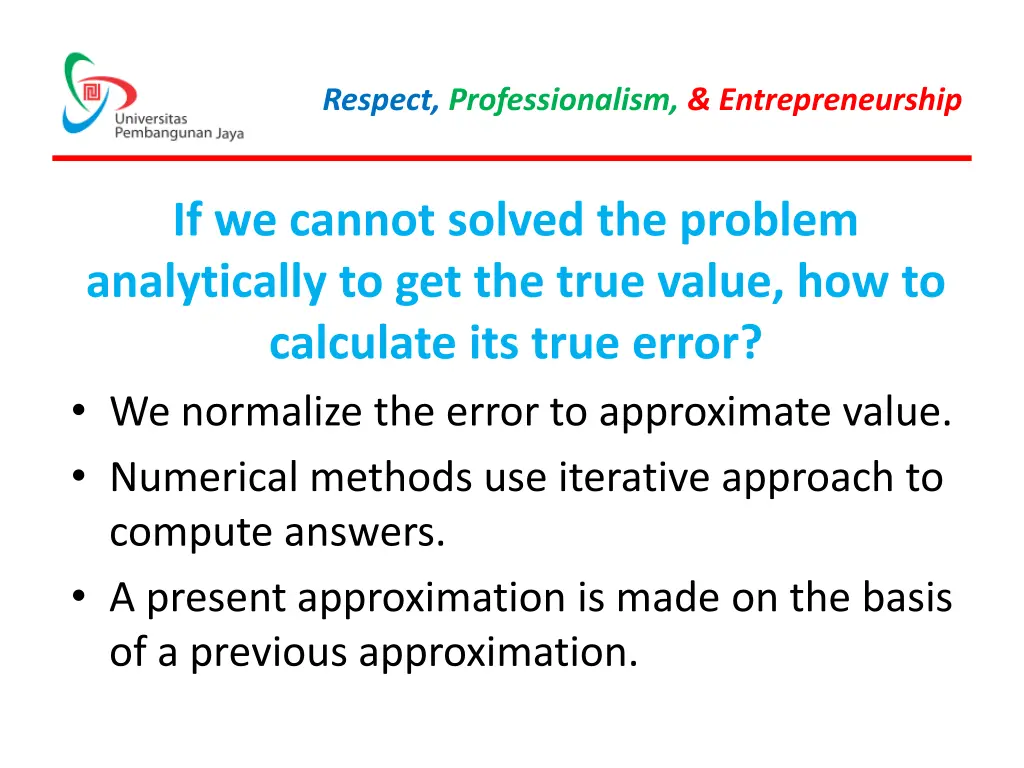
Respect, Professionalism, & Entrepreneurship If we cannot solved the problem analytically to get the true value, how to calculate its true error? We normalize the error to approximate value. Numerical methods use iterative approach to compute answers. A present approximation is made on the basis of a previous approximation.
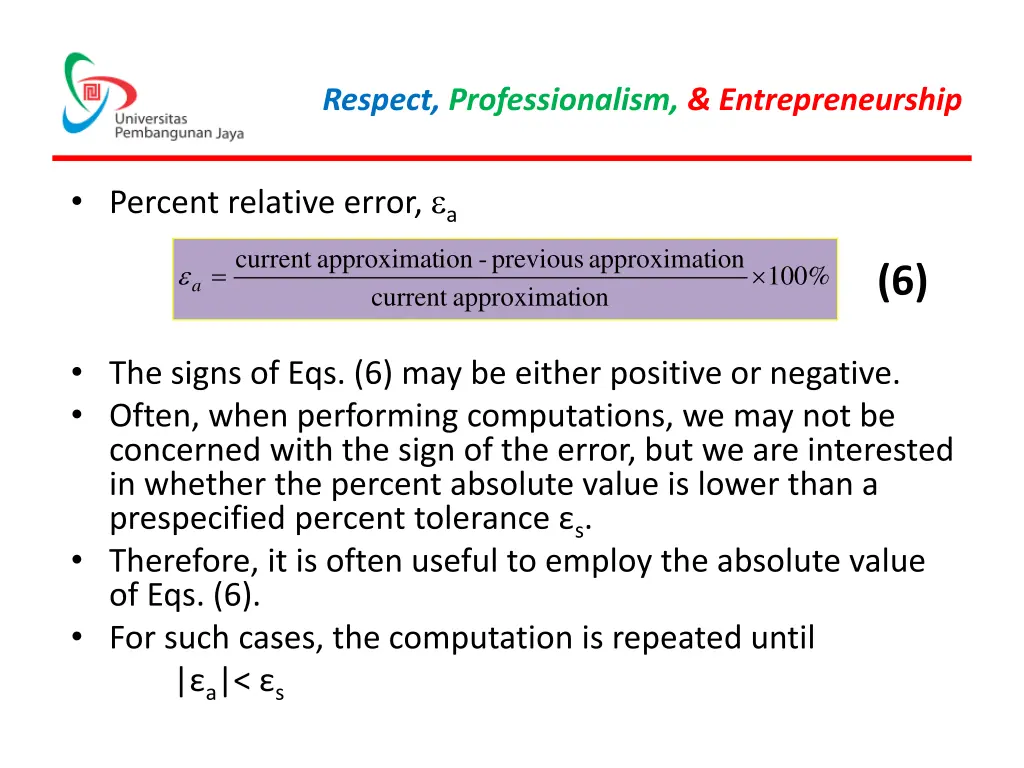
Respect, Professionalism, & Entrepreneurship Percent relative error, a current approximat ion - previous approximat ion = 100 % (6) a current approximat ion The signs of Eqs. (6) may be either positive or negative. Often, when performing computations, we may not be concerned with the sign of the error, but we are interested in whether the percent absolute value is lower than a prespecified percent tolerance s. Therefore, it is often useful to employ the absolute value of Eqs. (6). For such cases, the computation is repeated until | a|< s
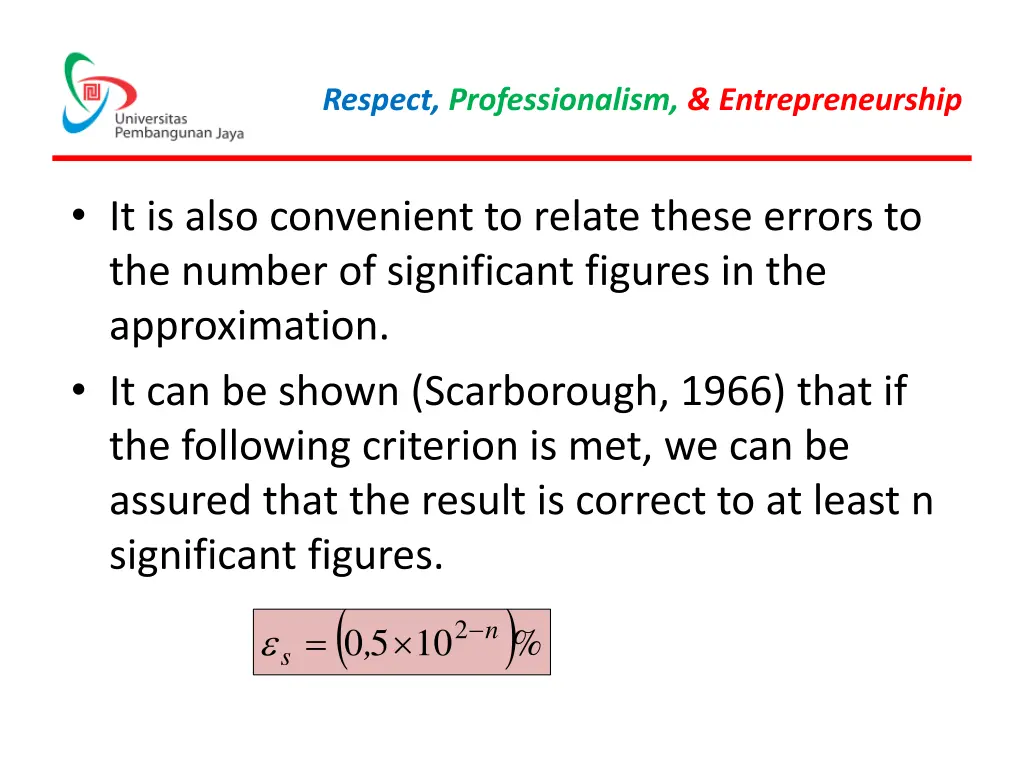
Respect, Professionalism, & Entrepreneurship It is also convenient to relate these errors to the number of significant figures in the approximation. It can be shown (Scarborough, 1966) that if the following criterion is met, we can be assured that the result is correct to at least n significant figures. ( , s = 10 5 0 )% 2 n
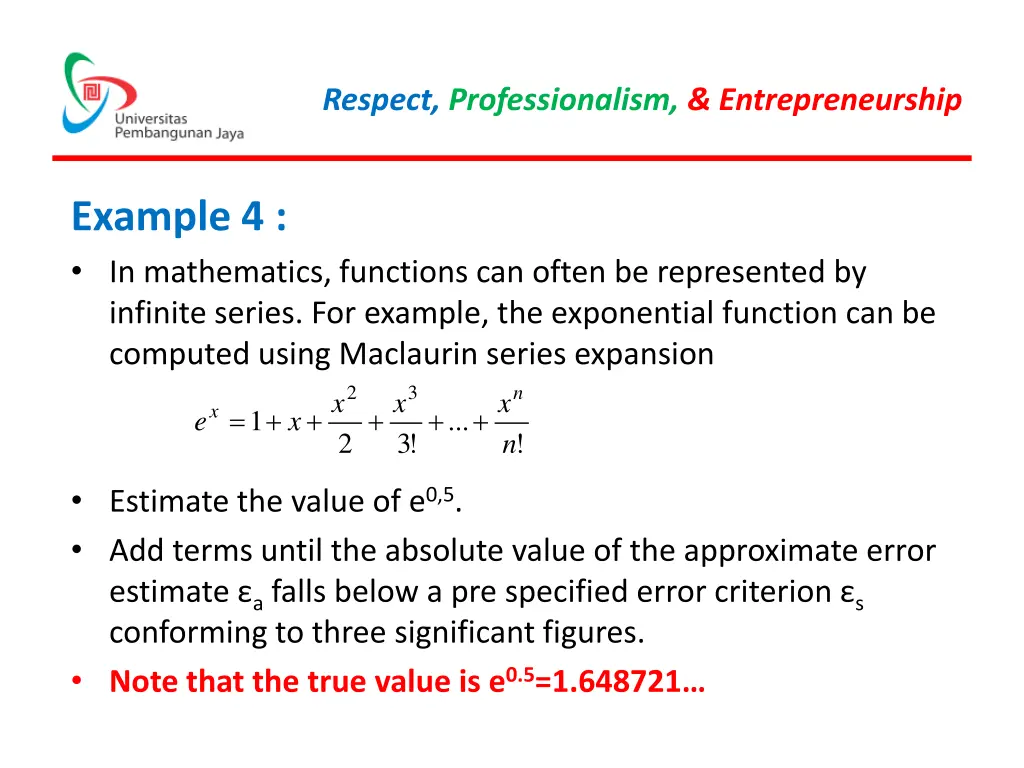
Respect, Professionalism, & Entrepreneurship Example 4 : In mathematics, functions can often be represented by infinite series. For example, the exponential function can be computed using Maclaurin series expansion 3 2 x ... x e + + + + + = n x x x 1 2 ! 3 ! n Estimate the value of e0,5. Add terms until the absolute value of the approximate error estimate a falls below a pre specified error criterion s conforming to three significant figures. Note that the true value is e0.5=1.648721