Ocean Plastics Lesson: What Can I Do?
In Lesson 7 of the Ocean Plastics curriculum for ages 7-11, students learn about the 6Rs - Reduce, Recycle, Reuse, Refuse, Repair, Rethink - and explore ways to address plastic pollution. They discuss the impact of Christmas on the environment and wild animals, examine technological advancements, and collaborate on planning a plastics campaign.

Download Presentation

Please find below an Image/Link to download the presentation.
The content on the website is provided AS IS for your information and personal use only. It may not be sold, licensed, or shared on other websites without obtaining consent from the author.If you encounter any issues during the download, it is possible that the publisher has removed the file from their server.
You are allowed to download the files provided on this website for personal or commercial use, subject to the condition that they are used lawfully. All files are the property of their respective owners.
The content on the website is provided AS IS for your information and personal use only. It may not be sold, licensed, or shared on other websites without obtaining consent from the author.
E N D
Presentation Transcript
ECE 6382 y x 1 2 1 Fall 2023 David R. Jackson Notes 8 Analytic Continuation Notes are adapted from D. R. Wilton, Dept. of ECE 1
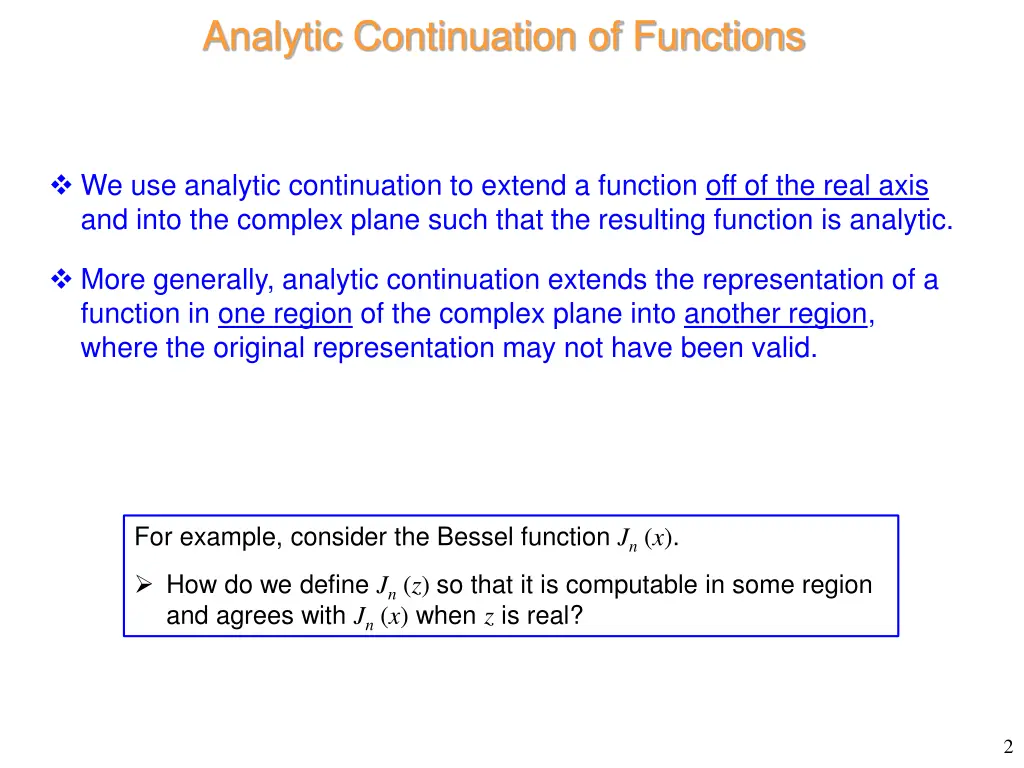
Analytic Continuation of Functions We use analytic continuation to extend a function off of the real axis and into the complex plane such that the resulting function is analytic. More generally, analytic continuation extends the representation of a function in one region of the complex plane into another region, where the original representation may not have been valid. For example, consider the Bessel function Jn (x). How do we define Jn (z) so that it is computable in some region and agrees with Jn (x) when z is real? 2
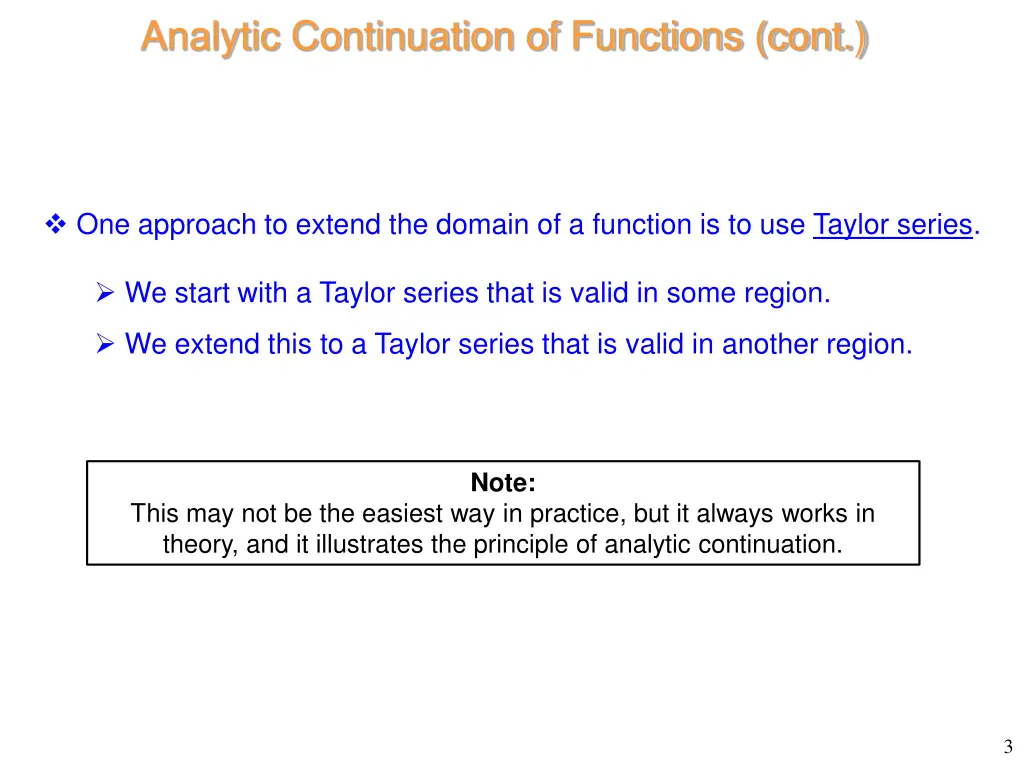
Analytic Continuation of Functions (cont.) One approach to extend the domain of a function is to use Taylor series. We start with a Taylor series that is valid in some region. We extend this to a Taylor series that is valid in another region. Note: This may not be the easiest way in practice, but it always works in theory, and it illustrates the principle of analytic continuation. 3
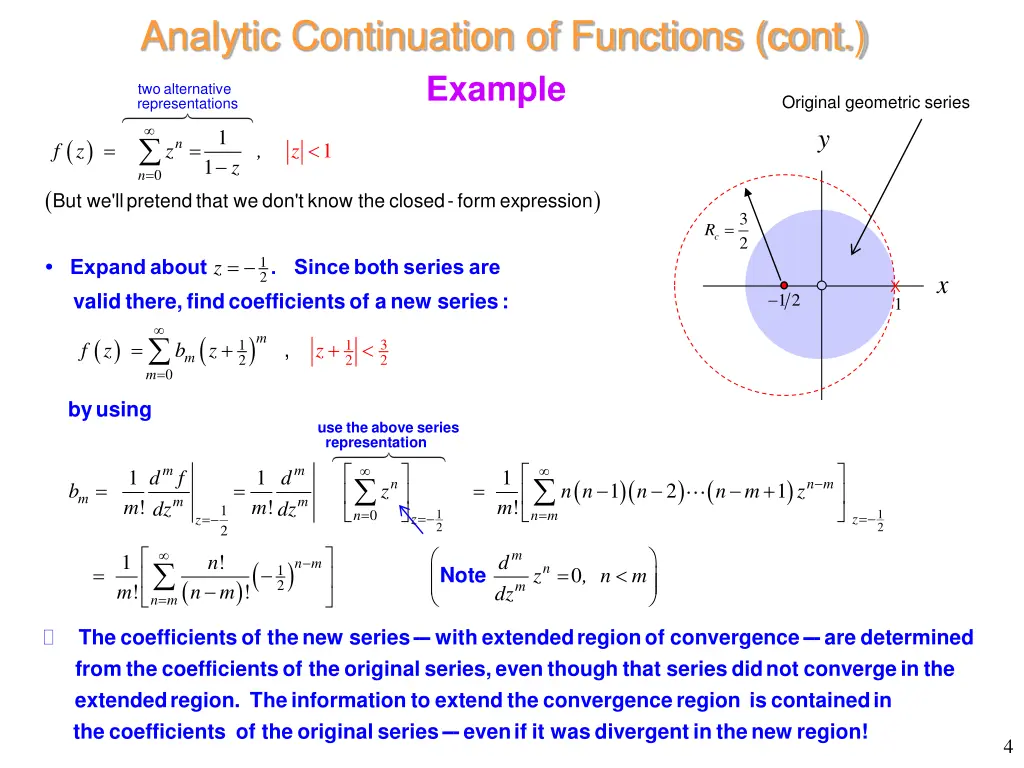
Analytic Continuation of Functions (cont.) Example two alternative representations Original geometric series y 1 ( ) f z n = = 1 z , z 1 z = 0 n ( ) But we'll pretend that we don't know the closed-form expression 3 2 c R = = 1 2 Expand about valid there, find coefficients of a = . Since both series are z x 1 2 new series: 1 ( ) m ( ) f z + + 3 2 1 2 1 2 , b z z m = 0 m by using use the above series representation m m 1 m 1 m 1 m d f dz d dz ( )( ) ( ) n m n = = = n m + 1 2 1 b z n n n z m m m ! ! ! 1 2 = n m = 0 1 2 1 2 n = = = z z z m mz 1 m ! n d dz )( ! ) n m n = = 1 2 Note 0 , n m ( ! n m n m = The coefficients of the new series---with extended region of convergence---are determined from the coefficients of the original series, even though that series did not converge in the extended region. The information to extend the convergence region is contained in the coefficients of the original series---even if it was divergent in the new region! 4
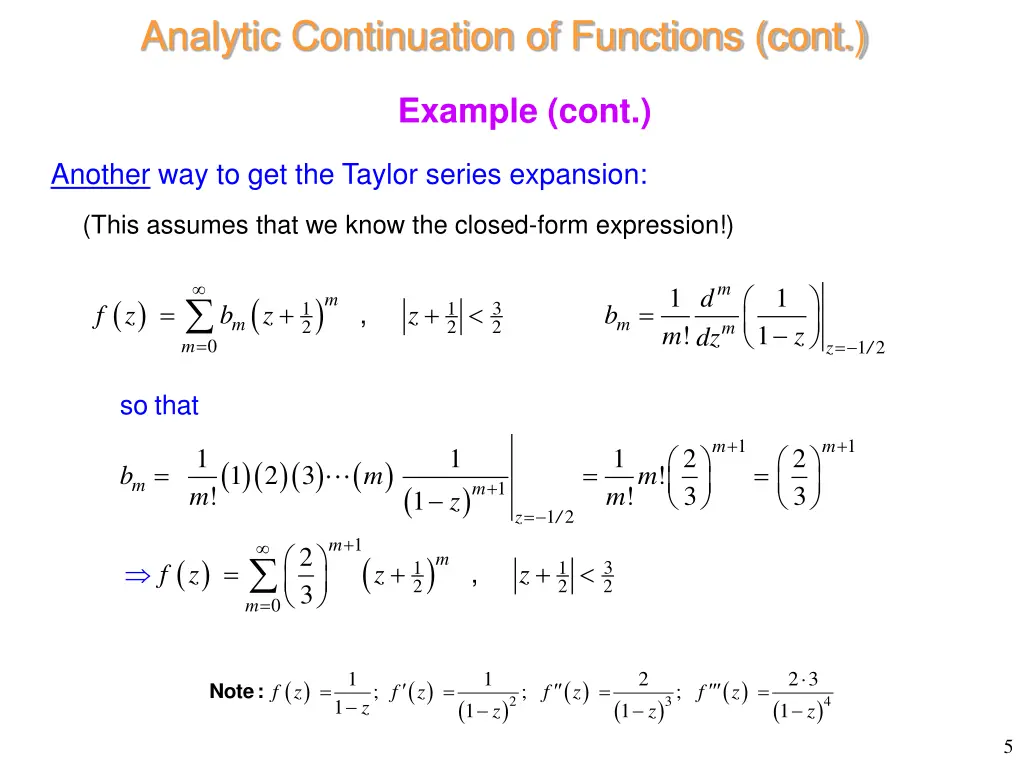
Analytic Continuation of Functions (cont.) Example (cont.) Another way to get the Taylor series expansion: (This assumes that we know the closed-form expression!) m 1 m 1 d dz ( ) m ( ) f z = + + = 3 2 1 2 1 2 , b z z b m m m ! 1 z = = 0 m 1 2 / z so tha t + + 1 1 m m 1 m 1 z 1 m 2 3 2 3 ( )( )( ) 1 2 3 ( ) m = = = ! b m m + ( ) 1 m ! ! 1 = 1 2 / z + 1 m 2 3 ( ) m ( ) f z = + + 3 2 1 2 1 2 , z z = 0 m 1 1 2 2 3 1 ( ) f z ( ) z ( ) z ( ) z = = = = Note: ; ; ; f f f ( ) ( ) ( ) 2 3 4 1 z 1 1 z z z 5
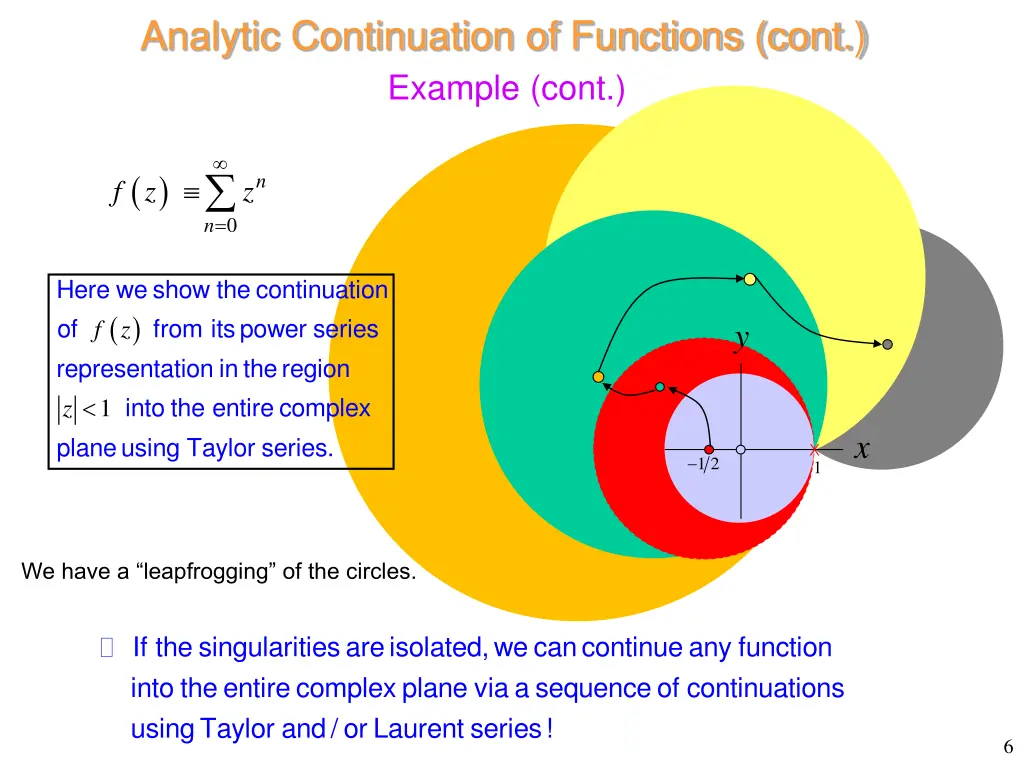
Analytic Continuation of Functions (cont.) Example (cont.) ( ) f z n z = 0 n Here we show the continuation of from its power series representation in the region into the entire complex ( ) f z y z plane using Taylor series. 1 x 1 2 1 We have a leapfrogging of the circles. If the singularities are isolated, we can continue any function into the entire complex plane via a sequence of continuations using Taylor and/or Laurent series ! 6
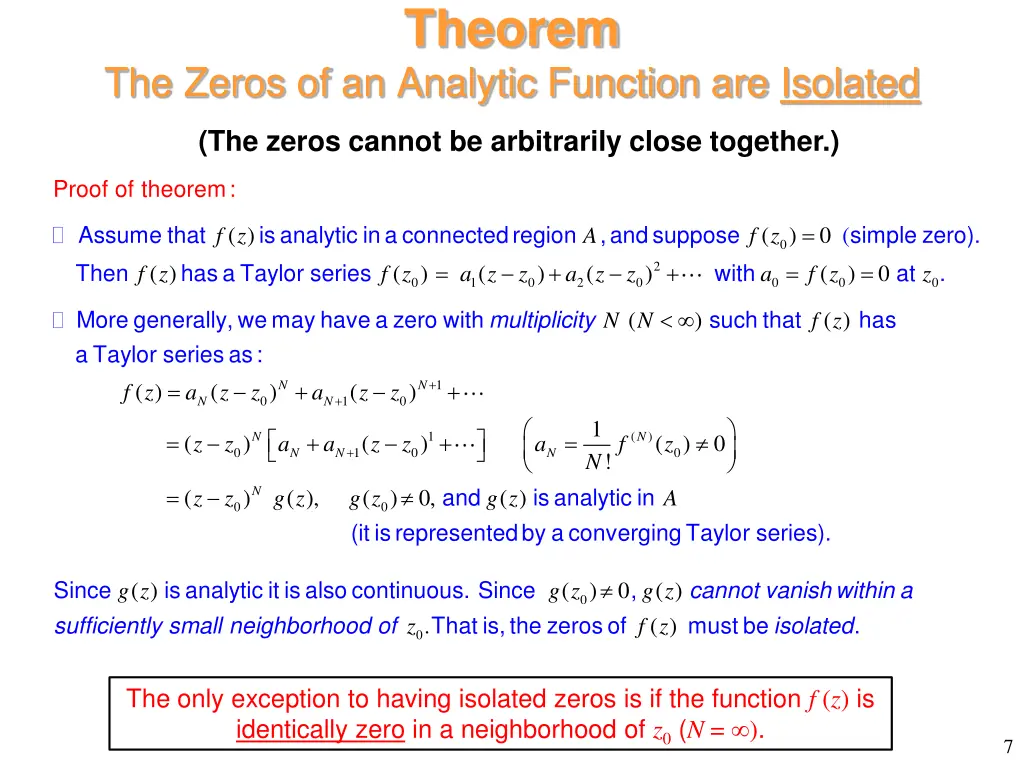
Theorem The Zeros of an Analytic Function are Isolated (The zeros cannot be arbitrarily close together.) Proof of theorem: = Assume that Then is analytic in a connected region , and suppose has a Taylor series simple zero). at . ( ) f z ( ) f z 0 ( A 0 = + + = = 2 with ( ) f z ( ) f z ( ) ( ) ( ) f z 0 a z z a z z a z 0 1 0 2 0 0 0 0 More generally a Taylor series as: , we may have a zero with multiplicity such that has ( ) ( ) f z N N + = + + 1 N N ( ) f z ( ) ( ) a z z a z z + 0 1 0 N N 1 N = + + = 1 ( ) N N ( ) ( ) ( ) z 0 z z a a z z a f + 0 1 0 0 N N N ! = N and is analy tic in ( ) ( ), g z ( ) g z (it is represented by a converging Taylor series). 0, ( ) g z z z A 0 0 Since sufficiently small neighborhood of is analytic it is also continuous. Since , cannot vanish within a must be isolated ( ) g z ( ) g z 0 ( ) g z ( ) f z 0 os of That is, the zer . . z 0 The only exception to having isolated zeros is if the function f (z) is identically zero in a neighborhood of z0 (N = ). 7
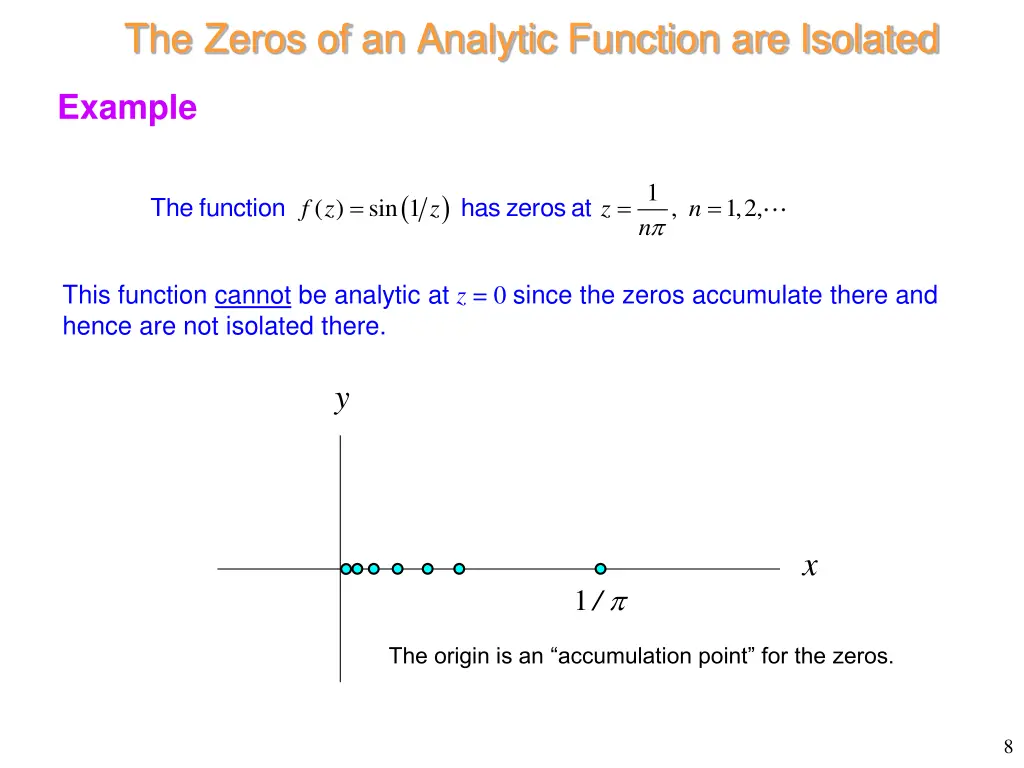
The Zeros of an Analytic Function are Isolated Example 1 ( ) = = = The function has zeros at ( ) f z sin 1 , 1,2, z z n n This function cannot be analytic at z = 0 since the zeros accumulate there and hence are not isolated there. y x 1/ The origin is an accumulation point for the zeros. 8
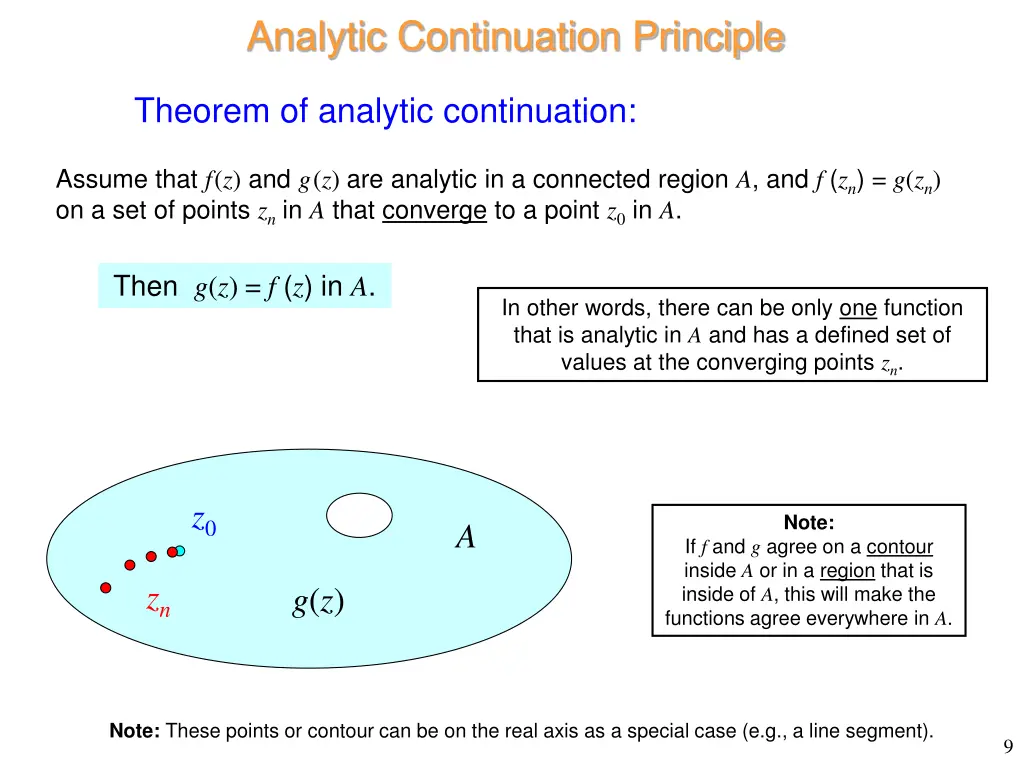
Analytic Continuation Principle Theorem of analytic continuation: Assume that f(z) and g(z) are analytic in a connected region A, and f (zn) = g(zn) on a set of points znin A that converge to a point z0 in A. Then g(z) = f (z) in A. In other words, there can be only one function that is analytic in A and has a defined set of values at the converging points zn. z0 Note: A If f and g agree on a contour inside A or in a region that is inside of A, this will make the functions agree everywhere in A. zn g(z) Note: These points or contour can be on the real axis as a special case (e.g., a line segment). 9
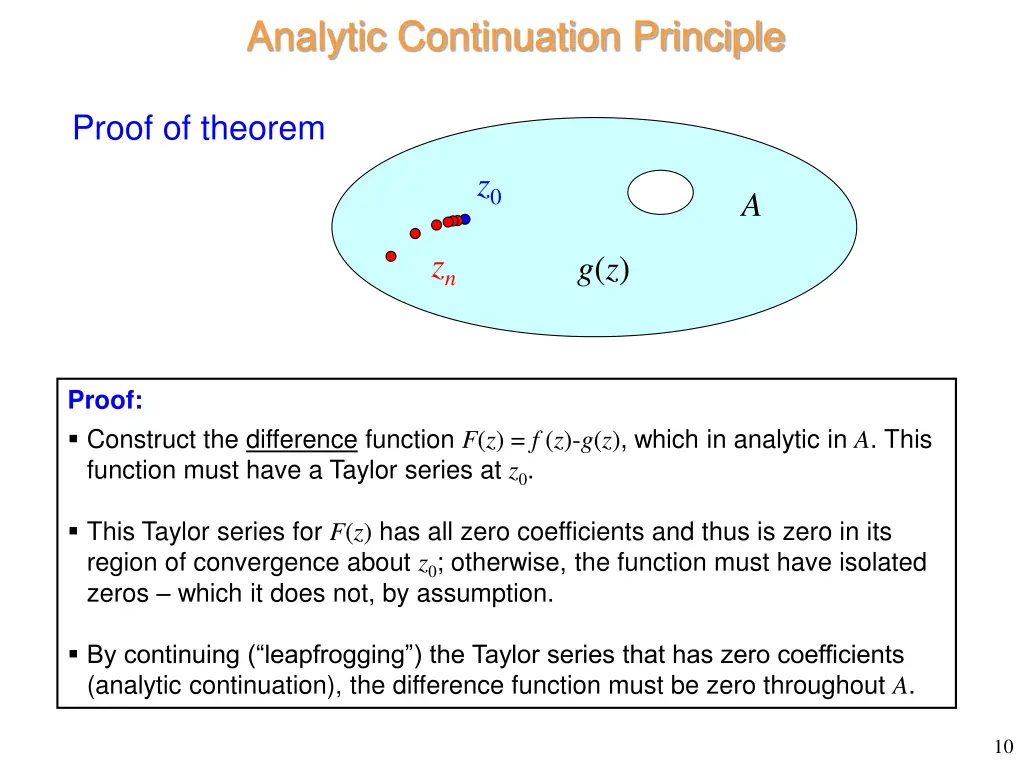
Analytic Continuation Principle Proof of theorem z0 A zn g(z) Proof: Construct the difference function F(z) = f (z)-g(z),which in analytic in A. This function must have a Taylor series at z0. This Taylor series for F(z) has all zero coefficients and thus is zero in its region of convergence about z0; otherwise, the function must have isolated zeros which it does not, by assumption. By continuing ( leapfrogging ) the Taylor series that has zero coefficients (analytic continuation), the difference function must be zero throughout A. 10
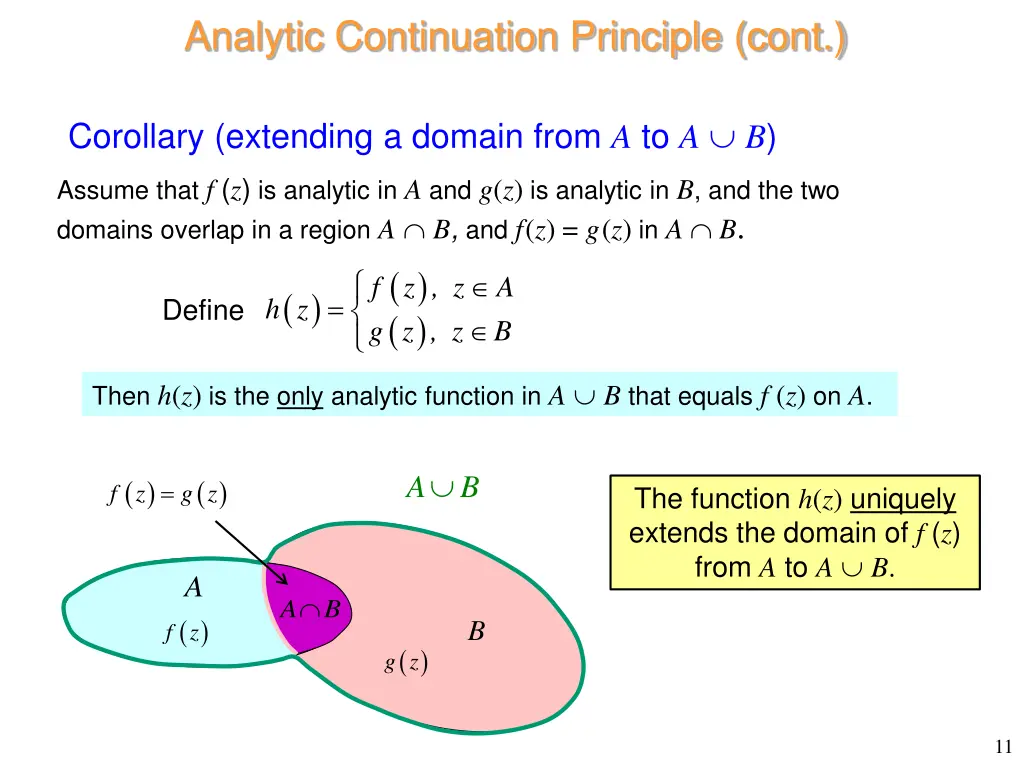
Analytic Continuation Principle (cont.) Corollary (extending a domain from A to A B) Assume that f (z) is analytic in A and g(z) is analytic in B, and the two domains overlap in a region A B, and f(z) = g(z) in A B. ( ) ( ) g z , z f z , z A B ( ) h z = Define Then h(z) is the only analytic function in A B that equals f(z) on A. A B ( ) f z ( ) = g z The function h(z) uniquely extends the domain of f (z) from A to A B. A ( ) f z A B B ( ) g z 11
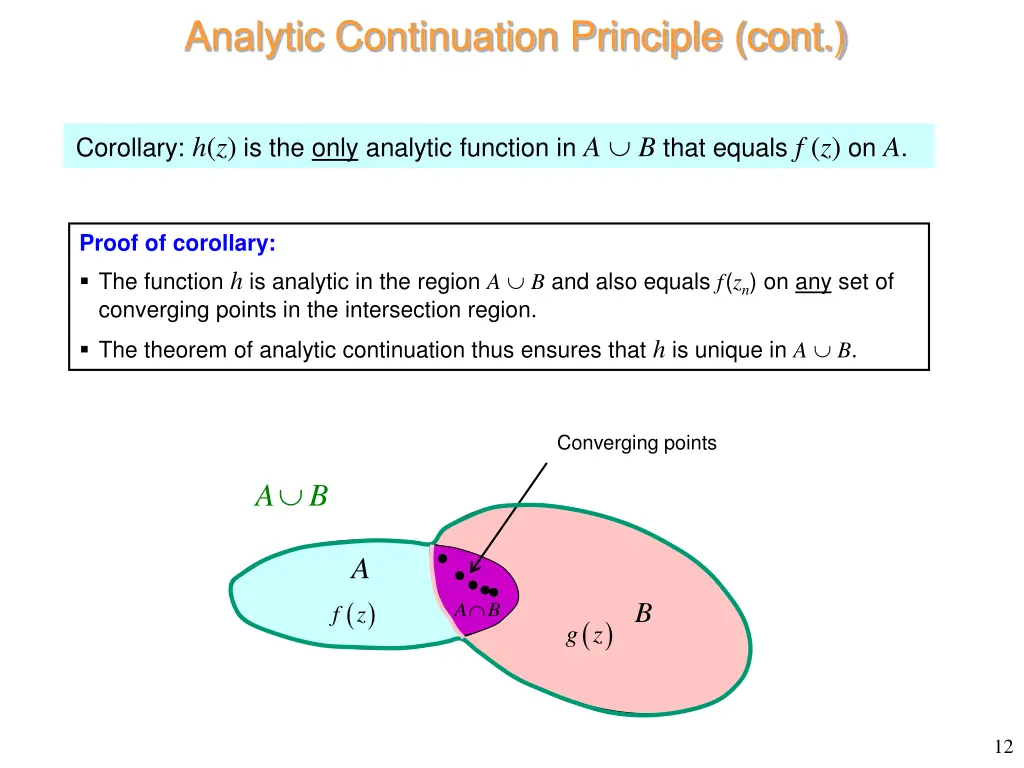
Analytic Continuation Principle (cont.) Corollary: h(z) is the only analytic function in A B that equals f(z) on A. Proof of corollary: The function h is analytic in the region A B and also equals f(zn) on any set of converging points in the intersection region. The theorem of analytic continuation thus ensures that h is unique in A B. Converging points A B A ( ) f z B A B ( ) g z 12
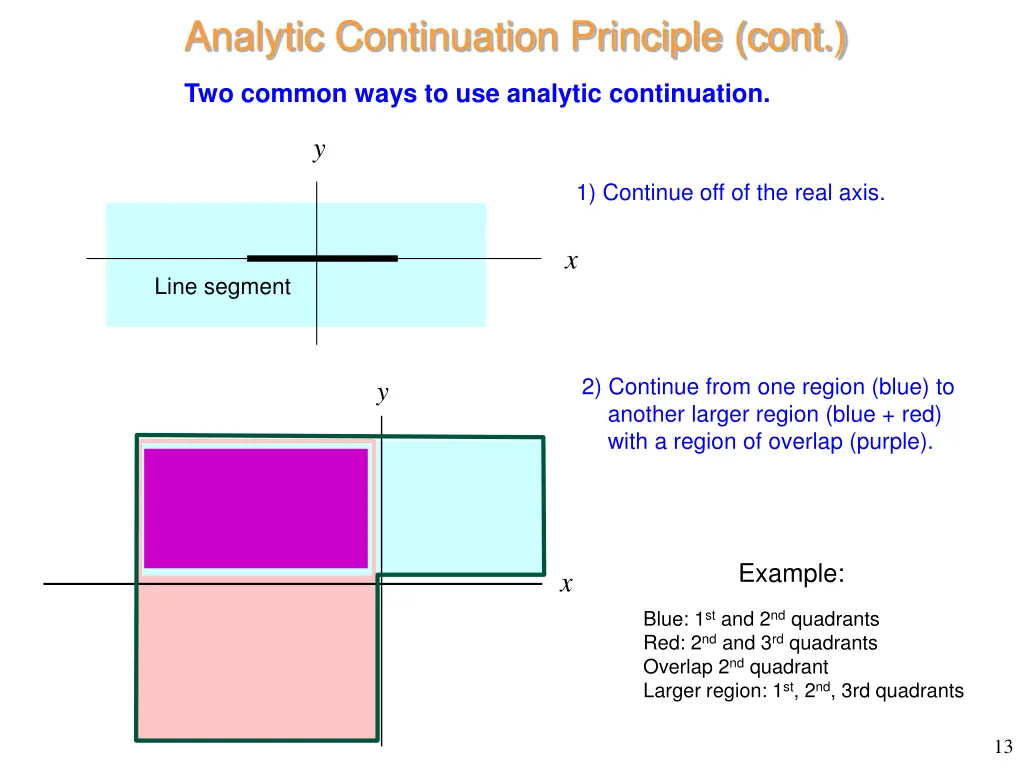
Analytic Continuation Principle (cont.) Two common ways to use analytic continuation. y 1) Continue off of the real axis. x Line segment 2) Continue from one region (blue) to another larger region (blue + red) with a region of overlap (purple). y Example: x Blue: 1st and 2nd quadrants Red: 2nd and 3rd quadrants Overlap 2nd quadrant Larger region: 1st, 2nd, 3rd quadrants 13
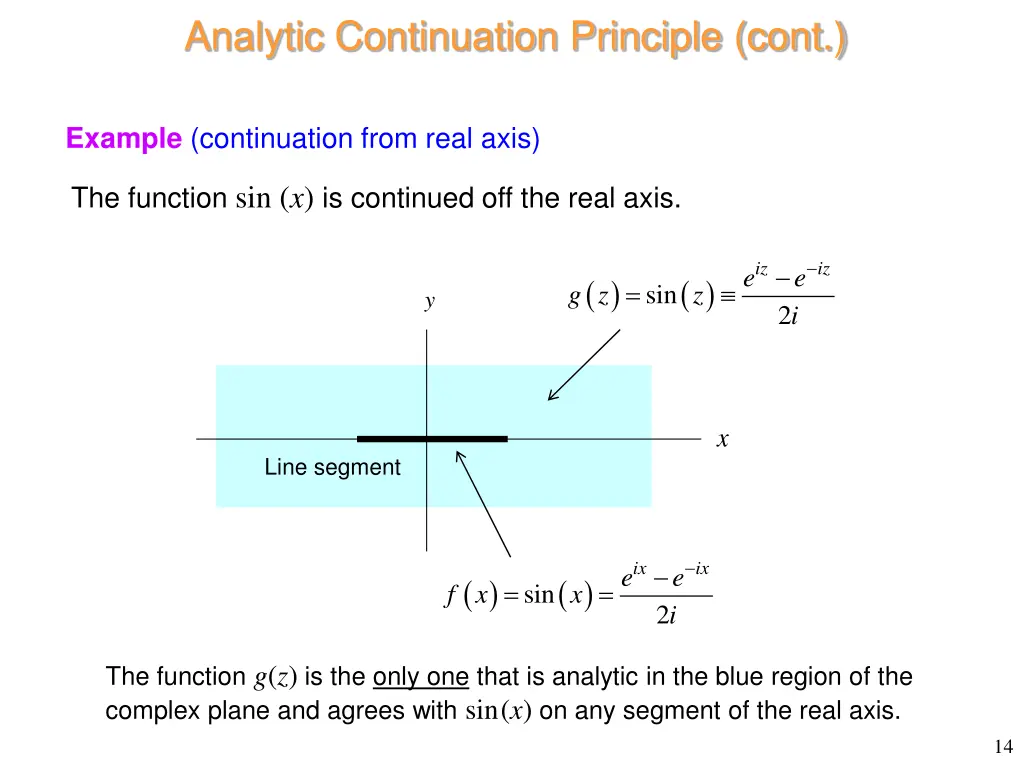
Analytic Continuation Principle (cont.) Example (continuation from real axis) The function sin (x) is continued off the real axis. iz iz e e i ( ) ( ) z = sin g z y 2 x Line segment ix ix e e i ( ) f x ( ) x = = sin 2 The function g(z) is the only one that is analytic in the blue region of the complex plane and agrees with sin(x) on any segment of the real axis. 14
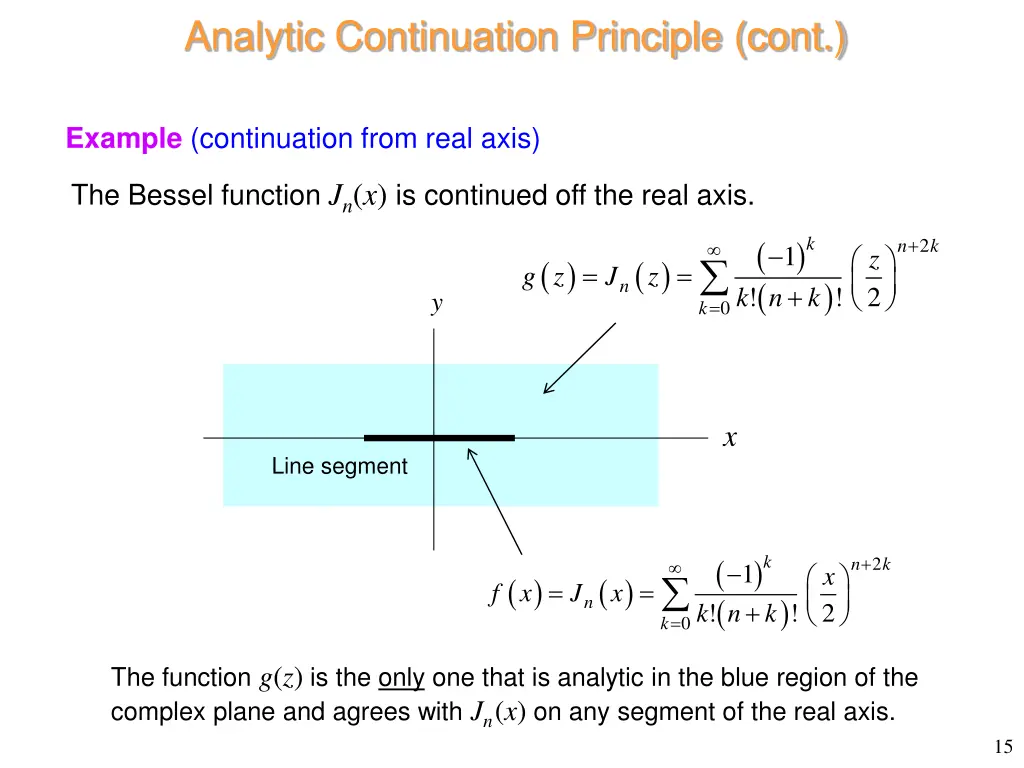
Analytic Continuation Principle (cont.) Example (continuation from real axis) The Bessel function Jn(x) is continued off the real axis. ( ( ) k + 2 n k 1 + z ( ) ( ) z = = g z J ) n ! ! 2 k n k y = 0 k x Line segment ( ( ) k + 2 n k 1 + x ( ) f x ( ) x = = J ) n ! ! 2 k n k = 0 k The function g(z) is the only one that is analytic in the blue region of the complex plane and agrees with Jn(x) on any segment of the real axis. 15
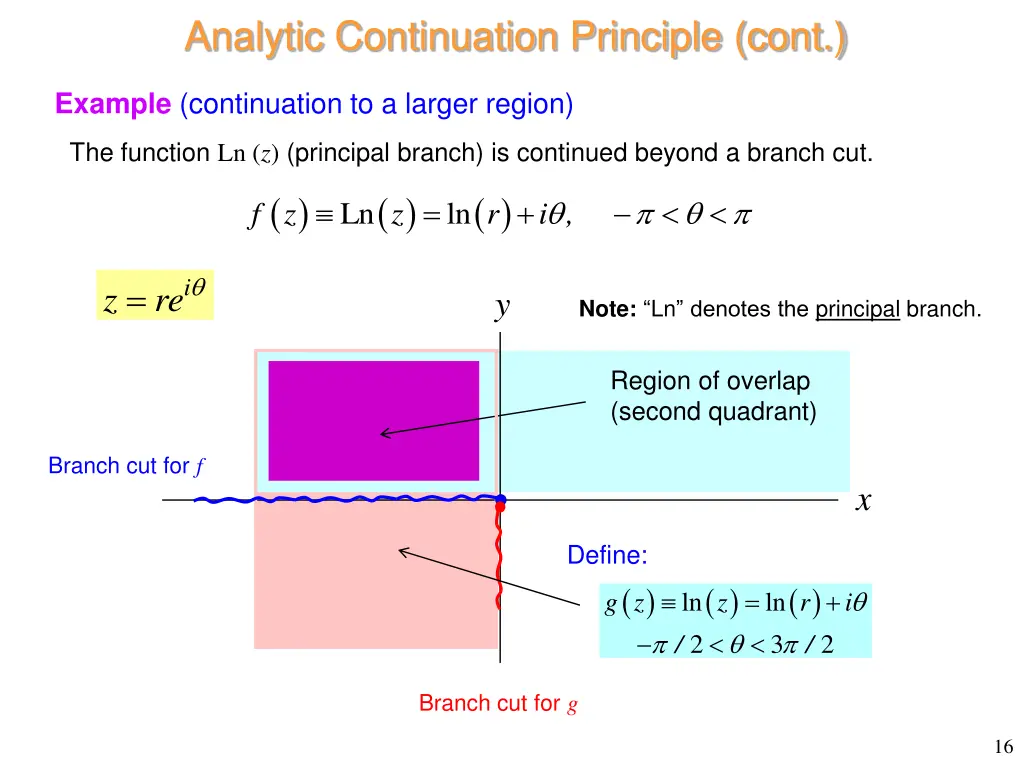
Analytic Continuation Principle (cont.) Example (continuation to a larger region) The function Ln (z) (principal branch) is continued beyond a branch cut. ( ) f z ( ) z ( ) r = + i , Ln ln re i = z y Note: Ln denotes the principal branch. Region of overlap (second quadrant) Branch cut for f x Define: ( ) ( ) z ( ) r = + ln 2 / ln 3 g z i 2 / Branch cut for g 16
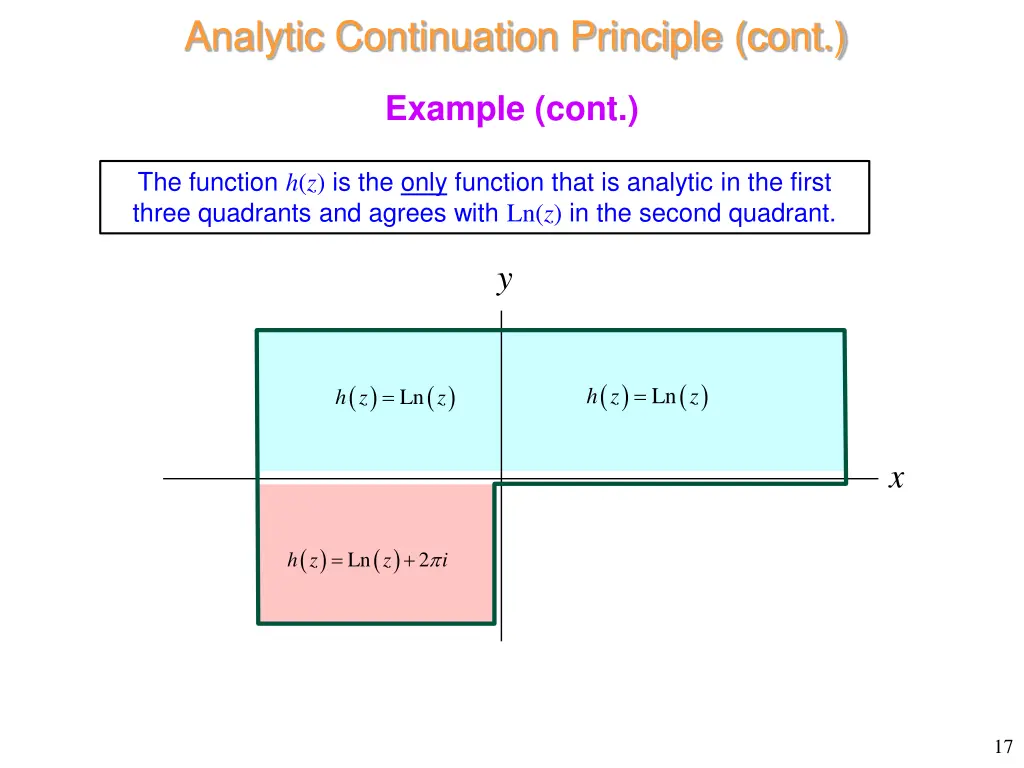
Analytic Continuation Principle (cont.) Example (cont.) The function h(z) is the only function that is analytic in the first three quadrants and agrees with Ln(z) in the second quadrant. y ( ) h z ( ) z ( ) h z ( ) z = = Ln Ln x ( ) h z ( ) z = + Ln 2 i 17
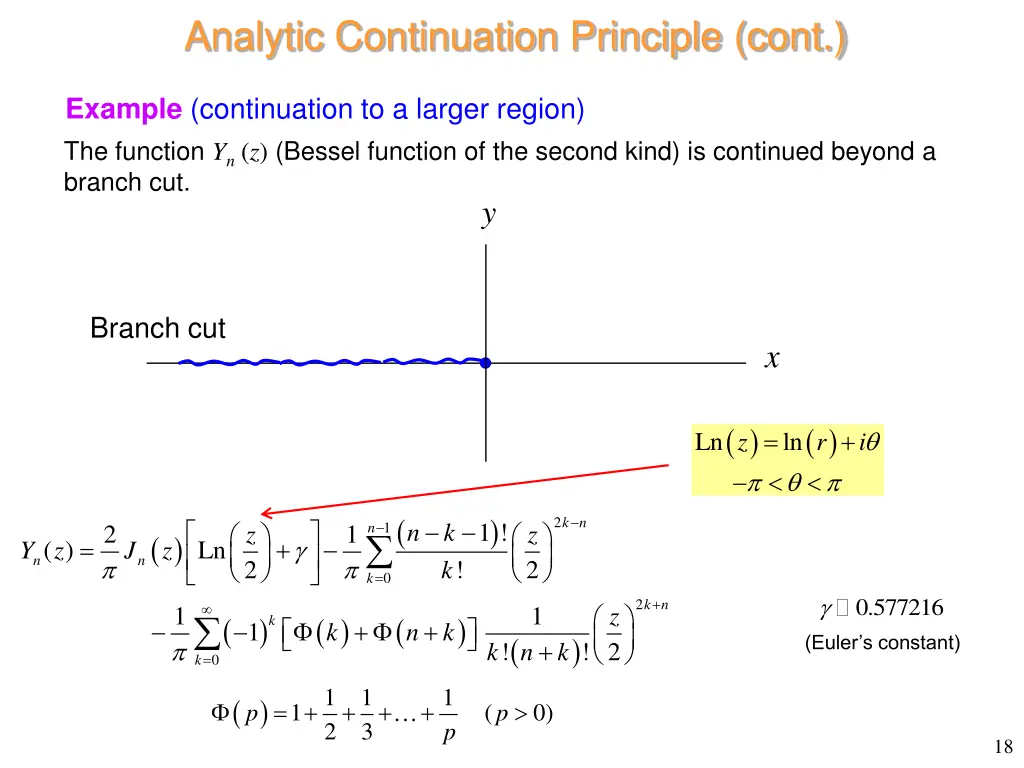
Analytic Continuation Principle (cont.) Example (continuation to a larger region) The function Yn (z) (Bessel function of the second kind) is continued beyond a branch cut. y Branch cut x ( ) z ( ) r = + i Ln ln ( ) k n 2 1 ! n k k 1 n 2 1 z z ( ) z = + ( ) Ln Y z J n n 2 ! 2 = 0 k 0.577216 k n + 2 1 1 z ( ) ( ) k ( ) k + + 1 n k ( ) (Euler s constant) + ! ! 2 k n k = 0 k 1 2 1 3 1 p ( ) p = + + + + 1 ( 0) p 18
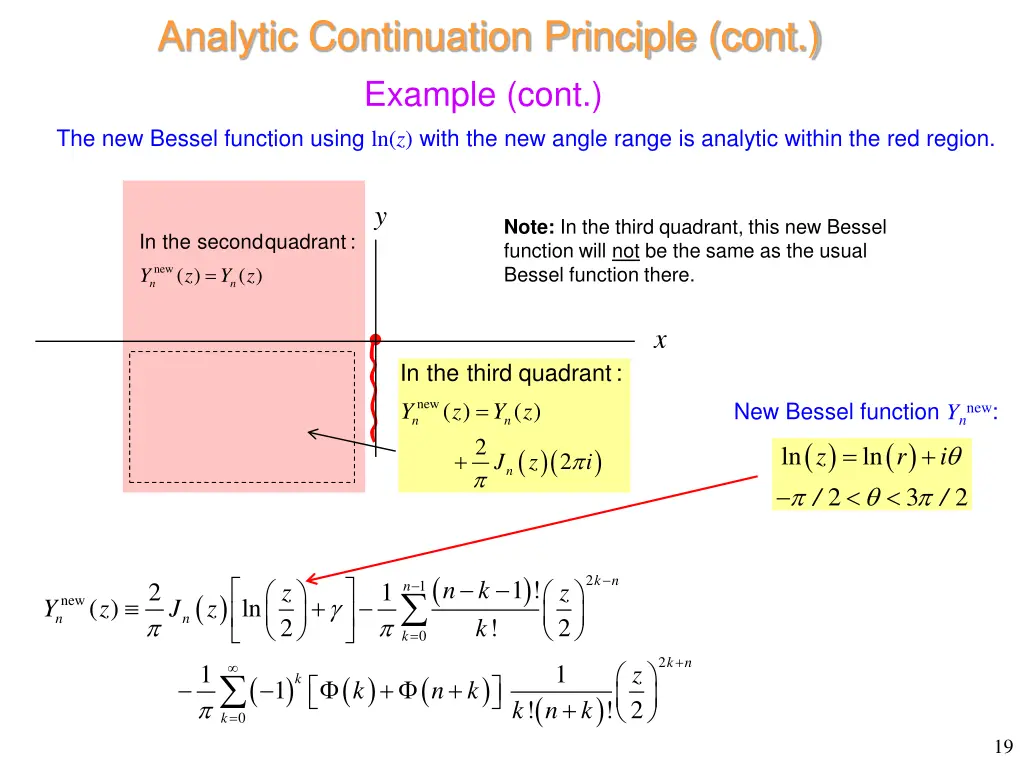
Analytic Continuation Principle (cont.) Example (cont.) The new Bessel function using ln(z) with the new angle range is analytic within the red region. y Note: In the third quadrant, this new Bessel function will not be the same as the usual Bessel function there. In the secondquadrant: = new( ) n Y ( ) z Y z n x In the third quadrant: = new( ) n Y ( ) z Y z New Bessel function Ynnew: n ( ) z / ( ) r 2 = + ( )( z ) ln ln i / + 2 J i n 2 3 2 ( ) k n 2 n k 1 ! 2 1 1 n z z ( ) z + new n Y ( ) z ln J n 2 ! 2 k = 0 k k n + 2 1 1 z ( ) ( ) k ( ) k + + 1 n k ( ) + ! ! 2 k n k = 0 k 19
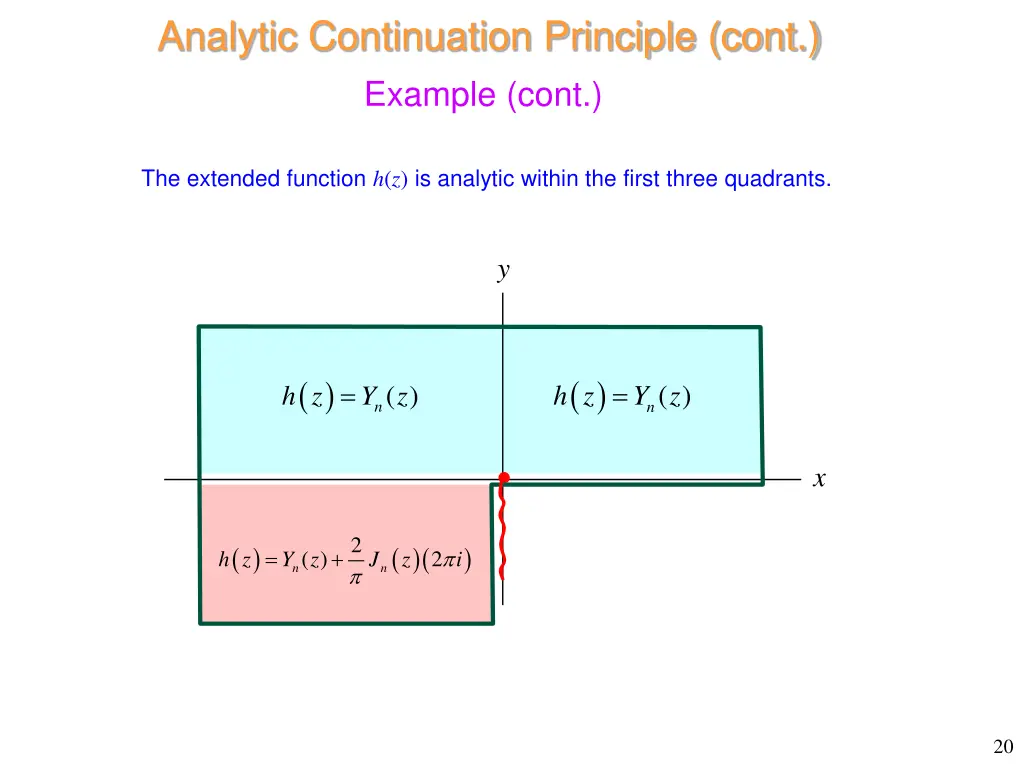
Analytic Continuation Principle (cont.) Example (cont.) The extended function h(z) is analytic within the first three quadrants. y ( ) h z ( ) h z = = ( ) Y z ( ) Y z n n x 2 ( ) h z ( )( z ) = + ( ) 2 Y z J i n n 20
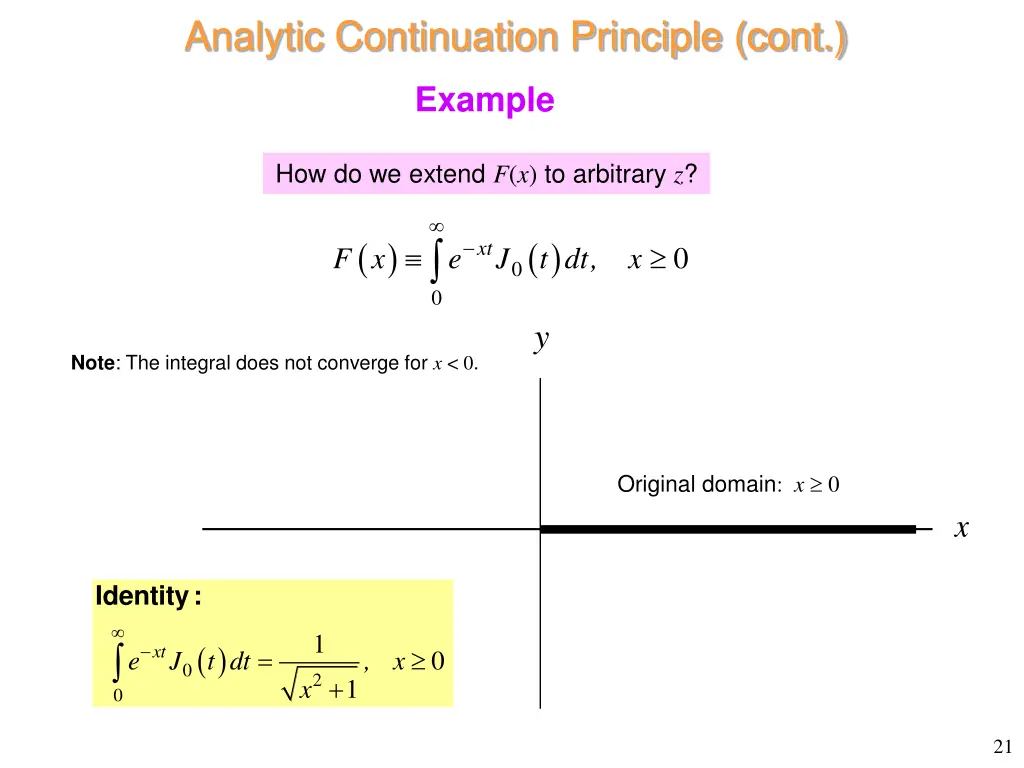
Analytic Continuation Principle (cont.) Example How do we extend F(x) to arbitrary z? ( ) ( ) t dt, xt 0 F x e J x 0 0 y Note: The integral does not converge for x < 0. Original domain: x 0 x Identity: 1 ( ) t dt xt = 0 e J , x 0 2 + 1 x 0 21
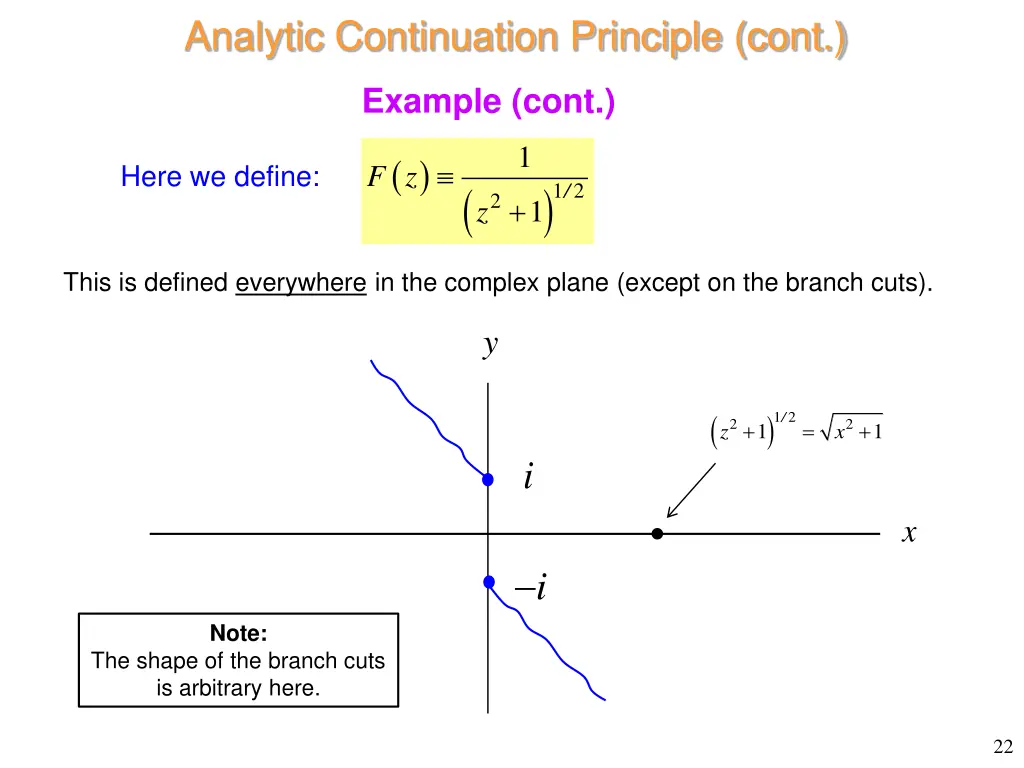
Analytic Continuation Principle (cont.) Example (cont.) 1 ( ) F z Here we define: ( ) 1 2 / 2 + 1 z This is defined everywhere in the complex plane (except on the branch cuts). y ( ) 1 2 / 2 2 + = + 1 1 z x i x i Note: The shape of the branch cuts is arbitrary here. 22
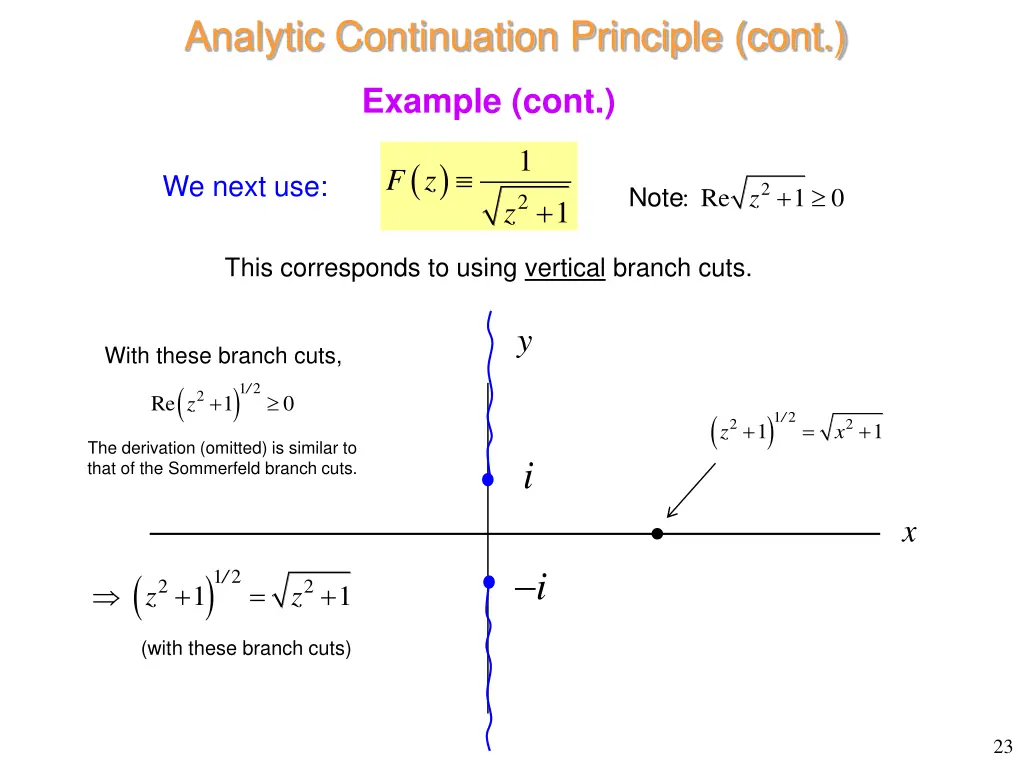
Analytic Continuation Principle (cont.) Example (cont.) 1 ( ) F z We next use: 2 z + Note : Re 1 0 2 + 1 z This corresponds to using vertical branch cuts. y With these branch cuts, ( Re 1 ) 1 2 / 2 z + 0 ( ) 1 2 / 2 2 + = + 1 1 z x The derivation (omitted) is similar to that of the Sommerfeld branch cuts. i x i ( ) 1 2 / 2 2 + = + 1 1 z z (with these branch cuts) 23
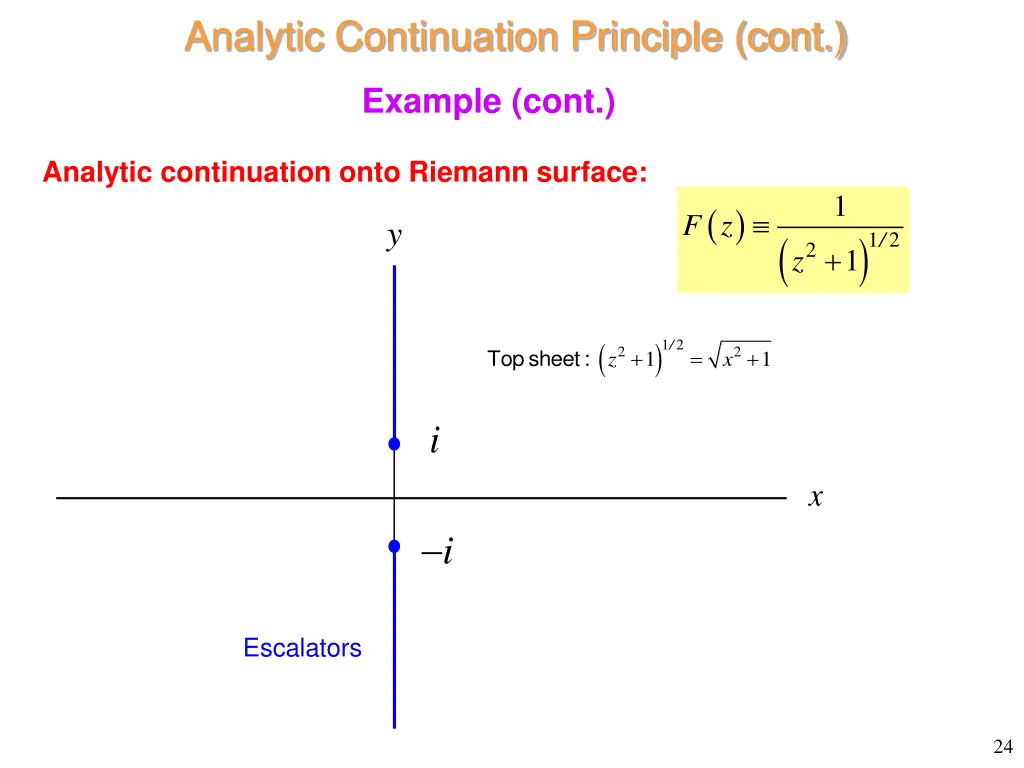
Analytic Continuation Principle (cont.) Example (cont.) Analytic continuation onto Riemann surface: 1 ( ) F z y ( ) 1 2 / 2 + 1 z ( ) 1 2 / 2 2 + = + Top sheet: 1 1 z x i x i Escalators 24
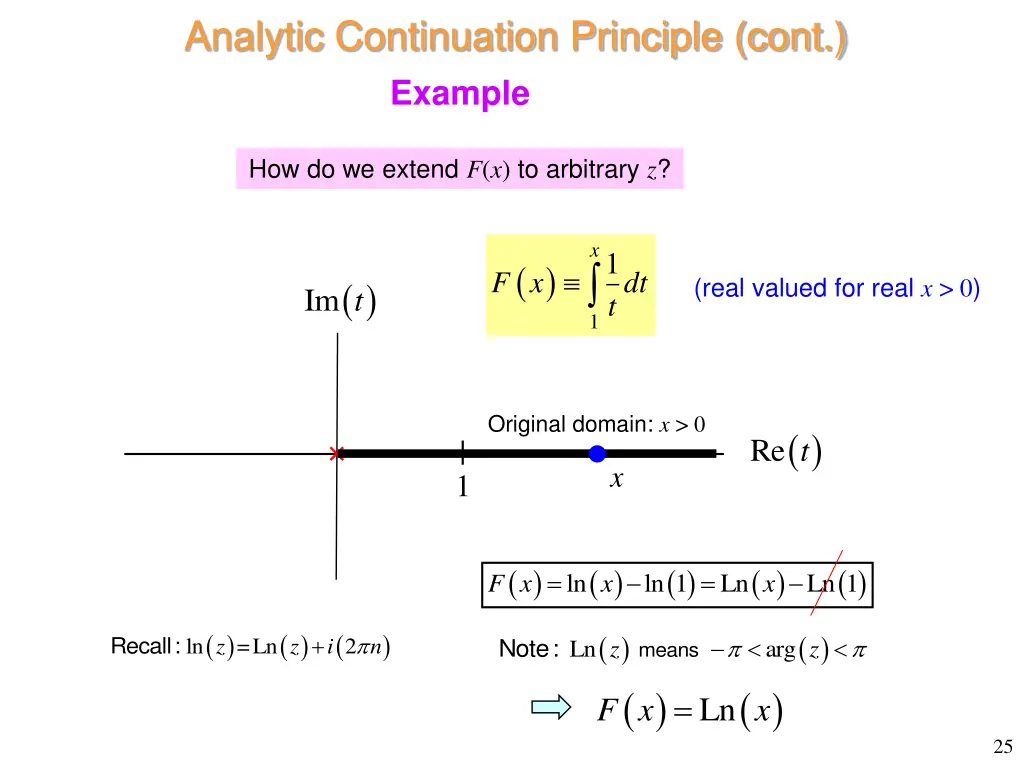
Analytic Continuation Principle (cont.) Example How do we extend F(x) to arbitrary z? x 1 t ( ) F x dt ( ) (real valued for real x > 0) Im t 1 Original domain: x > 0 ( ) Re t x 1 ( ) ( ) x ( ) ( ) x ( ) = = ln ln 1 Ln Ln 1 F x ( ) z ( ) z ( ) ( ) z ( ) z + Recall: ln =Ln 2 i n Note: Ln arg means ( ) F x ( ) x = Ln 25
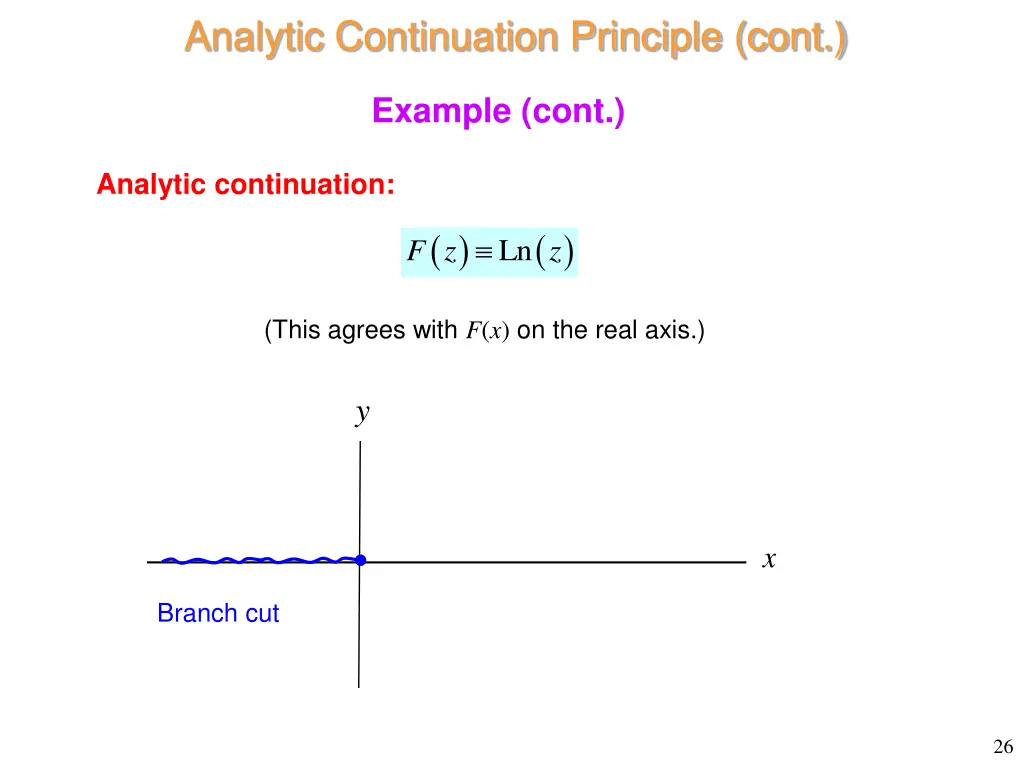
Analytic Continuation Principle (cont.) Example (cont.) Analytic continuation: ( ) ( ) z Ln F z (This agrees with F(x) on the real axis.) y x Branch cut 26
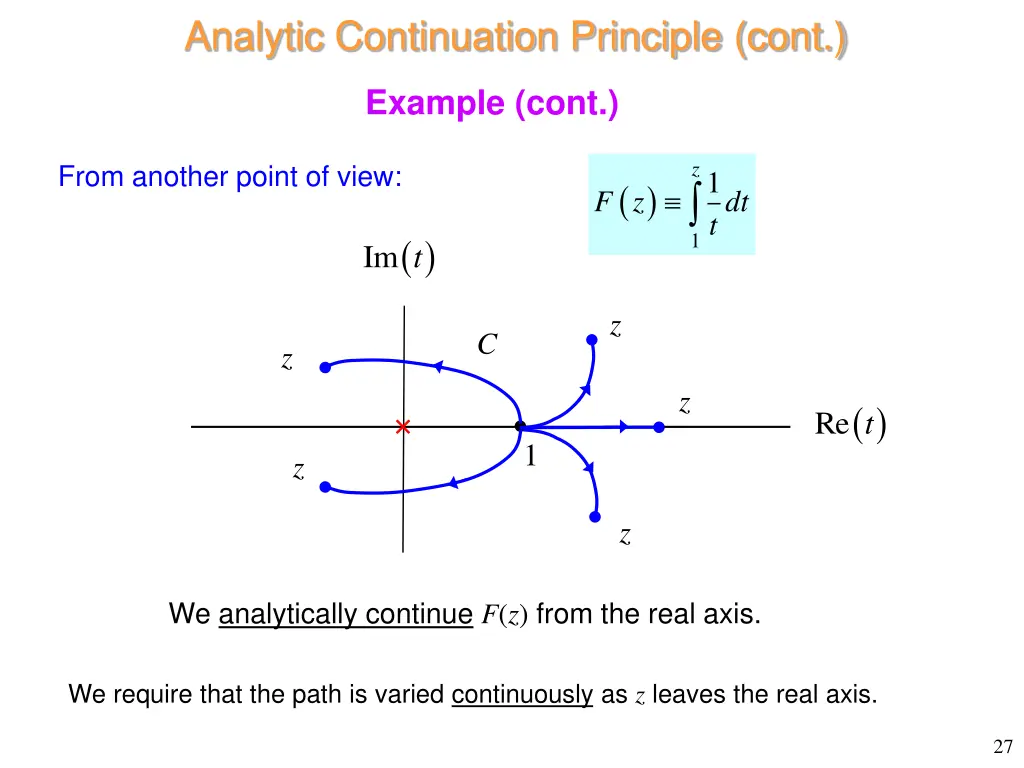
Analytic Continuation Principle (cont.) Example (cont.) z From another point of view: 1 t ( ) F z dt ( ) 1 Im t z C z z ( ) Re t 1 z z We analytically continue F(z) from the real axis. We require that the path is varied continuously as z leaves the real axis. 27
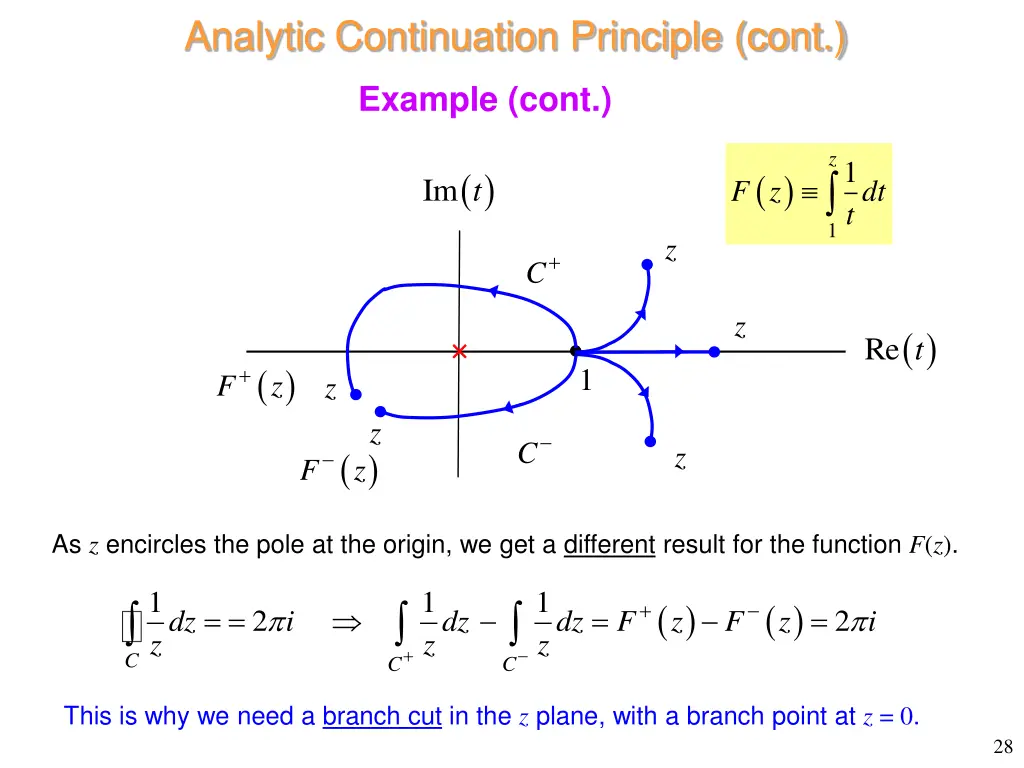
Analytic Continuation Principle (cont.) Example (cont.) z 1 t ( ) ( ) Im t F z dt 1 z C+ z ( ) Re t ( ) z + 1 F z z C z ( ) z F As z encircles the pole at the origin, we get a different result for the function F(z). 1 z 1 z 1 z ( ) z ( ) z + = = = = 2 2 dz i dz dz F F i + C C C This is why we need a branch cut in the z plane, with a branch point at z = 0. 28
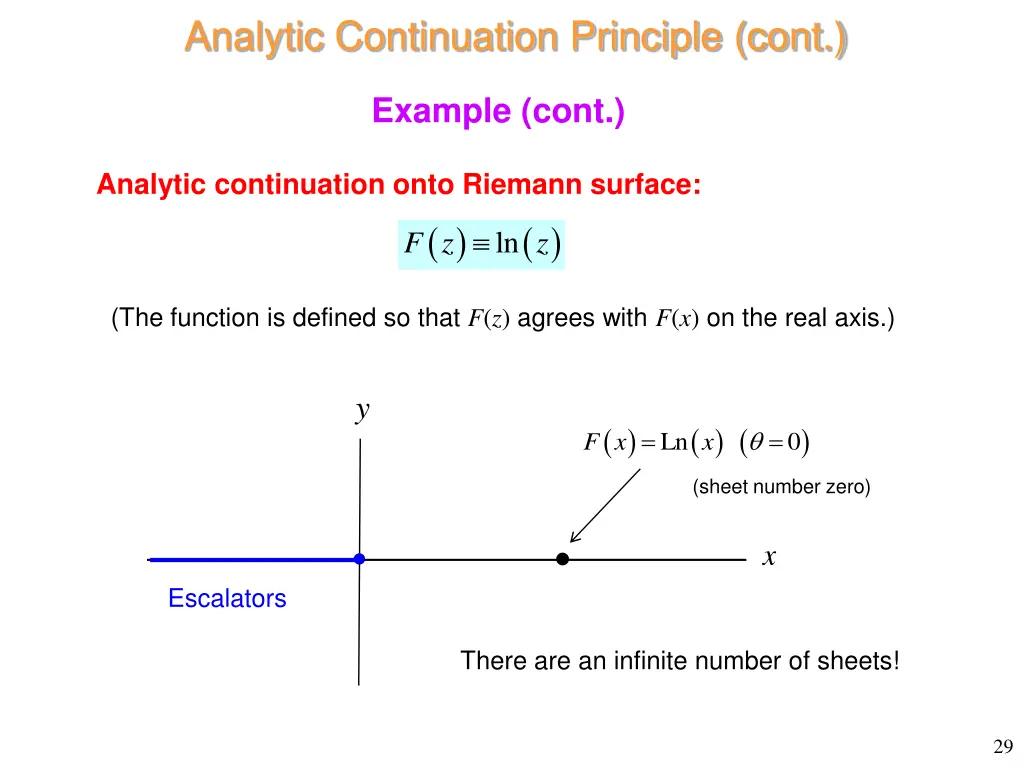
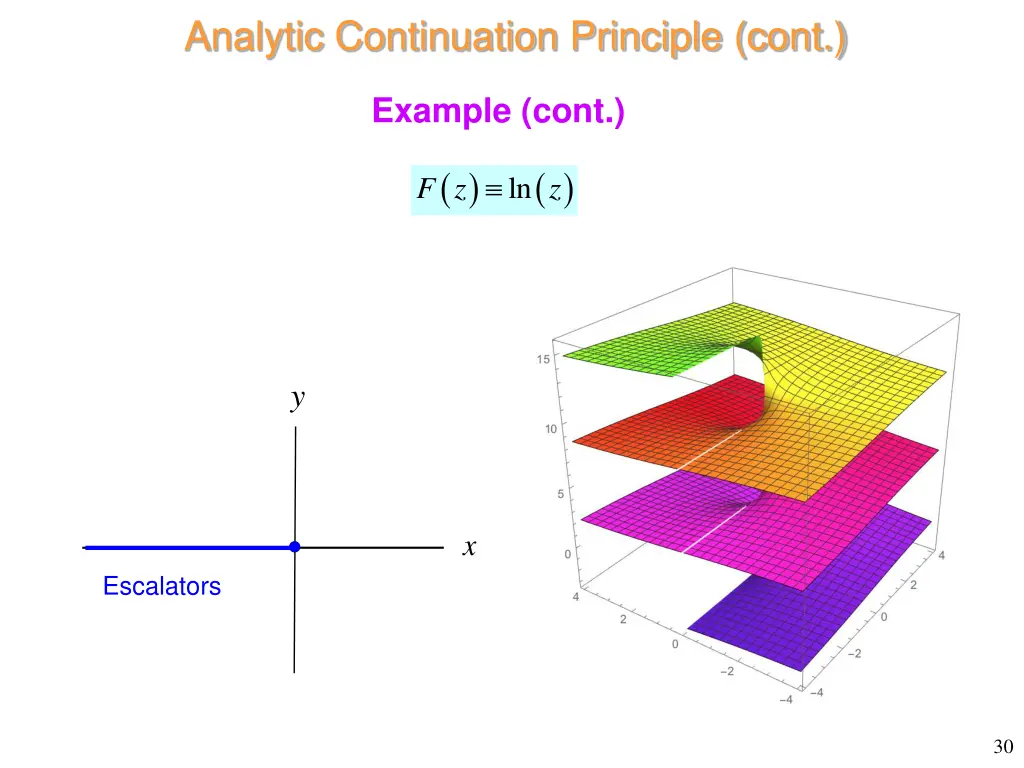
Analytic Continuation Principle (cont.) Example (cont.) Analytic continuation onto Riemann surface: ( ) ( ) z ln F z (The function is defined so that F(z) agrees with F(x) on the real axis.) y ( ) ( ) ( x ) = = Ln 0 F x (sheet number zero) x Escalators There are an infinite number of sheets! 29
Analytic Continuation Principle (cont.) Example (cont.) ( ) ( ) z ln F z y x Escalators 30
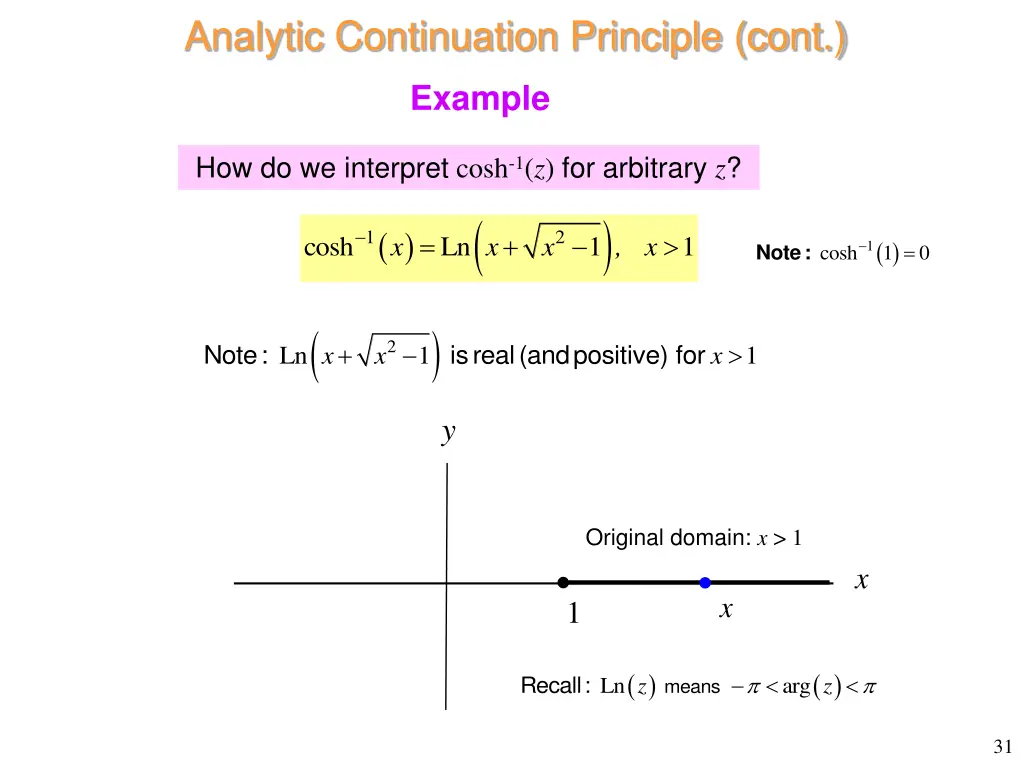
Analytic Continuation Principle (cont.) Example How do we interpret cosh-1(z) for arbitrary z? ) ( ( ) x 1 2 = + cosh Ln 1 1 x x , x ( ) 1 1 = Note: cosh 0 ) ( 2 + Note: is real (and positive) for Ln 1 1 x x x y Original domain: x > 1 x x 1 ( ) z ( ) z Recall: Ln arg means 31
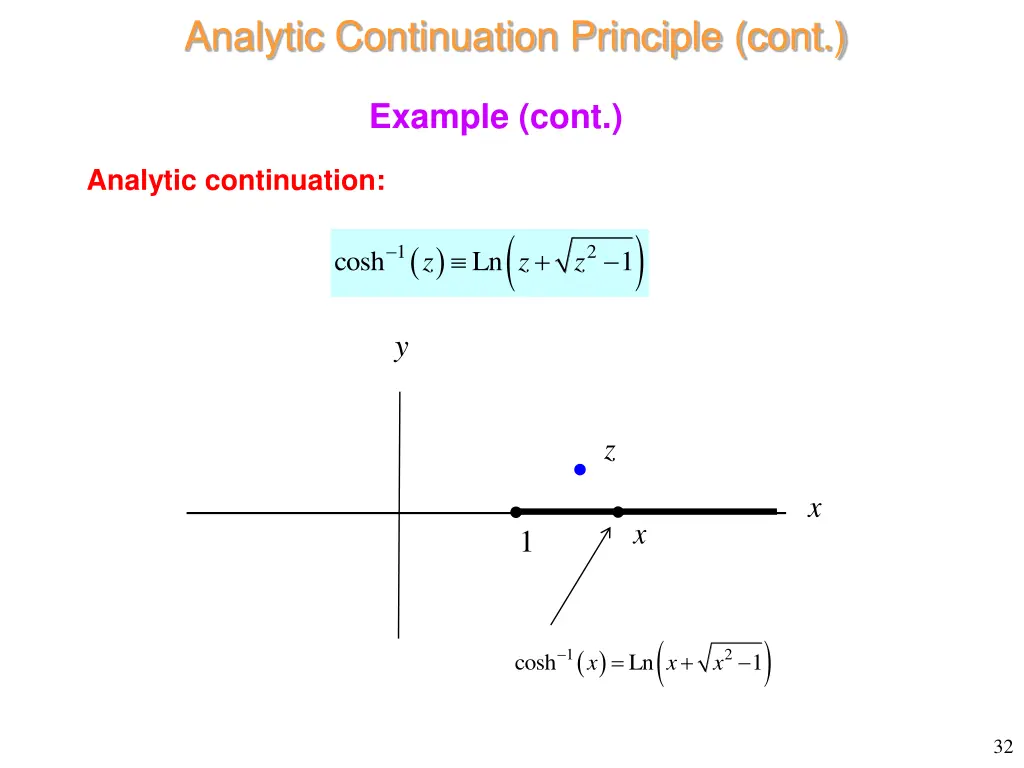
Analytic Continuation Principle (cont.) Example (cont.) Analytic continuation: ) ( ( ) z 1 2 + cosh Ln 1 z z y z x x 1 ) ( ( ) x 1 2 = + cosh Ln 1 x x 32
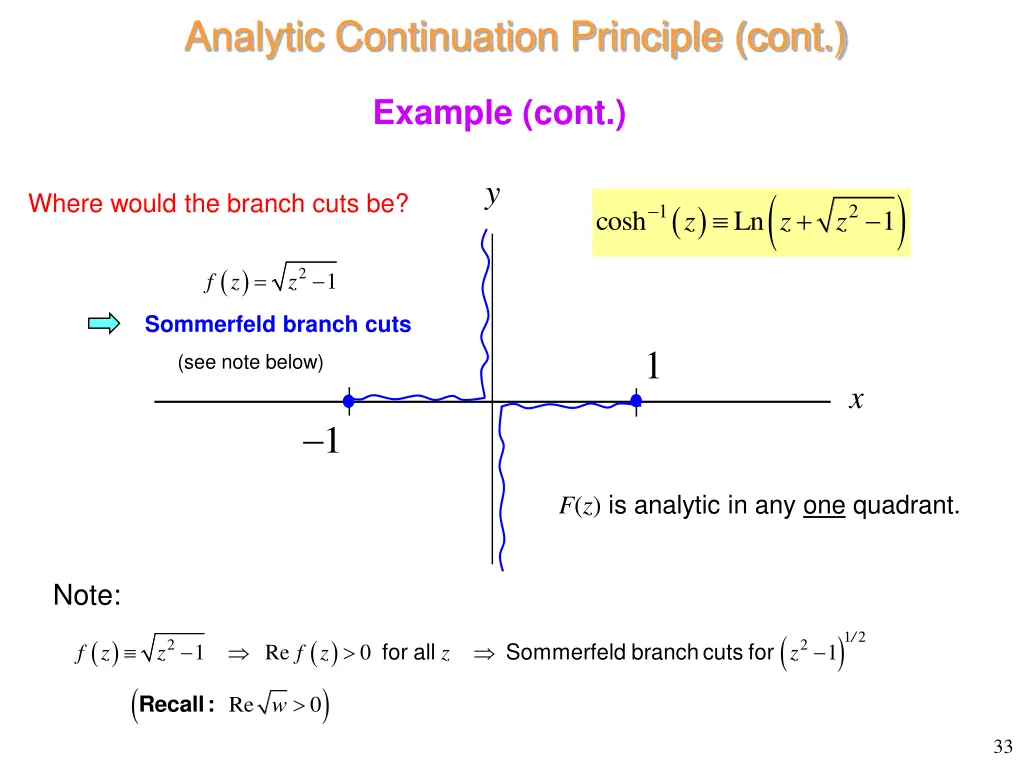
Analytic Continuation Principle (cont.) Example (cont.) y ) ( Where would the branch cuts be? ( ) z 1 2 + cosh Ln 1 z z ( ) f z 2 = 1 z Sommerfeld branch cuts 1 (see note below) x 1 F(z) is analytic in any one quadrant. Note: ( ) 1 2 / ( ) f z ( ) f z 2 2 for all Sommerfeld branch cuts for 1 Re 0 1 z z z ( ) w Recall: Re 0 33
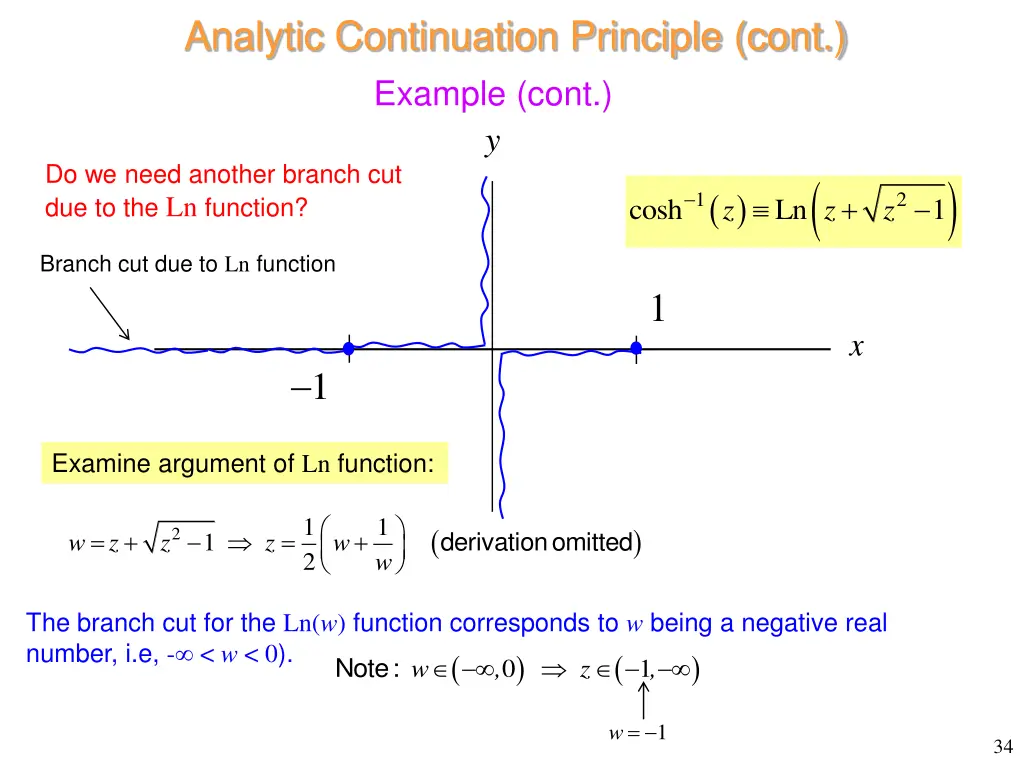
Analytic Continuation Principle (cont.) Example (cont.) y Do we need another branch cut due to the Ln function? ) ( ( ) z 1 2 + cosh Ln 1 z z Branch cut due to Ln function 1 x 1 Examine argument of Ln function: 1 2 1 w ( ) 2 = + = + derivation omitted 1 w z z z w The branch cut for the Ln(w) function corresponds to w being a negative real number, i.e, - < w < 0). ( w Note: ) ( ) 0 1 , z , w= 1 34
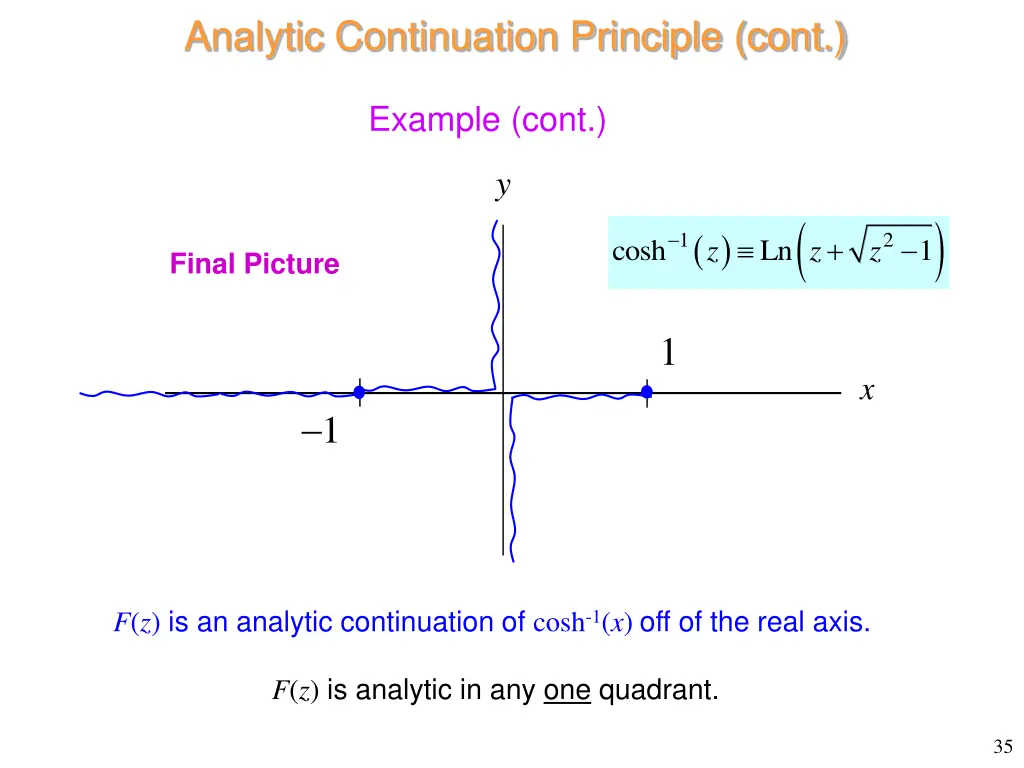
Analytic Continuation Principle (cont.) Example (cont.) y ) ( ( ) z 1 2 + cosh Ln 1 z z Final Picture 1 x 1 F(z) is an analytic continuation of cosh-1(x) off of the real axis. F(z) is analytic in any one quadrant. 35
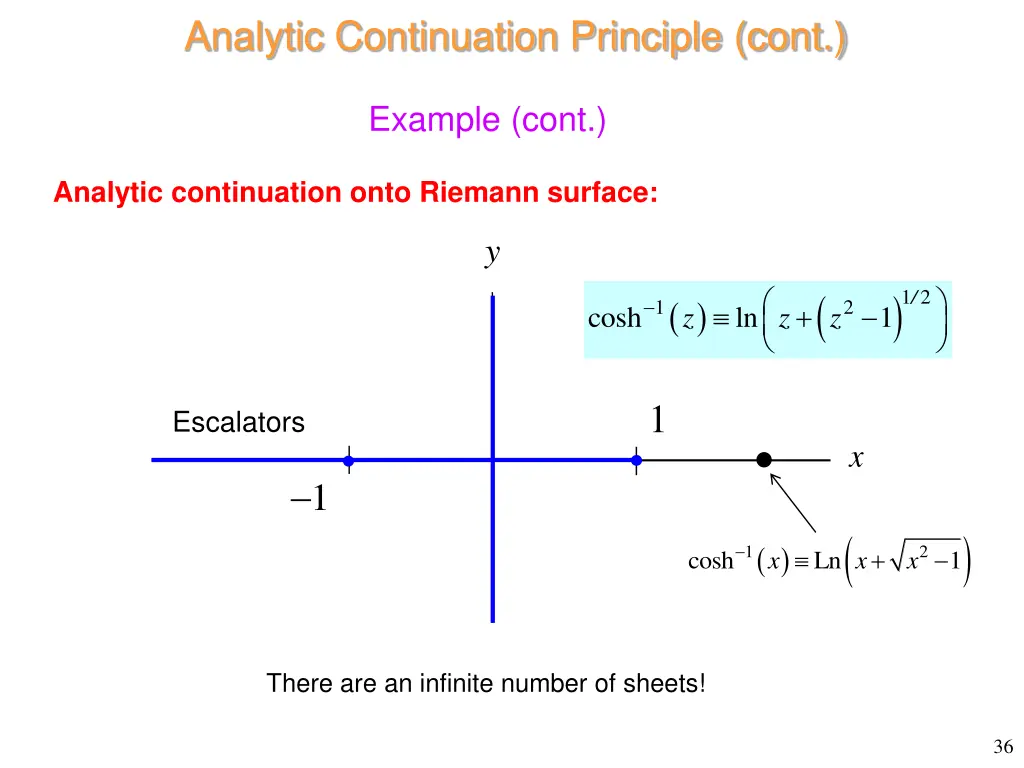
Analytic Continuation Principle (cont.) Example (cont.) Analytic continuation onto Riemann surface: y ( ) 1 2 / ( ) z 1 2 + cosh ln 1 z z 1 Escalators x 1 ) ( ( ) x 1 2 + cosh Ln 1 x x There are an infinite number of sheets! 36
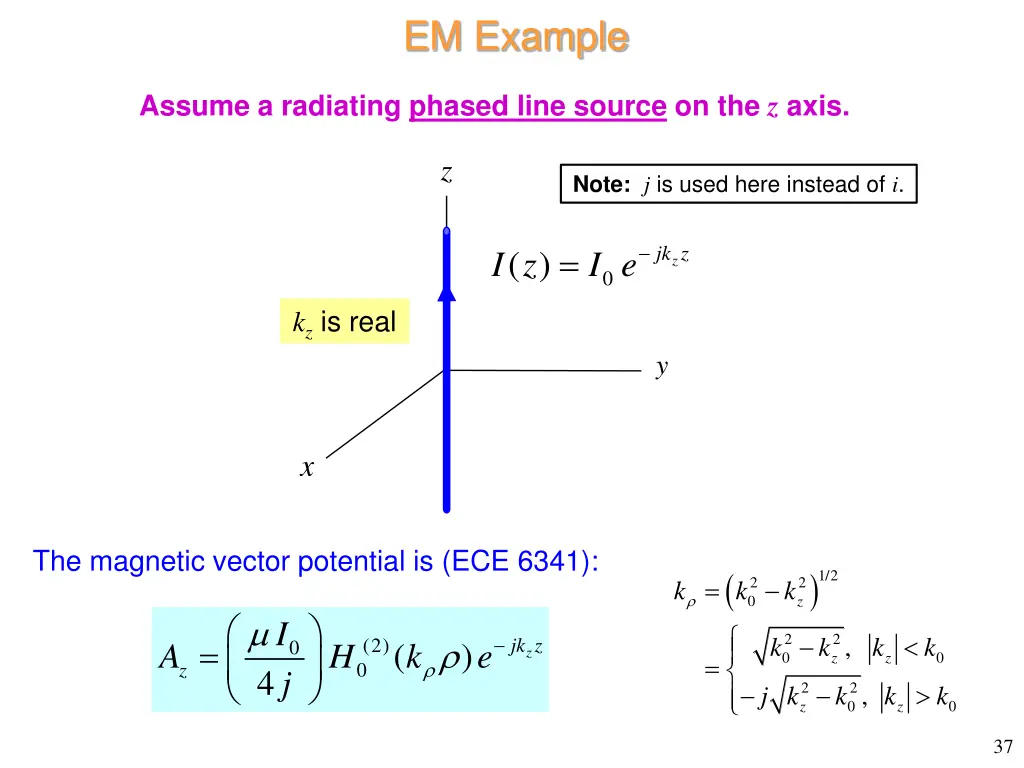
EM Example Assume a radiating phased line source on the z axis. z Note: j is used here instead of i. I e = jk z ( ) I z z 0 kz is real y x The magnetic vector potential is (ECE 6341): ( ) 1/2 = 2 0 2 z k k k I j 2 0 2 z , k k k k = jk z (2) 0( ) 0 A H k e z 0 z = z 4 2 z 2 0 , j k k k k 0 z 37
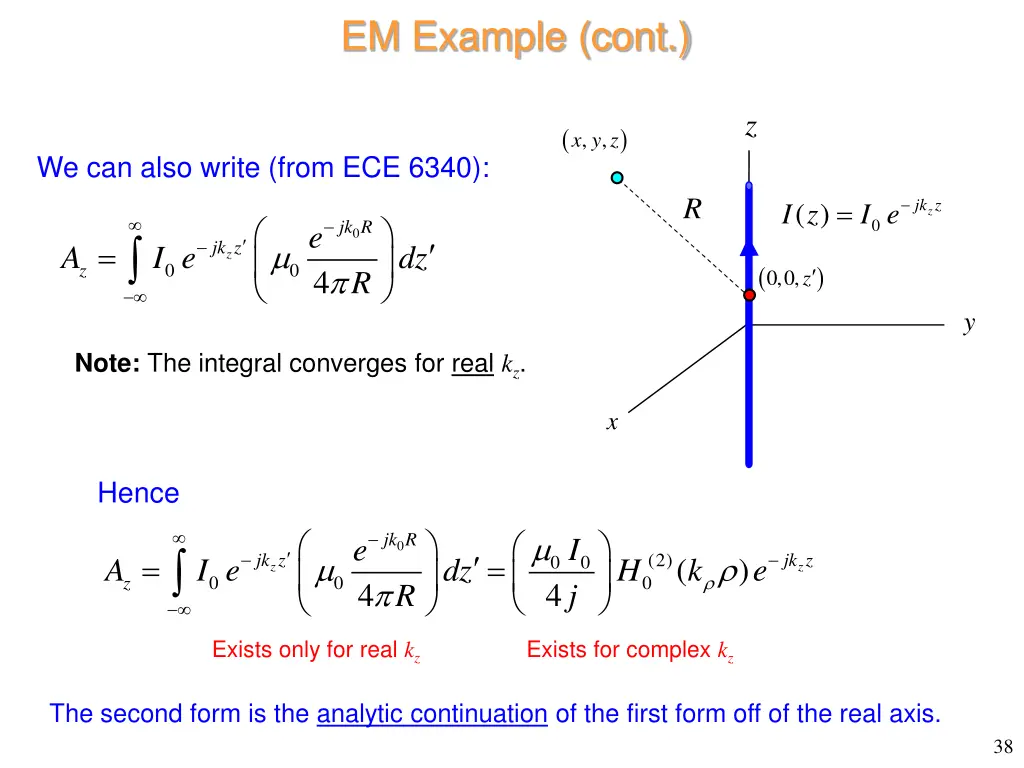
EM Example (cont.) z ( ) , , x y z We can also write (from ECE 6340): R I e = jk z ( ) I z z 0 jk R e 0 = jk z A I e dz z ( ) 0 04 z 0,0,z R y Note: The integral converges for real kz. x Hence jk R I j e 0 = = jk z jk z (2) 0( ) 0 0 A I e dz H k e z z 0 0 z 4 4 R Exists only for real kz Exists for complex kz The second form is the analytic continuation of the first form off of the real axis. 38
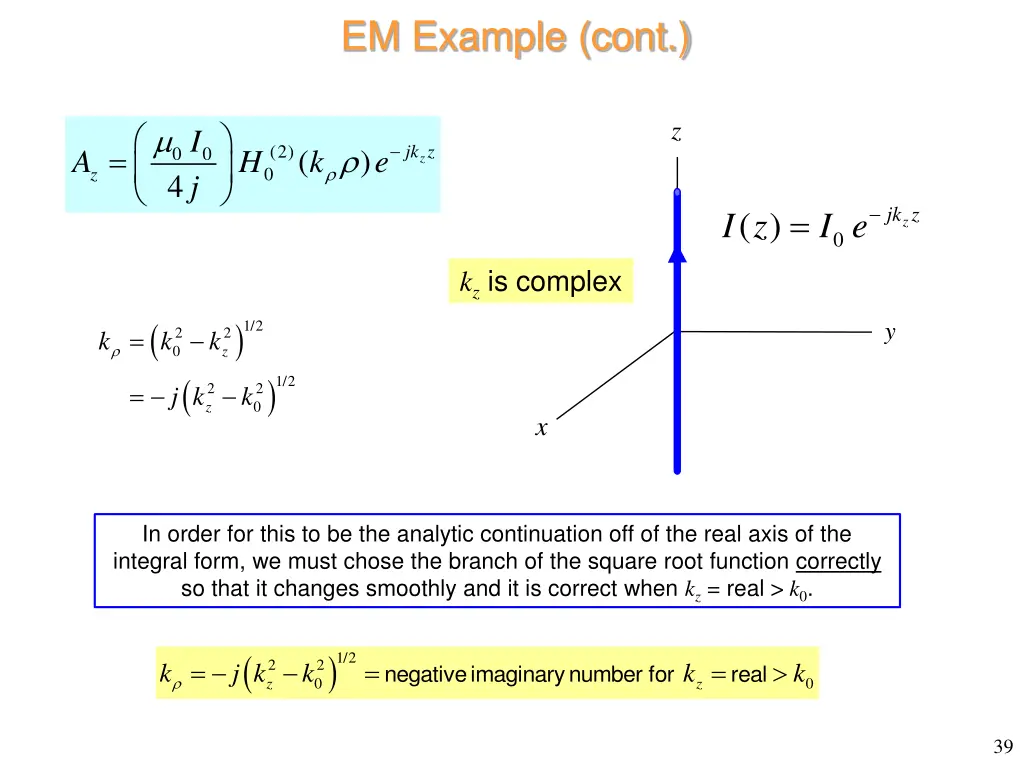
EM Example (cont.) z I j = jk z (2) 0( ) 0 0 A H k e z z 4 I e = jk z ( ) I z z 0 kz is complex ( ) y 1/2 = 2 0 2 z k k k ( ) 1/2 = 2 z 2 0 j k k x In order for this to be the analytic continuation off of the real axis of the integral form, we must chose the branch of the square root function correctly so that it changes smoothly and it is correct when kz= real > k0. ( ) 1/2 = = = 2 z 2 0 k j k k k k negative imaginary number for real 0 z 39
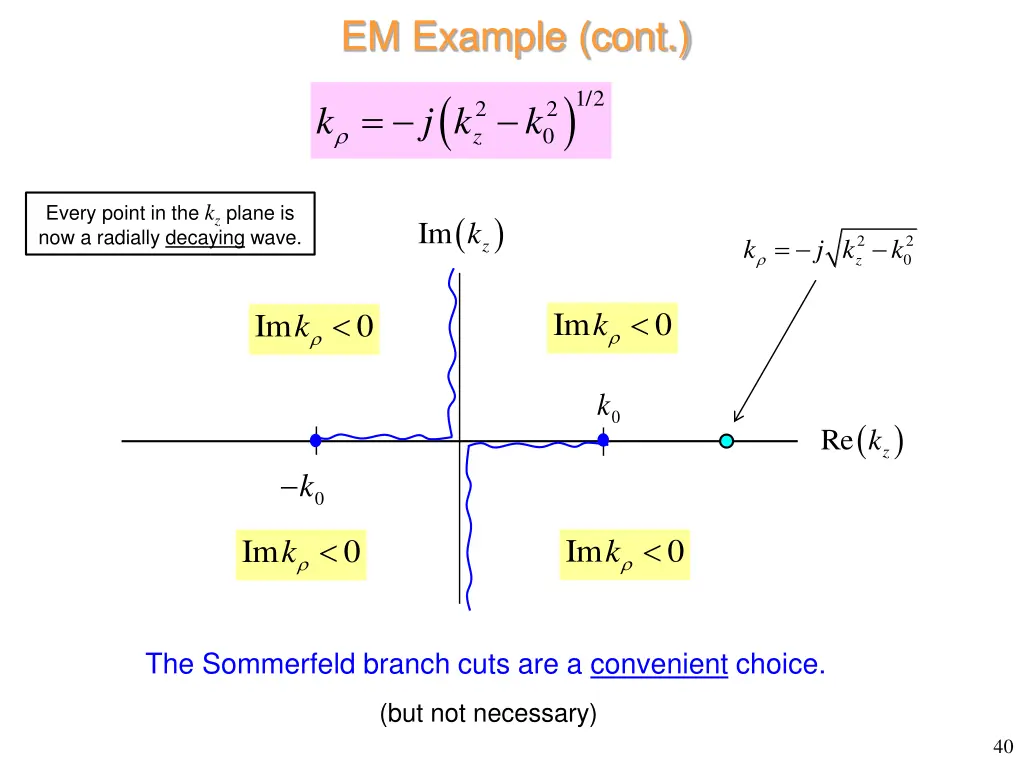
EM Example (cont.) ( z j k ) 1/2 = 2 2 0 k k Every point in the kz plane is now a radially decaying wave. ( ) Im zk = 2 z 2 0 k j k k k k Im 0 Im 0 0k ( ) Re zk 0k k k Im 0 Im 0 The Sommerfeld branch cuts are a convenient choice. (but not necessary) 40
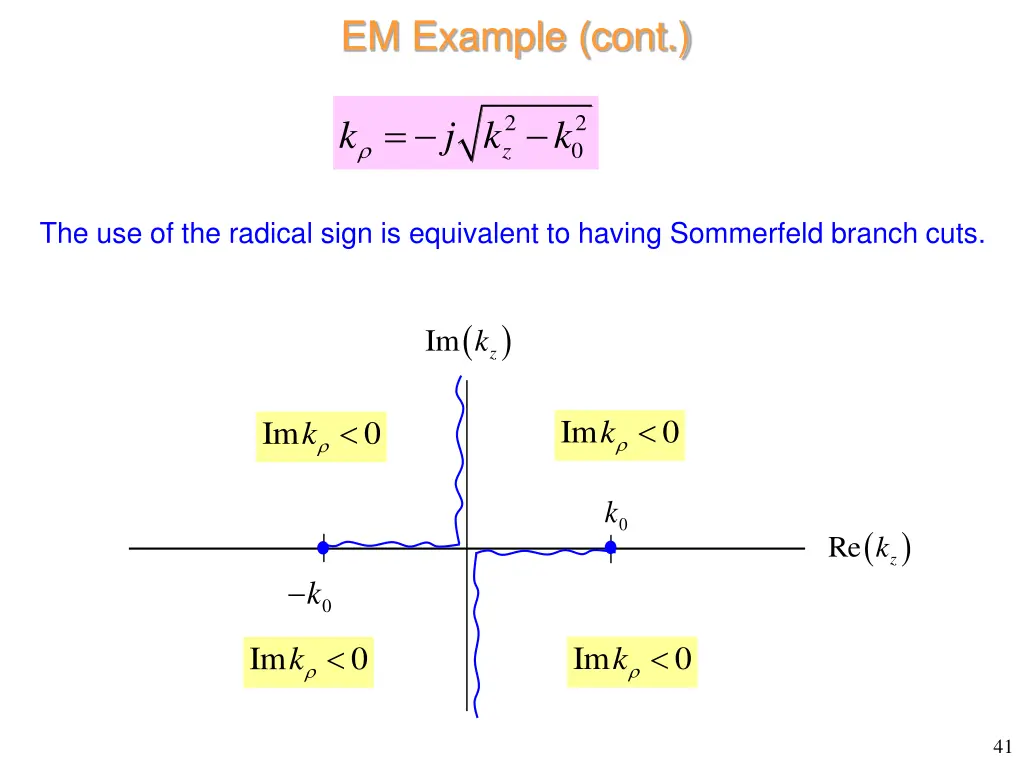
EM Example (cont.) = 2 z 2 0 k j k k The use of the radical sign is equivalent to having Sommerfeld branch cuts. ( ) Im zk k k Im 0 Im 0 0k ( ) Re zk 0k k k Im 0 Im 0 41
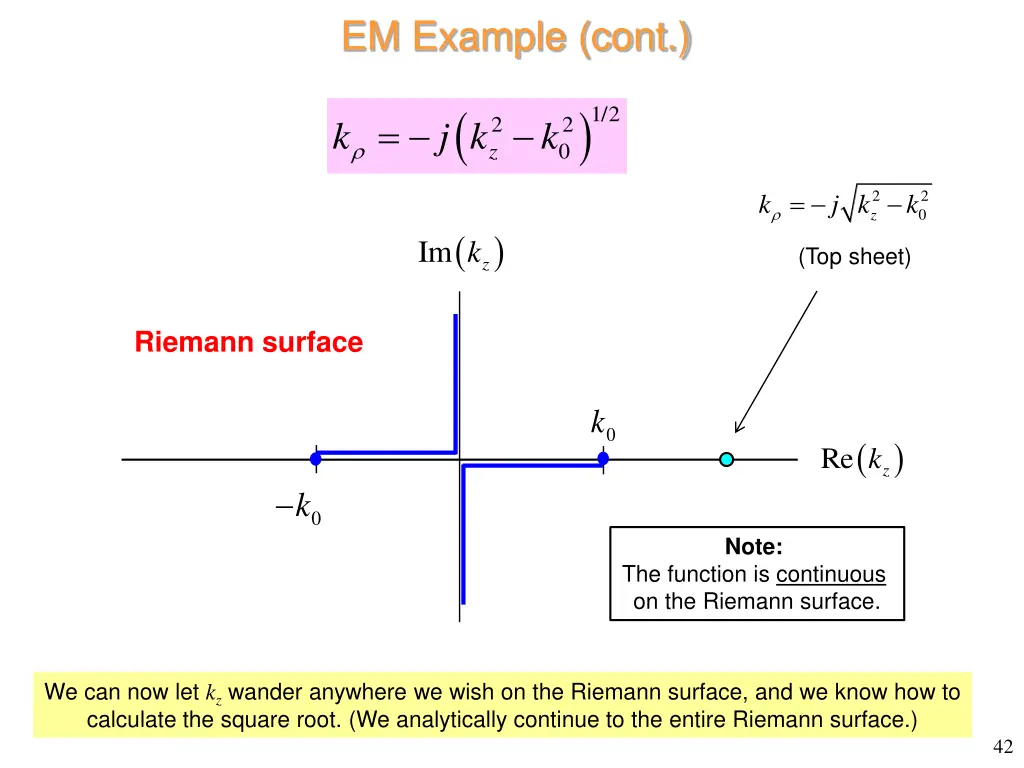
EM Example (cont.) ( ) 1/2 = 2 z 2 0 k j k k = 2 z 2 0 k j k k ( ) Im zk (Top sheet) Riemann surface 0k ( ) Re zk 0k Note: The function is continuous on the Riemann surface. We can now let kz wander anywhere we wish on the Riemann surface, and we know how to calculate the square root. (We analytically continue to the entire Riemann surface.) 42
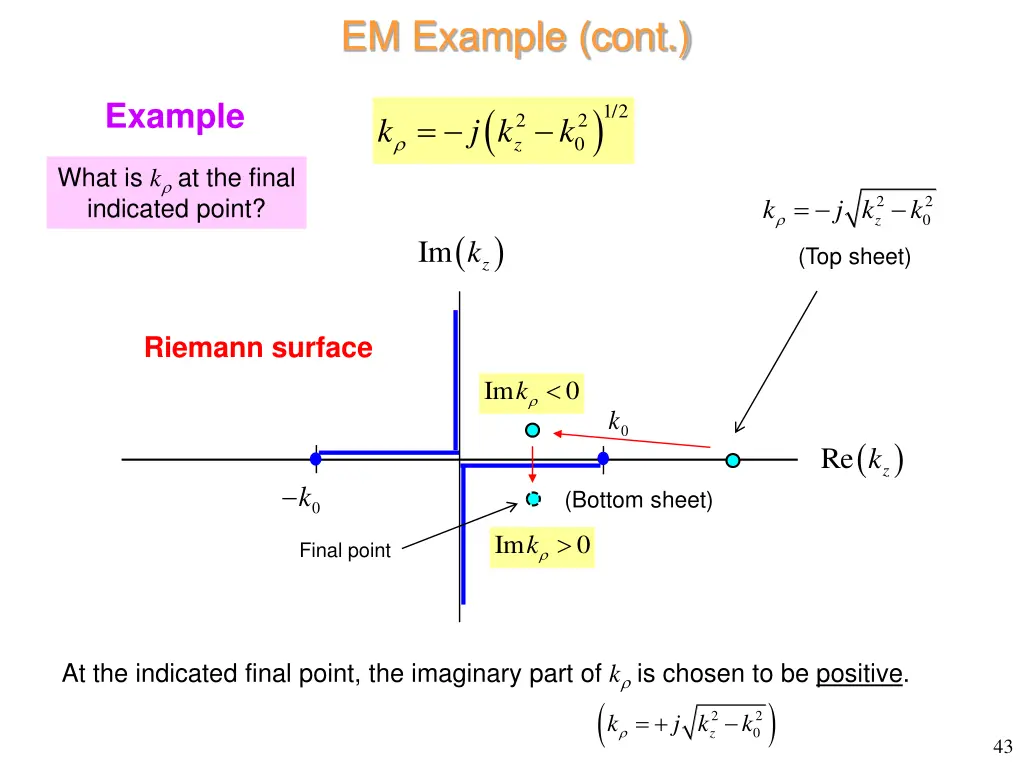
EM Example (cont.) ( ) Example 1/2 = 2 z 2 0 k j k k What is k at the final indicated point? = 2 z 2 0 k j k k ( ) Im zk (Top sheet) Riemann surface k Im 0 0k ( ) Re zk 0k (Bottom sheet) k Im 0 Final point At the indicated final point, the imaginary part of k is chosen to be positive. ) ( = + 2 z 2 0 k j k k 43
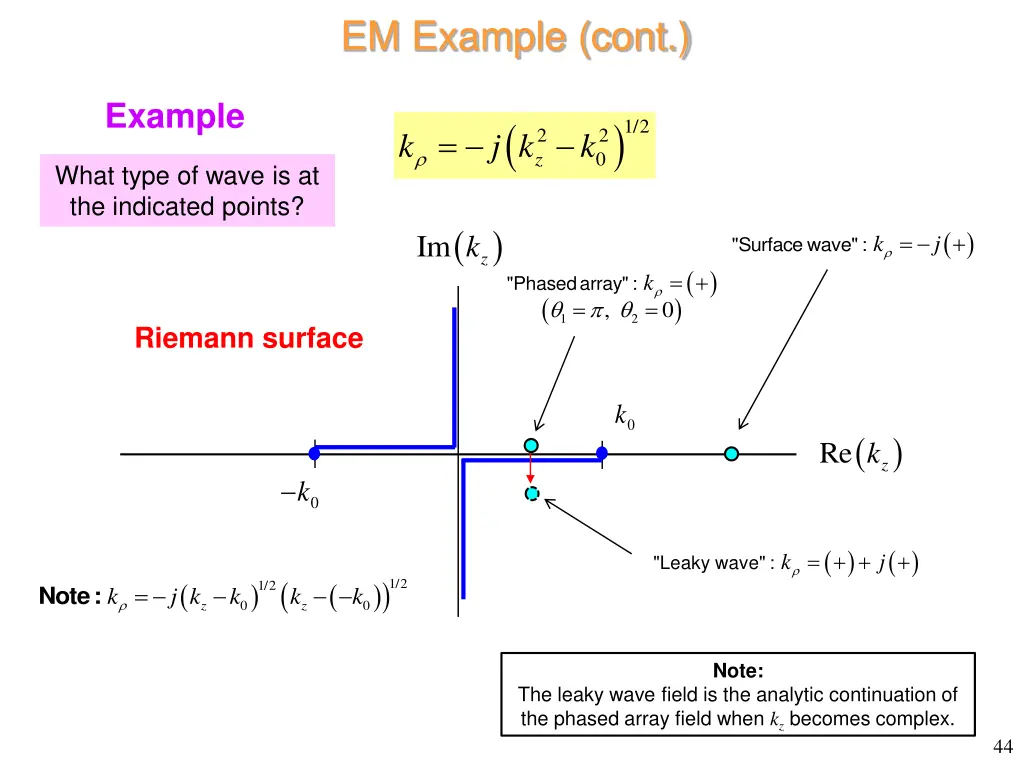
EM Example (cont.) Example ( ) 1/2 = 2 z 2 0 k j k k What type of wave is at the indicated points? ( ) ( ) + = Im zk k j "Surface wave": ( ) = + k = "Phased array": ( ) = , 0 1 2 Riemann surface 0k ( ) Re zk 0k ( ) ( ) + = + + k j "Leaky wave": ( ) ( ) ( ) 1/2 1/2 = Note: k j k k k k 0 0 z z Note: The leaky wave field is the analytic continuation of the phased array field when kz becomes complex. 44
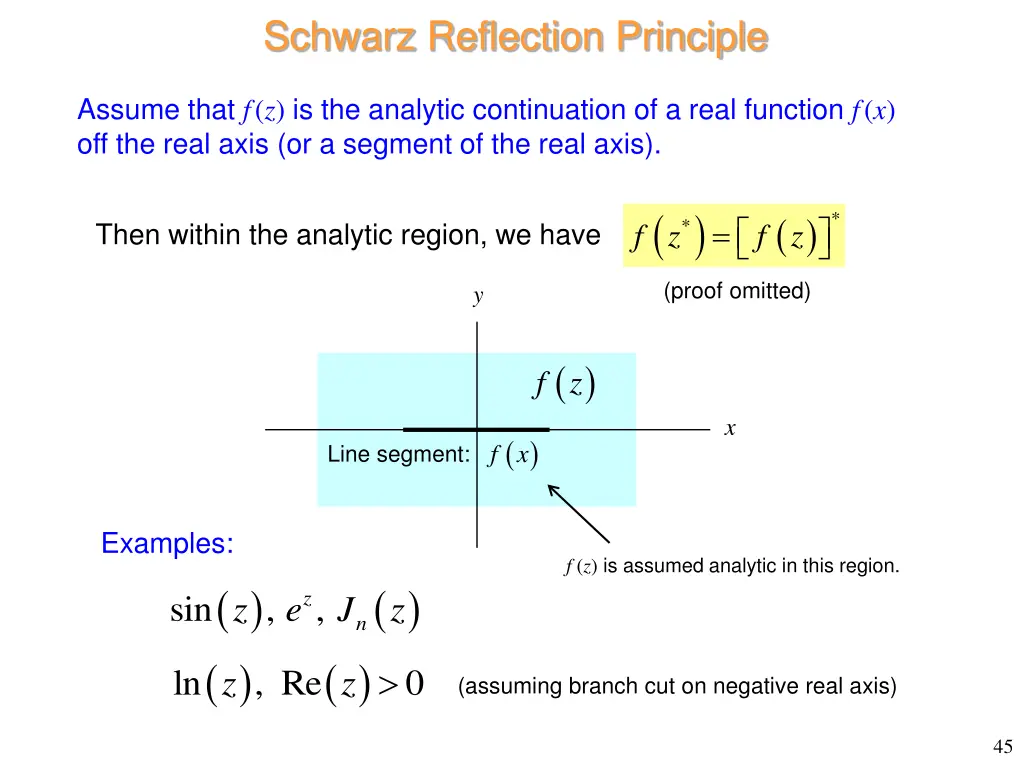
Schwarz Reflection Principle Assume that f(z) is the analytic continuation of a real function f(x) off the real axis (or a segment of the real axis). ( ) f z ( ) f z * = * Then within the analytic region, we have (proof omitted) y ( ) f z x ( ) f x Line segment: Examples: f (z) is assumed analytic in this region. ( ) z ( ) z ( ) z z sin , , e J n ( ) z ln , Re 0 (assuming branch cut on negative real axis) 45