Op-Amp as Comparator Circuits
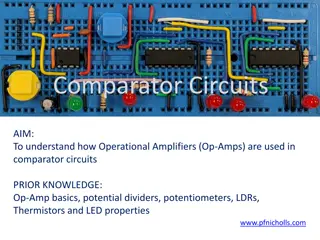
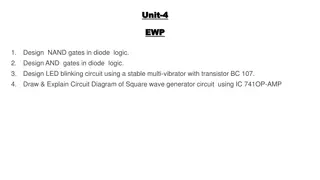
Figure 17.3a showcases a circuit utilizing an Op-Amp as a comparator with a positive reference voltage connected to the minus input. The output drives an LED indicator based on the voltage comparison. Different configurations and applications of voltage comparators using Op-Amps are presented in the illustrations.

Download Presentation

Please find below an Image/Link to download the presentation.
The content on the website is provided AS IS for your information and personal use only. It may not be sold, licensed, or shared on other websites without obtaining consent from the author.If you encounter any issues during the download, it is possible that the publisher has removed the file from their server.
You are allowed to download the files provided on this website for personal or commercial use, subject to the condition that they are used lawfully. All files are the property of their respective owners.
The content on the website is provided AS IS for your information and personal use only. It may not be sold, licensed, or shared on other websites without obtaining consent from the author.
E N D
Presentation Transcript
IDENTIFY TYPES OF NETWORK CABLES AND CONNECTORS
INTRODUCTION: you're expected to know the basic concepts of networking as well as the different types of cabling that can be used. For the latter, you should be able to identify connectors and cables from figures even if those figures are crude line art (think shadows) appearing in pop-up boxes. There are three specific types network cables, and the connectors associated with each, that you must know for this exam: fiber, twisted pair, and coaxial. Fiber is the most expensive of the three and can run the longest distance. A number of types of connectors can work with fiber, but three you must know are SC, ST, and LC.
Twisted pair Twisted pair is commonly used in office settings to connect workstations to hubs or switches. It comes in two varieties: unshielded (UTP) and shielded (STP), the two types of connectors commonly used are RJ-11 (four wires and popular with telephones), and RJ-45 (eight wires and used with xBaseT networks 100BaseT, 1000BaseT, and so forth). Two common wiring standards are T568A and T568B. Coaxial cabling is not as popular as it once was, but it's still used with cable television and some legacy networks. The two most regularly used connectors are F-connectors (television cabling) and BNC (10Base2, and so on).
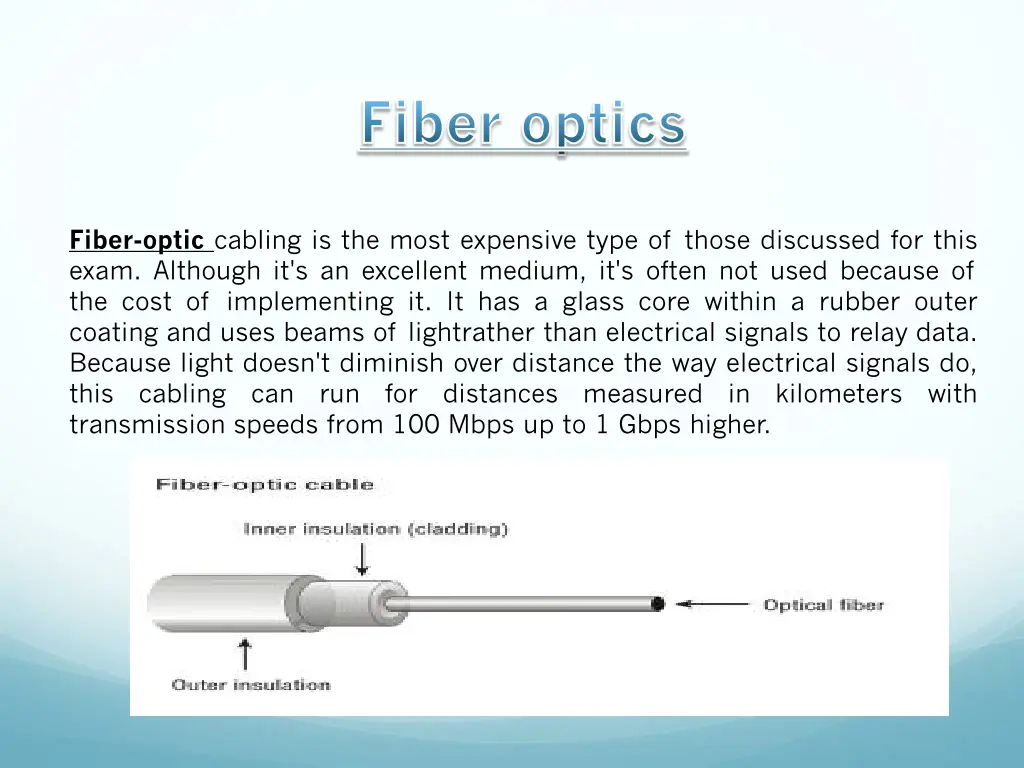
Fiber optics Fiber-optic cabling is the most expensive type of those discussed for this exam. Although it's an excellent medium, it's often not used because of the cost of implementing it. It has a glass core within a rubber outer coating and uses beams of lightrather than electrical signals to relay data. Because light doesn't diminish over distance the way electrical signals do, this cabling can run for distances measured in kilometers with transmission speeds from 100 Mbps up to 1 Gbps higher.
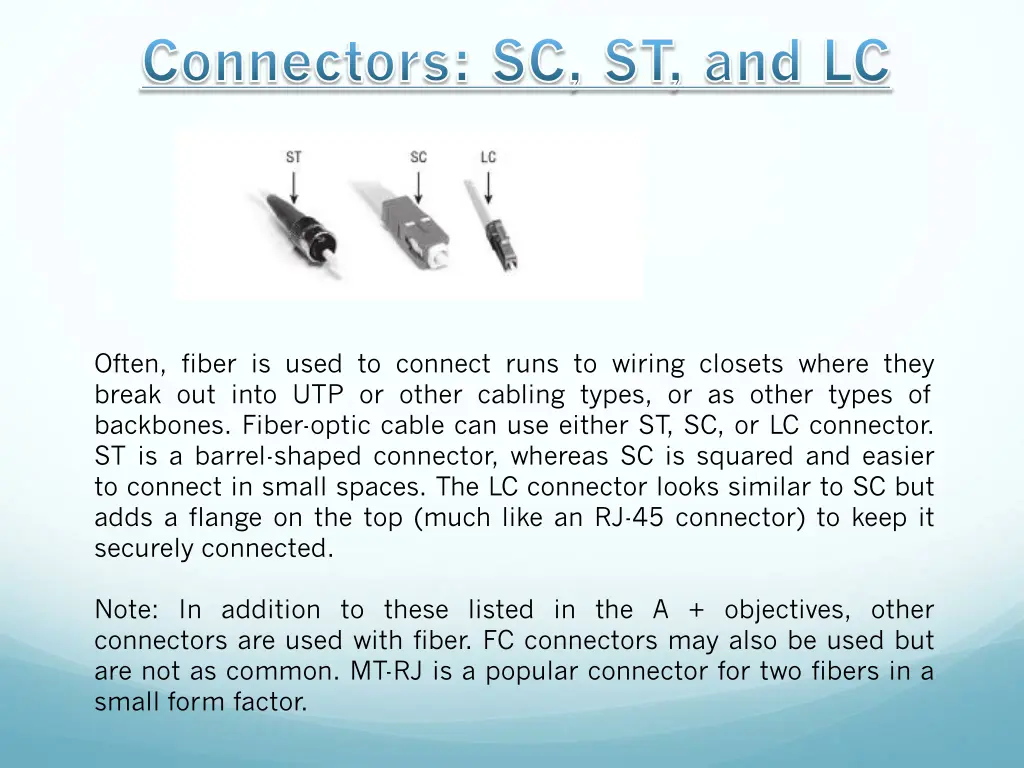
Connectors: SC, ST, and LC Often, fiber is used to connect runs to wiring closets where they break out into UTP or other cabling types, or as other types of backbones. Fiber-optic cable can use either ST, SC, or LC connector. ST is a barrel-shaped connector, whereas SC is squared and easier to connect in small spaces. The LC connector looks similar to SC but adds a flange on the top (much like an RJ-45 connector) to keep it securely connected. Note: In addition to these listed in the A + objectives, other connectors are used with fiber. FC connectors may also be used but are not as common. MT-RJ is a popular connector for two fibers in a small form factor.
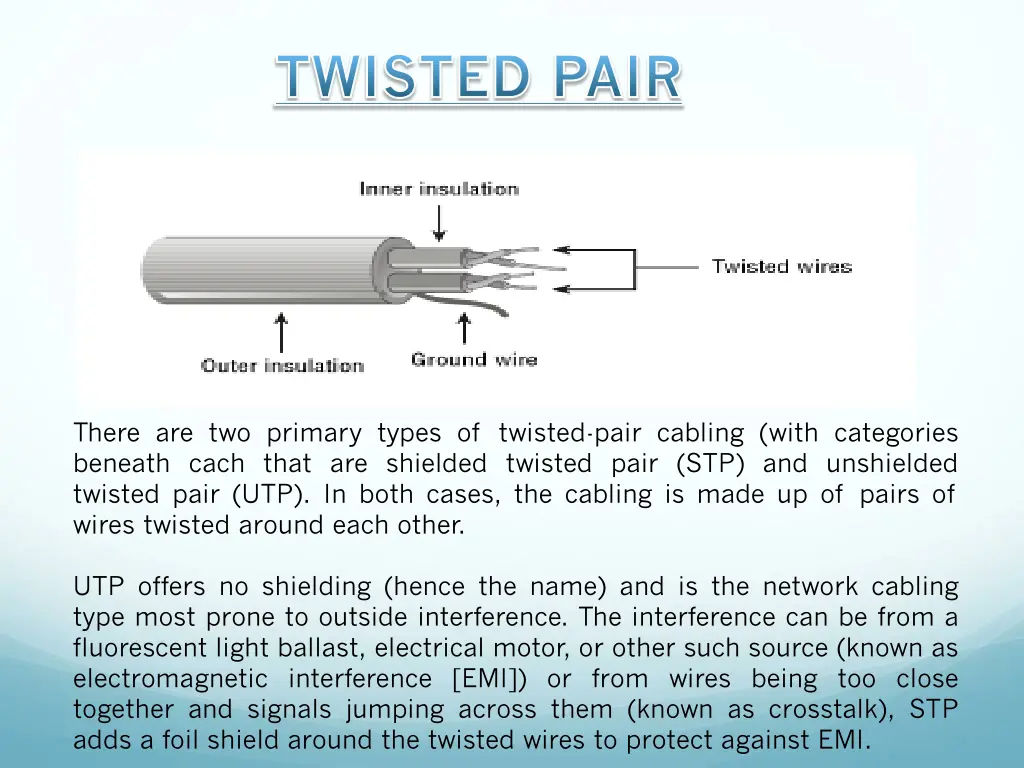
TWISTED PAIR There are two primary types of twisted-pair cabling (with categories beneath cach that are shielded twisted pair (STP) and unshielded twisted pair (UTP). In both cases, the cabling is made up of pairs of wires twisted around each other. UTP offers no shielding (hence the name) and is the network cabling type most prone to outside interference. The interference can be from a fluorescent light ballast, electrical motor, or other such source (known as electromagnetic interference [EMI]) or from wires being too close together and signals jumping across them (known as crosstalk), STP adds a foil shield around the twisted wires to protect against EMI.
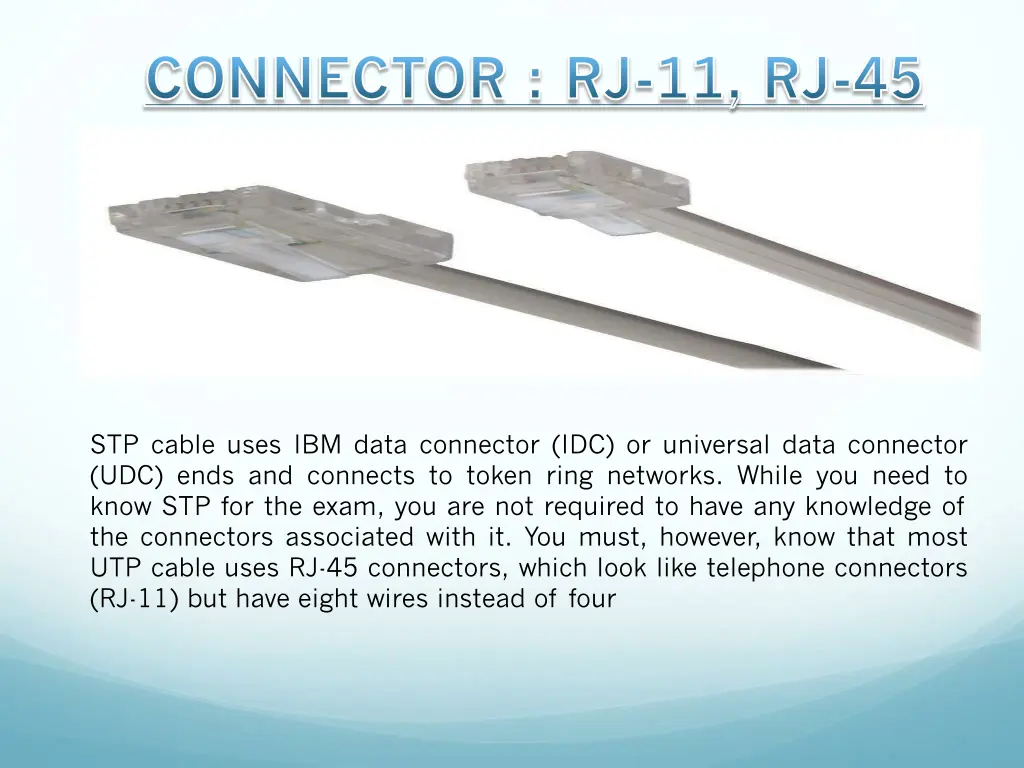
CONNECTOR : RJ-11, RJ-45 STP cable uses IBM data connector (IDC) or universal data connector (UDC) ends and connects to token ring networks. While you need to know STP for the exam, you are not required to have any knowledge of the connectors associated with it. You must, however, know that most UTP cable uses RJ-45 connectors, which look like telephone connectors (RJ-11) but have eight wires instead of four
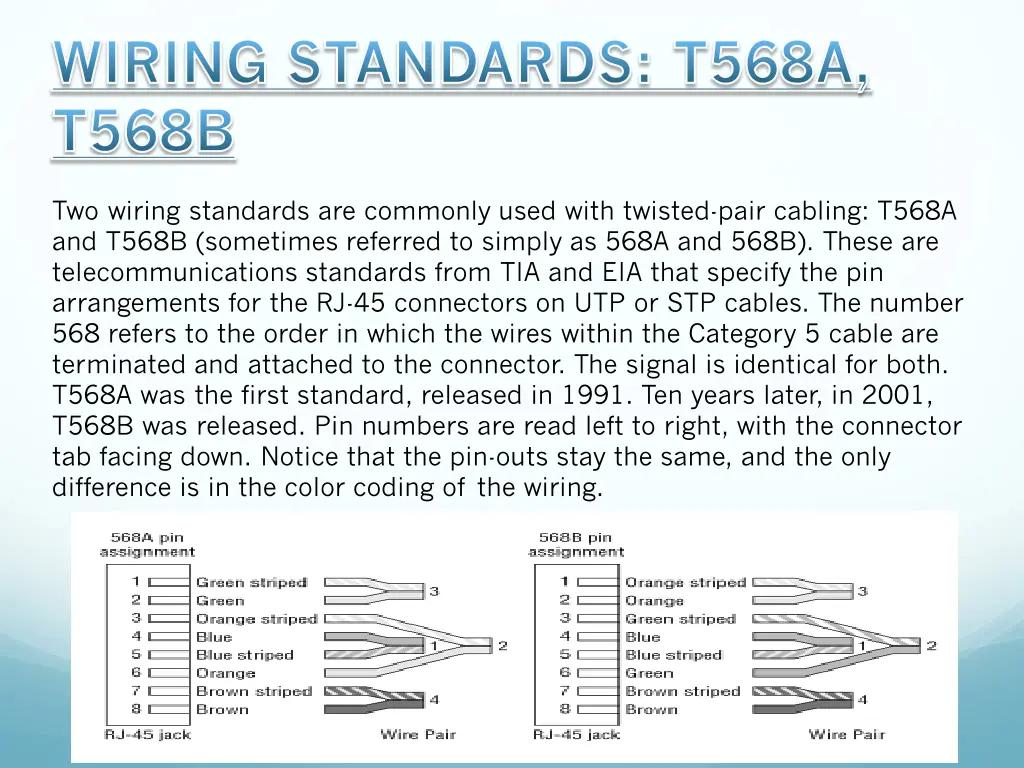
WIRING STANDARDS: T568A, T568B Two wiring standards are commonly used with twisted-pair cabling: T568A and T568B (sometimes referred to simply as 568A and 568B). These are telecommunications standards from TIA and EIA that specify the pin arrangements for the RJ-45 connectors on UTP or STP cables. The number 568 refers to the order in which the wires within the Category 5 cable are terminated and attached to the connector. The signal is identical for both. T568A was the first standard, released in 1991. Ten years later, in 2001, T568B was released. Pin numbers are read left to right, with the connector tab facing down. Notice that the pin-outs stay the same, and the only difference is in the color coding of the wiring.
Note: Mixing cables can cause communication problems on the network. Before installing a network or adding a new component to it, make sure the cable being used is in the correct wiring standard.
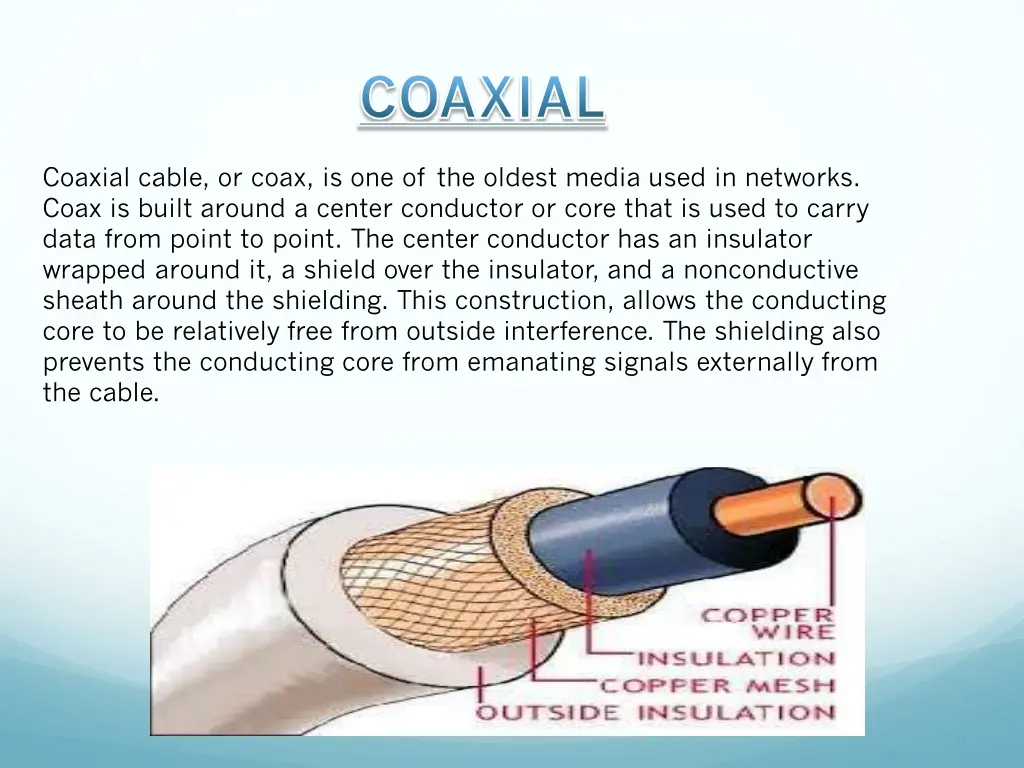
COAXIAL Coaxial cable, or coax, is one of the oldest media used in networks. Coax is built around a center conductor or core that is used to carry data from point to point. The center conductor has an insulator wrapped around it, a shield over the insulator, and a nonconductive sheath around the shielding. This construction, allows the conducting core to be relatively free from outside interference. The shielding also prevents the conducting core from emanating signals externally from the cable.