Operating Systems: Functions and Evolution in Computing
Explore the fundamental functions of operating systems, including abstraction of hardware and resource management. Delve into the evolution of computing paradigms and the importance of system programming skills for a comprehensive understanding of OS mechanisms and applications.

Download Presentation

Please find below an Image/Link to download the presentation.
The content on the website is provided AS IS for your information and personal use only. It may not be sold, licensed, or shared on other websites without obtaining consent from the author. If you encounter any issues during the download, it is possible that the publisher has removed the file from their server.
You are allowed to download the files provided on this website for personal or commercial use, subject to the condition that they are used lawfully. All files are the property of their respective owners.
The content on the website is provided AS IS for your information and personal use only. It may not be sold, licensed, or shared on other websites without obtaining consent from the author.
E N D
Presentation Transcript
Introduction to Operating Systems David Ferry CSCI 3500 Operating Systems Saint Louis University St. Louis, MO 63103 1
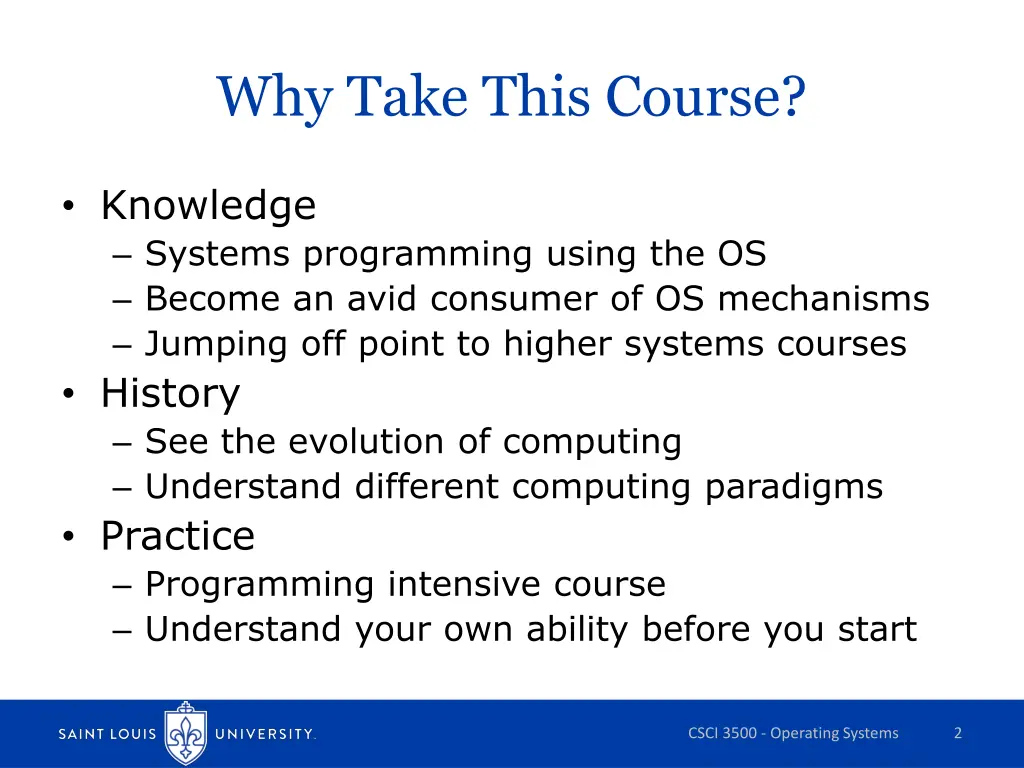
Why Take This Course? Knowledge Systems programming using the OS Become an avid consumer of OS mechanisms Jumping off point to higher systems courses History See the evolution of computing Understand different computing paradigms Practice Programming intensive course Understand your own ability before you start CSCI 3500 - Operating Systems 2
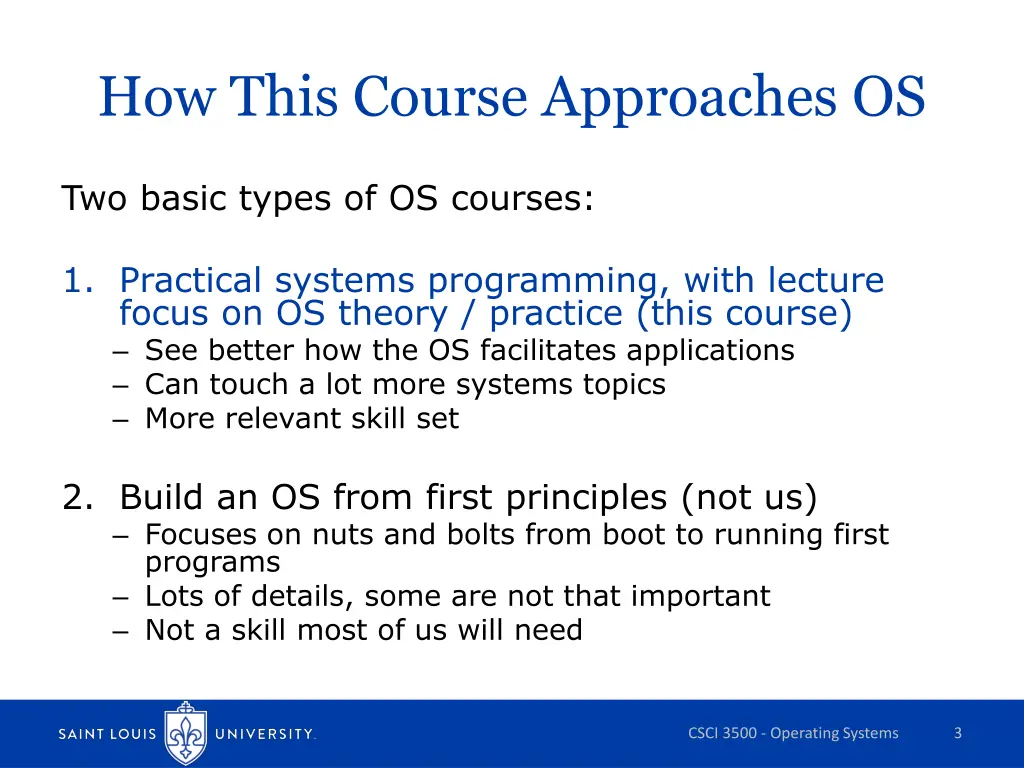
How This Course Approaches OS Two basic types of OS courses: 1. Practical systems programming, with lecture focus on OS theory / practice (this course) See better how the OS facilitates applications Can touch a lot more systems topics More relevant skill set 2. Build an OS from first principles (not us) Focuses on nuts and bolts from boot to running first programs Lots of details, some are not that important Not a skill most of us will need CSCI 3500 - Operating Systems 3
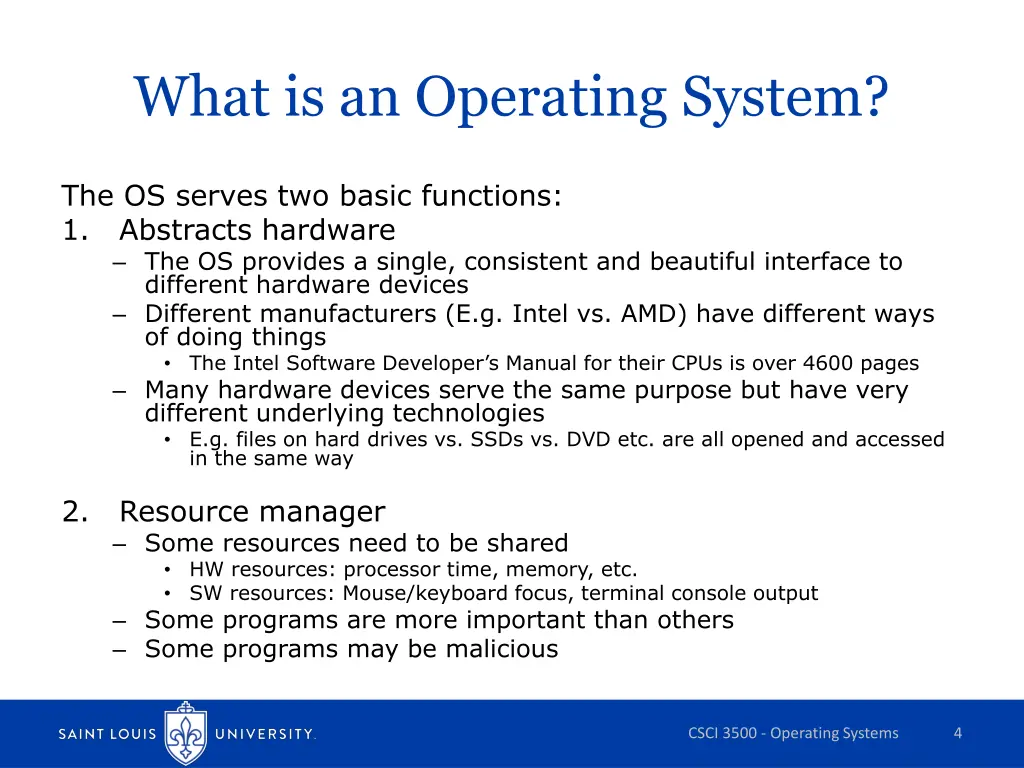
What is an Operating System? The OS serves two basic functions: 1. Abstracts hardware The OS provides a single, consistent and beautiful interface to different hardware devices Different manufacturers (E.g. Intel vs. AMD) have different ways of doing things The Intel Software Developer s Manual for their CPUs is over 4600 pages Many hardware devices serve the same purpose but have very different underlying technologies E.g. files on hard drives vs. SSDs vs. DVD etc. are all opened and accessed in the same way 2. Resource manager Some resources need to be shared HW resources: processor time, memory, etc. SW resources: Mouse/keyboard focus, terminal console output Some programs are more important than others Some programs may be malicious CSCI 3500 - Operating Systems 4
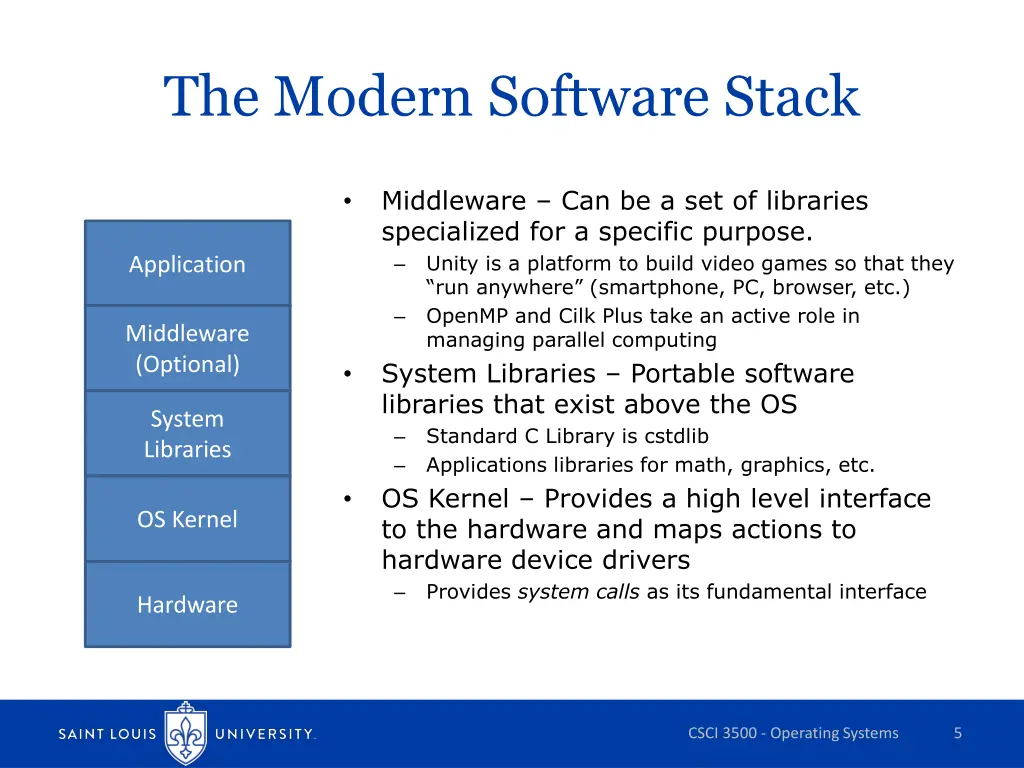
The Modern Software Stack Middleware Can be a set of libraries specialized for a specific purpose. Unity is a platform to build video games so that they run anywhere (smartphone, PC, browser, etc.) OpenMP and Cilk Plus take an active role in managing parallel computing System Libraries Portable software libraries that exist above the OS Standard C Library is cstdlib Applications libraries for math, graphics, etc. OS Kernel Provides a high level interface to the hardware and maps actions to hardware device drivers Provides system calls as its fundamental interface Application Middleware (Optional) System Libraries OS Kernel Hardware CSCI 3500 - Operating Systems 5
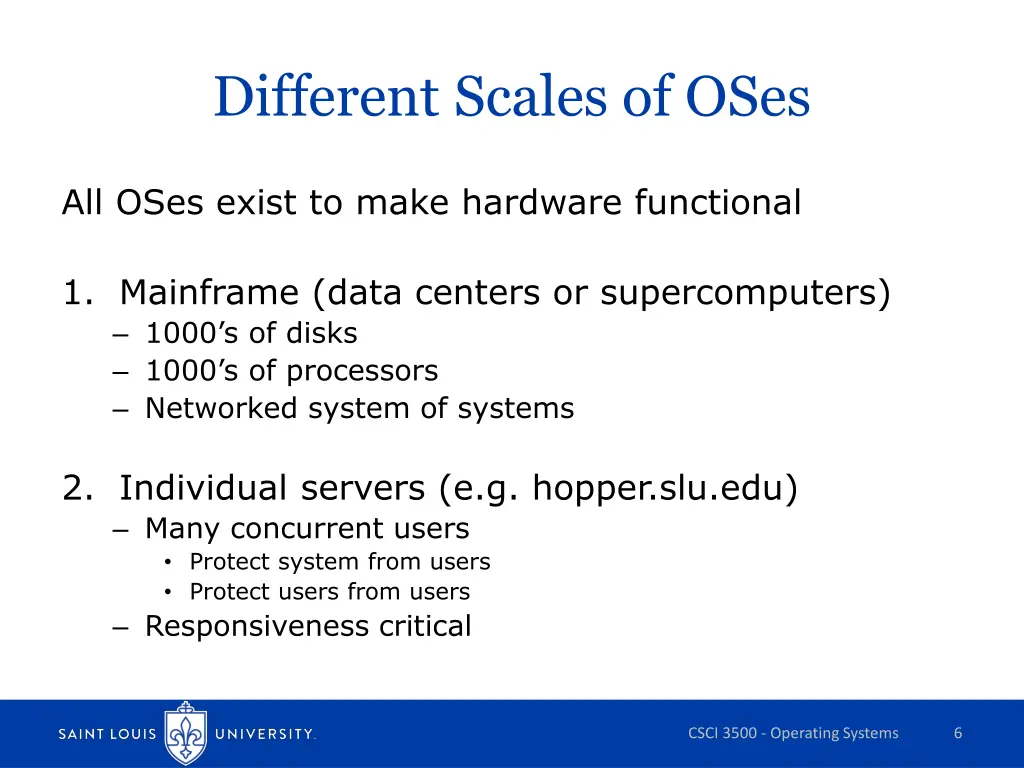
Different Scales of OSes All OSes exist to make hardware functional 1. Mainframe (data centers or supercomputers) 1000 s of disks 1000 s of processors Networked system of systems 2. Individual servers (e.g. hopper.slu.edu) Many concurrent users Protect system from users Protect users from users Responsiveness critical CSCI 3500 - Operating Systems 6
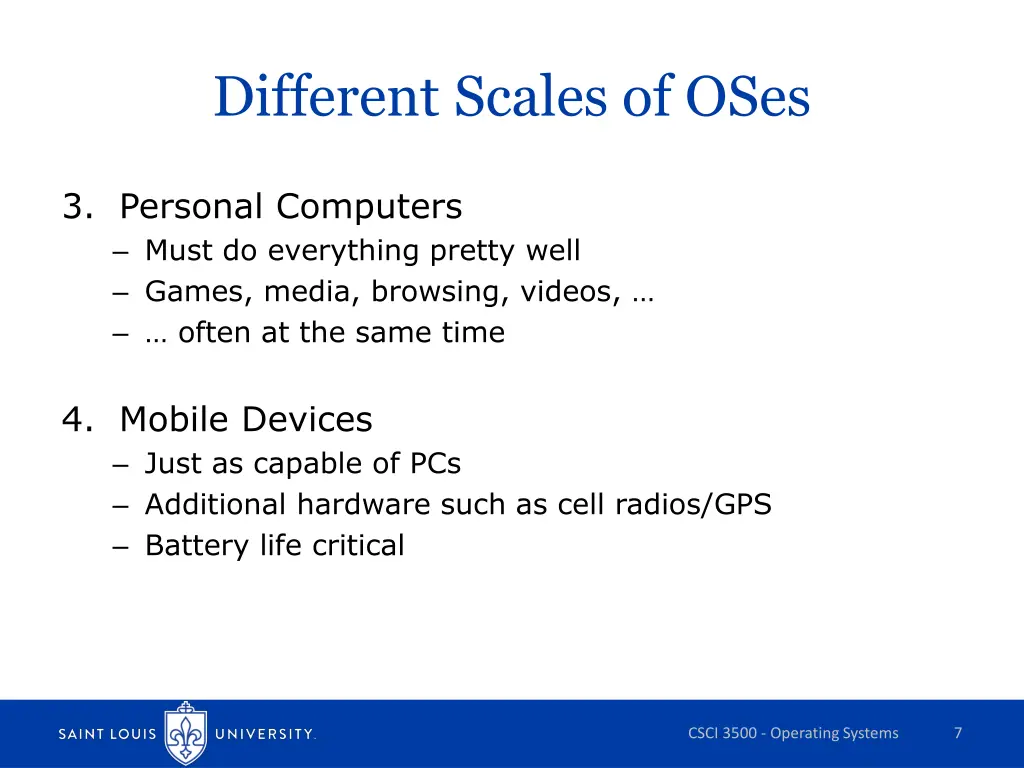
Different Scales of OSes 3. Personal Computers Must do everything pretty well Games, media, browsing, videos, often at the same time 4. Mobile Devices Just as capable of PCs Additional hardware such as cell radios/GPS Battery life critical CSCI 3500 - Operating Systems 7
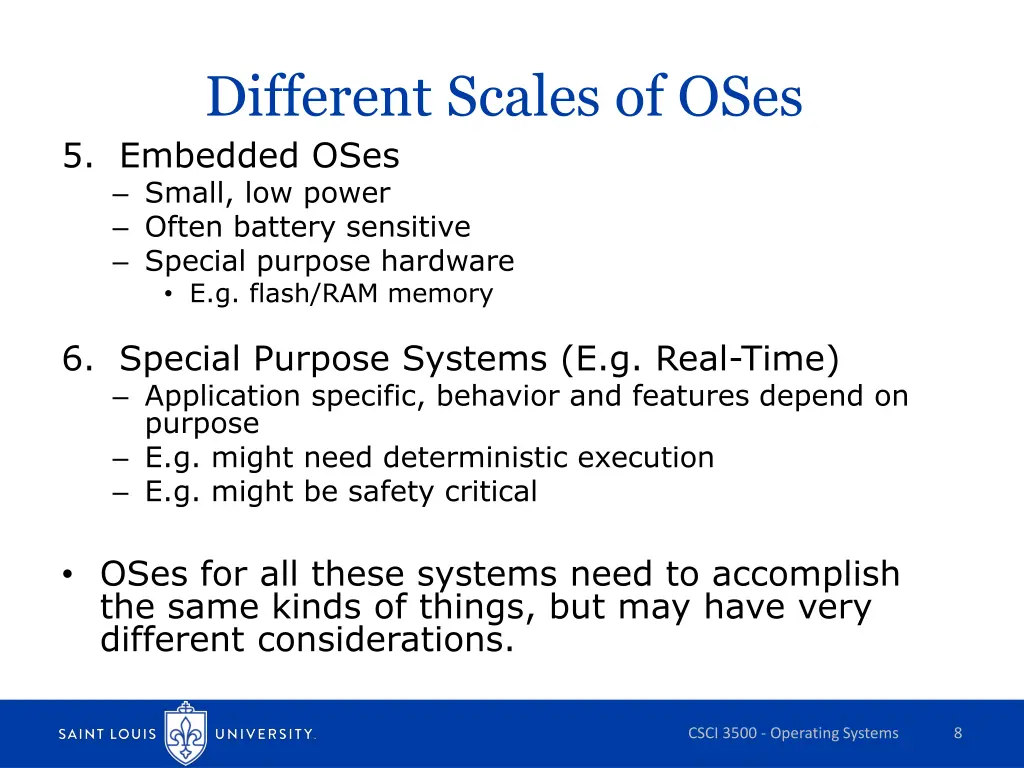
Different Scales of OSes 5. Embedded OSes Small, low power Often battery sensitive Special purpose hardware E.g. flash/RAM memory 6. Special Purpose Systems (E.g. Real-Time) Application specific, behavior and features depend on purpose E.g. might need deterministic execution E.g. might be safety critical OSes for all these systems need to accomplish the same kinds of things, but may have very different considerations. CSCI 3500 - Operating Systems 8
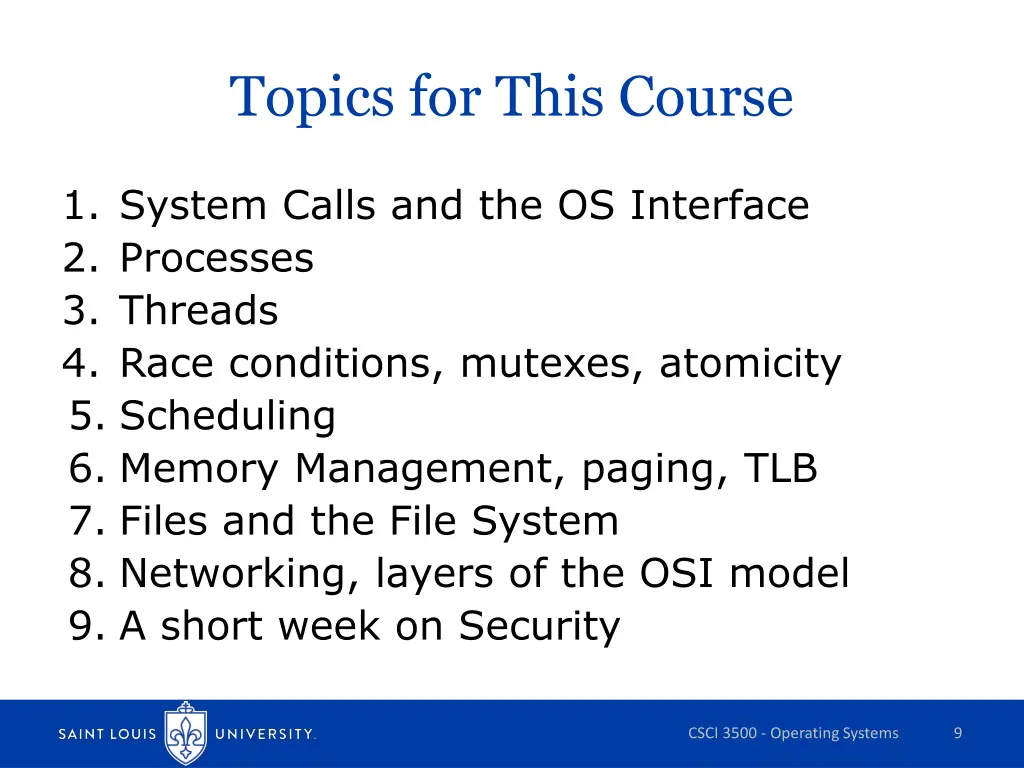
Topics for This Course 1. System Calls and the OS Interface 2. Processes 3. Threads 4. Race conditions, mutexes, atomicity 5. Scheduling 6. Memory Management, paging, TLB 7. Files and the File System 8. Networking, layers of the OSI model 9. A short week on Security CSCI 3500 - Operating Systems 9