Opportunistic Relay in IEEE 802.11-24: Enhancing Network Throughput
Leveraging nearby user devices for opportunistic relaying in IEEE 802.11-24 can significantly improve network throughput, especially for devices in low to median SNR scenarios. This approach breaks high-mobility NLOS channels into two hops, reducing interference and enhancing overall network performance. Learn how opportunistic relaying offers a cost-effective solution for improved connectivity and efficiency in wireless networks.

Download Presentation

Please find below an Image/Link to download the presentation.
The content on the website is provided AS IS for your information and personal use only. It may not be sold, licensed, or shared on other websites without obtaining consent from the author. If you encounter any issues during the download, it is possible that the publisher has removed the file from their server.
You are allowed to download the files provided on this website for personal or commercial use, subject to the condition that they are used lawfully. All files are the property of their respective owners.
The content on the website is provided AS IS for your information and personal use only. It may not be sold, licensed, or shared on other websites without obtaining consent from the author.
E N D
Presentation Transcript
April 2024 doc.: IEEE 802.11-24/0733r0 A case for opportunistic relaying Date: 2024-04-02 Authors: Name Bilal Sadiq Affiliations Samsung Electronics Address Phone email bilal.sadiq@samsung.com Peshal Nayak Vishnu V. Ratnam Rubayet Shafin Yue Qi Boon L. Ng Submission Slide 1 Bilal Sadiq, Samsung Electronics
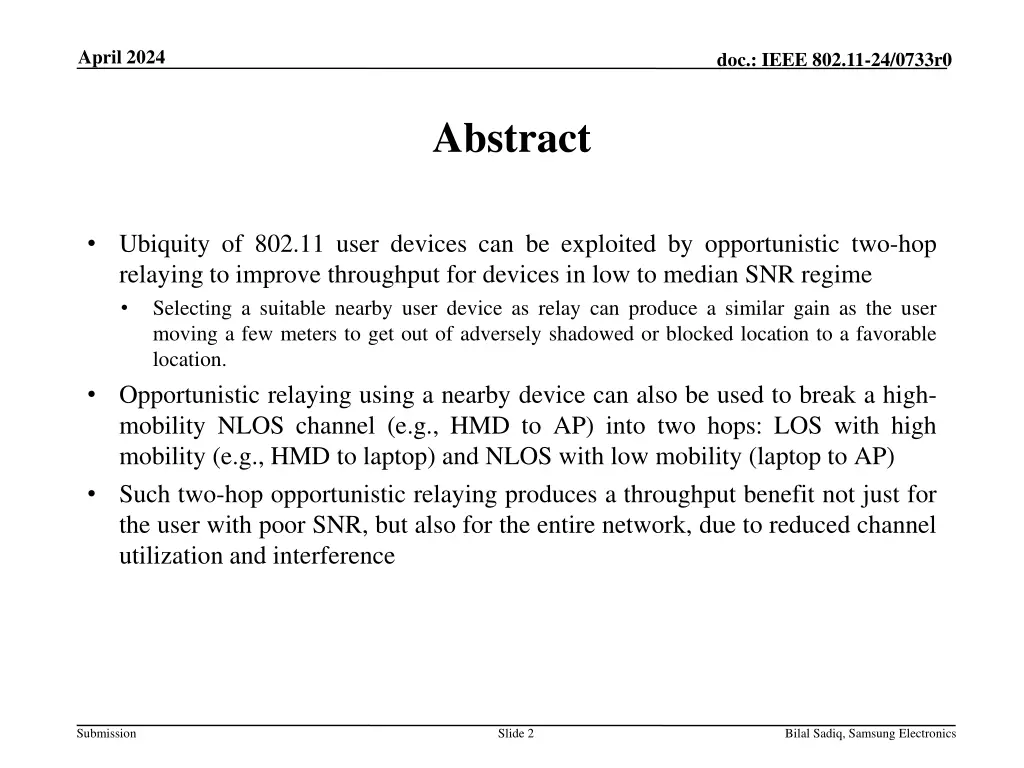
April 2024 doc.: IEEE 802.11-24/0733r0 Abstract Ubiquity of 802.11 user devices can be exploited by opportunistic two-hop relaying to improve throughput for devices in low to median SNR regime Selecting a suitable nearby user device as relay can produce a similar gain as the user moving a few meters to get out of adversely shadowed or blocked location to a favorable location. Opportunistic relaying using a nearby device can also be used to break a high- mobility NLOS channel (e.g., HMD to AP) into two hops: LOS with high mobility (e.g., HMD to laptop) and NLOS with low mobility (laptop to AP) Such two-hop opportunistic relaying produces a throughput benefit not just for the user with poor SNR, but also for the entire network, due to reduced channel utilization and interference Submission Slide 2 Bilal Sadiq, Samsung Electronics
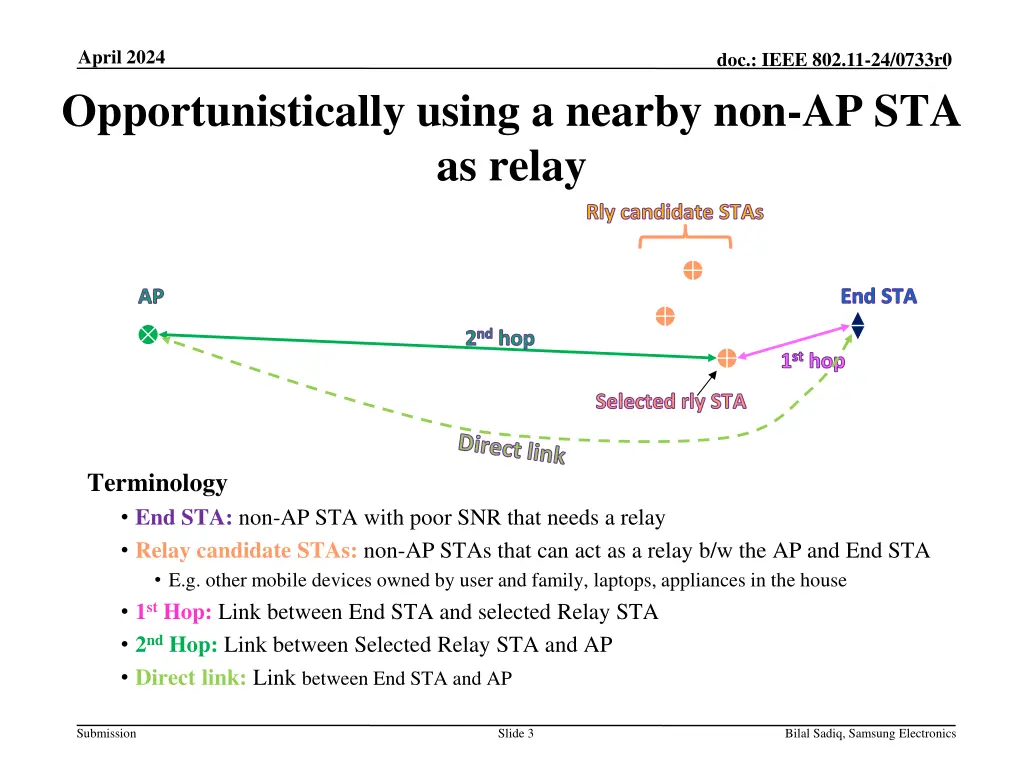
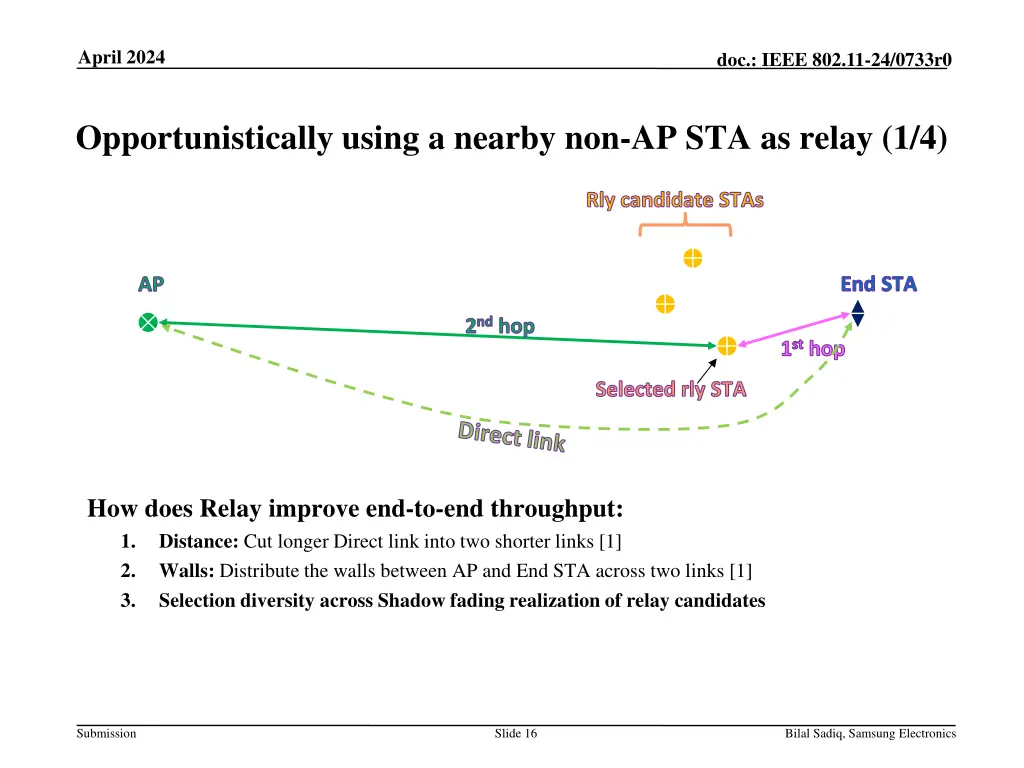
April 2024 doc.: IEEE 802.11-24/0733r0 Opportunistically using a nearby non-AP STA as relay Rly candidate STAs End STA AP 2ndhop 1sthop Selected rly STA Direct link Terminology End STA: non-AP STA with poor SNR that needs a relay Relay candidate STAs: non-AP STAs that can act as a relay b/w the AP and End STA E.g. other mobile devices owned by user and family, laptops, appliances in the house 1st Hop: Link between End STA and selected Relay STA 2nd Hop: Link between Selected Relay STA and AP Direct link: Link between End STA and AP Submission Slide 3 Bilal Sadiq, Samsung Electronics
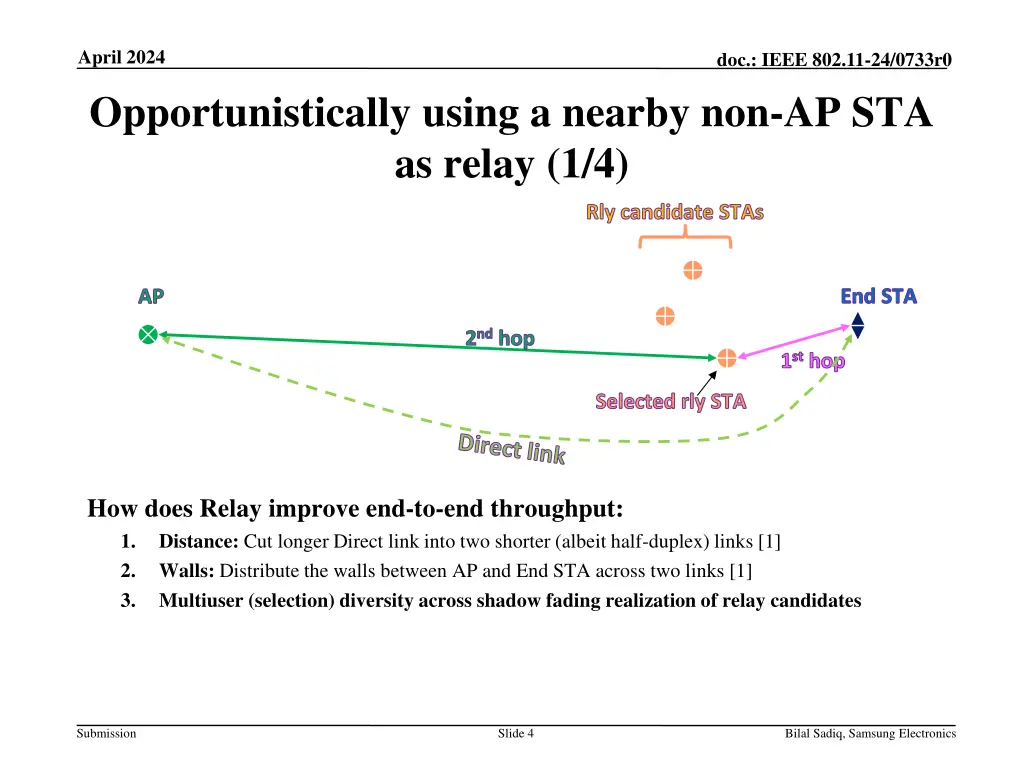
April 2024 doc.: IEEE 802.11-24/0733r0 Opportunistically using a nearby non-AP STA as relay (1/4) Rly candidate STAs End STA AP 2ndhop 1sthop Selected rly STA Direct link How does Relay improve end-to-end throughput: 1. Distance: Cut longer Direct link into two shorter (albeit half-duplex) links [1] 2. Walls: Distribute the walls between AP and End STA across two links [1] 3. Multiuser (selection) diversity across shadow fading realization of relay candidates Submission Slide 4 Bilal Sadiq, Samsung Electronics
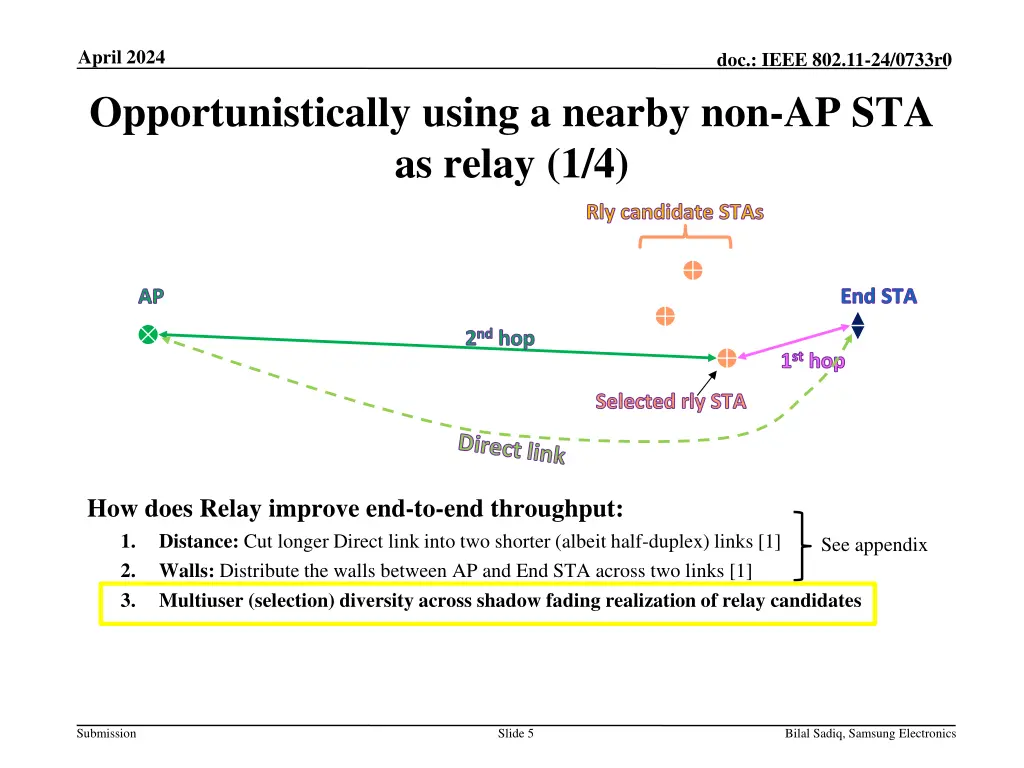
April 2024 doc.: IEEE 802.11-24/0733r0 Opportunistically using a nearby non-AP STA as relay (1/4) Rly candidate STAs End STA AP 2ndhop 1sthop Selected rly STA Direct link How does Relay improve end-to-end throughput: 1. Distance: Cut longer Direct link into two shorter (albeit half-duplex) links [1] 2. Walls: Distribute the walls between AP and End STA across two links [1] 3. Multiuser (selection) diversity across shadow fading realization of relay candidates See appendix Submission Slide 5 Bilal Sadiq, Samsung Electronics
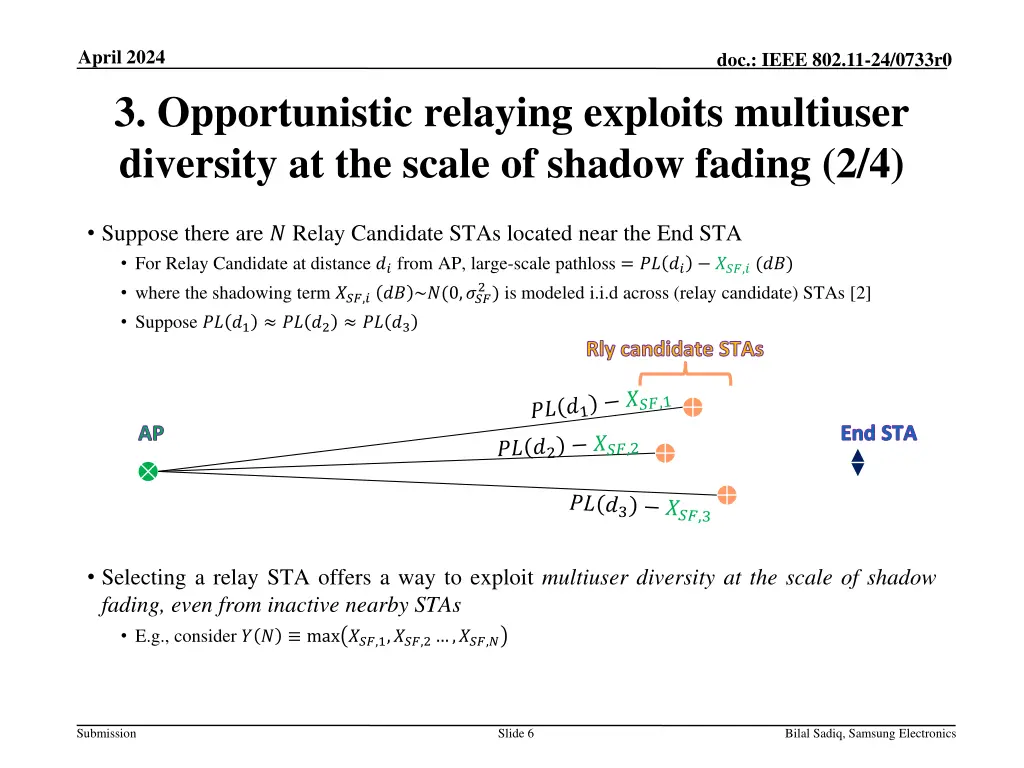
April 2024 doc.: IEEE 802.11-24/0733r0 3. Opportunistic relaying exploits multiuser diversity at the scale of shadow fading (2/4) Suppose there are ? Relay Candidate STAs located near the End STA For Relay Candidate at distance ?? from AP, large-scale pathloss = ?? ?? ???,? (??) where the shadowing term ???,? ?? ~?(0,??? Suppose ?? ?1 ?? ?2 ?? ?3 2) is modeled i.i.d across (relay candidate) STAs [2] Rly candidate STAs End STA AP Selecting a relay STA offers a way to exploit multiuser diversity at the scale of shadow fading, even from inactive nearby STAs E.g., consider ? ? max ???,1,???,2 ,???,? Submission Slide 6 Bilal Sadiq, Samsung Electronics
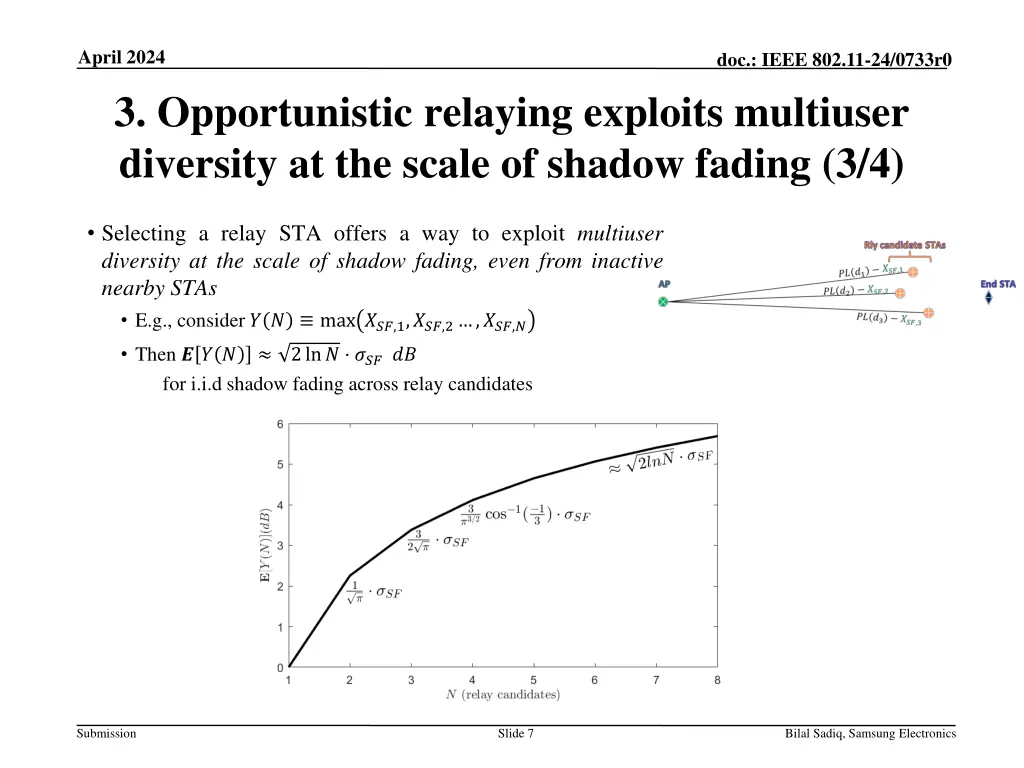
April 2024 doc.: IEEE 802.11-24/0733r0 3. Opportunistic relaying exploits multiuser diversity at the scale of shadow fading (3/4) Selecting a relay STA offers a way to exploit multiuser diversity at the scale of shadow fading, even from inactive nearby STAs E.g., consider ? ? max ???,1,???,2 ,???,? Then ? ? ? 2ln? ??? ?? for i.i.d shadow fading across relay candidates Submission Slide 7 Bilal Sadiq, Samsung Electronics
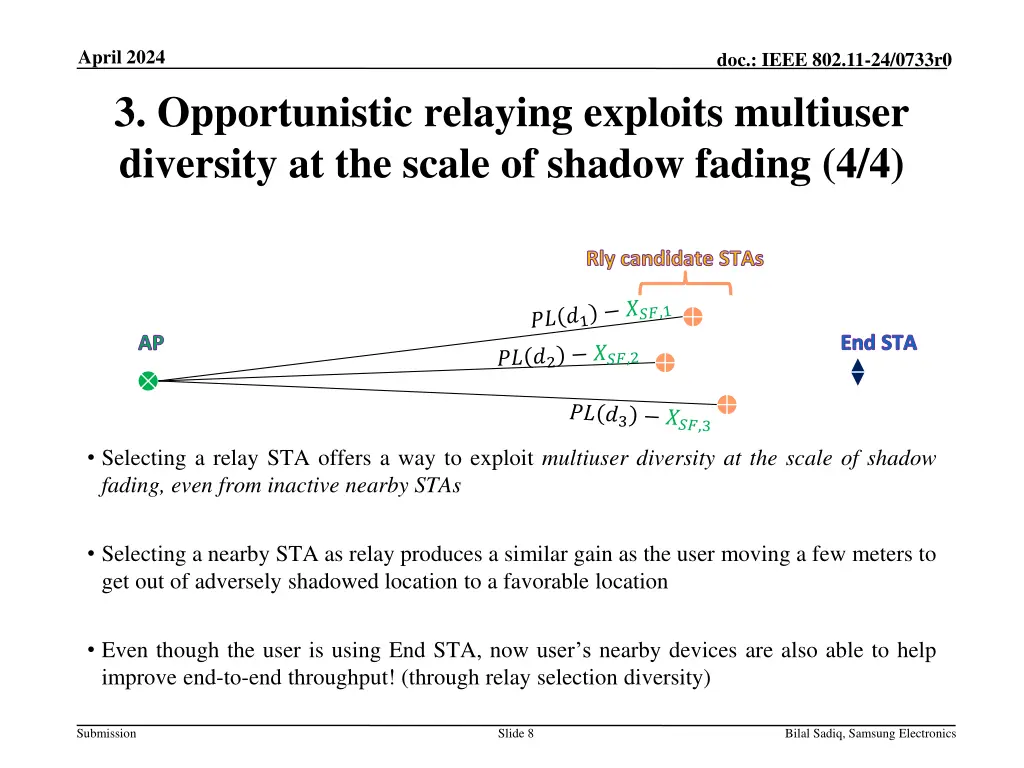
April 2024 doc.: IEEE 802.11-24/0733r0 3. Opportunistic relaying exploits multiuser diversity at the scale of shadow fading (4/4) Rly candidate STAs End STA AP Selecting a relay STA offers a way to exploit multiuser diversity at the scale of shadow fading, even from inactive nearby STAs Selecting a nearby STA as relay produces a similar gain as the user moving a few meters to get out of adversely shadowed location to a favorable location Even though the user is using End STA, now user s nearby devices are also able to help improve end-to-end throughput! (through relay selection diversity) Submission Slide 8 Bilal Sadiq, Samsung Electronics
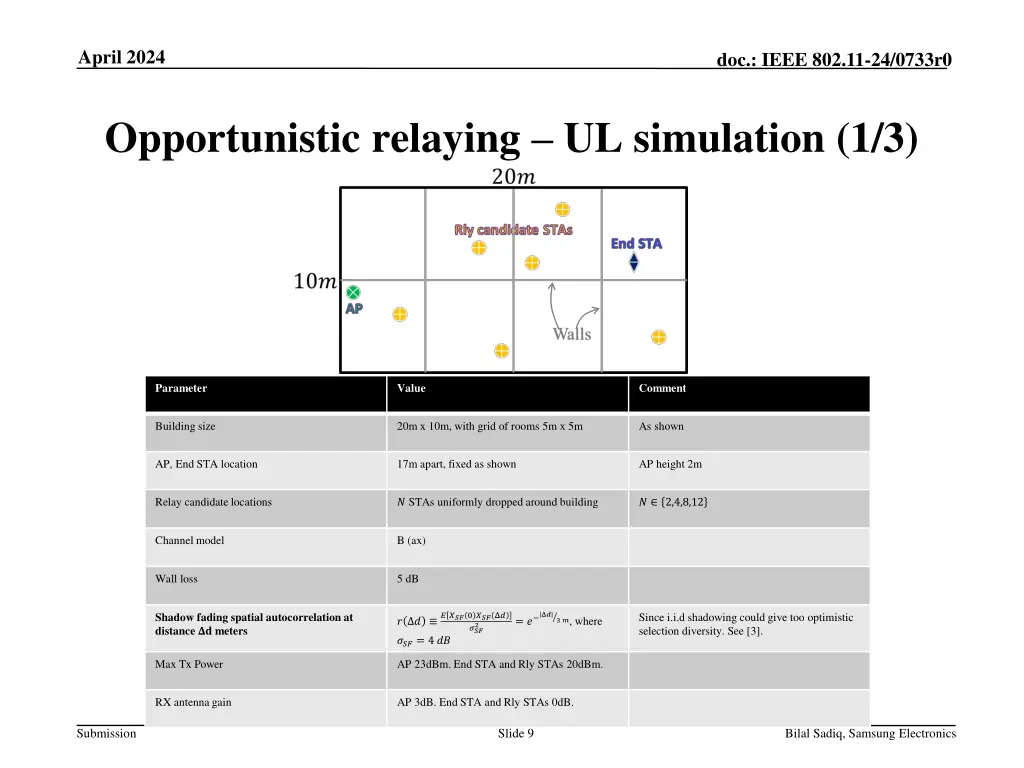
April 2024 doc.: IEEE 802.11-24/0733r0 Opportunistic relaying UL simulation (1/3) Parameter Value Comment Building size 20m x 10m, with grid of rooms 5m x 5m As shown AP, End STA location 17m apart, fixed as shown AP height 2m Relay candidate locations ? STAs uniformly dropped around building ? 2,4,8,12 Channel model B (ax) Wall loss 5 dB Shadow fading spatial autocorrelation at distance ?? meters Since i.i.d shadowing could give too optimistic selection diversity. See [3]. ? ? ? ? ???0 ??? ? = ? 3 ?, where 2 ??? ???= 4 ?? Max Tx Power AP 23dBm. End STA and Rly STAs 20dBm. RX antenna gain AP 3dB. End STA and Rly STAs 0dB. Submission Slide 9 Bilal Sadiq, Samsung Electronics
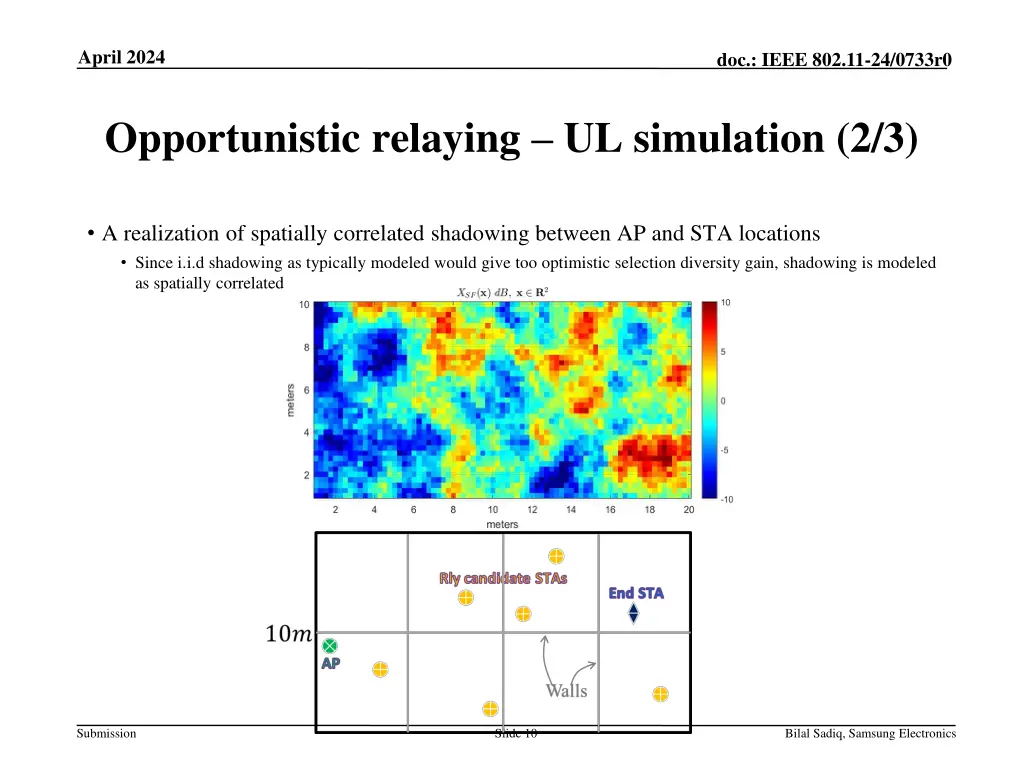
April 2024 doc.: IEEE 802.11-24/0733r0 Opportunistic relaying UL simulation (2/3) A realization of spatially correlated shadowing between AP and STA locations Since i.i.d shadowing as typically modeled would give too optimistic selection diversity gain, shadowing is modeled as spatially correlated Submission Slide 10 Bilal Sadiq, Samsung Electronics
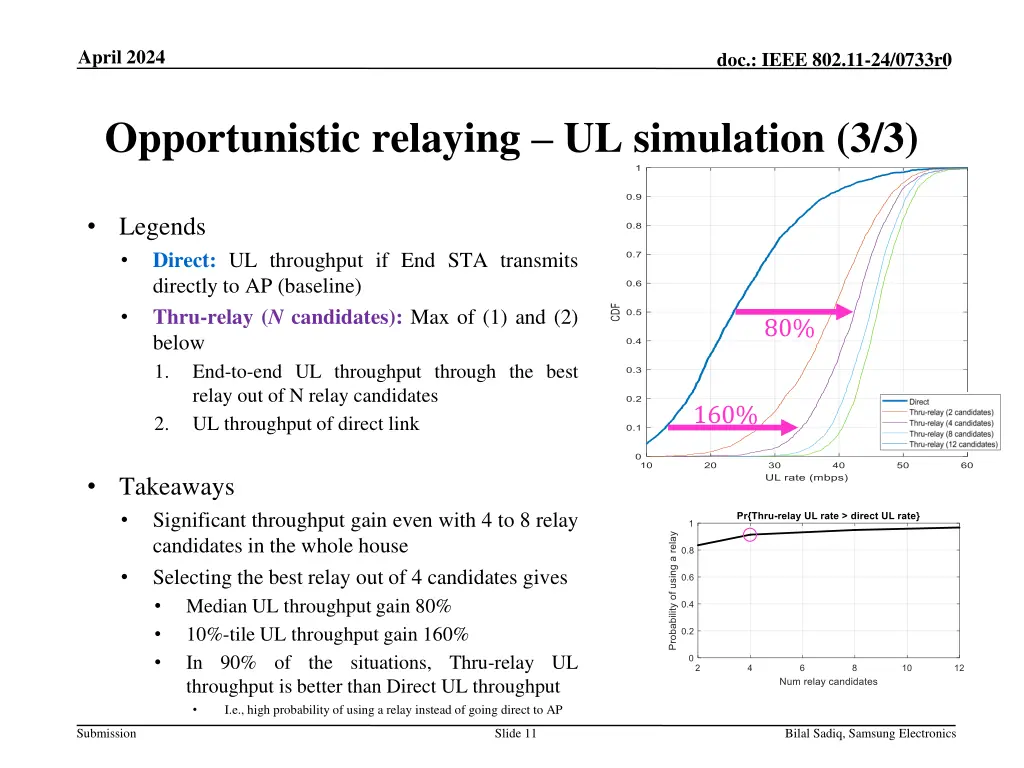
April 2024 doc.: IEEE 802.11-24/0733r0 Opportunistic relaying UL simulation (3/3) Legends Direct: UL throughput if End STA transmits directly to AP (baseline) Thru-relay (N candidates): Max of (1) and (2) below 1. End-to-end UL throughput through the best relay out of N relay candidates 2. UL throughput of direct link 80% 160% Takeaways Significant throughput gain even with 4 to 8 relay candidates in the whole house Selecting the best relay out of 4 candidates gives Median UL throughput gain 80% 10%-tile UL throughput gain 160% In 90% of the situations, Thru-relay UL throughput is better than Direct UL throughput I.e., high probability of using a relay instead of going direct to AP Submission Slide 11 Bilal Sadiq, Samsung Electronics
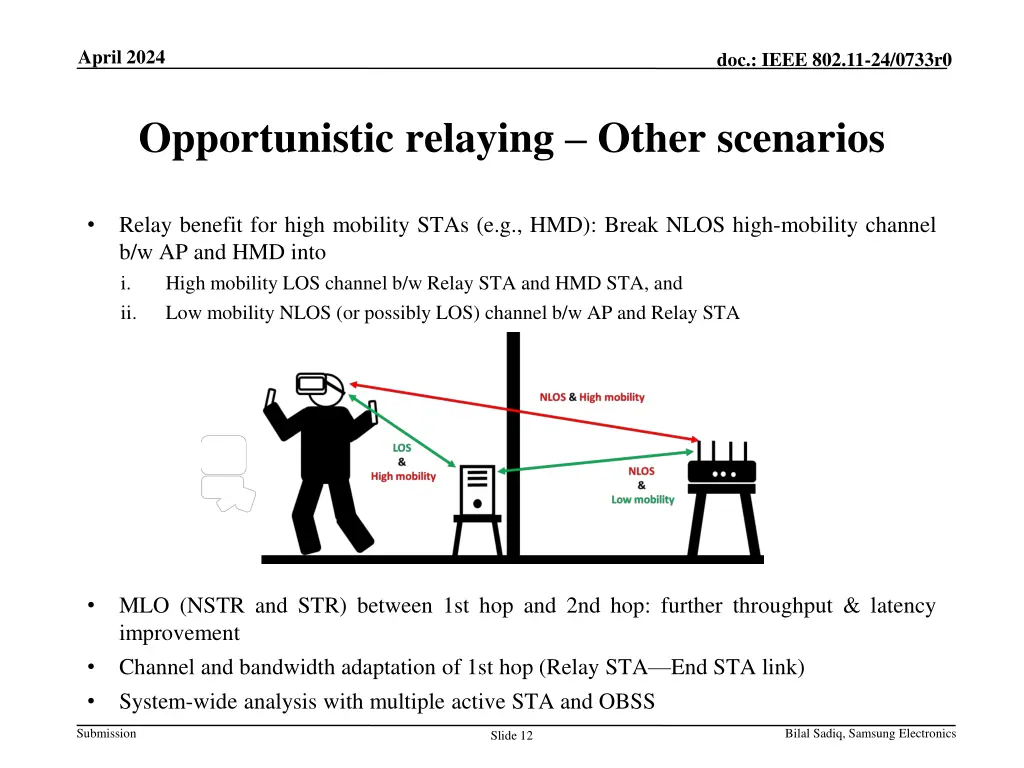
April 2024 doc.: IEEE 802.11-24/0733r0 Opportunistic relaying Other scenarios Relay benefit for high mobility STAs (e.g., HMD): Break NLOS high-mobility channel b/w AP and HMD into i. High mobility LOS channel b/w Relay STA and HMD STA, and ii. Low mobility NLOS (or possibly LOS) channel b/w AP and Relay STA MLO (NSTR and STR) between 1st hop and 2nd hop: further throughput & latency improvement Channel and bandwidth adaptation of 1st hop (Relay STA End STA link) System-wide analysis with multiple active STA and OBSS Submission Bilal Sadiq, Samsung Electronics Slide 12
April 2024 doc.: IEEE 802.11-24/0733r0 Conclusion Enabling a nearby user device (non-AP STAs) to act as a relay between the AP and the end STA can significantly improve throughput in the low to median SNR regime Network burden to network asset: This relay feature turns large number of 802.11 devices (including inactive/idle ones) present in a BSS into a network asset. Since devices in poor coverage utilize more resources, such relays have a system-wide benefit. From the POV of end user: even though the user is active on one device, the user s other nearby devices can still contribute to improving user s throughput, especially when user is in poor coverage. Through relay selection from amongst the nearby devices, this relay feature enables harvesting a form of multiuser diversity at the scale of shadowing fading and wall-loss, even from inactive/idle devices. Defining such a relay feature in 802.11bn would significantly deliver on RvR promise. Submission Slide 13 Bilal Sadiq, Samsung Electronics
April 2024 doc.: IEEE 802.11-24/0733r0 References [1] UHR Rate-vs-Range Enhancement with Relay, IEEE 802.11-22/1908r1 [2] IEEE 802.11ax Channel Model Document, IEEE 802.11-14/0882r4 [3] Study on channel model for frequencies from 0.5 to 100 GHz, 3GPP TR 38.901 Submission Slide 14 Bilal Sadiq, Samsung Electronics
April 2024 doc.: IEEE 802.11-24/0733r0 Appendix Submission Slide 15 Bilal Sadiq, Samsung Electronics
April 2024 doc.: IEEE 802.11-24/0733r0 Opportunistically using a nearby non-AP STA as relay (1/4) Rly candidate STAs End STA AP 2ndhop 1sthop Selected rly STA Direct link How does Relay improve end-to-end throughput: 1. Distance: Cut longer Direct link into two shorter links [1] 2. Walls: Distribute the walls between AP and End STA across two links [1] 3. Selection diversity across Shadow fading realization of relay candidates Submission Slide 16 Bilal Sadiq, Samsung Electronics
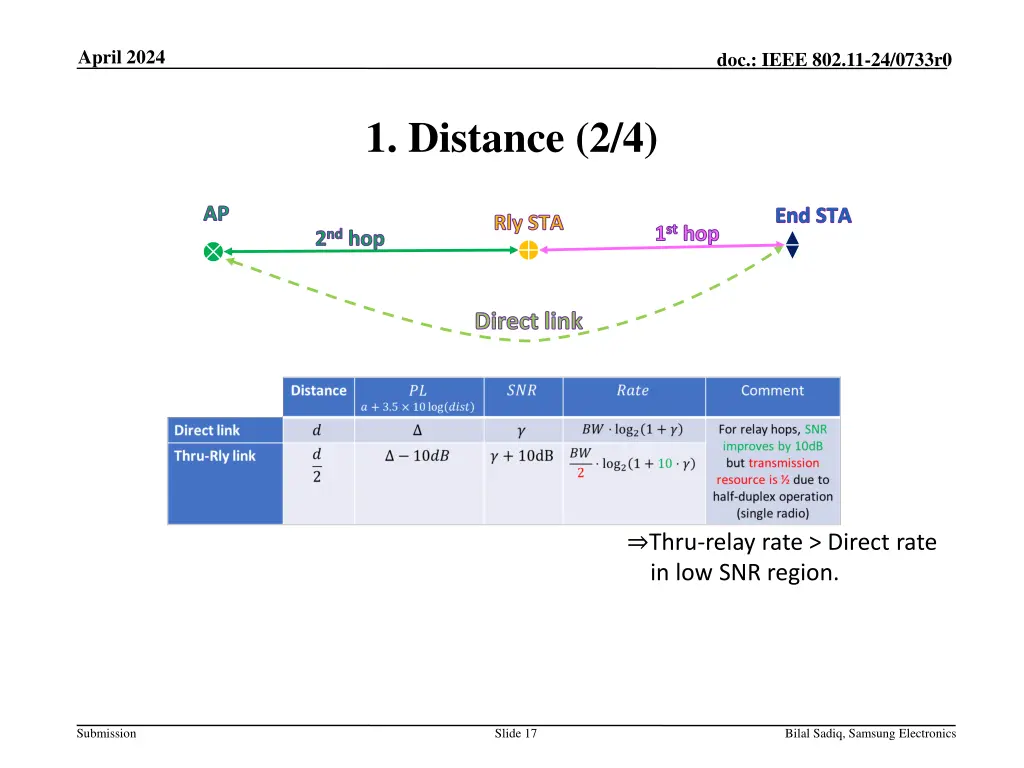
April 2024 doc.: IEEE 802.11-24/0733r0 1. Distance (2/4) AP End STA Rly STA 1sthop 2ndhop Direct link Thru-relay rate > Direct rate in low SNR region. Submission Slide 17 Bilal Sadiq, Samsung Electronics
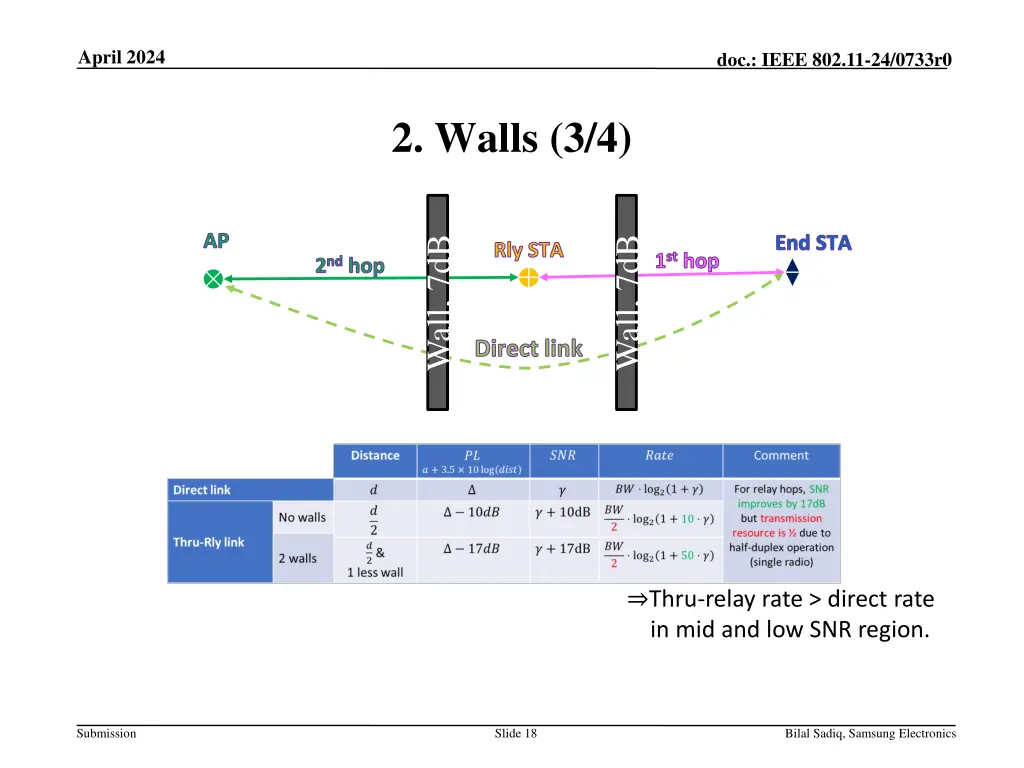
April 2024 doc.: IEEE 802.11-24/0733r0 2. Walls (3/4) AP End STA Wall, 7dB Wall, 7dB Rly STA 1sthop 2ndhop Direct link Thru-relay rate > direct rate in mid and low SNR region. Submission Slide 18 Bilal Sadiq, Samsung Electronics
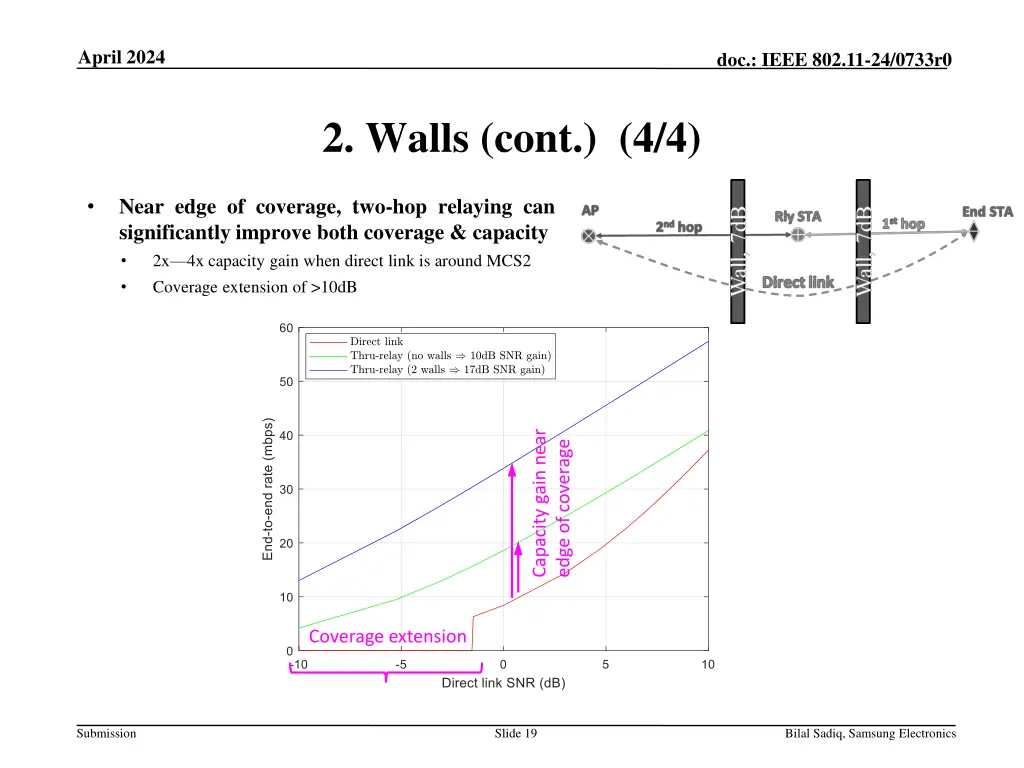
April 2024 doc.: IEEE 802.11-24/0733r0 2. Walls (cont.) (4/4) Near edge of coverage, two-hop relaying can significantly improve both coverage & capacity 2x 4x capacity gain when direct link is around MCS2 Coverage extension of >10dB Capacity gain near edge of coverage Coverage extension Submission Slide 19 Bilal Sadiq, Samsung Electronics
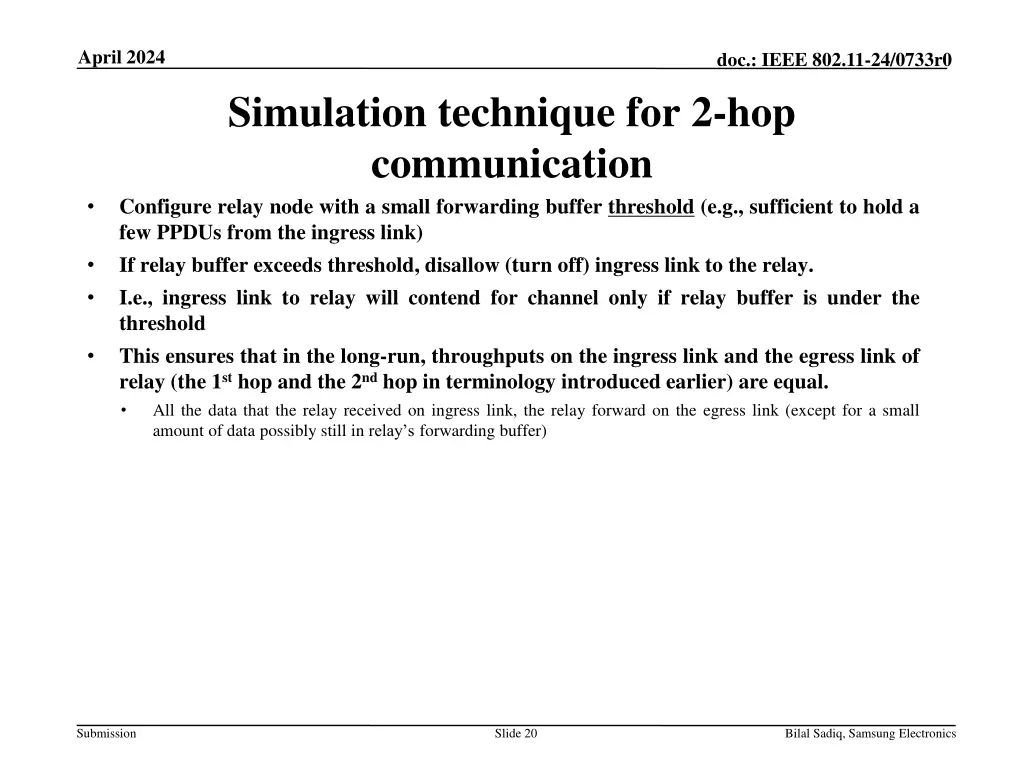
April 2024 doc.: IEEE 802.11-24/0733r0 Simulation technique for 2-hop communication Configure relay node with a small forwarding buffer threshold (e.g., sufficient to hold a few PPDUs from the ingress link) If relay buffer exceeds threshold, disallow (turn off) ingress link to the relay. I.e., ingress link to relay will contend for channel only if relay buffer is under the threshold This ensures that in the long-run, throughputs on the ingress link and the egress link of relay (the 1st hop and the 2nd hop in terminology introduced earlier) are equal. All the data that the relay received on ingress link, the relay forward on the egress link (except for a small amount of data possibly still in relay s forwarding buffer) Submission Slide 20 Bilal Sadiq, Samsung Electronics