Optimal Design of a Parallel Groups Trial with Prospective Baseline Period
This presentation delves into cluster randomised trials in continuous time, discussing optimal trial designs, assumptions, and patterns of recruitment. Topics covered include discrete repeated cross-sections, alternative recruitment patterns, and the impact of continuous recruitment on cluster size and crossover times.

Download Presentation

Please find below an Image/Link to download the presentation.
The content on the website is provided AS IS for your information and personal use only. It may not be sold, licensed, or shared on other websites without obtaining consent from the author.If you encounter any issues during the download, it is possible that the publisher has removed the file from their server.
You are allowed to download the files provided on this website for personal or commercial use, subject to the condition that they are used lawfully. All files are the property of their respective owners.
The content on the website is provided AS IS for your information and personal use only. It may not be sold, licensed, or shared on other websites without obtaining consent from the author.
E N D
Presentation Transcript
Cluster randomised trials in continuous time: Optimal design of a parallel groups trial with a prospective baseline period Richard Hooper Queen Mary University of London Andrew Copas University College London
Discrete repeated cross-sections Most papers on multi-period CRTs assume: exchangeability within each period time effect is constant within a period Motivated by an assumption that recruitment is in discrete, repeated cross-sections www.qmul.ac.uk/pctu
Discrete repeated cross-sections Most papers on multi-period CRTs assume: exchangeability within each period time effect is constant within a period Motivated by an assumption that recruitment is in discrete, repeated cross-sections e.g. Devon Active Villages Evaluation (DAVE): each village surveyed at five discrete times www.qmul.ac.uk/pctu
An alternative pattern of recruitment e.g. LBWSAT trial Evaluated impact on birth weight and children s weight-for-age Z-score of a behaviour change strategy for pregnant women Clusters were Village Development Committees in Nepal (pop. 4000-9000) Participants were women falling pregnant from Dec 2013 to Feb 2015 www.qmul.ac.uk/pctu
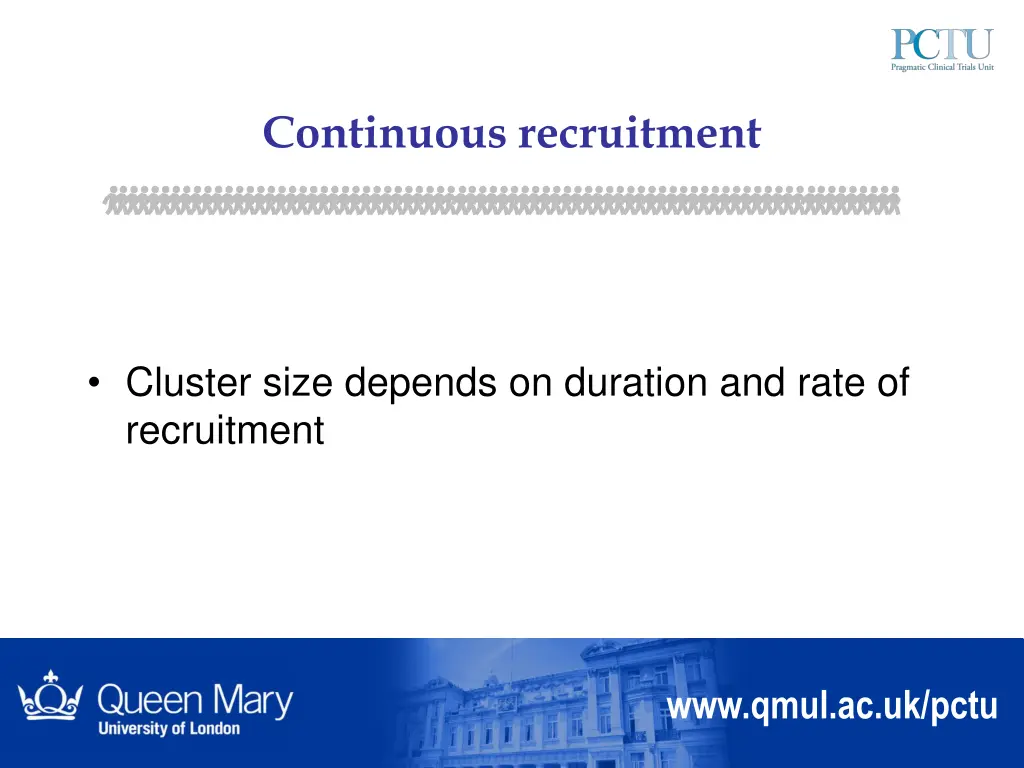
Continuous recruitment Cluster size depends on duration and rate of recruitment www.qmul.ac.uk/pctu
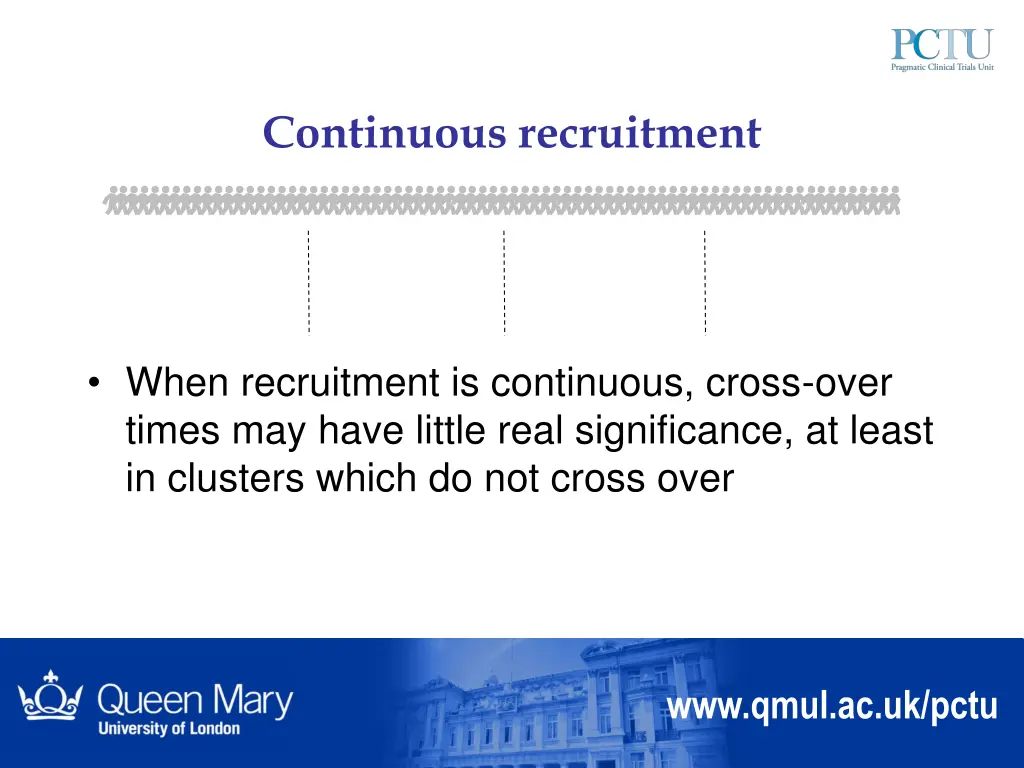
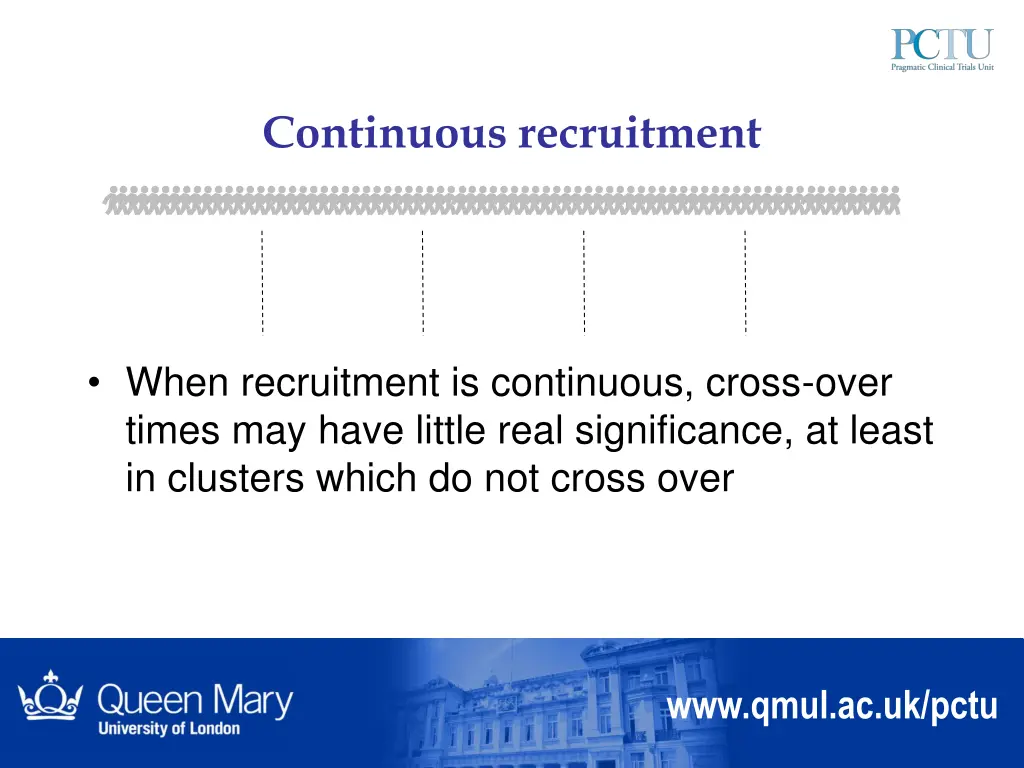
Continuous recruitment When recruitment is continuous, cross-over times may have little real significance, at least in clusters which do not cross over www.qmul.ac.uk/pctu
Continuous recruitment When recruitment is continuous, cross-over times may have little real significance, at least in clusters which do not cross over www.qmul.ac.uk/pctu
Continuous recruitment When recruitment is continuous, cross-over times may have little real significance, at least in clusters which do not cross over www.qmul.ac.uk/pctu
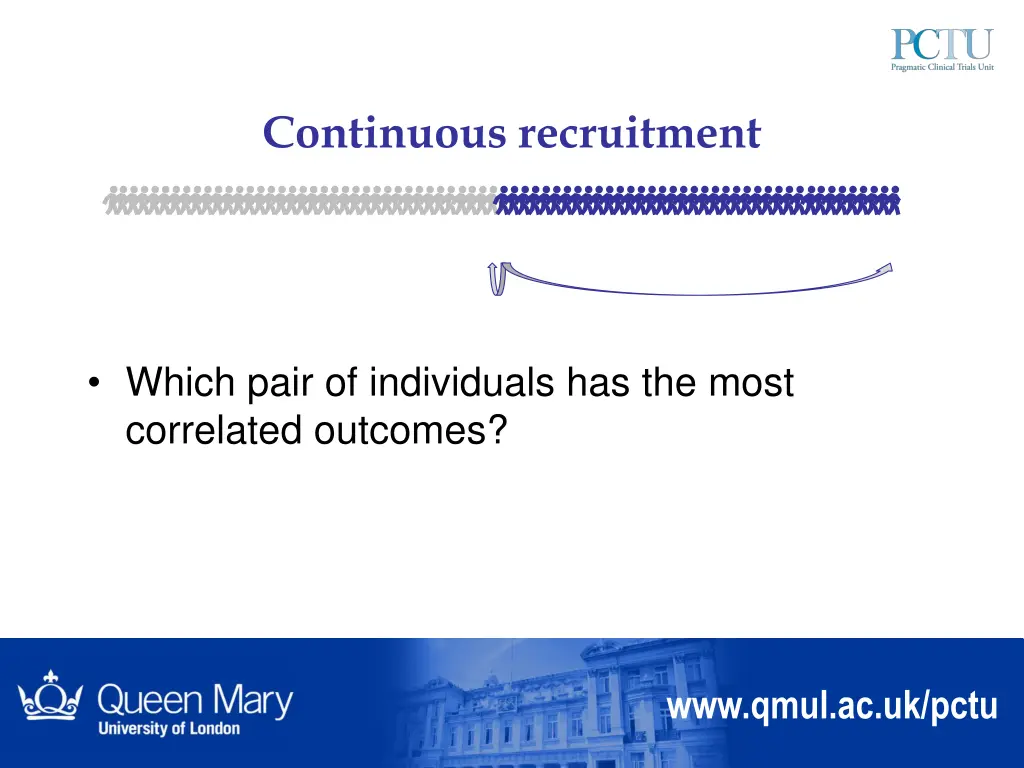
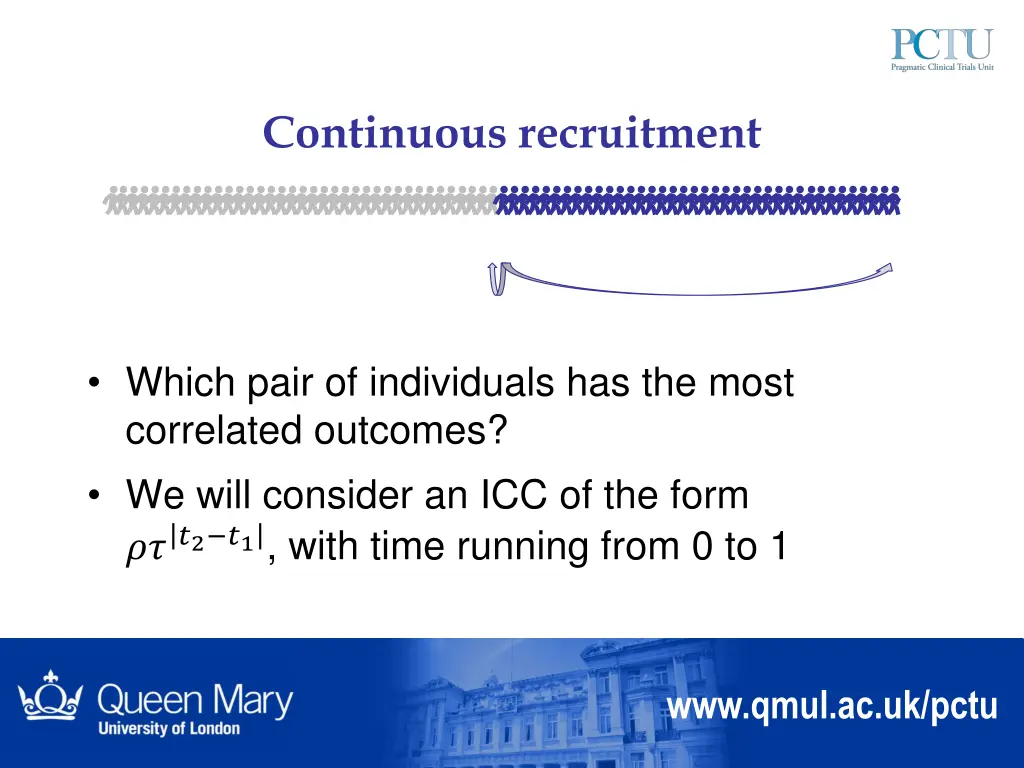
Continuous recruitment Which pair of individuals has the most correlated outcomes? www.qmul.ac.uk/pctu
Continuous recruitment Which pair of individuals has the most correlated outcomes? We will consider an ICC of the form ???2 ?1, with time running from 0 to 1 www.qmul.ac.uk/pctu
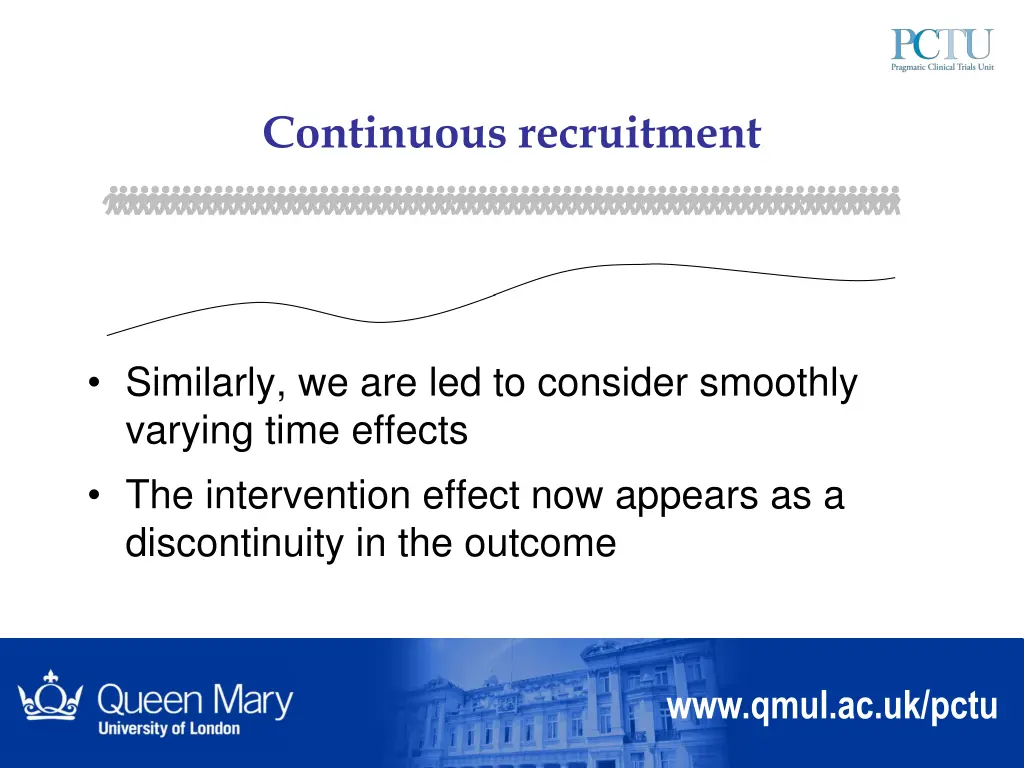
Continuous recruitment Similarly, we are led to consider smoothly varying time effects The intervention effect now appears as a discontinuity in the outcome www.qmul.ac.uk/pctu
Continuous recruitment Similarly, we are led to consider smoothly varying time effects The intervention effect now appears as a discontinuity in the outcome www.qmul.ac.uk/pctu
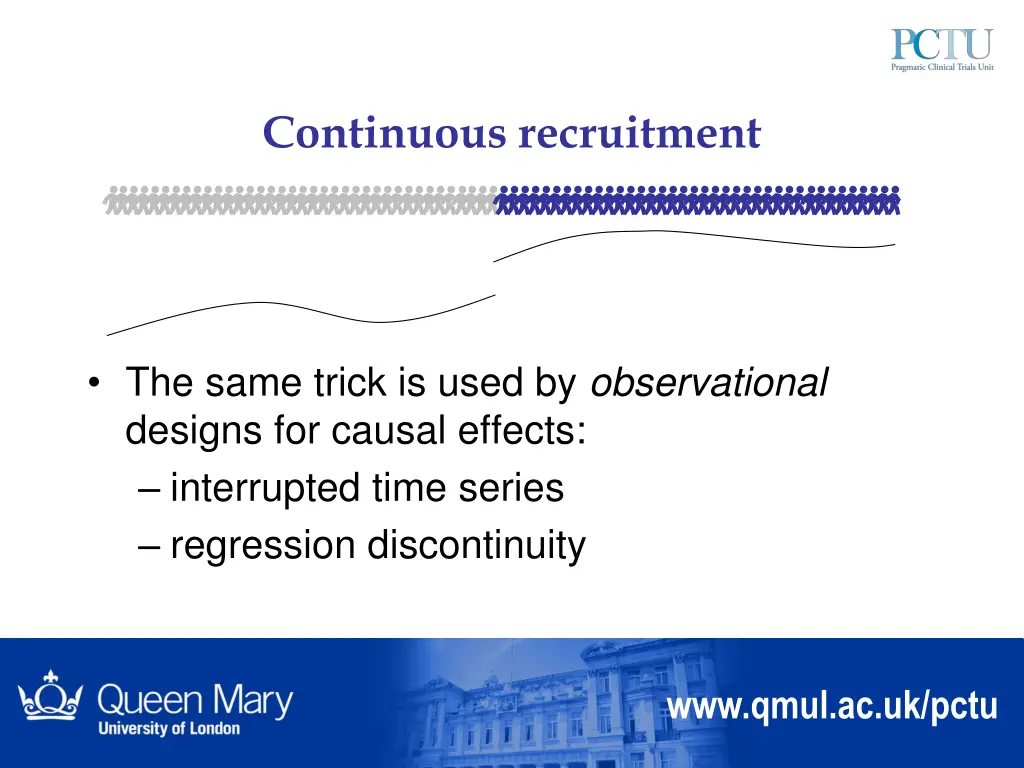
Continuous recruitment The same trick is used by observational designs for causal effects: interrupted time series regression discontinuity www.qmul.ac.uk/pctu
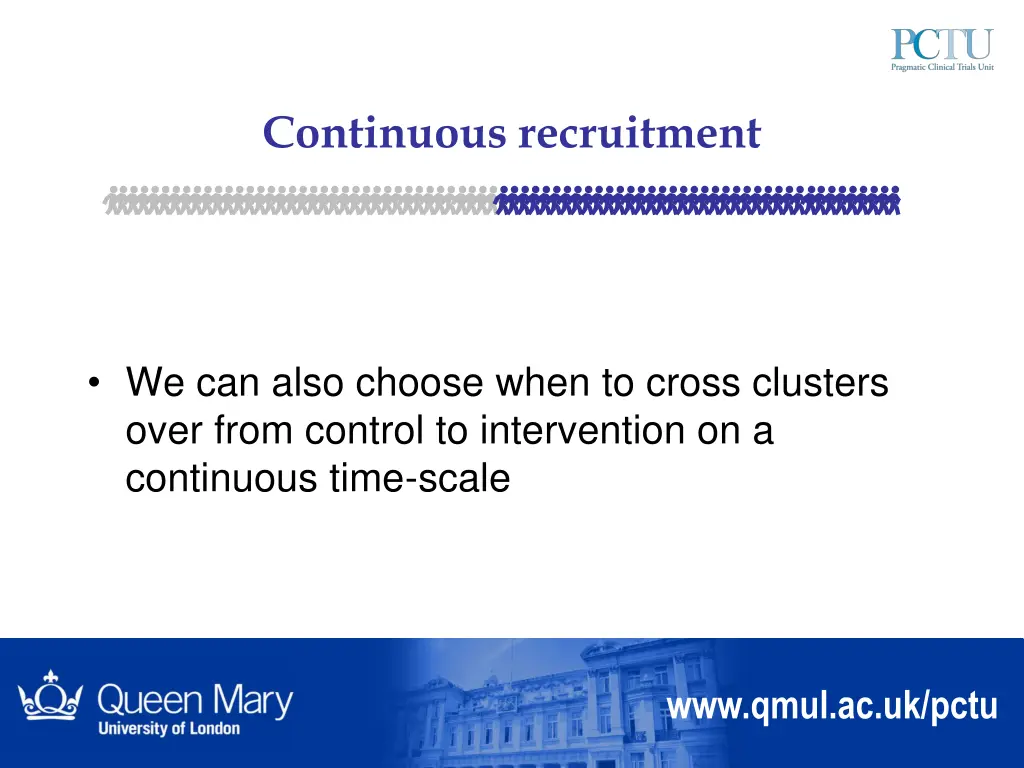
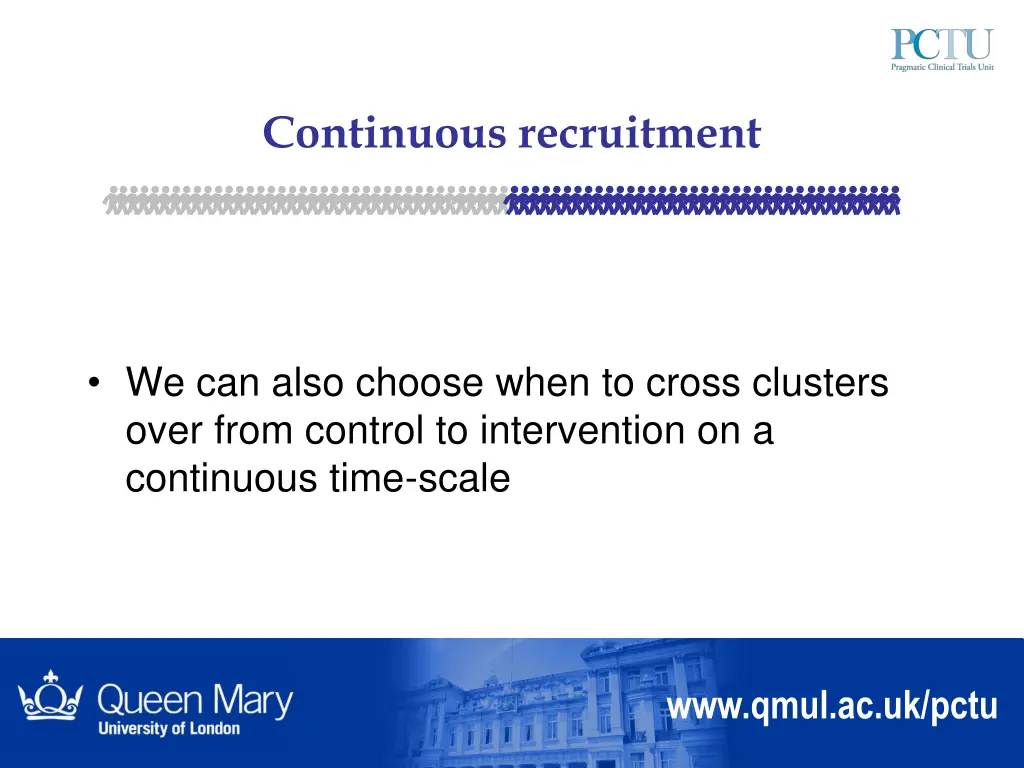
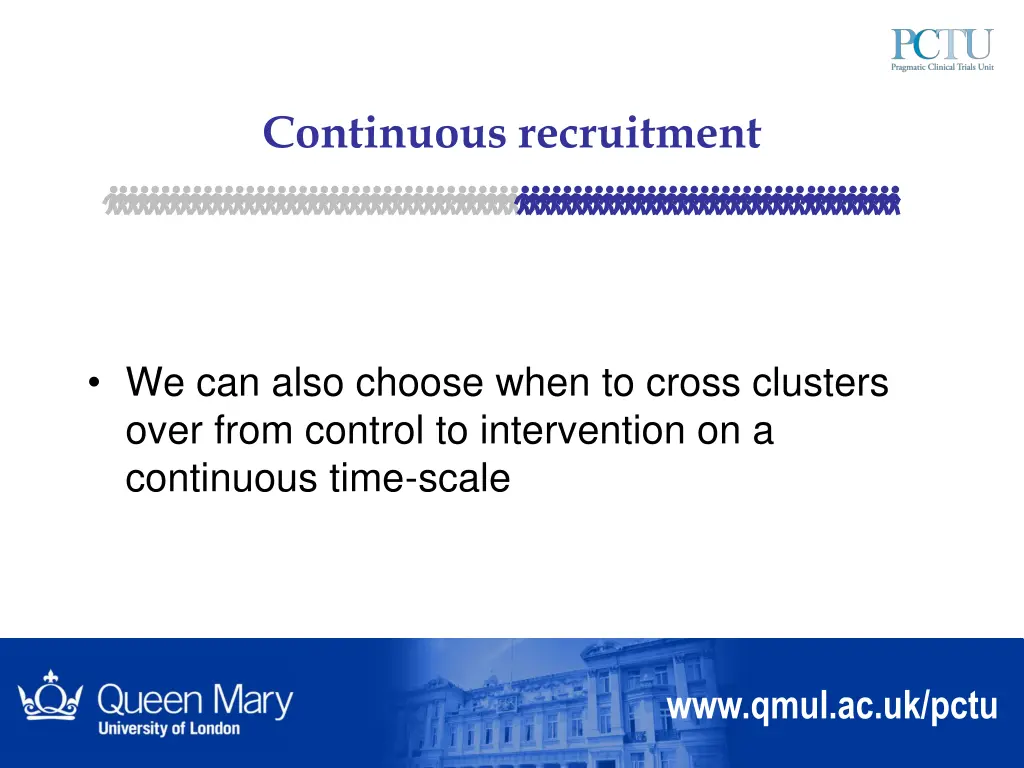
Continuous recruitment We can also choose when to cross clusters over from control to intervention on a continuous time-scale www.qmul.ac.uk/pctu
Continuous recruitment We can also choose when to cross clusters over from control to intervention on a continuous time-scale www.qmul.ac.uk/pctu
Continuous recruitment We can also choose when to cross clusters over from control to intervention on a continuous time-scale www.qmul.ac.uk/pctu
The design problem We consider the optimal design of a CRT in which clusters are allocated 1:1 to two arms: one stays in the control condition throughout the other crosses over to the intervention at some point (but when?) www.qmul.ac.uk/pctu
Schematic representations Time following randomisation Intervention arm Control arm Intervention arm Control arm www.qmul.ac.uk/pctu
Schematic representations Closure period{ Implementation period { Intervention arm Control arm Implementation period { Intervention arm Control arm www.qmul.ac.uk/pctu
Schematic representations Closure period{ Implementation period { Closure period: Long enough for all control participants to have left the cluster or to have had their outcomes assessed Intervention arm Control arm Implementation period { Intervention arm Control arm www.qmul.ac.uk/pctu
Schematic representations Closure period{ Implementation period { Closure + Implementation = Transition period Intervention arm Control arm Implementation period { Intervention arm Control arm www.qmul.ac.uk/pctu
Schematic representations Closure period{ Implementation period { Can continue to recruit in the control arm during the transition period Cf Stephen Senn s An unreasonable prejudice against modelling? Intervention arm Control arm Implementation period { Intervention arm Control arm www.qmul.ac.uk/pctu
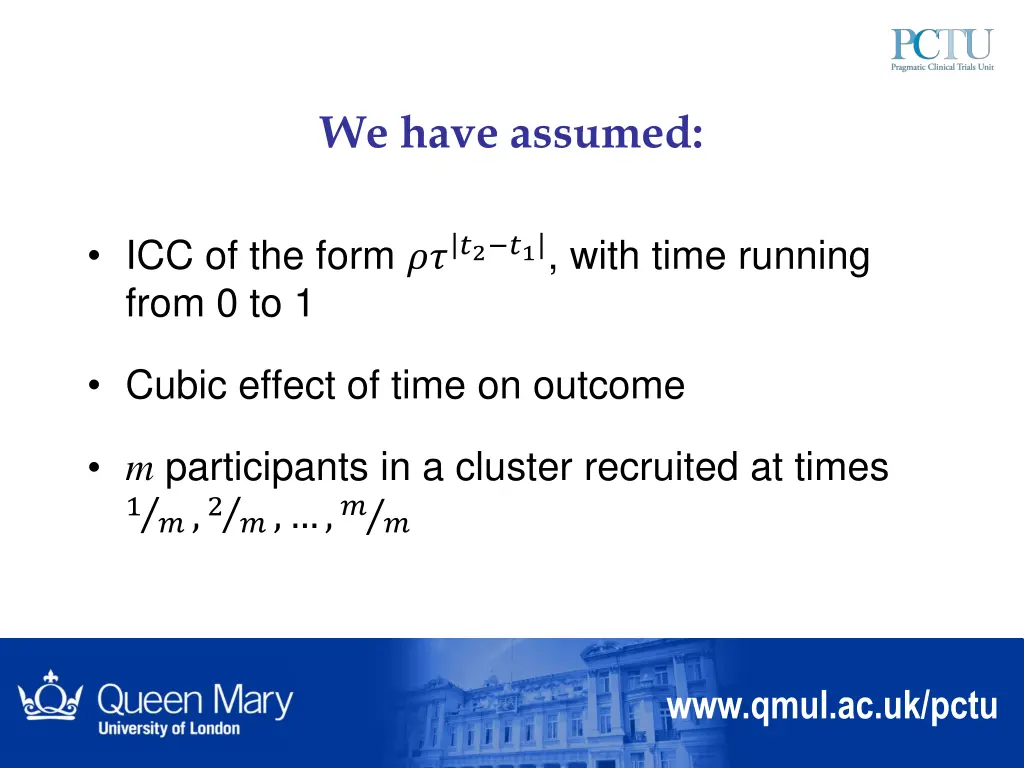
We have assumed: ICC of the form ???2 ?1, with time running from 0 to 1 Cubic effect of time on outcome m participants in a cluster recruited at times 1?, ?? 2?, , www.qmul.ac.uk/pctu
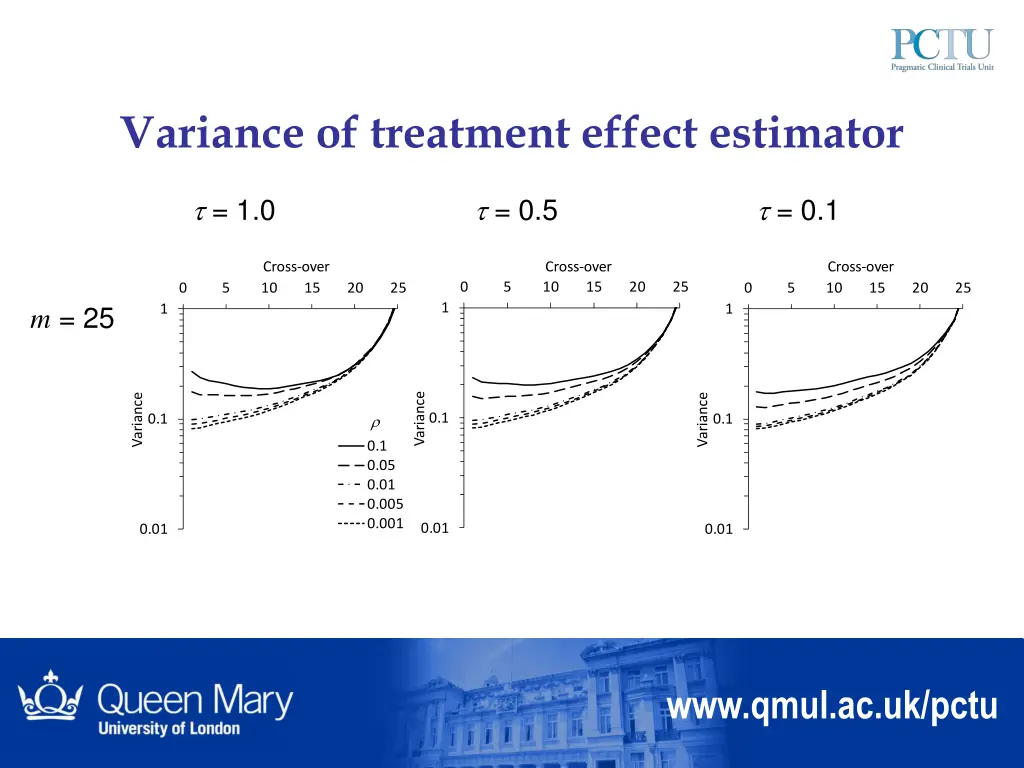
Variance of treatment effect estimator = 1.0 = 0.5 = 0.1 Cross-over Cross-over Cross-over 0 5 10 15 20 25 0 5 10 15 20 25 0 5 10 15 20 25 1 m = 25 1 1 Variance Variance Variance 0.1 r 0.1 0.1 0.1 0.05 0.01 0.005 0.001 0.01 0.01 0.01 www.qmul.ac.uk/pctu
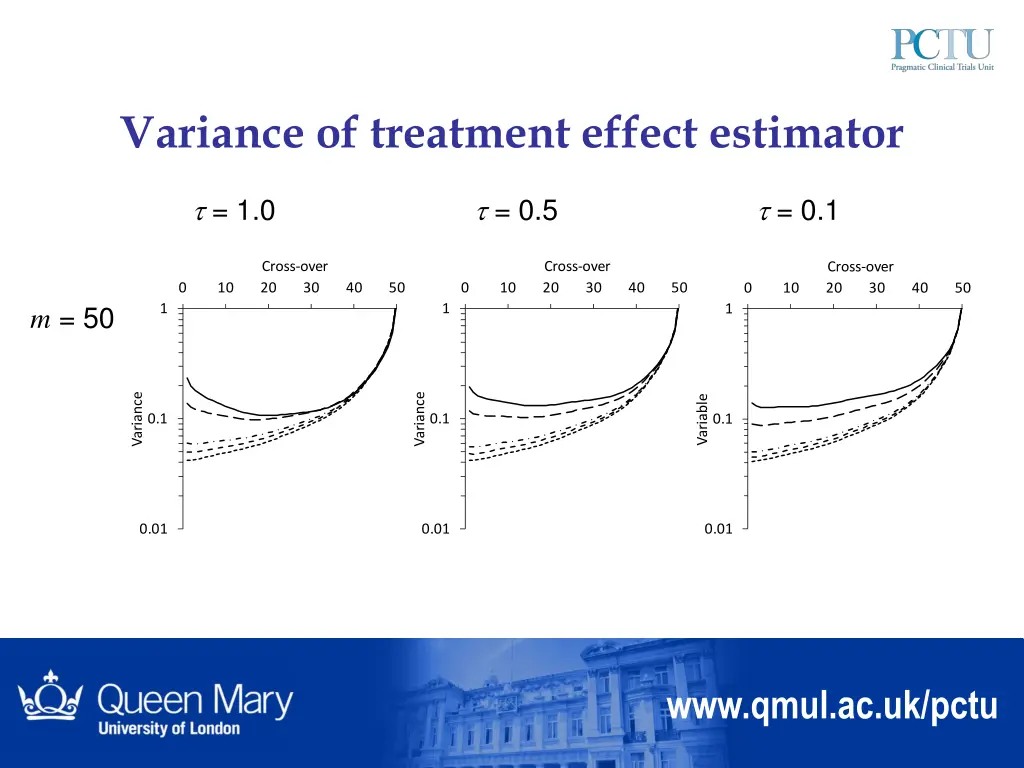
Variance of treatment effect estimator = 1.0 = 0.5 = 0.1 Cross-over Cross-over Cross-over 0 10 20 30 40 50 0 10 20 30 40 50 0 10 20 30 40 50 m = 50 1 1 1 Variance Variance Variable 0.1 0.1 0.1 0.01 0.01 0.01 www.qmul.ac.uk/pctu
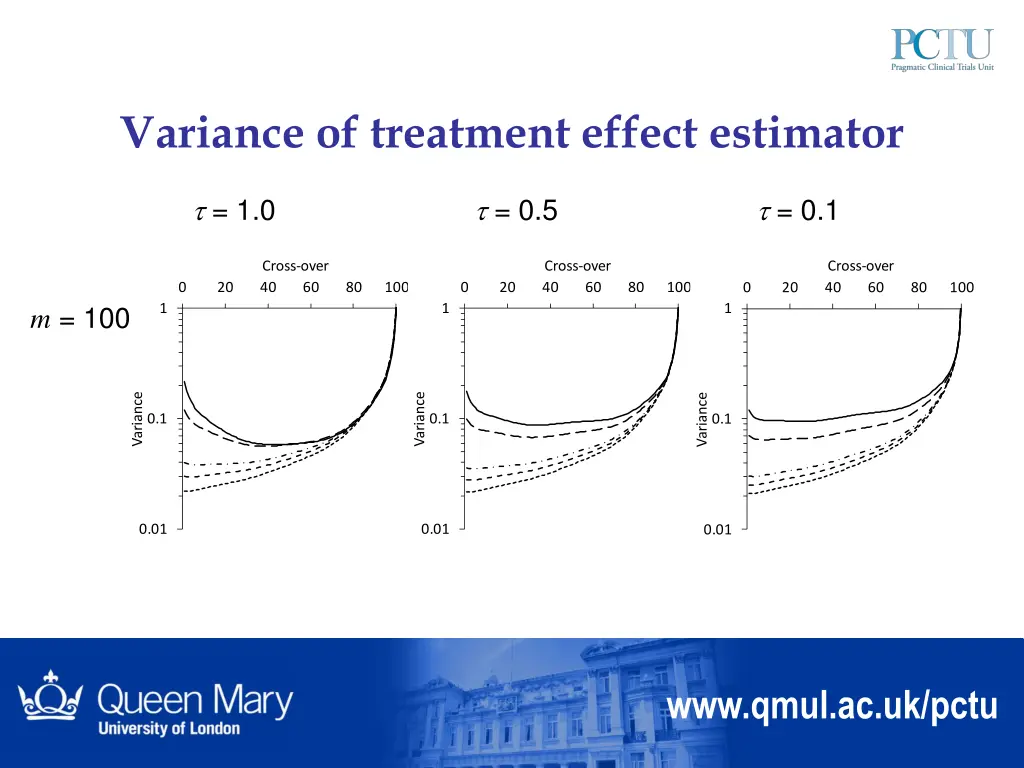
Variance of treatment effect estimator = 1.0 = 0.5 = 0.1 Cross-over Cross-over Cross-over 0 20 40 60 80 100 0 20 40 60 80 100 0 20 40 60 80 100 m = 100 1 1 1 Variance Variance Variance 0.1 0.1 0.1 0.01 0.01 0.01 www.qmul.ac.uk/pctu
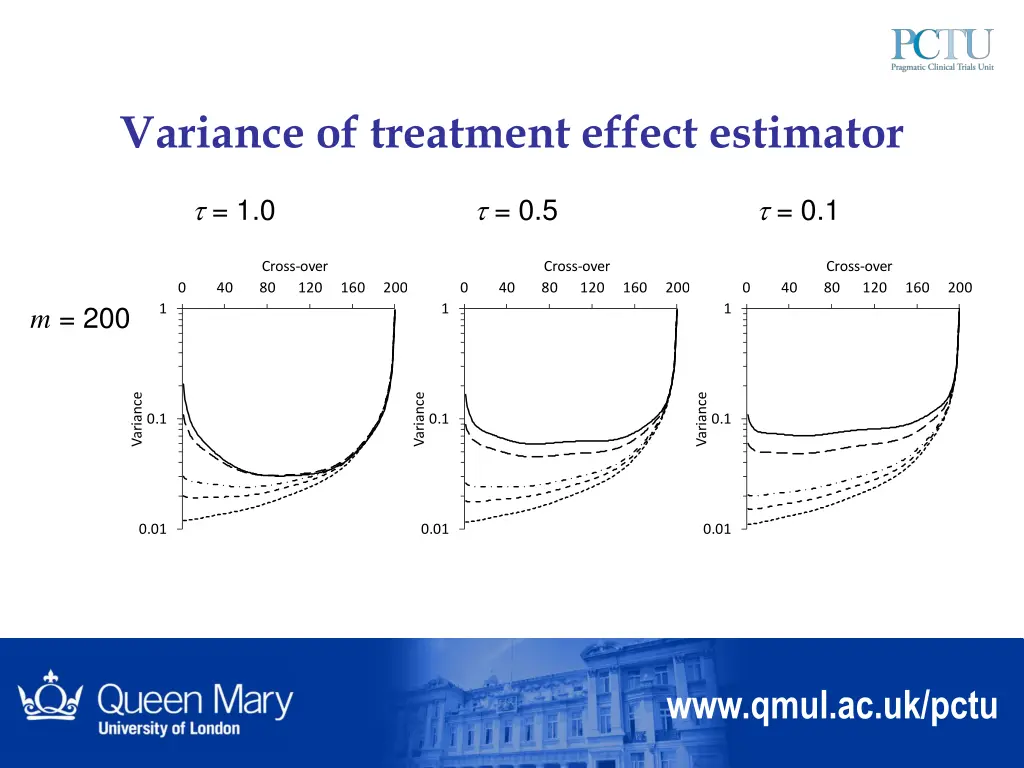
Variance of treatment effect estimator = 1.0 = 0.5 = 0.1 Cross-over Cross-over Cross-over 0 40 80 120 160 200 0 40 80 120 160 200 0 40 80 120 160 200 m = 200 1 1 1 Variance Variance Variance 0.1 0.1 0.1 0.01 0.01 0.01 www.qmul.ac.uk/pctu
Transition period in intervention arm = 1.0 = 0.5 = 0.1 Cross-over Cross-over Cross-over 0 40 80 120 160 200 0 40 80 120 160 200 0 40 80 120 160 200 m = 200 r = 0.01 1 1 1 Variance Variance Variance 0.1 0.1 0.1 r Transition 100 25 75 0 50 0.01 0.01 0.01 www.qmul.ac.uk/pctu
Transition period in both arms = 1.0 = 0.5 = 0.1 Cross-over Cross-over Cross-over 0 40 80 120 160 200 0 40 80 120 160 200 0 40 80 120 160 200 m = 200 r = 0.01 1 1 1 Variance Variance Variance 0.1 0.1 0.1 r 0.01 0.01 0.01 www.qmul.ac.uk/pctu
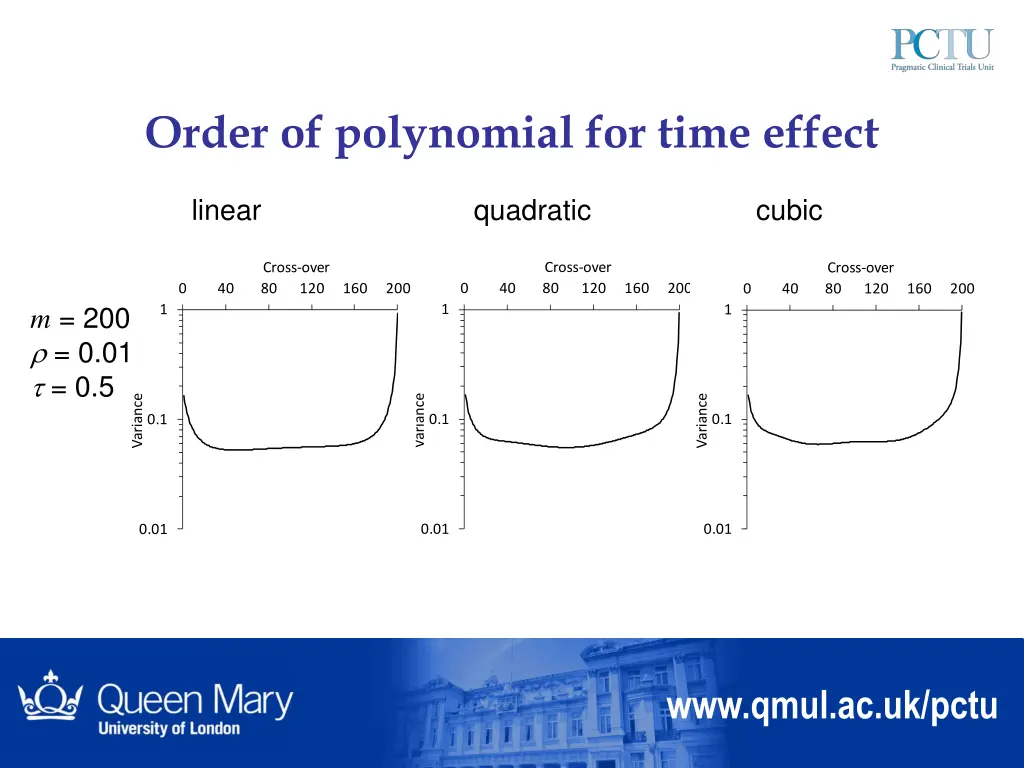
Order of polynomial for time effect linear quadratic cubic Cross-over Cross-over Cross-over 0 40 80 120 160 200 0 40 80 120 160 200 0 40 80 120 160 200 m = 200 r = 0.01 = 0.5 1 1 1 Variance Variance Variance 0.1 0.1 0.1 0.01 0.01 0.01 www.qmul.ac.uk/pctu
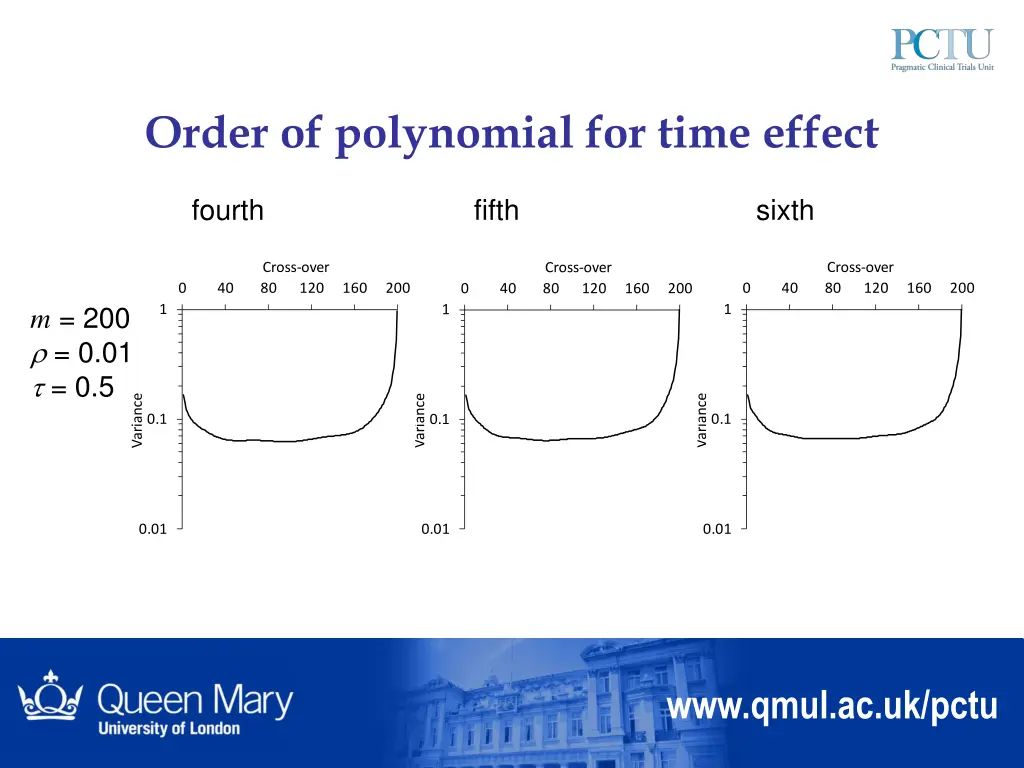
Order of polynomial for time effect fourth fifth sixth Cross-over Cross-over Cross-over 0 40 80 120 160 200 0 40 80 120 160 200 0 40 80 120 160 200 m = 200 r = 0.01 = 0.5 1 1 1 Variance Variance Variance 0.1 0.1 0.1 0.01 0.01 0.01 www.qmul.ac.uk/pctu
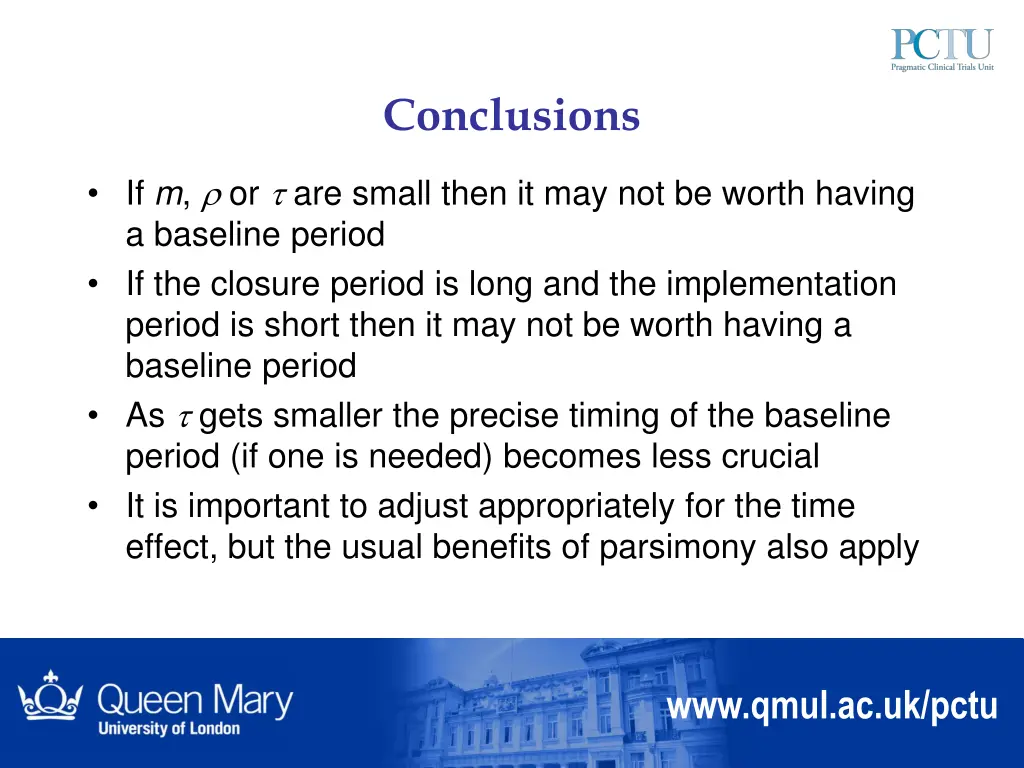
Conclusions If m, r or are small then it may not be worth having a baseline period If the closure period is long and the implementation period is short then it may not be worth having a baseline period As gets smaller the precise timing of the baseline period (if one is needed) becomes less crucial It is important to adjust appropriately for the time effect, but the usual benefits of parsimony also apply www.qmul.ac.uk/pctu
Thank you www.qmul.ac.uk/pctu