Optimize Embedded Code Coverage with LLVM: Strategies & Solutions
Explore strategies to optimize embedded code coverage using LLVM, including reducing memory requirements, moving data sections out of memory, and minimizing runtime support for efficient performance on embedded platforms.

Download Presentation

Please find below an Image/Link to download the presentation.
The content on the website is provided AS IS for your information and personal use only. It may not be sold, licensed, or shared on other websites without obtaining consent from the author. If you encounter any issues during the download, it is possible that the publisher has removed the file from their server.
You are allowed to download the files provided on this website for personal or commercial use, subject to the condition that they are used lawfully. All files are the property of their respective owners.
The content on the website is provided AS IS for your information and personal use only. It may not be sold, licensed, or shared on other websites without obtaining consent from the author.
E N D
Presentation Transcript
Source-based Code Coverage for Embedded Use Cases Alan Phipps, Texas Instruments Cody Addison, Nvidia 2020 LLVM Developers Meeting, October 2020 1
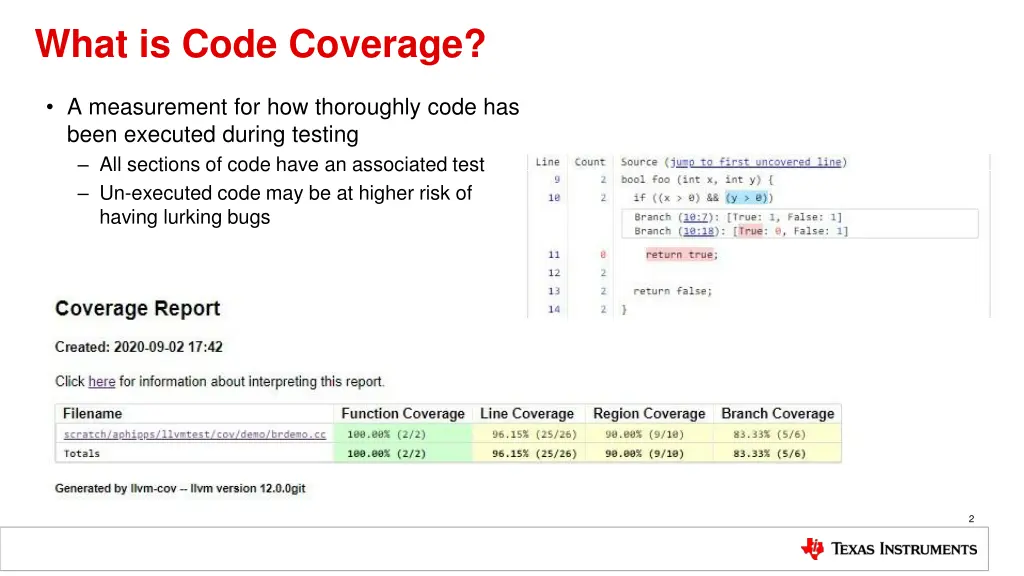
What is Code Coverage? A measurement for how thoroughly code has been executed during testing All sections of code have an associated test Un-executed code may be at higher risk of having lurking bugs 2
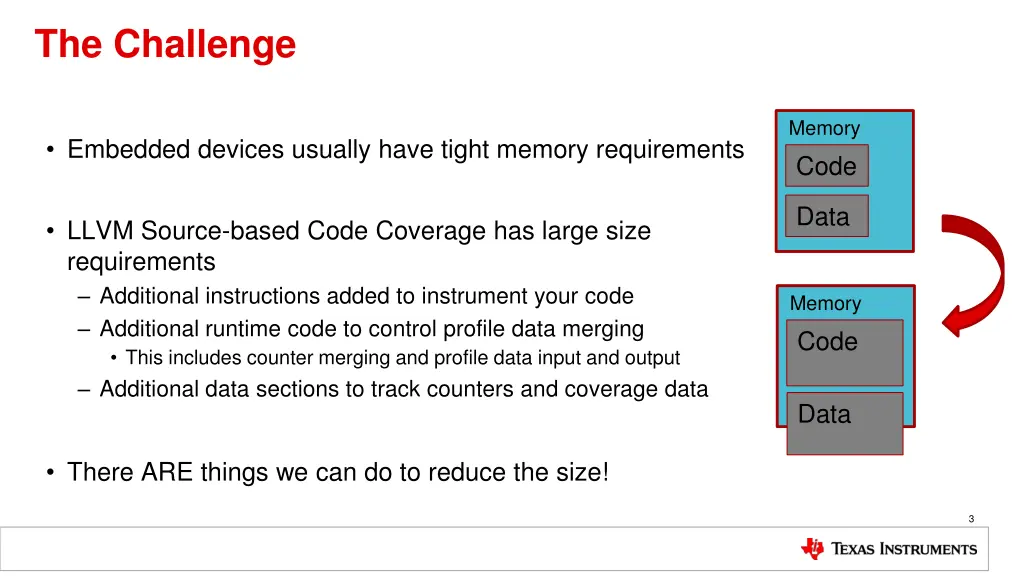
The Challenge Memory Code Embedded devices usually have tight memory requirements Data LLVM Source-based Code Coverage has large size requirements Additional instructions added to instrument your code Additional runtime code to control profile data merging This includes counter merging and profile data input and output Additional data sections to track counters and coverage data Memory Code Data There ARE things we can do to reduce the size! 3
1. Must all data sections be in memory? No! Code Coverage relies on several data sections: __llvm_prf_cnts : Profile counters, incremented at runtime __llvm_covfun : Coverage Function Records __llvm_covmap : Coverage Mapping Data Records __llvm_prf_data : Profile Data __llvm_prf_names : Profile Function names These sections may comprise 80%-90% of the data but do not require runtime modification 4
1. Must all data sections be in memory? No! Code Coverage relies on several data sections: __llvm_prf_cnts : Profile counters, incremented at runtime __llvm_covfun : Coverage Function Records __llvm_covmap : Coverage Mapping Data Records __llvm_prf_data : Profile Data __llvm_prf_names : Profile Function names Move these sections out of memory, preserved in object file Modify llvm-profdata to accept an object file argument Move it off-line: Combine its data with downloaded profile counters, producing an indexed profile data file 5
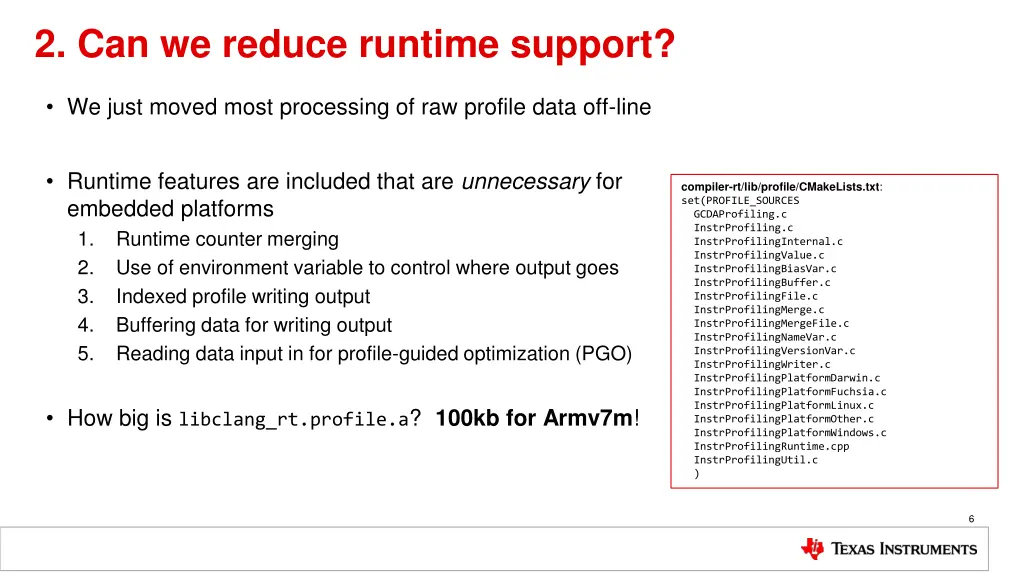
2. Can we reduce runtime support? We just moved most processing of raw profile data off-line Runtime features are included that are unnecessary for embedded platforms 1. Runtime counter merging 2. Use of environment variable to control where output goes 3. Indexed profile writing output 4. Buffering data for writing output 5. Reading data input in for profile-guided optimization (PGO) compiler-rt/lib/profile/CMakeLists.txt: set(PROFILE_SOURCES GCDAProfiling.c InstrProfiling.c InstrProfilingInternal.c InstrProfilingValue.c InstrProfilingBiasVar.c InstrProfilingBuffer.c InstrProfilingFile.c InstrProfilingMerge.c InstrProfilingMergeFile.c InstrProfilingNameVar.c InstrProfilingVersionVar.c InstrProfilingWriter.c InstrProfilingPlatformDarwin.c InstrProfilingPlatformFuchsia.c InstrProfilingPlatformLinux.c InstrProfilingPlatformOther.c InstrProfilingPlatformWindows.c InstrProfilingRuntime.cpp InstrProfilingUtil.c ) How big is libclang_rt.profile.a? 100kb for Armv7m! 6
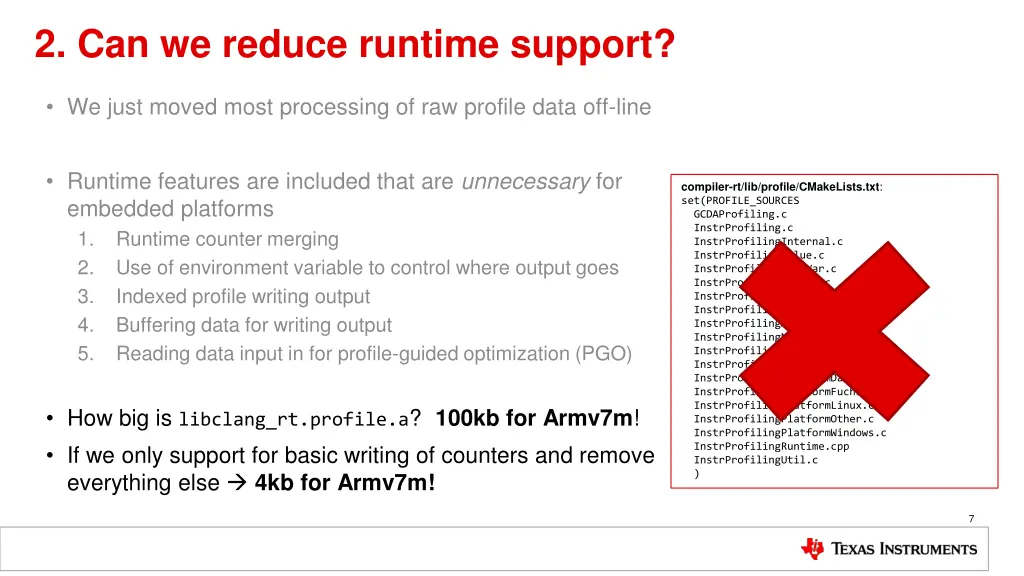
2. Can we reduce runtime support? We just moved most processing of raw profile data off-line Runtime features are included that are unnecessary for embedded platforms 1. Runtime counter merging 2. Use of environment variable to control where output goes 3. Indexed profile writing output 4. Buffering data for writing output 5. Reading data input in for profile-guided optimization (PGO) compiler-rt/lib/profile/CMakeLists.txt: set(PROFILE_SOURCES GCDAProfiling.c InstrProfiling.c InstrProfilingInternal.c InstrProfilingValue.c InstrProfilingBiasVar.c InstrProfilingBuffer.c InstrProfilingFile.c InstrProfilingMerge.c InstrProfilingMergeFile.c InstrProfilingNameVar.c InstrProfilingVersionVar.c InstrProfilingWriter.c InstrProfilingPlatformDarwin.c InstrProfilingPlatformFuchsia.c InstrProfilingPlatformLinux.c InstrProfilingPlatformOther.c InstrProfilingPlatformWindows.c InstrProfilingRuntime.cpp InstrProfilingUtil.c ) How big is libclang_rt.profile.a? 100kb for Armv7m! If we only support for basic writing of counters and remove everything else 4kb for Armv7m! 7
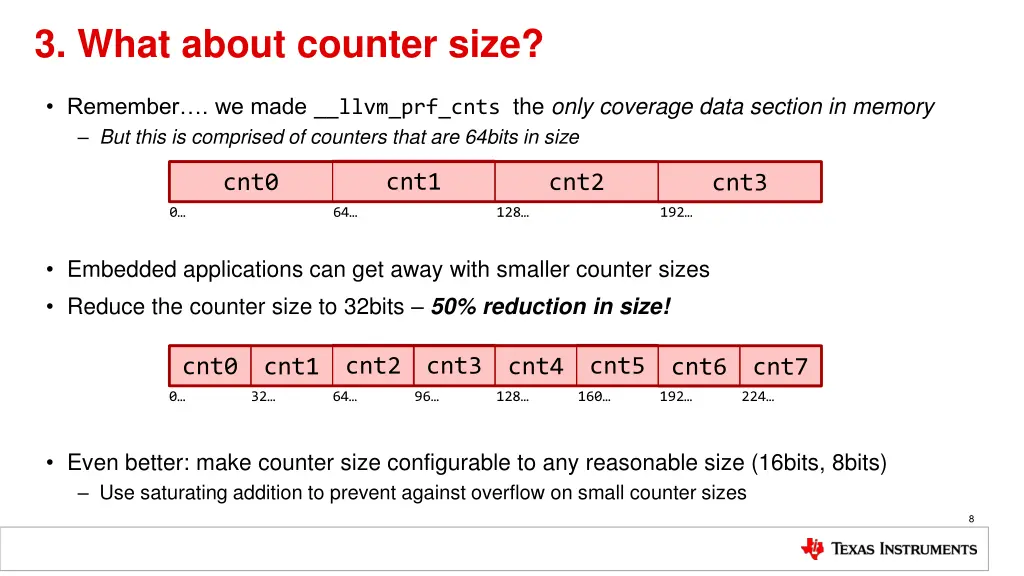
3. What about counter size? Remember . we made __llvm_prf_cnts the only coverage data section in memory But this is comprised of counters that are 64bits in size cnt1 cnt2 cnt0 cnt3 0 64 128 192 Embedded applications can get away with smaller counter sizes Reduce the counter size to 32bits 50% reduction in size! cnt2 cnt3 cnt5 cnt4 cnt0 cnt1 cnt6 cnt7 0 32 64 96 128 160 192 224 Even better: make counter size configurable to any reasonable size (16bits, 8bits) Use saturating addition to prevent against overflow on small counter sizes 8