Discover how Directed Self-Placement can assist you in selecting the ideal First-Year Writing course based on your learning preferences. This low-stakes survey guides you through the process without the pressure of exams, enabling you to make an informed decision about your academic path at Wheaton College.
Please find below an Image/Link to download the presentation.
The content on the website is provided AS IS for your information and personal use only. It may not be sold, licensed, or shared on other websites without obtaining consent from the author. If you encounter any issues during the download, it is possible that the publisher has removed the file from their server.
You are allowed to download the files provided on this website for personal or commercial use, subject to the condition that they are used lawfully. All files are the property of their respective owners.
The content on the website is provided AS IS for your information and personal use only. It may not be sold, licensed, or shared on other websites without obtaining consent from the author.
E N D
Presentation Transcript
Directed Self- Placement Survey First-Year Writing Wheaton College
What is Directed Self-Placement? Directed Self-Placement is a survey designed to help you select the best First-Year Writing course for your learning needs. The survey is not an exam or test; it is a low-stakes questionnaire that will help you make an informed decision about your enrollment.
How Does Directed Self-Placement Work? Step One: Complete the Directed Self-Placement survey here. It takes about 10 minutes. Step Two: Review your answers. Step Three. Review the First-Year Writing course descriptions. Step Four: Select a First-Year Writing course and enroll.
Time to start the survey! Please write your answers on your own paper. You will not be required to submit them.
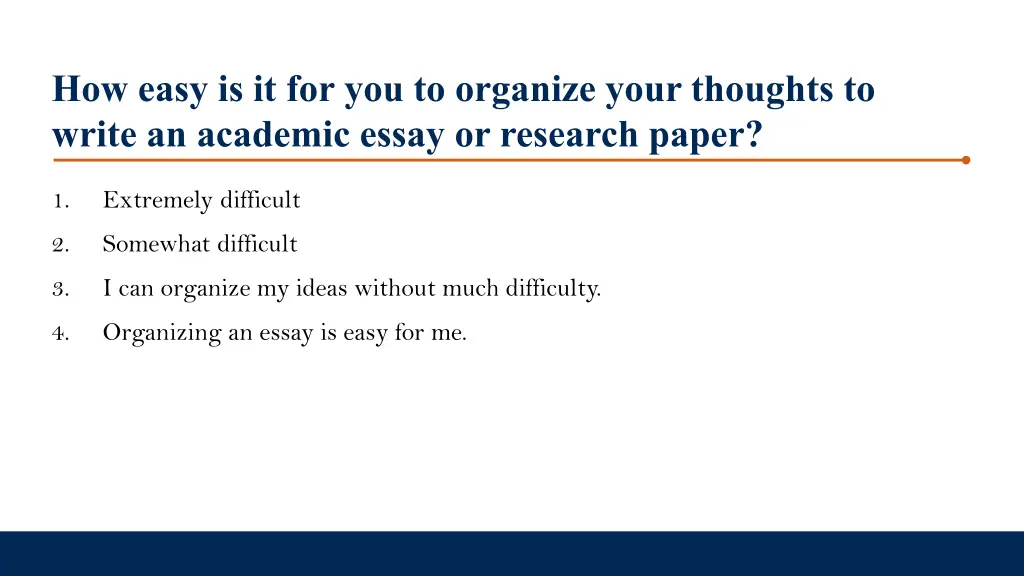
How easy is it for you to organize your thoughts to write an academic essay or research paper? 1. Extremely difficult 2. Somewhat difficult 3. I can organize my ideas without much difficulty. 4. Organizing an essay is easy for me.
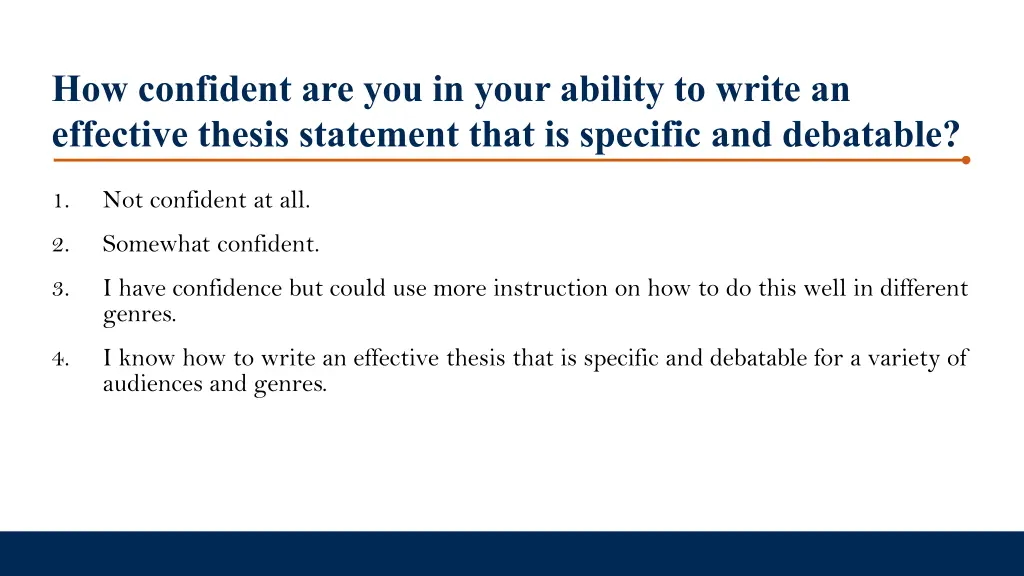
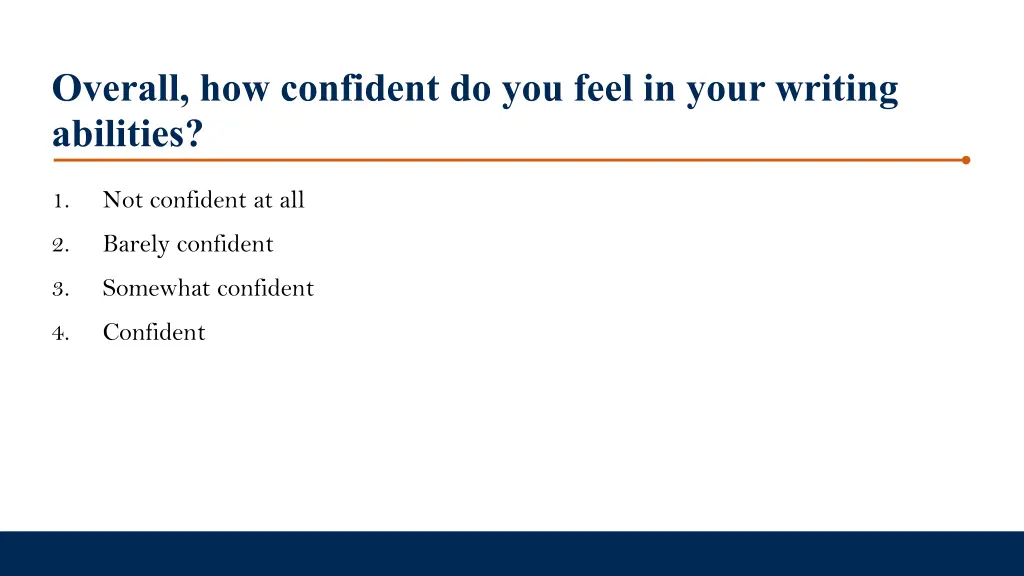
How confident are you in your ability to write an effective thesis statement that is specific and debatable? 1. Not confident at all. 2. Somewhat confident. 3. I have confidence but could use more instruction on how to do this well in different genres. 4. I know how to write an effective thesis that is specific and debatable for a variety of audiences and genres.
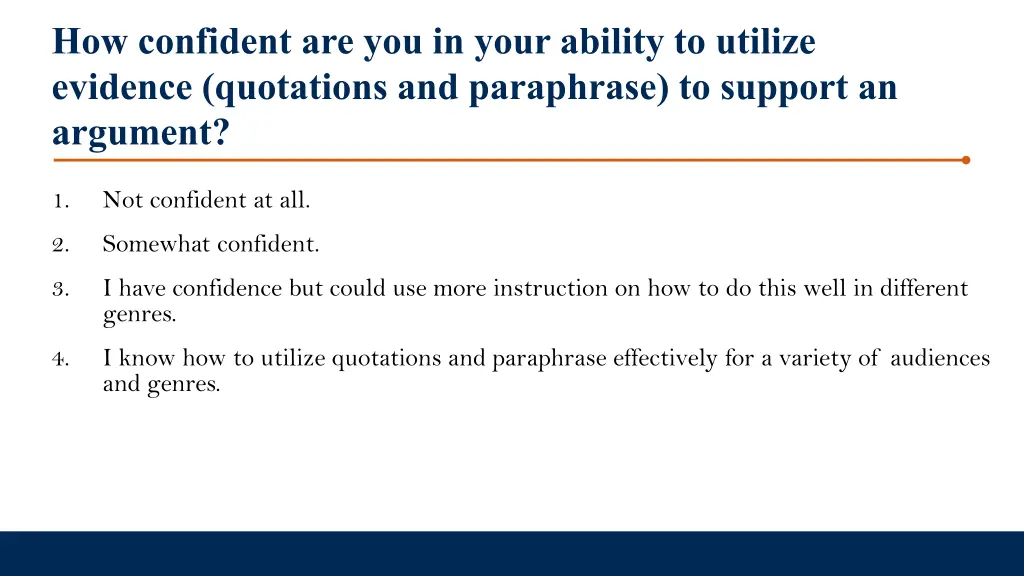
How confident are you in your ability to utilize evidence (quotations and paraphrase) to support an argument? 1. Not confident at all. 2. Somewhat confident. 3. I have confidence but could use more instruction on how to do this well in different genres. 4. I know how to utilize quotations and paraphrase effectively for a variety of audiences and genres.
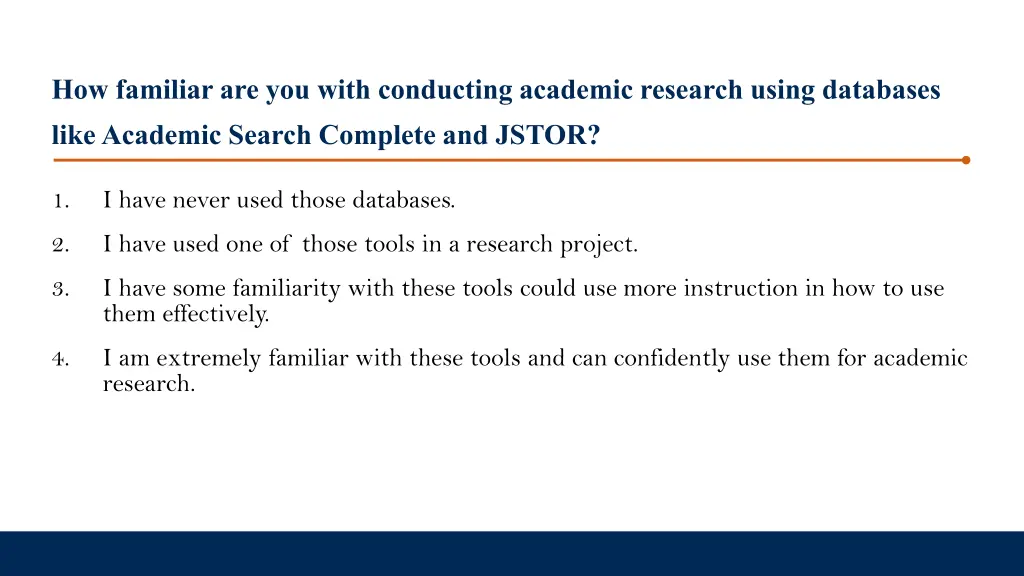
How familiar are you with conducting academic research using databases like Academic Search Complete and JSTOR? 1. I have never used those databases. 2. I have used one of those tools in a research project. 3. I have some familiarity with these tools could use more instruction in how to use them effectively. 4. I am extremely familiar with these tools and can confidently use them for academic research.
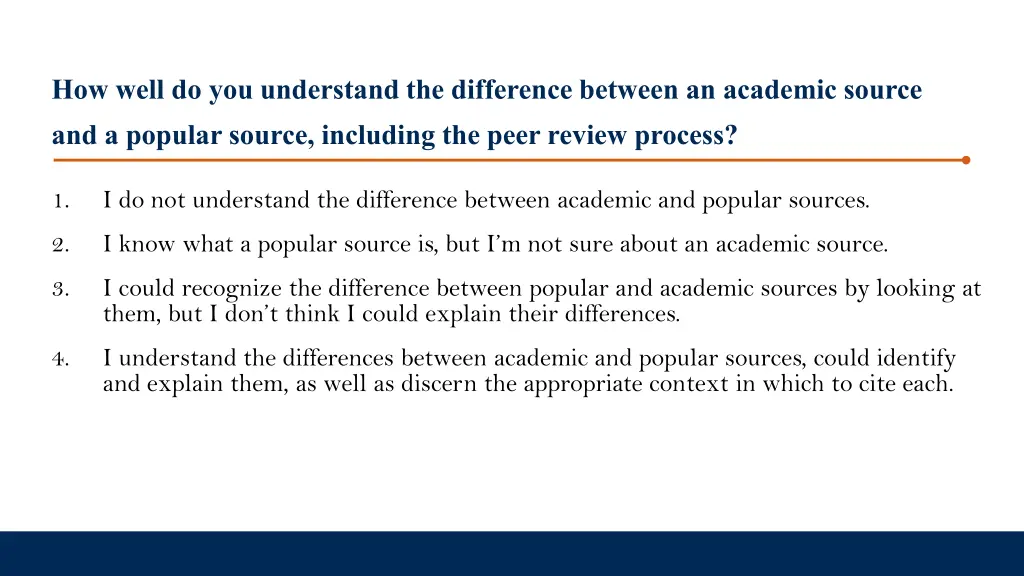
How well do you understand the difference between an academic source and a popular source, including the peer review process? 1. I do not understand the difference between academic and popular sources. 2. I know what a popular source is, but I m not sure about an academic source. 3. I could recognize the difference between popular and academic sources by looking at them, but I don t think I could explain their differences. 4. I understand the differences between academic and popular sources, could identify and explain them, as well as discern the appropriate context in which to cite each.
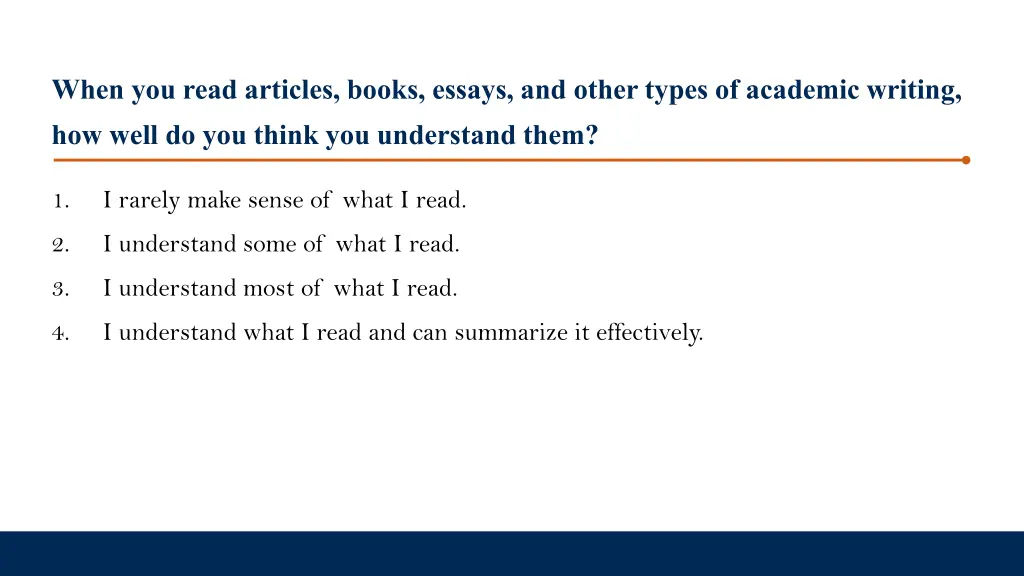
When you read articles, books, essays, and other types of academic writing, how well do you think you understand them? 1. I rarely make sense of what I read. 2. I understand some of what I read. 3. I understand most of what I read. 4. I understand what I read and can summarize it effectively.
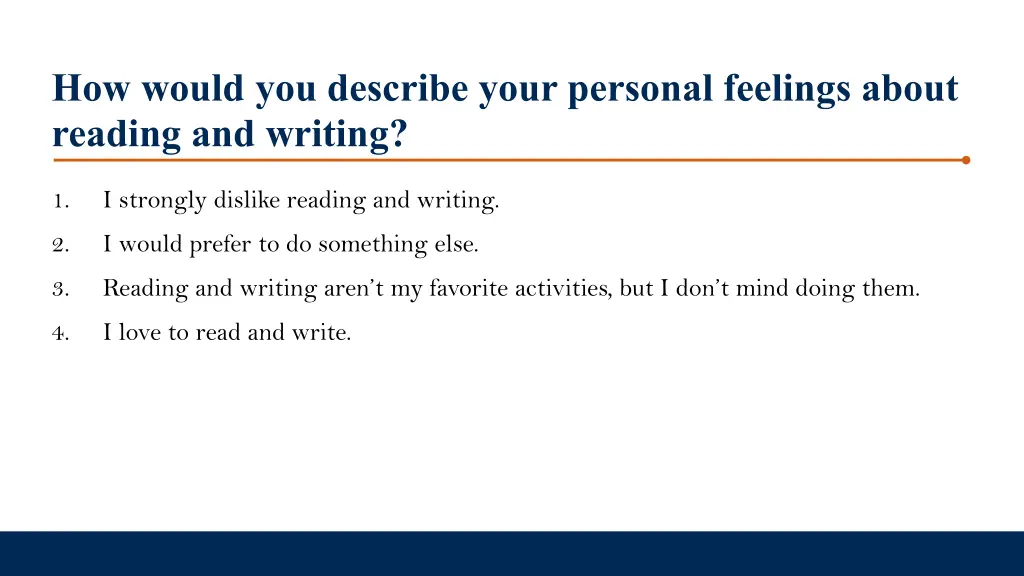
How would you describe your personal feelings about reading and writing? 1. I strongly dislike reading and writing. 2. I would prefer to do something else. 3. Reading and writing aren t my favorite activities, but I don t mind doing them. 4. I love to read and write.
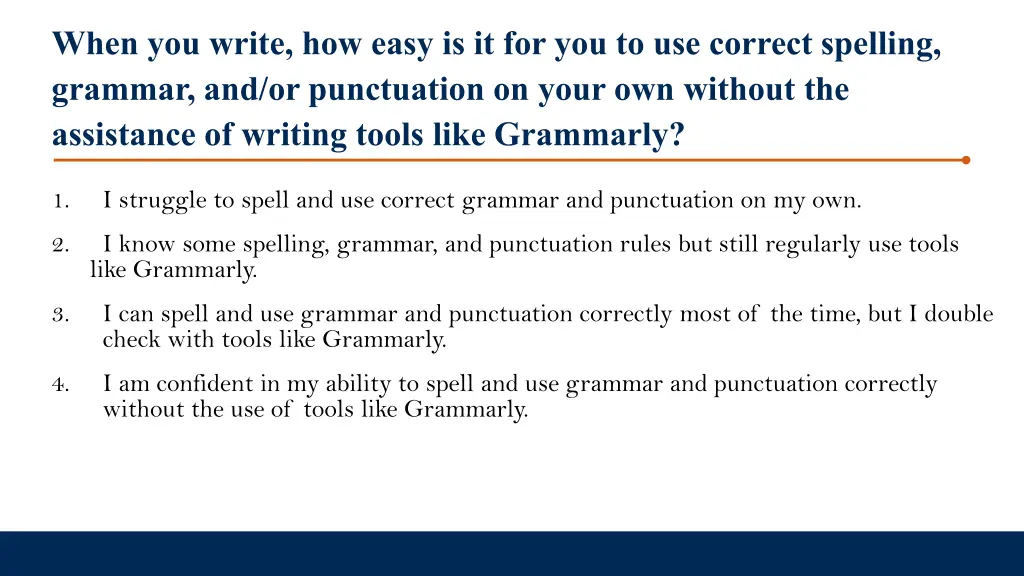
When you write, how easy is it for you to use correct spelling, grammar, and/or punctuation on your own without the assistance of writing tools like Grammarly? 1. I struggle to spell and use correct grammar and punctuation on my own. 2. I know some spelling, grammar, and punctuation rules but still regularly use tools like Grammarly. 3. I can spell and use grammar and punctuation correctly most of the time, but I double check with tools like Grammarly. 4. I am confident in my ability to spell and use grammar and punctuation correctly without the use of tools like Grammarly.
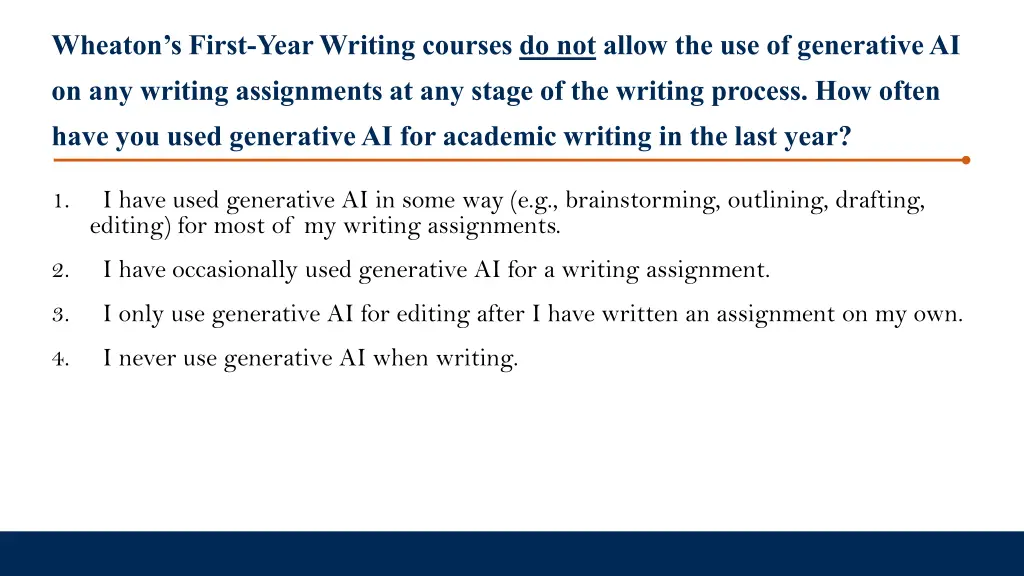
Wheatons First-Year Writing courses do not allow the use of generative AI on any writing assignments at any stage of the writing process. How often have you used generative AI for academic writing in the last year? 1. I have used generative AI in some way (e.g., brainstorming, outlining, drafting, editing) for most of my writing assignments. 2. I have occasionally used generative AI for a writing assignment. 3. I only use generative AI for editing after I have written an assignment on my own. 4. I never use generative AI when writing.
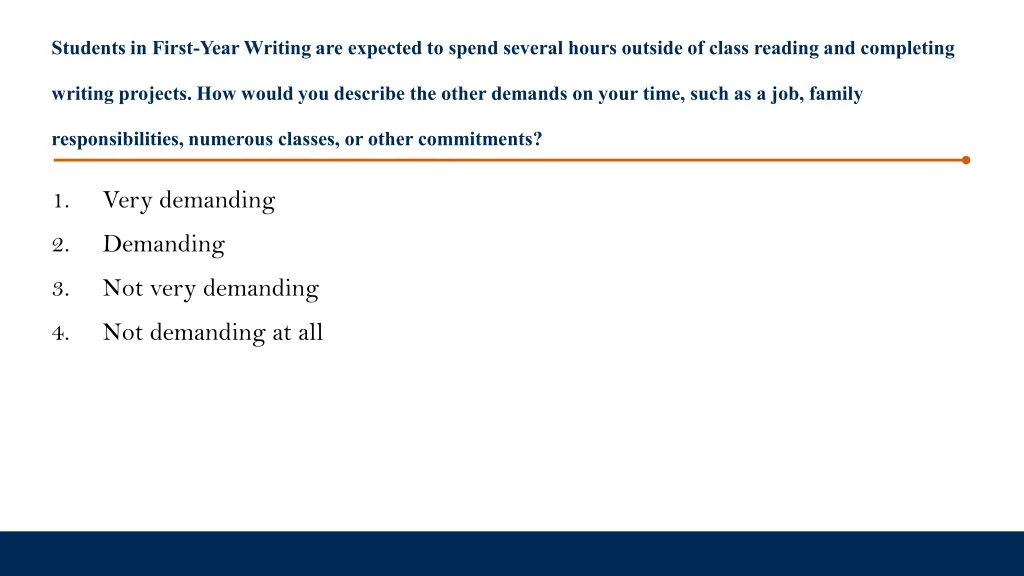
Students in First-Year Writing are expected to spend several hours outside of class reading and completing writing projects. How would you describe the other demands on your time, such as a job, family responsibilities, numerous classes, or other commitments? 1. Very demanding 2. Demanding 3. Not very demanding 4. Not demanding at all
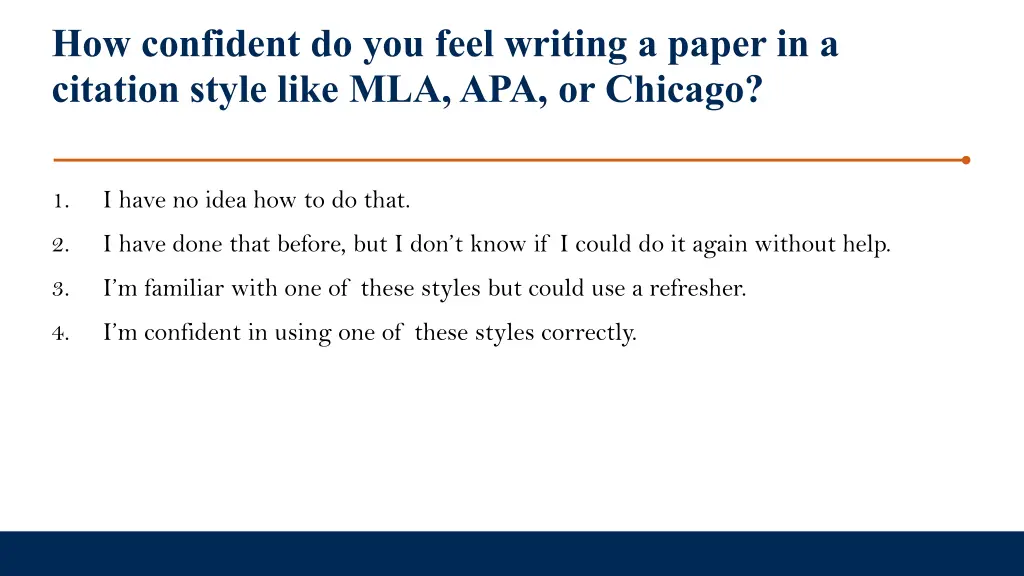
How confident do you feel writing a paper in a citation style like MLA, APA, or Chicago? 1. I have no idea how to do that. 2. I have done that before, but I don t know if I could do it again without help. 3. I m familiar with one of these styles but could use a refresher. 4. I m confident in using one of these styles correctly.
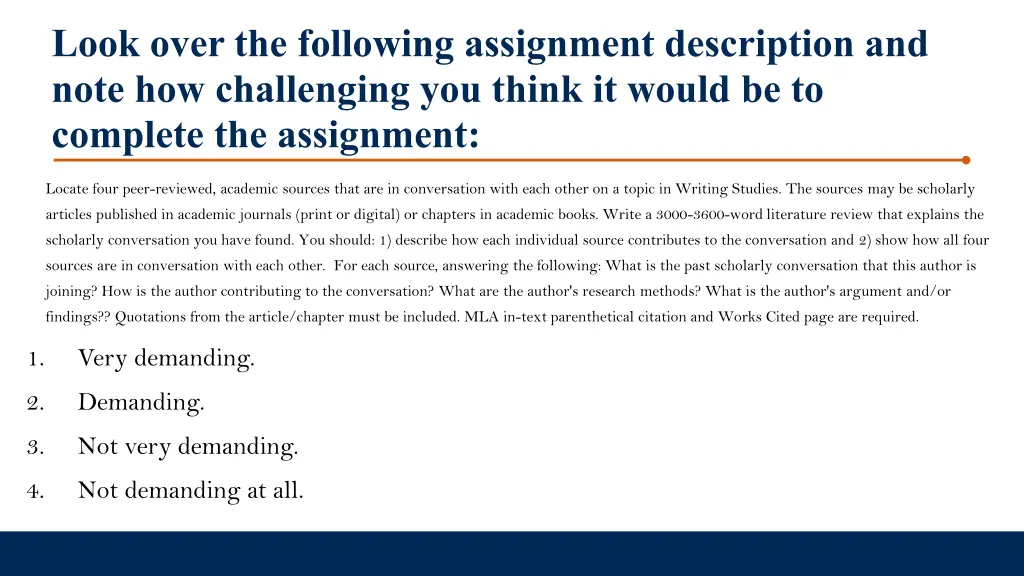
Look over the following assignment description and note how challenging you think it would be to complete the assignment: Locate four peer-reviewed, academic sources that are in conversation with each other on a topic in Writing Studies. The sources may be scholarly articles published in academic journals (print or digital) or chapters in academic books. Write a 3000-3600-word literature review that explains the scholarly conversation you have found. You should: 1) describe how each individual source contributes to the conversation and 2) show how all four sources are in conversation with each other. For each source, answering the following: What is the past scholarly conversation that this author is joining? How is the author contributing to the conversation? What are the author's research methods? What is the author's argument and/or findings?? Quotations from the article/chapter must be included. MLA in-text parenthetical citation and Works Cited page are required. 1. Very demanding. 2. Demanding. 3. Not very demanding. 4. Not demanding at all.
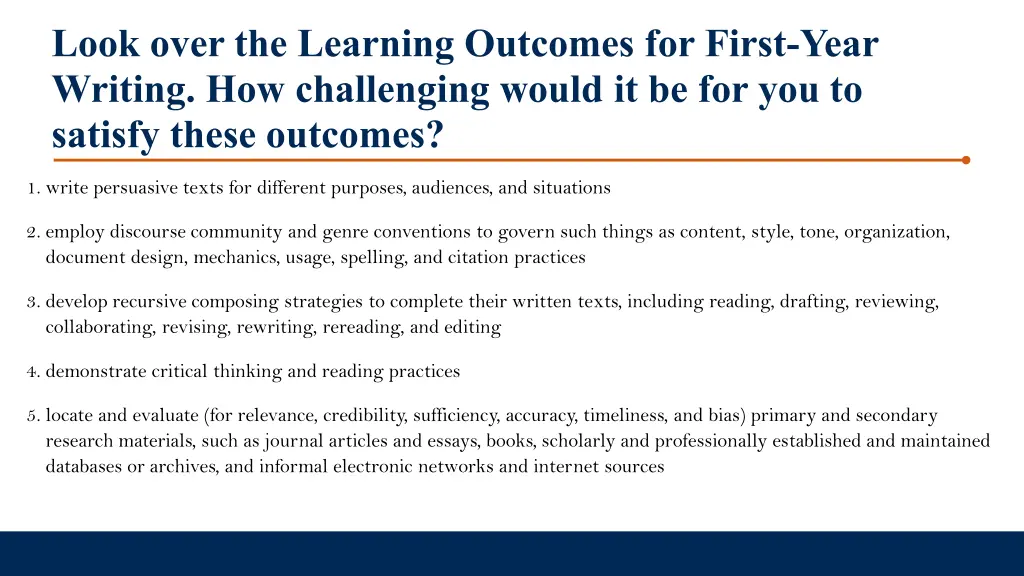
Look over the Learning Outcomes for First-Year Writing. How challenging would it be for you to satisfy these outcomes? 1. write persuasive texts for different purposes, audiences, and situations 2. employ discourse community and genre conventions to govern such things as content, style, tone, organization, document design, mechanics, usage, spelling, and citation practices 3. develop recursive composing strategies to complete their written texts, including reading, drafting, reviewing, collaborating, revising, rewriting, rereading, and editing 4. demonstrate critical thinking and reading practices 5. locate and evaluate (for relevance, credibility, sufficiency, accuracy, timeliness, and bias) primary and secondary research materials, such as journal articles and essays, books, scholarly and professionally established and maintained databases or archives, and informal electronic networks and internet sources
Review and Reflect Look over your answers. Then, choose the First-Year Writing course that is best for you.
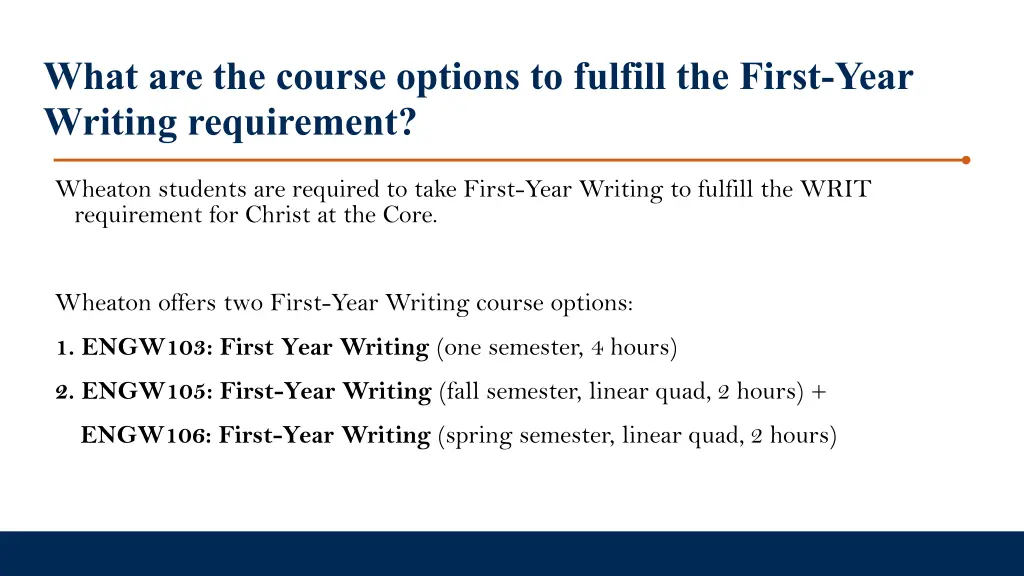
What are the course options to fulfill the First-Year Writing requirement? Wheaton students are required to take First-Year Writing to fulfill the WRIT requirement for Christ at the Core. Wheaton offers two First-Year Writing course options: 1. ENGW103: First Year Writing (one semester, 4 hours) 2. ENGW105: First-Year Writing (fall semester, linear quad, 2 hours) + ENGW106: First-Year Writing (spring semester, linear quad, 2 hours)
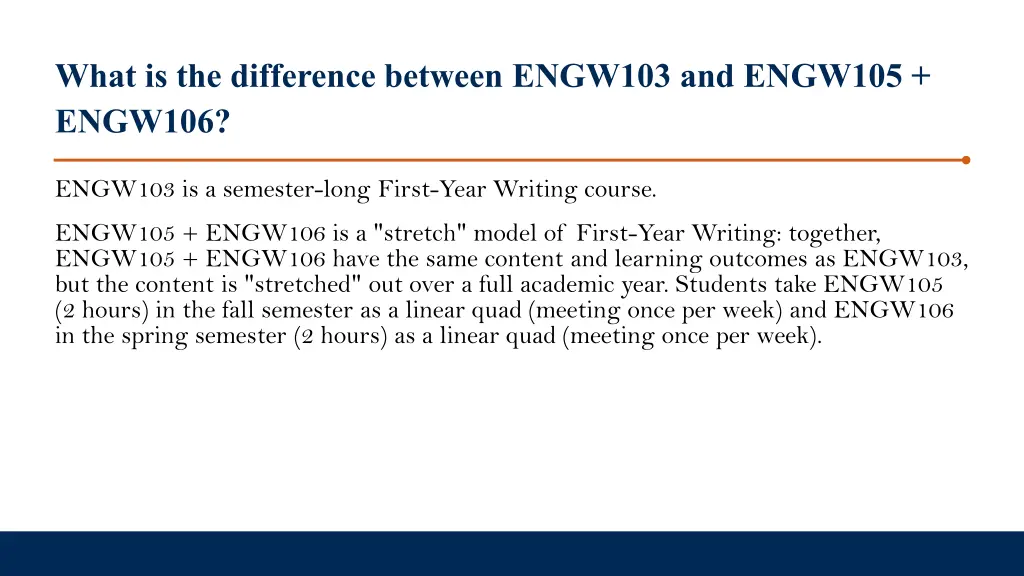
What is the difference between ENGW103 and ENGW105 + ENGW106? ENGW103 is a semester-long First-Year Writing course. ENGW105 + ENGW106 is a "stretch" model of First-Year Writing: together, ENGW105 + ENGW106 have the same content and learning outcomes as ENGW103, but the content is "stretched" out over a full academic year. Students take ENGW105 (2 hours) in the fall semester as a linear quad (meeting once per week) and ENGW106 in the spring semester (2 hours) as a linear quad (meeting once per week).
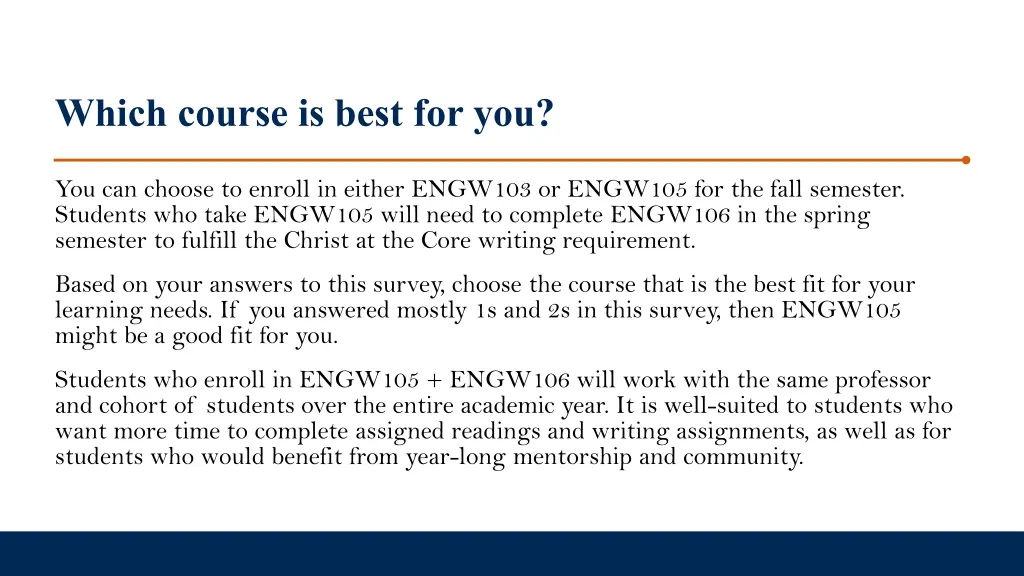
Which course is best for you? You can choose to enroll in either ENGW103 or ENGW105 for the fall semester. Students who take ENGW105 will need to complete ENGW106 in the spring semester to fulfill the Christ at the Core writing requirement. Based on your answers to this survey, choose the course that is the best fit for your learning needs. If you answered mostly 1s and 2s in this survey, then ENGW105 might be a good fit for you. Students who enroll in ENGW105 + ENGW106 will work with the same professor and cohort of students over the entire academic year. It is well-suited to students who want more time to complete assigned readings and writing assignments, as well as for students who would benefit from year-long mentorship and community.
Next step: Enroll Enroll in ENGW103 or ENGW105 for the fall semester. Still have questions? Talk to your advisor or reach out to the Academic Advising Office at academic.advising@wheaton.edu.