Optimizing Algorithms: A Practical Guide for Presentations
Learn effective presentation techniques for discussing algorithms, experimental results, and making informative plots. Follow a structured organization to engage your audience and deliver key insights. Enhance your slides with visuals and avoid text-heavy content. Gain valuable tips to keep your presentation concise and impactful. Check out the provided resources for further guidance.

Download Presentation

Please find below an Image/Link to download the presentation.
The content on the website is provided AS IS for your information and personal use only. It may not be sold, licensed, or shared on other websites without obtaining consent from the author. If you encounter any issues during the download, it is possible that the publisher has removed the file from their server.
You are allowed to download the files provided on this website for personal or commercial use, subject to the condition that they are used lawfully. All files are the property of their respective owners.
The content on the website is provided AS IS for your information and personal use only. It may not be sold, licensed, or shared on other websites without obtaining consent from the author.
E N D
Presentation Transcript
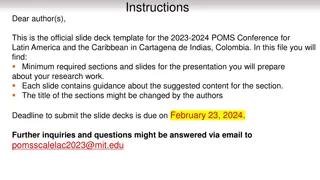
Title of your presentation Jane Doe Hans M ller
General Remarks Pay attention to the length: e.g., 10 minutes typically means 7 8 slides Use proper visuals as much as possible, avoid text-only bullet slides Don t put an overview or organization slide the talk is too short For the very motivated, check out this small guide http://people.inf.ethz.ch/markusp/teaching/guides/guide-presentations.pdf
Typical Organization I Algorithm that you consider (maybe 2 slides) State problem that it solves (input: , output: ) If possible visualize how it works or show high-level pseudocode State asymptotic runtime Cost analysis (cost measure, exact count) Baseline implementation (briefly explain), maybe show already performance plot and extract percentage of peak Optimizations you performed Briefly discuss major optimizations/code versions Maybe explain the most interesting in a bit greater detail Any analysis (e.g., profifling) you performed is interesting show the result If too much, explain only some things and just state the rest
Typical Organization II Experimental results Very brief: Experimental setup (platform, compiler) Performance plot over a range of sizes with different code versions Make sure you also push input size to the limit in the experiments Extract overall speedup Every project is different so adapt as needed Focus on the most interesting things, don t explain everything that will be in the final report.
Try to Make Nice Plots DFT 2n (single precision) on Pentium 4, 2.53 GHz [Gflop/s] 7 Spiral SSE 6 5 Intel MKL 4 Spiral C vectorized 3 2 Spiral C 1 0 4 5 6 7 8 9 10 11 12 13 n