Explore how integer programming solutions can be applied to solve assignment problems and graph coloring problems efficiently. Learn about maximizing assignments, the application of integer programs, and the benefits of utilizing these techniques for complex optimization tasks.
Please find below an Image/Link to download the presentation.
The content on the website is provided AS IS for your information and personal use only. It may not be sold, licensed, or shared on other websites without obtaining consent from the author. If you encounter any issues during the download, it is possible that the publisher has removed the file from their server.
You are allowed to download the files provided on this website for personal or commercial use, subject to the condition that they are used lawfully. All files are the property of their respective owners.
The content on the website is provided AS IS for your information and personal use only. It may not be sold, licensed, or shared on other websites without obtaining consent from the author.
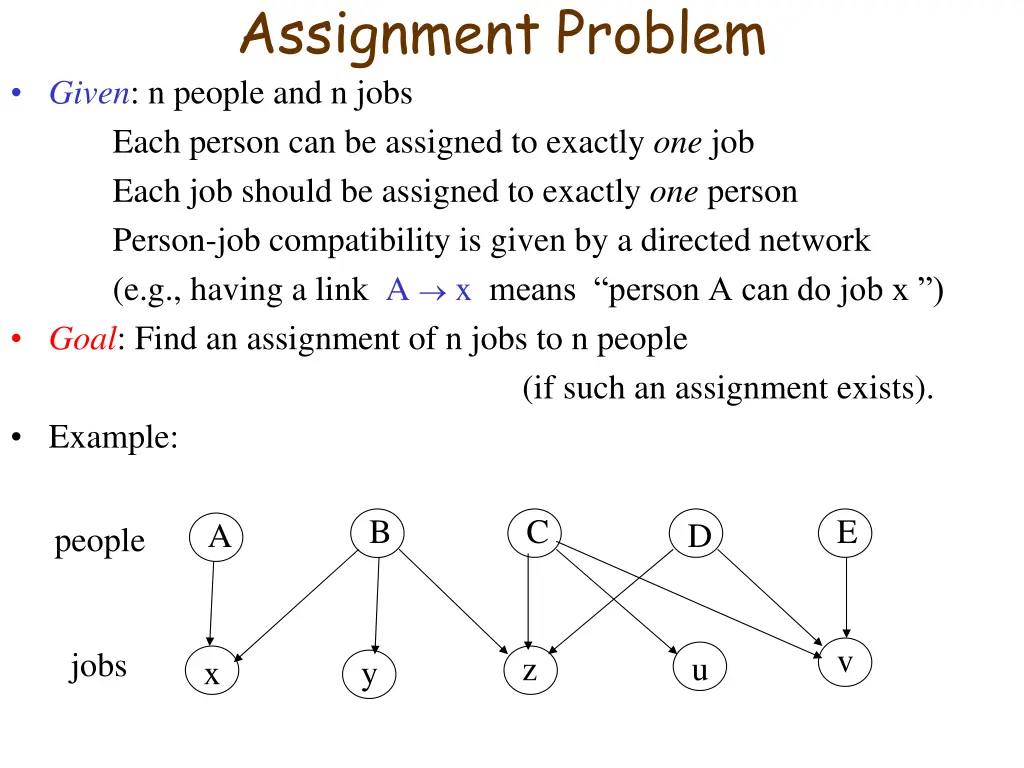
Assignment Problem Given: n people and n jobs Each person can be assigned to exactly one job Each job should be assigned to exactly one person Person-job compatibility is given by a directed network (e.g., having a link A x means person A can do job x ) Goal: Find an assignment of n jobs to n people (if such an assignment exists). Example: B C E A D people v jobs z u x y
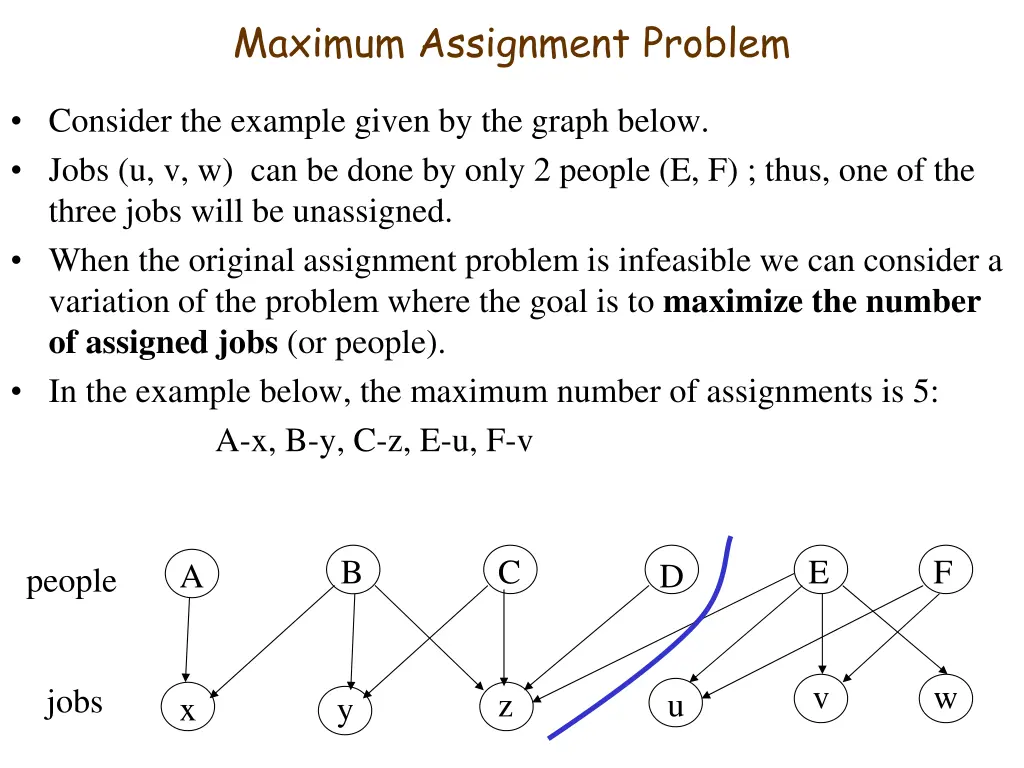
Maximum Assignment Problem Consider the example given by the graph below. Jobs (u, v, w) can be done by only 2 people (E, F) ; thus, one of the three jobs will be unassigned. When the original assignment problem is infeasible we can consider a variation of the problem where the goal is to maximize the number of assigned jobs (or people). In the example below, the maximum number of assignments is 5: A-x, B-y, C-z, E-u, F-v B C E F A D people v w jobs z u x y
Solving Maximum Assignmentproblem by integer programming set students; set projects; set arcs within students cross projects; var assign{(i,j) in arcs} binary; # is 1 if student i is assigned to project j, 0 otherwise maximize total_assignments: sum{(i,j) in arcs} assign[i,j]; s.t. at_most_one_project_for_each_student{i in students}: s.t. at_most_one_student_for_each_project{j in projects}: sum{(i,j) in arcs} assign[i,j] <= 1; sum{(i,j) in arcs} assign[i,j] <= 1;
Integer program for maximum assignmentproblem Suppose the constraints of the integer program are written in matrix form Ax B. Note that all the entries in A are 0 or 1. It can be shown that A is totally unimodular, that is, every square nonsingular submatrix has determinant 1 or -1. As a result of that property, the integer program for Maximum Assignment Problem has the following feature: All CPF solutions of LP-relaxation are integral. Thus, the optimal solution of LP-relaxation is also optimal solution for the original IP. Note that generally having entries 0, 1, -1 doesn t guarantee that A is totally unimodular (see Coloring Problem).
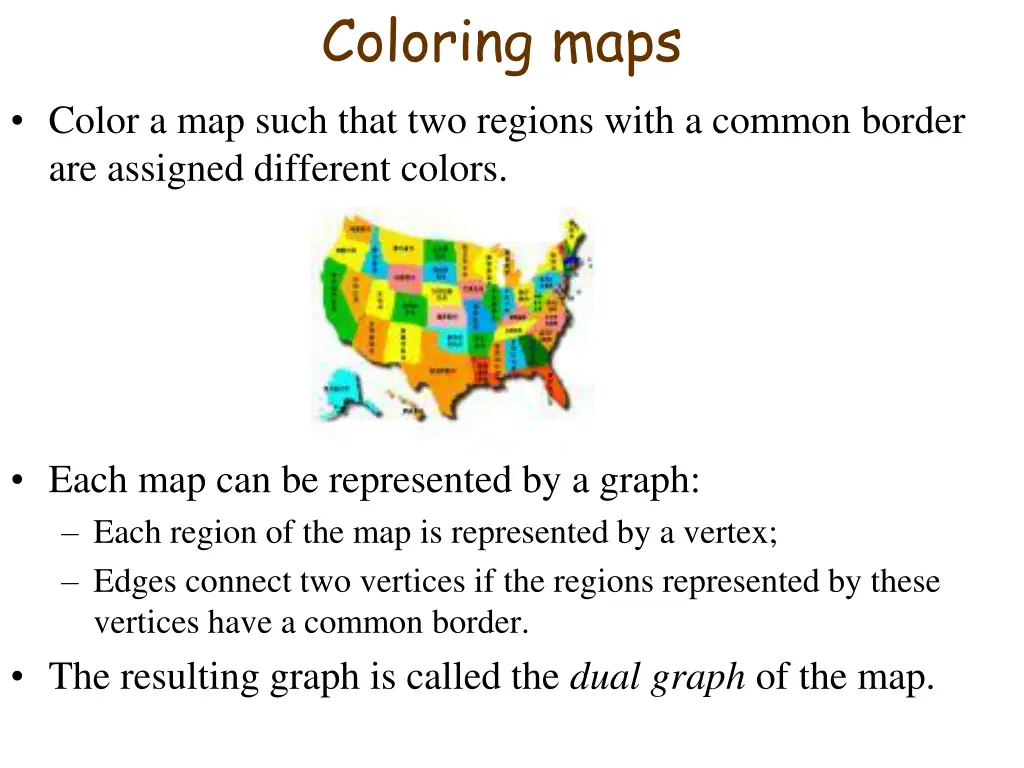
Coloring maps Color a map such that two regions with a common border are assigned different colors. usa-map Each map can be represented by a graph: Each region of the map is represented by a vertex; Edges connect two vertices if the regions represented by these vertices have a common border. The resulting graph is called the dual graph of the map.
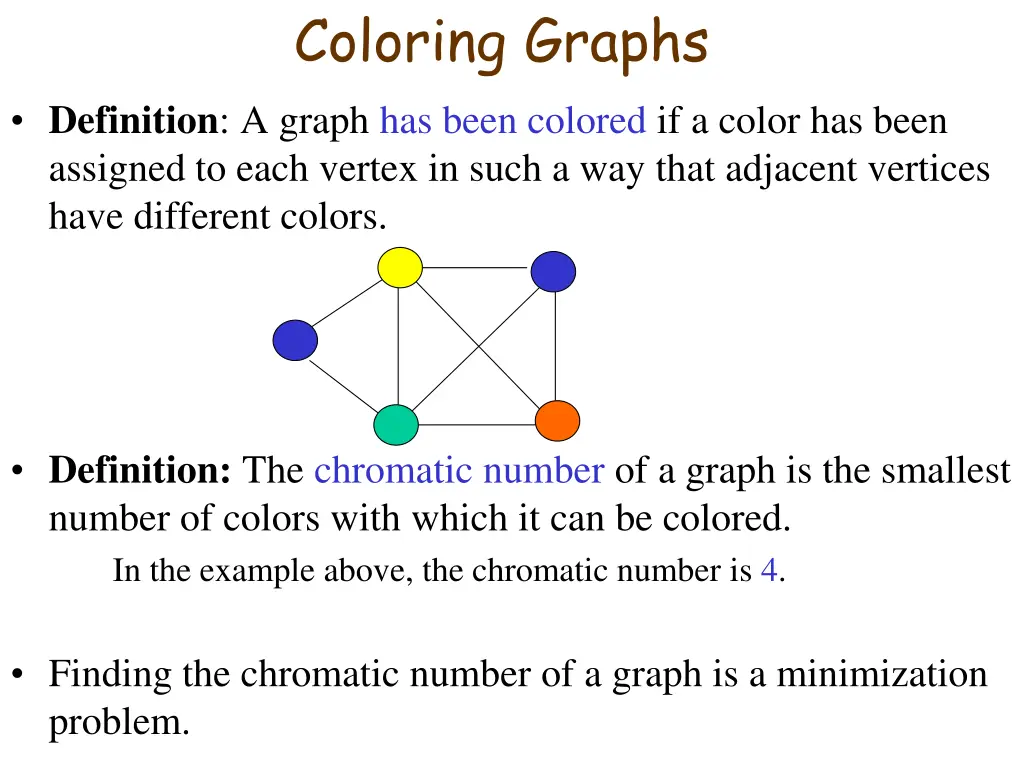
Coloring Graphs Definition: A graph has been colored if a color has been assigned to each vertex in such a way that adjacent vertices have different colors. Definition: The chromatic number of a graph is the smallest number of colors with which it can be colored. In the example above, the chromatic number is 4. Finding the chromatic number of a graph is a minimization problem.
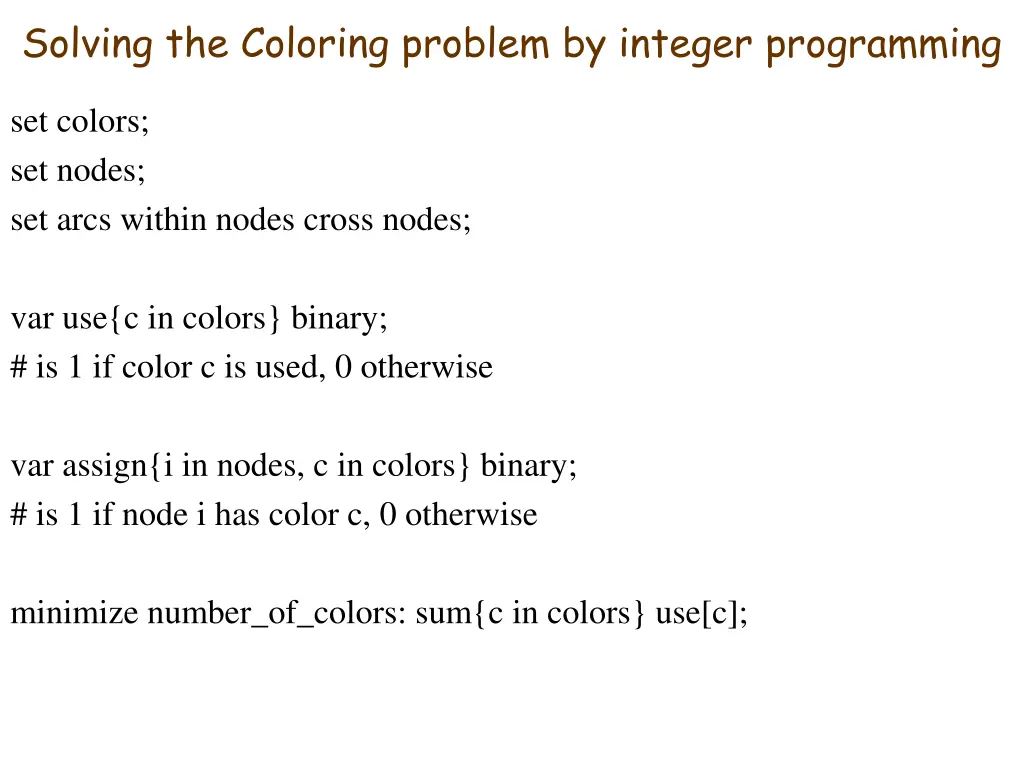
Solving the Coloring problem by integer programming set colors; set nodes; set arcs within nodes cross nodes; var use{c in colors} binary; # is 1 if color c is used, 0 otherwise var assign{i in nodes, c in colors} binary; # is 1 if node i has color c, 0 otherwise minimize number_of_colors: sum{c in colors} use[c];
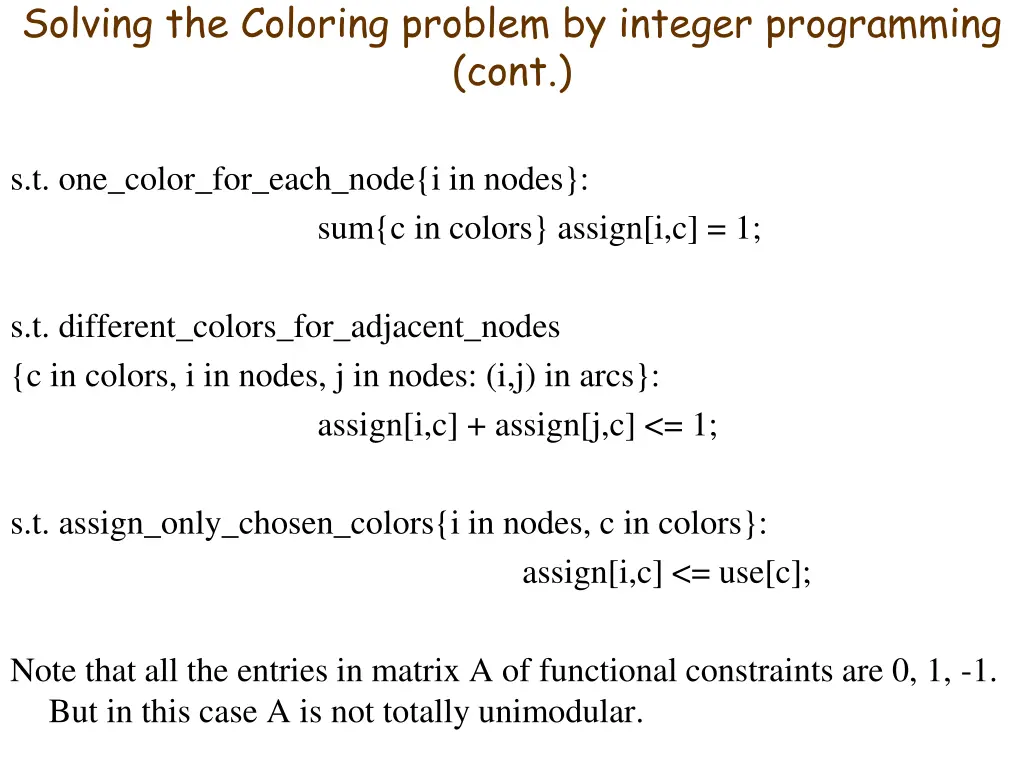
Solving the Coloring problem by integer programming (cont.) s.t. one_color_for_each_node{i in nodes}: sum{c in colors} assign[i,c] = 1; s.t. different_colors_for_adjacent_nodes {c in colors, i in nodes, j in nodes: (i,j) in arcs}: assign[i,c] + assign[j,c] <= 1; s.t. assign_only_chosen_colors{i in nodes, c in colors}: assign[i,c] <= use[c]; Note that all the entries in matrix A of functional constraints are 0, 1, -1. But in this case A is not totally unimodular.
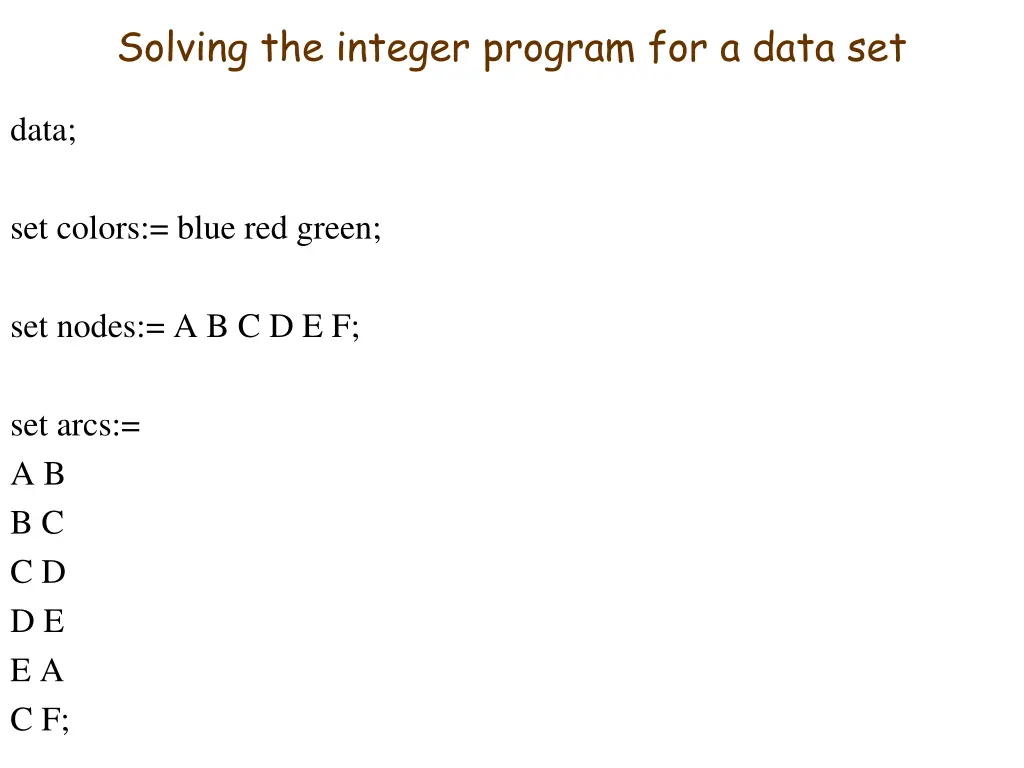
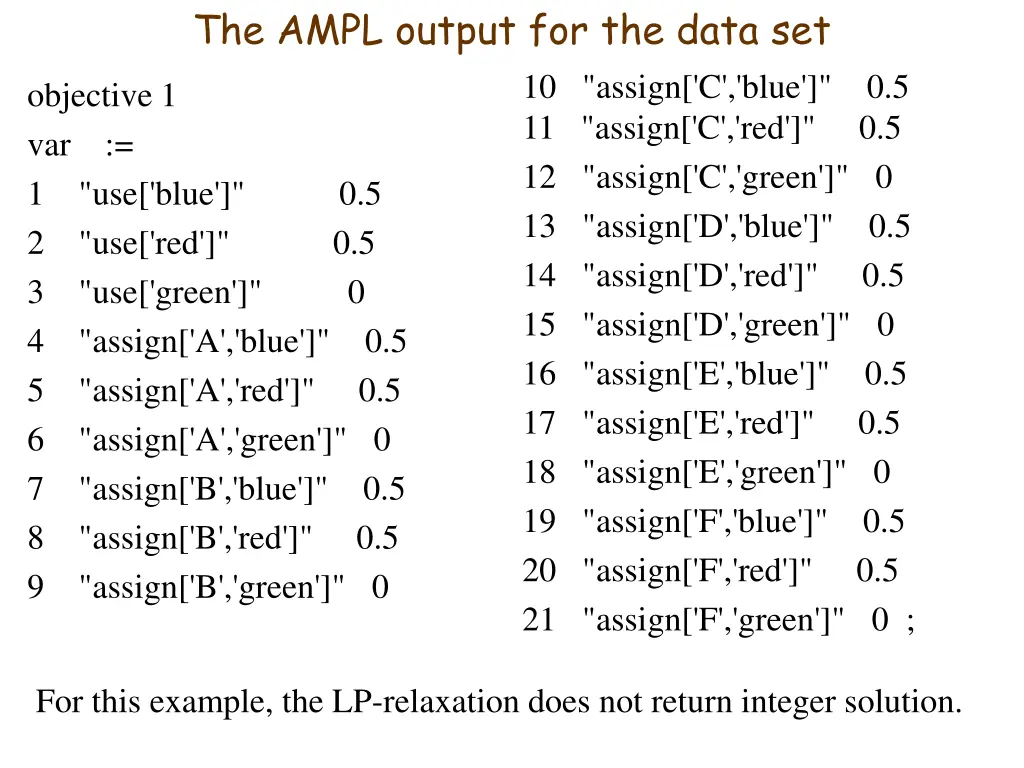
The AMPL output for the data set 10 "assign['C','blue']" 0.5 11 "assign['C','red']" 0.5 12 "assign['C','green']" 0 13 "assign['D','blue']" 0.5 14 "assign['D','red']" 0.5 15 "assign['D','green']" 0 16 "assign['E','blue']" 0.5 17 "assign['E','red']" 0.5 18 "assign['E','green']" 0 19 "assign['F','blue']" 0.5 20 "assign['F','red']" 0.5 21 "assign['F','green']" 0 ; objective 1 var := 1 "use['blue']" 0.5 2 "use['red']" 0.5 3 "use['green']" 0 4 "assign['A','blue']" 0.5 5 "assign['A','red']" 0.5 6 "assign['A','green']" 0 7 "assign['B','blue']" 0.5 8 "assign['B','red']" 0.5 9 "assign['B','green']" 0 For this example, the LP-relaxation does not return integer solution.
An application of graph coloring in scheduling Twelve faculty members in a mathematics department serve on the following committees: Undergraduate education:Sineman, Limitson, Axiomus, Functionini Graduate Education: Graphian, Vectorades, Functionini, Infinitescu Colloquium: Lemmeau, Randomov, Proofizaki Library: Van Sum, Sineman, Lemmeau Staffing: Graphian, Randomov, Vectorades, Limitson Promotion: Vectorades, Van Sum, Parabolton The committees must all meet during the first week of classes, but there are only three time slots available. Find a schedule that will allow all faculty members to attend the meetings of all committees on which they serve. Model and solve the problem by graph coloring. (the solution on the board)