"Explore a project by Mobility21 researcher Peter Zhang focusing on optimizing first/last-mile transportation in disadvantaged neighborhoods like east Pittsburgh, addressing challenges such as cost management and route efficiency. The initiative involves analyzing service data, reviewing existing routes, and proposing strategies to enhance rider experience and operational effectiveness." (286 characters)
Please find below an Image/Link to download the presentation.
The content on the website is provided AS IS for your information and personal use only. It may not be sold, licensed, or shared on other websites without obtaining consent from the author. If you encounter any issues during the download, it is possible that the publisher has removed the file from their server.
You are allowed to download the files provided on this website for personal or commercial use, subject to the condition that they are used lawfully. All files are the property of their respective owners.
The content on the website is provided AS IS for your information and personal use only. It may not be sold, licensed, or shared on other websites without obtaining consent from the author.
E N D
Presentation Transcript
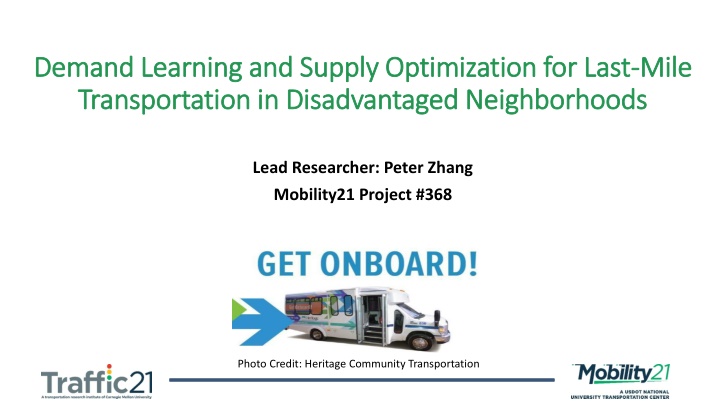
Demand Learning and Supply Optimization for Last Demand Learning and Supply Optimization for Last- -Mile Transportation in Disadvantaged Neighborhoods Transportation in Disadvantaged Neighborhoods Mile Lead Researcher: Peter Zhang Mobility21 Project #368 Photo Credit: Heritage Community Transportation
Brief Overview of Project Brief Overview of Project Background Heritage Community Transportation (HCT) provides first/last-mile transportation in disadvantaged communities (east Pittsburgh) that lack access to public transit Problem COVID increased pressure on cost management due to ridership decrease and increased driver/passenger health risk Goals Analyze HCT service data and public transit data to ensure that their vehicles are utilizing the best available routes and operating in a cost- effective, rider-focused manner
Project Name Project Name Expected Outcomes Expected Outcomes Exploratory data analysis on existing rider surveys Collect data to understand latent demand Review of existing routes and fixed-route strategies Review of similar first/last-mile systems in other communities Qualitative and quantitative comparison of the benefits and drawbacks of different routing strategies, including on-demand schedule, mixed fleet (e.g., van + TNC)
Deployment Plan Deployment Plan July September 2021 Hold kick-off meeting with deployment partner (Heritage). Meet with stakeholders to gather data for the model development. October December 2021 Survey/data collection from current users. Meet with stakeholders to share findings of current system performance January March 2022 Beta test the model/software. April June 2022 Submit publication for consideration into an academic publication and/or conference. Provide Heritage with the findings via written report and presentation, which includes Review of existing routes and fixed-route strategies Review of similar first/last-mile systems in other communities Qualitative and quantitative comparison of the benefits and drawbacks of different routing strategies, including on-demand schedule, mixed fleet (e.g., van + TNC) Recommended strategies for HCT Proposal for Phase 2 collaboration
Additional Background Additional Background 63% of riders household incomes are less than $10,000 a year
Additional Background Additional Background More than 3,000 riders (based on active registration) 85% of riders use it to connect to the larger bus service According to July 2013 survey: The service is the only option for 97% of riders! Average rider age: 47 81% of riders use the system to connect with Port Authority routes 820,000 rides Adding $132 Million in economic activity in the region Source: Heritage Community Initiatives connecting residents of the Mon Valley to jobs. (2019, October 07). Retrieved February 15, 2021, from https://t4america.org/
Additional Background Additional Background Three fixed routes that charge 25 cents a ride Monroeville, East Pittsburgh, McKeesport For all routes, it takes about an hour Begin at 6 a.m. or earlier and end at 10:45 p.m. or later on weekdays Source: Heritage community Transportation. (n.d.). Retrieved February 15, 2021, from https://www.heritageserves.org/transportation.html
Proposed Data Collection Proposed Data Collection Passenger side Number of passengers per day How much fee they need to pay The reason why they need this service Wait time Which stop they need to get off the van Van operation Route Number of drivers How many shifts per day? Schedule TNC Normal costs and surge multipliers