Optimizing Plant Layout for Efficiency and Safety
Explore the importance of plant layout in minimizing operating costs and maximizing efficiency. Learn about the objectives, stages, and features of a good layout to ensure smooth operations and worker safety in a manufacturing facility.

Download Presentation

Please find below an Image/Link to download the presentation.
The content on the website is provided AS IS for your information and personal use only. It may not be sold, licensed, or shared on other websites without obtaining consent from the author. If you encounter any issues during the download, it is possible that the publisher has removed the file from their server.
You are allowed to download the files provided on this website for personal or commercial use, subject to the condition that they are used lawfully. All files are the property of their respective owners.
The content on the website is provided AS IS for your information and personal use only. It may not be sold, licensed, or shared on other websites without obtaining consent from the author.
E N D
Presentation Transcript
Definitions 'Plant layout identically involves the allocation of space and the arrangement of equipments in such a mannerthat overalloperating costare minimized. The disposition of the various parts of a plant along with all the equipments used is known as Plant Layout. It should be designed that the plant functions most effectively.
A good layout results in comforts, convenience, safety, efficiency of the plant. A poor layout results in congestion, waste, frustration and inefficiency. Development of a good layout depends on a seriesof decisionsalready taken on location,capacity, facility, manufacturing methodsand materialhandling.
Stages in Plant Layout Product demand. Product requirements. Components and parts analysis. Work methods and measurements. Machine requirements. Handling and movement requirements Space requirements.
Objectives of Plant Layout Economies in materials, facilitate manufacturing process and handling of semi-finished and finished goods . Proper and efficient utilisation of available floor space. To ensure that work proceeds from one point to another point inside the plant without any delay Careful planning to avoid frequent changes in layout which may result in undue increase in cost of production . To provide adequate safety to the workers from the accidents . To meet the quality and capacity requirements in the most economical manner. To provide efficient materialhandling system. Provision of medicalfacilitiesand cafeteria at suitable places.
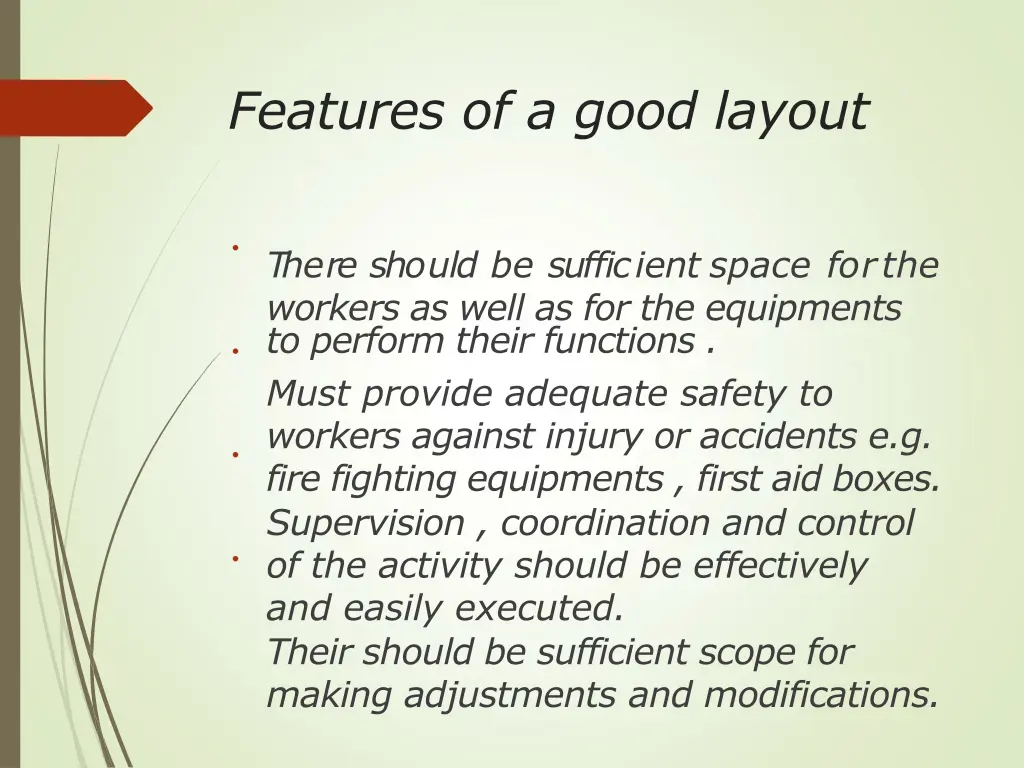
Features of a good layout There should be sufficient space forthe workers as well as for the equipments to perform their functions . Must provide adequate safety to workers against injury or accidents e.g. fire fighting equipments , first aid boxes. Supervision , coordination and control of the activity should be effectively and easily executed. Their should be sufficient scope for making adjustments and modifications.
Types of Plants Layout Product layout Process or functional layout Fixed layout
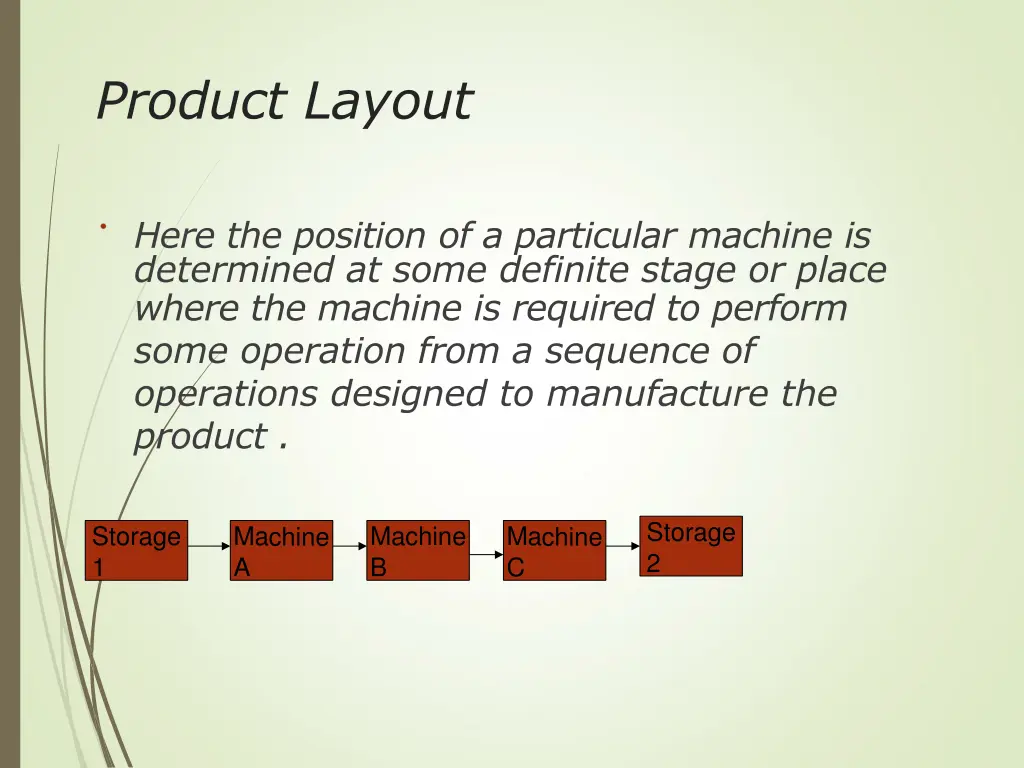
Product Layout Here the position of a particular machine is determined at some definite stage or place where the machine is required to perform some operation from a sequence of operations designed to manufacture the product . Storage 2 Storage 1 Ma A Mac B hine Ma C chine chine
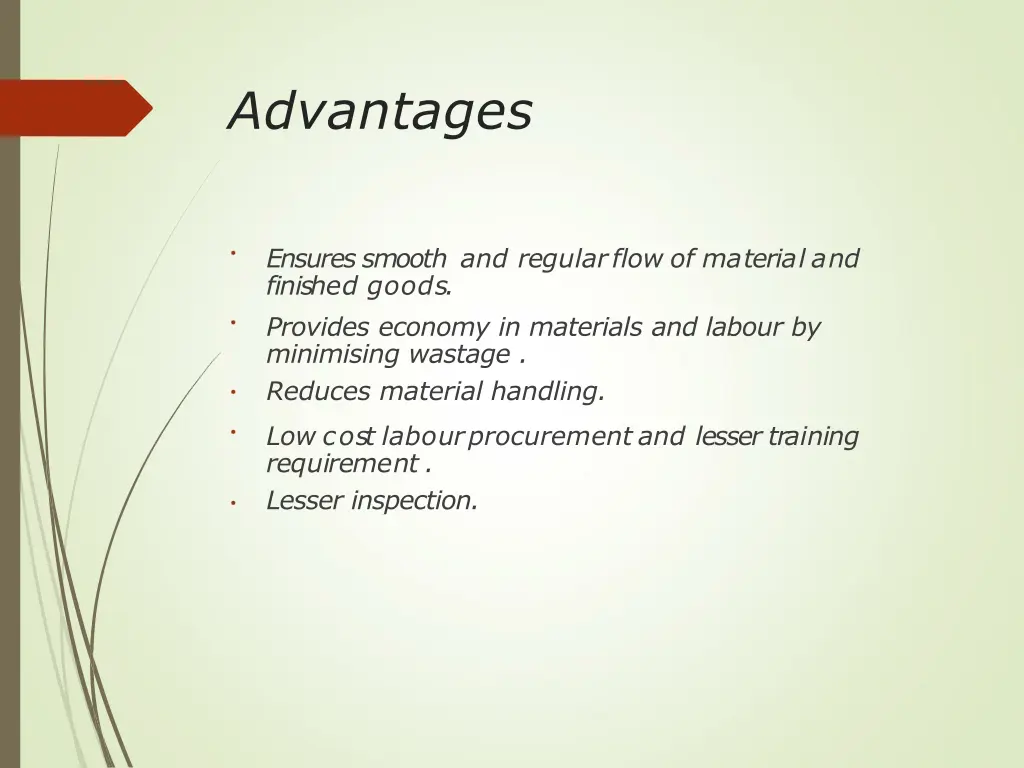
Advantages Ensuressmooth and regularflow of material and finished goods. Provides economy in materials and labour by minimising wastage . Reduces material handling. Low cost labourprocurement and lesser training requirement . Lesser inspection.
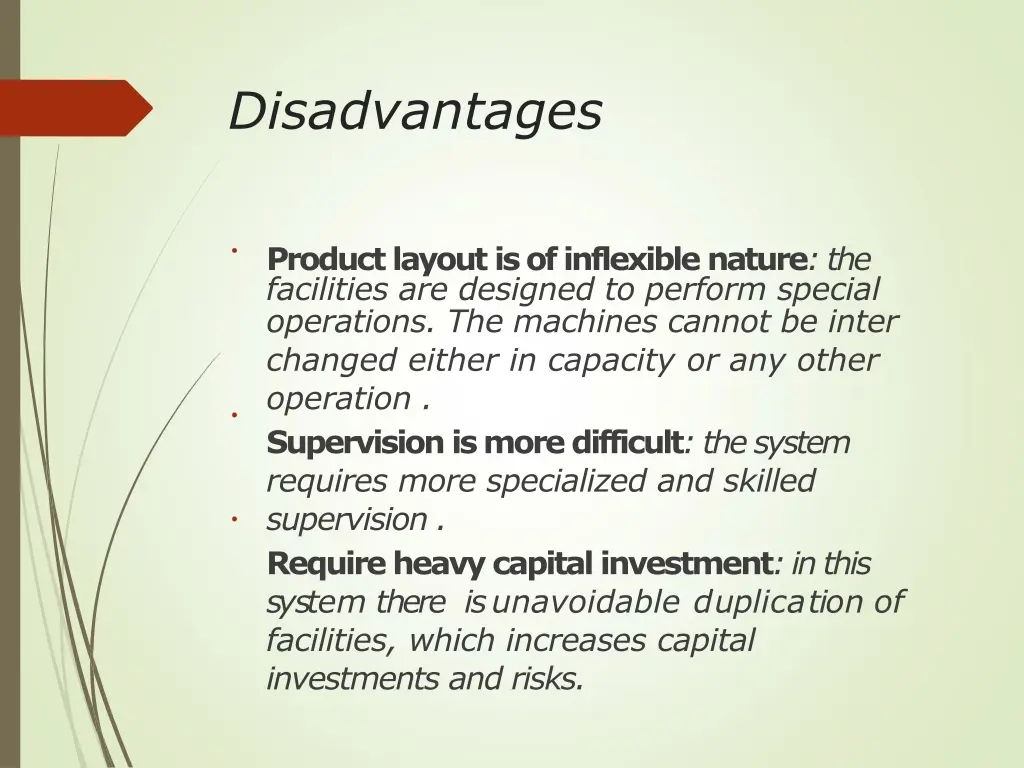
Disadvantages Product layout is of inflexible nature: the facilities are designed to perform special operations. The machines cannot be inter changed either in capacity or any other operation . Supervision is more difficult: the system requires more specialized and skilled supervision . Require heavy capital investment: in this system there isunavoidable duplication of facilities, which increases capital investments and risks.
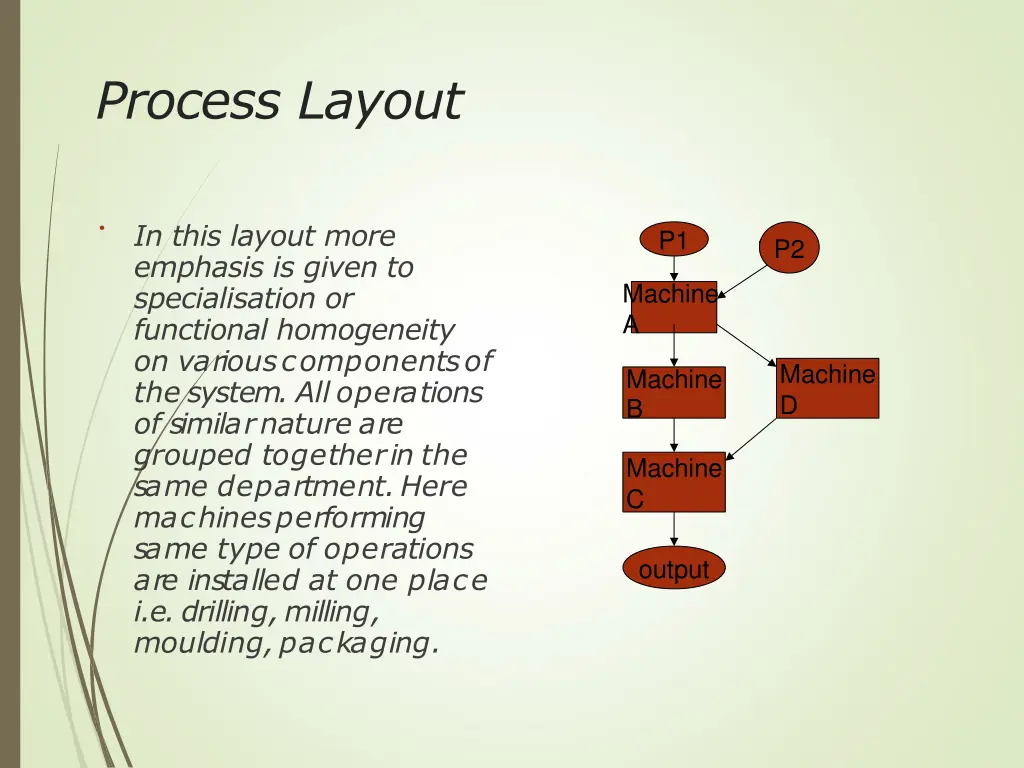
Process Layout In this layout more emphasis is given to specialisation or functional homogeneity on variouscomponentsof the system. Alloperations of similarnature are grouped togetherin the same department.Here machinesperforming same type of operations are installed at one place i.e. drilling,milling, moulding,packaging. P1 P2 Machine A Machine D Machine B Machine C output
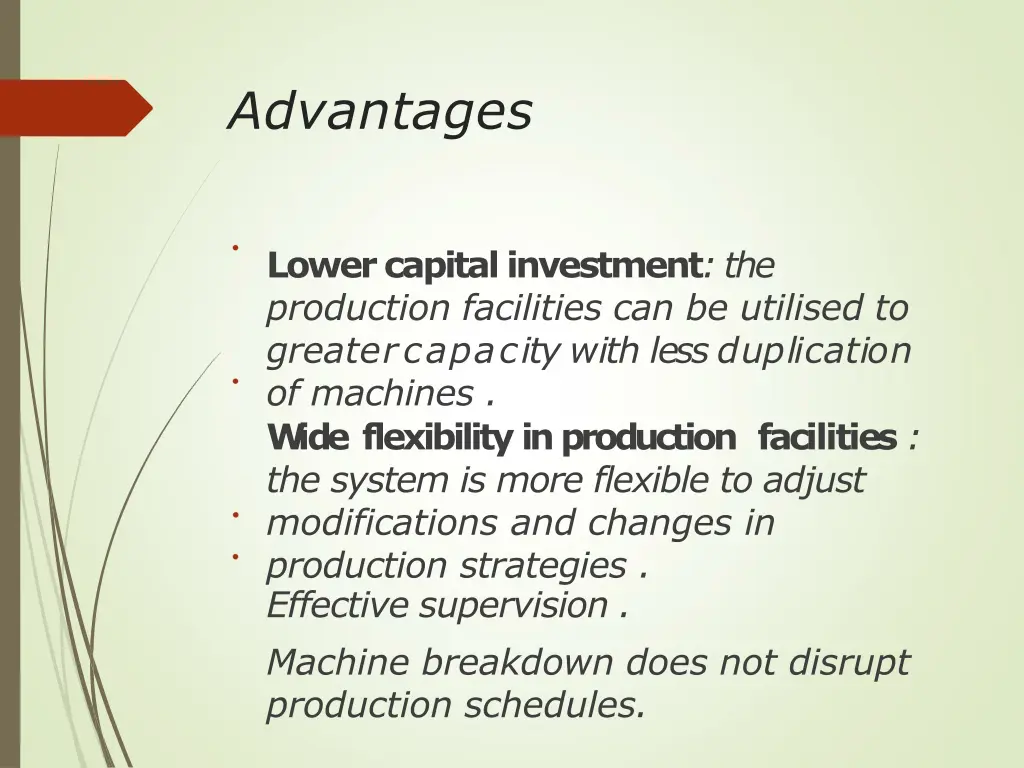
Advantages Lower capital investment: the production facilities can be utilised to greatercapacity with less duplication of machines . W ide flexibilityinproduction facilities : the system is more flexible to adjust modifications and changes in production strategies . Effective supervision . Machine breakdown does not disrupt production schedules.
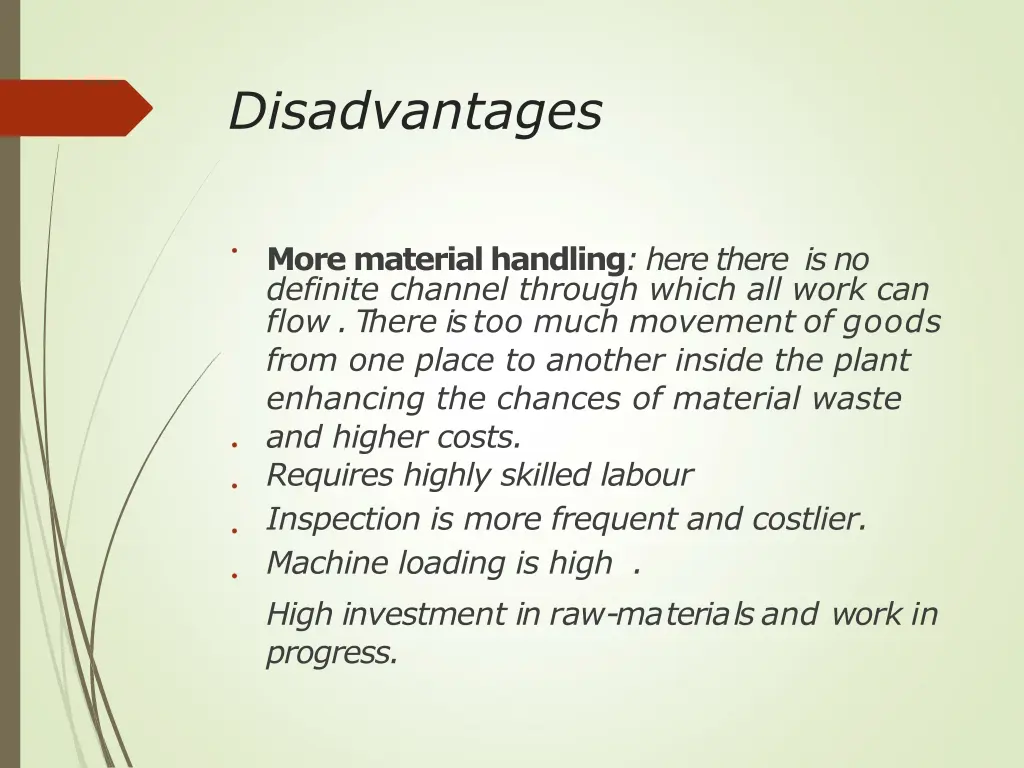
Disadvantages More material handling: here there is no definite channel through which all work can flow .There istoo much movement of goods from one place to another inside the plant enhancing the chances of material waste and higher costs. Requires highly skilled labour Inspection is more frequent and costlier. Machine loading is high . High investment in raw-materialsand work in progress.
Fixed Layout This type of layout is used in those situations where the goods are of such a size and weight that their movement from one place to another is not possible e.g. ship-building, construction of dams and bridges .
Advantages Layout is simple and capable of frequent adjustments both with respect with respect to product and the process. Labourers and workers can be employed and remain busy throughout the process in one work.
Disadvantages Since machines and equipments are transferred to some particular place, heavy and sophisticated equipment cannot be used in such cases. Due to low efficiency of men and machines this layout issuitable only forsome special type of project and for the production of smalleramount of items