Oregon Disaster Housing Task Force Overview
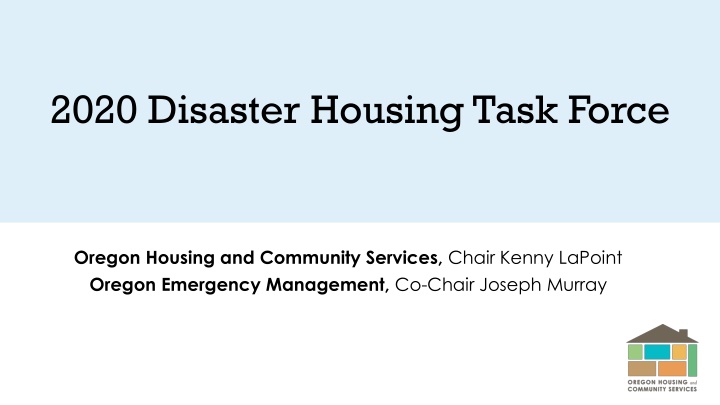
The Oregon Disaster Housing Task Force, chaired by Kenny LaPoint and co-chaired by Joseph Murray, is responsible for developing and implementing the Oregon Disaster Housing Strategy. This task force aims to efficiently meet the housing needs of individuals and families post-disaster when local resources are insufficient. The State Recovery Function 5 focuses on establishing intermediate and long-term housing solutions for Oregonians affected by disasters, with an emphasis on community-based recovery plans. Key objectives include assessing housing impacts, planning temporary and long-term housing options, and establishing a resilient and sustainable housing market within specified timelines.

Download Presentation

Please find below an Image/Link to download the presentation.
The content on the website is provided AS IS for your information and personal use only. It may not be sold, licensed, or shared on other websites without obtaining consent from the author.If you encounter any issues during the download, it is possible that the publisher has removed the file from their server.
You are allowed to download the files provided on this website for personal or commercial use, subject to the condition that they are used lawfully. All files are the property of their respective owners.
The content on the website is provided AS IS for your information and personal use only. It may not be sold, licensed, or shared on other websites without obtaining consent from the author.
E N D
Presentation Transcript
2020 Disaster Housing Task Force Oregon Housing and Community Services, Chair Kenny LaPoint Oregon Emergency Management, Co-Chair Joseph Murray
Oregon Disaster Housing Taskforce The Oregon Disaster Task Force has the responsibility to develop, maintain, and implement the Oregon Disaster Housing Strategy (Strategy), which is a component of Emergency Support Function (ESF) 6 of the State Emergency Operations Plan (EOP) addressing mass care, emergency assistance, housing and human services. The purpose of the Task Force is to prepare the state to quickly and effectively meet the housing needs of individuals and families in the aftermath of disasters when local resources are inadequate and need to be supplemented by assistance from the state or federal government.
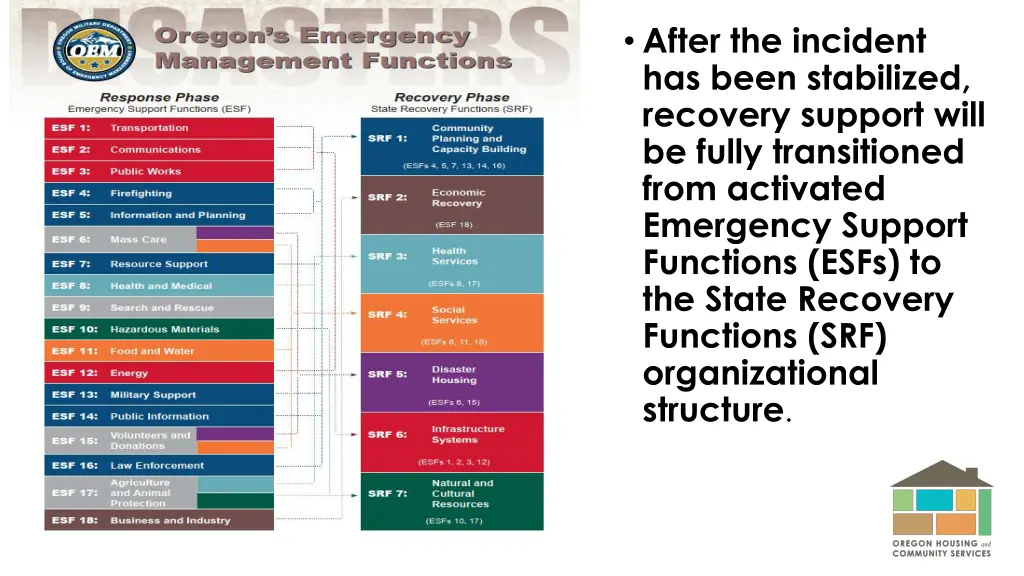
After the incident has been stabilized, recovery support will be fully transitioned from activated Emergency Support Functions (ESFs) to the State Recovery Functions (SRF) organizational structure.
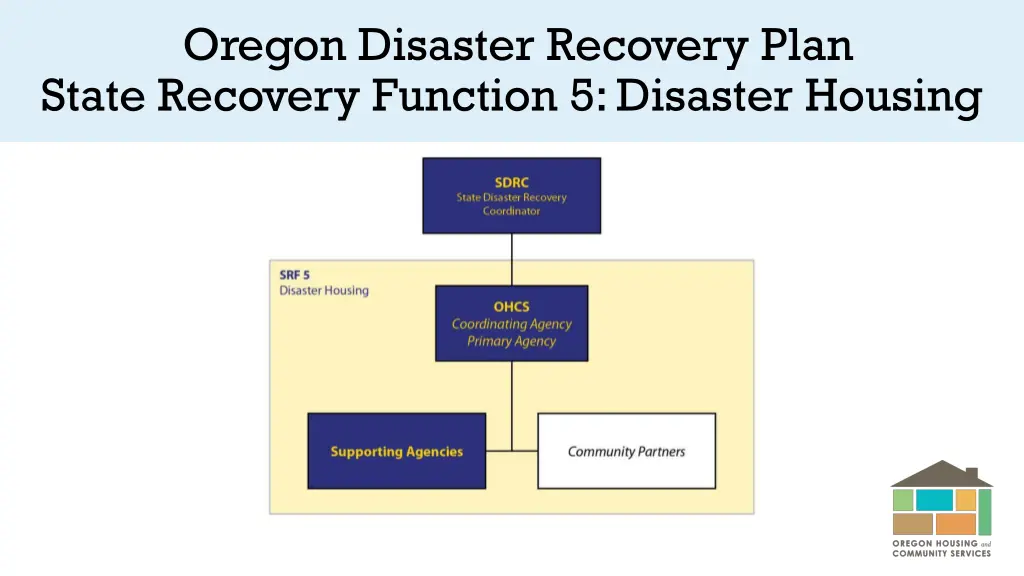
Oregon Disaster Recovery Plan State Recovery Function 5: Disaster Housing
Goals Establishing intermediate and long-term housing for Oregonians displaced by a disaster, with a goal of long- term solutions in their own communities. SRF 5 addresses pre- and post-disaster housing issues; coordinates and facilitates the delivery of state resources to assist local and tribal governments in the rehabilitation and reconstruction of destroyed and damaged housing, and the development of other new accessible, long- term housing options.
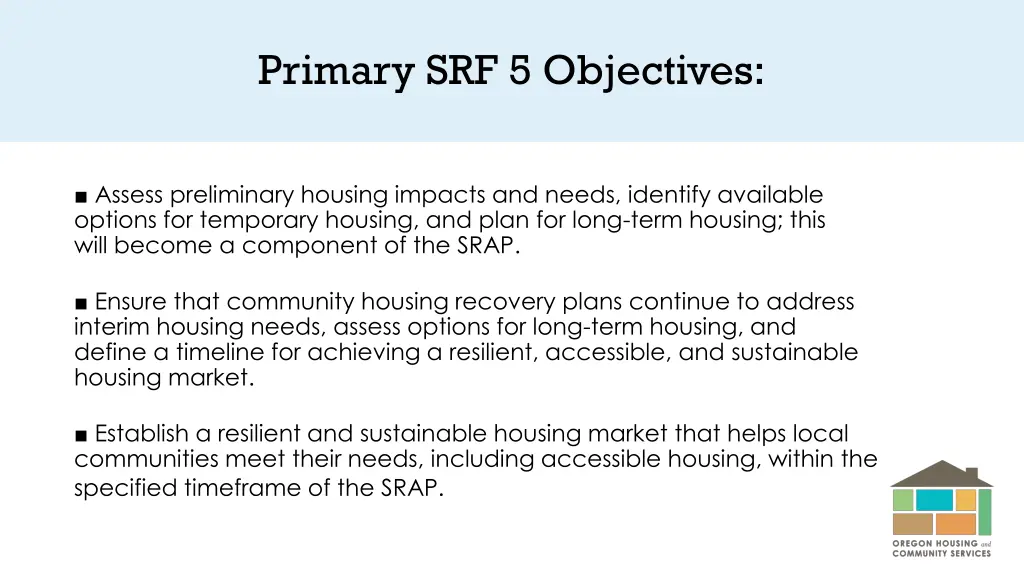
Primary SRF 5 Objectives: Assess preliminary housing impacts and needs, identify available options for temporary housing, and plan for long-term housing; this will become a component of the SRAP. Ensure that community housing recovery plans continue to address interim housing needs, assess options for long-term housing, and define a timeline for achieving a resilient, accessible, and sustainable housing market. Establish a resilient and sustainable housing market that helps local communities meet their needs, including accessible housing, within the specified timeframe of the SRAP.
Office of Emergency Management Update Stan Thomas and Joseph Murray situational update What does a major disaster declaration mean? 2021 Legislative Agenda: Investment and Engagement Updates
Federal Emergency Management Agency Update Overview of Sequence of Delivery update provided by Anita Jeanette (AJ) 2021 Legislative Agenda: Investment and Engagement Updates
Oregon Housing and Community Services Wildfire Relief program total applicants to date Plan to use resources to fill gaps after Federal resources are applied OHCS portfolio assessment 2021 Legislative Agenda: Investment and Engagement Updates
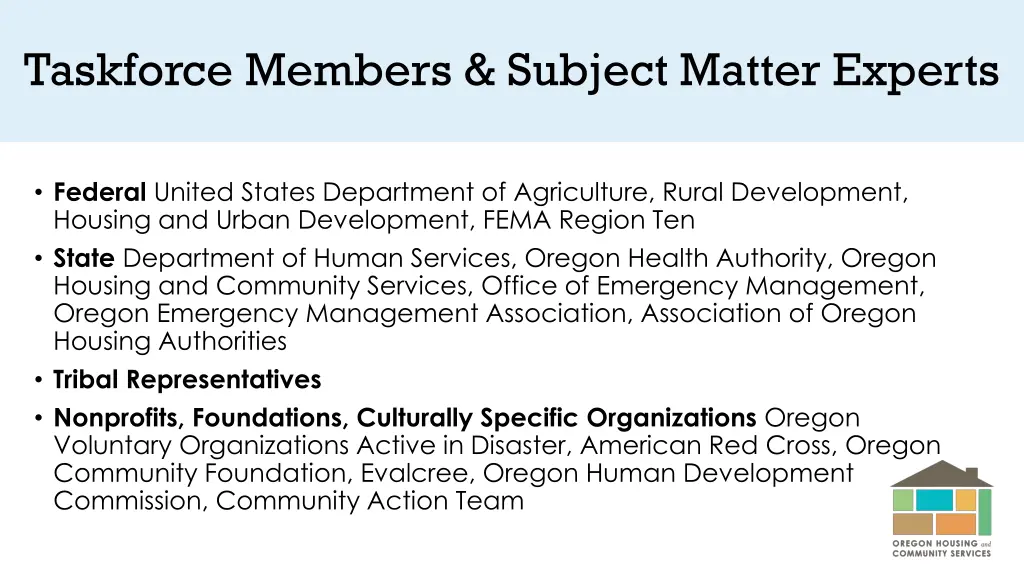
Taskforce Members & Subject Matter Experts Federal United States Department of Agriculture, Rural Development, Housing and Urban Development, FEMA Region Ten State Department of Human Services, Oregon Health Authority, Oregon Housing and Community Services, Office of Emergency Management, Oregon Emergency Management Association, Association of Oregon Housing Authorities Tribal Representatives Nonprofits, Foundations, Culturally Specific Organizations Oregon Voluntary Organizations Active in Disaster, American Red Cross, Oregon Community Foundation, Evalcree, Oregon Human Development Commission, Community Action Team
Discussion: Membership and Subject Matter Expertise - Whom are we missing? Other time sensitive issues and updates? Topics for future agenda items/discussion? How will the COVID-19 pandemic impact this work?
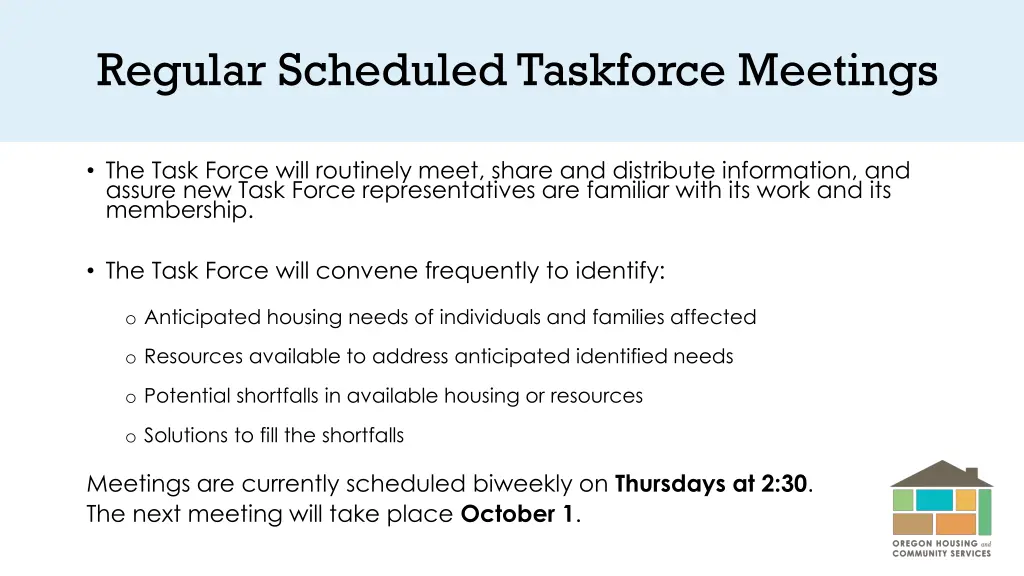
Regular Scheduled Taskforce Meetings The Task Force will routinely meet, share and distribute information, and assure new Task Force representatives are familiar with its work and its membership. The Task Force will convene frequently to identify: o Anticipated housing needs of individuals and families affected o Resources available to address anticipated identified needs o Potential shortfalls in available housing or resources o Solutions to fill the shortfalls Meetings are currently scheduled biweekly on Thursdays at 2:30. The next meeting will take place October 1.
Resources: Encourage Oregonians to register with FEMA to access individual assistance. Every Oregonian who is eligible should receive the assistance they need. Let s spread the word. Contact: 800-621-3362, download the FEMA app or visit http://DisasterAssistance.gov Please continue to share the wildfire.oregon.gov website with your networks.
Contact Kenny LaPoint, Director, Public Affairs Oregon Housing & Community Services 503-986-6758| Kenny.LaPoint@Oregon.Gov