Explore the historical origins and evolution of the legal concept of trespass in English law, tracing its development from the Anglo-Saxon period to the mid-18th century. Delve into the central royal courts and the emergence of the writ of trespass, shedding light on the precursors and legal complexities surrounding trespass actions.
Please find below an Image/Link to download the presentation.
The content on the website is provided AS IS for your information and personal use only. It may not be sold, licensed, or shared on other websites without obtaining consent from the author. If you encounter any issues during the download, it is possible that the publisher has removed the file from their server.
You are allowed to download the files provided on this website for personal or commercial use, subject to the condition that they are used lawfully. All files are the property of their respective owners.
The content on the website is provided AS IS for your information and personal use only. It may not be sold, licensed, or shared on other websites without obtaining consent from the author.
Introduction In the last lecture we gave an overall outline of where we are heading with regard to the personal actions. Our ultimate goal, which we will not reach until the end of the course, is something that bears a fairly close resemblance to the modern law of tort and contract, at least at the structural level. Also in the last lecture we looked at contract-like actions in the local courts. In this lecture and the next, we go back to the central royal courts to trace the origins and development of the action of trespass. We will also show how in the mid-14th an action called trespass on the case or just case emerged which considerably broadened the scope of the trespass action. In this lecture, having shown the origins of the action on the case, we go back to trespass itself and point to the emergence at the end of the 14th of quite systematic thinking about liability for wrongs..
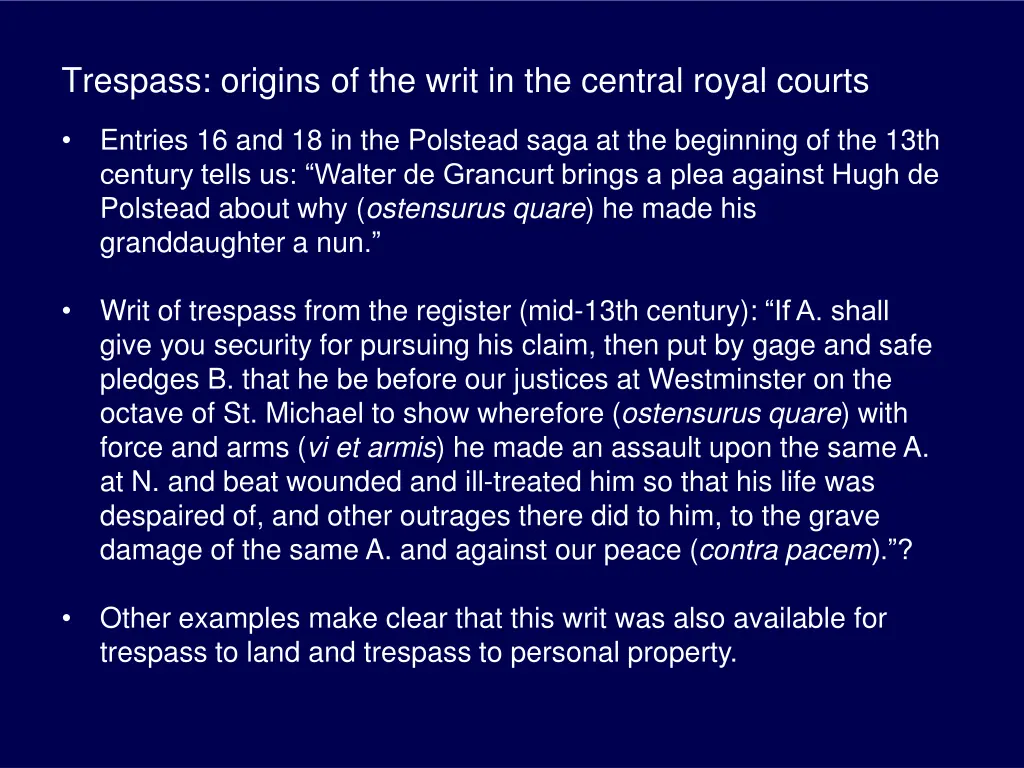
Trespass: origins of the writ in the central royal courts Entries 16 and 18 in the Polstead saga at the beginning of the 13th century tells us: Walter de Grancurt brings a plea against Hugh de Polstead about why (ostensurus quare) he made his granddaughter a nun. Writ of trespass from the register (mid-13th century): If A. shall give you security for pursuing his claim, then put by gage and safe pledges B. that he be before our justices at Westminster on the octave of St. Michael to show wherefore (ostensurus quare) with force and arms (vi et armis) he made an assault upon the same A. at N. and beat wounded and ill-treated him so that his life was despaired of, and other outrages there did to him, to the grave damage of the same A. and against our peace (contra pacem). ? Other examples make clear that this writ was also available for trespass to land and trespass to personal property.
Trespass: origins of the writ: possible precursors Bracton s Notebook appeals of novel disseisin Bill procedure in Coram rege (King s Bench) Res addiratae in local courts Actions for wrongs in local courts and loss of honor (iniuria)
Trespass: the tyranny of a word forgive us our trespasses felonious or non-felonious (trespass >misdemeanor) plea of the crown or not (contra pacem, usually vi et armis public proceedings (indictment) vs. private proceedings (appeal) appeal of felony vs. appeal of trespass (if an appeal of trespass is also a plea of the crown it must be heard in the central royal courts because c. 24 of Magna Carta says The sheriff shall not hear pleas of the crown. This should make it clear that a great deal of legal history on this topic is wrong. What looks like a development of ideas in the mid 14th c., when the requirement of force and arms was dropped in the action on the case, is in fact a jurisdictional shift, and the origins of the idea of wrongs by nonfeasance, the modern tort of negligence, must be found, if at all, in the local courts, perhaps particularly the county court.
Trespass: early development (13th c.) In the last years of Henry III contra pacem writs and bills usually with vi et armis and leading to damages begin to appear in large numbers. The Statute of Gloucester (1278) limits trespass in the central royal courts to cases involving more than 40 s. Special trespass writs: repair of dykes, breach of market franchises The general issue is not guilty, personal attachment capias ad respondendum, capias ad audiendum judicium, capias ad satificiendum, i.e., That is to say, the defendant could be arrested to respond to writ, to hear the judgment, or to pay the damages.
Trespass: early 14th c. obscurity Ferrers v. Dodford (1307 Mats, p. VII 18): whereas lately the king had by his letters ordered his beloved and faithful John de Ferrers to come quickly to him with horses and arms on his Scottish expedition to assist him with his aforesaid expedition and the same John, getting ready to come to the aforesaid parts, had bought at Dodford a certain horse for a certain great sum of money from the aforesaid John, vicar of the church of Dodford, trusting in the same John s words, for he put that horse up for sale under guarantee, affirming by corporal oath taken at Dodford before trustworthy men that the same horse was healthy in all its limbs and unmaimed. The horse collapsed and by the time that Ferrers got to Scotland the war was over.
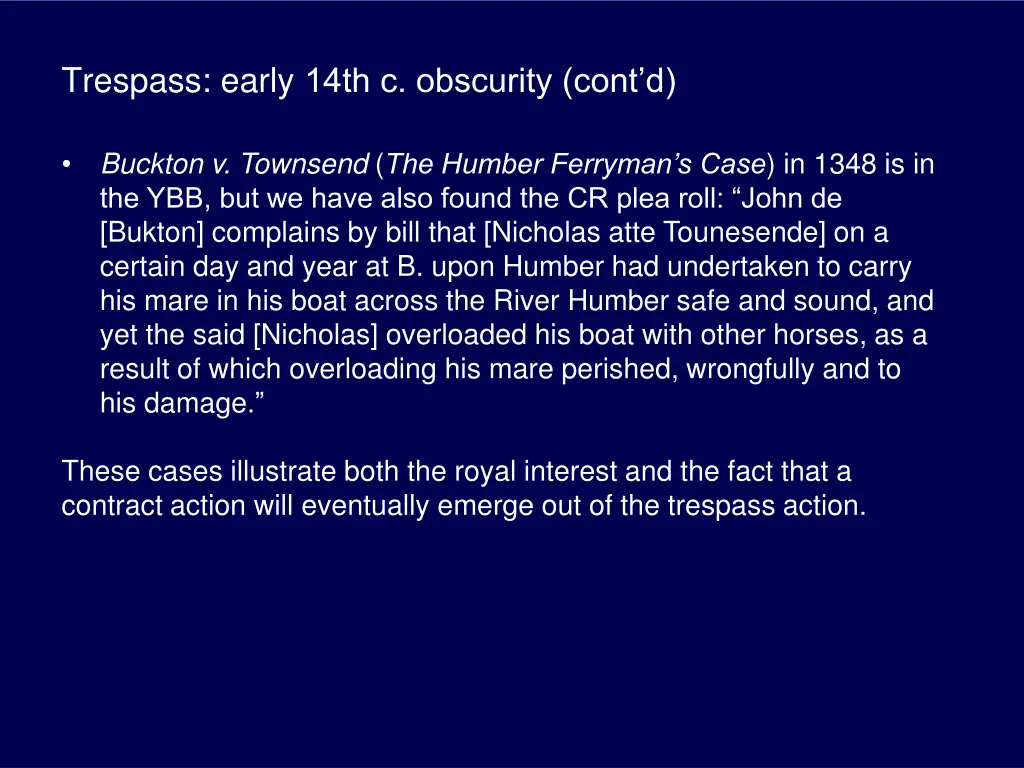
Trespass: early 14th c. obscurity (contd) Buckton v. Townsend (The Humber Ferryman s Case) in 1348 is in the YBB, but we have also found the CR plea roll: John de [Bukton] complains by bill that [Nicholas atte Tounesende] on a certain day and year at B. upon Humber had undertaken to carry his mare in his boat across the River Humber safe and sound, and yet the said [Nicholas] overloaded his boat with other horses, as a result of which overloading his mare perished, wrongfully and to his damage. These cases illustrate both the royal interest and the fact that a contract action will eventually emerge out of the trespass action.
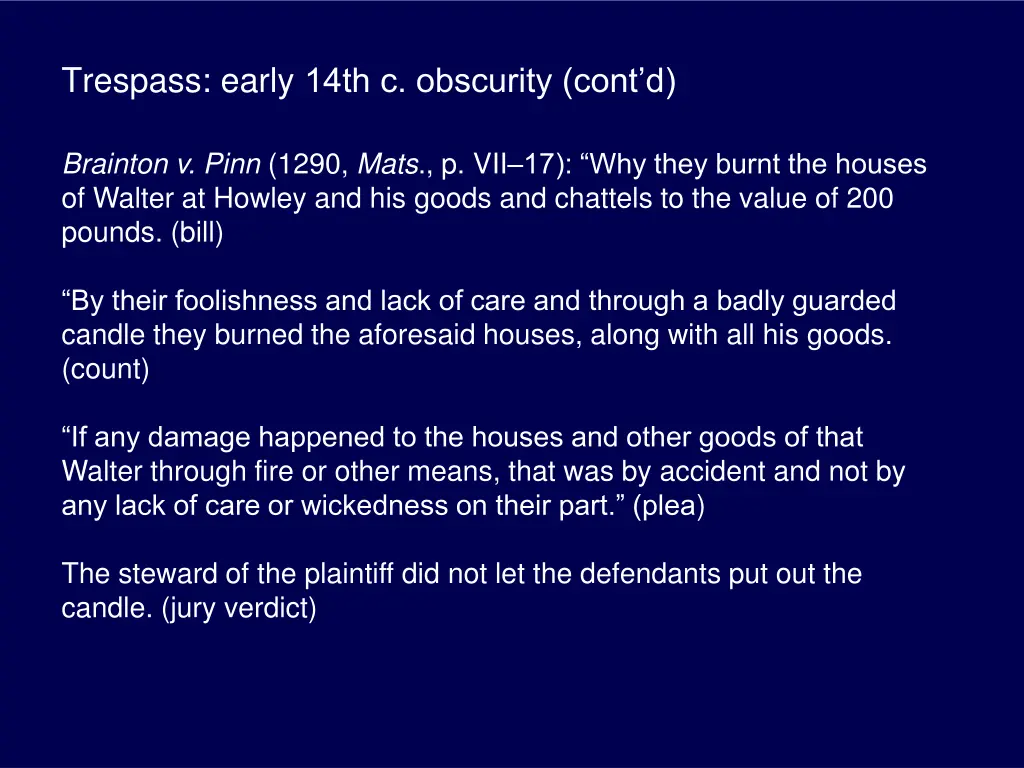
Trespass: early 14th c. obscurity (contd) Brainton v. Pinn (1290, Mats., p. VII 17): Why they burnt the houses of Walter at Howley and his goods and chattels to the value of 200 pounds. (bill) By their foolishness and lack of care and through a badly guarded candle they burned the aforesaid houses, along with all his goods. (count) If any damage happened to the houses and other goods of that Walter through fire or other means, that was by accident and not by any lack of care or wickedness on their part. (plea) The steward of the plaintiff did not let the defendants put out the candle. (jury verdict)
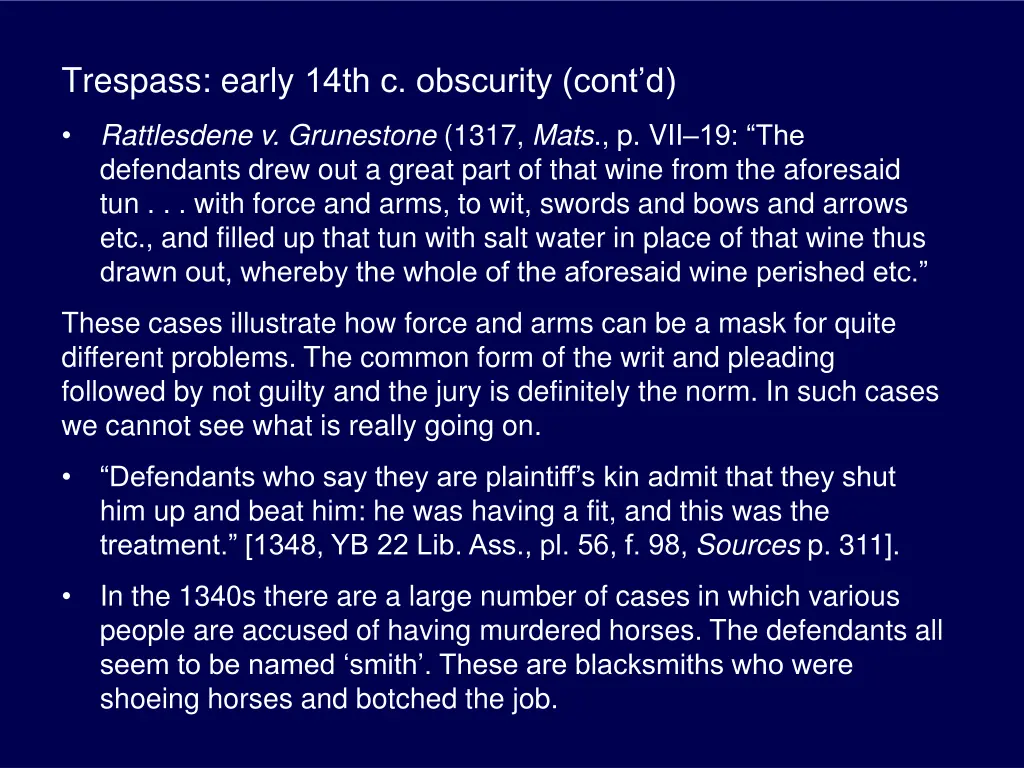
Trespass: early 14th c. obscurity (contd) Rattlesdene v. Grunestone (1317, Mats., p. VII 19: The defendants drew out a great part of that wine from the aforesaid tun . . . with force and arms, to wit, swords and bows and arrows etc., and filled up that tun with salt water in place of that wine thus drawn out, whereby the whole of the aforesaid wine perished etc. These cases illustrate how force and arms can be a mask for quite different problems. The common form of the writ and pleading followed by not guilty and the jury is definitely the norm. In such cases we cannot see what is really going on. Defendants who say they are plaintiff s kin admit that they shut him up and beat him: he was having a fit, and this was the treatment. [1348, YB 22 Lib. Ass., pl. 56, f. 98, Sources p. 311]. In the 1340s there are a large number of cases in which various people are accused of having murdered horses. The defendants all seem to be named smith . These are blacksmiths who were shoeing horses and botched the job.
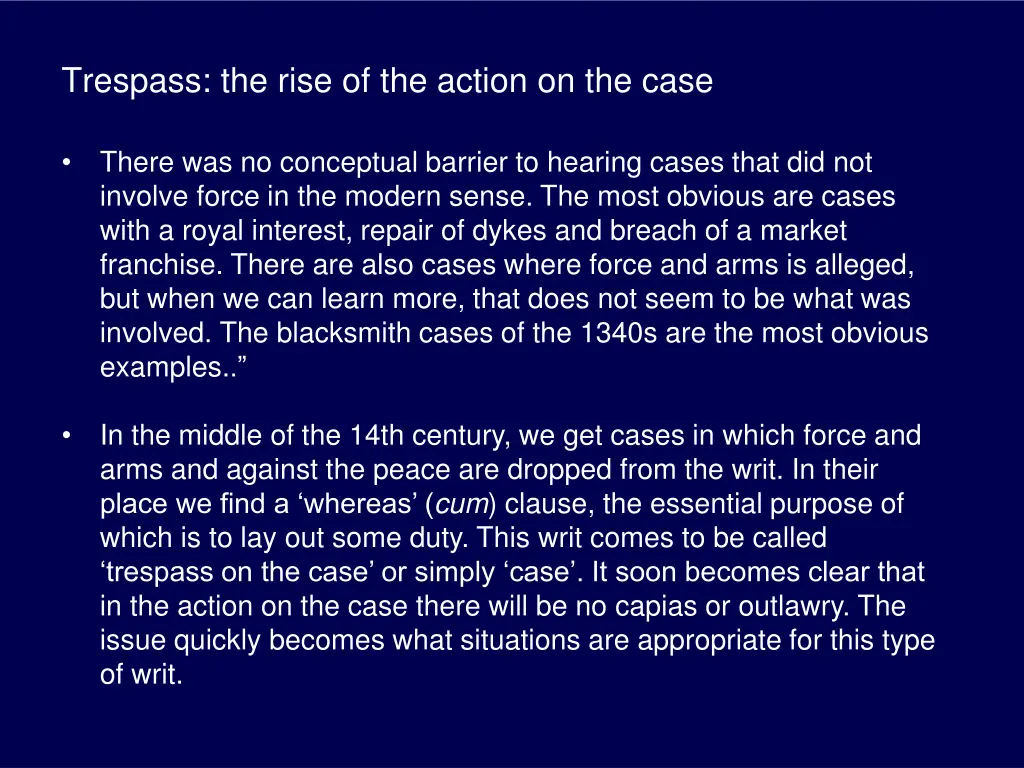
Trespass: the rise of the action on the case There was no conceptual barrier to hearing cases that did not involve force in the modern sense. The most obvious are cases with a royal interest, repair of dykes and breach of a market franchise. There are also cases where force and arms is alleged, but when we can learn more, that does not seem to be what was involved. The blacksmith cases of the 1340s are the most obvious examples.. In the middle of the 14th century, we get cases in which force and arms and against the peace are dropped from the writ. In their place we find a whereas (cum) clause, the essential purpose of which is to lay out some duty. This writ comes to be called trespass on the case or simply case . It soon becomes clear that in the action on the case there will be no capias or outlawry. The issue quickly becomes what situations are appropriate for this type of writ.
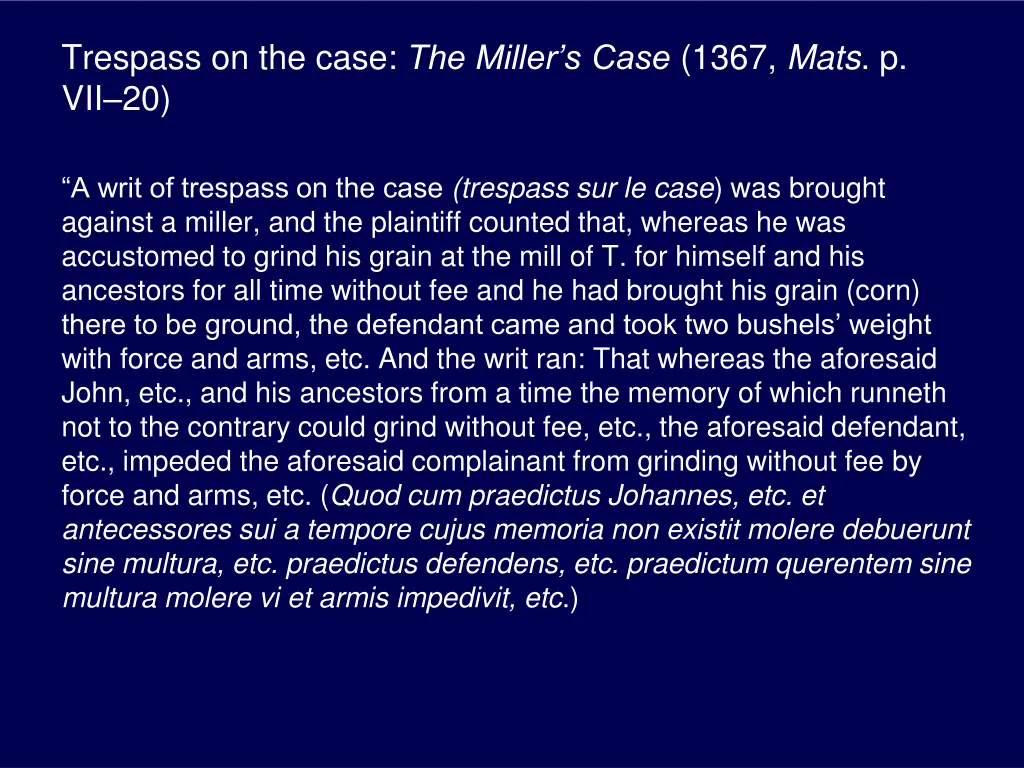
Trespass on the case: The Millers Case (1367, Mats. p. VII 20) A writ of trespass on the case (trespass sur le case) was brought against a miller, and the plaintiff counted that, whereas he was accustomed to grind his grain at the mill of T. for himself and his ancestors for all time without fee and he had brought his grain (corn) there to be ground, the defendant came and took two bushels weight with force and arms, etc. And the writ ran: That whereas the aforesaid John, etc., and his ancestors from a time the memory of which runneth not to the contrary could grind without fee, etc., the aforesaid defendant, etc., impeded the aforesaid complainant from grinding without fee by force and arms, etc. (Quod cum praedictus Johannes, etc. et antecessores sui a tempore cujus memoria non existit molere debuerunt sine multura, etc. praedictus defendens, etc. praedictum querentem sine multura molere vi et armis impedivit, etc.)
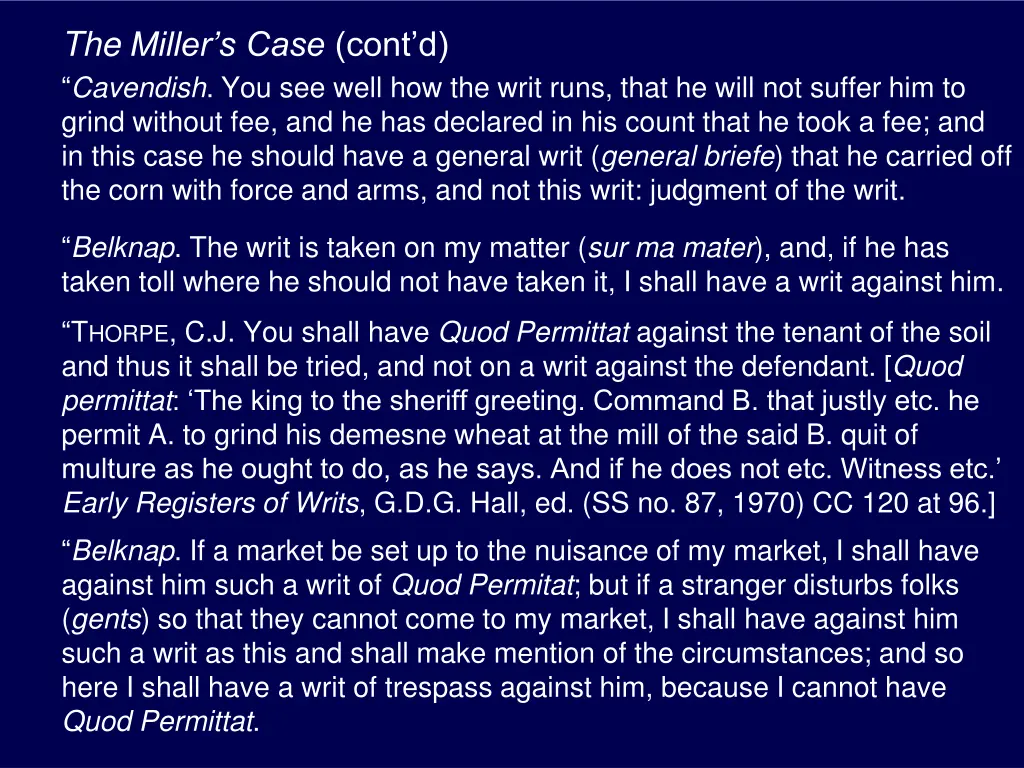
The Millers Case(contd) Cavendish. You see well how the writ runs, that he will not suffer him to grind without fee, and he has declared in his count that he took a fee; and in this case he should have a general writ (general briefe) that he carried off the corn with force and arms, and not this writ: judgment of the writ. Belknap. The writ is taken on my matter (sur ma mater), and, if he has taken toll where he should not have taken it, I shall have a writ against him. THORPE, C.J. You shall have Quod Permittat against the tenant of the soil and thus it shall be tried, and not on a writ against the defendant. [Quod permittat: The king to the sheriff greeting. Command B. that justly etc. he permit A. to grind his demesne wheat at the mill of the said B. quit of multure as he ought to do, as he says. And if he does not etc. Witness etc. Early Registers of Writs, G.D.G. Hall, ed. (SS no. 87, 1970) CC 120 at 96.] Belknap. If a market be set up to the nuisance of my market, I shall have against him such a writ of Quod Permitat; but if a stranger disturbs folks (gents) so that they cannot come to my market, I shall have against him such a writ as this and shall make mention of the circumstances; and so here I shall have a writ of trespass against him, because I cannot have Quod Permittat.
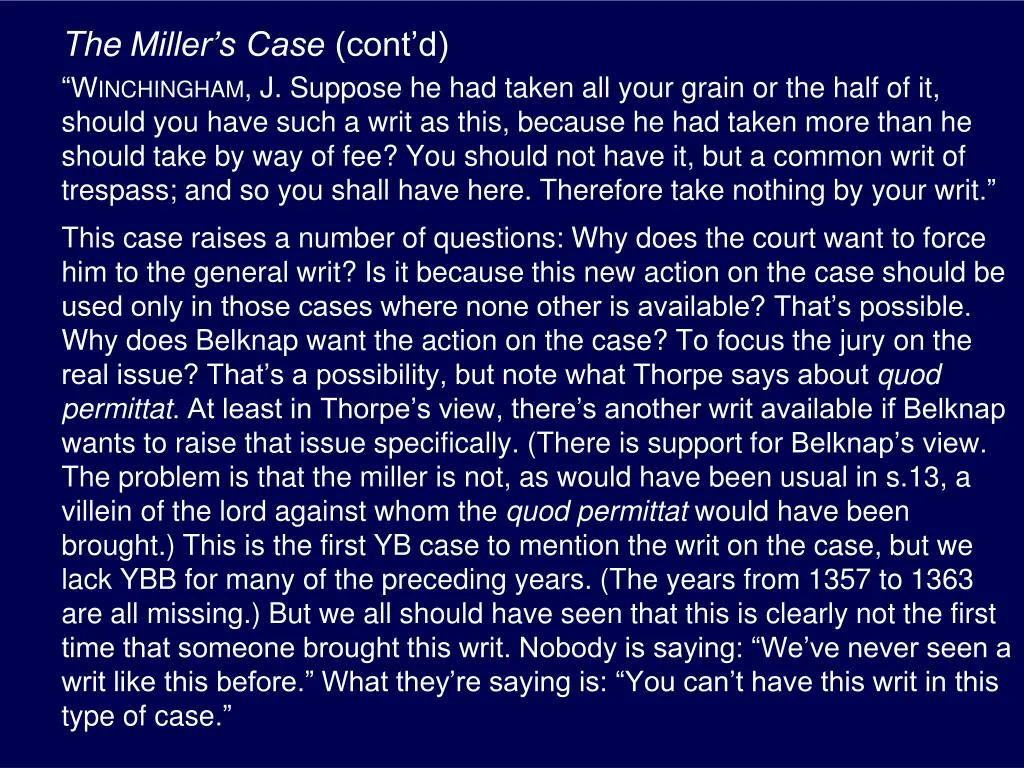
The Millers Case(contd) WINCHINGHAM, J. Suppose he had taken all your grain or the half of it, should you have such a writ as this, because he had taken more than he should take by way of fee? You should not have it, but a common writ of trespass; and so you shall have here. Therefore take nothing by your writ. This case raises a number of questions: Why does the court want to force him to the general writ? Is it because this new action on the case should be used only in those cases where none other is available? That s possible. Why does Belknap want the action on the case? To focus the jury on the real issue? That s a possibility, but note what Thorpe says about quod permittat. At least in Thorpe s view, there s another writ available if Belknap wants to raise that issue specifically. (There is support for Belknap s view. The problem is that the miller is not, as would have been usual in s.13, a villein of the lord against whom the quod permittat would have been brought.) This is the first YB case to mention the writ on the case, but we lack YBB for many of the preceding years. (The years from 1357 to 1363 are all missing.) But we all should have seen that this is clearly not the first time that someone brought this writ. Nobody is saying: We ve never seen a writ like this before. What they re saying is: You can t have this writ in this type of case.
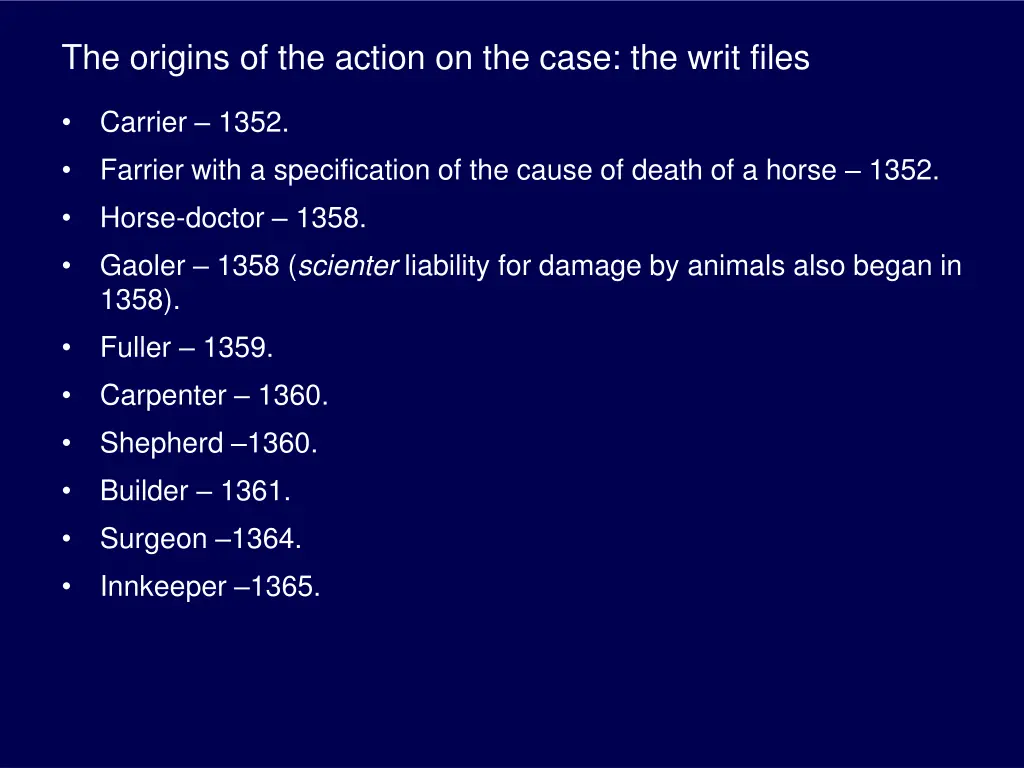
The origins of the action on the case: the writ files Carrier 1352. Farrier with a specification of the cause of death of a horse 1352. Horse-doctor 1358. Gaoler 1358 (scienter liability for damage by animals also began in 1358). Fuller 1359. Carpenter 1360. Shepherd 1360. Builder 1361. Surgeon 1364. Innkeeper 1365.
The origins of the action on the case: the writ files (contd) These writs were not simply one-off. In most cases they were followed by a steady stream of similar actions. They were similar in that, with the exception of the scienter writs, they accused someone in a particular occupation of having damaged the plaintiff by doing his job badly, or, in some cases, of not doing it at all. Most of them are in the quare cum form; those that are hardly ever allege vi et armis; a few allege contra pacem, but normally that inclusion seems to be surplusage. The one group of writs that is not occupation-specific is the scienter writs, and in the case of the scienter writs the vast majority of them deal with a specific animal, vicious dogs, knowingly (scienter) maintained by the defendant. As the list of the first writs shows, occupational liability for each type of occupation did not begin at the same time. New occupations were added over the course of the years from 1352 to 1365. All of the major occupational categories had, however, been established by 1365, and there were no additions to these major categories prior to 1382, perhaps not until the end of the century.
Trespass on the case: Navenby v. Lassels (The Innkeeper s Case) (1368, Mats. p. VII 21) Trespass was brought by one W. against one T., an innkeeper, and his servants; and he counted that, whereas throughout the whole kingdom of England it was the custom and use, where a common inn was kept, that the innkeeper and his servants should keep the goods and chattels which their guests had in their rooms within the inn while they were lodged there, the said W. came there on such a day, etc., into the town of Canterbury to the said T. and there lodged with him together with his horse and other goods and chattels, to wit, clothes, etc. and twenty marks of silver in a purse, and he took a room there and put these goods and chattels and the silver in the room, and then went into the town for other things; and while he was in the town, the said goods and chattels and silver were taken out of his room by evildoers through the default of the innkeeper and his servants in keeping them, wrongfully and against the peace, to his damage, etc. And he had a writ on all the matter according to the case. Ultimately, the court allowed the action There was no suggestion that the innkeeper had stolen the money; his fault, if such it was, lay in his failure to prevent the theft.
Trespass on the case: (Waldon v. Marshall (1370, Mats. p. VII 23) William Waldon brought a writ against one J. Marshall [the word means horse-doctor, i.e., veterinarian], and alleged by his writ that the aforesaid John took in his hand the horse of the aforesaid William to cure it of its infirmity, and afterwards the aforesaid John so negligently did his cure that the horse died. Kirton. We challenge the writ, because it makes mention of contra pacem, and in his count he has counted of his cure so negligently so that the horse died, so that he should not have said against the peace. And the judges were of opinion that the writ was ill framed. And then the writ was read, and he had not said contra pacem in the writ, and the writ was held to be good. . . . It is unclear in this case whether the horse doctor tried to cure the horse or just did not do anything.
Trespass on the case: The Farriers Case (1373, Mats. p. VII 23) Trespass was brought against a farrier for that he had lamed his horse, and the writ contained the words Why he fixed a nail in the foot of his horse in a certain place by which he lost the profit of his horse for a long time , etc. Persay. He has brought a writ of trespass against us and it does not contain the words vi et armis: judgment of the writ. FINCHEDON, C.J. He has brought his writ on his case so his writ is good. Persay. The writ should say vi et armis or he wickedly fixed it , and it has neither the one nor the other: judgment. Also he has not supposed in his count that he bailed us the horse to shoe; so otherwise it should be understood that if any trespass was done, it should be against the peace; wherefore judgment. And then the writ was adjudged good, and issue was joined that he shod the horse, without this, that he lamed it, etc. Not all the features of the usual action against farriers are here. That is probably why this case was reported.
Explanations of these developments The forty-shilling minimum for damages in trespass became less and less significant as forty shillings came be less and less valuable? The problem with this explanation is that it fits uneasily with the date of these developments. The mid-fourteenth century saw some inflation but not enough to cause a flood of cases that had previously been kept out because of the 40s. limit. The decline of the county court over the course of the 14th century? Various reasons have been suggested for what seems to be a fact. It is possible that the county court became more and more political, and, hence, plaintiffs became dissatisfied with the quality of justice that they were getting in that court. The vast majority of trespass cases were decided by local juries, and the sheriff, who was the chief officer of the county court, was also responsible for empaneling juries. This was a problem, but it was not a problem that one could avoid by bringing one s case in the central royal courts.
Explanations of these developments (contd) Related to capias? Capias was available in the common-law action of trespass vi et armis, probably from the beginning. That capias was regarded a particularly effective process is shown by the fact that it was extended by the statute of Westminster II (1285), c. 11, to account and by statute in 1351 to debt, detinue and replevin, but it was not available in the action on the case, at least not by statute, until 1504. The argument is that it was thought inappropriate for the less serious wrongs that were involved in the action on the case, and that the distinction between the two actions developed in order to make clear what was not appropriate for capias. The power of this argument depends on the assumption that a large number of cases that were later to be called case were already being brought under the rubric of trespass in the first half of the 14th century. Some were. The question is whether there were enough of them to cause the differentiation of the writs for procedural reasons. Otherwise, the decision not to allow capias in the action on the case was post hoc, taken after the action had been developed.
Explanations of these developments (contd) The Black Death? Robert Palmer has constructed an elaborate argument that the Black Death explains the rise of the action. As he sees it the Black Death caused a crisis in traditional services. The blacksmith died in the plague, and somebody who thought he knew what he was doing tried to do his job. The result was a bunch of dead horses. The decision was consciously taken by the council in conjunction with the chancery to expand trespass to include professional incompetence. The evidence from the writ files certainly suggests that different types of activities were brought in under the rubric of trespass on the case at different times. Palmer also suggests that there was a conceptual breakthrough in that there was a breach in the traditional notion that not doing is no trespass. Not everyone accepts all of Palmer s argument, but some of it is probably right. The absence of YBB reports for the critical years certainly does not help.
What is left for trespass not on the case? Berden v. Burton (1382, Mats., VII 24) A man brought a writ of trespass against Davy Houlgrave and Thomas de Burton and twelve others for his house burnt and broken, his servants beaten and maltreated, twelve oxen and a hundred sheep taken and driven off, and other goods and chattels taken and carried away, and other wrongs etc., to his damage etc. . . . Whatever else we might say about this, it is clear that we are not at the hazy borderline between what is actionable and what isn t. Absent justification, this is a wrong. But there was a justification, the defendants were taking a distress, so the question becomes where did they go over the line of what was permissible in taking a distress?
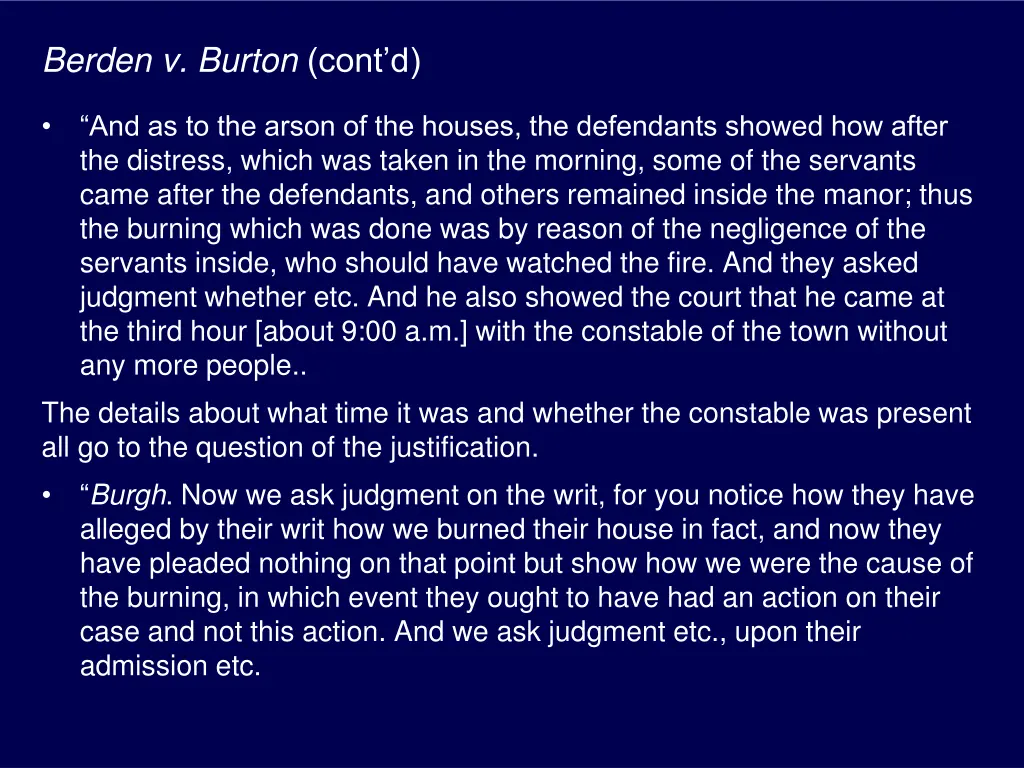
Berden v. Burton(contd) And as to the arson of the houses, the defendants showed how after the distress, which was taken in the morning, some of the servants came after the defendants, and others remained inside the manor; thus the burning which was done was by reason of the negligence of the servants inside, who should have watched the fire. And they asked judgment whether etc. And he also showed the court that he came at the third hour [about 9:00 a.m.] with the constable of the town without any more people.. The details about what time it was and whether the constable was present all go to the question of the justification. Burgh. Now we ask judgment on the writ, for you notice how they have alleged by their writ how we burned their house in fact, and now they have pleaded nothing on that point but show how we were the cause of the burning, in which event they ought to have had an action on their case and not this action. And we ask judgment etc., upon their admission etc.
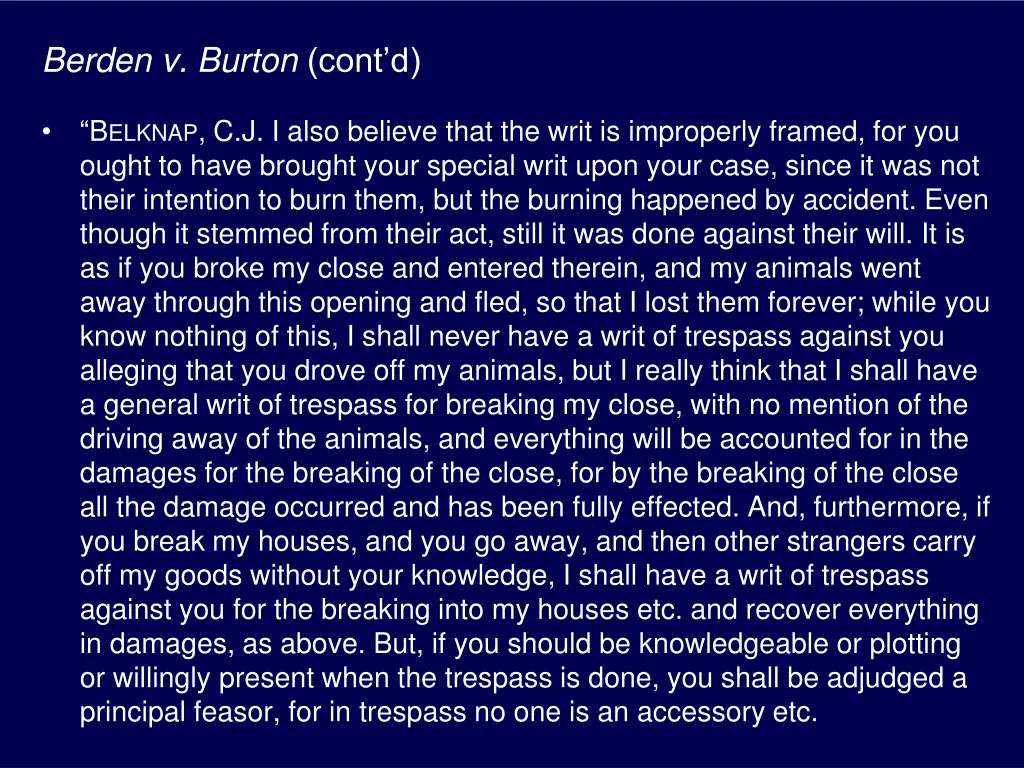
Berden v. Burton(contd) BELKNAP, C.J. I also believe that the writ is improperly framed, for you ought to have brought your special writ upon your case, since it was not their intention to burn them, but the burning happened by accident. Even though it stemmed from their act, still it was done against their will. It is as if you broke my close and entered therein, and my animals went away through this opening and fled, so that I lost them forever; while you know nothing of this, I shall never have a writ of trespass against you alleging that you drove off my animals, but I really think that I shall have a general writ of trespass for breaking my close, with no mention of the driving away of the animals, and everything will be accounted for in the damages for the breaking of the close, for by the breaking of the close all the damage occurred and has been fully effected. And, furthermore, if you break my houses, and you go away, and then other strangers carry off my goods without your knowledge, I shall have a writ of trespass against you for the breaking into my houses etc. and recover everything in damages, as above. But, if you should be knowledgeable or plotting or willingly present when the trespass is done, you shall be adjudged a principal feasor, for in trespass no one is an accessory etc.
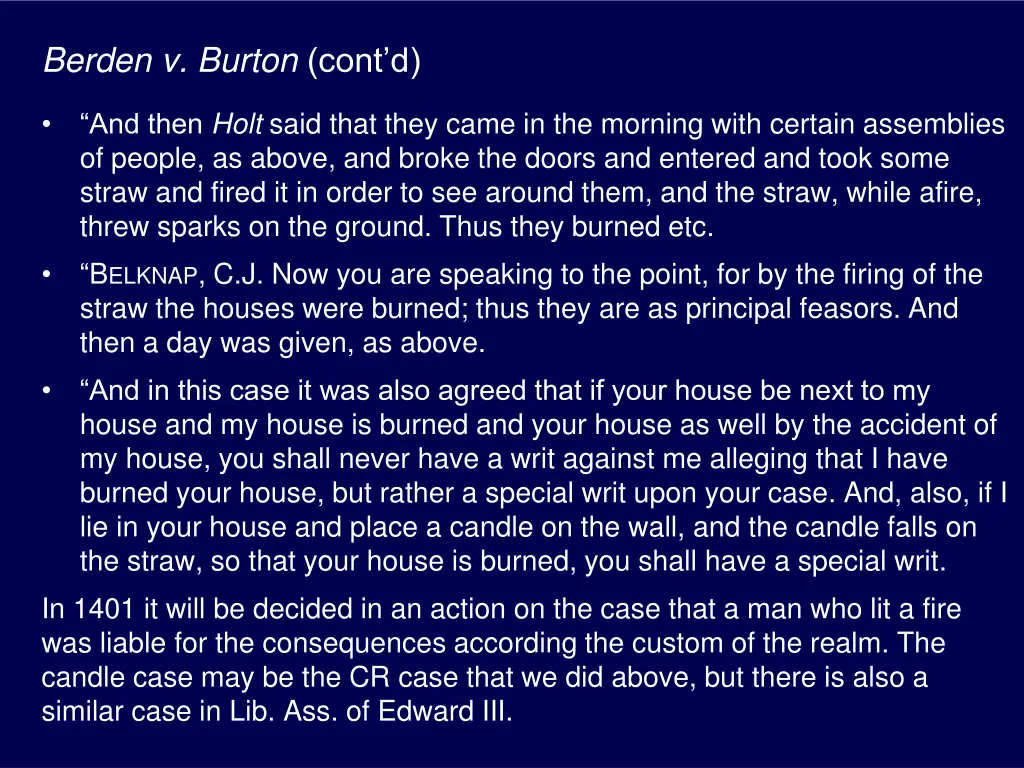
Berden v. Burton(contd) And then Holt said that they came in the morning with certain assemblies of people, as above, and broke the doors and entered and took some straw and fired it in order to see around them, and the straw, while afire, threw sparks on the ground. Thus they burned etc. BELKNAP, C.J. Now you are speaking to the point, for by the firing of the straw the houses were burned; thus they are as principal feasors. And then a day was given, as above. And in this case it was also agreed that if your house be next to my house and my house is burned and your house as well by the accident of my house, you shall never have a writ against me alleging that I have burned your house, but rather a special writ upon your case. And, also, if I lie in your house and place a candle on the wall, and the candle falls on the straw, so that your house is burned, you shall have a special writ. In 1401 it will be decided in an action on the case that a man who lit a fire was liable for the consequences according the custom of the realm. The candle case may be the CR case that we did above, but there is also a similar case in Lib. Ass. of Edward III.
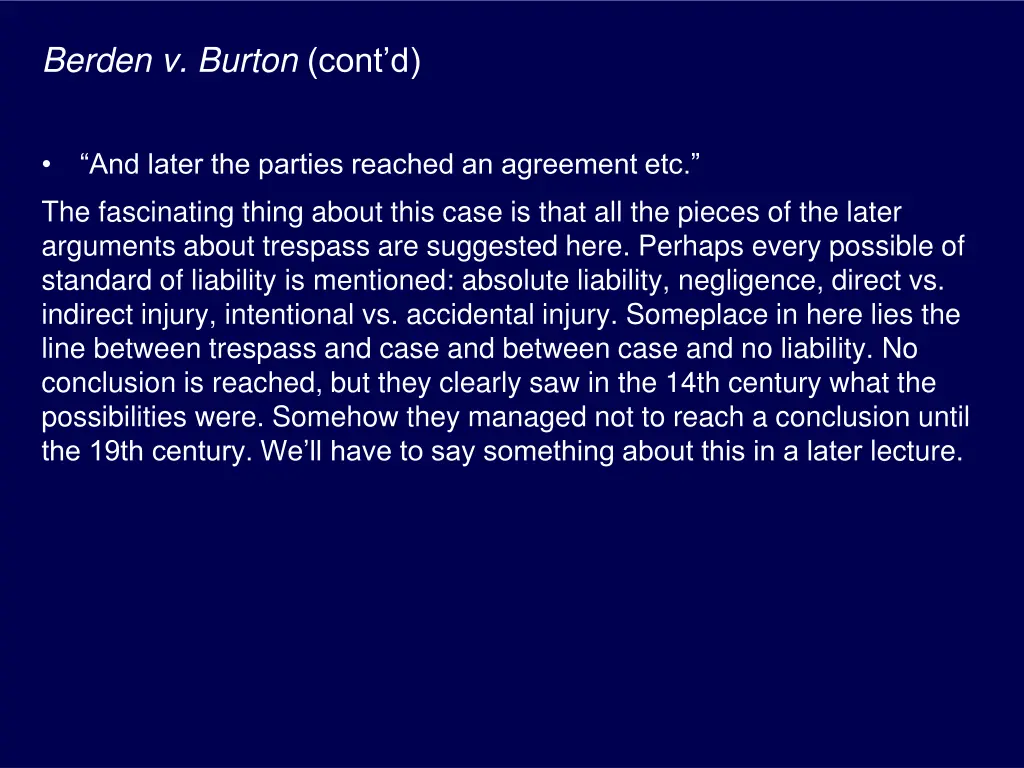
Berden v. Burton(contd) And later the parties reached an agreement etc. The fascinating thing about this case is that all the pieces of the later arguments about trespass are suggested here. Perhaps every possible of standard of liability is mentioned: absolute liability, negligence, direct vs. indirect injury, intentional vs. accidental injury. Someplace in here lies the line between trespass and case and between case and no liability. No conclusion is reached, but they clearly saw in the 14th century what the possibilities were. Somehow they managed not to reach a conclusion until the 19th century. We ll have to say something about this in a later lecture.
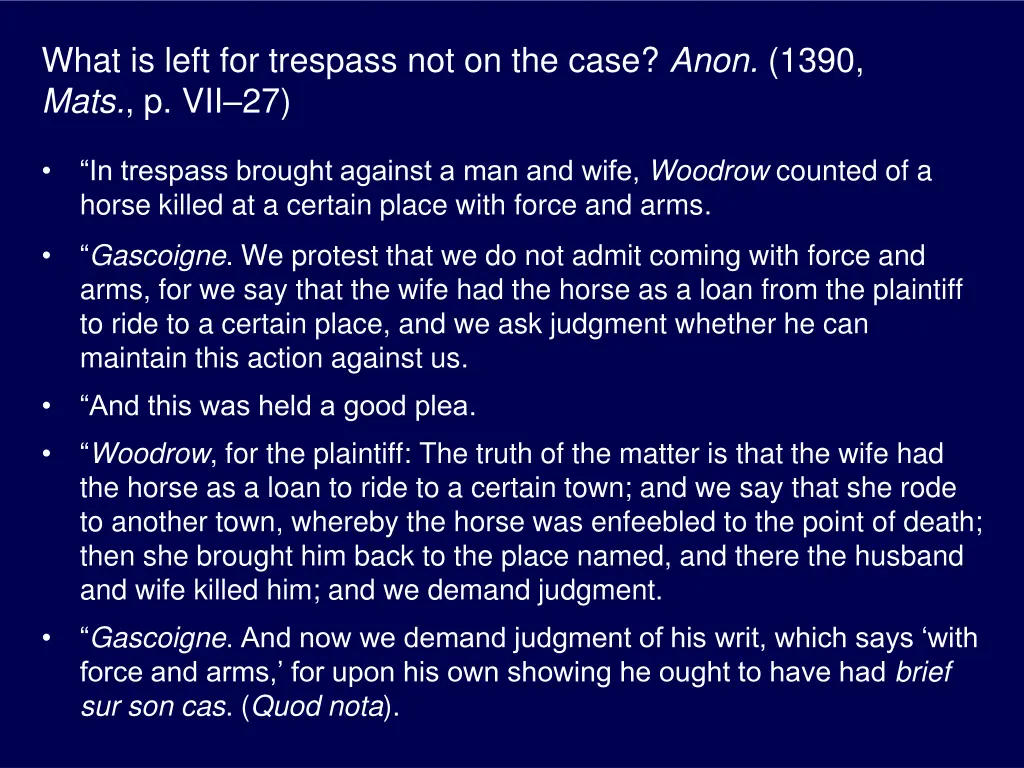
What is left for trespass not on the case? Anon. (1390, Mats., p. VII 27) In trespass brought against a man and wife, Woodrow counted of a horse killed at a certain place with force and arms. Gascoigne. We protest that we do not admit coming with force and arms, for we say that the wife had the horse as a loan from the plaintiff to ride to a certain place, and we ask judgment whether he can maintain this action against us. And this was held a good plea. Woodrow, for the plaintiff: The truth of the matter is that the wife had the horse as a loan to ride to a certain town; and we say that she rode to another town, whereby the horse was enfeebled to the point of death; then she brought him back to the place named, and there the husband and wife killed him; and we demand judgment. Gascoigne. And now we demand judgment of his writ, which says with force and arms, for upon his own showing he ought to have had brief sur son cas. (Quod nota).
Anon.(contd) So Woodrow said, we wish to imparl. Imparlance or licentia loquendi: means leave to end the matter amicably without farther suit, by talking with the other party. Woodrow here clearly sees that his writ is not going work, and seeks to settle the case with the defendants. The bottom line here is pretty clear. In a case involving the bailment of the horse, you can t use the general writ; you must use case.
Trespass and case: conclusion I can t tell you the rest of the tort story today, nor can I tell it to you tomorrow; it really hasn t been told. In the 17th c. we ll see something that will come to be called the action on the case for negligence. It is generally thought that the development of the modern law of tort is a phenomenon of the 19th century necessitated by the development of machinery. Maybe that s right, or maybe we just haven t done the work. We ll try to say something about this at the end of the course.