Explore the definition of orthopedic impairment, its impact on educational performance, prevalence statistics, and information on related conditions like cerebral palsy, spina bifida, muscular dystrophy, and spinal cord injuries. Learn about professional advocacy organizations and gain insights into common physical disabilities in school-age children.
Please find below an Image/Link to download the presentation.
The content on the website is provided AS IS for your information and personal use only. It may not be sold, licensed, or shared on other websites without obtaining consent from the author. If you encounter any issues during the download, it is possible that the publisher has removed the file from their server.
You are allowed to download the files provided on this website for personal or commercial use, subject to the condition that they are used lawfully. All files are the property of their respective owners.
The content on the website is provided AS IS for your information and personal use only. It may not be sold, licensed, or shared on other websites without obtaining consent from the author.
Definition Definition IDEA Definition 300.8 (c) (8) Orthopedic impairment means a severe orthopedic impairment that adversely affects a child s educational performance. The term includes impairments caused by a congenital anomaly, impairments caused by disease (e.g., poliomyelitis, bone tuberculosis), and impairments from other causes (e.g., cerebral palsy, amputations, and fractures or burns that cause contractures).
Prevalence Prevalence In 2020 21, the number of students ages 3 21 who received special education services under the Individuals with Disabilities Education Act (IDEA) was 7.2 million, or 15 percent of all public school students. >1% of all school-age children in special education, ages 3 through 21 years, received special education under the category of OI. The actual number of children served is much higher than the number receiving special education services under IDEA because: Many children with O I and O H I receive services under other categories. Some do not require specialized educational services.
Cerebral Palsy Cerebral Palsy A disorder of movement and posture A permanent condition that results from lesion to the brain or an abnormal brain growth Most prevalent physical disability in school-age children No clear relationship between the degree of motor impairment and degree of intellectual impairment (if any) Classified according to muscle tone (hypertonia) and motor movement Spastic, athetosis, ataxia
Spina Bifida Spina Bifida Congenital malformations of the brain, spinal cord, or vertebrae Most common neural tube defect Can result in paralysis below affected vertebra Three types: spina bifida occulta (mildest form), meningocele, myclomeningocele (most common and most severe form) Hydrocephalic condition common in many children with myclomeningocele treated with a shunt Requires clean intermittent catherization
Muscular Dystrophy and Spinal Cord Injuries Muscular Dystrophy and Spinal Cord Injuries Muscular Dystrophy Progressive atrophy of the body s muscles Duchenne muscular dystrophy most common Spinal Cord Injuries Caused by penetrating injury, fracture, stretching, or compression of spinal cord Can result in paralysis the higher the injury on the spine and the more the injury cuts the spinal cord Quadriplegia Paraplegia
Characteristics Characteristics Students with physical disabilities or health impairments function well below grade level academically Daily health care routines and medications have negative side effects Educational progress is often hampered by frequent and sometimes prolonged absences As a group, these students perform below average on measures of social-behavioral skills. Concerns about physical appearance are reasons for emotional difficulties and feelings of depression
Variables Affecting Educational Performance Variables Affecting Educational Performance A physical disability or health impairment can limit a child s ability to engage in age-appropriate activities, mobility, cognitive functioning, social and emotional development, sensory functioning, and communication across a continuum ranging from normal functioning to extremely impaired. Age of onset children with congenital or acquired impairments have different needs Visibility the visibility of impairment may cause some to underestimate the child s abilities and limit opportunities
Educational Approaches Educational Approaches Environmental Modifications Barrier-free Architecture Functional Adaptations Assistive Technology Assistive Technology Devices Assistive Technology Services Animal Assistance Helper or Service Dogs Monkeys as Personal Care Attendants
Special Health Care Routines Special Health Care Routines Proper positioning and movement encourage the development of muscles and bones and help maintain healthy skin. Proper seating helps combat poor circulation, muscle tightness, and pressure sores and contributes to proper digestion, respiration, and physical development. Lifting and transferring requires making contact with the child, communicating what is going to happen in a manner the child can understand, preparing the child physically for the transfer, and requiring the child to participate in the routine as much as possible.
Independence and Self Independence and Self- -Esteem Esteem Children need encouragement to develop: A positive, realistic view of themselves and their physical conditions As much independence as possible The ability to cope with their disabilities, set realistic expectations, and accept help gracefully when needed The ability to explain their physical disability or health condition and to respond to questions Collaboration with self-help groups for people with similar disabilities
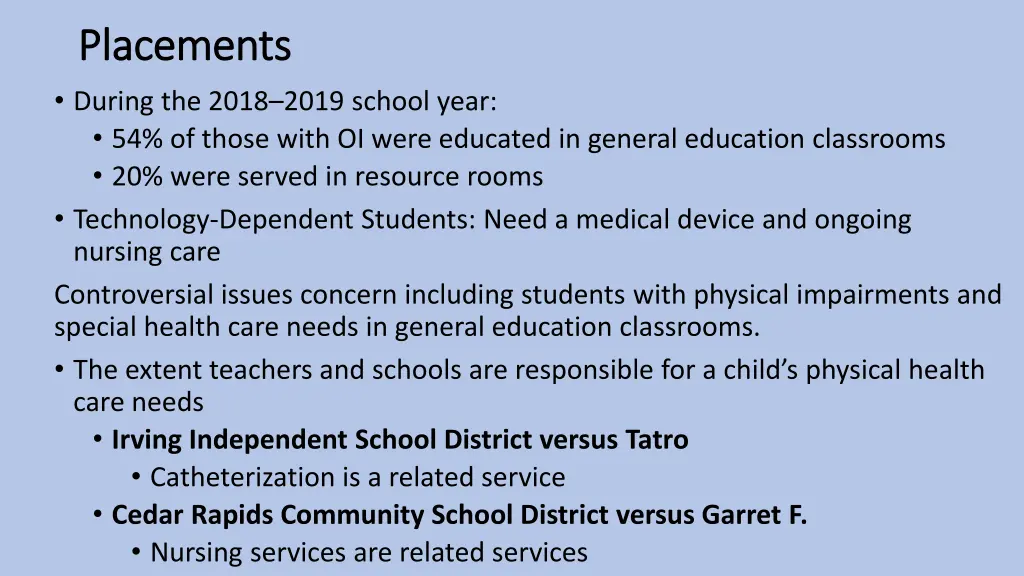
Placements Placements During the 2018 2019 school year: 54% of those with OI were educated in general education classrooms 20% were served in resource rooms Technology-Dependent Students: Need a medical device and ongoing nursing care Controversial issues concern including students with physical impairments and special health care needs in general education classrooms. The extent teachers and schools are responsible for a child s physical health care needs Irving Independent School District versus Tatro Catheterization is a related service Cedar Rapids Community School District versus Garret F. Nursing services are related services