Overcoming Challenges in Culture and Mindset Change for Healthcare Stakeholders
Addressing issues such as heavy workloads on physicians, lack of alignment between leadership and clinical staff, and stakeholder focus on financial aspects over outcomes in implementing value-based healthcare initiatives. Strategies include engaging a full clinical team, emphasizing benefits to late adopters, and adjusting data communications for different stakeholders.

Download Presentation

Please find below an Image/Link to download the presentation.
The content on the website is provided AS IS for your information and personal use only. It may not be sold, licensed, or shared on other websites without obtaining consent from the author. If you encounter any issues during the download, it is possible that the publisher has removed the file from their server.
You are allowed to download the files provided on this website for personal or commercial use, subject to the condition that they are used lawfully. All files are the property of their respective owners.
The content on the website is provided AS IS for your information and personal use only. It may not be sold, licensed, or shared on other websites without obtaining consent from the author.
E N D
Presentation Transcript
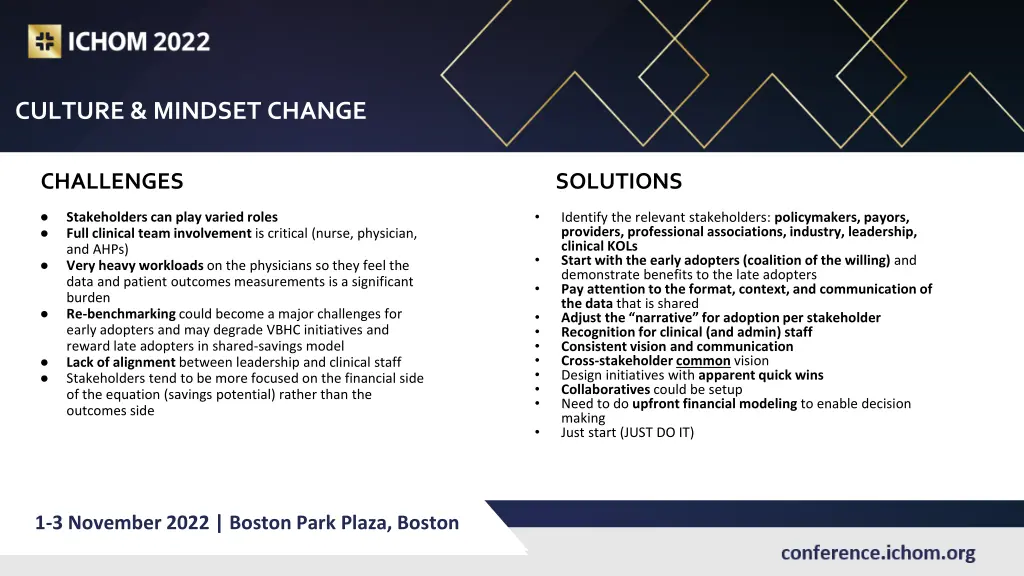
CULTURE & MINDSET CHANGE CHALLENGES SOLUTIONS Stakeholders can play varied roles Full clinical team involvement is critical (nurse, physician, and AHPs) Very heavy workloads on the physicians so they feel the data and patient outcomes measurements is a significant burden Re-benchmarking could become a major challenges for early adopters and may degrade VBHC initiatives and reward late adopters in shared-savings model Lack of alignment between leadership and clinical staff Stakeholders tend to be more focused on the financial side of the equation (savings potential) rather than the outcomes side Identify the relevant stakeholders: policymakers, payors, providers, professional associations, industry, leadership, clinical KOLs Start with the early adopters (coalition of the willing) and demonstrate benefits to the late adopters Pay attention to the format, context, and communication of the data that is shared Adjust the narrative for adoption per stakeholder Recognition for clinical (and admin) staff Consistent vision and communication Cross-stakeholder common vision Design initiatives with apparent quick wins Collaboratives could be setup Need to do upfront financial modeling to enable decision making Just start (JUST DO IT) 1-3 November 2022 | Boston Park Plaza, Boston p
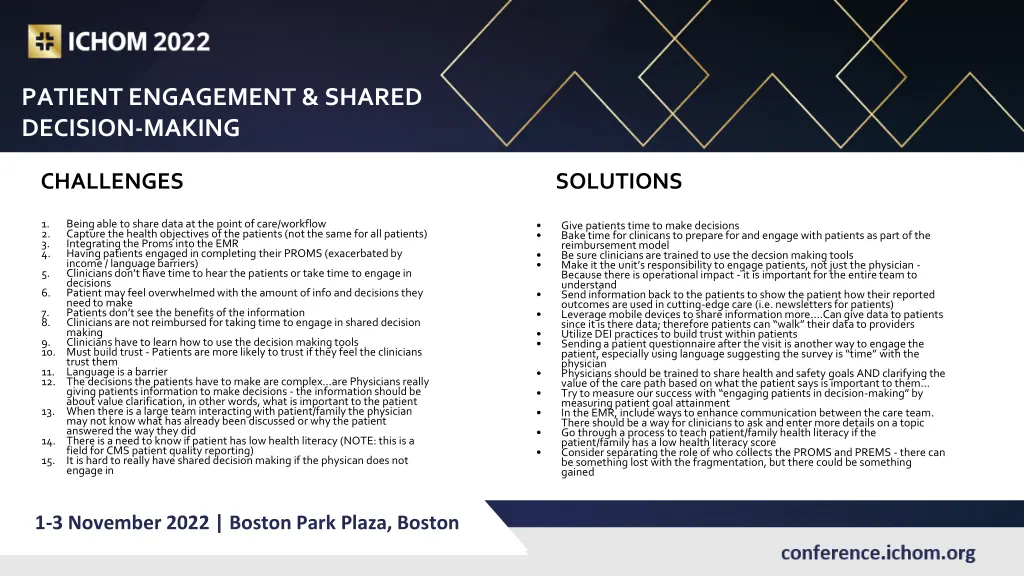
PATIENT ENGAGEMENT & SHARED DECISION-MAKING CHALLENGES SOLUTIONS 1. 2. 3. 4. Being able to share data at the point of care/workflow Capture the health objectives of the patients (not the same for all patients) Integrating the Proms into the EMR Having patients engaged in completing their PROMS (exacerbated by income / language barriers) Clinicians don t have time to hear the patients or take time to engage in decisions Patient may feel overwhelmed with the amount of info and decisions they need to make Patients don t see the benefits of the information Clinicians are not reimbursed for taking time to engage in shared decision making Clinicians have to learn how to use the decision making tools Must build trust - Patients are more likely to trust if they feel the clinicians trust them Language is a barrier The decisions the patients have to make are complex are Physicians really giving patients information to make decisions - the information should be about value clarification, in other words, what is important to the patient When there is a large team interacting with patient/family the physician may not know what has already been discussed or why the patient answered the way they did There is a need to know if patient has low health literacy (NOTE: this is a field for CMS patient quality reporting) It is hard to really have shared decision making if the physican does not engage in Give patients time to make decisions Bake time for clinicans to prepare for and engage with patients as part of the reimbursement model Be sure clinicians are trained to use the decsion making tools Make it the unit s responsibility to engage patients, not just the physician - Because there is operational impact - it is important for the entire team to understand Send information back to the patients to show the patient how their reported outcomes are used in cutting-edge care (i.e. newsletters for patients) Leverage mobile devices to share information more .Can give data to patients since it is there data; therefore patients can walk their data to providers Utilize DEI practices to build trust within patients Sending a patient questionnaire after the visit is another way to engage the patient, especially using language suggesting the survey is time with the physician Physicians should be trained to share health and safety goals AND clarifying the value of the care path based on what the patient says is important to them Try to measure our success with engaging patients in decision-making by measuring patient goal attainment In the EMR, include ways to enhance communication between the care team. There should be a way for clinicians to ask and enter more details on a topic Go through a process to teach patient/family health literacy if the patient/family has a low health literacy score Consider separating the role of who collects the PROMS and PREMS - there can be something lost with the fragmentation, but there could be something gained 5. 6. 7. 8. 9. 10. 11. 12. 13. 14. 15. 1-3 November 2022 | Boston Park Plaza, Boston p
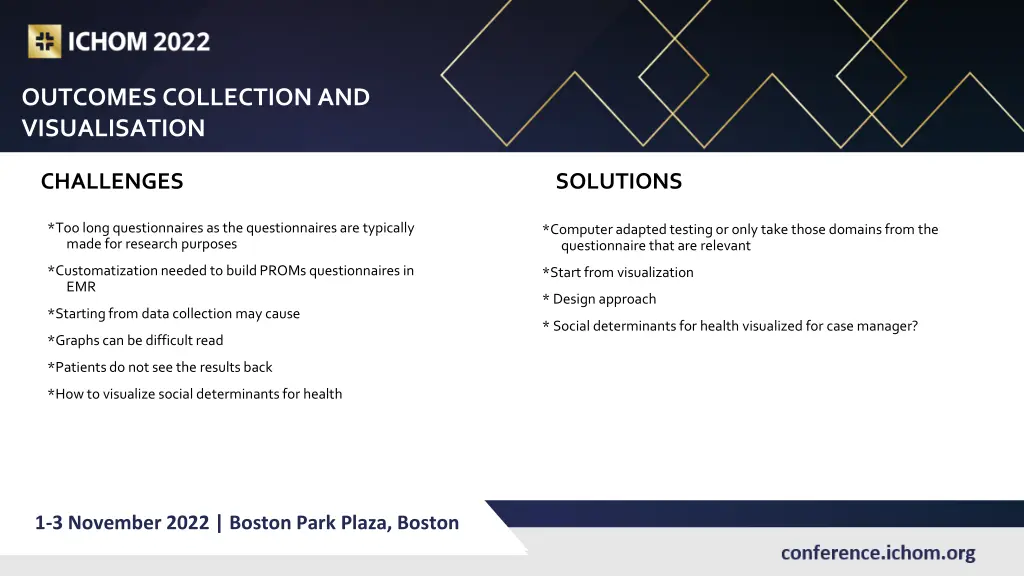
OUTCOMES COLLECTION AND VISUALISATION CHALLENGES SOLUTIONS *Too long questionnaires as the questionnaires are typically made for research purposes *Computer adapted testing or only take those domains from the questionnaire that are relevant *Customatization needed to build PROMs questionnaires in EMR *Start from visualization * Design approach *Starting from data collection may cause * Social determinants for health visualized for case manager? *Graphs can be difficult read *Patients do not see the results back *How to visualize social determinants for health 1-3 November 2022 | Boston Park Plaza, Boston p
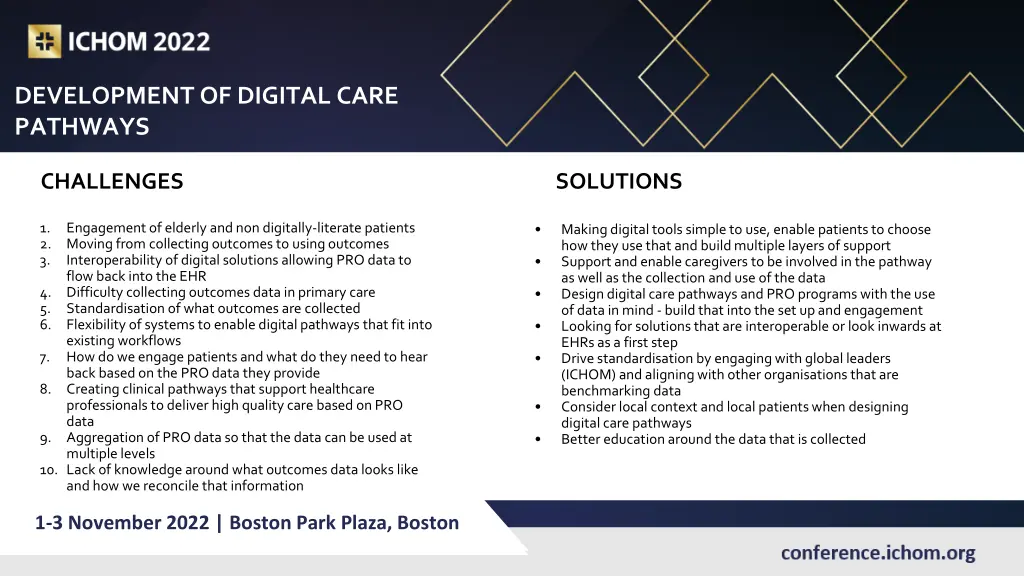
DEVELOPMENT OF DIGITAL CARE PATHWAYS CHALLENGES SOLUTIONS 1. 2. 3. Engagement of elderly and non digitally-literate patients Moving from collecting outcomes to using outcomes Interoperability of digital solutions allowing PRO data to flow back into the EHR Difficulty collecting outcomes data in primary care Standardisation of what outcomes are collected Flexibility of systems to enable digital pathways that fit into existing workflows How do we engage patients and what do they need to hear back based on the PRO data they provide Creating clinical pathways that support healthcare professionals to deliver high quality care based on PRO data Aggregation of PRO data so that the data can be used at multiple levels 10. Lack of knowledge around what outcomes data looks like and how we reconcile that information Making digital tools simple to use, enable patients to choose how they use that and build multiple layers of support Support and enable caregivers to be involved in the pathway as well as the collection and use of the data Design digital care pathways and PRO programs with the use of data in mind -build that into the set up and engagement Looking for solutions that are interoperable or look inwards at EHRs as a first step Drive standardisation by engaging with global leaders (ICHOM) and aligning with other organisations that are benchmarking data Consider local context and local patients when designing digital care pathways Better education around the data that is collected 4. 5. 6. 7. 8. 9. 1-3 November 2022 | Boston Park Plaza, Boston p
Thank you! 1-3 November 2022 | Boston Park Plaza, Boston p conference.ichom.org