Overview of 15.6-2012 Standard Revision and Future Enhancements
This document explores the 15.6-2012 standard and its revision, focusing on improving dependability in dense scenarios and introducing support for vehicles. It delves into the interoperability between HBAN and VBAN, ensuring data delivery to infrastructure. The TG 15.6ma's interest in TSN is highlighted as well.

Download Presentation

Please find below an Image/Link to download the presentation.
The content on the website is provided AS IS for your information and personal use only. It may not be sold, licensed, or shared on other websites without obtaining consent from the author.If you encounter any issues during the download, it is possible that the publisher has removed the file from their server.
You are allowed to download the files provided on this website for personal or commercial use, subject to the condition that they are used lawfully. All files are the property of their respective owners.
The content on the website is provided AS IS for your information and personal use only. It may not be sold, licensed, or shared on other websites without obtaining consent from the author.
E N D
Presentation Transcript
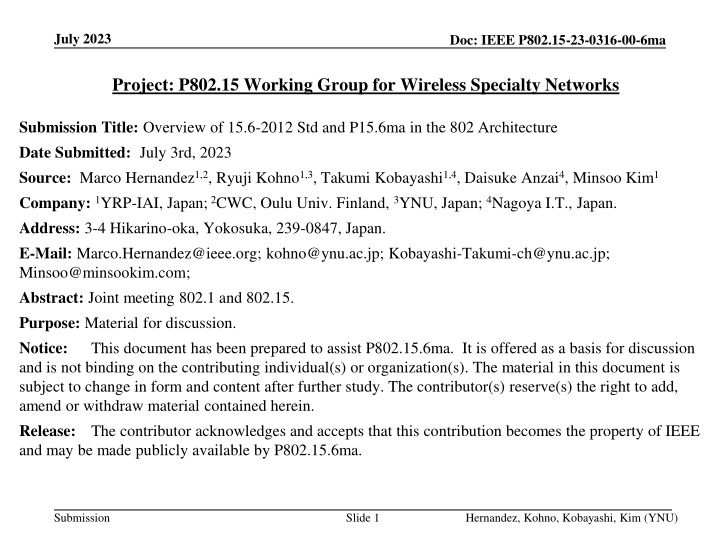
July 2023 Doc: IEEE P802.15-23-0316-00-6ma Project: P802.15 Working Group for Wireless Specialty Networks Submission Title: Overview of 15.6-2012 Std and P15.6ma in the 802 Architecture Date Submitted: July 3rd, 2023 Source: Marco Hernandez1,2, Ryuji Kohno1,3, Takumi Kobayashi1,4, Daisuke Anzai4, Minsoo Kim1 Company:1YRP-IAI, Japan;2CWC, Oulu Univ. Finland, 3YNU, Japan; 4Nagoya I.T., Japan. Address: 3-4 Hikarino-oka, Yokosuka, 239-0847, Japan. E-Mail: Marco.Hernandez@ieee.org; kohno@ynu.ac.jp; Kobayashi-Takumi-ch@ynu.ac.jp; Minsoo@minsookim.com; Abstract: Joint meeting 802.1 and 802.15. Purpose: Material for discussion. Notice: This document has been prepared to assist P802.15.6ma. It is offered as a basis for discussion and is not binding on the contributing individual(s) or organization(s). The material in this document is subject to change in form and content after further study. The contributor(s) reserve(s) the right to add, amend or withdraw material contained herein. Release: The contributor acknowledges and accepts that this contribution becomes the property of IEEE and may be made publicly available by P802.15.6ma. Submission Slide 1 Hernandez, Kohno, Kobayashi, Kim (YNU)
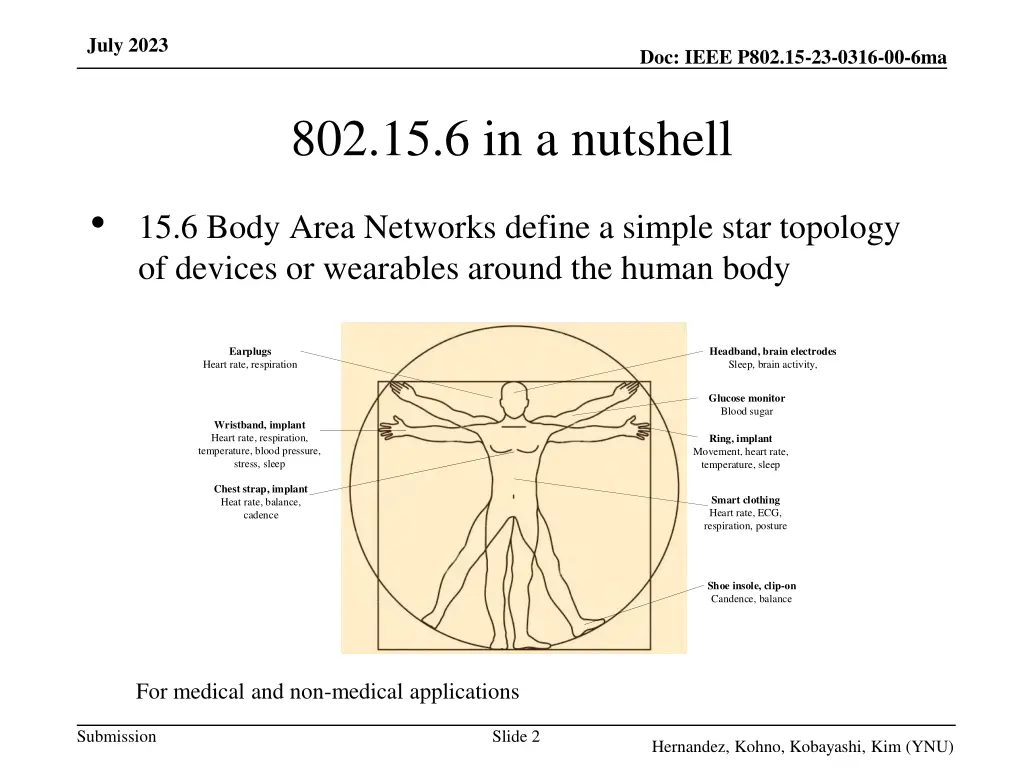
July 2023 Doc: IEEE P802.15-23-0316-00-6ma 802.15.6 in a nutshell 15.6 Body Area Networks define a simple star topology of devices or wearables around the human body Earplugs Headband, brain electrodes Sleep, brain activity, Heart rate, respiration Glucose monitor Blood sugar Wristband, implant Heart rate, respiration, temperature, blood pressure, stress, sleep Ring, implant Movement, heart rate, temperature, sleep Chest strap, implant Heat rate, balance, cadence Smart clothing Heart rate, ECG, respiration, posture Shoe insole, clip-on Candence, balance For medical and non-medical applications Submission Slide 2 Hernandez, Kohno, Kobayashi, Kim (YNU)
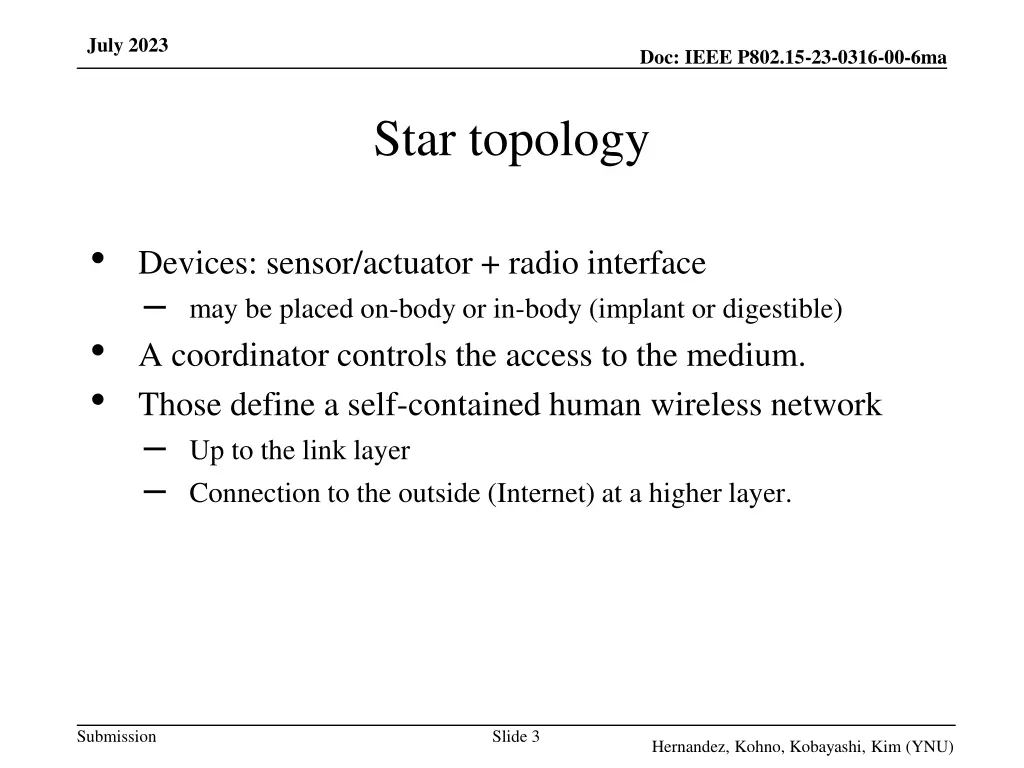
July 2023 Doc: IEEE P802.15-23-0316-00-6ma Star topology Devices: sensor/actuator + radio interface may be placed on-body or in-body (implant or digestible) A coordinator controls the access to the medium. Those define a self-contained human wireless network Up to the link layer Connection to the outside (Internet) at a higher layer. Submission Slide 3 Hernandez, Kohno, Kobayashi, Kim (YNU)
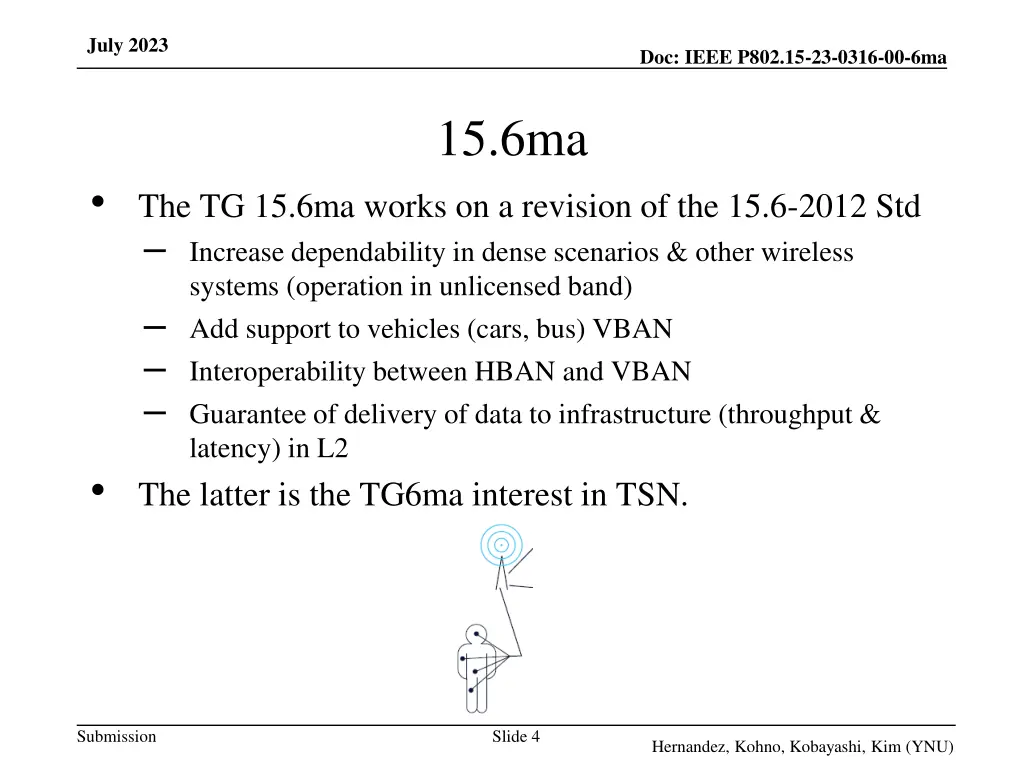
July 2023 Doc: IEEE P802.15-23-0316-00-6ma 15.6ma The TG 15.6ma works on a revision of the 15.6-2012 Std Increase dependability in dense scenarios & other wireless systems (operation in unlicensed band) Add support to vehicles (cars, bus) VBAN Interoperability between HBAN and VBAN Guarantee of delivery of data to infrastructure (throughput & latency) in L2 The latter is the TG6ma interest in TSN. Submission Slide 4 Hernandez, Kohno, Kobayashi, Kim (YNU)
July 2023 Doc: IEEE P802.15-23-0316-00-6ma Context of 15.6 and 15.6ma in the 802 Architecture Outline: Use of the LLC, MAC address format, QoS mechanism and MSDU formats. Submission Slide 5 Hernandez, Kohno, Kobayashi, Kim (YNU)
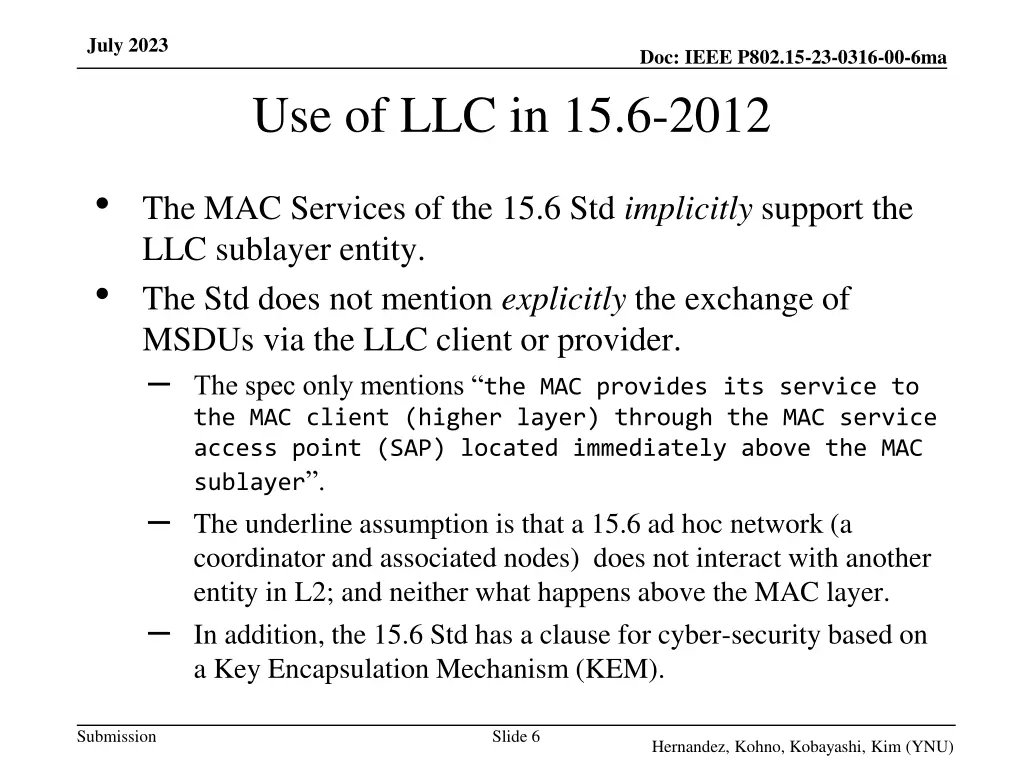
July 2023 Doc: IEEE P802.15-23-0316-00-6ma Use of LLC in 15.6-2012 The MAC Services of the 15.6 Std implicitly support the LLC sublayer entity. The Std does not mention explicitly the exchange of MSDUs via the LLC client or provider. The spec only mentions the MAC provides its service to the MAC client (higher layer) through the MAC service access point (SAP) located immediately above the MAC sublayer . The underline assumption is that a 15.6 ad hoc network (a coordinator and associated nodes) does not interact with another entity in L2; and neither what happens above the MAC layer. In addition, the 15.6 Std has a clause for cyber-security based on a Key Encapsulation Mechanism (KEM). Submission Slide 6 Hernandez, Kohno, Kobayashi, Kim (YNU)
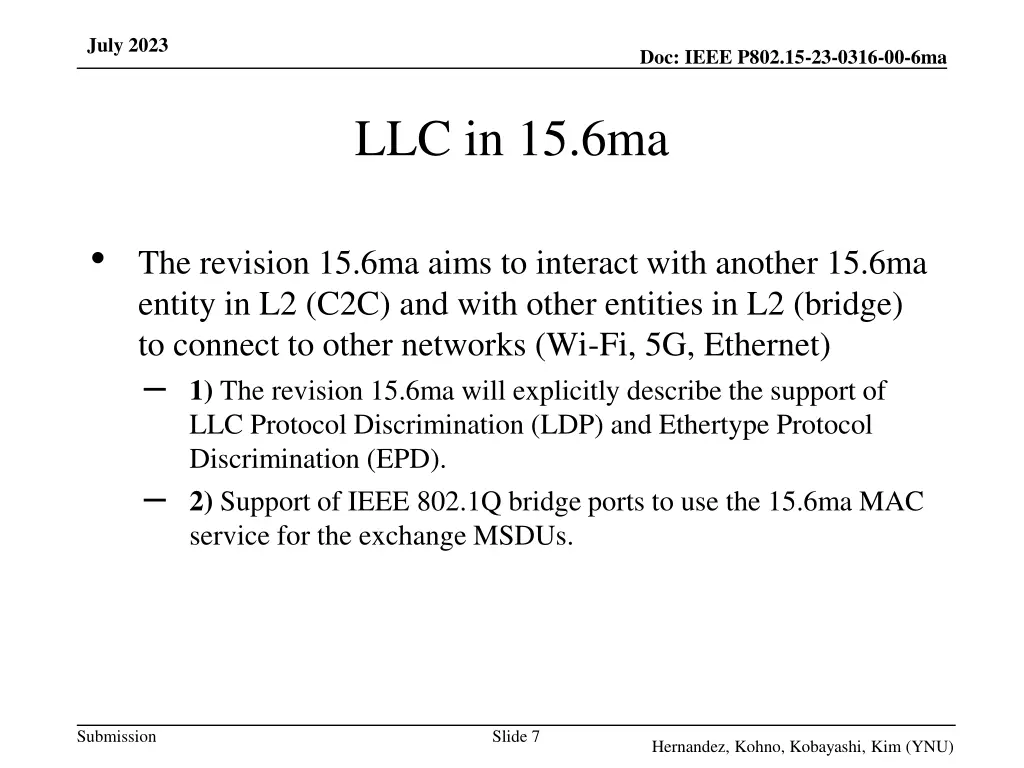
July 2023 Doc: IEEE P802.15-23-0316-00-6ma LLC in 15.6ma The revision 15.6ma aims to interact with another 15.6ma entity in L2 (C2C) and with other entities in L2 (bridge) to connect to other networks (Wi-Fi, 5G, Ethernet) 1) The revision 15.6ma will explicitly describe the support of LLC Protocol Discrimination (LDP) and Ethertype Protocol Discrimination (EPD). 2) Support of IEEE 802.1Q bridge ports to use the 15.6ma MAC service for the exchange MSDUs. Submission Slide 7 Hernandez, Kohno, Kobayashi, Kim (YNU)
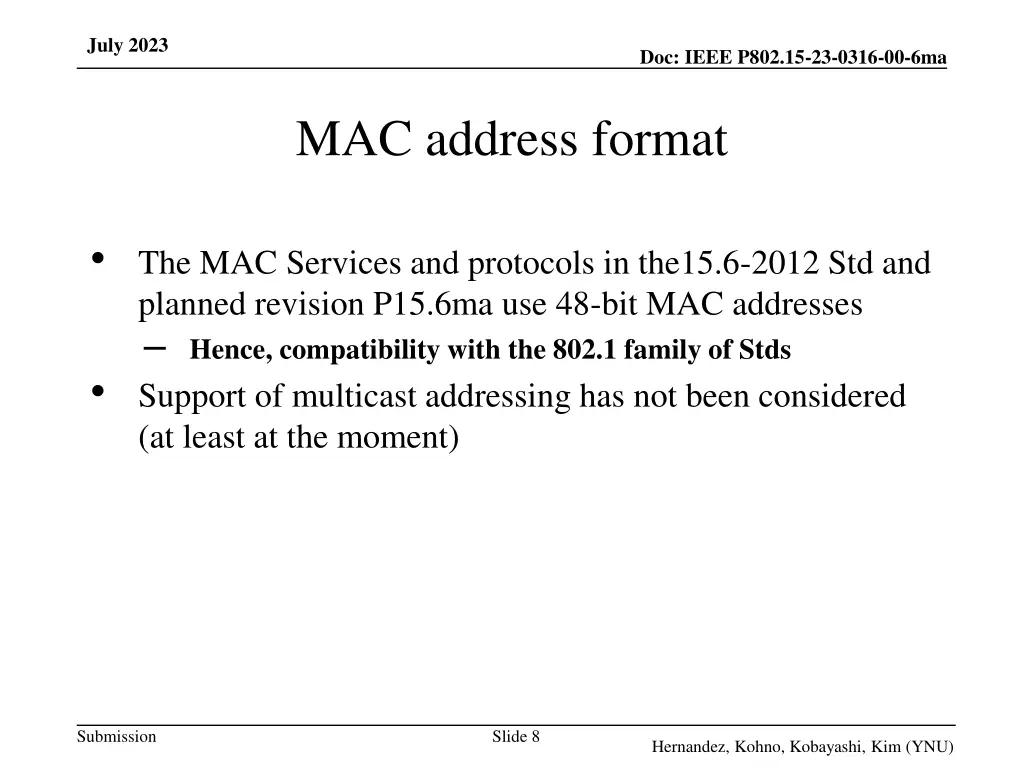
July 2023 Doc: IEEE P802.15-23-0316-00-6ma MAC address format The MAC Services and protocols in the15.6-2012 Std and planned revision P15.6ma use 48-bit MAC addresses Hence, compatibility with the 802.1 family of Stds Support of multicast addressing has not been considered (at least at the moment) Submission Slide 8 Hernandez, Kohno, Kobayashi, Kim (YNU)
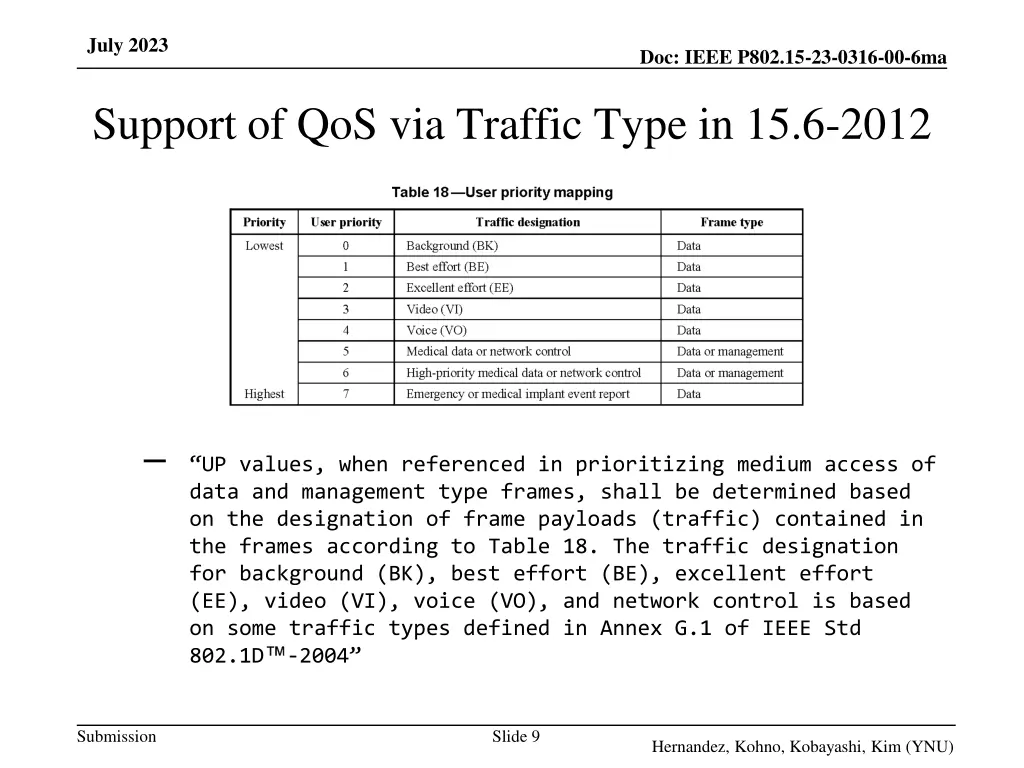
July 2023 Doc: IEEE P802.15-23-0316-00-6ma Support of QoS via Traffic Type in 15.6-2012 UP values, when referenced in prioritizing medium access of data and management type frames, shall be determined based on the designation of frame payloads (traffic) contained in the frames according to Table 18. The traffic designation for background (BK), best effort (BE), excellent effort (EE), video (VI), voice (VO), and network control is based on some traffic types defined in Annex G.1 of IEEE Std 802.1D -2004 Submission Slide 9 Hernandez, Kohno, Kobayashi, Kim (YNU)
July 2023 Doc: IEEE P802.15-23-0316-00-6ma Traffic type for the UWB PHY in 15.6 The UWB PHY clause defines high QoS mode to traffic type 6, and default mode any other traffic type (~7). This was necessary to discriminate between two UWB technologies Default mode: IR-UWB and optional FM-UWB High QoS mode: only IR-UWB The TG will discuss if FM-UWB will be deprecated. Submission Slide 10 Hernandez, Kohno, Kobayashi, Kim (YNU)
July 2023 Doc: IEEE P802.15-23-0316-00-6ma Planned QoS in P15.6ma TG6ma has plans to revise Table 18, but nothing concrete yet. Nevertheless, TG 15.6ma will support compatibility with 802.1 traffic classification. Submission Slide 11 Hernandez, Kohno, Kobayashi, Kim (YNU)
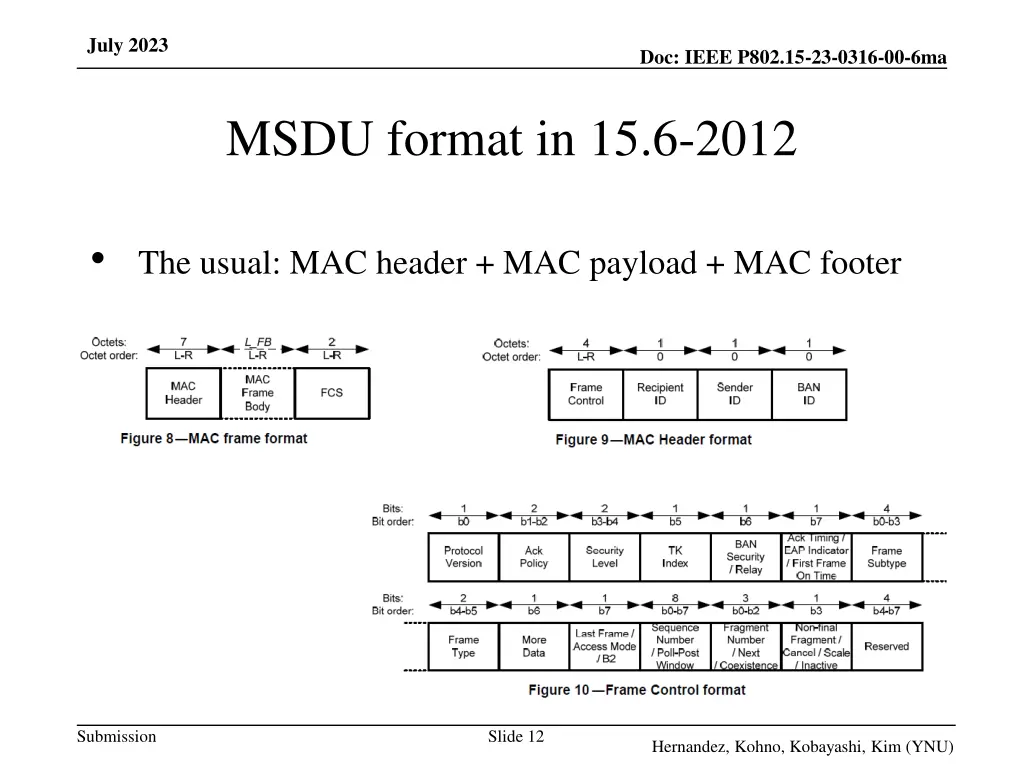
July 2023 Doc: IEEE P802.15-23-0316-00-6ma MSDU format in 15.6-2012 The usual: MAC header + MAC payload + MAC footer Submission Slide 12 Hernandez, Kohno, Kobayashi, Kim (YNU)
July 2023 Doc: IEEE P802.15-23-0316-00-6ma 15.6ma MAC Due to the historic background of 15.6, the MSDU format supports several MAC mechanisms (polling, CSMA, slotted Aloha, LBT), and it is up to vendors what specifically to implement. However, the result was that the MAC spec is difficult to understand The revision 15.6ma plans to simplify the MAC mechanism under a UWB PHY: LBT & slotted Aloha (CAP) and TDMA (CFP) (maybe the support of an Ethertype field) Hence, the MSDU Header will change. Submission Slide 13 Hernandez, Kohno, Kobayashi, Kim (YNU)
July 2023 Doc: IEEE P802.15-23-0316-00-6ma Next steps Plan next actions: Submission Slide 14 Hernandez, Kohno, Kobayashi, Kim (YNU)