Overview of Fertilization Process in Reproduction
The fertilization process involves the fusion of sperm and egg nuclei to form a zygote with the complete set of chromosomes. It includes steps like sperm capacitation, sperm-egg binding, acrosome reaction, and zona pellucida penetration. Understanding these intricate processes is crucial for reproductive biology.

Download Presentation

Please find below an Image/Link to download the presentation.
The content on the website is provided AS IS for your information and personal use only. It may not be sold, licensed, or shared on other websites without obtaining consent from the author.If you encounter any issues during the download, it is possible that the publisher has removed the file from their server.
You are allowed to download the files provided on this website for personal or commercial use, subject to the condition that they are used lawfully. All files are the property of their respective owners.
The content on the website is provided AS IS for your information and personal use only. It may not be sold, licensed, or shared on other websites without obtaining consent from the author.
E N D
Presentation Transcript
FERTILIZATION FERTILIZATION
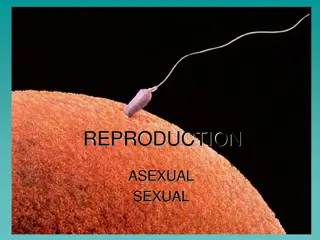
Fertilization The fusion of the sperm cell nucleus with the egg cell nucleus to produce a zygote (fertilized egg) which have the total number of chromosomes The sperms move toward the site of fertilization Sperm motility, cilia, female reproductive system contraction The site of fertilization in oviduct ( the first third of oviduct in the site of union between isthmus and ampulla) The oocyte before fertilization in metaphase 2 and didn t complete the second meiosis
Sperm Capacitation Freshly ejaculated sperm are unable to fertilize. They must first undergo a series of changes known collectively as capacitation. Capacitation is associated with: 1- removal of adherent seminal plasma proteins (remove de- capacitation factor) 2-re-organization of plasma membrane lipids and proteins 3- It also seems to involve an influx of extracellular calcium 4- increase in cyclic AMP 5-decrease in intracellular pH.
Sperm Capacitation Capacitation occurs while sperm inside in the female reproductive tract The length of time required varies with species, but usually requires several hours.
Sperm-Zona Pellucida Binding Binding of sperm to the zona pellucida is a receptor-ligand interaction with a high degree of Species specificity. The carbohydrate groups on the zona pellucida glycoproteins function as sperm receptors. This binding activate the acrosomal reaction
The Acrosome Reaction Binding of sperm to the zona pellucida provide a number of proteolytic enzymes will diffuse and release from acrosome within the zona pellucida These enzymes act to digest the zona pellucida
Penetration of the Zona Pellucida The constant propulsive force from the sperm's flagellating tail, in combination with acrosomal enzymes, allow the sperm to create a tract through the zona pellucida. These two factors - motility and zona-digesting enzymes- allow the sperm to traverse the zona pellucida to enter the perivitelline space
Sperm-Oocyte Binding Once a sperm penetrates the zona pellucida, it binds to and fuses with the plasma membrane of the oocyte. Binding occurs at the posterior (post-acrosomal) region of the sperm head. The molecular nature of sperm-oocyte binding is ( Sperm glycoprotein called fertilin, which binds to a protein in the oocyte plasma membrane and may also induce fusion) Lastly the oocyte complete the second meiotic division and form ova pronucleus which bind with sperm pronucleus to form zygote
Egg Activation and the Cortical Reaction Egg activation is mean a series of morphological , physiological and molecular changes that occur in the egg in response to fusion of the sperm with egg , the events of egg activation include : 1- releasing of ca , Na, H 2- cortical reaction : rupture of cortical granules that occur by ca release. The content of granules are released in to perivitelline space and cause hardening of the vitelline membrane or zona pellucida and prevent another sperm penetrate the oocyte (poly spermia ) 3- re- organization of the egg cytoplasm 4- the zygote start with division to form embryo