Propofol is a non-barbiturate intravenous induction agent used in anesthesia. It has rapid onset and short duration of action. This article discusses its dosage, administration, adverse effects, indications, and contraindications. Remember to consult a healthcare professional before use.
Please find below an Image/Link to download the presentation.
The content on the website is provided AS IS for your information and personal use only. It may not be sold, licensed, or shared on other websites without obtaining consent from the author. If you encounter any issues during the download, it is possible that the publisher has removed the file from their server.
You are allowed to download the files provided on this website for personal or commercial use, subject to the condition that they are used lawfully. All files are the property of their respective owners.
The content on the website is provided AS IS for your information and personal use only. It may not be sold, licensed, or shared on other websites without obtaining consent from the author.
propofol Propofol is a non- barbiturate rapidly acting I.V. induction agent. Of all non-barbiturate agents, its induction characteristics are most like those of thiopentone. It produces a greater fall in arterial blood pressure than equipotent doses of thiopentone due to a greater fall in systemic vascular resistance. Cardiac output falls slightly, and a compensatory tachycardia does not occur. It is as potent a respiratory depressant as thiopentone. The duration of sleep is short. It has also been used in a continuous infusion to maintain anaesthesia. On cessation of infusion, the drug decays rapidly.
Dosage and administration In healthy, unpremedicated adults, a dose of 1.5- 2.5 mg/ Kg is used to induce anaesthesia. The dose should be reduced in elderly, an initial dose of 1.25 mg/Kg is appropriate. In children, a dose of 3-3.5mg/Kg is required, the drug is not recommended for use in children less than 3 years of age. Lower doses are required for induction in premedicated patients. Sedation during regional analgesia or endoscopy can be achieved with doses of 1.5-4.5mg/Kg/h.
Adverse effects (1) Cardiovascular depression. It is Likely to cause profound hypotension in hypovolaemic or previously hypertensive patients and in those with cardiac disease. Cardiovascular depression is modest if the drug is administered slowly or by infusion. (2) Respiratory depression. Apnoea is more common and longer duration than after barbiturate administration. (3) Excitatory phenomena. These are more frequent than with thiopentone. (4) Pain on injection. This occurs in up to 40% of patients. The incidence is reduced if a large vein is used, if a small dose (10 mg) of lignocaine is injected shortly before propofol, or if lignocaine is mixed with propofol in the syringe (up to 1 ml of 0.5% or 1% lignocaine per 20 ml of propofol). (5) Allergic reactions. Skin rashes occur occasionally. Anaphylactic reactions have also been reported, but appear to be no more common than with thiopentone.
Indications (1) Induction of anaesthesia. Propofol is indicated particularly when rapid early recovery of consciousness is required. (2) Sedation during surgery. Propofol has been used successfully for sedation during regional analgesic techniques, and during endoscopy. Control of airway may be lost at any time, and patients must be supervised continuously by an anaesthetist. (3) Total I.V. anaesthesia. Propofol is the most suitable of the agents currently available. Recovery time is increased after infusion of propofol compared with that after a single bolus dose, but cumulation is significantly less than with the barbiturates. (4) Sedation in ITU. Propofol has been used successfully to sedate adult patients for several days in ITU. The level of sedation is controlled easily, and recovery is rapid (usually 30 min).
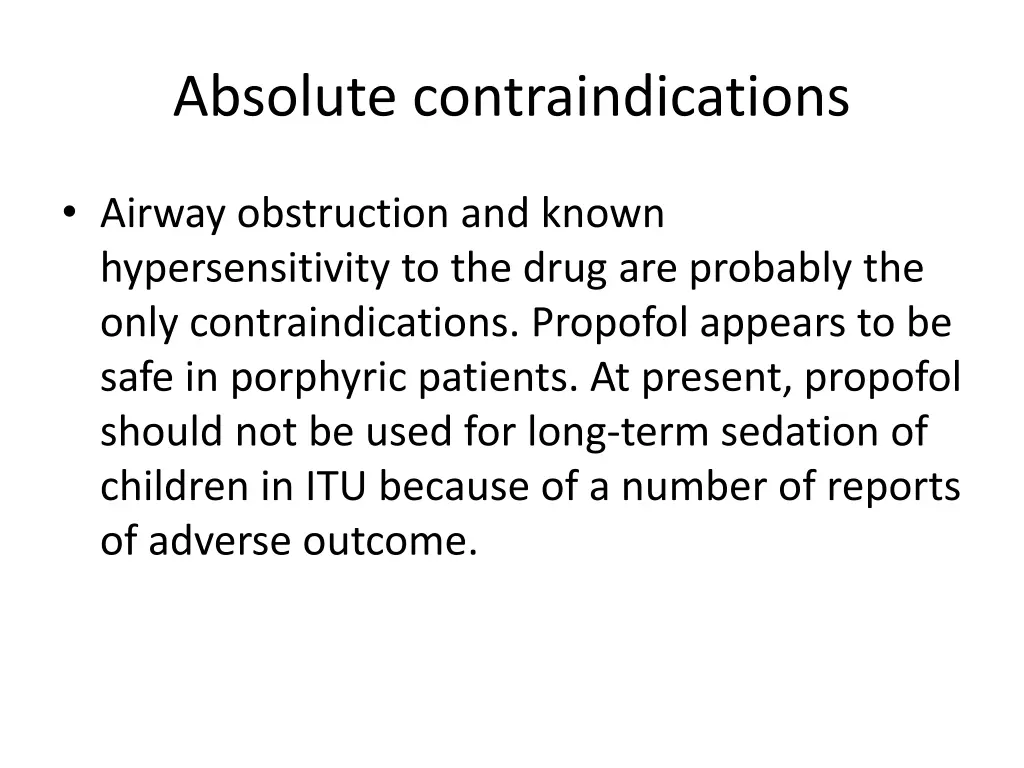
Absolute contraindications Airway obstruction and known hypersensitivity to the drug are probably the only contraindications. Propofol appears to be safe in porphyric patients. At present, propofol should not be used for long-term sedation of children in ITU because of a number of reports of adverse outcome.
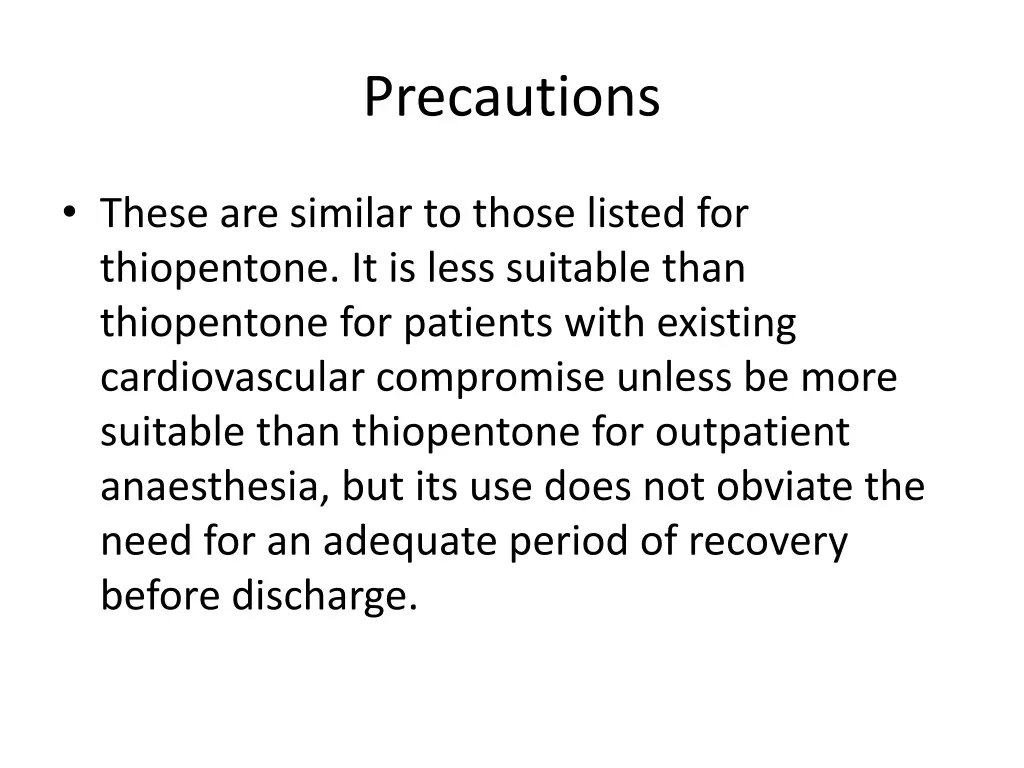
Precautions These are similar to those listed for thiopentone. It is less suitable than thiopentone for patients with existing cardiovascular compromise unless be more suitable than thiopentone for outpatient anaesthesia, but its use does not obviate the need for an adequate period of recovery before discharge.