Oxygen Transport Proteins: Myoglobin and Hemoglobin Overview
Explore the physiological roles, structural differences, and mutations affecting myoglobin and hemoglobin in oxygen transport. Understand the essentiality of oxygen for cellular respiration and the unique properties of these proteins in carrying out this crucial function.

Download Presentation

Please find below an Image/Link to download the presentation.
The content on the website is provided AS IS for your information and personal use only. It may not be sold, licensed, or shared on other websites without obtaining consent from the author. If you encounter any issues during the download, it is possible that the publisher has removed the file from their server.
You are allowed to download the files provided on this website for personal or commercial use, subject to the condition that they are used lawfully. All files are the property of their respective owners.
The content on the website is provided AS IS for your information and personal use only. It may not be sold, licensed, or shared on other websites without obtaining consent from the author.
E N D
Presentation Transcript
Ministry of higher Education and Scientific Researches UNIVERSITY OF BASRAH AL-ZAHRAA MEDICAL COLLEGE The module: Molecular, Gene and Diseases Molecular, Gene and Diseases Session 2 Lecture 4 Oxygen Transport Proteins Duration: 1 h. Module staff: Dr. Dr. Ihsan Ihsan M. Dr. Dr. Hussain Hussain K. Abdul Dr. Dr. Nibras Nibras S. Al Dr. Dr. Wamedh Wamedh H. Dr. Dr. Ilham Ilham Mahammed Dr. Dr. Sadiq Sadiq Ali M. Humod Humod K. Abdul- -Sada S. Al- -Ammar Ammar H. Alqatrani Alqatrani Mahammed Ali Sada Marks Basic Medical Biochemistry Chapter 7 Medical Biochemistry Chapters 2, 5 Lippincott s Illustrated Reviews: Biochemistry Chapters 2&3 For more detailed instruction, any question, cases need help please post to the group of session. 1
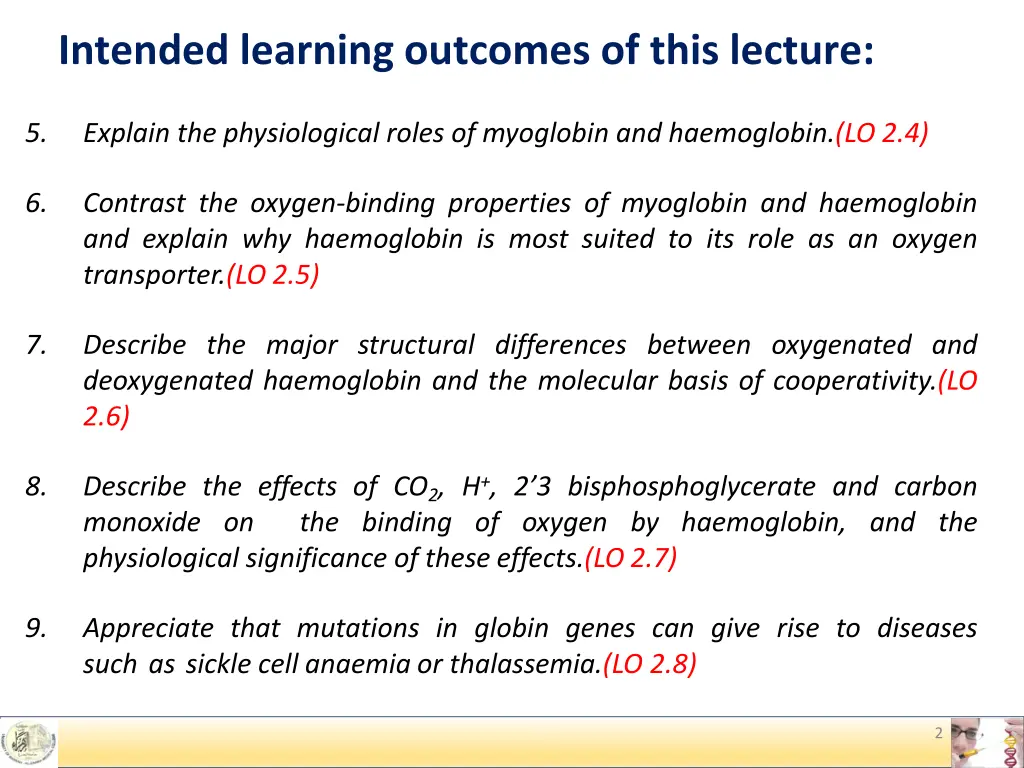
Intended learning outcomes of this lecture: 5. Explain the physiological roles of myoglobin and haemoglobin.(LO 2.4) 6. Contrast the oxygen-binding properties of myoglobin and haemoglobin and explain why haemoglobin is most suited to its role as an oxygen transporter.(LO 2.5) 7. Describe the major structural differences between oxygenated and deoxygenated haemoglobin and the molecular basis of cooperativity.(LO 2.6) Describe the effects of CO2, H+, 2 3 bisphosphoglycerate and carbon monoxide on the binding of oxygen by haemoglobin, and the physiological significance of these effects.(LO 2.7) 8. 9. Appreciate that mutations in globin genes can give rise to diseases such as sickle cell anaemia or thalassemia.(LO 2.8) 2
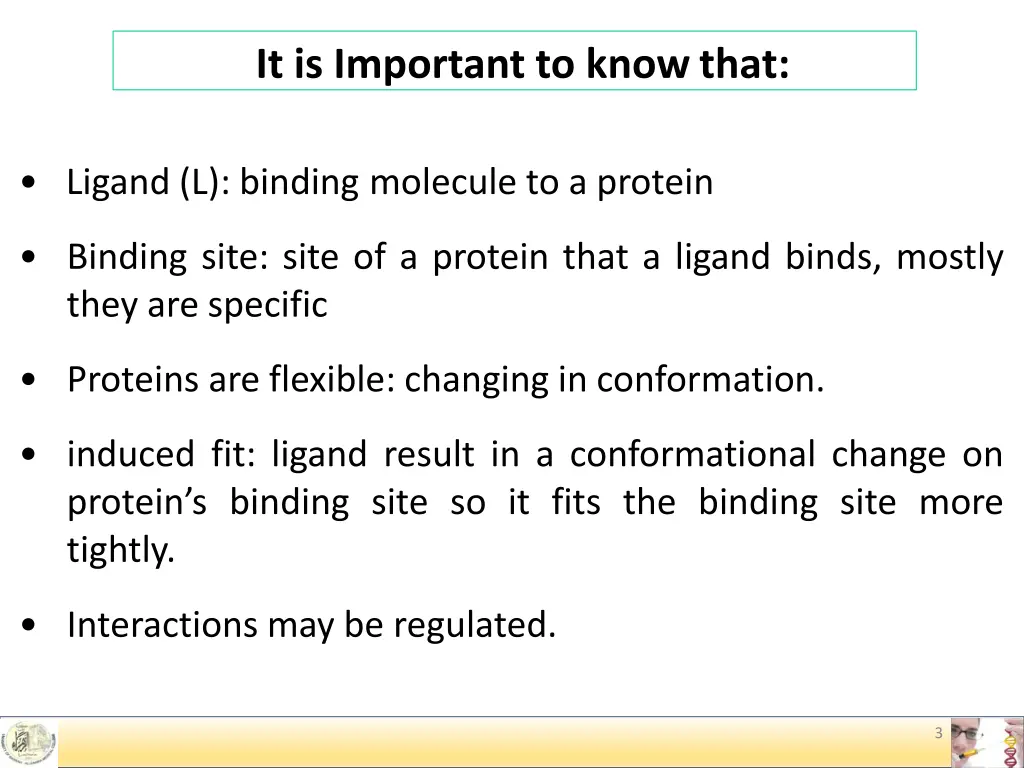
It is Important to know that: Ligand (L): binding molecule to a protein Binding site: site of a protein that a ligand binds, mostly they are specific Proteins are flexible: changing in conformation. induced fit: ligand result in a conformational change on protein s binding site so it fits the binding site more tightly. Interactions may be regulated. 3
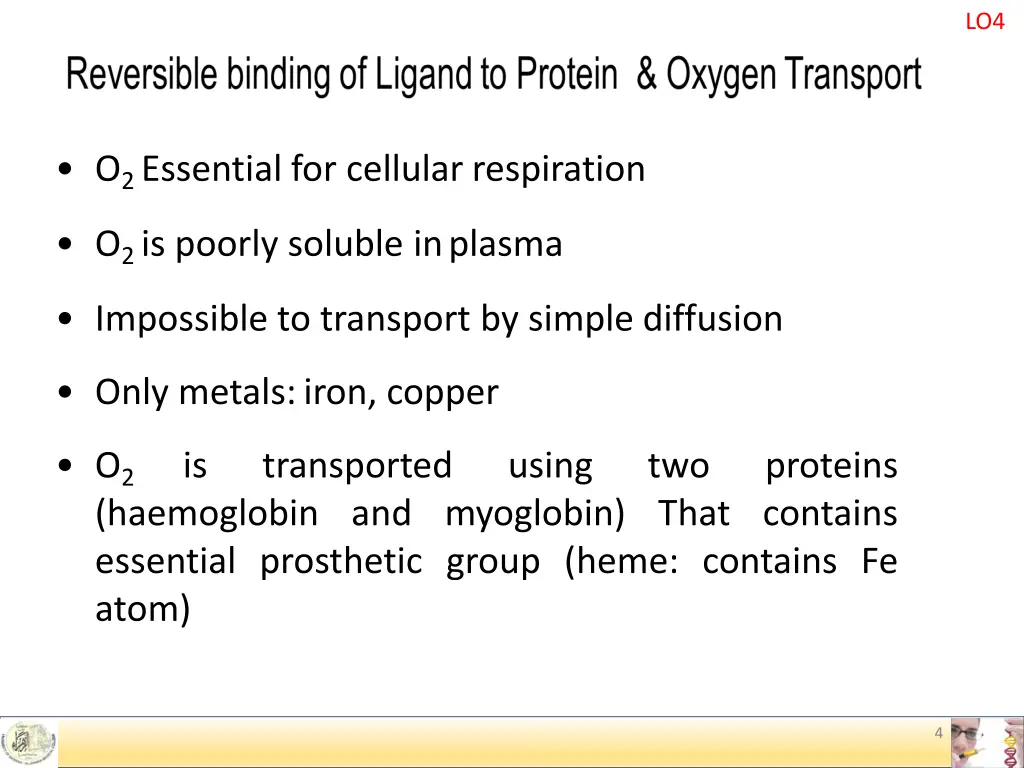
LO4 O2 Essential for cellular respiration O2 is poorly soluble in plasma Impossible to transport by simple diffusion Only metals: iron, copper O2 (haemoglobin and myoglobin) That contains essential prosthetic group (heme: contains Fe atom) is transported using two proteins 4
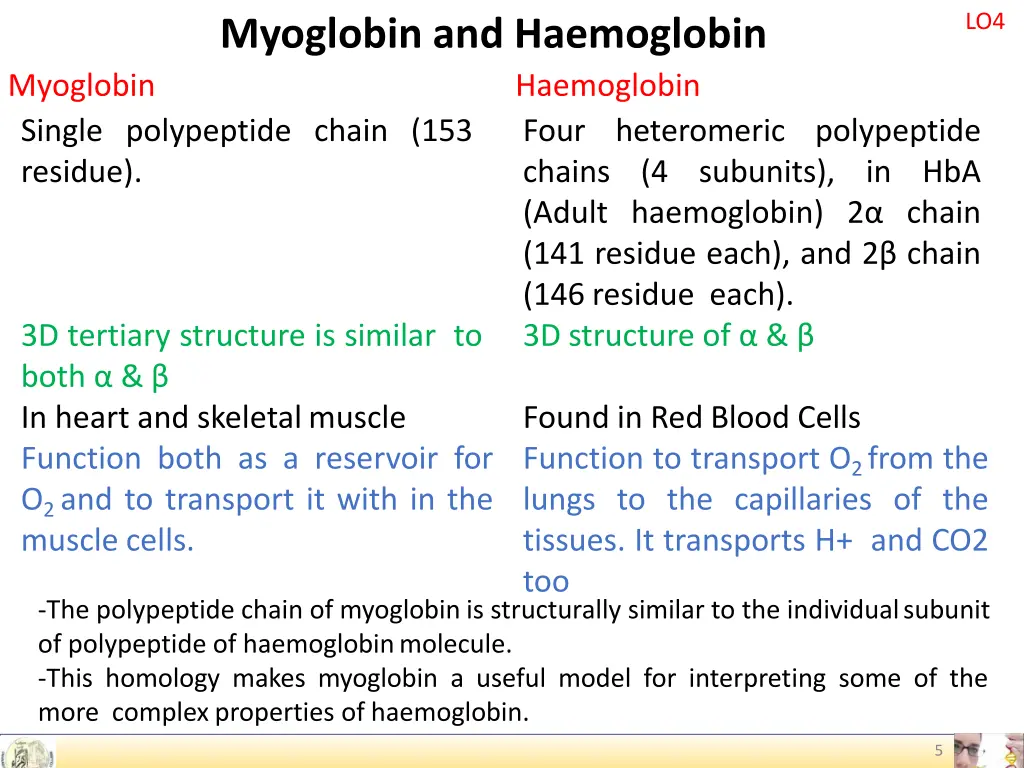
LO4 Myoglobin and Haemoglobin Myoglobin Single polypeptide chain (153 residue). Haemoglobin Four heteromeric polypeptide chains (4 subunits), in HbA (Adult haemoglobin) 2 chain (141 residue each), and 2 chain (146 residue each). 3D structure of & 3D tertiary structure is similar to both & In heart and skeletal muscle Function both as a reservoir for O2 and to transport it with in the muscle cells. Found in Red Blood Cells Function to transport O2 from the lungs to the capillaries of the tissues. It transports H+ and CO2 too -The polypeptide chain of myoglobin is structurally similar to the individual subunit of polypeptide of haemoglobin molecule. -This homology makes myoglobin a useful model for interpreting some of the more complex properties of haemoglobin. 5
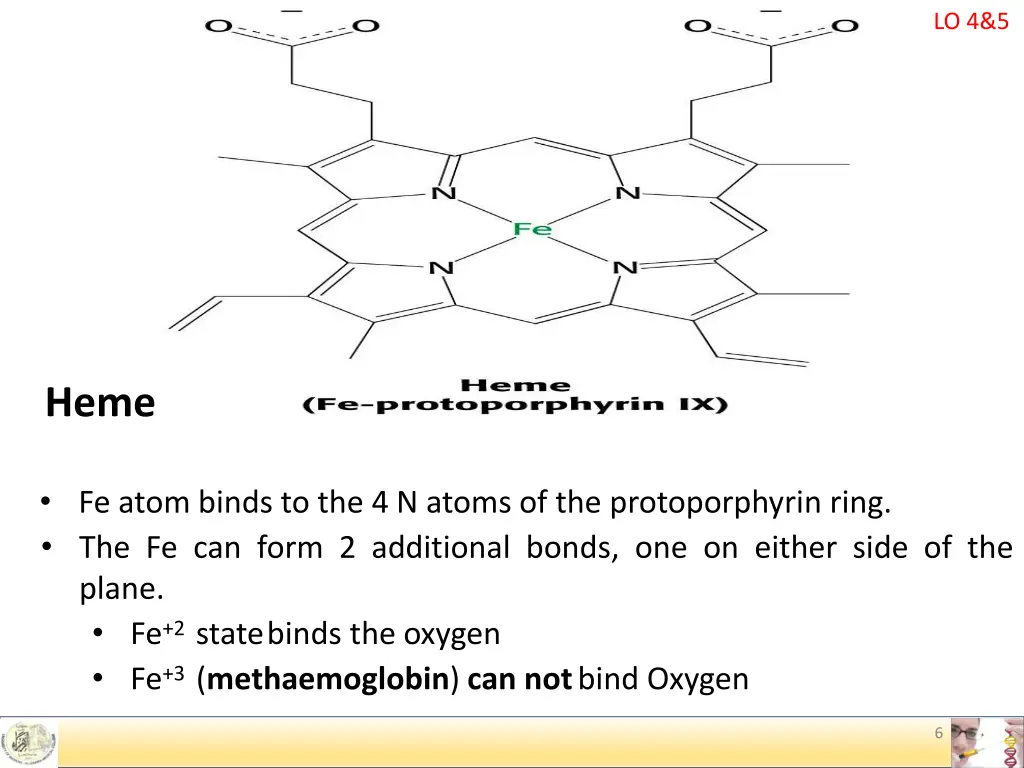
LO 4&5 Heme Featom binds to the 4 N atoms of the protoporphyrin ring. The Fe can form 2 additional bonds, one on either side of the plane. Fe+2 state binds the oxygen Fe+3 (methaemoglobin) can not bind Oxygen 6
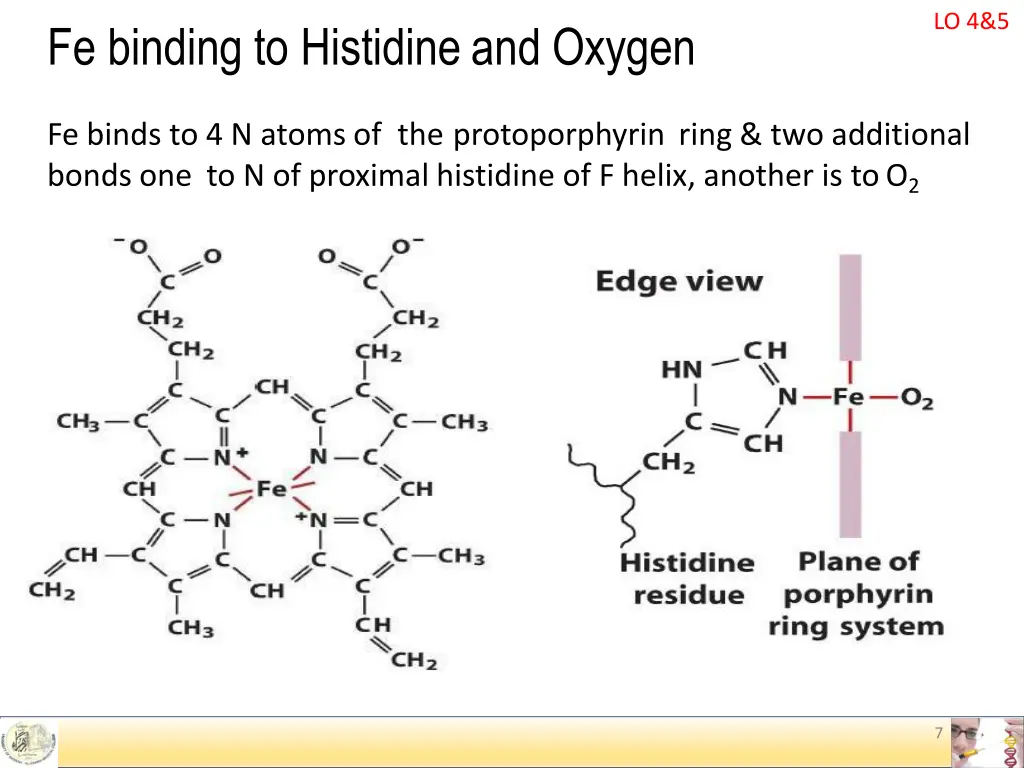
LO 4&5 Fe binding to Histidine and Oxygen Fe binds to 4 N atoms of the protoporphyrin ring & two additional bonds one to N of proximal histidine of F helix, another is to O2 7
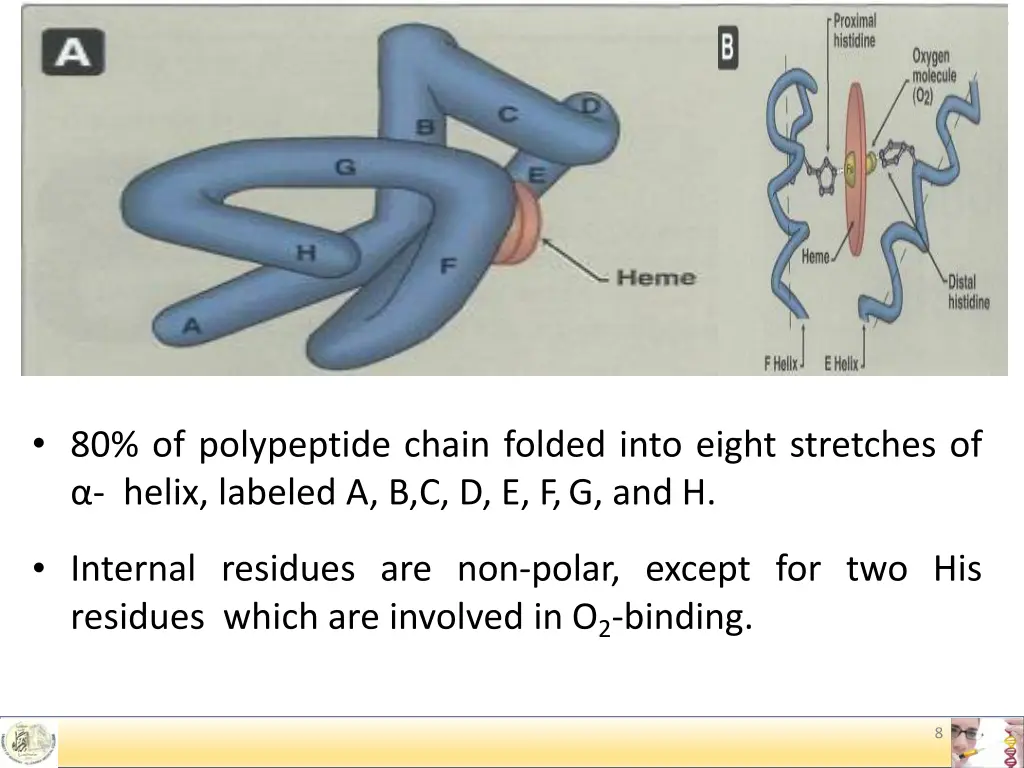
LO 4&5 80% of polypeptide chain folded into eight stretches of - helix, labeled A, B,C, D, E, F, G, and H. Internal residues are non-polar, except for two His residues which are involved in O2-binding. 8
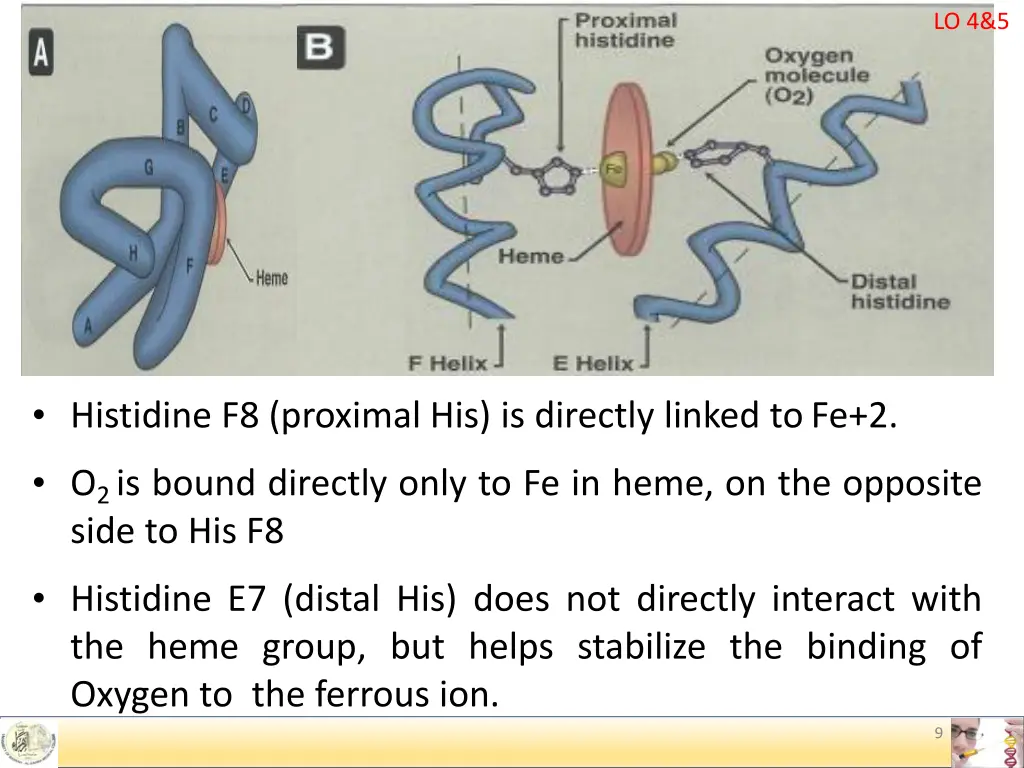
LO 4&5 Histidine F8 (proximal His) is directly linked to Fe+2. O2 is bound directly only to Fe in heme, on the opposite side to His F8 Histidine E7 (distal His) does not directly interact with the heme group, but helps stabilize the binding of Oxygen to the ferrous ion. 9
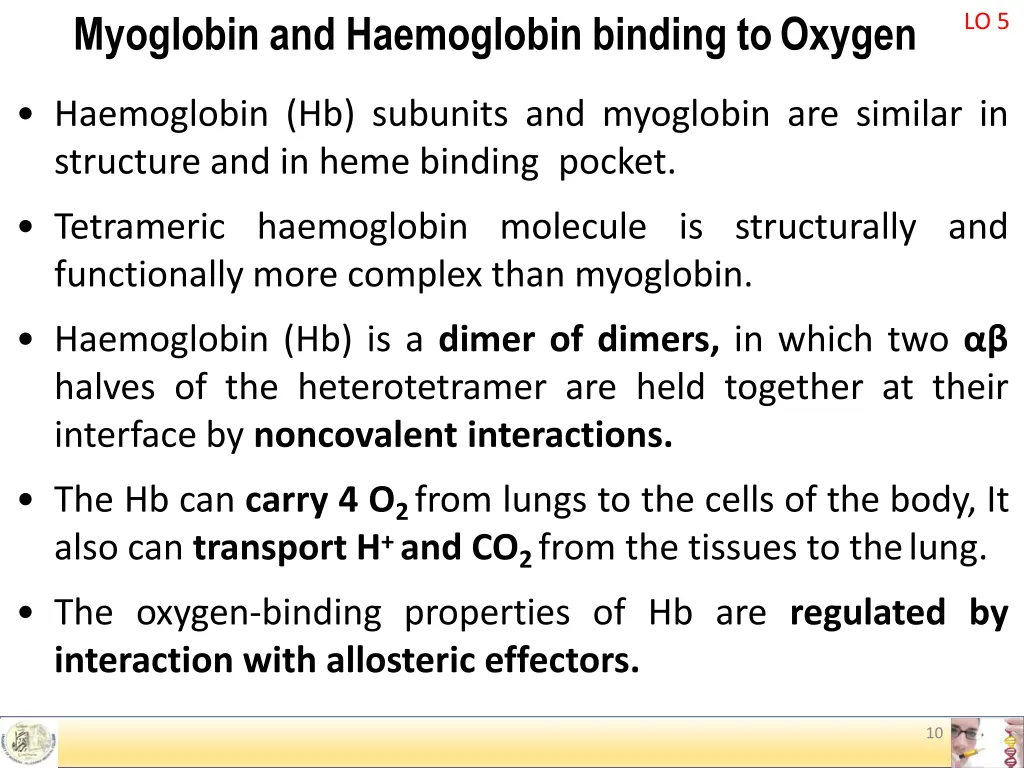
Myoglobin and Haemoglobin binding to Oxygen LO 5 Haemoglobin (Hb) subunits and myoglobin are similar in structure and in heme binding pocket. Tetrameric haemoglobin molecule is structurally and functionally more complex than myoglobin. Haemoglobin (Hb) is a dimer of dimers, in which two halves of the heterotetramer are held together at their interface by noncovalent interactions. The Hb can carry 4 O2 from lungs to the cells of the body, It also can transport H+ and CO2 from the tissues to the lung. The oxygen-binding properties of Hb are regulated by interaction with allosteric effectors. 10
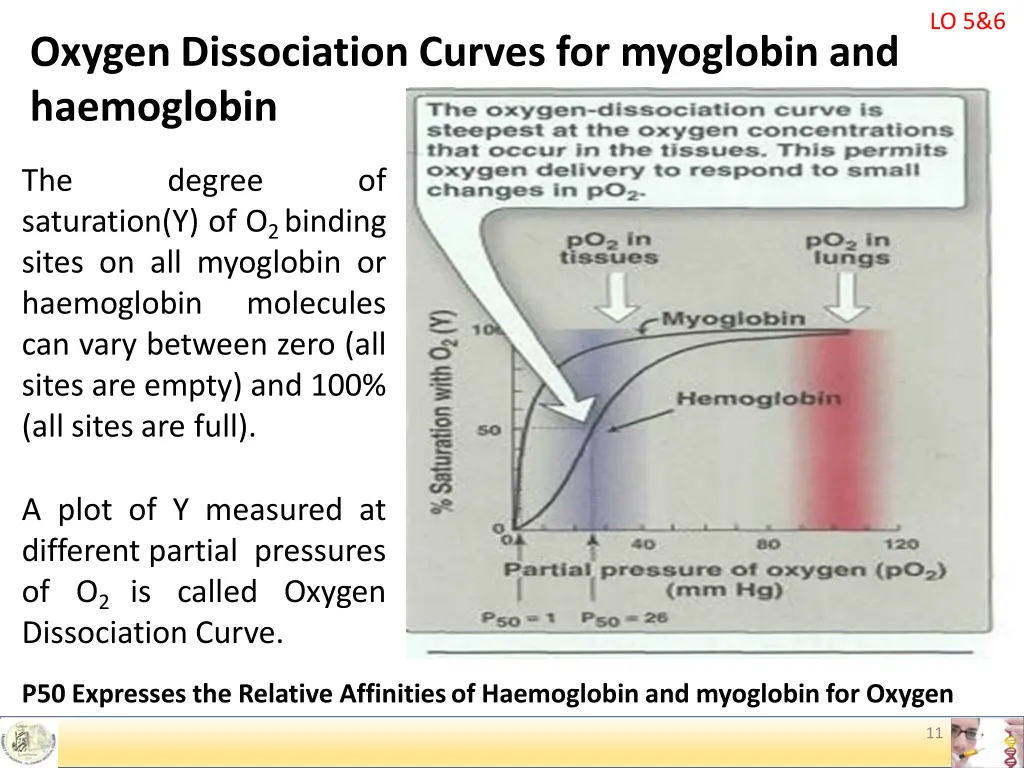
LO 5&6 Oxygen Dissociation Curves for myoglobin and haemoglobin The saturation(Y) of O2 binding sites on all myoglobin or haemoglobin can vary between zero (all sites are empty) and 100% (all sites are full). degree of molecules A plot of Y measured at different partial pressures of O2 is called Oxygen Dissociation Curve. P50 Expresses the Relative Affinities of Haemoglobin and myoglobin for Oxygen 11
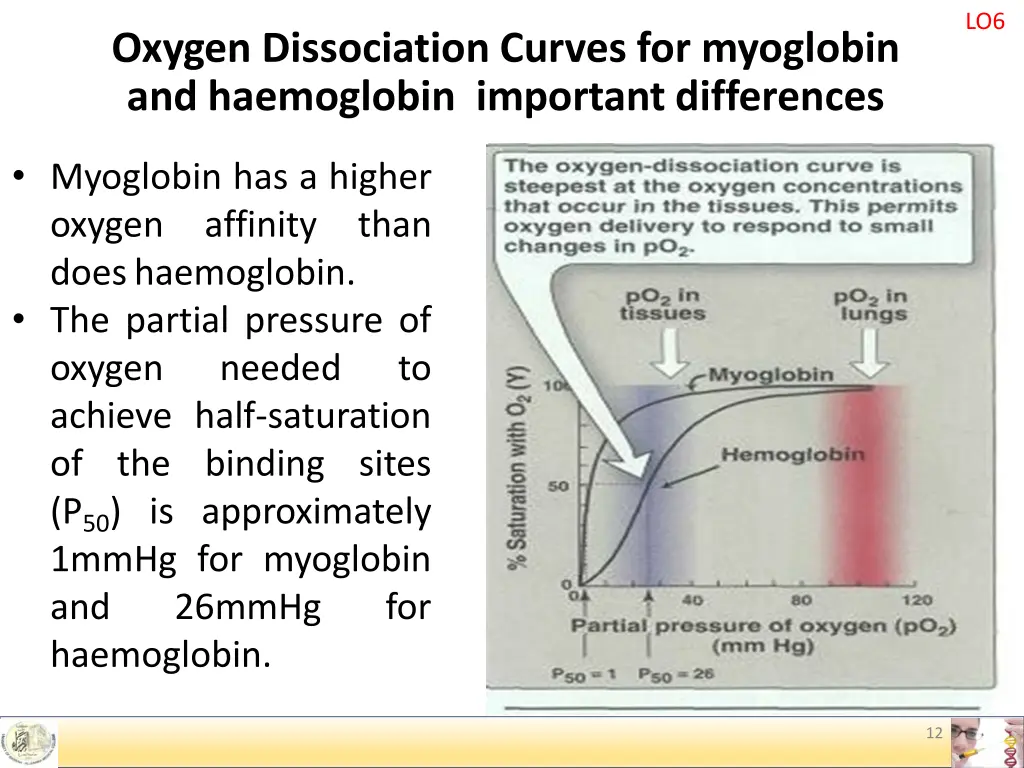
LO6 Oxygen Dissociation Curves for myoglobin and haemoglobin important differences Myoglobin has a higher oxygen affinity than does haemoglobin. The partial pressure of oxygen needed achieve half-saturation of the binding sites (P50) is approximately 1mmHg for myoglobin and 26mmHg haemoglobin. to for 12
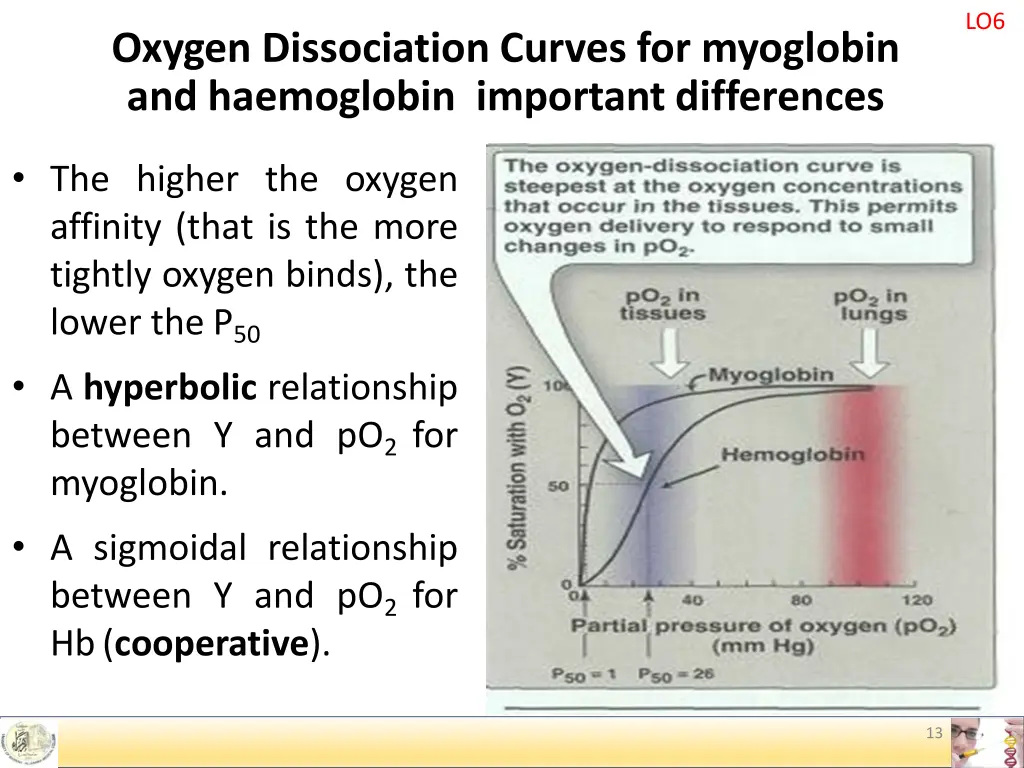
LO6 Oxygen Dissociation Curves for myoglobin and haemoglobin important differences The higher the oxygen affinity (that is the more tightly oxygen binds), the lower the P50 A hyperbolic relationship between Y and pO2 for myoglobin. A sigmoidal relationship between Y and pO2 for Hb (cooperative). 13
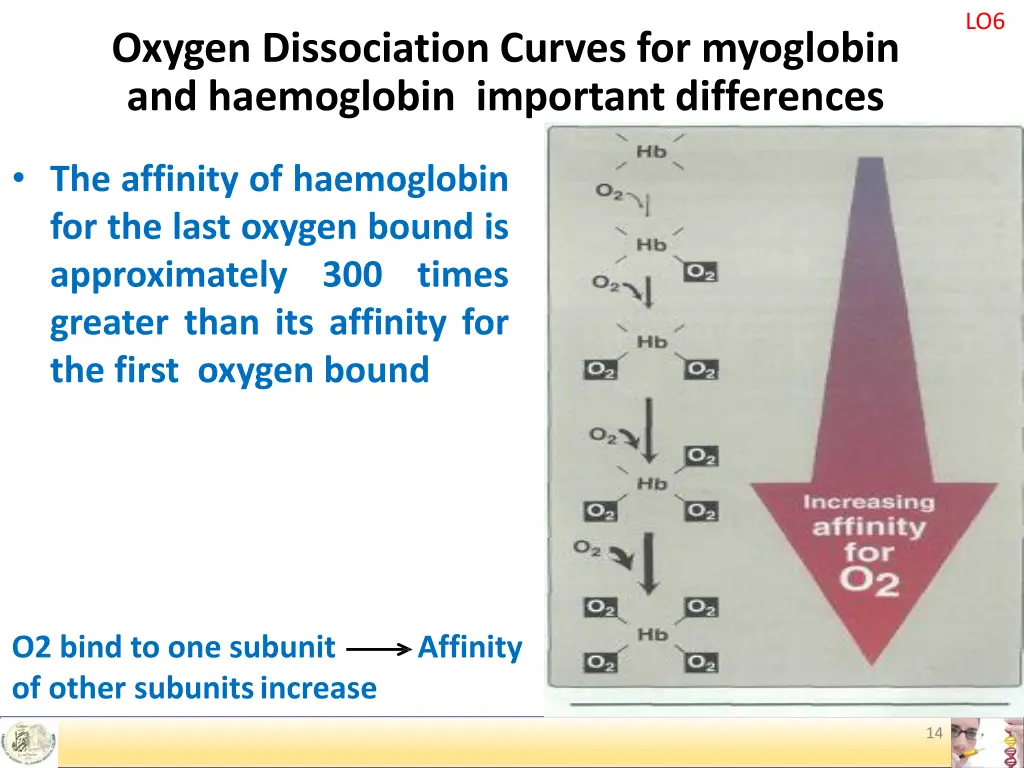
LO6 Oxygen Dissociation Curves for myoglobin and haemoglobin important differences The affinity of haemoglobin for the last oxygen bound is approximately 300 times greater than its affinity for the first oxygen bound O2 bind to one subunit of other subunits increase Affinity 14
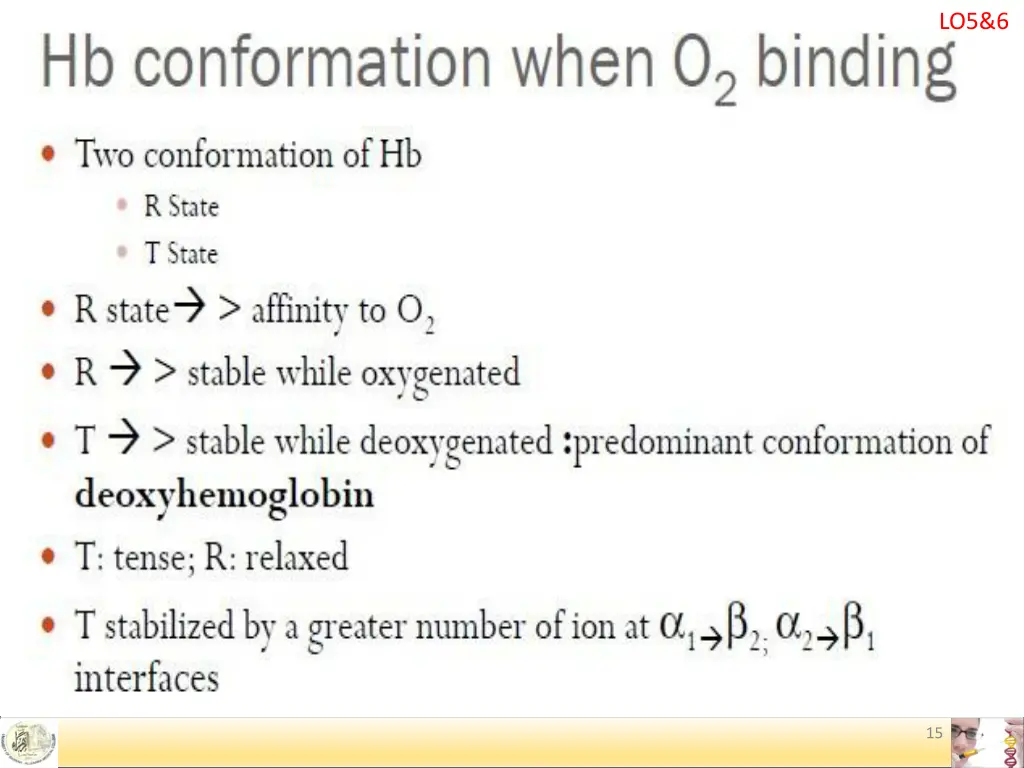
LO5&6 15
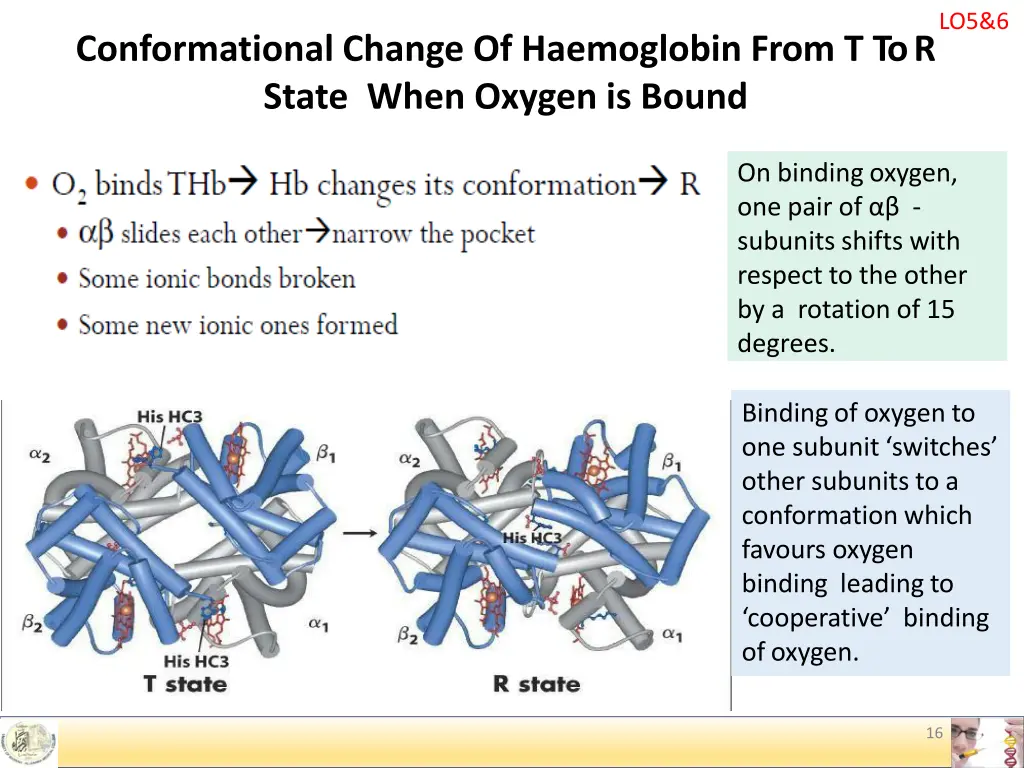
LO5&6 Conformational Change Of Haemoglobin From T To R State When Oxygen is Bound On binding oxygen, one pair of - subunits shifts with respect to the other by a rotation of 15 degrees. Binding of oxygen to one subunit switches other subunits to a conformation which favours oxygen binding leading to cooperative binding of oxygen. 16
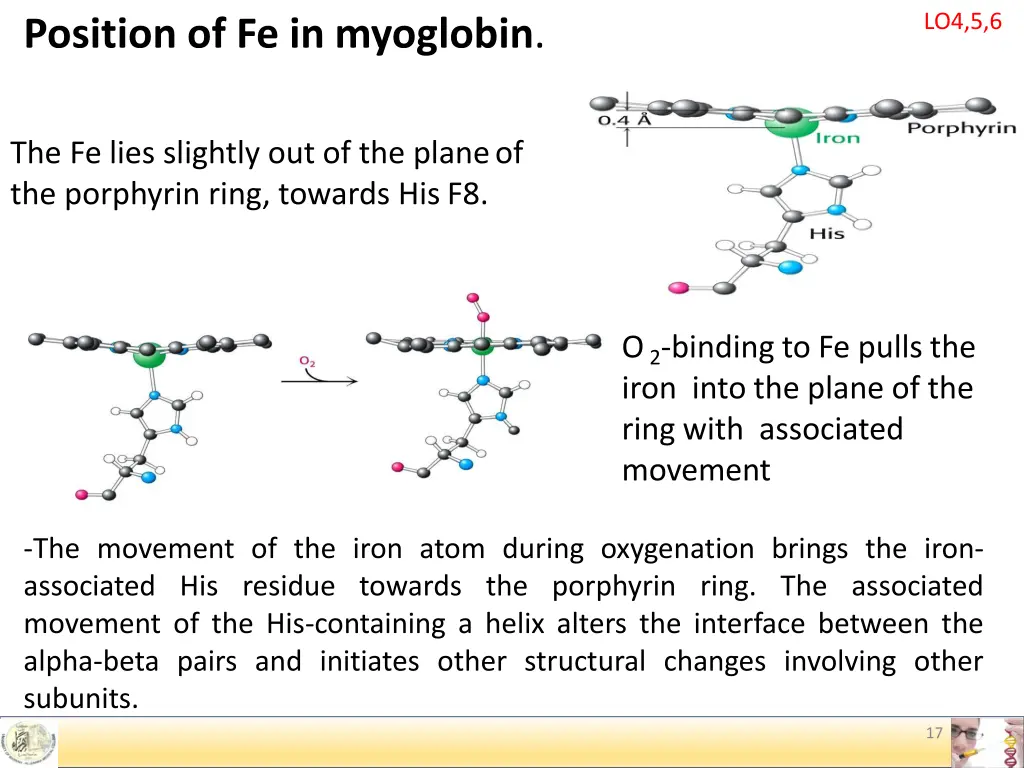
LO4,5,6 Position of Fe in myoglobin. The Fe lies slightly out of the plane of the porphyrin ring, towards His F8. O 2-binding to Fe pulls the iron into the plane of the ring with associated movement -The movement of the iron atom during oxygenation brings the iron- associated His residue towards the porphyrin ring. The associated movement of the His-containing a helix alters the interface between the alpha-beta pairs and initiates other structural changes involving other subunits. 17
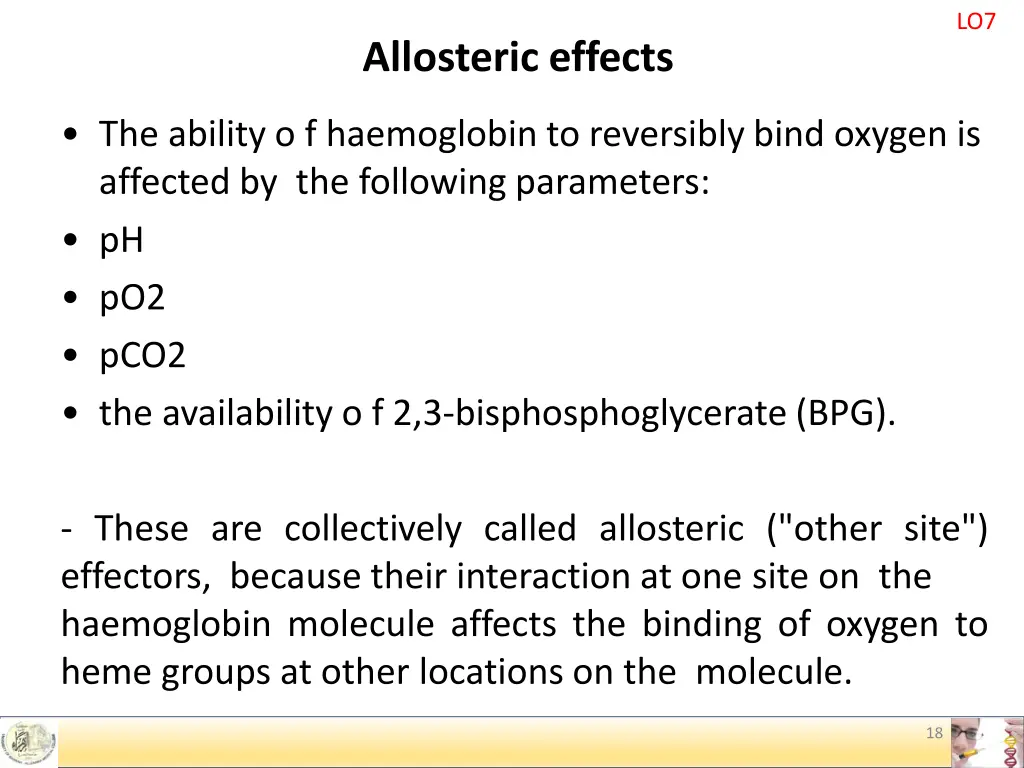
LO7 Allosteric effects The ability o f haemoglobin to reversibly bind oxygen is affected by the following parameters: pH pO2 pCO2 the availability o f 2,3-bisphosphoglycerate (BPG). - These are collectively called allosteric ("other site") effectors, because their interaction at one site on the haemoglobin molecule affects the binding of oxygen to heme groups at other locations on the molecule. 18
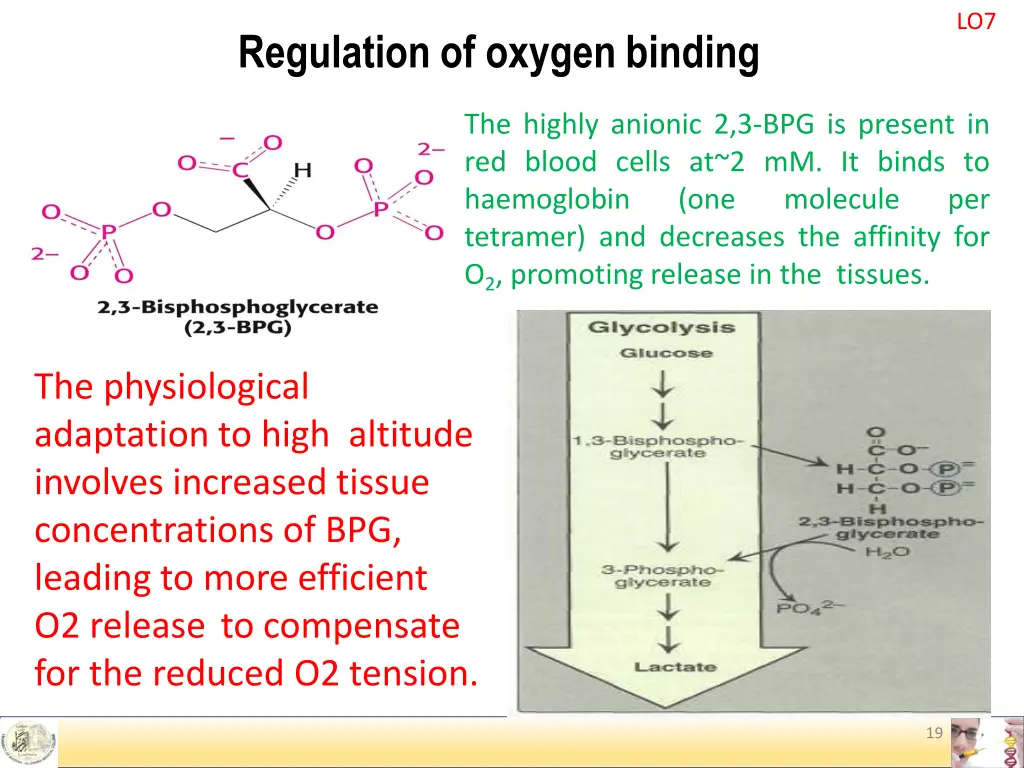
LO7 Regulation of oxygen binding The highly anionic 2,3-BPG is present in red blood cells at~2 mM. It binds to haemoglobin (one tetramer) and decreases the affinity for O2, promoting release in the tissues. molecule per The physiological adaptation to high altitude involves increased tissue concentrations of BPG, leading to more efficient O2 release to compensate for the reduced O2 tension. 19
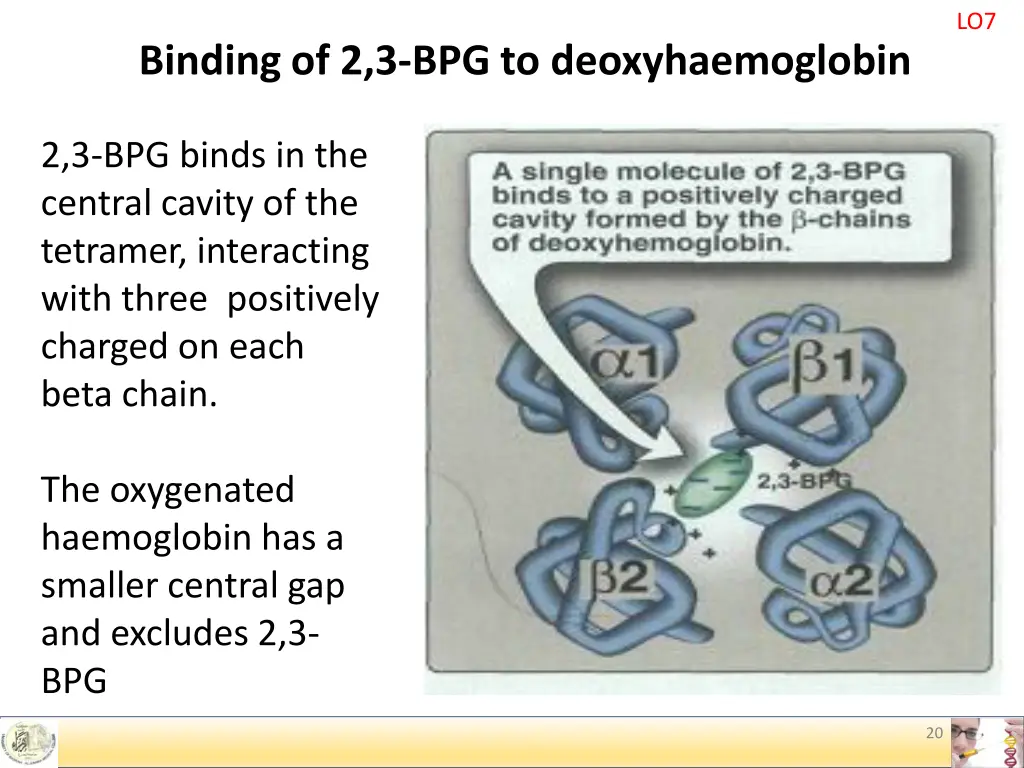
LO7 Binding of 2,3-BPG to deoxyhaemoglobin 2,3-BPG binds in the central cavity of the tetramer, interacting with three positively charged on each beta chain. The oxygenated haemoglobin has a smaller central gap and excludes 2,3- BPG 20
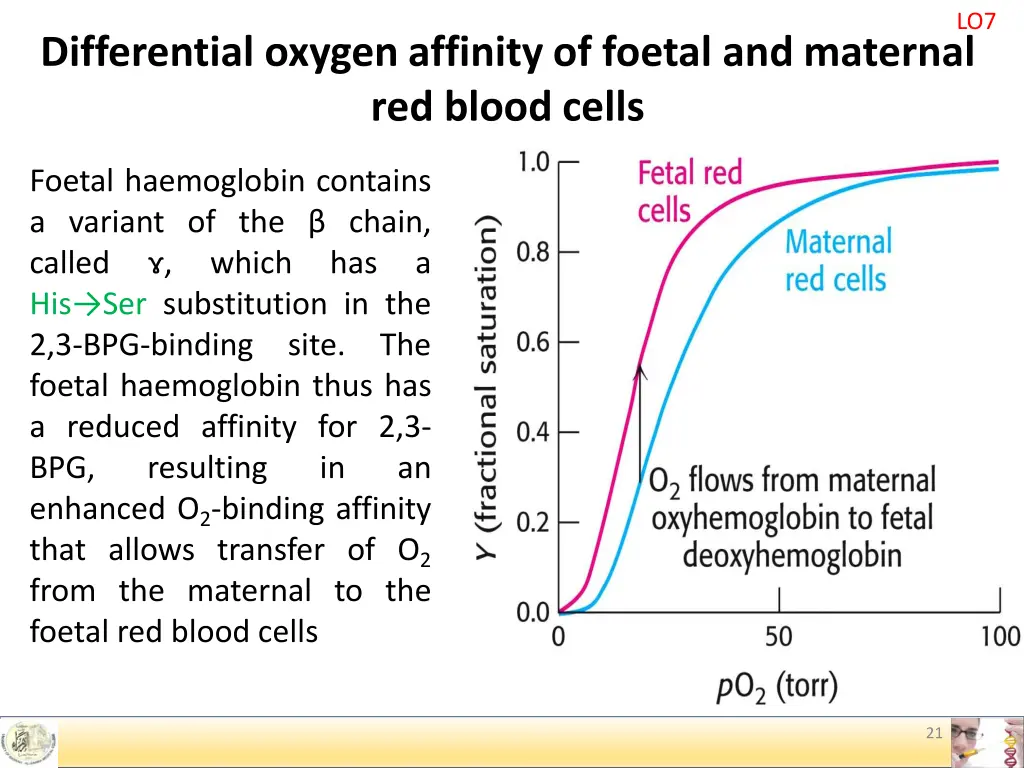
LO7 Differential oxygen affinity of foetal and maternal red blood cells Foetal haemoglobin contains a variant of the chain, called , which has a His Ser substitution in the 2,3-BPG-binding site. The foetal haemoglobin thus has a reduced affinity for 2,3- BPG, resulting enhanced O2-binding affinity that allows transfer of O2 from the maternal to the foetal red blood cells in an 21
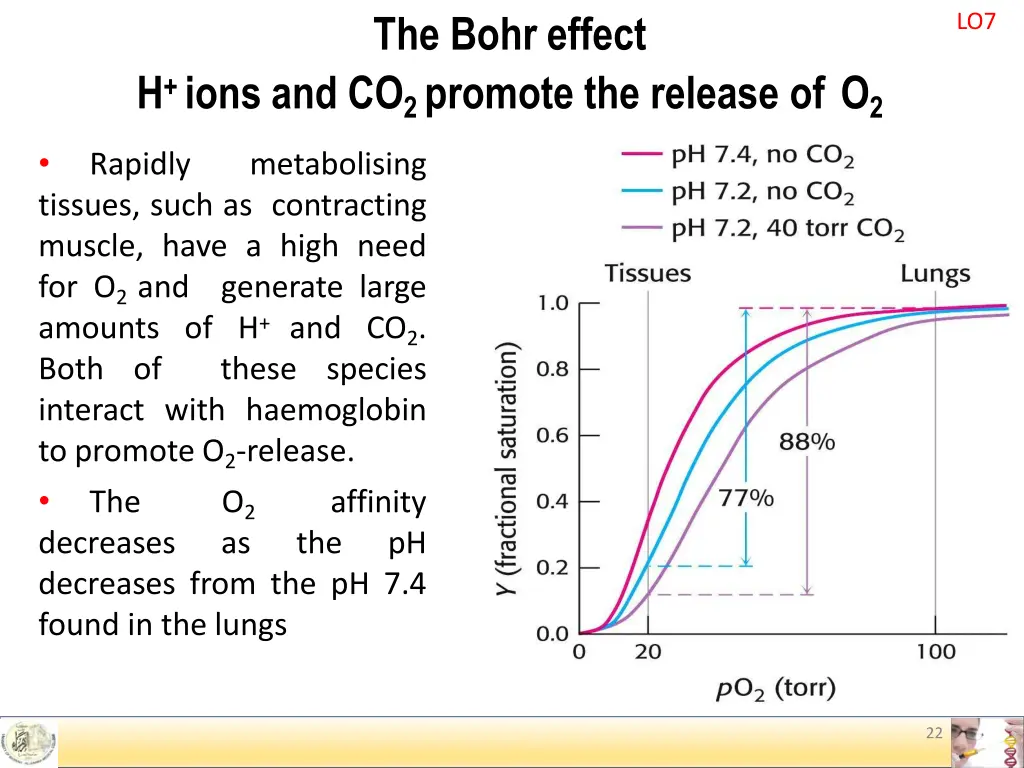
The Bohr effect LO7 H+ ions and CO2 promote the release of O2 tissues, such as contracting muscle, have a high need for O2 and generate large amounts of H+ and CO2. Both of these species interact with haemoglobin to promote O2-release. The O2 decreases as decreases from the pH 7.4 found in the lungs Rapidly metabolising affinity the pH 22
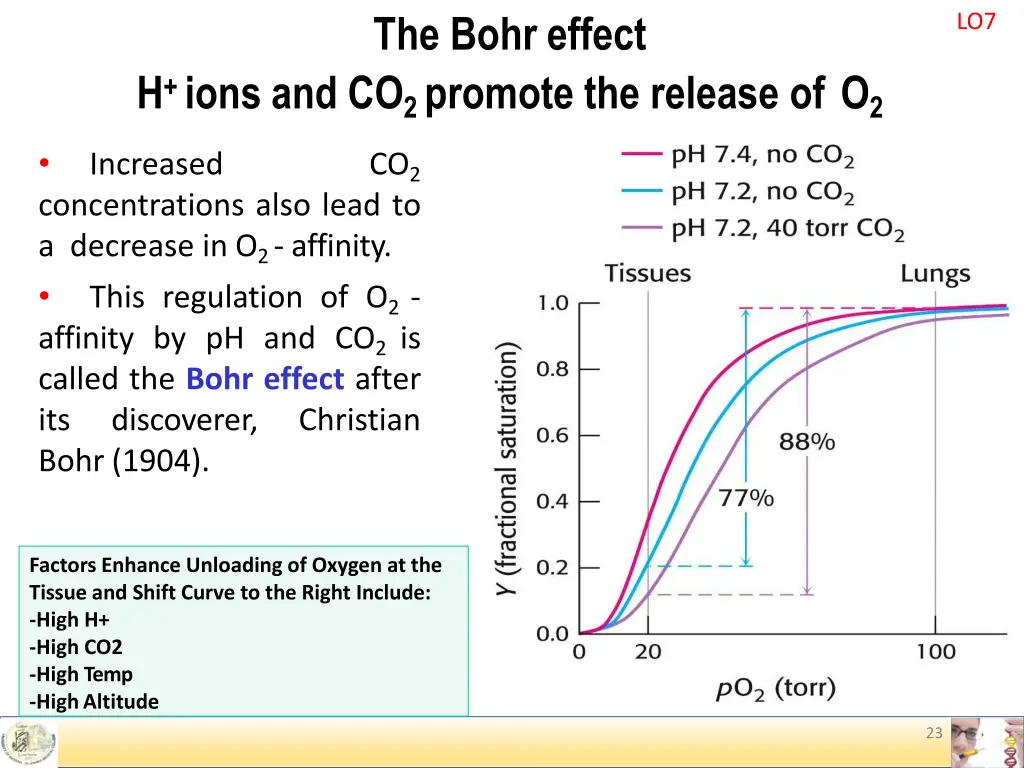
The Bohr effect LO7 H+ ions and CO2 promote the release of O2 concentrations also lead to a decrease in O2 - affinity. This regulation of O2 - affinity by pH and CO2 is called the Bohr effect after its discoverer, Bohr (1904). Increased CO2 Christian Factors Enhance Unloading of Oxygen at the Tissue and Shift Curve to the Right Include: -High H+ -High CO2 -High Temp -High Altitude 23
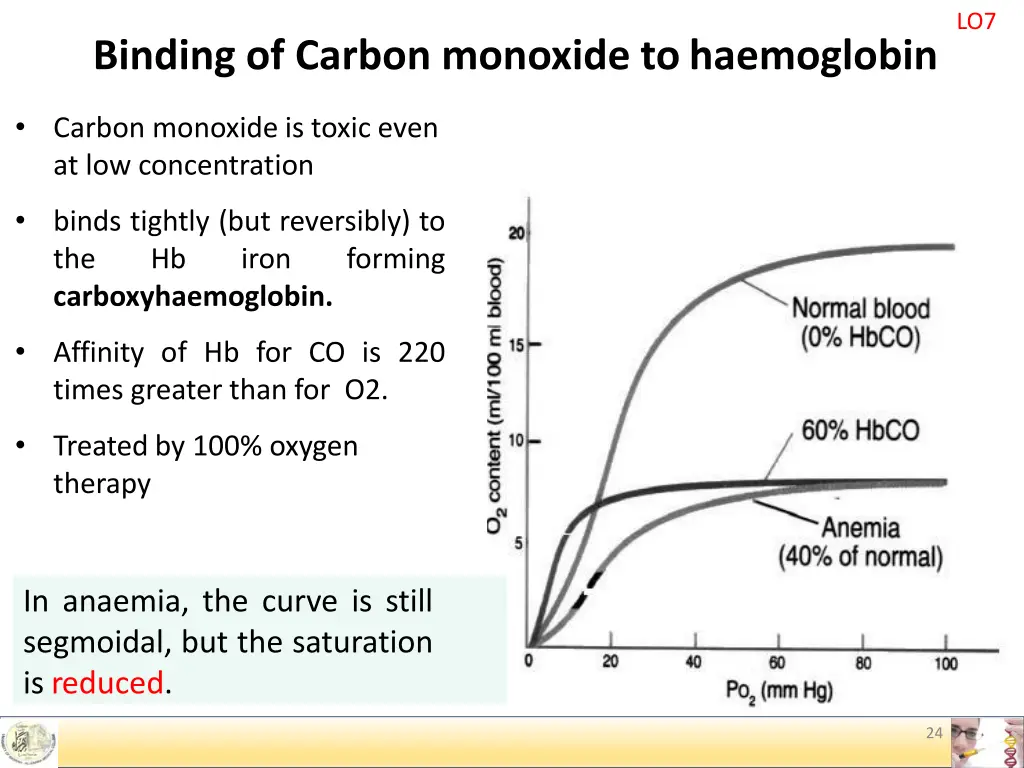
LO7 Binding of Carbon monoxide to haemoglobin Carbon monoxide is toxic even at low concentration binds tightly (but reversibly) to the Hb carboxyhaemoglobin. iron forming Affinity of Hb for CO is 220 times greater than for O2. Treated by 100% oxygen therapy In anaemia, the curve is still segmoidal, but the saturation is reduced. 24
LO8 25
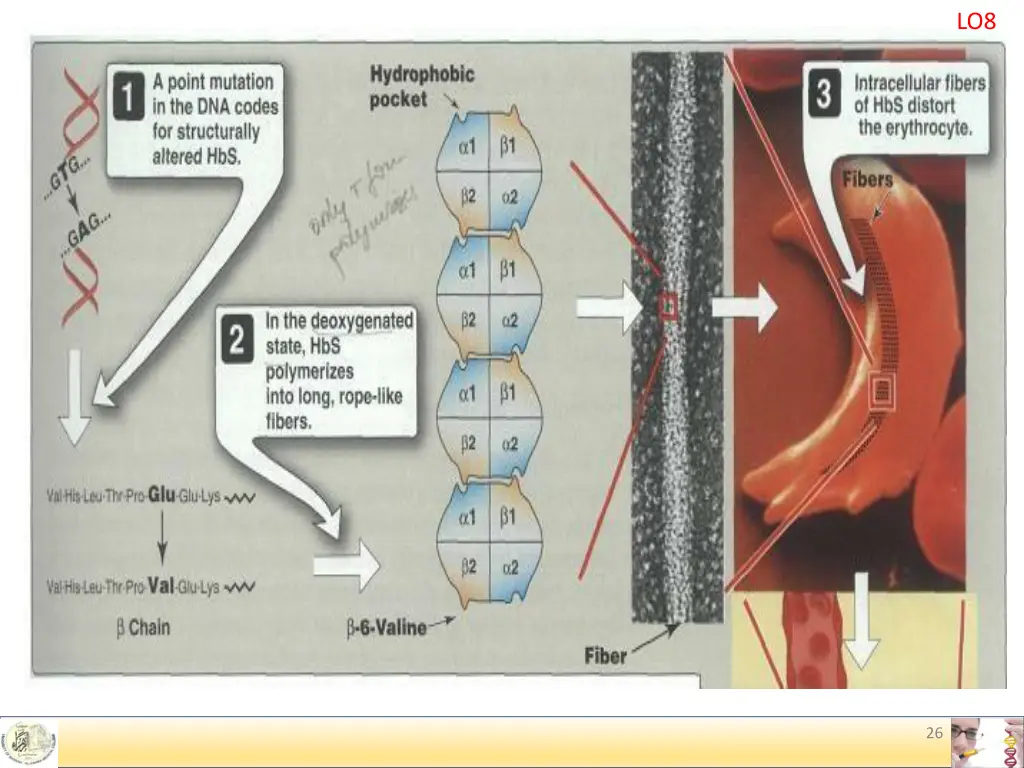
LO8 26
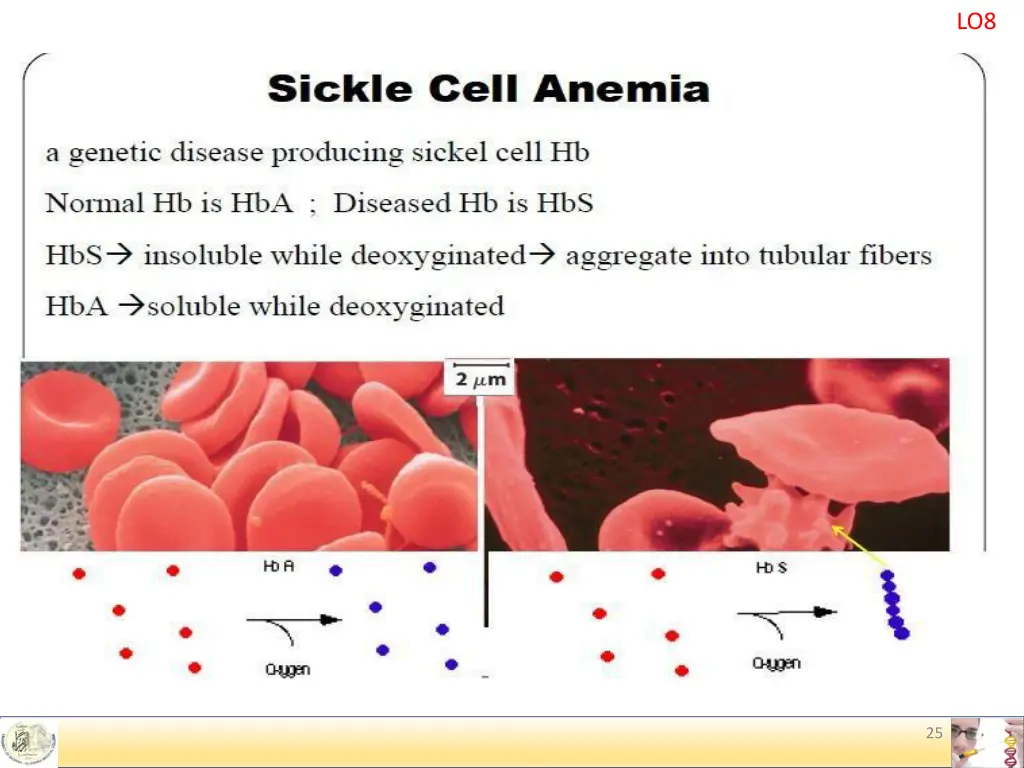
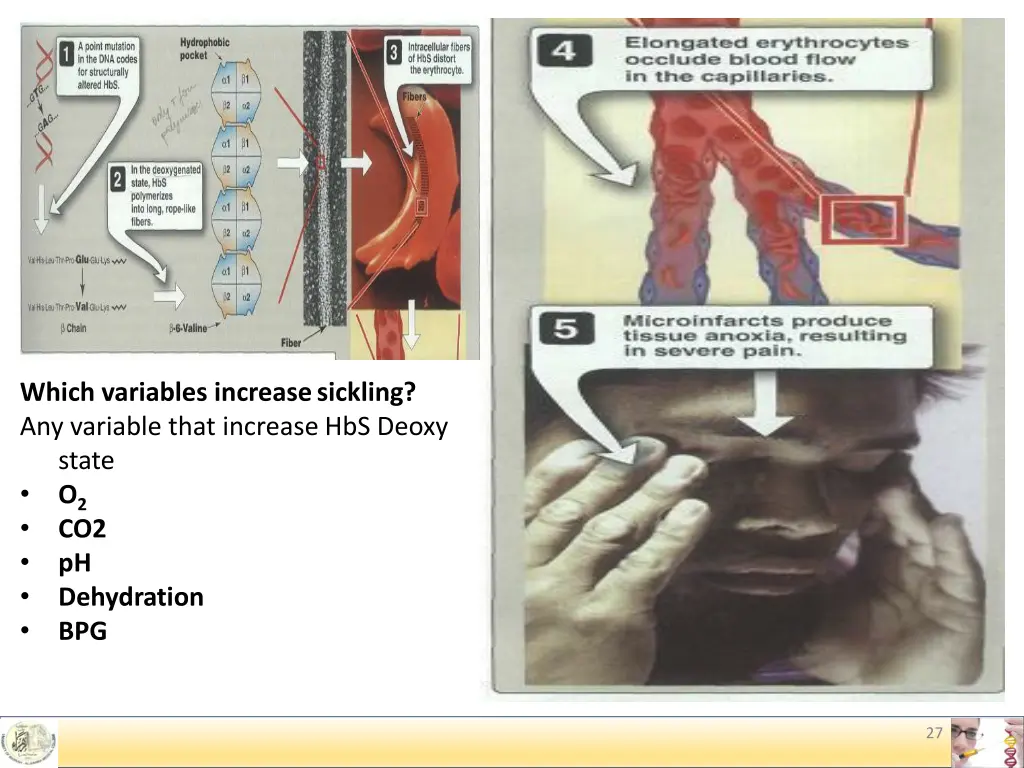
Which variables increase sickling? Any variable that increase HbS Deoxy state O2 CO2 pH Dehydration BPG 27
Questions A 14-year-old girl was admitted to a children s hospital in coma. Her mother stated that several days before admission the girl began to complain of thirst and also started to get up several times during the night to urinate. She diagnosed as Diabetic keto acidosis (DKA). 1) Predict the effect of DKA on the patient's oxygen dissociation curve (ODC). 2) Briefly explain the molecular bases of such change in (ODC). 3) Suppose this girl has sickle cell anaemia, how can the DKA affect her haemoglobin structure? 4) Will this relief or amplify her illness? Why? 28