P2P: Storage
This content provides a chronological exploration of peer-to-peer (P2P) systems, covering various aspects including file-sharing, structured networks, and storage solutions in the cloud. Key challenges and design techniques related to P2P architecture are discussed, alongside comparisons between systems like Cassandra and Dynamo. Notable design choices from historical P2P frameworks and their implications for modern cloud-based services are also highlighted.

Download Presentation

Please find below an Image/Link to download the presentation.
The content on the website is provided AS IS for your information and personal use only. It may not be sold, licensed, or shared on other websites without obtaining consent from the author.If you encounter any issues during the download, it is possible that the publisher has removed the file from their server.
You are allowed to download the files provided on this website for personal or commercial use, subject to the condition that they are used lawfully. All files are the property of their respective owners.
The content on the website is provided AS IS for your information and personal use only. It may not be sold, licensed, or shared on other websites without obtaining consent from the author.
E N D
Presentation Transcript
Overall outline (Relatively) chronological overview of P2P areas: What is P2P? Filesharing structured networks storage the cloud Dynamo Design considerations Challenges and design techniques Evaluation, takeaways, and discussion Cassandra Vs Dynamo Notable design choices
Background: P2P Formal definition? Symmetric division of responsibility and functionality Client-server: Nodes both request and provide service Each node enjoys conglomerate service provided by peers Can offer better load distribution, fault-tolerance, scalability... On a fast rise in the early 2000 s
Background:P2P filesharing & unstructured networks Napster (1999) Gnutella (2000) FreeNet (2000) Key challenges: Decentralize content search and routing
Background: P2P structured networks CAN (2001) Chord (2001) Pastry (2001) Tapestry (2001) More systematic+formal Key challenges: Routing latency Churn-resistance Scalability
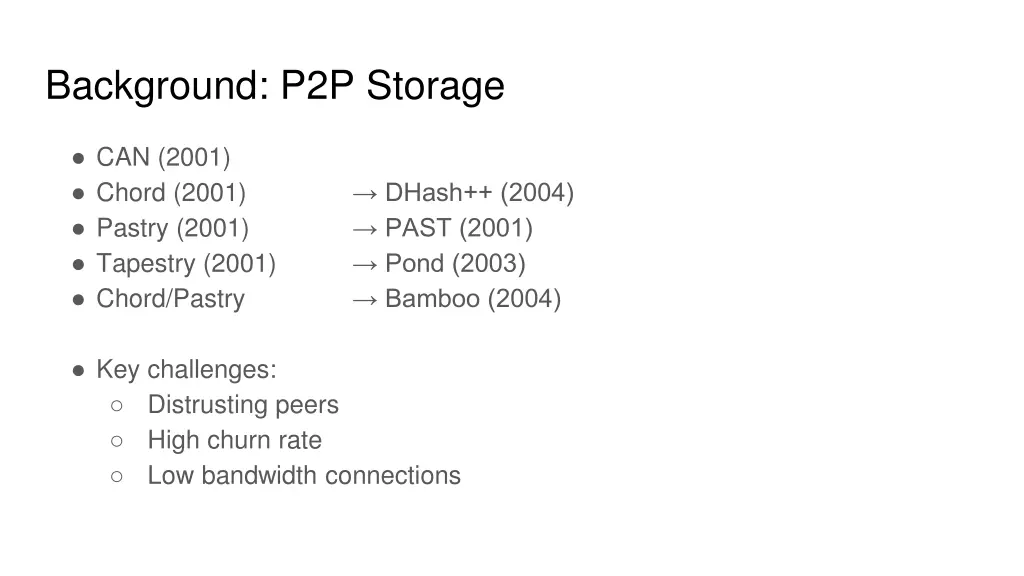
Background: P2P Storage CAN (2001) Chord (2001) Pastry (2001) Tapestry (2001) Chord/Pastry DHash++ (2004) PAST (2001) Pond (2003) Bamboo (2004) Key challenges: Distrusting peers High churn rate Low bandwidth connections
Background: P2P on the Cloud In contrast: Single administrative domain Low churn (only due to permanent failure) High bandwidth connections
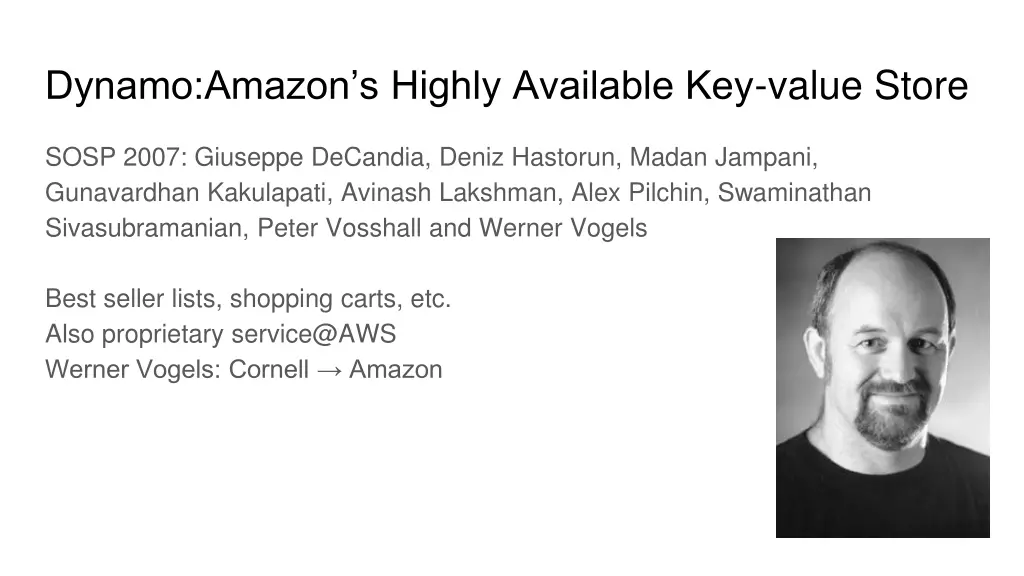
Dynamo:Amazons Highly Available Key-value Store SOSP 2007: Giuseppe DeCandia, Deniz Hastorun, Madan Jampani, Gunavardhan Kakulapati, Avinash Lakshman, Alex Pilchin, Swaminathan Sivasubramanian, Peter Vosshall and Werner Vogels Best seller lists, shopping carts, etc. Also proprietary service@AWS Werner Vogels: Cornell Amazon
Interface Put (key, context, object) Success/Fail Success of (set of values, context)/Fail Get (key)
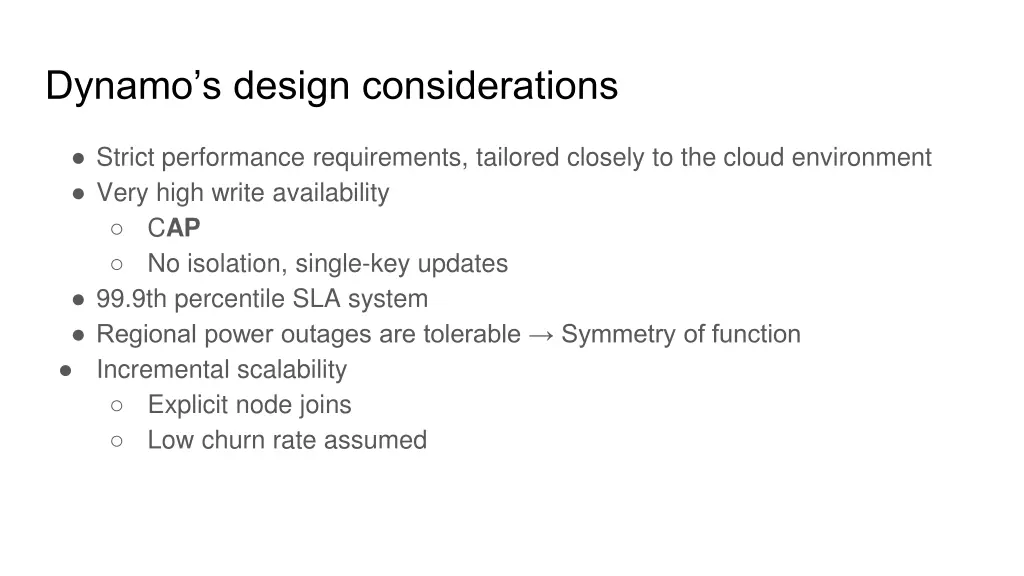
Dynamos design considerations Strict performance requirements, tailored closely to the cloud environment Very high write availability CAP No isolation, single-key updates 99.9th percentile SLA system Regional power outages are tolerable Symmetry of function Incremental scalability Explicit node joins Low churn rate assumed
List of challenges: 1.Incremental scalability and load balance 2.Flexible durability 3.High write availability 4.Handling temporary failure 5.Handling permanent failure 6.Membership protocol and failure detection
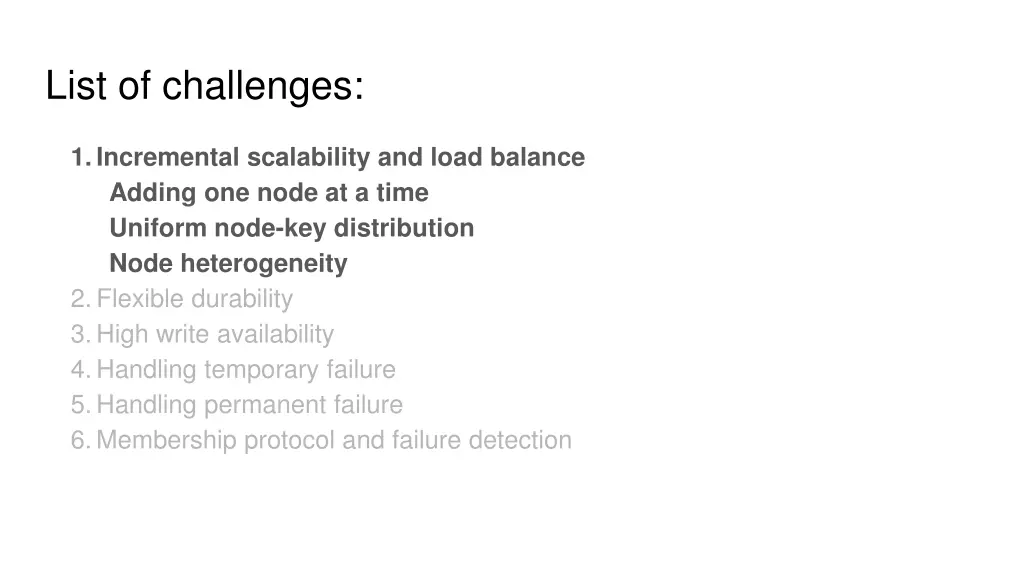
List of challenges: 1.Incremental scalability and load balance Adding one node at a time Uniform node-key distribution Node heterogeneity 2.Flexible durability 3.High write availability 4.Handling temporary failure 5.Handling permanent failure 6.Membership protocol and failure detection
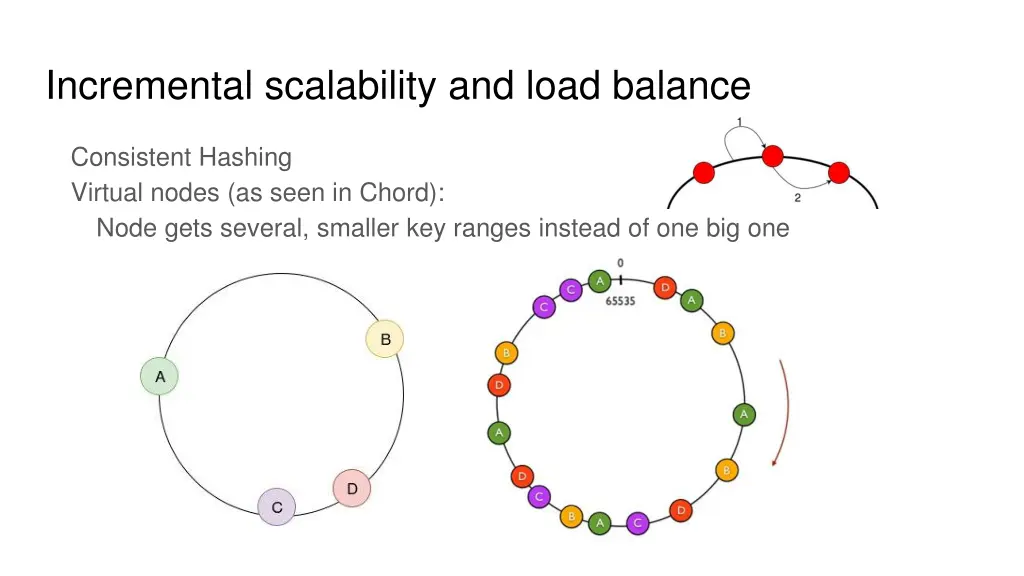
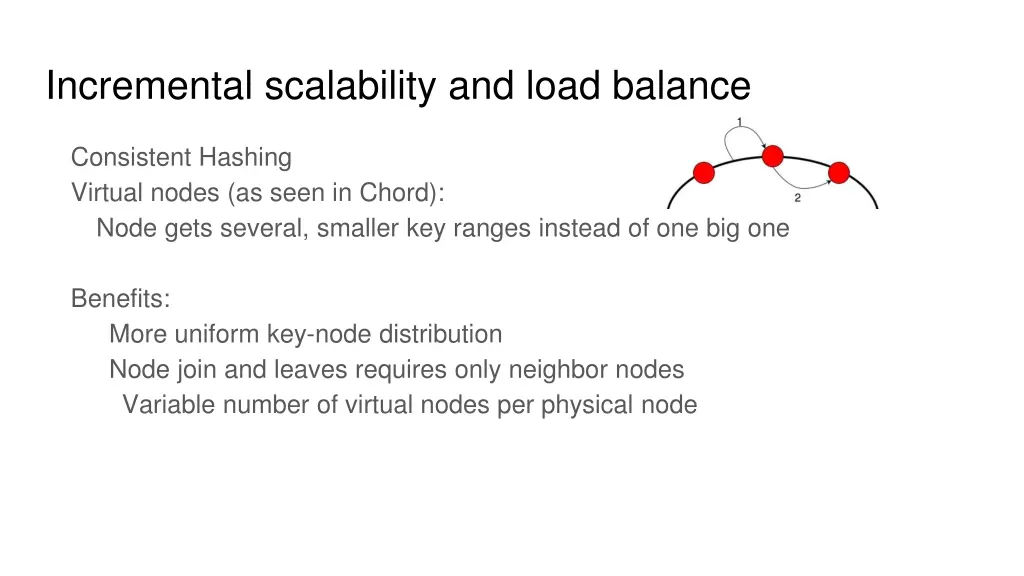
Incremental scalability and load balance Consistent Hashing Virtual nodes (as seen in Chord): Node gets several, smaller key ranges instead of one big one
Incremental scalability and load balance Consistent Hashing Virtual nodes (as seen in Chord): Node gets several, smaller key ranges instead of one big one Benefits: More uniform key-node distribution Node join and leaves requires only neighbor nodes Variable number of virtual nodes per physical node
List of challenges: 1.Incremental scalability and load balance 2.Flexible durability Latency vs durability 3.High write availability 4.Handling temporary failure 5.Handling permanent failure 6.Membership protocol and failure detection
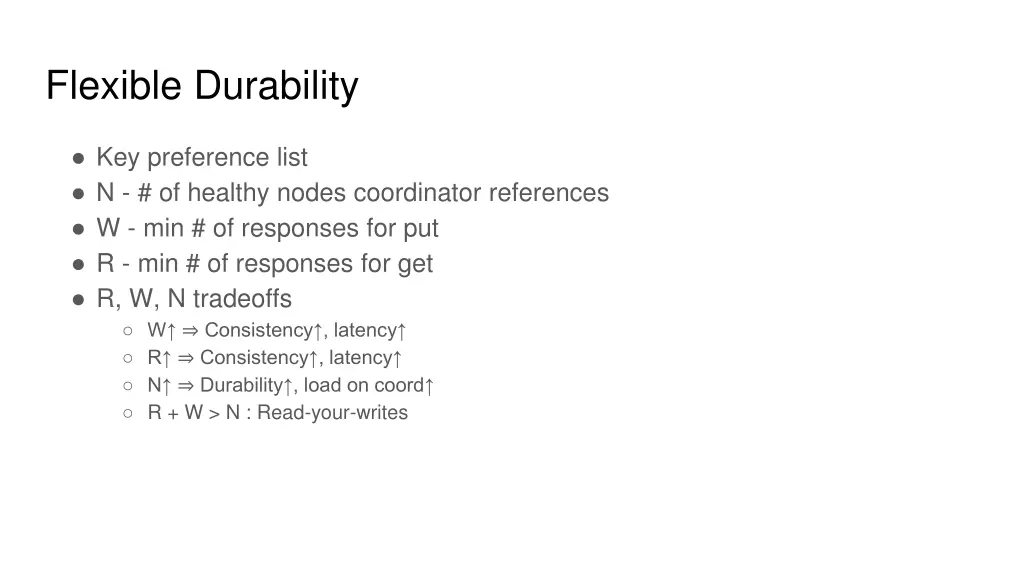
Flexible Durability Key preference list N - # of healthy nodes coordinator references W - min # of responses for put R - min # of responses for get R, W, N tradeoffs W Consistency , latency R Consistency , latency N Durability , load on coord R + W > N : Read-your-writes
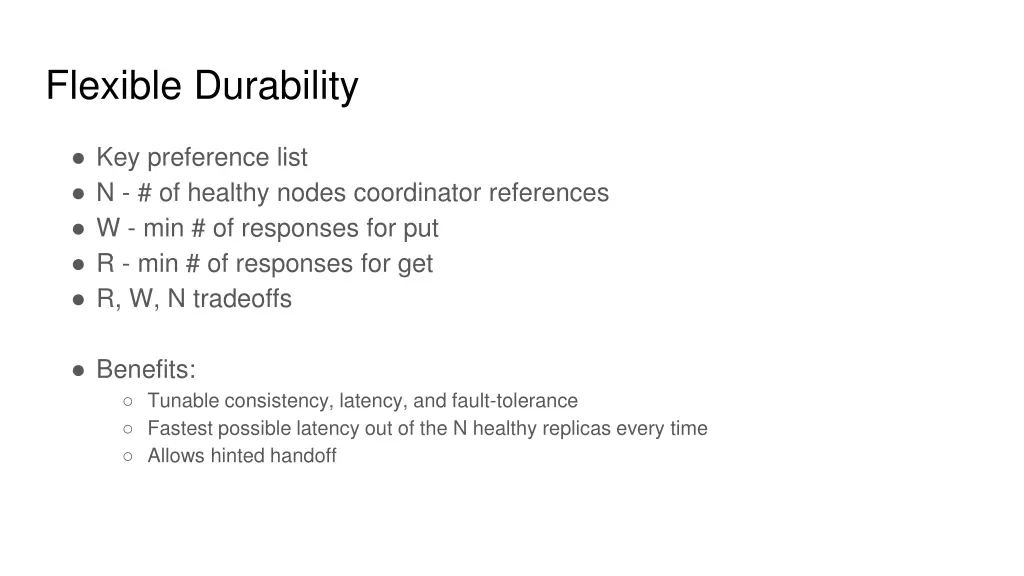
Flexible Durability Key preference list N - # of healthy nodes coordinator references W - min # of responses for put R - min # of responses for get R, W, N tradeoffs Benefits: Tunable consistency, latency, and fault-tolerance Fastest possible latency out of the N healthy replicas every time Allows hinted handoff
List of challenges: 1.Incremental scalability and load balance 2.Flexible durability 3.High write availability Writes cannot fail or delay because of consistency management 4.Handling temporary failure 5.Handling permanent failure 6.Membership protocol and failure detection
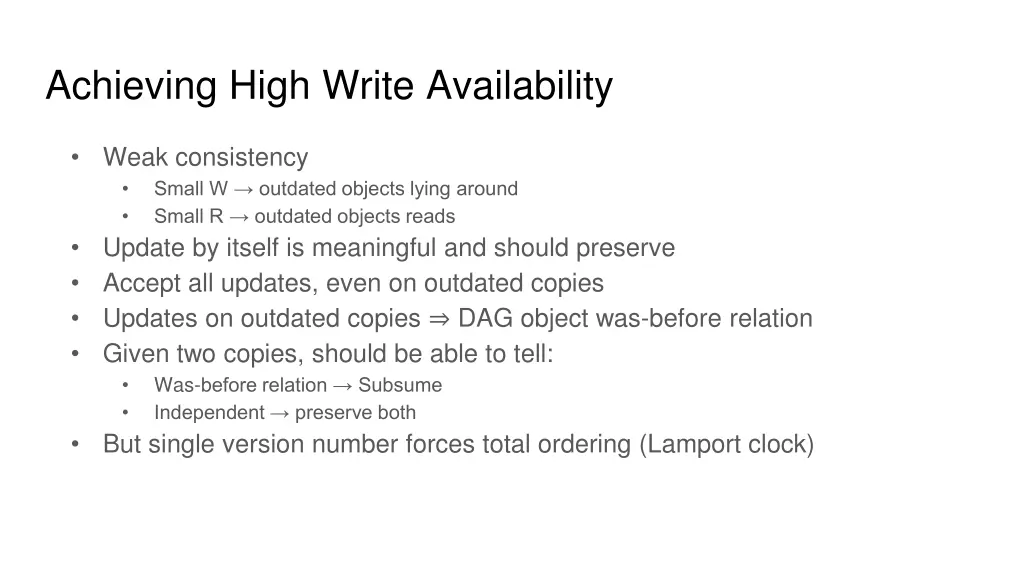
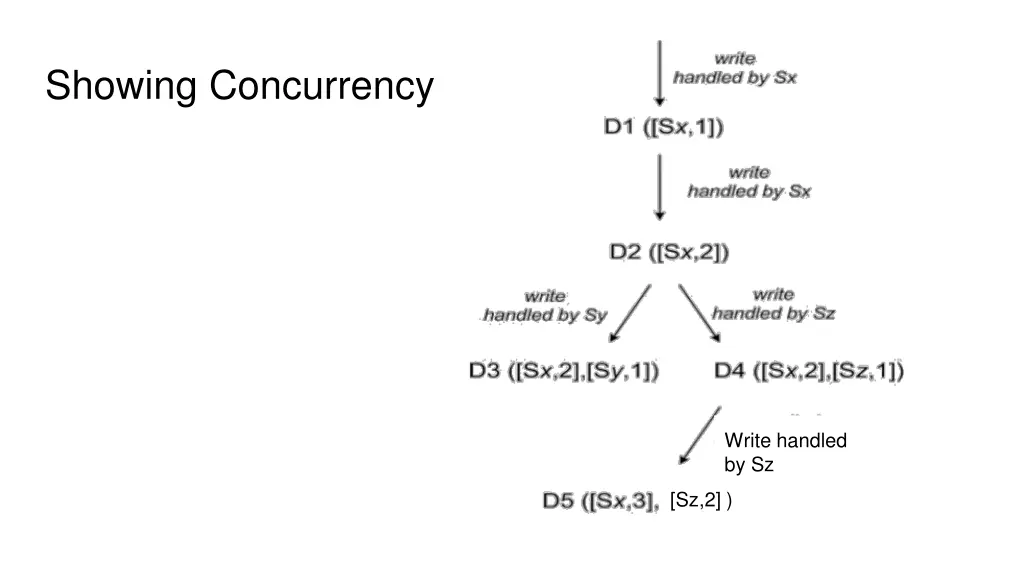
Achieving High Write Availability Weak consistency Small W outdated objects lying around Small R outdated objects reads Update by itself is meaningful and should preserve Accept all updates, even on outdated copies Updates on outdated copies DAG object was-before relation Given two copies, should be able to tell: Was-before relation Subsume Independent preserve both But single version number forces total ordering (Lamport clock)
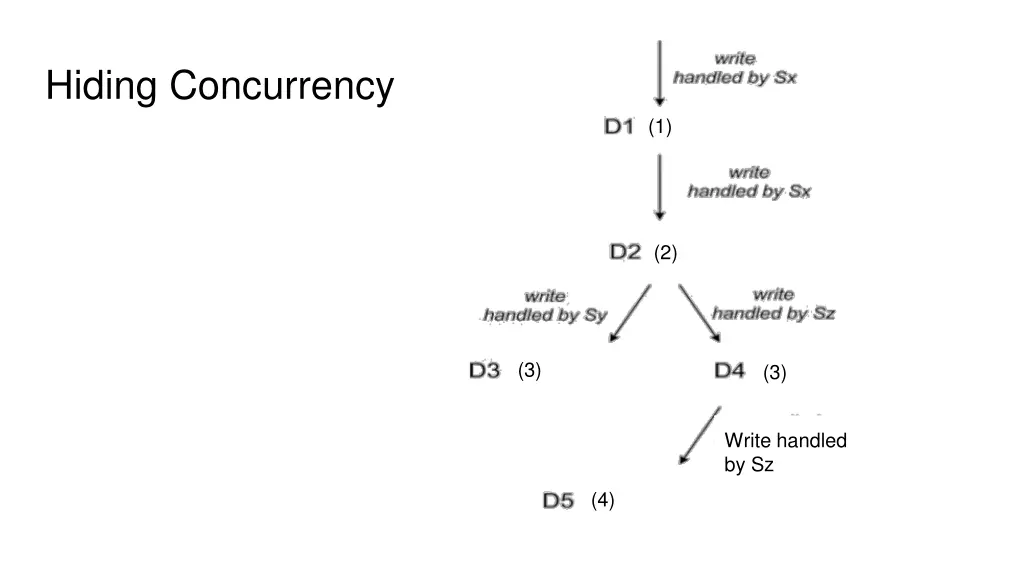
Hiding Concurrency (1) (2) (3) (3) Write handled by Sz (4)
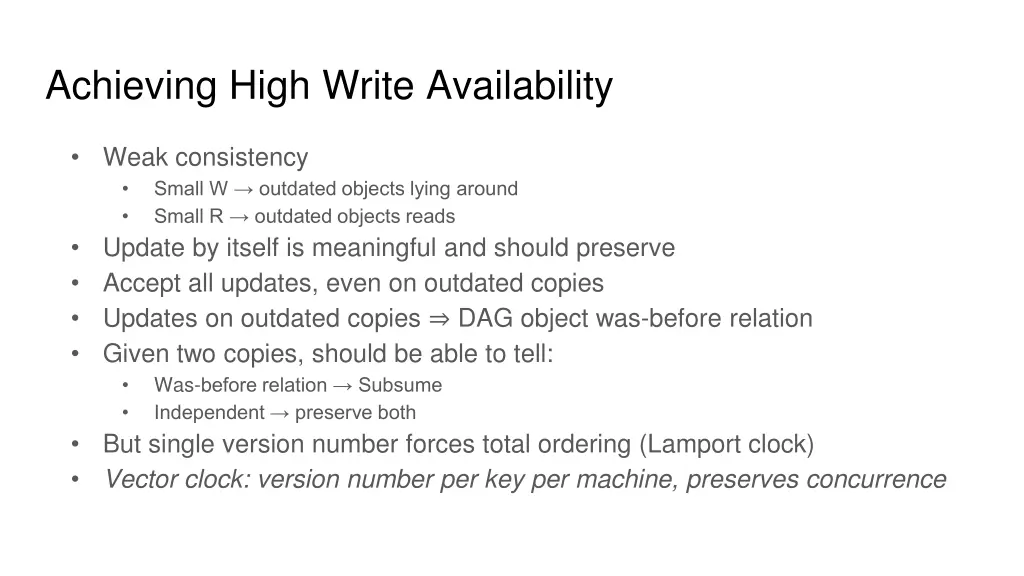
Achieving High Write Availability Weak consistency Small W outdated objects lying around Small R outdated objects reads Update by itself is meaningful and should preserve Accept all updates, even on outdated copies Updates on outdated copies DAG object was-before relation Given two copies, should be able to tell: Was-before relation Subsume Independent preserve both But single version number forces total ordering (Lamport clock) Vector clock: version number per key per machine, preserves concurrence
Showing Concurrency Write handled by Sz [Sz,2] )
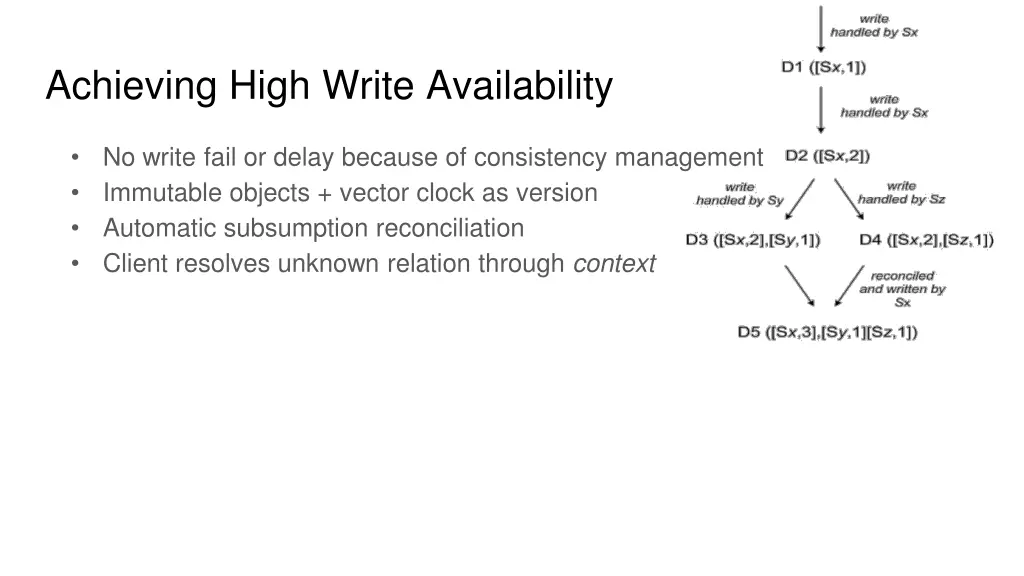
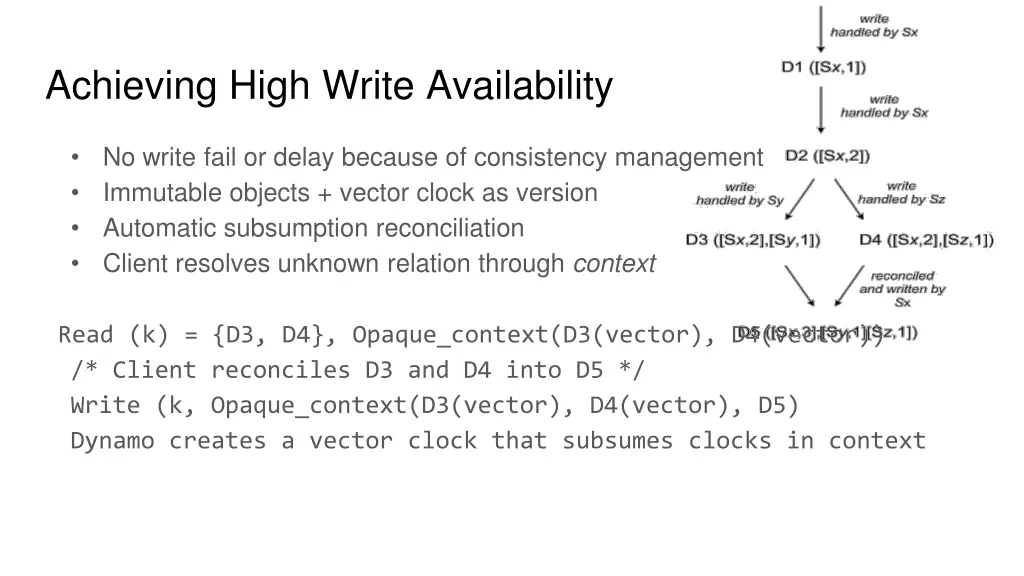
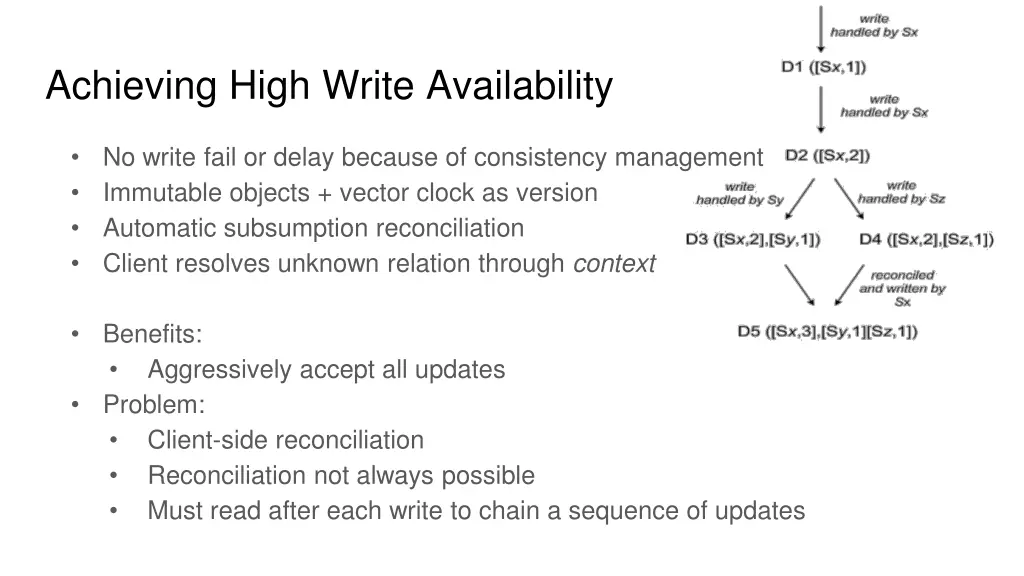
Achieving High Write Availability No write fail or delay because of consistency management Immutable objects + vector clock as version Automatic subsumption reconciliation Client resolves unknown relation through context
Achieving High Write Availability No write fail or delay because of consistency management Immutable objects + vector clock as version Automatic subsumption reconciliation Client resolves unknown relation through context Read (k) = {D3, D4}, Opaque_context(D3(vector), D4(vector)) /* Client reconciles D3 and D4 into D5 */ Write (k, Opaque_context(D3(vector), D4(vector), D5) Dynamo creates a vector clock that subsumes clocks in context
Achieving High Write Availability No write fail or delay because of consistency management Immutable objects + vector clock as version Automatic subsumption reconciliation Client resolves unknown relation through context Benefits: Aggressively accept all updates Problem: Client-side reconciliation Reconciliation not always possible Must read after each write to chain a sequence of updates
List of challenges: 1.Incremental scalability and load balance 2.Flexible durability 3.High write availability 4.Handling temporary failure Writes cannot fail or delay because of temporary inaccessibility 5.Handling permanent failure 6.Membership protocol and failure detection
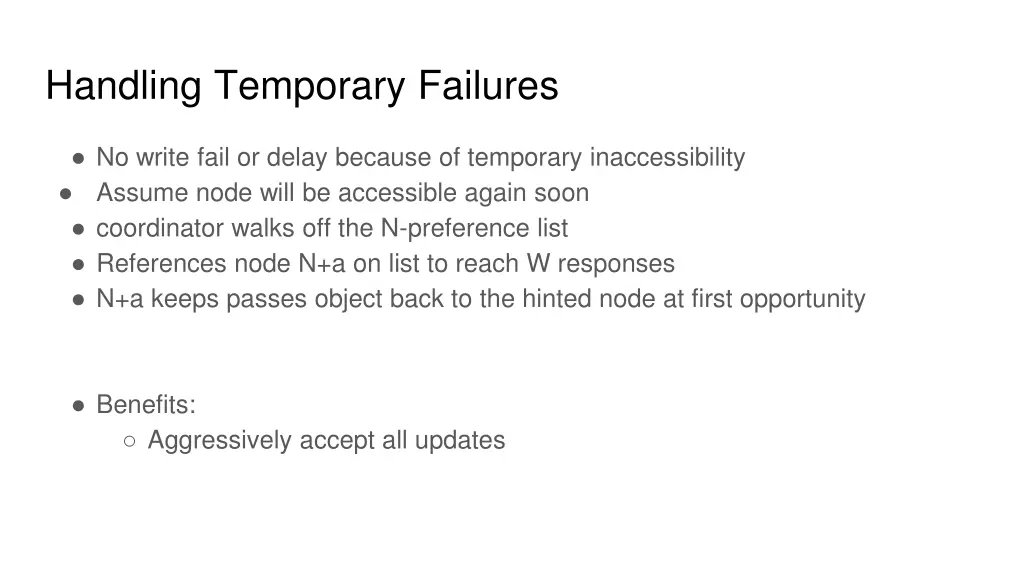
Handling Temporary Failures No write fail or delay because of temporary inaccessibility Assume node will be accessible again soon coordinator walks off the N-preference list References node N+a on list to reach W responses N+a keeps passes object back to the hinted node at first opportunity Benefits: Aggressively accept all updates
List of challenges: 1.Incremental scalability and load balance 2.Flexible durability 3.High write availability 4.Handling temporary failure 5.Handling permanent failure Maintain eventual consistency with permanent failure 6.Membership protocol and failure detection
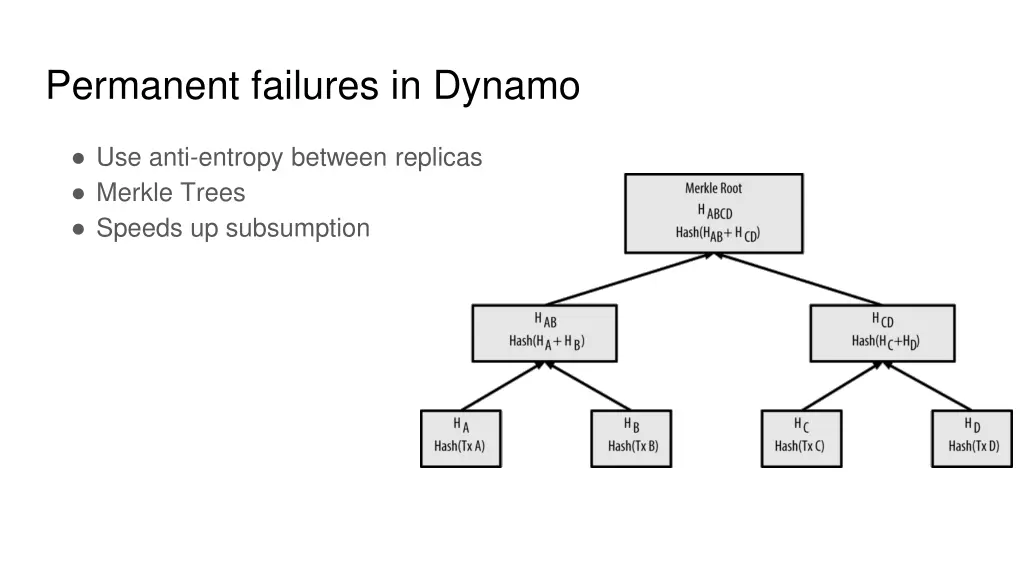
Permanent failures in Dynamo Use anti-entropy between replicas Merkle Trees Speeds up subsumption
List of challenges: 1.Incremental scalability and load balance 2.Flexible durability 3.High write availability 4.Handling temporary failure 5.Handling permanent failure 6.Membership protocol and failure detection
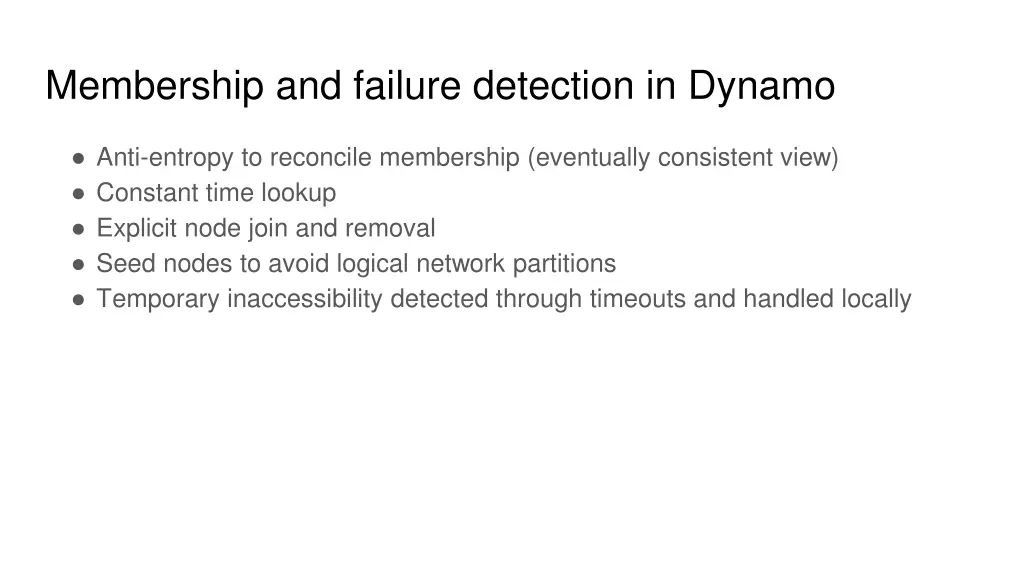
Membership and failure detection in Dynamo Anti-entropy to reconcile membership (eventually consistent view) Constant time lookup Explicit node join and removal Seed nodes to avoid logical network partitions Temporary inaccessibility detected through timeouts and handled locally
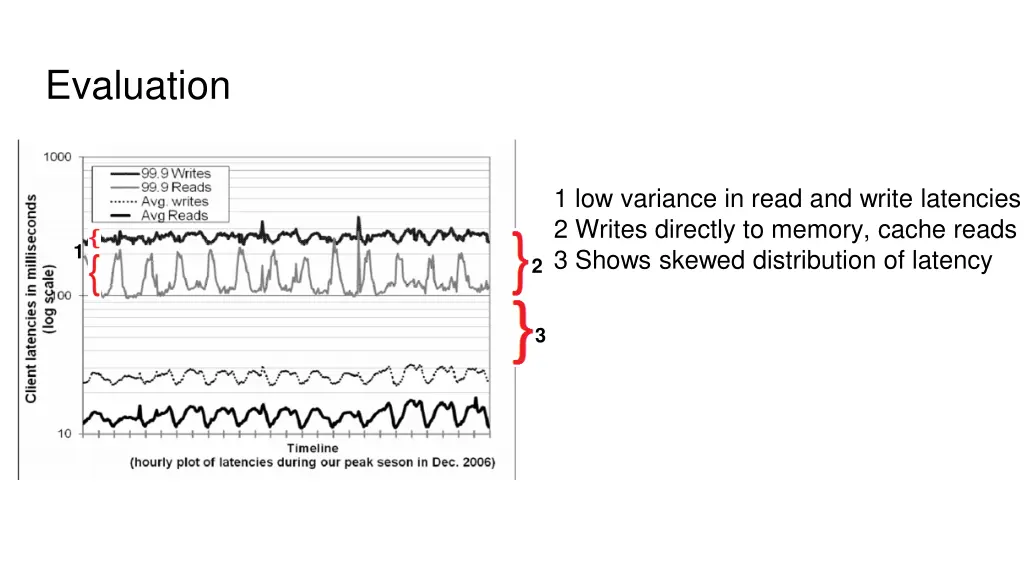
Evaluation 1 low variance in read and write latencies 2 Writes directly to memory, cache reads 3 Shows skewed distribution of latency 1 2 3
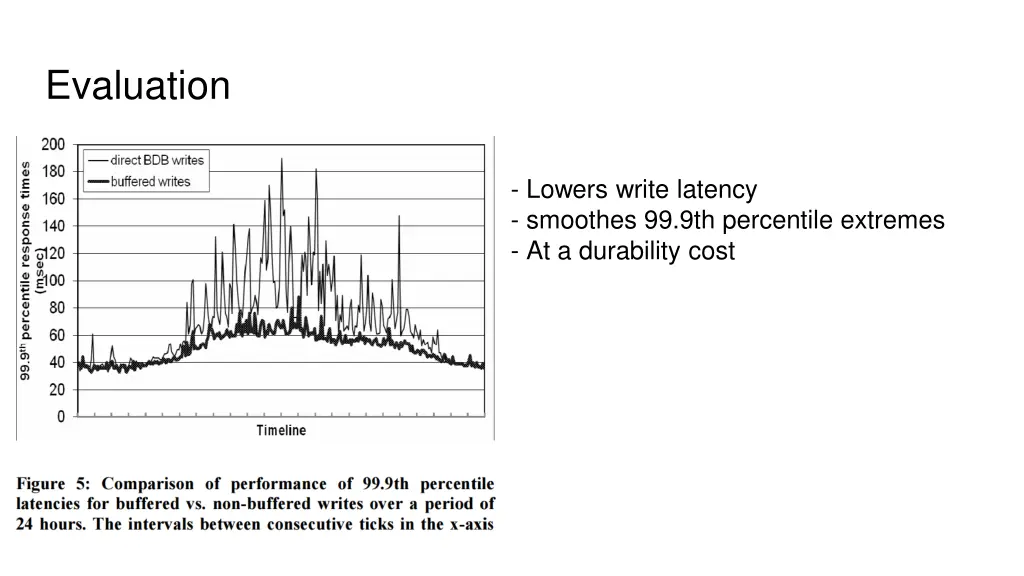
Evaluation - Lowers write latency - smoothes 99.9th percentile extremes - At a durability cost
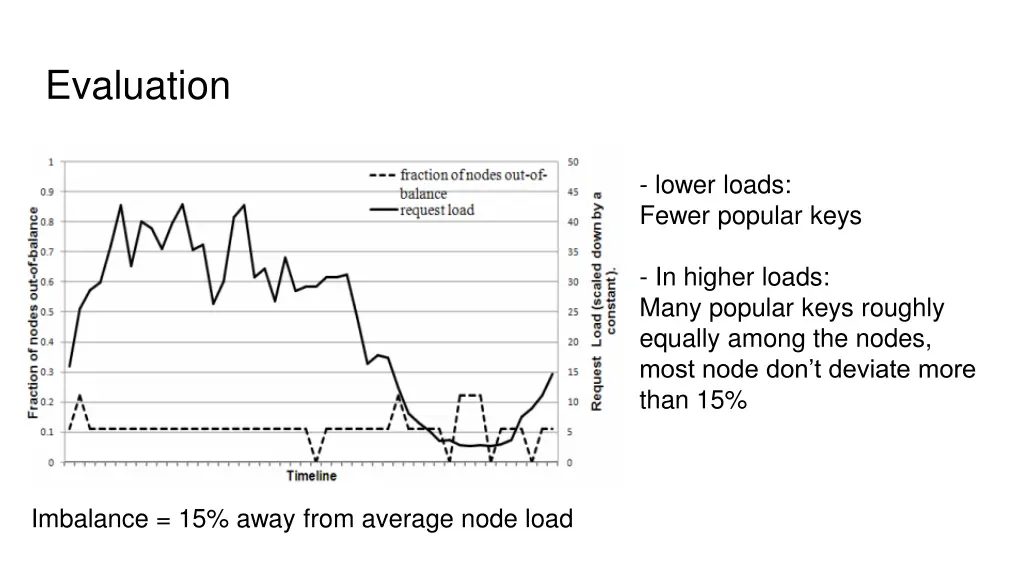
Evaluation - lower loads: Fewer popular keys - In higher loads: Many popular keys roughly equally among the nodes, most node don t deviate more than 15% Imbalance = 15% away from average node load
Takeaways User gets knobs to balance durability, latency, and consistency P2P techniques can be used in the cloud environment to produce highly- available services Instead resolving consistency for all clients at a universally higher latency, let each client resolve their own consistency individually Industry services that require the update to always preserve
Cassandra - A Decentralized Structured Storage System Avinash Lakshman, Prashant Malik Avinash from Dynamo team Used in multiple internals in FB, including inbox search
Interface / Data Model Borrows from BigTable Rows are keys Columns are common key attributes Column families and super columns
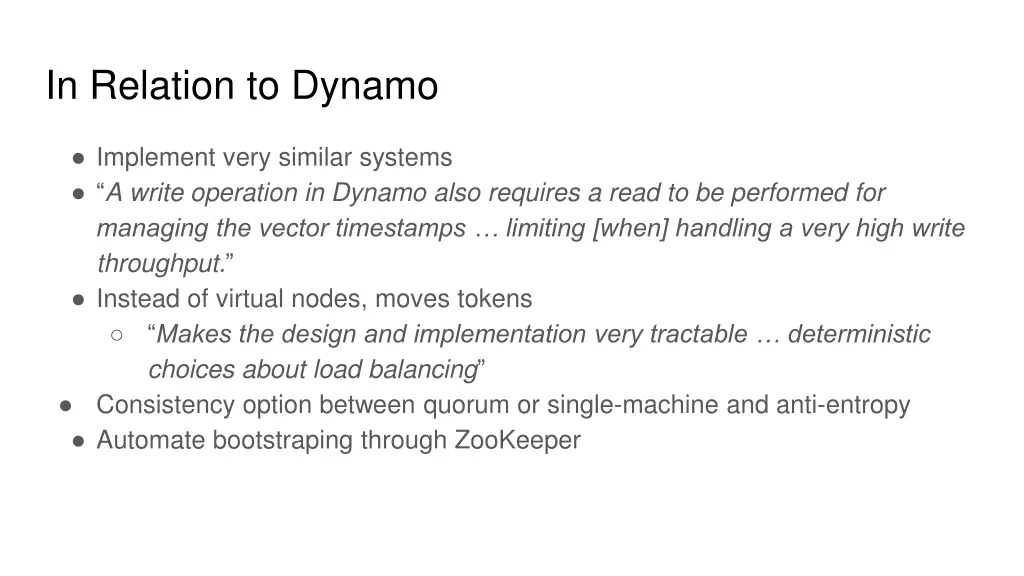
In Relation to Dynamo Implement very similar systems A write operation in Dynamo also requires a read to be performed for managing the vector timestamps limiting [when] handling a very high write throughput. Instead of virtual nodes, moves tokens Makes the design and implementation very tractable deterministic choices about load balancing Consistency option between quorum or single-machine and anti-entropy Automate bootstraping through ZooKeeper