Participation, Inclusion, Engagement: Trends, Theories, and Analytical Frameworks
In the third module of the civil handbook, authored by László Kőkai, PhD, and Viktor Glied, PhD from the Department of Political Science and International Studies at the University of Pécs, Hungary, various trends, theories, and analytical frameworks related to participation, inclusion, and engagement are explored. The publication delves into the dynamics shaping these concepts, providing valuable insights for practitioners, researchers, and policymakers in the field of civil society and governance.

Download Presentation

Please find below an Image/Link to download the presentation.
The content on the website is provided AS IS for your information and personal use only. It may not be sold, licensed, or shared on other websites without obtaining consent from the author.If you encounter any issues during the download, it is possible that the publisher has removed the file from their server.
You are allowed to download the files provided on this website for personal or commercial use, subject to the condition that they are used lawfully. All files are the property of their respective owners.
The content on the website is provided AS IS for your information and personal use only. It may not be sold, licensed, or shared on other websites without obtaining consent from the author.
E N D
Presentation Transcript
CIVIL HANDBOOK: Participation, inclusion, engagement Third module: Trends, theories and analytical frameworks L szl K kai, PhD Viktor Glied, PhD Department of Political Science and International Studies University of P cs, Hungary
The following disclaimer shall be added to the inner pages of the publications and studies written by external independent bodies with support from the European Commission: , , , . BG Podpora Evropsk komise p i tvorb t to publikace nep edstavuje souhlas s obsahem, kter odr pouze n zory autor , a Komise nem e b t zodpov dn za jak koliv vyu it informac obsa en ch v t to publikaci. CS Europa-Kommissionens st tte til produktionen af denne publikation udg r ikke en godkendelse af indholdet, som kun afspejler forfatternes egne synspunkter, og Kommissionen kan ikke holdes ansvarlig for den brug, der m tte blive gjort af de deri indeholdte oplysninger. DA Die Unterst tzung der Europ ischen Kommission f r die Erstellung dieser Ver ffentlichung stellt keine Billigung des Inhalts dar, welcher nur die Ansichten der Verfasser wiedergibt, und die Kommission kann nicht f r eine etwaige Verwendung der darin enthaltenen Informationen haftbar gemacht werden. DE , , . EL The European Commission's support for the production of this publication does not constitute an endorsement of the contents, which reflect the views only of the authors, and the Commission cannot be held responsible for any use which may be made of the information contained therein. EN El apoyo de la Comisi n Europea para la producci n de esta publicaci n no constituye una aprobaci n del contenido, el cual refleja nicamente las opiniones de los autores, y la Comisi n no se hace responsable del uso que pueda hacerse de la informaci n contenida en la misma. ES Euroopa Komisjoni toetus k esoleva v ljaande koostamisele ei t henda v ljaandes esitatud sisu kinnitamist. V ljaandes esitatud sisu peegeldab vaid autorite seisukohti. Euroopa Komisjon ei vastuta selles sisalduva teabe kasutamise eest. ET Euroopan komission tuki t m n julkaisun tuottamiseen ei tarkoita sit , ett sis lt , joka kuvastaa pelk st n tekij iden n kemyksi , saa kannatusta, eik komissiota voida saattaa vastuuseen niiden sis lt mien tietojen mahdollisesta k yt st . FI Le soutien de la Commission europ enne la production de cette publication ne constitue pas une approbation du contenu, qui refl te uniquement le point de vue des auteurs, et la Commission ne peut pas tre tenue responsable de toute utilisation qui pourrait tre faite des informations qu elle contient. FR N hionann taca ocht an Choimisi in Eorpaigh do th irgeadh an fhoilseach in seo agus formhuini ar bhair an fhoilseach in, lena l ir tear tuairim na n- dar amh in, agus n f idir freagracht a chur ar an gCoimisi n bhfaisn is at ann. GA as aon s id a d fh adfa a bhaint as an HR Potpora Europske komisije proizvodnji ove publikacije ne predstavlja potporu sadr aju koji odra ava samo stavove autora i Komisija ne mo e biti odgovorna za uporabu sadr anih informacija.
Az Eurpai Bizottsg tmogatsa ezen kiadvny elksztshez nem jelenti a tartalom jvhagyst, amely kizrlag a szerzk ll spontj t t kr zi, valamint a Bizotts g nem tehet felel ss ezen inform ci k b rminem felhaszn l s rt. HU Il sostegno della Commissione europea alla produzione di questa pubblicazione non costituisce un'approvazione del contenuto, che riflette esclusivamente il punto di vista degli autori, e la Commissione non pu essere ritenuta responsabile per l'uso che pu essere fatto delle informazioni ivi contenute. IT Europos Komisijos parama io leidinio rengimui nerei kia pritarimo jo turiniui, kuriame pateikiama autori nuomon , tod l Europos Komisija negali b ti laikoma atsakinga u informacij panaudot iame leidinyje. LT Eiropas Komisijas atbalsts s publik cijas sagatavo anai nav uzskat ms par satura apstiprin jumu, kas atspogu o tikai autoru viedok us, un Komisija nevar b t atbild ga par taj ietvert s inform cijas jebk du izmanto anu. LV L-appo tal-Kummissjoni Ewropea g all-produzzjoni ta din il-pubblikazzjoni ma jikkostitwixxix approvazzjoni tal-kontenut, li jirrifletti biss il-fehmiet tal-awturi, u l-Kummissjoni ma tistax tin amm responsabbli g al kwalunkwe u u li jista jsir mill- informazzjoni li tinsab fiha. MT De steun van de Europese Commissie voor de productie van deze publicatie houdt geen goedkeuring van de inhoud in. De inhoud geeft de standpunten van de auteurs weer en de Commissie kan niet aansprakelijk worden gesteld voor het gebruik dat eventueel wordt gemaakt van de daarin opgenomen informatie. NL PL Wsparcie Komisji Europejskiej dla produkcji tej publikacji nie stanowi poparcia dla tre ci, kt re odzwierciedlaj jedynie pogl dy autor w, a Komisja nie mo e zosta pociagni ta do odpowiedzialno ci za jakiekolwiek wykorzystanie informacji w niej zawartych. O apoio da Comiss o Europeia produ o desta publica o n o constitui um aval do seu conte do, que reflete unicamente o ponto de vista dos autores, e a Comiss o n o pode ser considerada respons vel por eventuais utiliza es que possam ser feitas com as informa es nela contidas. PT RO Sprijinul acordat de Comisia European pentru elaborarea acestei publica ii nu constituie o aprobare a con inutului, care reflect doar opiniile autorilor, iar Comisia nu poate fi tras la r spundere pentru orice utilizare a informa iilor con inute n aceasta. Podpora Eur pskej komisie na v robu tejto publik cie nepredstavuje s hlas s obsahom, ktor odr a len n zory autorov, a Komisia nem e by zodpovedn za pr padn pou itie inform ci , ktor s v nej obsiahnut . SK Podpora Evropske komisije za pripravo te publikacije ne pomeni potrditve vsebine, ki izra a le mnenja avtorjev, in Komisija ne more biti odgovorna za kakr no koli uporabo informacij, ki jih vsebuje. SL Europeiska Kommissionens st d t framst llningen av detta dokument utg r inte ett godk nnande av dess inneh ll, vilket endast terspeglar upphovsm nnens sikter, och Kommissionen kan inte h llas ansvarigt f r n gon anv ndning av informationen i det. SV
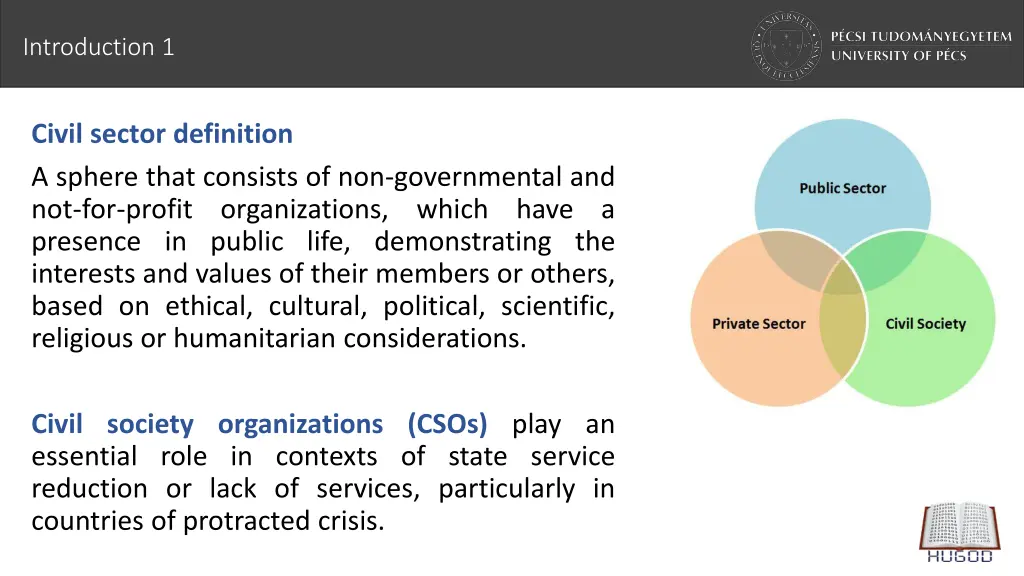
Introduction 1 Civil sector definition A sphere that consists of non-governmental and not-for-profit organizations, presence in public life, demonstrating the interests and values of their members or others, based on ethical, cultural, political, scientific, religious or humanitarian considerations. which have a Civil society organizations (CSOs) play an essential role in contexts of state service reduction or lack of services, particularly in countries of protracted crisis.
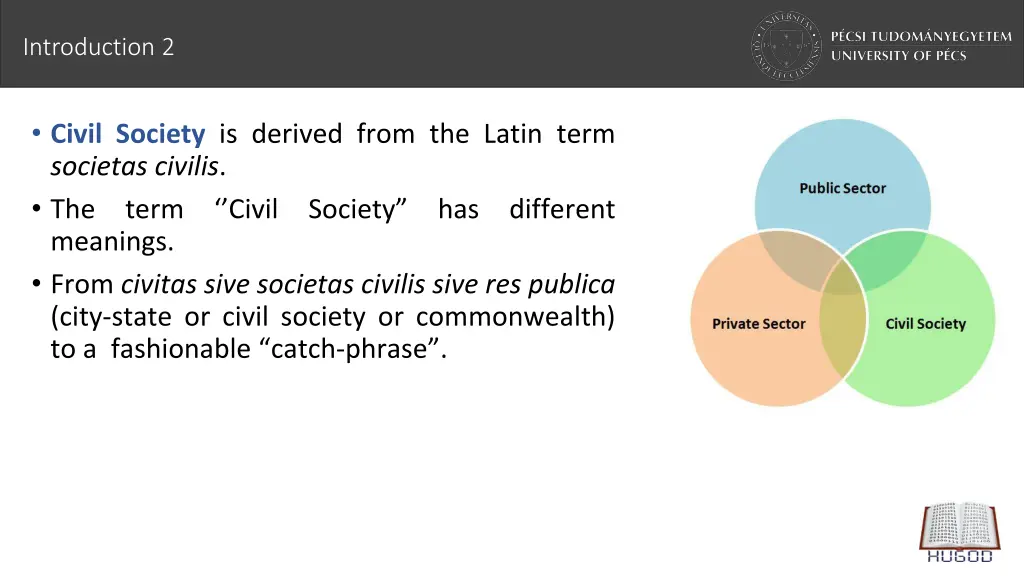
Introduction 2 Civil Society is derived from the Latin term societas civilis. The term Civil Society meanings. From civitas sive societas civilis sive res publica (city-state or civil society or commonwealth) to a fashionable catch-phrase . has different
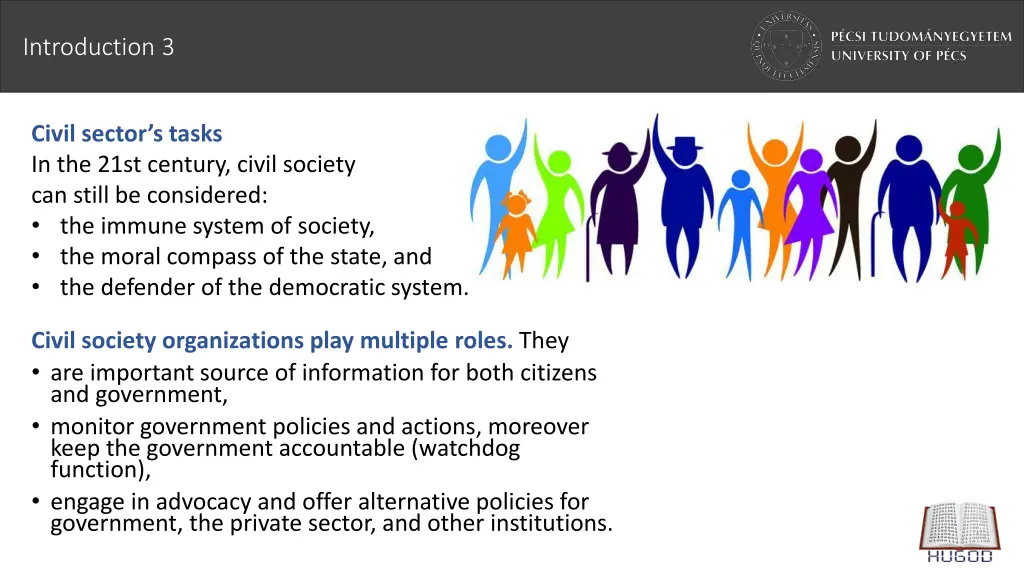
Introduction 3 Civil sector s tasks In the 21st century, civil society can still be considered: the immune system of society, the moral compass of the state, and the defender of the democratic system. Civil society organizations play multiple roles. They are important source of information for both citizens and government, monitor government policies and actions, moreover keep the government accountable (watchdog function), engage in advocacy and offer alternative policies for government, the private sector, and other institutions.
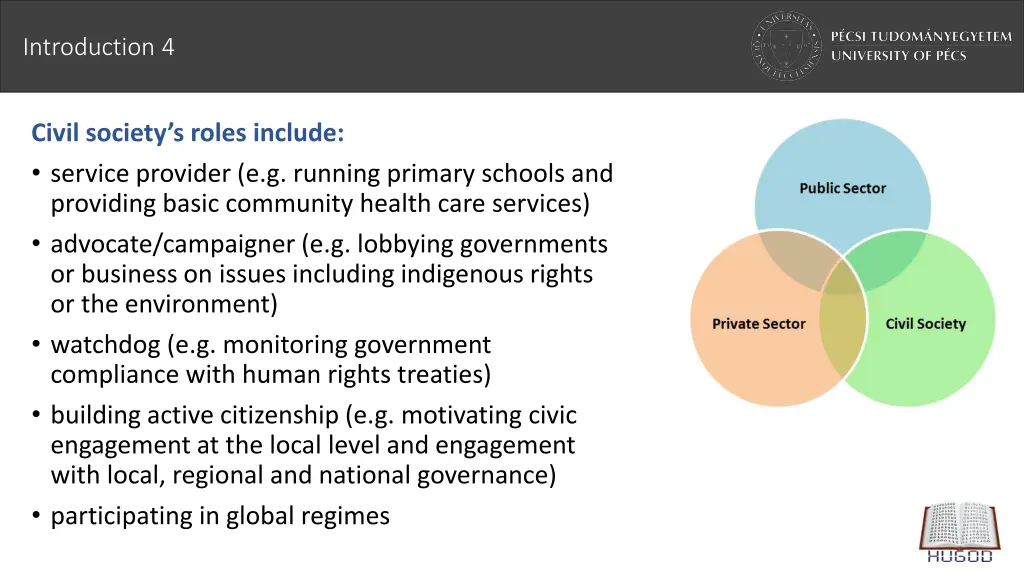
Introduction 4 Civil society s roles include: service provider (e.g. running primary schools and providing basic community health care services) advocate/campaigner (e.g. lobbying governments or business on issues including indigenous rights or the environment) watchdog (e.g. monitoring government compliance with human rights treaties) building active citizenship (e.g. motivating civic engagement at the local level and engagement with local, regional and national governance) participating in global regimes
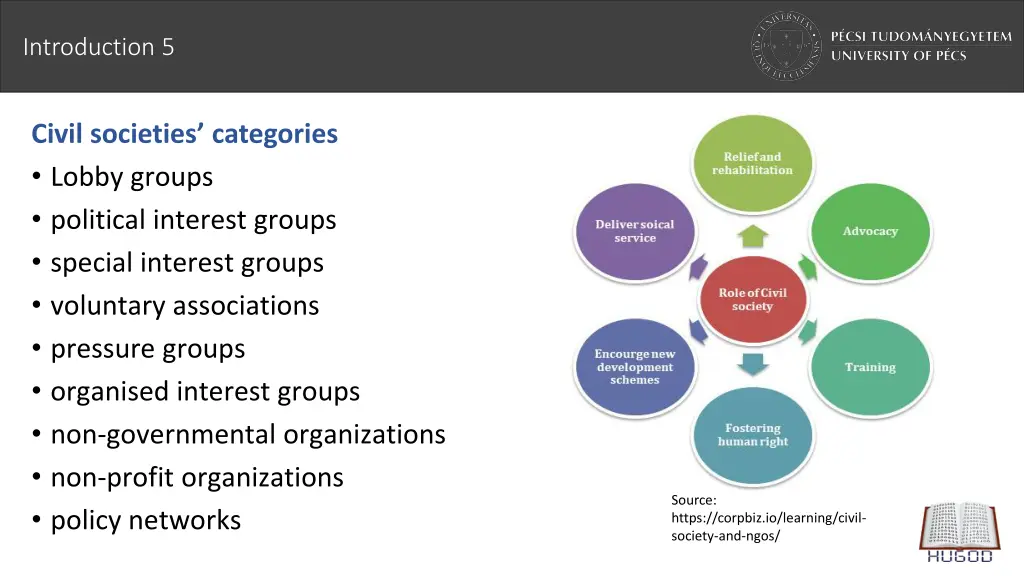
Introduction 5 Civil societies categories Lobby groups political interest groups special interest groups voluntary associations pressure groups organised interest groups non-governmental organizations non-profit organizations policy networks Source: https://corpbiz.io/learning/civil- society-and-ngos/
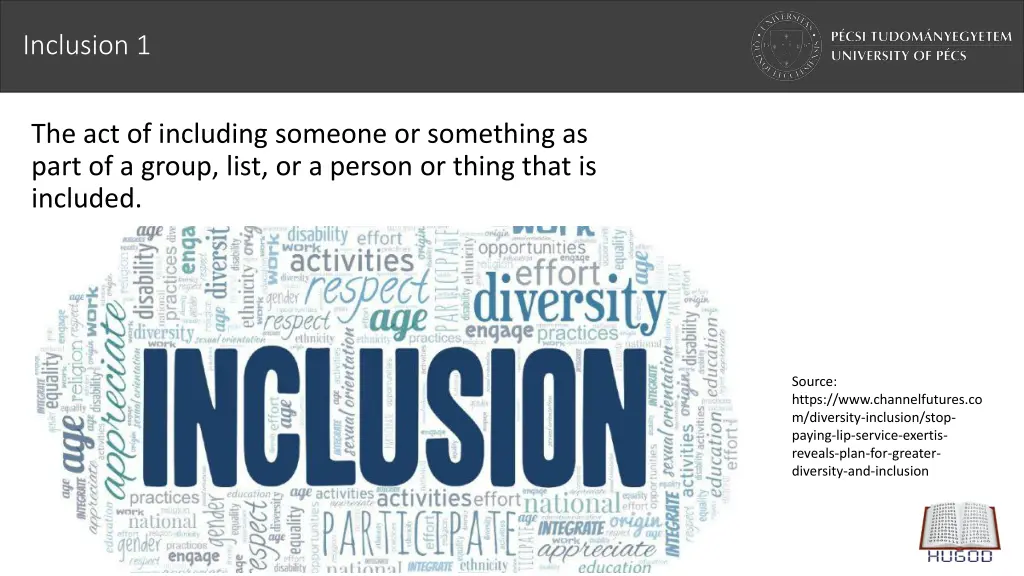
Inclusion 1 The act of including someone or something as part of a group, list, or a person or thing that is included. Source: https://www.channelfutures.co m/diversity-inclusion/stop- paying-lip-service-exertis- reveals-plan-for-greater- diversity-and-inclusion
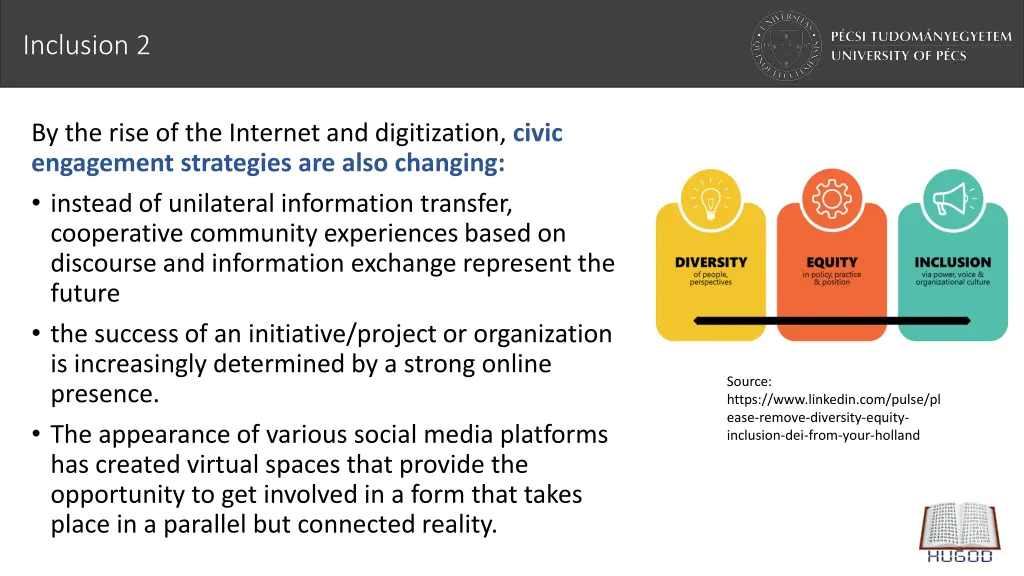
Inclusion 2 By the rise of the Internet and digitization, civic engagement strategies are also changing: instead of unilateral information transfer, cooperative community experiences based on discourse and information exchange represent the future the success of an initiative/project or organization is increasingly determined by a strong online presence. The appearance of various social media platforms has created virtual spaces that provide the opportunity to get involved in a form that takes place in a parallel but connected reality. Source: https://www.linkedin.com/pulse/pl ease-remove-diversity-equity- inclusion-dei-from-your-holland
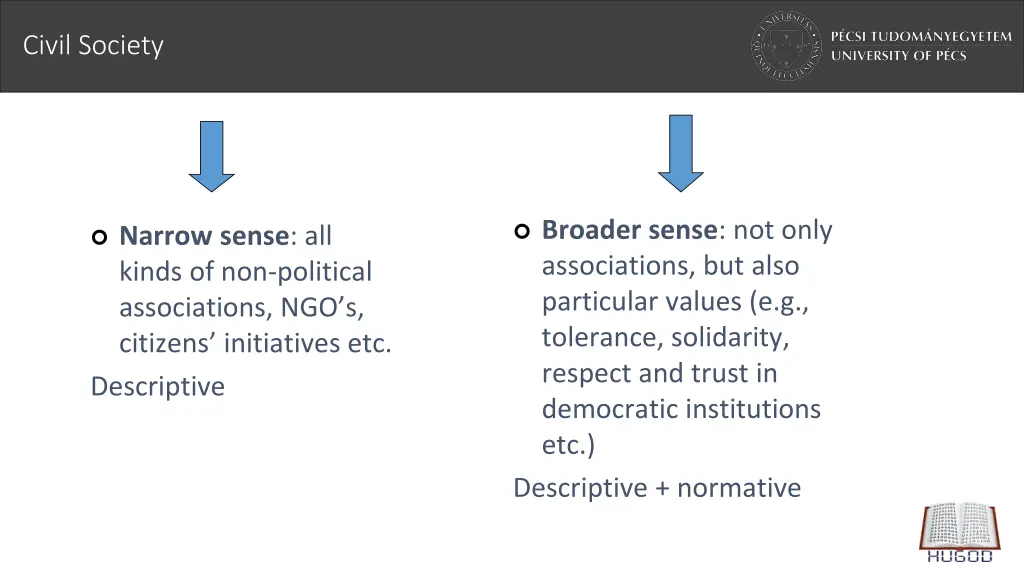
Civil Society Broader sense: not only associations, but also particular values (e.g., tolerance, solidarity, respect and trust in democratic institutions etc.) Descriptive + normative Narrow sense: all kinds of non-political associations, NGO s, citizens initiatives etc. Descriptive
Global Civil Society 1 Like the term globalization , the definition of global civil society is debated and contested, and is one of the reason it is attractive to stakeholders from differing fields of interest and activity. Sometimes it is described and explained in terms of new social movements that show up globally; In international relations it is called transnational civil society; In sociology it is identified with the emergence of a world society ; In economics it is related to the intenational labor movement and the public reaction to globalized markets and neoliberalism; In political science the focus is on the characteristics of spreading democracy around the world. Normatively, global civil society is associated with initiatives that embody certain values and ethical principles. Examples: M d cins sans Frontiers, Save the Children, Oxfam, Amnesty International, WWF, Red Cross, Greenpeace, FoE, Human Rights Watch Source: https://www.amazon.com/Global- Society-Contemporary-Political- Theory/dp/052189462X
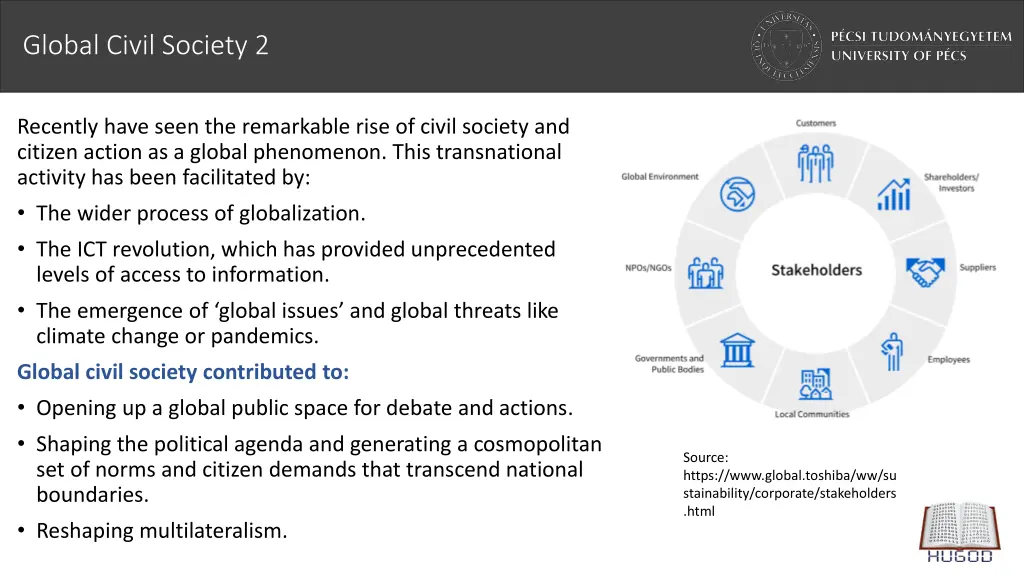
Global Civil Society 2 Recently have seen the remarkable rise of civil society and citizen action as a global phenomenon. This transnational activity has been facilitated by: The wider process of globalization. The ICT revolution, which has provided unprecedented levels of access to information. The emergence of global issues and global threats like climate change or pandemics. Global civil society contributed to: Opening up a global public space for debate and actions. Shaping the political agenda and generating a cosmopolitan set of norms and citizen demands that transcend national boundaries. Reshaping multilateralism. Source: https://www.global.toshiba/ww/su stainability/corporate/stakeholders .html
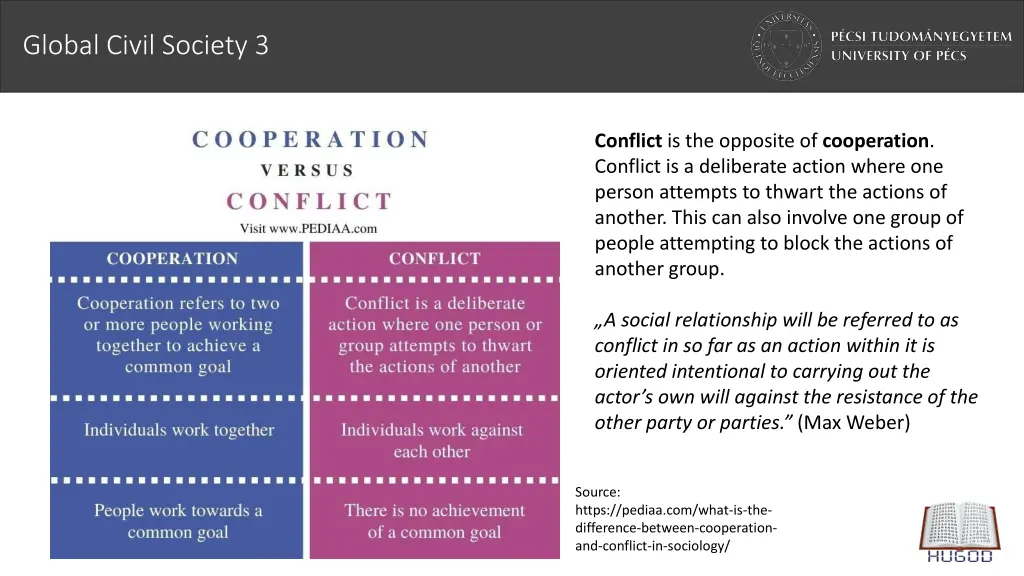
Global Civil Society 3 Conflict is the opposite of cooperation. Conflict is a deliberate action where one person attempts to thwart the actions of another. This can also involve one group of people attempting to block the actions of another group. A social relationship will be referred to as conflict in so far as an action within it is oriented intentional to carrying out the actor s own will against the resistance of the other party or parties. (Max Weber) Source: https://pediaa.com/what-is-the- difference-between-cooperation- and-conflict-in-sociology/
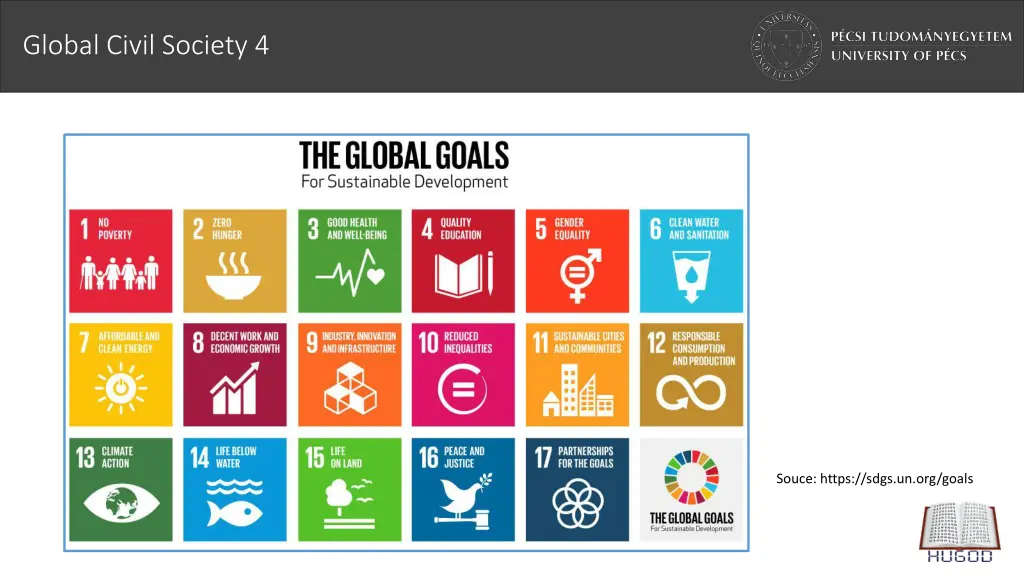
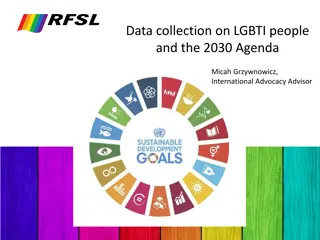
Global Civil Society 4 Souce: https://sdgs.un.org/goals
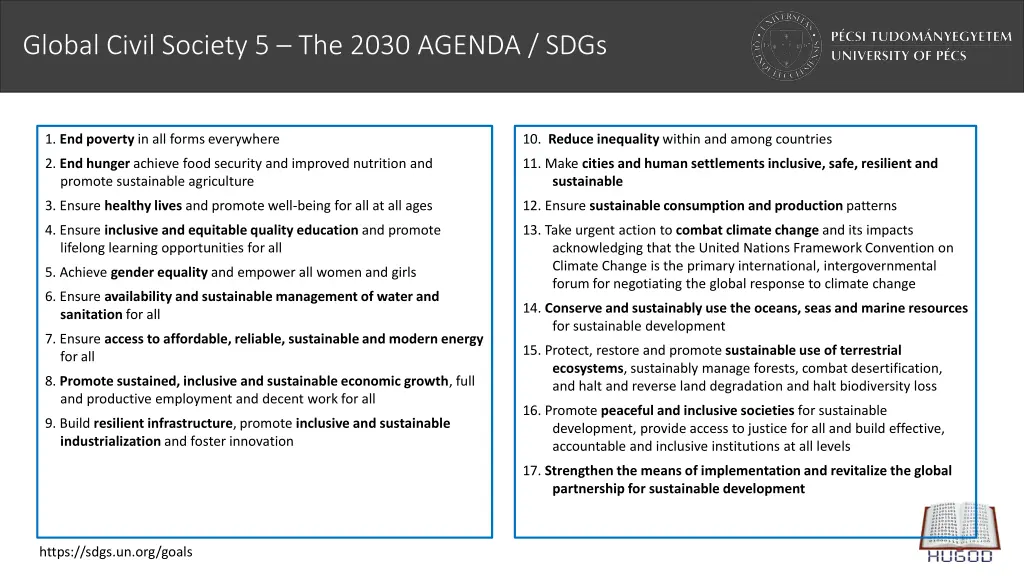
Global Civil Society 5 The 2030 AGENDA / SDGs 1. End poverty in all forms everywhere 10. Reduce inequality within and among countries 2. End hunger achieve food security and improved nutrition and promote sustainable agriculture 11. Make cities and human settlements inclusive, safe, resilient and sustainable 3. Ensure healthy lives and promote well-being for all at all ages 12. Ensure sustainable consumption and production patterns 4. Ensure inclusive and equitable quality education and promote lifelong learning opportunities for all 13. Take urgent action to combat climate change and its impacts acknowledging that the United Nations Framework Convention on Climate Change is the primary international, intergovernmental forum for negotiating the global response to climate change 5. Achieve gender equality and empower all women and girls 6. Ensure availability and sustainable management of water and sanitation for all 14. Conserve and sustainably use the oceans, seas and marine resources for sustainable development 7. Ensure access to affordable, reliable, sustainable and modern energy for all 15. Protect, restore and promote sustainable use of terrestrial ecosystems, sustainably manage forests, combat desertification, and halt and reverse land degradation and halt biodiversity loss 8. Promote sustained, inclusive and sustainable economic growth, full and productive employment and decent work for all 16. Promote peaceful and inclusive societies for sustainable development, provide access to justice for all and build effective, accountable and inclusive institutions at all levels 9. Build resilient infrastructure, promote inclusive and sustainable industrialization and foster innovation 17. Strengthen the means of implementation and revitalize the global partnership for sustainable development https://sdgs.un.org/goals
Bibliography Books Books Cohen, Jean L. Arato, Andrew (1994): Civil Society and Political Theory. The MIT Press. Edwards, Michael (2013): Oxford Handbook of Civil Society. Oxford University Press Inc. Global Civil Society (2004): (Global Civil Society Year Books) Eds. Helmut K Anheier, Mary Kaldor, Marlies Glasius. SAGE Publications Ltd. Hall, John A. (1995): Civil Society Theory History Comparison. Polity Press. K kai, L szl (2020): Development or reflections of the nonprofit sector in Central and Eastern Europe and Hungary. Politics in Central Europe 16:S1 pp. 135-158. K kai, L szl Glied, Viktor (2017): Sketch of the Hungarian non-profit sector after the regime change Civil Studies 14:3 pp. 13-34. Keane, John (2003): Global Civil Society. Cambridge University Press. Lang, Sabine (2014): NGOs, Civil Society, and the Public Sphere. Cambridge University Press. United Nations. https://sdgs.un.org/goals
Thank you for your attention!