Perinatal Mood Disorder Treatment Guidelines & Clinical Pearls
Learn about the treatment guidelines, screening, psychotropic medication decisions, referral to resources, and consequences of untreated Perinatal Mood and Anxiety Disorders (PMADs). Explore incidence rates, screening options, tools, risk factors, and who is susceptible to PMADs.

Download Presentation

Please find below an Image/Link to download the presentation.
The content on the website is provided AS IS for your information and personal use only. It may not be sold, licensed, or shared on other websites without obtaining consent from the author.If you encounter any issues during the download, it is possible that the publisher has removed the file from their server.
You are allowed to download the files provided on this website for personal or commercial use, subject to the condition that they are used lawfully. All files are the property of their respective owners.
The content on the website is provided AS IS for your information and personal use only. It may not be sold, licensed, or shared on other websites without obtaining consent from the author.
E N D
Presentation Transcript
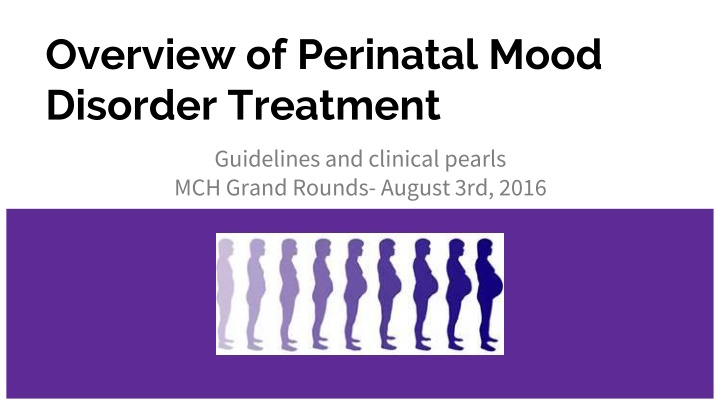
Overview of Perinatal Mood Disorder Treatment Guidelines and clinical pearls MCH Grand Rounds-August 3rd, 2016
Our goals Providers would be screening, starting during pregnancy Decision making regarding prescribing psychotropic medications to pregnant/lactating patients. Referral to Community Resources if screen positive; warm hand-off when possible.
PMAD not PPD PMAD incompasses all postpartum mood and anxiety disorders. Postpartum Depression Postpartum Anxiety Postpartum OCD Postpartum Psychosis Postpartum Bipolar Disorder Postpartum PTSD PPD includes only postpartum depression.
Incidence of Sx in Postpartum 1stPsychotic episode 1:500 Relapse after ANY previous psychotic episode 1:7 Depression symptoms 70% Major Depression 10-16% Bipolar relapse 32-67% Anxiety symptoms 22-25% Sit, Rothschild, Wisner, 2006 Claessen, Josefsson, Sydsjo, 2010 Armstrong, 2008
Consequences of untreated PMADs: Long term attachment difficulties = increased chance of mental/emotional and behavioral risks for child in adolescence and adulthood Increased risk of abuse for fathers/anger Increased risk to baby/fetus of untreated health concerns or neglect (including use of substances) Relationship stress/divorce
Screening Options Edinburgh Postnatal Depression Scale (EPDS). Free, most validated instrument; Con: only assesses depression DSM V criteria PHQ or GAD Verbally asking if either parent has a previous traumatic experience, or mental health history.
Who gets PMADs? Incidence : 25-30% Risk factors: Low education level Family history of psychiatric illness Low socioeconomic status Social isolation Perfectionistic personality style Limited social support Previous mental health issues Partner/ relational problems Health condition with baby Domestic violence Numerous situational stressors Child abuse history Inherent risk of negative outcomes in pregnancy History of attachment problems
Barriers to Accessing Care Stigma of mental health and psychiatric illness in general Lack of timely intervention with knowledgeable providers Aversion to taking medication - mostly fear based due to lack of knowledge Lack of knowledge Negative feedback from support system on symptoms or use of medications Sometimes providers are quick to offer a prescription without listening which disrupts the therapeutic alliance
Who should screen? OB/Gyn, Nurse Midwives, MD- starting prenatally, and again postpartum Pediatricians- well checks Social Workers, NICU staff (if appropriate) Other birthing professionals-doulas, lactation consultants Anyone can screen- it is free, does not have to take a lot of time, and do not need knowledge of diagnosis.
Why arent we screening? Time Ethical dilemma--resources? Who is the patient?
Clinical Guidelines Established by AHRQ Scientific evidence- Level A Lithium is associated with congenital cardiac defects Valproate increases risk of fetal anomalies Carbamazepine syndrome Benzodiazepines near delivery cause floppy infant syndrome - Should be avoided if possible.
Clinical Guidelines Established by AHRQ Limited evidence- Level B Paxil exposure early pregnancy may cause heart defects, benzodiazepine exposure increases oral cleft by 0.01% suggest to avoid both. Lamictal may protect against bipolar depression, relative safe profile. Maternal psych illnesses if inadequately treated result in poor compliance w/ prenatal care, inadequate nutrition, exposure to herbal remedies, increased ETOH and tobacco use, mother-infant bonding and family disruptions.
Clinical Guidelines Established by AHRQ Expert Opinion - Level C Whenever possible, multidisciplinary management involving the patient's obstetrician, mental health clinician, primary health care provider, and pediatrician is recommended to facilitate care. Use of a single medication at a higher dose is favored over the use of multiple medications for the treatment of psychiatric illness during pregnancy. The physiologic alterations of pregnancy may affect the absorption, distribution, metabolism, and elimination of lithium, and close monitoring of lithium levels during pregnancy and postpartum is recommended. For women who breastfeed, measuring serum levels in the neonate is not recommended. Treatment with all selective serotonin reuptake inhibitors (SSRIs) or selective norepinephrine reuptake inhibitors or both during pregnancy should be individualized. Fetal assessment with fetal echocardiogram should be considered in pregnant women exposed to lithium in the first trimester.
Number of Studies Showing Risk Increased risk No increased risk wellbutrin 2 2 celexa 4 4 cymbalta 1 0 lexapro 0 4 prozac 4 7 luvox 0 4 remeron 0 2 paxil 8 7 zoloft 3 6 trazodone 0 2 effexor 1 3
Risks associated with Antidepressants Inherent Risk On AD Risk Spontaneous Abortion 8.7% 12.4% Low Birth Weight 8.2% 9.6% Preterm Labor 5.4% 8.8% Cardiac Malformation 1% 2% Persistent Pulmonary Hypertension 0.7% 3.7% Postnatal Adaption Syndrome 6.9% 10-30% Mother Baby Risk Program 2015 Einarson et all 2014
Number of studies finding risk: 6 Number of studies finding no risk: 6 Two of the studies finding a correlation w/ AD use found the same correlation with maternal history of depression. None of the studies finding and association w/ ADS controlled for all impacting comorbid considerations; socioeconomic status, age of mother, gestational age, obesity, smoking, maternal hx depression, chronic health conditions, prenatal care. General consensus from + findings; risk of ASD on AD increase from 1% to 1.5% similar to ASD risk of babies born to mothers w/ hx of depression.
Study Found ASD/AD No ASD/AD Notes 2013- Wangari X = N 589,114 2016 - Castro X = N 3000 2015 - Erb X = N 3600 2104 - Gidaya X = N 628,408 No MD control 2013 - Rai X = N 60,000 MD as much risk ADS As the AD exposure 2013 - Sorensen X = N 668,468 Did control MD, age 2013- Hviid X = N626,875 1997- Nulman X = N 164 2011 - Croen X = N 1507 No depression control 2015 - Boukhris X = N 145,456 Control issues 2015 - Man X = Meta analysis No control MD,age, $ 2014- Marroun X = N 4264 AD risk same in SSRI As w/ MD
Postnatal Adaption Syndrome Symptoms Insomnia or somnolence Agitation, tremors, jitteriness, shivering and/ or altered tone Restlessness, irritability & constant crying Poor feeding, vomiting or diarrhoea Poor temperature control, hypoglycaemia Tachypnoea, respiratory distress, nasal congestion or cyanosis Seizures
Postnatal Adaption Syndrome 10-30% babies born mom s on SRRI Usually short lived with a median duration of 3 days 75 % complete resolution by 5 days reports of adaptation signs lasting up to 4 weeks Premature babies are more vulnerable to PNAS Symptoms can vary greatly in severity from mild transitory symptoms to more severe symptoms including seizures and dehydration Increased PNAS in babies born to mom s that have Cyp mutations resulting in drug level elevations
CYP 1A2 = decreased processing in pregnancy CYP 2C9 = decreased processing CYP 2C19 = decreased processing CYP 2D6 = increased clearance in pregnancy, 48% by 3rd trimester CYP 3A4 = increased by 35-38% in all stages of pregnancy
Everyday medications affect other drugs PPI s/ H2 agonists inhibit CYP function Dexamethasone inhibits 2C9 but induces 3A4 Erythromycin 3A4 inhibitor Nifedipine 2C9 and 3A4 inhibitor
Gene Expression MTHFR- C677T variant more likely to have depression SLC6A4- babies born with this SNP are more likely to have postnatal adaption syndrome. Babies will have this SNP mutation based on maternal/paternal.
Relative infant dose SSRIs Wellbutrin 0.6-2% citalopram 3.6% Remeron 1.6-6.3% escitalopram 5.2-8% Effexor 6.8-8.1% fluoxetine 1.6-14.6% Cymbalta < 1% fluvoxamine 0.3-1.4% WAPC_med_chart_2012 paroxetine 1.2-2.8% Amitriptyline 1.9-2.8% sertraline 0.4-2.2% Imipramine 0.1-4.4% Hale s breastfeeding rating 2012
Resources for patients PPSM- www.ppsupportmn.org (in Minnesota) Postpartum Support International- www.postpartum.net http://www.infantrisk.com https://womensmentalhealth.org http://perinatalweb.org/assets/cms/uploads/files/WAPC_Med_C hart_2012_v9%281%29.pdf
Resources for Providers http://Reprotx.com http://www.medsmilk.com http://toxnet.nlm.nih.gov/newtoxnet/lactmed.htm https://womensmentalhealth.org http://ajp.psychiatryonline.org/doi/abs/10.1176/appi.ajp.2015.15040506 Standardized Clinical Guidelines https://www.guideline.gov/content.aspx?id=12490 Antidepressant use in pregnancy: Knowledge transfer and translation of research findings http://dspace.library.uu.nl/bitstream/handle/1874/311668/Einarson.pdf?sequence=2#page=23 Hope Line HCMC Mother Baby. 612-873-HOPE (medication information, may be 2 day turnaround on message) (MN)
Please Register Your Patients!! Antidepressants--1-844-405-6185 Antipsychotics--1-866-961-2388
References Boukhris, T., Sheehy, O., & B rard, A. (2014). Antidepressant use during pregnancy and risk of autism spectrum disorders in children: A population- based cohort study. Value in Health, 17(3), A211. Boukhris, T., Sheehy, O., Mottron, L., & B rard, A. (2015). Antidepressant use during pregnancy and the risk of autism spectrum disorder in children. JAMA pediatrics, 1-8. Brummelte, S., et al. "Antidepressant use during pregnancy and serotonin transporter genotype (SLC6A4) affect newborn serum reelin levels." Developmental psychobiology 55.5 (2013): 518-529. Castro, V. M., Kong, S. W., Clements, C. C., Brady, R., Kaimal, A. J., Doyle, A. E., ... & Perlis, R. H. (2016). Absence of evidence for increase in risk for autism or attention-deficit hyperactivity disorder following antidepressant exposure during pregnancy: a replication study. Translational psychiatry, 6(1), e708. Clements, C. C., Castro, V. M., Blumenthal, S. R., Rosenfield, H. R., Murphy, S. N., Fava, M., ... & Robinson, E. B. (2015). Prenatal antidepressant exposure is associated with risk for attention-deficit hyperactivity disorder but not autism spectrum disorder in a large health system. Molecular psychiatry, 20(6), 727-734.
References Harrington, R. A., Lee, L. C., Crum, R. M., Zimmerman, A. W., & Hertz-Picciotto, I. (2014). Prenatal SSRI use and offspring with autism spectrum disorder or developmental delay. Pediatrics, 133(5), e1241-e1248. Hviid, A., Melbye, M., & Pasternak, B. (2013). Use of selective serotonin reuptake inhibitors during pregnancy and risk of autism. New England Journal of Medicine, 369(25), 2406-2415. Jani, S., Banu, S., & Shah, A. A. (2015). SSRI Use During Pregnancy and Autism: Is It a Real Threat?. Psychiatric Annals, 45(2), 83-88. King, B. H. (2015). Assessing Risk of Autism Spectrum Disorder in Children After Antidepressant Use During Pregnancy. JAMA pediatrics, 1-2. Man, K. K., Tong, H. H., Wong, L. Y., Chan, E. W., Simonoff, E., & Wong, I. C. (2015). Exposure to selective serotonin reuptake inhibitors during pregnancy and risk of autism spectrum disorder in children: A systematic review and meta-analysis of observational studies. Neuroscience & Biobehavioral Reviews, 49, 82-89. Rai, D. (2013). Environmental risk factors for autism spectrum disorders. Rai, D., Lee, B. K., Dalman, C., Golding, J., Lewis, G., & Magnusson, C. (2013). Parental depression, maternal antidepressant use during pregnancy, and risk of autism spectrum disorders: population based case-control study.
References Rosenberg, K. (2016). A Possible Link Between Antidepressant Use During Pregnancy and Autism Spectrum Disorder. AJN The American Journal of Nursing, 116(3), 58-59. Shea, A. K., & Oberlander, T. F. (2012). Fetal serotonin reuptake inhibitor antidepressant exposure: maternal and fetal factors.Canadian Journal of Psychiatry, 57(9), 523. Wemakor, A., Casson, K., Garne, E., Bakker, M., Addor, M. C., Arriola, L., ... & O Mahoney, M. (2015). Selective serotonin reuptake inhibitor antidepressant use in first trimester pregnancy and risk of specific congenital anomalies: a European register-based study. European journal of epidemiology, 30(11), 1187-1198.
References Meridith Corp, 2011- http://www.parents.com/pregnancy/my-life/emotions/understanding-pregnancy-hormones/ Lactmed - https://www.nlm.nih.gov/news/lactmed Mothers Milk- http://www.halepublishing.com/medications-mothers-milk-online-10 Hales Breastfeeding Rating Croen, L. 2011. Antidepressant Use During Pregnancy and Childhood Autism Spectrum Disorders. file:///C:/Users/Owner/Downloads/yoa15049_1104_1112.pdf